Srirangam Ranganathaswamy
श्रीरंगम रंगनाथस्वामी
The foremost of the 108 Divya Desams, Vaikuntha on earth, where Vishnu reclines as Ranganatha
Srirangam, Tamil Nadu, India
Śrīraṅgam RaṅganāthasvāmīAlso known as: Sri Ranganathaswamy Temple, Thiruvarangam, Koil (the Temple), Bhuloka Vaikuntham, Periya Koil
युग
An ancient temple sung by the Alvars in the first millennium, expanded under the Cholas, Pandyas, Hoysalas, Vijayanagara and Nayakas; the great outer Rajagopuram was completed only in 1987
वास्तुकला
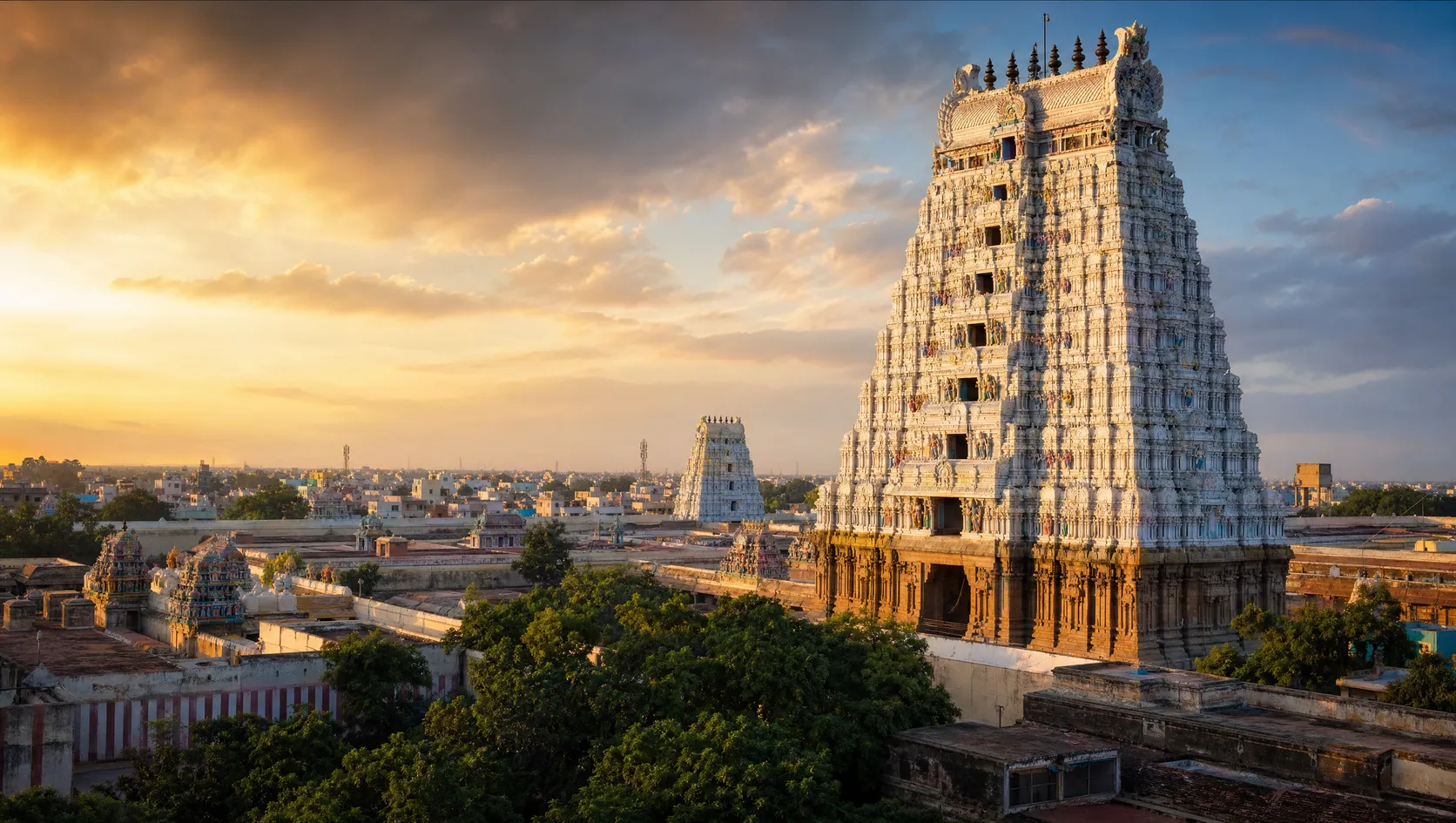
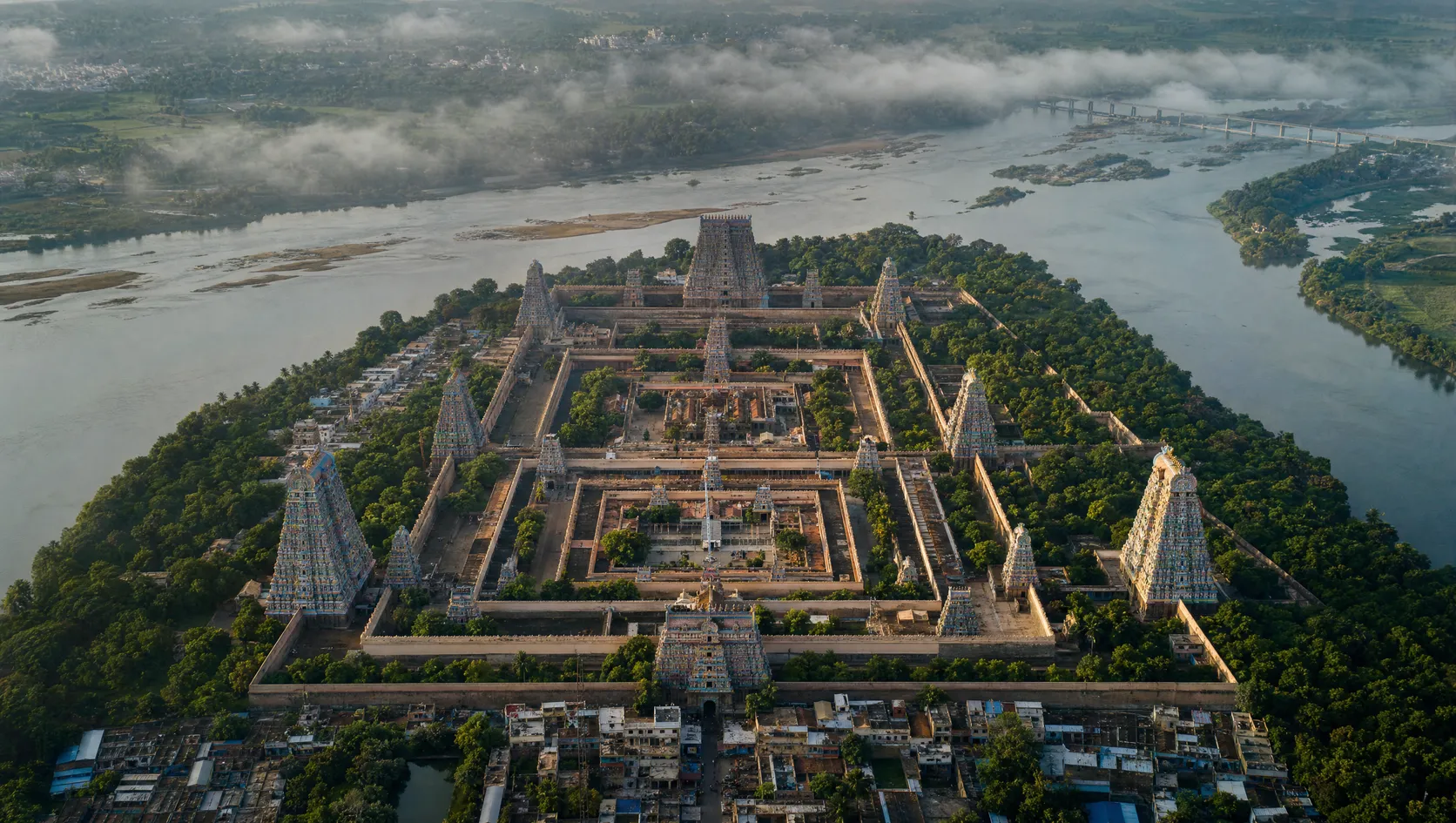
Dravidian, on a vast scale: seven concentric prakara enclosures with twenty-one gopurams, the Rajagopuram among the tallest temple towers in Asia, and the thousand-pillared hall
खुला
06:00 – 21:00
विशेष
The temple observes a full Srivaishnava ritual round with several daily services to Ranganatha, and the recitation of the Nalayira Divya Prabandham and Araiyar Sevai at set occasions. Timings run in sessions through the day with a midday break and vary with the festival calendar; they should be confirmed locally.
पवित्र कथा · पवित्र कथा
Among the hundred and eight Divya Desams, the abodes of Vishnu sung by the Alvar poet-saints, one stands first, so much the chief that in Srivaishnava usage it needs no name of its own: it is simply Koil, the Temple. Srirangam, on an island held between the Kaveri and its branch the Kollidam, is that temple, and the Vishnu who reclines here on the coils of the serpent Adishesha, facing south toward Lanka, is Ranganatha, Periya Perumal, the Great Lord. The tradition calls Srirangam Bhuloka Vaikuntham, Vaikuntha on earth, and treats the reclining god not as an image of the distant heaven but as the heaven itself made present on the ground. Here Vishnu lies in yoga-nidra, the cosmic sleep from which the worlds are dreamed, and the vast temple, the largest functioning Hindu complex in the world, is built as seven concentric enclosures folded around that sleeping form, a whole city turned inward toward a single reclining god. And Srirangam is the heart of Srivaishnavism itself. Here Ramanuja lived, taught and organised the tradition; here the Alvars' Tamil hymns, the Nalayira Divya Prabandham, are sung as scripture beside the Sanskrit Veda; here, more than anywhere, the path of loving surrender to Vishnu found its home. To come to Srirangam is to come to the centre of a whole world of devotion.
Sacred Designationपवित्र पदनाम
Sacred Origin Storyपवित्र उत्पत्ति कथा
Source: The Srivaishnava tradition, the Sthala Purana of Srirangam, and the Ramayana connection through the deity's southward gaze
The tradition traces the reclining Ranganatha of Srirangam to the very beginning, holding the image to be a self-manifest form of Vishnu worshipped first in the highest heaven and then by a line of the greatest devotees before it came to the island in the Kaveri. In the most cherished account it passed to the kings of Ayodhya and was worshipped there by the solar dynasty, the line of Rama himself.
When Vibhishana, the righteous brother of Ravana, came to Rama's coronation and asked for a gift to carry home to Lanka, he was given this very image of Ranganatha to worship. He set out south, but was warned that once the image was set down upon the earth it would take root there and could not be moved again. On the island of Srirangam, where the Kaveri divides, he set it down, whether tricked by the gods who wished the Lord to remain in the Tamil land, or halted by the Kaveri's beauty, and there Ranganatha stayed, facing south toward Lanka, so that even fixed to the spot he gazes always toward the devotee who brought him.
This is why the god of Srirangam lies facing south, against the usual eastward orientation, his face turned to Vibhishana's island. The reclining posture is yoga-nidra, the cosmic sleep of Vishnu upon the serpent between the dissolution and the making of the worlds, and the whole vast temple is built around that sleep, seven walls folded about the one who dreams the universe into being.
उद्धृत स्रोत:
- Sthala Purana of Srirangam
- Srivaishnava tradition and the Nalayira Divya Prabandham
- Ramayana tradition of Vibhishana and the Ranganatha image
अन्य परंपराएँ · अन्य परंपराएँ
The Srivaishnava acharya tradition and temple history
विद्वत संदर्भ
Srirangam is among the most studied temples of southern India, for its scale, its continuous history and its centrality to Srivaishnavism. The temple is sung in the Nalayira Divya Prabandham of the Alvars, whose activity spans the middle centuries of the first millennium, giving Srirangam an attested importance of great antiquity; the physical temple was then expanded by successive dynasties, the Cholas, Pandyas, Hoysalas, the Vijayanagara empire and the Madurai Nayakas, over many centuries, into the vast seven-walled complex seen today. Historically the temple is inseparable from Ramanuja, the eleventh- to twelfth-century philosopher of Vishishtadvaita, qualified non-dualism, who made Srirangam the base of his reform and organisation of the Srivaishnava community, and whose preserved body is enshrined here. The temple's later history includes the traumatic invasions of the early fourteenth century, when the Delhi Sultanate's forces reached the far south, the image was carried into hiding and long exile, and many devotees are traditionally said to have died defending it, before its return under Vijayanagara. The great outer tower, the Rajagopuram, though planned for centuries, was completed only in 1987, and is among the tallest temple gopurams in Asia. Scholars treat Srirangam as a case study in how a living temple accretes over more than a thousand years while keeping a single devotional focus at its unmoving centre.
Historyइतिहास
Srirangam is the foremost of the 108 Divya Desams and the largest functioning Hindu temple complex in the world, sacred to Vishnu as Ranganatha, who reclines here on the serpent Adishesha facing south. Its importance is attested from deep antiquity by the hymns of the Alvars, the Tamil poet-saints, who sang it in the Nalayira Divya Prabandham, and no Divya Desam receives more of their verses than Srirangam.
The temple grew over more than a thousand years. Successive dynasties, the Cholas, Pandyas, Hoysalas, the Vijayanagara emperors and the Madurai Nayakas, endowed and enlarged it, wall by wall and tower by tower, until it reached its present form of seven concentric enclosures with twenty-one gopurams and a thousand-pillared hall. The outermost enclosure holds not only shrines but streets, homes and markets, a living town wrapped around the god.
Srirangam is inseparable from Ramanuja, the great philosopher of Vishishtadvaita, who in the eleventh and twelfth centuries made the temple the centre of his organisation of the Srivaishnava community, reforming its worship and its institutions; his preserved body is enshrined in a shrine within the temple. The Alvars and the acharyas after Ramanuja are all bound to this place, which became the living capital of Srivaishnavism.
In the early fourteenth century the temple suffered gravely when the armies of the Delhi Sultanate reached the far south. The processional image of Ranganatha was carried into hiding and taken on a long exile lasting decades, through Tirupati and beyond, while the temple was sacked; the tradition holds that great numbers of devotees died defending the shrine and the god. The image was returned and the worship restored under the protection of the Vijayanagara empire, and the temple's later prosperity owes much to that recovery.
The temple carries a striking legend of this period in the shrine of the Thulukka Nachiyar, worshipped as a Muslim princess of Delhi who is said to have loved the processional image during its exile in the north and to be honoured in the temple to this day. The great outer Rajagopuram, planned for centuries and left unfinished, was at last completed in 1987. Srirangam remains a living centre of Srivaishnava worship, drawing vast crowds above all at Vaikuntha Ekadasi, when the gate of heaven is opened.
Historical Timelineऐतिहासिक कालक्रम
The Alvars, the Tamil poet-saints of Vishnu, sing Srirangam in the hymns gathered as the Nalayira Divya Prabandham, giving it an attested sanctity of great antiquity; no Divya Desam receives more of their verses.
The Alvars' activity is generally placed across the middle centuries of the first millennium; their hymns are the earliest firm evidence of Srirangam's importance.
Under the Cholas the temple is richly endowed and greatly expanded, with enclosures, halls and gopurams added, establishing the pattern of growth that later dynasties would continue.
Srirangam is among the most richly inscribed temples of the south, its walls recording centuries of endowment.
Ramanuja, the philosopher of Vishishtadvaita, makes Srirangam the centre of his reform and organisation of the Srivaishnava community, shaping its worship and institutions; his preserved body is later enshrined in the temple.
Ramanuja's association makes Srirangam the living capital of Srivaishnavism; the Ramanuja shrine holding his preserved form is a focus of pilgrimage.
The Hoysalas and later the Pandyas add to the temple, continuing its expansion, and the community of acharyas after Ramanuja keeps Srirangam at the heart of the tradition.
The armies of the Delhi Sultanate under Malik Kafur reach the far south; the processional image of Ranganatha is carried into hiding as the temple faces the threat of invasion.
The temple's own chronicle, the Koil Olugu, is a principal source for the events of the invasions and the image's exile.
Srirangam is sacked in a further invasion; the tradition holds that great numbers of devotees died defending the shrine, and the processional image begins a long exile of decades through Tirupati and other refuges.
The exile of the image and the defence of the temple are remembered as among the most traumatic episodes of the tradition's history.
Under the protection of the rising Vijayanagara empire the image of Ranganatha is returned to Srirangam and worship is restored, beginning the temple's recovery and renewed prosperity.
The return of the image under Vijayanagara protection is a turning point in the temple's fortunes.
The Vijayanagara emperors and the Madurai Nayakas endow and further expand the temple, adding halls including the thousand-pillared mandapa and enriching its festivals and endowments.
The temple and its vast complex are documented in colonial-era surveys of the south, which record its scale, its seven enclosures and its standing as the chief of the Vaishnava shrines of the Tamil country.
The great outer Rajagopuram, planned for centuries and long left unfinished, is at last completed, rising as one of the tallest temple towers in Asia over the outermost enclosure.
The Rajagopuram's completion in the twentieth century marks the finishing of a work begun in earlier centuries and left unbuilt for generations.
Srirangam remains a living centre of Srivaishnava worship and the foremost of the Divya Desams, drawing vast crowds above all at Vaikuntha Ekadasi, when the Paramapada Vasal, the gate of heaven, is opened for devotees to pass through.
What You'll Seeदर्शन में
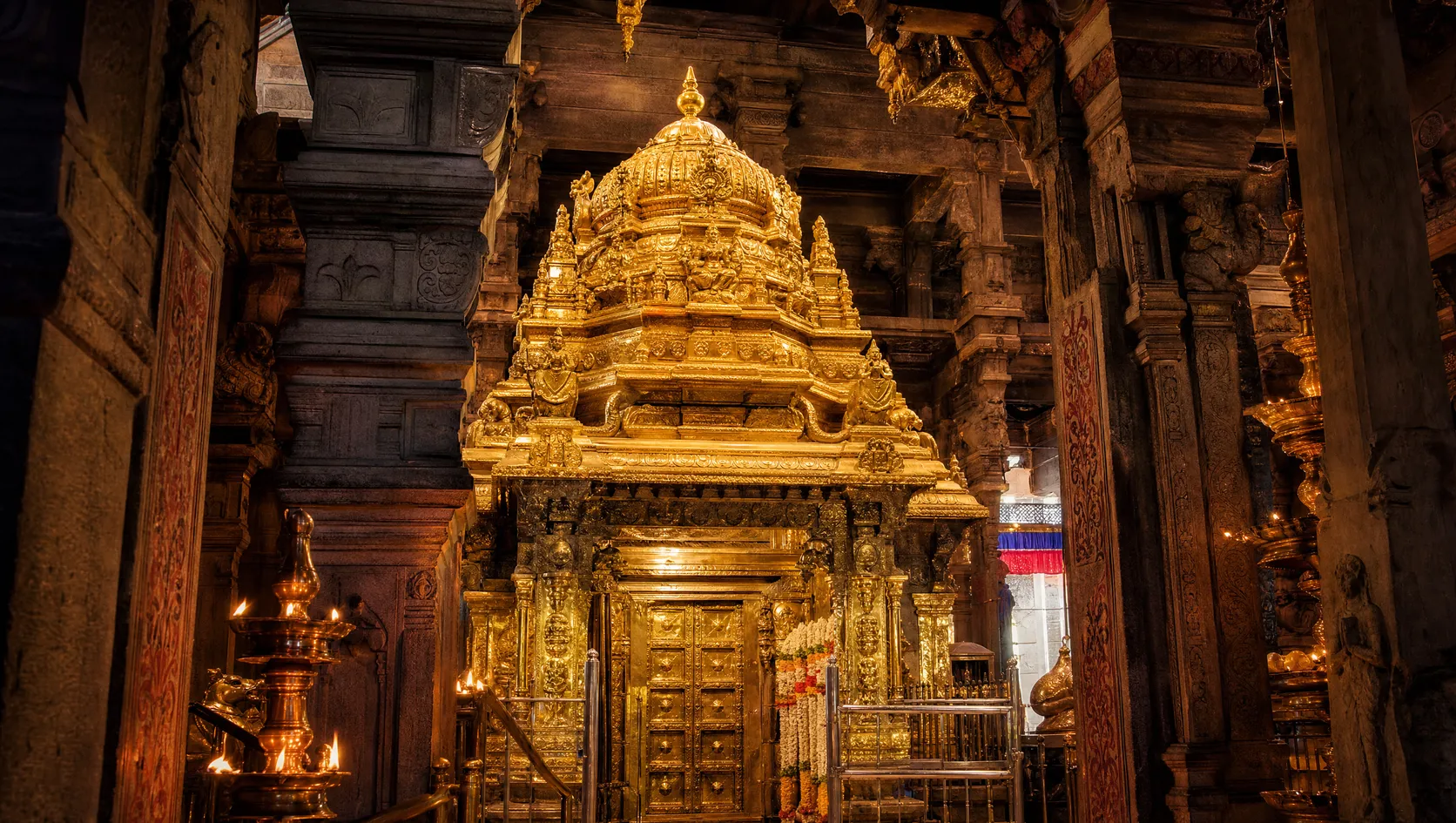
The presiding image of Srirangam is Ranganatha, Vishnu reclining at full length upon the coils of the serpent Adishesha, whose many hoods spread above him as a canopy. This is the god in yoga-nidra, the cosmic sleep upon the milk-ocean between the ages of the world, one of the great forms of Vishnu, and at Srirangam it is the Moolavar, the immovable stone image in the innermost sanctum, over which rises the Sri Ranga Vimana, shaped, the tradition says, like the syllable Om.
Unusually, the god faces south, not the customary east, his gaze turned toward Lanka and the devotee Vibhishana who bore him here, a departure the origin myth exists to explain. He is Periya Perumal, the Great Lord, and his consort Ranganayaki, Sri Ranga Nachiyar, has her own large shrine within the complex, so that the temple holds the Lord and the Goddess each in their own precinct.
Beside the stone Moolavar stands the processional image, the utsava murti, which is carried in the festivals and which underwent the long exile of the fourteenth century; the distinction between the fixed and the moving forms of the one god is central to the temple's ritual life. Within the vast enclosures are shrines to the Alvars and the acharyas, above all the shrine of Ramanuja holding his preserved body, and the shrine of the Thulukka Nachiyar, the Muslim princess of the exile legend. The reclining Lord at the still centre, and around him the whole community of his poets, teachers and devotees given their own shrines, is the iconographic pattern of Srirangam: a god surrounded, wall within wall, by those who loved him.
Distinctive Practicesविशिष्ट परंपराएँ
Vaikuntha Ekadasi and the Gate of Heaven
वैकुण्ठ एकादशी और स्वर्ग का द्वार
Vaikuntha Ekadasi, in Margazhi (Dec-Jan)
On Vaikuntha Ekadasi, the great festival of the temple, the Paramapada Vasal, the gate of the highest heaven, is opened, and enormous crowds pass through it in the belief that Ranganatha grants a vision of Vaikuntha to those who do so. It is the most thronged day of the Srirangam year.
The gate of heaven, opened only on this day, makes a doctrine walkable. Srirangam is already Vaikuntha on earth, and to pass through the Paramapada Vasal is to enact bodily the passage into the highest heaven that the tradition promises to the devotee of Vishnu. The crowd is not incidental; the whole community moves through the gate together, a picture of the collective hope of Srivaishnavism to reach the Lord's own abode.
Recitation of the Nalayira Divya Prabandham and Araiyar Sevai
नालायिर दिव्य प्रबंधम् का पाठ और अरैयर सेवै
Daily in worship, and centrally in the festival of Adhyayana Utsavam
The Tamil hymns of the Alvars, the Nalayira Divya Prabandham, are recited in the temple's worship beside the Sanskrit Veda, and in the Araiyar Sevai a hereditary line of singers presents the hymns with gesture and enactment before the god, a rare living survival of an ancient art.
That the Tamil hymns are given equal standing with the Sanskrit Veda is the defining claim of Srivaishnavism: the Prabandham is the Dravida Veda, the Veda in Tamil, and the Alvars are seers on a level with the ancient rishis. To sing their hymns before Ranganatha is to worship the god in the language of the land, and the Araiyar Sevai, with its gesture and enactment, keeps the hymns not as text but as living presentation offered directly to the Lord.
Veneration of Ramanuja's Preserved Body
रामानुज के संरक्षित शरीर की श्रद्धा
Year-round, at the Ramanuja shrine
Within the temple stands the shrine of Ramanuja, holding what the tradition venerates as his preserved body, the Thiruvarasu, seated as in life. Devotees come to it as to the founder-teacher of their tradition, and it is among the most revered shrines of the complex.
To keep and worship the preserved body of the founding acharya is to keep the teacher present, not as memory but as continuing presence within the temple he made his centre. In Srivaishnavism the acharya is the door to the Lord, and to have Ramanuja himself enshrined a few walls from Ranganatha places the teacher and the god within one pilgrimage, the surrender to Vishnu and the reverence for the guru who taught it held together.
The Shrine of the Thulukka Nachiyar
तुलुक्क नाच्चियार का मंदिर
Year-round, with her own observances
The temple honours the Thulukka Nachiyar, worshipped as a Muslim princess of Delhi who, the legend holds, loved the processional image of Ranganatha during its exile in the north, and who is given her own shrine and offerings, including food unusual for a temple, in keeping with her story.
The Thulukka Nachiyar's shrine is the tradition's way of keeping the memory of the exile as a story of love rather than only of loss. That a Muslim princess is worshipped within the temple, honoured for her devotion to the wandering image, folds the trauma of the invasions into the wider theme that draws all the shrines of Srirangam: the god is loved, and those who love him, of whatever origin, are gathered around him.
Did You Know?क्या आप जानते हैं?
Srirangam is the foremost of the 108 Divya Desams, so central to Srivaishnavism that it is called simply Koil, the Temple, needing no name of its own.
Srivaishnava tradition
It is the largest functioning Hindu temple complex in the world, built as seven concentric enclosures with twenty-one gopurams, the outermost holding streets, homes and markets around the god.
Temple surveys
Ranganatha faces south, not the usual east, his gaze turned toward Lanka and Vibhishana, the devotee who bore the image here, as the origin myth explains.
Sthala Purana of Srirangam
The temple is inseparable from Ramanuja, the philosopher of Vishishtadvaita, whose preserved body, the Thiruvarasu, is enshrined within it and venerated as the founder-teacher of the tradition.
Srivaishnava acharya tradition
In the fourteenth century the processional image was carried into a long exile of decades to escape invasion, and the tradition holds that great numbers of devotees died defending the temple.
Koil Olugu temple chronicle
The temple honours the Thulukka Nachiyar, worshipped as a Muslim princess of Delhi said to have loved the processional image during its northern exile, in her own shrine.
Temple tradition
The great outer Rajagopuram, planned for centuries and long left unfinished, was completed only in 1987 and is among the tallest temple towers in Asia.
Temple administration records
Visitor Accessप्रवेश जानकारी
The temple is open to all Hindus, and the inner sanctum of Ranganatha is reached through the successive enclosures. As at many major Vaishnava temples of the south, entry to the innermost precinct is restricted to Hindus, and this is signposted at the temple. The complex is vast, and moving from the outer gopuram to the sanctum passes through several walled enclosures, shrines and halls; allow time, and expect long queues on festival days, above all at Vaikuntha Ekadasi. A dress code of traditional attire applies, and footwear is left outside the temple. Timings run in sessions through the day with a midday closure, and vary with the festival calendar. Special-entry darshan arrangements exist for a fee alongside the free queue. Confirm current timings and any restrictions locally before visiting.
आध्यात्मिक आधार
The passage inward through seven enclosures is itself a spiritual form. To reach the reclining Lord one moves from the world of the outermost streets, through walls that grow quieter and more sacred, to the still centre where he sleeps; the architecture makes the pilgrimage a graded approach from the ordinary to the innermost. The restriction of the innermost precinct to Hindus follows the practice of the major Vaishnava temples of the south, which preserve the ritual purity of the sanctum according to their tradition. The god's accessibility is held to be real for all his devotees within these forms: Ranganatha is Periya Perumal, the Great Lord who receives the surrender of anyone who comes, and the graded enclosures order that approach rather than deny it.
समकालीन संदर्भ
Srirangam is one of the busiest temples of the south, drawing pilgrims year-round and immense crowds at festivals. The town of Srirangam is essentially the temple's outer enclosures grown into a living settlement, so that the sacred and the everyday are woven together across the island. The temple is administered as a major institution, with organised queues, special-darshan tickets and festival management for the great occasions. Vaikuntha Ekadasi in particular draws crowds in the hundreds of thousands, and visitors on that day should expect very long waits and dense crowds; a visit on an ordinary day allows a far more unhurried darshan of the reclining Lord and the many shrines.
व्यावहारिक मार्गदर्शन
Allow at least a half day to move through the enclosures and see the principal shrines: the sanctum of Ranganatha, the shrine of Ranganayaki, the Ramanuja shrine, the thousand-pillared hall and the Thulukka Nachiyar shrine. Non-Hindu visitors can see much of the outer complex and its architecture but should note the restriction at the innermost precinct. Dress traditionally and leave footwear outside. Consider a special-darshan ticket if time is short or on a busy day. Avoid Vaikuntha Ekadasi unless the great festival itself is the aim, when crowds are immense. Srirangam is easily combined with the nearby Jambukeshwaram temple on the same island and with the temples of Tiruchirappalli across the river.
Festivalsत्योहार
Vaikuntha Ekadasi
वैकुण्ठ एकादशी
Dec-Jan (Margazhi)
The greatest festival of Srirangam, when the Paramapada Vasal, the gate of the highest heaven, is opened and vast crowds pass through it seeking a vision of Vaikuntha. It is the most thronged and sacred day of the temple's year.
Adhyayana Utsavam
अध्ययन उत्सवम्
Dec-Jan (Margazhi), around Vaikuntha Ekadasi
The festival of the recitation of the Nalayira Divya Prabandham, when the Tamil hymns of the Alvars are chanted and presented in full over its days, including the Araiyar Sevai, the enactment of the hymns before the god, a central observance of the Srivaishnava year.
Chithirai Brahmotsavam
चित्तिरै ब्रह्मोत्सवम्
Apr-May (Chithirai)
The great annual Brahmotsavam of the temple, over which the processional Ranganatha is taken in procession on the many vahanas around the enclosures and streets, the fullest celebration of the Lord's public presence in the town.
Ramanuja Jayanti
रामानुज जयंती
Apr-May (Chithirai)
The appearance day of Ramanuja, the founder-teacher of the tradition whose preserved body is enshrined here, observed with particular reverence at the temple that was the centre of his life and work.
Traditional Offeringsपारंपरिक अर्पण
प्राथमिक अर्पण
Tulasi (holy basil)
तुलसी
तुलसी
Tulasi, the holy basil beloved of Vishnu, is the offering most proper to Ranganatha as to any form of Vishnu, laid at his feet and woven into his garlands. No worship of Vishnu is complete without it, and at Srirangam it is offered in abundance to the reclining Lord.
Sacred food (prasadam)
प्रसाद
The temple is renowned for its prasadam, the food offered to Ranganatha and shared with devotees, including the tamarind rice and curd rice associated with Srirangam. To receive the Lord's prasadam is to receive his grace made tangible.
Garlands of flowers
पुष्प-मालाएँ
Garlands of flowers, with tulasi, are offered to Ranganatha and to the goddess Ranganayaki, and garlands that have adorned the deity are returned to devotees as a blessing carrying the touch of the Lord.
Recitation of the Prabandham and the Sahasranama
प्रबंधम् और सहस्रनाम का पाठ
Beyond material offerings, the recitation of the Alvars' Tamil hymns and of the Vishnu Sahasranama, the thousand names of Vishnu, is held a high offering to Ranganatha, the god worshipped as much in sung word as in flower and food. At Srirangam the offering of hymn is central to the daily worship.
इस मंदिर की विशेषता
The Offering of Surrender to Periya Perumal
पेरिय पेरुमाल को शरणागति की भेंट
What is particular to Srirangam, the heart of Srivaishnavism, is that its highest offering is prapatti, loving surrender to the Lord. The tradition holds that Ranganatha, Periya Perumal, receives the one who simply casts himself upon his grace, and the whole path taught here by Ramanuja and the acharyas is the offering of oneself to the reclining Lord in trust. A pilgrim brings tulasi, flowers and food as at any shrine of Vishnu, but the offering the tradition holds highest is the turning of the heart to the god who sleeps at the centre, the surrender of the self to Periya Perumal in the confidence that he receives all who come. The offering and the blessing meet in that surrender: the devotee gives himself, and the Lord gives Vaikuntha.
Offerings at Srirangam follow the Srivaishnava tradition, with tulasi, flowers, garlands and prasadam central, and the recitation of the Prabandham and the Vishnu Sahasranama held as offerings of word. The temple's prasadam is famous and widely distributed. Eternal Raga presents these practices as a devotional tradition; specific seva and offering arrangements should be confirmed with the temple.
How to Reachकैसे पहुँचें
Srirangam lies on a river island between the Kaveri and Kollidam rivers, immediately adjoining Tiruchirappalli (Trichy) in central Tamil Nadu, and is very easily reached.
By air: Tiruchirappalli International Airport is about 15 km away, connected to Chennai and several domestic and international destinations.
By rail: Srirangam has its own railway station on the island, and Tiruchirappalli Junction, one of the major railheads of the south, is a short distance across the river, connected to Chennai, Madurai and the wider network.
By road: Srirangam is joined to Tiruchirappalli by road across the rivers and is served by frequent city buses, autos and taxis; the temple is at the heart of the island town. Long-distance buses connect Trichy to Chennai, Madurai, Thanjavur and the temple towns of the Kaveri delta.
Many pilgrims combine Srirangam with the Jambukeshwaram temple on the same island, one of the Pancha Bhoota Sthalas, and with the rock fort and temples of Tiruchirappalli.
Plan Your Visitयात्रा की योजना
🌤 सर्वोत्तम मौसम
October to March is the most comfortable time to visit, with milder temperatures in the Kaveri plain. The Margazhi month (December-January) brings the temple's greatest observances, Vaikuntha Ekadasi and the Adhyayana Utsavam, a spiritually rich but very crowded season. April to June is hot in central Tamil Nadu, though the Chithirai Brahmotsavam falls in this period and is a major draw. The southwest and northeast monsoons bring rain but the temple remains fully accessible. Early morning and evening sessions are the most atmospheric, when the temple is active with worship and the heat of the plain is least. On ordinary days a visit is unhurried; on the great festival days it becomes an immense gathering.
👘 पहनावे का नियम
Traditional and modest dress is required. Men commonly wear a dhoti or trousers with a shirt; women a saree or salwar kameez. Footwear is left outside the temple. As a major Vaishnava temple, Srirangam expects respectful traditional attire throughout the enclosures.
📱 फोन और फोटोग्राफी
Photography is restricted, and generally not permitted within the inner enclosures and the sanctum; cameras and phones may need to be deposited or kept away in the innermost areas. Follow the posted rules and the directions of temple staff, and keep phones silenced within the shrines.
🏨 आवास
Srirangam and the adjoining city of Tiruchirappalli together offer a full range of accommodation, from temple-related lodges and guest houses near the shrine to hotels of all standards across Trichy. Being a large city, Tiruchirappalli has ample options a short distance from the temple. Demand rises sharply around Vaikuntha Ekadasi, the Adhyayana Utsavam and the Chithirai Brahmotsavam, when booking well ahead is advisable. Outside the great festivals the area absorbs its pilgrims easily.
Sacred Soundsपवित्र ध्वनि
क्या आप जानते हैं? · Did You Know?
वही अनुवाद त्रुटि जिसने हिन्दू धर्म में '33 कोटि' को '33 करोड़' बनाया, बौद्ध धर्म में भी हुई। बौद्ध ग्रन्थों के चीनी अनुवाद ने 'सप्त कोटि बुद्ध' (7 श्रेष्ठ बुद्ध) का अनुवाद '7 करोड़ बुद्ध' कर दिया। तिब्बती अनुवाद ने सही किया: 7 प्रकार, 7 करोड़ नहीं। एक संस्कृत शब्द, दो प्रमुख विश्व धर्मों में गलत पढ़ा गया, ने दो एकसमान भ्रम स्वतन्त्र रूप से उत्पन्न किए।
Related Contentसंबंधित सामग्री
Related Scriptures
Community Reflections
🕉️
Be the first to share your reflection.