Sringeri Sharada Peetham
श्रृंगेरी शारदा पीठम्
A cobra shading a frog, and the monastery Shankara built on the spot
Sringeri, Karnataka, India
Śṛṅgeri Śāradā PīṭhamAlso known as: Sringeri Matha, Dakshinamnaya Sharada Peetham, Sharadamba Temple, Rishyashringagiri

युग
Founded by Adi Shankaracharya as the first of his four cardinal mathas; the Vidyashankara temple dates to the fourteenth century, and the Sharadamba temple has been rebuilt and enlarged across periods
वास्तुकला
The Vidyashankara temple combines Hoysala and Dravidian-Vijayanagara idioms; the Sharadamba temple is later and largely Dravidian
विशेष
The matha maintains a daily ritual schedule alongside the temples, and the Jagadguru's public audience is observed at set times. Timings are set by the matha and vary with the ritual calendar.
पवित्र कथा · पवित्र कथा
Shankara was walking along the Tunga, looking for somewhere to establish the first of his mathas, when he saw something that stopped him. A cobra had raised its hood over a frog in labour, shading it from the sun. Predator and prey, and the predator was providing shelter. He took it as a sign that at this place natural enmity was suspended, and he founded the matha there. It is worth noticing what he treated as evidence of holiness. Not a miracle, not a vision, not a god appearing. An animal declining to eat another animal, in the heat, by a river. The tradition's most consequential monastic decision rests on a moment of restraint between two creatures who had no theology at all.
Sacred Designationपवित्र पदनाम
Sacred Origin Storyपवित्र उत्पत्ति कथा
Source: Shankara Digvijaya biographical tradition and the matha's own institutional records
The place is older than the matha. Sringeri takes its name from Rishyashringa, the sage of the horn, whose story is told in the Ramayana and elsewhere.
He was raised in the forest by his father in total ignorance of women, and his innocence was said to be so complete that it had power over the weather. When a neighbouring kingdom suffered a drought that would not break, its king was advised that the only remedy was to bring the boy inside his borders. Courtesans were sent into the forest to draw him out. They succeeded, and when he crossed into the kingdom the rain came.
The hill of Rishyashringa, Rishyashringagiri, contracts over time into Sringeri, so the name of Shankara's first monastery records a story about the fragility and the force of an untouched mind.
On to this older sanctity Shankara laid a new institution. Walking along the Tunga in search of a site, he saw a cobra spread its hood over a frog in labour, shading it from the sun, and took the suspension of natural enmity as the sign he was looking for.
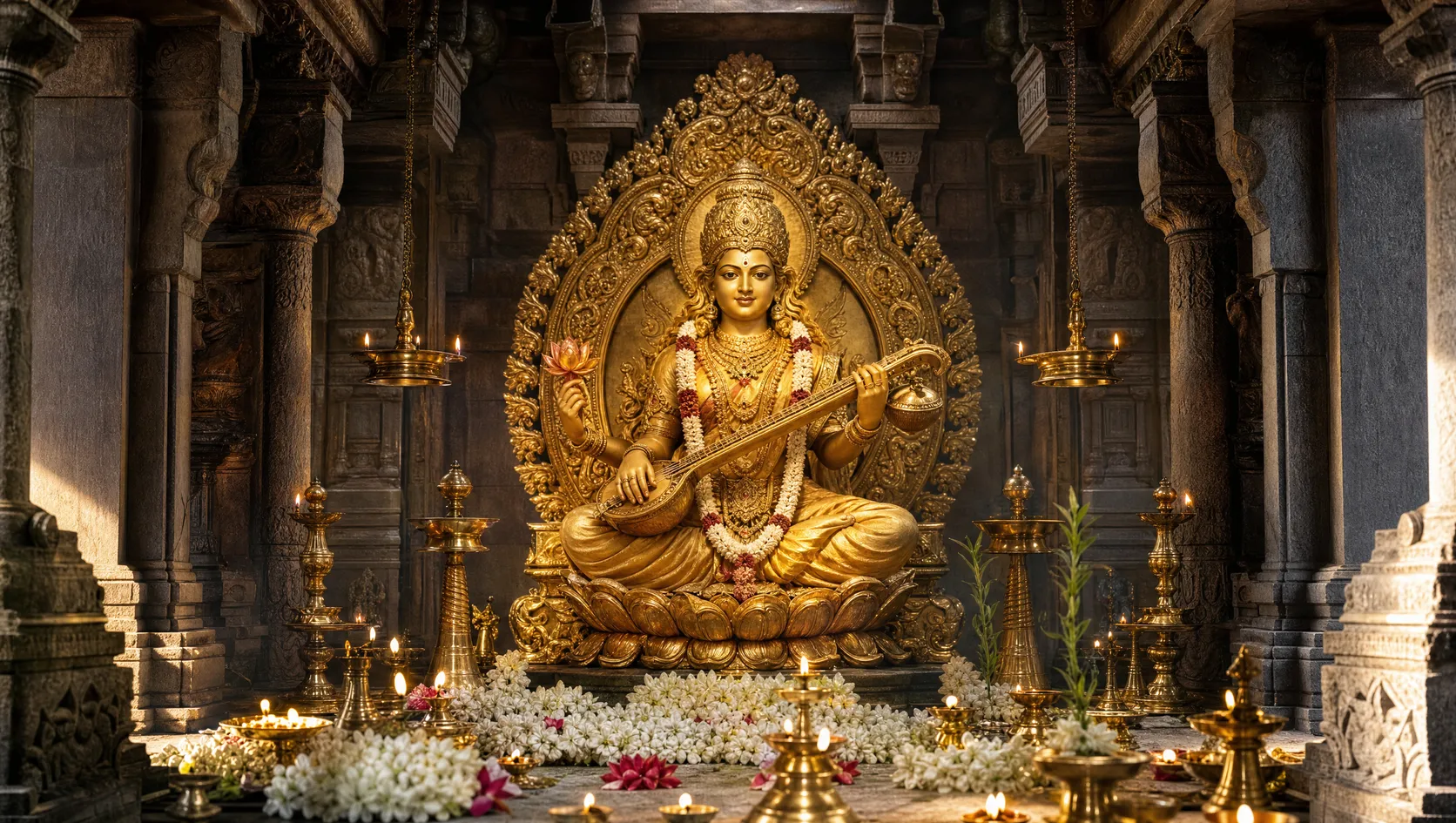
He established the matha there and installed Sharada, goddess of learning, as its presiding deity, appointing his disciple Sureshvaracharya as its first head. The original image of Sharada is held by tradition to have been of sandalwood; it was replaced with an image in gold in the fourteenth century under Vidyaranya, and the sandalwood original is remembered in the temple's account of itself.
उद्धृत स्रोत:
- Shankara Digvijaya biographical tradition
- Ramayana, Balakanda (Rishyashringa episode)
- Sringeri Sharada Peetham institutional records
विद्वत संदर्भ
The traditional dating of Adi Shankaracharya, and therefore of the matha's founding, is debated. The matha's own reckoning places Shankara considerably earlier than the eighth-century date most modern scholars accept, and the two chronologies coexist without resolution. What is not disputed is that Sringeri has functioned as a continuously occupied Advaita institution for a very long time, with a documented succession. Vidyaranya's role in the founding of Vijayanagara is attested in both the matha's records and in inscriptional and literary sources of the period, though the extent of his personal agency, as against the narrative shaped by later court historiography, is a live scholarly question. The 1791 Sringeri-Tipu Sultan correspondence survives in the matha's archive and is unusual as documentary evidence: it is a contemporary record of a Muslim ruler funding the restoration of a Hindu monastery after a raid by a Hindu power, and it is frequently cited in discussions of religious policy in eighteenth-century Mysore.
Historyइतिहास
Sringeri is the Dakshinamnaya, the southern seat, and the first of the four cardinal mathas Adi Shankaracharya established to anchor Advaita Vedanta across the subcontinent. Its first head was Sureshvaracharya, Shankara's own disciple, and the lineage of Jagadgurus has continued from him in unbroken succession, which makes it among the longest continuously occupied institutional offices anywhere in the world.
The matha's most consequential figure after Shankara is Vidyaranya, in the fourteenth century. Tradition and historical record together credit him with a decisive role in the founding of the Vijayanagara Empire, guiding the brothers Harihara and Bukka in establishing a state that would hold much of southern India for two centuries. The relationship ran both ways: Vijayanagara patronage transformed Sringeri, funding building work including the gold image of Sharada and endowing the matha substantially. A monastery in the Western Ghats had a hand in founding an empire, and the empire in turn rebuilt the monastery.
The Vidyashankara temple, built in this period, commemorates the Jagadguru Vidyashankara. It is architecturally unusual, blending Hoysala and Vijayanagara idioms, and its twelve pillars are arranged in relation to the zodiac.
After Vijayanagara's decline the Keladi Nayakas and later the Mysore Wodeyars extended patronage, and the matha retained its standing through successive changes of regional power. The best-known episode of this later history comes from 1791, when Maratha raiders plundered Sringeri, killing and looting and desecrating the shrine. Tipu Sultan, ruler of Mysore, responded by writing to the Jagadguru in terms of considerable warmth and providing for the restoration of the temple and the reconsecration of the deity. The correspondence survives in the matha's archive and is frequently cited in discussions of the period.
Sringeri continues today as a functioning monastic institution rather than a historical site, with a wide network of educational and religious activity, Sanskrit scholarship, and branch establishments across India.
Historical Timelineऐतिहासिक कालक्रम
The site is associated with the sage Rishyashringa, whose hill, Rishyashringagiri, gives Sringeri its name. The association establishes the place's sanctity as older than the monastery built on it.
The toponymic derivation from Rishyashringagiri is generally accepted.
Adi Shankaracharya establishes the matha at Sringeri as the first of his four cardinal seats, installing Sharada as presiding deity and appointing Sureshvaracharya as its first head.
The matha's own chronology places Shankara considerably earlier than the eighth-century dating most modern scholars accept; the two reckonings coexist without resolution.
The lineage of Jagadgurus continues in unbroken succession, with each incumbent designating his successor during his own lifetime, establishing the pattern that has held since.
Hoysala-period patronage supports the matha, and the architectural idiom of the region begins to shape its buildings.
Vidyaranya, Jagadguru of Sringeri, plays a decisive role in the founding of the Vijayanagara Empire under the brothers Harihara and Bukka.
The extent of Vidyaranya's personal agency, as against the narrative shaped by later court historiography, remains a live scholarly question.
Vijayanagara patronage transforms the matha, funding substantial building work and endowing it on a scale it had not previously known.
The Vidyashankara temple is built, commemorating the Jagadguru Vidyashankara, combining Hoysala and Vijayanagara architectural idioms with twelve pillars arranged in relation to the zodiac.
The image of Sharada, held by tradition to have originally been of sandalwood, is replaced with an image in gold under Vidyaranya.
After Vijayanagara's decline the Keladi Nayakas extend patronage to the matha, which retains its standing through the change of regional power.
Maratha raiders plunder Sringeri, killing and looting and desecrating the shrine. Tipu Sultan of Mysore writes to the Jagadguru and provides for the temple's restoration and the reconsecration of the deity.
The correspondence is unusual documentary evidence: a contemporary record of a Muslim ruler funding the restoration of a Hindu monastery after a raid by a Hindu power. It is frequently cited in discussions of religious policy in eighteenth-century Mysore.
Mysore Wodeyar patronage continues the matha's support under the restored kingdom, and its role in Sanskrit scholarship and religious authority is consolidated.
The matha expands its institutional activity, establishing educational bodies, Sanskrit pathashalas and branch establishments across India, and continues as a functioning monastic institution rather than a heritage site.
What You'll Seeदर्शन में
Sharada is Saraswati under a southern name, and the image at Sringeri is seated, holding the attributes of learning. The present murti is of gold, installed in the fourteenth century under Vidyaranya, replacing what tradition holds to have been an original image of sandalwood. The Sharadamba temple around her is later than the Vidyashankara temple and largely Dravidian in idiom.
The more architecturally remarkable structure is the Vidyashankara temple. It is apsidal in plan, drawing on Hoysala and Vijayanagara idioms in a combination not commonly found, and its exterior carries dense sculptural work: figures, friezes and the horse-and-rider motifs characteristic of the period.
Its distinguishing feature is a set of twelve pillars, the Rashi Stambhas, associated with the twelve signs of the zodiac and arranged in relation to the sun's movement through the year. The building functions as an architectural calendar as well as a shrine, which is unusual anywhere and particularly so in a monastic setting where one might expect austerity rather than astronomical display.
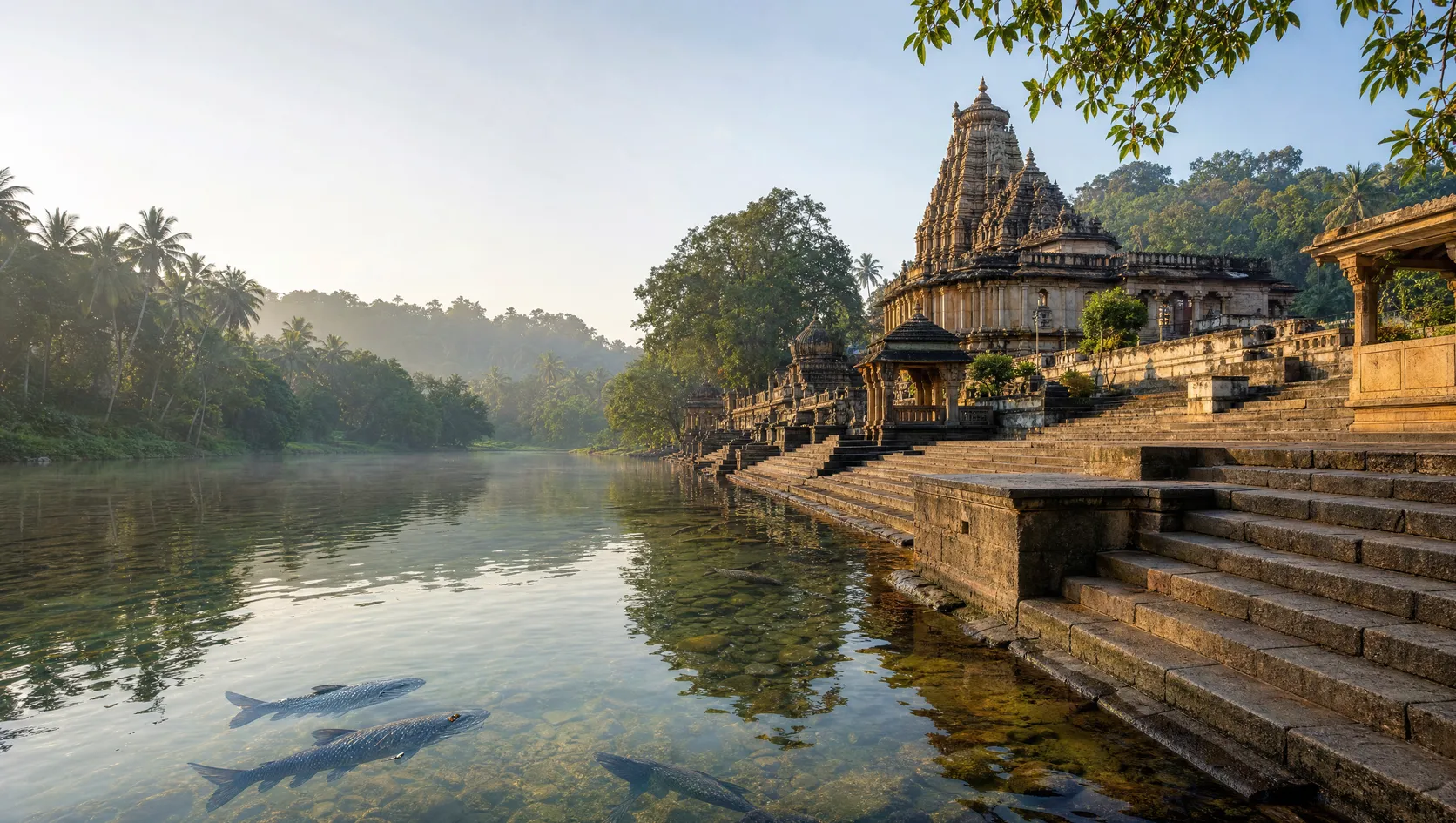
The temple stands beside the Tunga, and the setting is part of the effect: the Malnad forest, the river running clear, and a monastery that has occupied the same ground since the eighth century by the general reckoning, and considerably longer by its own.
Distinctive Practicesविशिष्ट परंपराएँ
The Unbroken Guru Parampara
अटूट गुरु परम्परा
Continuous since the matha's founding
The line of Jagadgurus at Sringeri runs from Sureshvaracharya, Shankara's disciple, in continuous succession to the present. Each head designates his successor during his own lifetime, and the successor is trained in the office and in the tradition's texts before assuming it.
Advaita is taught, not merely written, and the lineage is the mechanism of transmission. Designating a successor in one's own lifetime means the teaching passes person to person rather than through texts alone, which is what the tradition means by parampara. The overlap matters: for a period there are two, and the transfer is a training rather than an inheritance.
The Rashi Stambhas
राशि स्तंभ
Observed through the solar year
The twelve pillars of the Vidyashankara temple are associated with the twelve zodiacal signs and set in relation to the sun's annual movement, so that the structure functions as an architectural calendar as well as a shrine.
Building the solar year into the fabric of a temple treats time as something to be inhabited rather than measured. The worshipper stands inside a structure that is itself keeping the calendar, which suits an Advaita institution: the claim is not that time is unreal but that it is not other than what contains it.
Ganga Snana, Tunga Pana
गंगा स्नान, तुंगा पान
Proverbial, observed by visitors to the matha
A well-known saying holds that one should bathe in the Ganga and drink from the Tunga. The river at Sringeri is noted for the clarity of its water, and drinking from it is part of what a visit means. The fish in the river before the temple are protected and fed by visitors, and are unusually large and unafraid.
The saying distributes sanctity rather than concentrating it. One river is best for purification and another for sustenance, and neither claim diminishes the other. The protected fish extend the same logic to the creatures in it: the river is not a resource here but a neighbour.
Chaturmasya Vrata
चातुर्मास्य व्रत
The four months of the monsoon, annually
During the monsoon months the Jagadguru observes the Chaturmasya vrata, remaining in one place rather than travelling, and devoting the period to intensified study, discourse and ritual. Devotees gather at Sringeri for the duration in numbers larger than usual.
The vrata originates in a practical concern, that of avoiding harm to the small life that proliferates in the rains, and became a discipline of settlement for those who otherwise travel. For a lineage whose authority depends on teaching, a fixed period in one place is also the season in which the most sustained instruction happens.
Did You Know?क्या आप जानते हैं?
Shankara is said to have chosen the site after seeing a cobra spread its hood to shade a frog in labour. The sign he accepted was not a miracle but a suspension of natural enmity between two animals.
Shankara Digvijaya biographical tradition; matha's own account
Vidyaranya, a fourteenth-century Jagadguru of Sringeri, is credited with a decisive role in founding the Vijayanagara Empire. A monastery in the Western Ghats had a hand in establishing a state that held much of southern India for two centuries.
Vijayanagara historiography; Sringeri matha records
The twelve pillars of the Vidyashankara temple correspond to the signs of the zodiac and are set in relation to the sun's movement through the year, making the building function as a calendar as well as a shrine.
Architectural surveys of the Vidyashankara temple
After Maratha raiders plundered Sringeri in 1791, Tipu Sultan of Mysore wrote to the Jagadguru and provided for the temple's restoration and the reconsecration of the deity. The correspondence survives in the matha's archive.
Surviving Sringeri-Tipu Sultan correspondence, widely reproduced
The name Sringeri contracts from Rishyashringagiri, the hill of Rishyashringa, the sage raised in total ignorance of women whose innocence was said to break a drought.
Ramayana, Balakanda; regional toponymic tradition
The succession works by designation in the incumbent's lifetime rather than by election or inheritance after death, so for a period the lineage has both a sitting head and a trained successor.
Sringeri guru parampara practice
The fish in the Tunga before the temple are protected and fed by visitors, and are unusually large and unafraid of people, having been unmolested for generations.
Local observance at Sringeri
Visitor Accessप्रवेश जानकारी
Sringeri is a working monastery as well as a temple complex, and the atmosphere is correspondingly ordered. Traditional dress is expected, and the matha's conventions on conduct within the premises are observed more closely than at a general pilgrimage site. Photography is restricted in the temples. The Jagadguru's audience is held at set times and is not continuous through the day. Sringeri lies in the Malnad hills, so approach roads wind and journeys take longer than distances suggest. Facilities in the town are modest but adequate, and the matha maintains accommodation for visitors. Timings, audience hours and accommodation arrangements are set by the matha and should be confirmed before travelling.
आध्यात्मिक आधार
The ordered atmosphere follows from what the place is. A matha is a residence for renunciates and a school before it is a destination, and the conventions exist to protect a working routine of study and ritual rather than to impress visitors with solemnity. The Jagadguru's audience being held at set hours reflects the same logic. Access to the head of the lineage is not a service offered to the public but an extension of the teaching relationship, and it is scheduled around the day's obligations rather than around demand.
समकालीन संदर्भ
Sringeri receives a steady flow of visitors without the crush of the major pilgrimage centres, and the town remains small. Most visitors come for a day or a night, often as part of a Malnad circuit with Horanadu and Kollur. The matha maintains a substantial institutional presence beyond the temples, including Sanskrit education and publishing, and visitors interested in that side of it will find more than the shrines alone suggest. During Navaratri, particularly around Vijayadashami when families arrive for Vidyarambham, the town fills well beyond its ordinary capacity and accommodation becomes difficult without advance booking.
व्यावहारिक मार्गदर्शन
Allow more travel time than distances suggest; the Ghat roads wind considerably and are slow in the monsoon. Check the Jagadguru's audience hours in advance if that is part of the reason for visiting, as it is not available through the day. Dress traditionally and expect to remove footwear. The Vidyashankara temple deserves unhurried time rather than a glance on the way to Sharadamba; its sculptural programme and the arrangement of the twelve pillars are the architectural point of the visit. Sringeri combines naturally with Horanadu and Kollur in a two- or three-day Malnad circuit, which is the practical way to see the region.
Festivalsत्योहार
Sharada Navaratri
शारदा नवरात्रि
Sep-Oct (Ashwin Shukla Pratipada onward)
The principal festival of the peetham, observed over nine nights with elaborate worship of Sharada, scholarly assemblies and the Rathotsava. As the goddess of learning is the presiding deity, Navaratri here has a particularly strong association with study and with initiation into learning. The town fills for the duration, and the concluding days draw the largest gatherings of the year.
Vidyarambham
विद्यारंभम्
Sep-Oct (during Navaratri, on Vijayadashami)
Children are initiated into learning, tracing their first letters in rice in the presence of the goddess of learning. Families travel to Sringeri specifically for this rite, and for many it is a child's first journey to the matha. The rite is brief and the queue is long, which is a fair description of most beginnings.
Shankara Jayanti
शंकर जयंती
Apr-May (Vaishakha Shukla Panchami)
The appearance day of Adi Shankaracharya, observed at his first matha with particular solemnity, with discourses on Advaita and special worship. For an institution founded by him, this is the day on which the lineage's origin rather than its deity is at the centre.
Chaturmasya
चातुर्मास्य
Jul-Oct (the four monsoon months)
The Jagadguru observes the Chaturmasya vrata, remaining at Sringeri rather than travelling and devoting the period to intensified study, discourse and ritual. Devotees gather for the duration, and the vrata's conclusion is marked with particular ceremony. It is the season in which the matha is most fully itself: a place of teaching rather than of visiting.
Traditional Offeringsपारंपरिक अर्पण
प्राथमिक अर्पण
Books, pens and instruments of learning
पुस्तकें, लेखनी और विद्या के उपकरण
Students and scholars place books, pens and instruments before Sharada, particularly during Navaratri, and take them back after the goddess has been worshipped. Musicians leave instruments, and craftspeople sometimes leave tools. The tools of study are treated as offerings in themselves rather than as objects to be blessed and returned unchanged. During the Navaratri days when the books are with the goddess, they are not used, so the offering costs the giver the thing they most want to be doing.
White flowers
श्वेत पुष्प
White is the colour associated with Saraswati, and white flowers are the offering most closely tied to her worship, read as clarity and the absence of agitation. Jasmine and locally grown white varieties are used. The association is with a mind that is not disturbed rather than with purity in a moral sense: learning requires stillness before it requires virtue.
Tunga water
तुंगा जल
Water from the Tunga is used in the temple's ritual and is drunk by visitors, following the proverb that one should bathe in the Ganga and drink from the Tunga. Unlike most sacred waters, which are carried away in vessels, this one is mainly consumed on the spot. What is offered and what is received are the same water, and the river before the temple is treated as part of the shrine rather than as its setting.
Payasam and cooked offerings
पायसम् और पका नैवेद्य
Cooked offerings prepared in the matha's kitchens are presented to the deity and distributed afterwards, and the matha maintains a free meal service for visitors as a continuing obligation rather than a courtesy. Feeding is a monastic duty as much as a ritual one. A matha that teaches is also expected to feed, and at Sringeri the two have been carried on together for as long as the institution has existed.
इस मंदिर की विशेषता
Aksharabhyasa (the first letters)
अक्षराभ्यास
A child is brought before Sharada and guided to trace their first letters, usually in a tray of rice, sometimes with the hand held by a priest or an elder. Families travel to Sringeri specifically for this, and Vijayadashami during Navaratri is the day most sought. What is offered is not an object but a beginning. The rite marks the point at which a person becomes someone who reads, and it is performed at the feet of the deity whose entire domain is that capacity. Children too young to remember it are brought anyway, on the understanding that the record is kept elsewhere than in their memory.
Offerings are arranged at the temple, and the matha's counters handle sevas and archanas. Books and instruments left for Navaratri are placed and collected on a schedule set by the matha, so those intending to leave them should check the days in advance. Aksharabhyasa is scheduled rather than performed on arrival, and demand around Vijayadashami is heavy; enquire ahead if the visit is being made for that purpose.
How to Reachकैसे पहुँचें
Sringeri is in the Malnad hills of the Western Ghats, and the approach is by road through forested country.
By air: Mangaluru International Airport is roughly 105 km away and is the usual choice. Bengaluru is considerably further, around 330 km, but far better connected.
By rail: Shivamogga (Shimoga) is the practical railhead at roughly 100 km. Udupi and Mangaluru are alternatives on the coastal line, and Chikkamagaluru is nearer but less well served.
By road: Sringeri is reached from Shivamogga, Chikkamagaluru, Udupi or Mangaluru. KSRTC buses serve the town and taxis are available from all the nearby hubs. The roads through the Ghats are winding, and journey times run longer than the distances suggest, particularly in the monsoon when visibility drops and landslips occasionally affect the hill routes.
Many visitors combine Sringeri with Horanadu and Kollur in a single circuit through the Malnad, which is the practical way to see the region and spreads the winding driving across two or three days rather than one.
Plan Your Visitयात्रा की योजना
🌤 सर्वोत्तम मौसम
October to February is the most comfortable period, with the Ghats green after the rains and the Tunga running clear. Temperatures are mild and the driving is at its easiest. The Malnad monsoon, roughly June to September, is heavy and prolonged. The region is at its most beautiful then, but roads, leeches and continuous rain make travel harder, and hill routes can be affected by landslips. Chaturmasya falls in this period, so the matha is at its most active precisely when travel is least convenient. Sharada Navaratri (Sep-Oct) is the most significant time to visit and also the busiest, particularly around Vijayadashami when families arrive for Vidyarambham. Book accommodation well ahead for that window.
👘 पहनावे का नियम
Traditional dress is expected. Men commonly wear a dhoti or trousers with a shirt; in the inner areas of the temples a dhoti without an upper garment may be expected, following South Indian convention. Women wear saree or salwar kameez. Footwear is removed before entering the temple precincts. As a working matha, the expectation of modest and traditional dress extends across the premises rather than being confined to the sanctum.
📱 फोन और फोटोग्राफी
Photography is restricted within the temples, and mobile phones should be silenced across the premises. The Vidyashankara temple's exterior sculpture can generally be photographed, but check locally rather than assuming. The Jagadguru's audience is not a photo opportunity, and recording during discourses or rituals should not be attempted without explicit permission.
🏨 आवास
The matha maintains guest accommodation for visitors, which is the usual choice and is allocated through its own arrangements. A modest number of private lodges and homestays operate in the town and in the surrounding Malnad countryside. Options are limited relative to demand during Navaratri and around Vidyarambham, when booking well in advance is necessary rather than advisable. Outside those periods the town absorbs its visitors comfortably.
Sacred Soundsपवित्र ध्वनि
क्या आप जानते हैं? · Did You Know?
वही अनुवाद त्रुटि जिसने हिन्दू धर्म में '33 कोटि' को '33 करोड़' बनाया, बौद्ध धर्म में भी हुई। बौद्ध ग्रन्थों के चीनी अनुवाद ने 'सप्त कोटि बुद्ध' (7 श्रेष्ठ बुद्ध) का अनुवाद '7 करोड़ बुद्ध' कर दिया। तिब्बती अनुवाद ने सही किया: 7 प्रकार, 7 करोड़ नहीं। एक संस्कृत शब्द, दो प्रमुख विश्व धर्मों में गलत पढ़ा गया, ने दो एकसमान भ्रम स्वतन्त्र रूप से उत्पन्न किए।
Related Contentसंबंधित सामग्री
Related Scriptures
Community Reflections
🕉️
Be the first to share your reflection.