Swamimalai
स्वामीमलै
Where the son became the guru — Murugan who taught Shiva the meaning of Om
Kumbakonam, Tamil Nadu, India
SvāmimalaiAlso known as: Swami Malai, Thiruvedagam, Swaminatha Swami Temple, Arulmigu Swaminathaswamy Temple Swamimalai
युग
Attested from c. 2nd century CE (Sangam period); present structure largely Chola and later medieval period
वास्तुकला
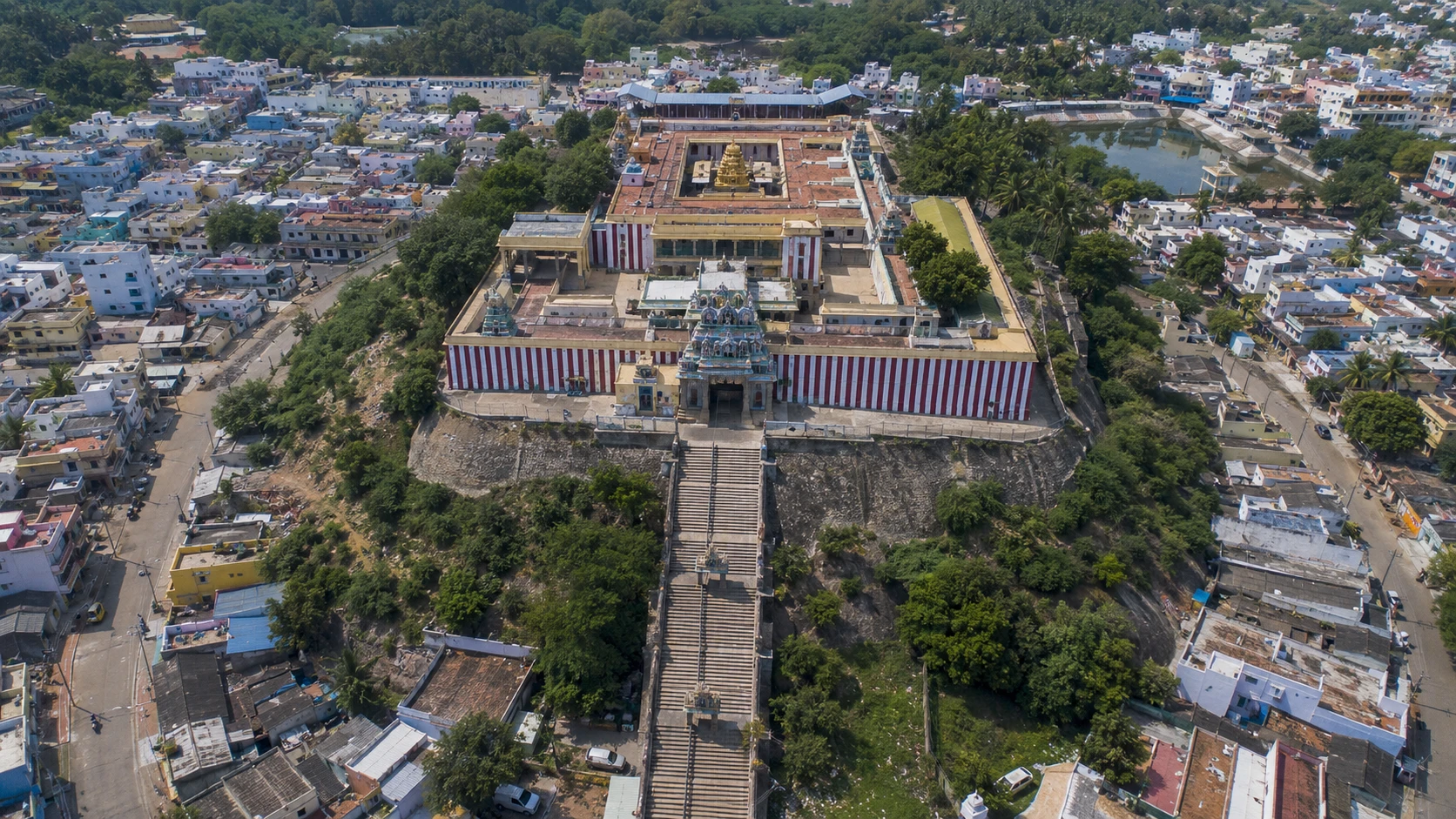
Dravidian (Chola); modest hill temple; 60 steps to the hilltop sanctum
खुला
06:00 – 21:00
आरती
06:00 · 08:00 · 12:00 · 18:00 · 20:30
विशेष
Vaikasi Visakam (May–June): birth-star festival of Murugan draws large gatherings; Panguni Uthiram and Skanda Sashti also major
पवित्र कथा · पवित्र कथा
At Swamimalai, the cosmic order is inverted. The child becomes the teacher; the creator god is imprisoned; the father becomes the disciple. According to the Skanda Purana and the Tamil Sthala Purana tradition, the young Murugan challenged Brahma for failing to explain the meaning of the Pranava mantra (Om) and imprisoned him. When Shiva came to investigate, Murugan made even his own father sit as a shishya (student) — and from the top of this hill, taught Shiva the deepest secret of Om. The hill took its name from the event: Swami (lord/guru) + malai (hill). The deity here bears a name found nowhere else in the Murugan canon: Swaminatha — he who became the guru of his own father. In the landscape of the six Arupadaiveedu, Thirupparankundram shows Murugan as husband, Thiruchendur as warrior, Palani as ascetic — Swamimalai reveals the most unsettling face: the divine child as the supreme gnana guru, reminding creation that wisdom does not defer to seniority, that the Pranava is beyond rank, and that the highest teaching may arrive through the youngest mouth.
Sacred Designationपवित्र पदनाम
Sacred Origin Storyपवित्र उत्पत्ति कथा
Source: Skanda Purana / Tamil Sthala Purana of Swamimalai / Kanda Puranam tradition
After the great war against Surapadman, the asuras were destroyed and the devas were freed. Brahma, the Creator, resumed his work of cosmic administration. One day, the young Murugan approached Brahma and asked him: what is the meaning of the Pranava — the syllable Om, the primordial sound from which all creation springs? Brahma, who had been confidently cataloguing the Vedas, paused. He did not know. He could recite the Vedas; he could not explain the Pranava. Murugan, unimpressed, imprisoned Brahma. Creation ground to a halt without its administrator. The devas appealed to Shiva. Shiva went to his son and asked: release Brahma. Murugan agreed — on one condition. He asked his father to sit as a student before him. Shiva, Lord of all the universe, the destroyer, the first teacher — sat down as a shishya. Murugan climbed to the top of the hill and, standing above his father, taught Shiva the secret meaning of the Pranava. What that secret was, the texts do not record in full — some matters are transmitted only in the guru-shishya relationship, not in writing. Brahma was released. The hill on which Murugan stood to teach was called Swamimalai — 'the hill of the Swami, the guru-lord'. And Murugan's name at this site became Swaminatha: not the lord who rules by force, but the lord who rules by wisdom, by teaching, by the inexplicable grace of the highest knowledge.
उद्धृत स्रोत:
- Skanda Purana — Swaminatha episode
- Tamil Sthala Purana of Swamimalai (local temple tradition)
- Kacciyappa Sivachariyar, Kanda Puranam (Tamil, 14th century CE)
- Arunagirinathar, Thirupugazh — verses addressing Swaminatha (c. 15th century CE)
विद्वत संदर्भ
The Swaminatha mythology — Murugan teaching Shiva the Pranava — is a specifically Tamil theological formulation that inverts the normative guru-shishya hierarchy. Scholars including Kamil Zvelebil ('The Smile of Murugan', 1973) and Fred Clothey ('The Many Faces of Murukan', 1978) have noted that this narrative encodes a Tamil assertion of the primacy of gnana (wisdom) over lineage and seniority — a recurring theme in Tamil Shaiva Siddhanta philosophy. The Saiva Siddhanta school, most fully developed in Tamil Nadu, holds that the guru is the supreme instrument of Shiva's grace; the Swaminatha narrative dramatises this by making the child-guru (Murugan) superior even to Shiva in the transmission of the highest knowledge.
Historyइतिहास
Swamimalai's sacred status is attested in the Sangam-era Tirumurugaṟṟuppaṭai (c. 2nd century CE), which names it among Murugan's six abodes. The temple is situated in the heart of the Kaveri delta — Chola Nadu — one of the most temple-dense regions in all of India, and the Chola kings were significant patrons. Tevaram saints of the Bhakti period composed hymns here, embedding the site within the canonical devotional circuit. Arunagirinathar (c. 15th century CE) composed Thirupugazh verses specific to Swamimalai's Swaminatha. The town of Swamimalai is also home to one of Tamil Nadu's most celebrated living craft traditions: the Panchaloha bronze casting practiced by the Sthapati (Vishwakarma) artisan community. For over a millennium, the bronzesmiths of Swamimalai have cast Chola-style Panchaloha (five-metal alloy) idols for temples across Tamil Nadu and, in recent centuries, the world. This craft — using the traditional lost-wax (cire perdue) technique — is a direct continuation of the Chola bronze tradition that produced the great Nataraja and other classical bronzes now in museums worldwide. The temple is administered by the Hindu Religious and Charitable Endowments (HR&CE) Department, Government of Tamil Nadu.
Historical Timelineऐतिहासिक कालक्रम
Nakkirar's Tirumurugaṟṟuppaṭai names Swamimalai among Murugan's six Padai Veedu, providing the earliest datable literary attestation of the site's sacred status.
Nayanmar Bhakti saints composed Tevaram hymns on Swamimalai. The temple was integrated into the Saiva pilgrimage canon during the Bhakti period, receiving royal attention from the Pallava and early Chola dynasties whose territories included the Kaveri delta.
The imperial Chola dynasty — based in the Kaveri delta region and among the greatest temple patrons in Indian history — oversaw extensive construction and endowment across the Kumbakonam region, including at Swamimalai. Chola bronzesmiths in this period produced the classical Panchaloha idols for which the region became famous.
Arunagirinathar composed Thirupugazh verses specific to Swamimalai's Swaminatha, crystallising the image of Murugan as the gnana guru — the supreme teacher of the Pranava — in Tamil devotional literature.
The Panchaloha bronze-casting tradition of Swamimalai — practiced by Sthapati artisans using the classical lost-wax technique inherited from the Chola period — continues as a living craft. Swamimalai bronzes are supplied to temples across Tamil Nadu and internationally. The tradition represents an unbroken chain of craft knowledge spanning over a millennium.
The 'living tradition' entry is an ongoing process rather than a datable event; it is included to document the temple town's distinctive cultural heritage in the historicalEvents field as the most appropriate structural home for this information.
What You'll Seeदर्शन में
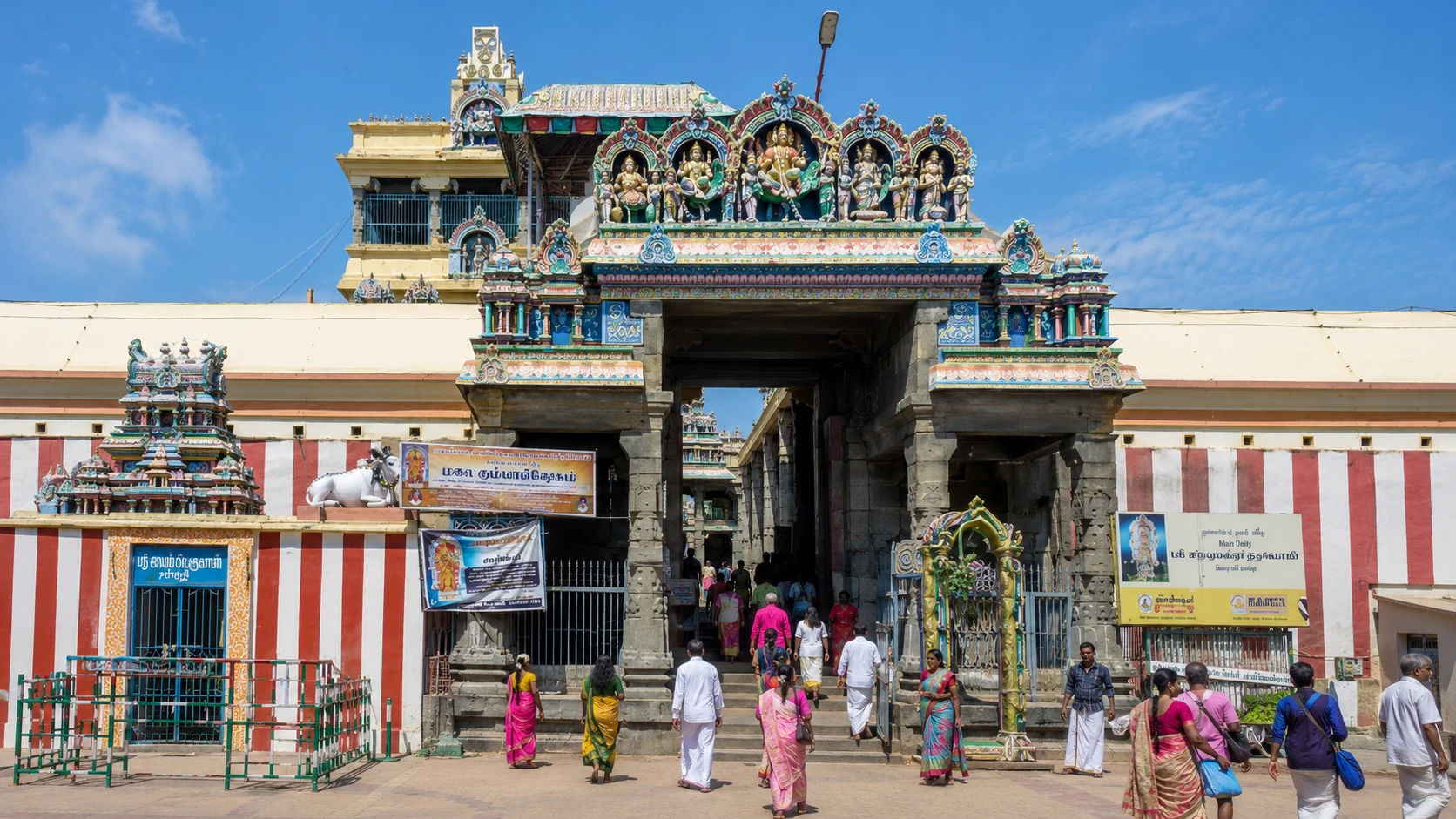
Murugan at Swamimalai is enshrined as Swaminatha — the guru-lord, the divine teacher. The iconography here is the rarest in the Arupadaiveedu: Murugan is depicted in the posture of a teacher, standing above a seated student-figure, one hand raised in the chin mudra (the gesture of imparting knowledge — index finger touching the thumb in a loop, the remaining fingers extended). In some sculptural representations at this site, a small figure of Shiva sits at Murugan's feet, a compositional inversion with no parallel elsewhere in classical Hindu temple sculpture: the destroyer-god of the universe positioned as student before his own child. The sanctum faces east. The idol is adorned with the traditional Murugan ornaments and garlands but the defining posture — the chin mudra, the gesture of the teacher — distinguishes him from every other form in the Arupadaiveedu. Photography is not permitted inside the inner sanctum.
Distinctive Practicesविशिष्ट परंपराएँ
Guru Vandanam — Seeking the Teacher's Grace
गुरु वंदनम — शिक्षक की कृपा माँगना
Year-round; intensified on Guru Purnima and Vaikasi Visakam
Students, scholars, musicians, and seekers of all kinds come to Swamimalai specifically to offer Guru Vandanam — a salutation to Murugan in his form as the supreme guru. The offering includes a distinctive ritual: the devotee approaches the deity, places their learning implements (books, musical instruments, tools of their craft) before the idol, and prays for clarity, retention, and the grace of transmission. This is distinct from the general Vidhyarambham (learning initiation) observed elsewhere — at Swamimalai, the prayer is not for beginning knowledge but for deepening it, for the kind of understanding that Murugan revealed when he taught his father the Pranava.
Swamimalai is theologically unique among the six Arupadaiveedu as the site of Murugan's manifestation as guru — not teacher in the ordinary sense, but guru in the Saiva Siddhanta sense: the human or divine form through whom Shiva's grace operates directly. To receive Swaminatha's blessing is understood as receiving the same grace that Shiva himself received at this hill. The paradox of the child-teacher is not resolved but embraced: wisdom, the tradition insists, does not follow the rules of age.
Did You Know?क्या आप जानते हैं?
Swamimalai is the only one of the six Arupadaiveedu where Murugan is worshipped specifically as a guru — the divine teacher who instructed his own father, the creator-god Shiva, in the meaning of the Pranava (Om). In classical Hindu theology, the guru is the highest form of divine grace; at Swamimalai, that logic reaches its most radical expression: the son outranks the father in wisdom.
Skanda Purana; Tamil Sthala Purana of Swamimalai; Fred Clothey, 'The Many Faces of Murukan' (1978)
The town of Swamimalai has been one of the foremost centres of Panchaloha bronze casting in India for over a millennium. The Sthapati artisan community here uses the traditional lost-wax (cire perdue) technique — the same method used by Chola bronzesmiths to produce the great Nataraja statues now in the British Museum, the Musée Guimet, and the National Museum of India. The bronzes of Swamimalai still supply temples across Tamil Nadu.
Vidya Dehejia, 'The Art of the Imperial Cholas' (1990); Tamil Nadu state crafts board documentation; Crafts Council of India
Swamimalai is located in the heart of the Kaveri delta — within 50 km radius lie Kumbakonam (the 'city of temples'), the Brihadeeshwara Temple at Thanjavur (UNESCO World Heritage), the Gangaikonda Cholapuram temple (UNESCO World Heritage), and the Airavatesvara Temple at Darasuram (UNESCO World Heritage). No other Arupadaiveedu is surrounded by such a density of classical Chola architecture.
UNESCO World Heritage List; Archaeological Survey of India; Tamil Nadu Tourism
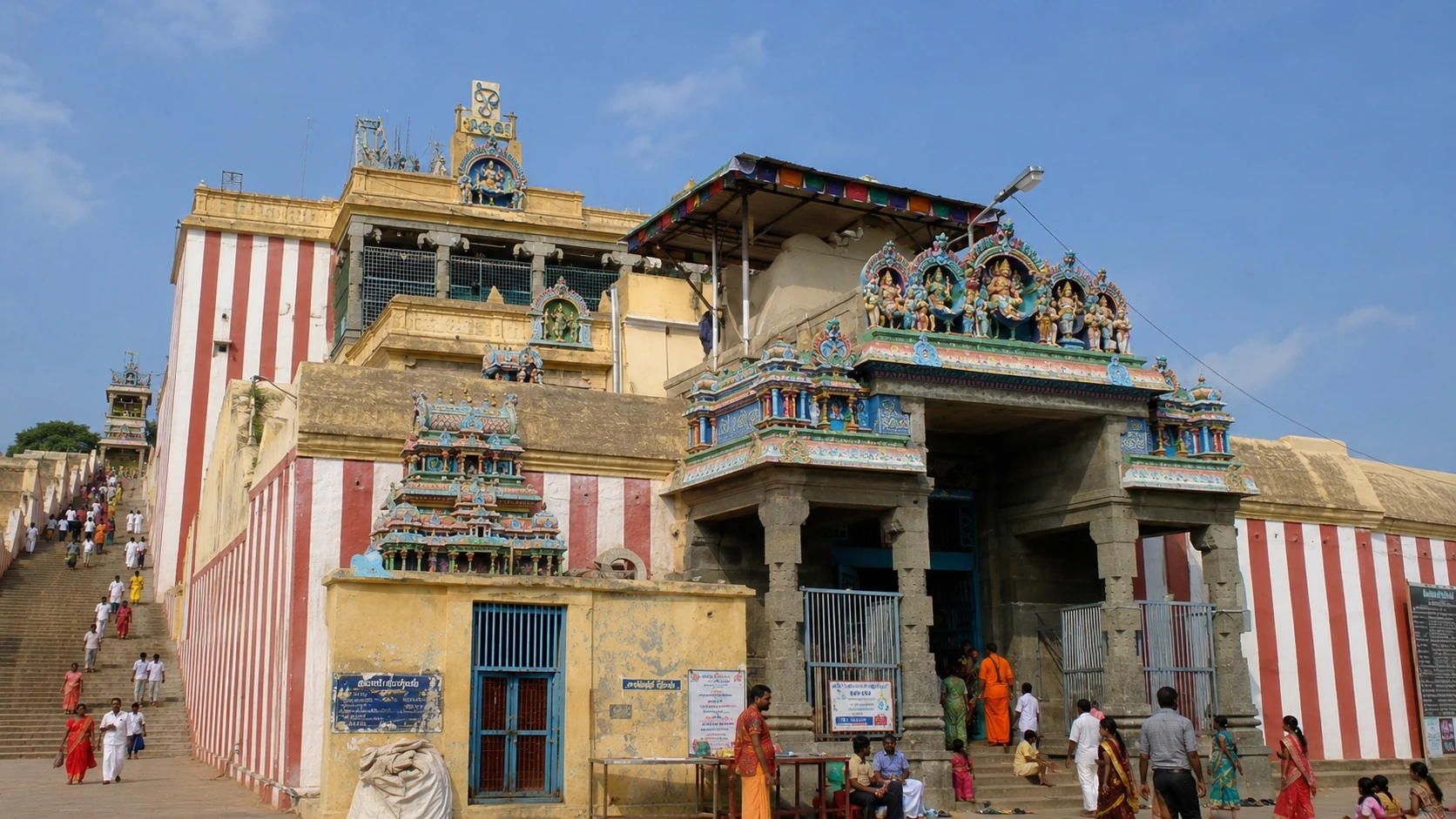
The 60 steps to the Swamimalai hilltop are said to represent the 60-year cycle (Shashti Abda Purthi) of the Tamil calendar — each step corresponding to one year of the traditional cyclic time system. This numerical encoding is a common feature of Tamil Murugan hill temples, linking the physical ascent to devotional and cosmological meaning.
Tamil temple tradition; Swamimalai Sthala Purana
Visitor Accessप्रवेश जानकारी
Swamimalai is open to devotees of all backgrounds. Modest dress is required. Photography is not permitted inside the inner sanctum. The temple is reached by 60 steps — a gentle climb manageable for most devotees. The Panchaloha bronze workshops in the town are generally open for visits; enquire locally for workshop access.
60 steps is a moderate climb; suitable for most devotees including elderly with care. Enter barefoot. Men typically remove shirts at the inner sanctum. The bronze-casting workshops in Swamimalai town are a culturally significant addition to any visit — allow extra time.
Festivalsत्योहार
Vaikasi Visakam
वैकासी विशाखम
May–June
The birth-star festival of Murugan (Visakha nakshatra in the Tamil month of Vaikasi) is particularly significant at Swamimalai, celebrated as the day when the divine guru-child manifested. Special abhishekam, processional rituals, and recitation of Thirupugazh hymns mark the occasion.
Skanda Sashti
स्कंद षष्ठी
October–November
Six-day festival celebrating Murugan's victory over Surapadman. At Swamimalai, the celebration also resonates with the Swaminatha narrative — having achieved the ultimate victory, Murugan taught the ultimate wisdom. Soorasamharam and Thirukalyanam are observed.
Panguni Uthiram
पंगुनी उत्तिरम
March–April
Observed at all six Arupadaiveedu; at Swamimalai, Brahmotsavam (grand festival) is celebrated with special processions, abhishekam, and Thirupugazh recitation.
How to Reachकैसे पहुँचें
Swamimalai is located approximately 6 km west of Kumbakonam in the Kaveri delta region. Kumbakonam Railway Station (6 km) is the nearest major station, well-connected to Chennai, Thanjavur, Trichy, and other Tamil Nadu cities. Tiruchirappalli International Airport (90 km) has domestic flights; Chennai International Airport (280 km) for broader national and international connectivity. State buses (TNSTC) connect Swamimalai to Kumbakonam, Thanjavur, Trichy, and Chennai. Auto-rickshaws and taxis are available from Kumbakonam. The Kumbakonam region is also well-covered by private cabs and tour operators given its density of major temples.
Plan Your Visitयात्रा की योजना
🌤 सर्वोत्तम मौसम
October through March. Summers in the delta are humid and hot; mornings and evenings are cooler. The Kumbakonam region is best visited as part of a broader Chola temple circuit — plan 2–3 days to cover Swamimalai along with the UNESCO World Heritage sites at Thanjavur, Gangaikonda Cholapuram, and Darasuram.
👘 पहनावे का नियम
Modest traditional dress. Men typically remove shirts at the inner sanctum. No shorts or sleeveless garments. Footwear removed at the temple entrance.
📱 फोन और फोटोग्राफी
Mobile phones permitted in outer precincts. Photography strictly prohibited inside the inner sanctum.
🏨 आवास
Kumbakonam (6 km) offers a range of accommodation from pilgrim lodges to mid-range hotels, with extensive options given its status as a major temple city. Swamimalai town itself has smaller pilgrim lodges. For more upscale options, Thanjavur (40 km) has hotel properties with wider amenities.
Book a Pujaपूजा बुक करें
Booking links and phone numbers are verified periodically but may change without notice. Always confirm the destination URL belongs to the official temple trust before payment. Phone numbers and email addresses listed here are provided by the official temple authority where available; verify on the trust's official website before contacting.
Managed by: Hindu Religious and Charitable Endowments (HR&CE) Department, Government of Tamil Nadu — Arulmigu Swaminathaswamy Temple, Swamimalai
Booking information verified: 2026-05-23
Sacred Soundsपवित्र ध्वनि
क्या आप जानते हैं? · Did You Know?
वही अनुवाद त्रुटि जिसने हिन्दू धर्म में '33 कोटि' को '33 करोड़' बनाया, बौद्ध धर्म में भी हुई। बौद्ध ग्रन्थों के चीनी अनुवाद ने 'सप्त कोटि बुद्ध' (7 श्रेष्ठ बुद्ध) का अनुवाद '7 करोड़ बुद्ध' कर दिया। तिब्बती अनुवाद ने सही किया: 7 प्रकार, 7 करोड़ नहीं। एक संस्कृत शब्द, दो प्रमुख विश्व धर्मों में गलत पढ़ा गया, ने दो एकसमान भ्रम स्वतन्त्र रूप से उत्पन्न किए।
Related Contentसंबंधित सामग्री
Related Scriptures
Community Reflections
🕉️
Be the first to share your reflection.