Thiruchendur
तिरुचेन्दूर
The shore temple where Murugan defeated Surapadman — and the sea bore witness
Thoothukudi, Tamil Nadu, India
TiruccendūrAlso known as: Thiruchitrambalam, Senthilandavar Kovil, Tiruchendur Murugan Temple, Subramanya Swami Temple Thiruchendur
युग
Attested from c. 2nd century CE (Sangam period); present Dravidian structure largely medieval, with significant Pandya and Nayaka-period construction
वास्तुकला
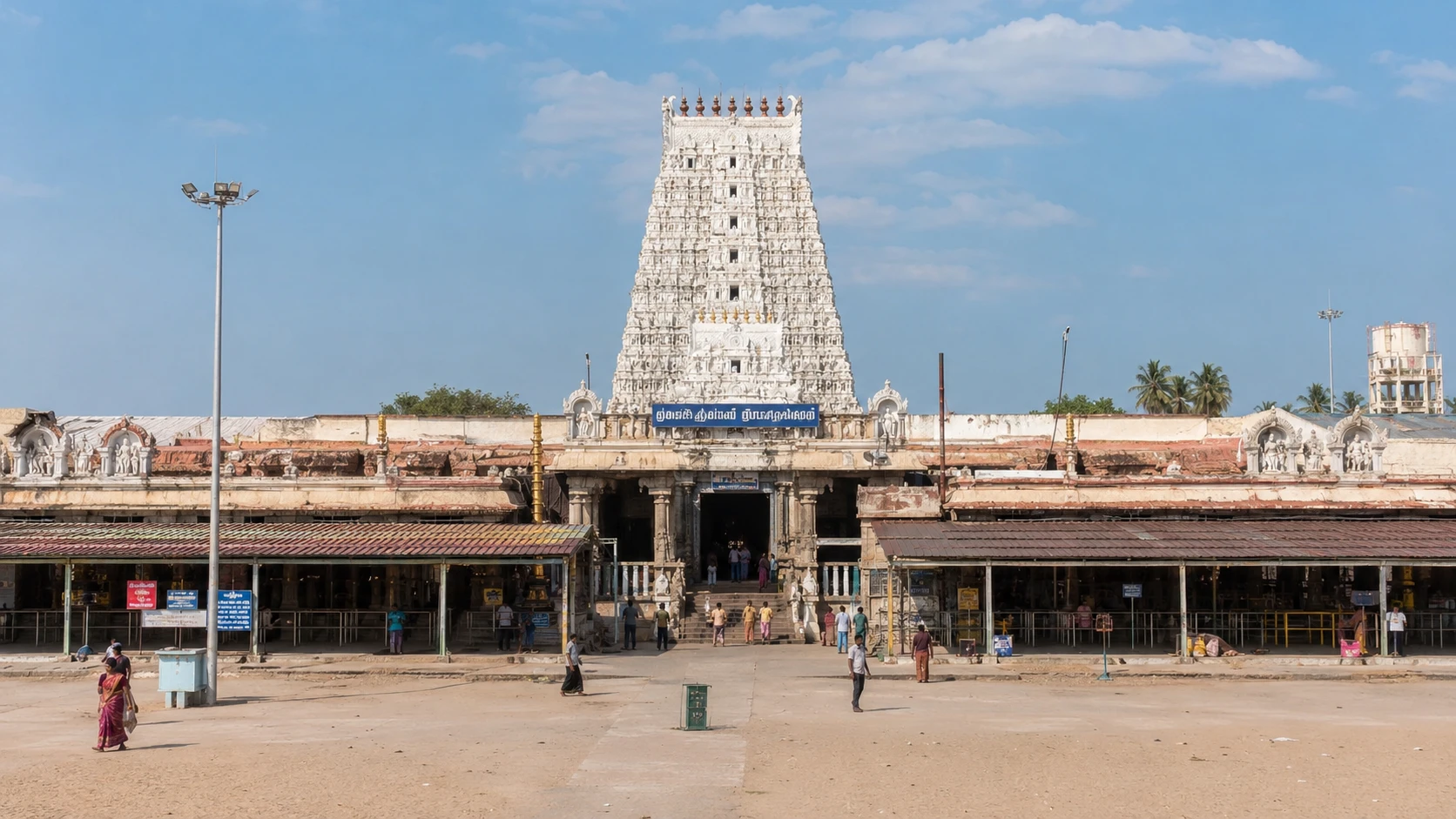
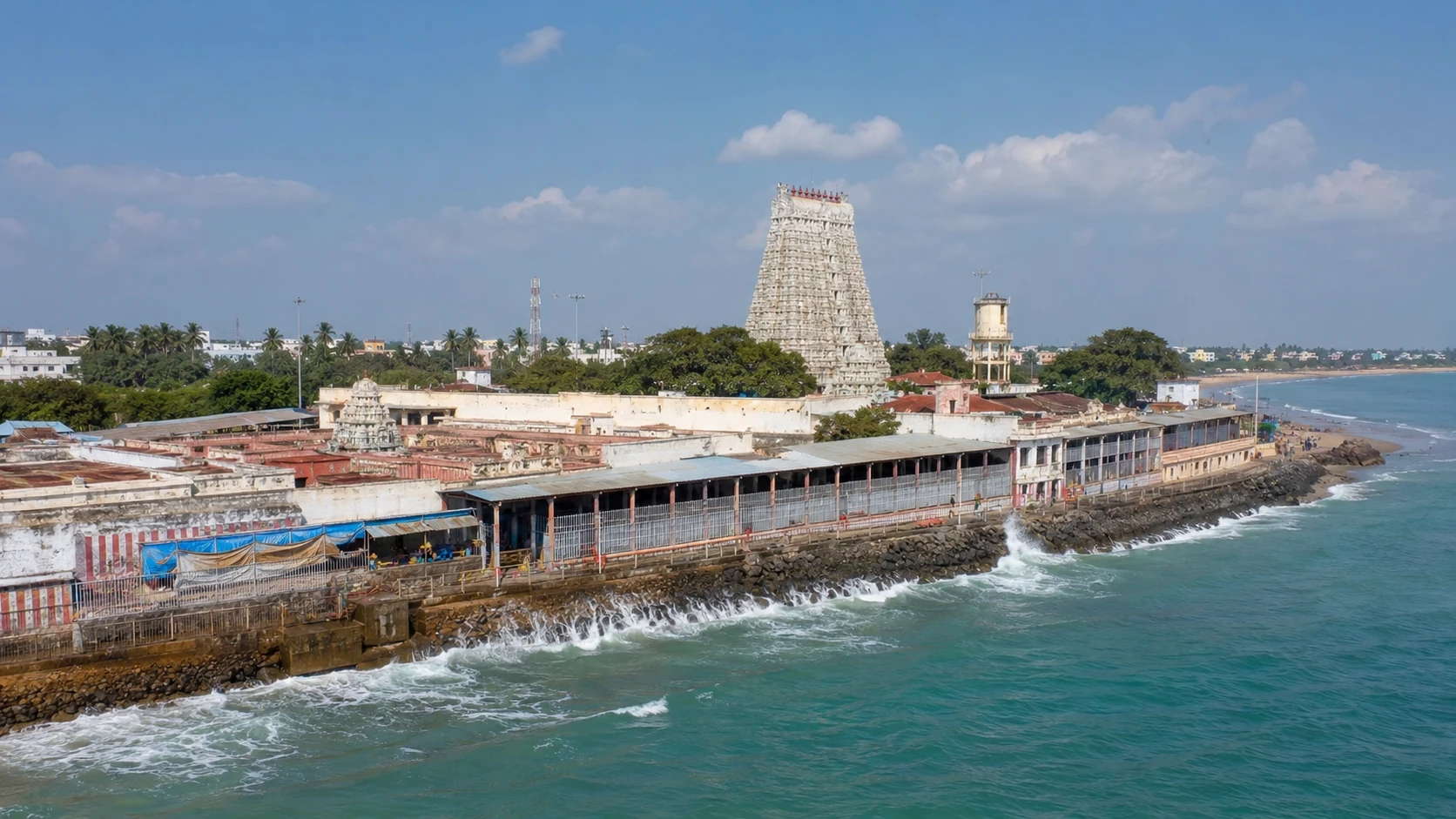
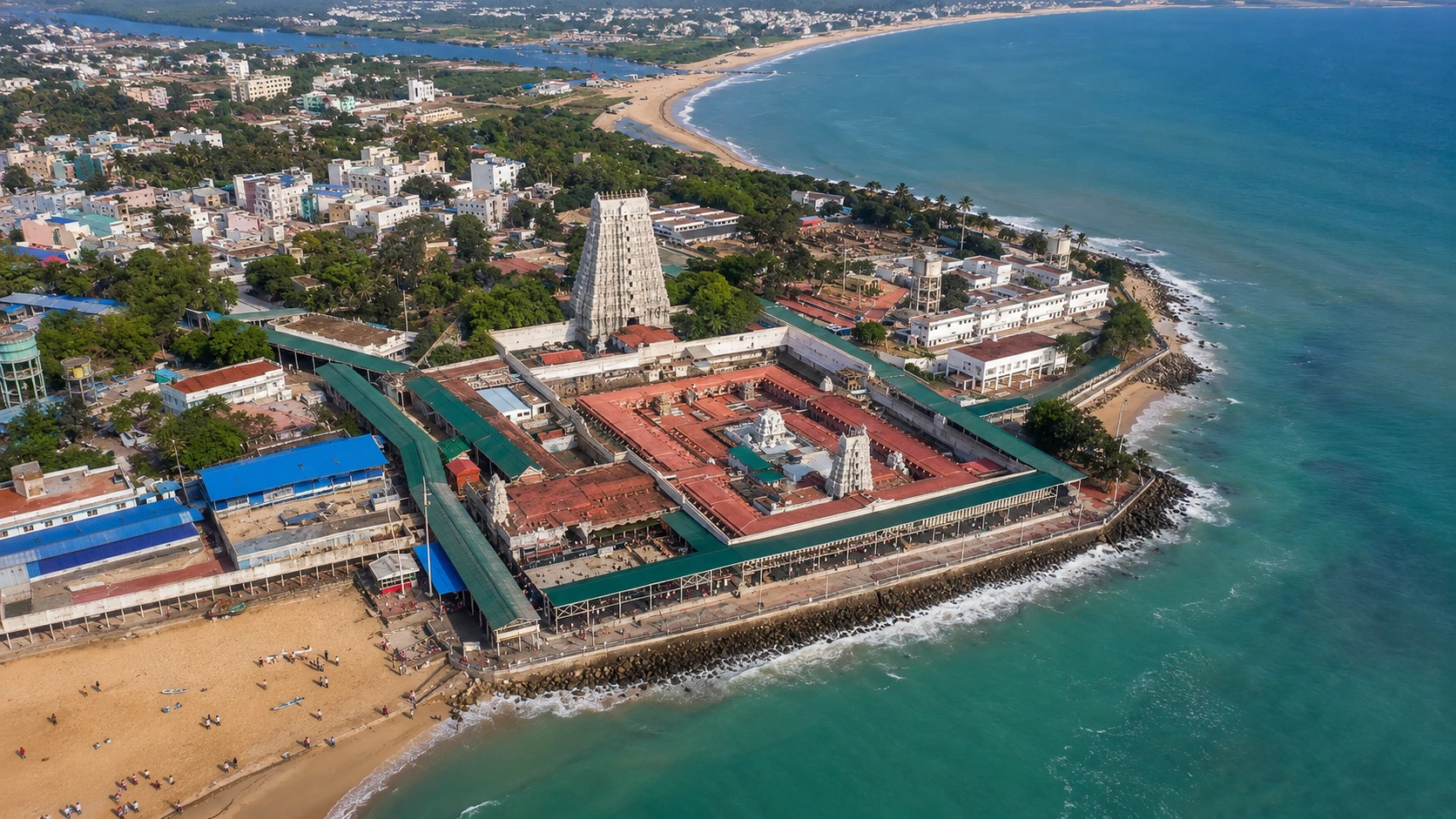
Dravidian (Pandya/Nayaka); five-tier rajagopuram; unique coastal setting with the sea forming the eastern boundary
खुला
05:30 – 21:00
आरती
05:30 · 08:00 · 12:00 · 18:00 · 20:30
विशेष
Skanda Sashti (October–November): Soorasamharam re-enactment on the beach — the most powerful six days in the Murugan devotional calendar
पवित्र कथा · पवित्र कथा
Thiruchendur is the only one of the six Arupadaiveedu that stands on the seashore — its eastern face open to the Gulf of Mannar, its rajagopuram visible to sailors approaching the Tamil Nadu coast. According to the Skanda Purana, this was the site of Murugan's encampment before the cosmic battle against the asura Surapadman, the battlefield itself, and the place of final victory. Here Parvati handed Murugan the vel — the divine spear — with which he split Surapadman's mango tree form, turning one half into a peacock (his vahana) and the other into a rooster (the emblem on his flag). The Skanda Sashti Kavacham, the most widely recited Tamil protective hymn, draws its power and its narrative from this beach at the edge of the Indian subcontinent. On December 26, 2004, when the Indian Ocean tsunami swept across the Tamil Nadu coast and obliterated entire villages, the Thiruchendur temple complex sustained minimal structural damage — an event that has entered the devotional memory of Tamil Nadu as testimony to Murugan's protection of his own abode.
Sacred Designationपवित्र पदनाम
Sacred Origin Storyपवित्र उत्पत्ति कथा
Source: Skanda Purana (Kumara Khanda) / Kanda Puranam (Tamil; Kacciyappa Sivachariyar, 14th century CE)
Before the final war, Tarakasura's brother Surapadman had grown in power until he held dominion over the three worlds, enslaved the devas, and imprisoned Indra's son Jayanta. The devas appealed to Brahma, who directed them to Shiva. Shiva and Parvati generated Murugan through their divine will — born as six flames on the Saravana lake, raised by the six Krittika stars, united into one six-faced god, Shanmukha, by Parvati's embrace. Murugan assembled the celestial armies. Parvati placed her vel — the weapon of wisdom — in his hand at the seashore of Thiruchendur, saying: this spear does not miss; let it carry my power. The great battle unfolded across the cosmic sea. One by one, Surapadman's commanders fell: Tarakasura first, then Simhamukha, then army after army. Surapadman himself transformed through every form — mountain, sea, serpent, fire — and Murugan's vel pursued him through each. In his final transformation, Surapadman became an immense mango tree. Murugan raised the vel and cleft the tree. From one half rose a peacock, which Murugan accepted as his mount; from the other rose a rooster, which became the emblem on his battle flag. Surapadman, the great asura, was not destroyed — he was transformed. The devas were freed. Indra's daughter Devasena was promised to Murugan in gratitude. The victory was celebrated on the Sashti (sixth) day of the waxing moon in the Tamil month of Karthigai — and that day has been Skanda Sashti ever since.
उद्धृत स्रोत:
- Skanda Purana, Kumara Khanda — Surapadman yuddha narrative
- Kacciyappa Sivachariyar, Kanda Puranam (Tamil, 14th century CE) — definitive Tamil retelling of the Skanda narrative
- Nakkirar, Tirumurugaṟṟuppaṭai, verses describing Thiruchendur as the sea-shore Padai Veedu (Sangam era, c. 2nd century CE)
विद्वत संदर्भ
The Kanda Puranam by Kacciyappa Sivachariyar (14th century CE) is the authoritative Tamil-language retelling of the Skanda narrative and is the source most widely cited in ritual contexts at Thiruchendur. The Sanskrit Skanda Purana's Kumara Khanda covers the same battle narrative, though with different details of the geography. Scholars including Kamil Zvelebil ('The Smile of Murugan', 1973) have traced the Surapadman battle myth as a specifically South Indian elaboration of the pan-Indian Skanda tradition, with the coastal geography of Thiruchendur playing a structuring role in the Tamil version that is absent from northern Sanskrit retellings.
Historyइतिहास
Thiruchendur is among the most ancient documented Murugan shrines in Tamil Nadu. The Tirumurugaṟṟuppaṭai (c. 2nd century CE) names it among the six Padai Veedu, describing the seashore setting with specific reference to the waves, the sand, and the coastal kadamba grove. In the Bhakti period, Thirugnanasambandar and Appar (Thirunavukkarasar) composed Tevaram hymns for this temple, and the site was part of the canonical Saiva pilgrimage circuit by the 7th century CE. The Pandya dynasty, whose territory encompassed the far southern Tamil Nadu coast, were principal patrons; medieval inscriptions record Pandya donations and land grants. The Nayaka period (16th–17th centuries) saw significant architectural additions, including expansion of the gopuram complex. The temple derives special devotional currency from its association with the Skanda Sashti Kavacham, a Tamil protective hymn composed by Devaraya Swamigal (19th century) and addressed specifically to the Thiruchendur Murugan. On December 26, 2004, the Indian Ocean tsunami struck the Tamil Nadu coast with devastating force; the town of Thiruchendur was in the direct path of the waves. The temple complex sustained minimal structural damage, while significant destruction occurred in the surrounding coastal areas — an event that entered the devotional record of the temple and is cited by devotees as evidence of Murugan's protective presence. The temple is administered by the Hindu Religious and Charitable Endowments (HR&CE) Department, Government of Tamil Nadu.
Historical Timelineऐतिहासिक कालक्रम
Nakkirar's Tirumurugaṟṟuppaṭai names Thiruchendur among Murugan's six Padai Veedu, describing the seashore setting — waves, coastal kadamba groves, and the sound of the ocean — in verses that constitute the earliest datable textual attestation of the temple's sacred status.
Thirugnanasambandar and Appar (Thirunavukkarasar), Shaiva Nayanmar saints, composed Tevaram hymns on Thiruchendur, embedding the temple firmly within the pan-Tamil Bhakti pilgrimage circuit.
Kacciyappa Sivachariyar composed the Kanda Puranam — the definitive Tamil retelling of the Murugan–Surapadman battle narrative — in which Thiruchendur is the named site of the cosmic war and the final victory. The text became the liturgical authority for Skanda Sashti observances across Tamil Nadu.
Nayaka-period rulers sponsored major architectural additions to the Thiruchendur complex, including expansion of the gopuram tiers and mandapam construction, giving the temple much of its present monumental Dravidian form.
On December 26, 2004, the Indian Ocean tsunami struck the Tamil Nadu coast with catastrophic force. The town of Thiruchendur was in the direct path of the waves. The Thiruchendur temple complex sustained minimal structural damage, while significant destruction occurred across the surrounding coastal areas. The event entered the devotional record of the temple and is widely cited by devotees as evidence of divine protection.
The claim that 'the waves stopped at the temple boundary' is a widely circulated devotional account. The documented fact is that the temple complex sustained minimal structural damage relative to other coastal structures in the area. The precise mechanics of wave attenuation at this site have not been independently published in peer-reviewed scientific literature; the temple's coastal topography (elevated granite base, enclosed compound walls) is a plausible contributing factor.
What You'll Seeदर्शन में
Murugan at Thiruchendur is enshrined as Senthilandavar — 'Lord of Thiruchendur', the red-hued sovereign of the southern shore. The primary utsava murti (processional deity) depicts Murugan in a standing posture, holding the vel (divine spear) in his right hand — the vel that Parvati placed in his hands on this very beach before the battle with Surapadman. Unlike some other Arupadaiveedu where Murugan appears with a consort or as a teacher, here he stands as the victorious general: erect, radiantly robed, crowned, the vel upright. The sanctum faces east, toward the sea — the Bay of Bengal is Murugan's eastern wall. The sixfold form, Shanmukha, is present in ritual iconography, though the primary darshan is of the single standing form. The peacock vahana is depicted at the base of the idol; the rooster emblem (seval) appears on the dhvaja stambha (flagpole) in the temple courtyard. Photography is not permitted inside the inner sanctum.
Distinctive Practicesविशिष्ट परंपराएँ
Skanda Sashti — Soorasamharam (Slaying of Surapadman)
स्कंद षष्ठी — सूरसंहारम (सुरापद्मन का वध)
Annual, October–November; the Soorasamharam is enacted on the sixth (Sashti) day
For six days during the Tamil month of Karthigai, the Skanda Sashti festival at Thiruchendur re-enacts the cosmic battle between Murugan and Surapadman. Each day's rituals follow the narrative arc of the Kanda Puranam — the divine army's assembly, the successive battles, the death of Surapadman's commanders. On the sixth day, Soorasamharam, the climax is staged on the beach itself: an actor embodying Surapadman as the mango tree is struck down with the vel, the tree splits into the peacock and rooster forms, and the assembly roars in triumph. Hundreds of thousands of devotees gather on the sands to witness the re-enactment.
Thiruchendur's Soorasamharam is considered the most potent enactment of the event in all of Tamil Nadu because it occurs at the site where the original victory is held to have taken place. Attending is understood as participating in the victory itself — the devotee stands on the same beach, in the same moment of divine triumph, and receives the grace that flows from that moment. The six-day fast-and-worship cycle mirrors Murugan's six-day campaign.
Skanda Sashti Kavacham Parayanam
स्कंद षष्ठी कवचम पारायण
Daily; intensified during Skanda Sashti and Fridays
The Skanda Sashti Kavacham — a Tamil protective hymn of 82 verses composed by Devaraya Swamigal (19th century CE) and addressed specifically to the Thiruchendur Murugan — is recited collectively by devotees in the temple precincts. The kavacham (armour) invokes Murugan to protect every limb and organ of the devotee, naming each body part and requesting his shield. It is among the most widely memorised devotional texts in Tamil Nadu and is recited in homes across the Tamil-speaking world. At Thiruchendur, collective recitation by assembled devotees is a regular practice.
The kavacham draws its protective power specifically from its association with the Thiruchendur Murugan — the warrior-god at the moment of his greatest victory. Reciting it is understood as summoning Murugan's battle-tested, absolute protection. The hymn's structure — naming each body part, each organ, each sense — transforms the devotee's body itself into an armoured form under Murugan's guardianship.
Did You Know?क्या आप जानते हैं?
Thiruchendur is the only one of the six Arupadaiveedu that stands directly on the seashore — its main sanctum faces east toward the Gulf of Mannar, and the rajagopuram is visible to sailors at sea. This coastal orientation is not incidental: the sea is integral to the temple's mythology, as the battlefield of the Surapadman war extends from this shore.
Nakkirar, Tirumurugaṟṟuppaṭai (Sangam, c. 2nd century CE); temple geography; Kanda Puranam
The Skanda Sashti Kavacham — the most widely recited Tamil protective hymn across the global Tamil diaspora — was composed specifically for the Thiruchendur Murugan by Devaraya Swamigal in the 19th century. Its 82 verses invoke Murugan to protect every part of the devotee's body; it is recited in temples, homes, cars, and offices from Chennai to Singapore to Toronto.
Devaraya Swamigal, Skanda Sashti Kavacham (19th century CE); Tamil devotional literature scholarship
On December 26, 2004, when the Indian Ocean tsunami struck Thiruchendur's coast with devastating force, the temple complex sustained minimal structural damage while significant destruction occurred in the surrounding area. The event has entered the devotional memory of the temple; scholars note the granite elevation and compound walls of the complex as contributing physical factors, while devotees regard it as direct divine protection.
Government of Tamil Nadu disaster response documentation (December 2004); media reports; ASI post-tsunami inspection
In the mythology of the Surapadman battle, the demon's final transformation was into a mango tree — and when Murugan split the tree with his vel, one half became his peacock vahana and the other his rooster flag-emblem. This is why the rooster (seval) appears on Murugan's battle flag at Thiruchendur: the enemy himself became the devotee's symbol of surrender and grace.
Kacciyappa Sivachariyar, Kanda Puranam (14th century CE); Skanda Purana, Kumara Khanda
Visitor Accessप्रवेश जानकारी
Thiruchendur is open to devotees of all backgrounds. Modest dress is required. Photography is not permitted inside the inner sanctum. The beach adjacent to the temple complex is a public area; waves can be strong and unpredictable — exercise caution near the water, particularly with children and during monsoon season (October–December).
Enter barefoot. Men typically remove shirts before entering the inner sanctum. The temple is on the coast; summers are humid and hot. Carry water. The beach adjacent to the temple is not safe for swimming — strong currents. During Skanda Sashti, the area becomes extremely crowded; arrange accommodation and transport well in advance.
Festivalsत्योहार
Skanda Sashti
स्कंद षष्ठी
October–November
The defining festival of Thiruchendur and the most important date in the Murugan devotional calendar for Tamil Nadu. Six days of fasting, worship, and processional re-enactment of the Surapadman war, culminating in Soorasamharam — the staged slaying of the demon on the beach. Hundreds of thousands of pilgrims travel to Thiruchendur for this festival; the beach becomes one of the most densely populated ritual spaces in India.
Thai Poosam
थाई पूसम
January–February
Major Murugan festival observed on Poosam nakshatra in the Tamil month of Thai. At Thiruchendur, kavadi-bearing devotees carry decorated frames as votive offerings, many having walked long distances. The festival commemorates Parvati's gift of the vel to Murugan — the same vel she gave at this very shore.
Panguni Uthiram
पंगुनी उत्तिरम
March–April
Celebrated across all six Arupadaiveedu; at Thiruchendur, the festival has particular resonance because the shore that witnessed the victory of Skanda Sashti is the same shore associated with Devasena's marriage promise to Murugan. Brahmotsavam (grand festival) is observed.
How to Reachकैसे पहुँचें
Thiruchendur is located on the Gulf of Mannar coastline, approximately 60 km from Tirunelveli and 40 km from Thoothukudi (Tuticorin). A direct railway station — Thiruchendur — serves the town and is on the broad-gauge network connecting to Tirunelveli Junction and beyond. Thoothukudi Airport (40 km) has flights from Chennai; Madurai Airport (155 km) has broader national connectivity. State government buses (SETC/TNSTC) run direct services from Tirunelveli, Thoothukudi, Madurai, and Chennai. Taxis and auto-rickshaws are available from Tirunelveli and Thoothukudi. The temple is at sea level; no climbing required.
Plan Your Visitयात्रा की योजना
🌤 सर्वोत्तम मौसम
October through April. The coast is most pleasant in the cool season (November–February). The monsoon (October–December) can bring heavy rain and rough seas; the temple remains open but beach access may be restricted. Skanda Sashti (October–November) brings enormous crowds — accommodation must be arranged far in advance.
👘 पहनावे का नियम
Modest traditional dress. Men typically remove shirts before entering the inner sanctum. No shorts, miniskirts, or sleeveless garments. Footwear removed at the temple entrance.
📱 फोन और फोटोग्राफी
Mobile phones permitted in outer precincts. Photography strictly prohibited inside the inner sanctum.
🏨 आवास
Thiruchendur town has pilgrim lodges and small hotels near the temple. For wider options, Tirunelveli (60 km) and Thoothukudi (40 km) offer more varied accommodation. During Skanda Sashti, all accommodation within a wide radius fills rapidly — book months in advance.
Book a Pujaपूजा बुक करें
Booking links and phone numbers are verified periodically but may change without notice. Always confirm the destination URL belongs to the official temple trust before payment. Phone numbers and email addresses listed here are provided by the official temple authority where available; verify on the trust's official website before contacting.
Managed by: Hindu Religious and Charitable Endowments (HR&CE) Department, Government of Tamil Nadu
Karpaga Archanai
कर्पग अर्चनै
Abishekam
अभिषेकम
Kavadi (advance arrangement)
कावड़ी (अग्रिम व्यवस्था)
Booking information verified: 2026-05-23
Sacred Soundsपवित्र ध्वनि
क्या आप जानते हैं? · Did You Know?
वही अनुवाद त्रुटि जिसने हिन्दू धर्म में '33 कोटि' को '33 करोड़' बनाया, बौद्ध धर्म में भी हुई। बौद्ध ग्रन्थों के चीनी अनुवाद ने 'सप्त कोटि बुद्ध' (7 श्रेष्ठ बुद्ध) का अनुवाद '7 करोड़ बुद्ध' कर दिया। तिब्बती अनुवाद ने सही किया: 7 प्रकार, 7 करोड़ नहीं। एक संस्कृत शब्द, दो प्रमुख विश्व धर्मों में गलत पढ़ा गया, ने दो एकसमान भ्रम स्वतन्त्र रूप से उत्पन्न किए।
Related Contentसंबंधित सामग्री
Related Scriptures
Community Reflections
🕉️
Be the first to share your reflection.