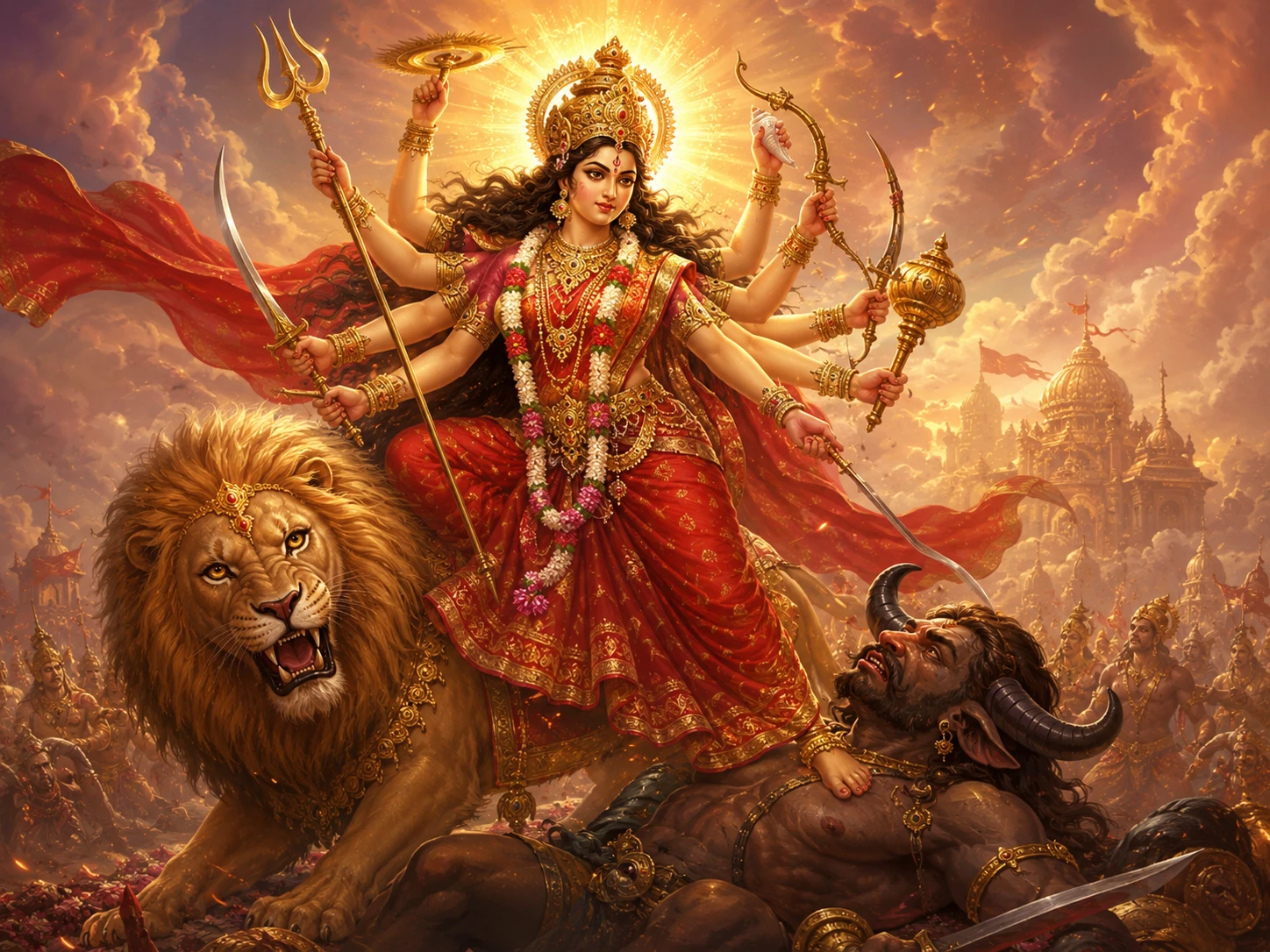
Durga -- The Warrior Goddess Who Cannot Be Defeated
दुर्गा -- अपराजित योद्धा देवी
The most important battle in Hindu mythology was not won by Vishnu, Shiva, Brahma, or Indra. It was won by a goddess who did not exist until the moment she was needed.
The Devi Mahatmya -- the 700-verse text embedded within the Markandeya Purana, also known as the Durga Saptashati or Chandi Path -- tells the story of Mahishasura, a demon who obtained a boon from Brahma that he could not be killed by any god or man. Armed with this immunity, Mahishasura conquered heaven, drove out the gods, and established himself as the ruler of the three worlds. The gods, humiliated and exiled, gathered before Vishnu and Shiva. Their collective rage and divine energy (tejas) blazed from their bodies and merged into a single, blinding mass of light. From that light, a woman emerged -- more powerful than any of them.
This is not a peripheral myth. This is the origin story of Durga, and its theological implications are extraordinary. The text is saying: the combined power of every male deity in the pantheon was insufficient to defeat evil. Only when that power was reconstituted as feminine -- as Shakti, as the Goddess -- did it become effective. This is not feminism grafted onto ancient myth after the fact. This is the core narrative of one of the most important texts in Hinduism, composed roughly between the 5th and 6th centuries CE, chanted by millions during every Navaratri.
For the girl in Kota being told that engineering is for boys. For the woman founder pitching to a room of male VCs on Sand Hill Road. For the female IPS officer walking into a thana where she is the first woman to hold charge. The Devi Mahatmya is not allegory. It is ammunition.
सर्वमङ्गलमाङ्गल्ये शिवे सर्वार्थसाधिके। शरण्ये त्र्यम्बके गौरि नारायणि नमोऽस्तु ते॥
sarvamaṅgalamāṅgalye śive sarvārthasādhike | śaraṇye tryambake gauri nārāyaṇi namo'stu te ||
O auspiciousness of all that is auspicious, O consort of Shiva, O fulfiller of all objectives! O giver of refuge, O three-eyed one, O Gauri -- O Narayani, salutations to you.
— Devi Mahatmya (Durga Saptashati), Chapter 11, Verse 9 -- Markandeya Purana
The creation of Durga, as described in the Devi Mahatmya's second charita, is one of the most cinematically powerful origin sequences in world mythology.
The tejas (blazing divine energy) that emerged from each god was not abstract. The text specifies what each god contributed to form her body. From Shiva's tejas came her face. From Yama's, her hair. From Vishnu's, her arms. From Chandra (the Moon), her breasts. From Indra, her waist. From Varuna, her thighs and calves. From Prithvi (Earth), her hips. From Brahma, her feet. From Surya, her toes. From the Vasus, her fingers. From Kubera, her nose. From Prajapati, her teeth. From Agni, her three eyes.
Then each god gave her a weapon. Shiva drew a trident from his own trident and gave it to her. Vishnu produced a discus from his own discus. Varuna gave her a conch. Agni gave a spear. Vayu gave a bow. Surya filled her quiver with arrows. Indra gave a thunderbolt. Yama gave a staff of death. Kubera gave a mace. Vishwakarma gave a battle-axe and impenetrable armour. And Himalaya -- her father-mountain in her Parvati form -- gave her a lion to ride and a garland of unfading lotuses.
The ocean gave her jewels. The cosmic serpent Shesha gave her a necklace of nagas. She was adorned, weaponed, armoured, and mounted. And then she roared -- a roar so tremendous that the earth shook, the mountains trembled, and the ocean surged. That roar is recreated every year in thousands of Durga Puja pandals when the dhak (drum) first thunders on Shashthi morning.
The construction of Durga from the constituent parts of every god is a radical theological statement about the nature of feminine power. She is not a secondary creation. She is a synthesis -- a being composed of the best attributes of every existing power, assembled into a form more powerful than any of its components. The whole is greater than the sum of its parts. This is not a goddess who was always there; she is a goddess who was made when the situation demanded it. She is emergency divinity. She is the response the universe generates when all standard responses have failed.
The Devi Mahatmya contains three episodes (charitas), each describing a cosmic battle where the Goddess defeats demonic forces that no male deity can overcome.
The First Charita (Chapters 1-4): Madhu-Kaitabha Vadha. The demons Madhu and Kaitabha emerge from Vishnu's earwax while he sleeps on the cosmic ocean. Brahma, unable to wake Vishnu, prays to Yoga Nidra -- the goddess of cosmic sleep who holds Vishnu in her trance. She withdraws, Vishnu wakes and fights the demons for 5,000 years, finally killing them on his thigh (after they grant him a boon that he can kill them wherever there is no water -- and the entire earth is submerged, so Vishnu creates a dry spot on his own thigh). The theological point: even Vishnu's wakening depends on the Goddess's permission.
The Second Charita (Chapters 5-8): Mahishasura Vadha -- the central myth. Mahishasura, the buffalo demon, is immune to all male deities. Durga is created from their combined tejas. Each god contributes a weapon: Shiva's trident, Vishnu's discus, Varuna's conch, Agni's spear, Vayu's bow, Surya's arrows, Indra's thunderbolt, Yama's staff, Kala's sword, Vishwakarma's axe, and Himalaya's lion as her mount. The battle is epic in scale and described in vivid, cinematic detail across four chapters. Mahishasura shapeshifts -- becoming a buffalo, then a lion, then a man with a sword, then an elephant, then a buffalo again -- and Durga defeats each form until, as he transitions between his buffalo and human forms, she pins him with her foot on his neck and drives her trident through his chest.
The image of Durga standing on the buffalo with her trident piercing Mahishasura -- the Mahishasuramardini -- is the most reproduced image in Indian art, present in Durga Puja pandals from Kolkata to Kuala Lumpur, on the walls of Mahabalipuram's rock-cut caves (7th century), on Gupta-era coins (5th century), and in the galleries of the Metropolitan Museum and the British Museum.
The Third Charita (Chapters 9-13): Shumbha-Nishumbha Vadha. Two demon brothers, Shumbha and Nishumbha, conquer heaven with their general Raktabija -- a demon whose blood spawns a new demon wherever a drop falls. In one of the most terrifying scenes in Puranic literature, Kali (an emanation of Durga) drinks Raktabija's blood before it touches the ground, finally making him mortal. Shumbha challenges Durga by saying she fights with others' help and is not really powerful alone. Durga responds by absorbing all the other goddesses (Kali, Brahmani, Vaishnavi, etc.) back into herself and fighting Shumbha one-on-one, killing him. The message: all power is ultimately one, and it is feminine.
Durga's iconography is a weapons catalogue of the entire Hindu divine arsenal, and each element tells a theological story.
The lion (or tiger in some traditions) as her vahana represents fearless dharmic action. Unlike Vishnu's Garuda (speed, cosmic vision) or Shiva's Nandi (patient devotion), Durga's lion is raw, predatory courage -- the willingness to charge directly into the heart of evil. The lion does not strategise. It does not negotiate. It attacks. Durga's theology, unlike the philosophical subtlety of Shiva or the strategic patience of Vishnu, is direct confrontation: some evils cannot be reasoned with; they must be destroyed.
Her multiple arms (eight, ten, or eighteen depending on the tradition) hold weapons gifted by every god -- making her a living synthesis of all divine power. This is theologically significant: she is not separate from the gods but their collective expression. When you worship Durga, you are worshipping the concentrated essence of the entire pantheon.
The Navadurga -- nine forms worshipped over the nine nights of Navaratri -- represent the complete arc of the Goddess's journey, from the innocent mountain girl to the all-destroying cosmic power:
Day 1: Shailaputri (Daughter of the Mountain) -- Parvati in her purest, most innocent form, fresh from the Himalayas. Day 2: Brahmacharini (The Ascetic) -- Parvati performing tapas for Shiva, embodying discipline and renunciation. Day 3: Chandraghanta (Moon-Bell) -- the fierce, battle-ready form with a crescent moon on her forehead. Day 4: Kushmanda (The Cosmic Egg) -- the creator of the universe from her smile. Day 5: Skandamata (Mother of Skanda/Kartikeya) -- the nurturing mother. Day 6: Katyayani -- the fierce warrior form born to sage Katyayana, ready for battle against Mahishasura. Day 7: Kalaratri (Dark Night) -- the most terrifying form, black as night, destroyer of all darkness. Day 8: Mahagauri (The Great White One) -- the form attained after tapas, radiantly pure. Day 9: Siddhidatri (Giver of Perfections) -- the ultimate form, bestowing all eight siddhis.
The progression is not random. It traces the spiritual journey from innocence (Shailaputri) through discipline (Brahmacharini) through battle (Katyayani, Kalaratri) to ultimate achievement (Siddhidatri). The nine days of Navaratri are, in effect, a nine-step sadhana -- a guided spiritual practice compressed into a festival.
The Three Charitas of the Devi Mahatmya -- Three Cosmic Battles
| Charita | Chapters | Demon(s) | Goddess Form | Cosmic Function | Guna Overcome |
|---|---|---|---|---|---|
| First (Prathama) | 1-4 | Madhu and Kaitabha | Yoga Nidra / Maha Maya | Goddess withdraws sleep from Vishnu, enabling his awakening | Tamas (cosmic inertia and delusion) |
| Second (Madhyama) | 5-8 | Mahishasura | Durga / Mahishasuramardini | Created from combined tejas of all gods, rides lion into battle | Rajas (demonic desire, ambition, tyranny) |
| Third (Uttama) | 9-13 | Shumbha, Nishumbha, Raktabija | Chandika / Kali / Ambika | Emanates Kali and Matrikas, absorbs all back, fights alone | Sattva (pride in spiritual purity, the subtlest trap) |
The three charitas map onto the three gunas -- the three fundamental qualities of Prakriti (Nature) that bind all beings. Defeating Tamas (inertia), Rajas (passion), and finally Sattva (spiritual ego) represents the complete liberation of the soul. The Devi Mahatmya is not just a war story; it is a map of spiritual evolution.
Durga Puja in Bengal is not merely a religious festival. It is the single most important cultural event in the Bengali calendar -- a five-day explosion of art, devotion, community, and controlled chaos that transforms Kolkata into the world's largest open-air art gallery every autumn.
The festival spans Shashthi (Day 6 of Navaratri) to Dashami (Vijayadashami, Day 10). Thousands of pandals (temporary structures) are erected across Kolkata, each competing to be the most artistically innovative. The themes range from traditional (a pandal replicating a Rajasthani haveli or a Mysore palace) to avant-garde (pandals made entirely of recycled waste, or designed to look like a COVID vaccination centre, or modelled after the Sistine Chapel). The artistic innovation is staggering -- major contemporary artists participate, and the pandal-hopping circuit has become a UNESCO-recognised cultural practice (Durga Puja was inscribed on UNESCO's Representative List of Intangible Cultural Heritage in 2021).
But behind the art and spectacle is a theological structure of profound depth. The Puja follows a precise ritual calendar: Mahalaya (the invocation, when Durga is called from her mythological sleep); Shashthi (the unveiling of the deity's face); Saptami, Ashtami, Navami (three days of worship corresponding to the three charitas of the Devi Mahatmya); and Dashami (the immersion, when the clay murti is dissolved in the Hooghly River, symbolising Durga's return to Kailash).
The immersion (visarjan) on Dashami is one of the most emotionally charged moments in Indian religious life. Married women apply sindoor (vermillion) to the goddess's murti and then to each other, in the sindoor khela ceremony. Drums thunder. Conch shells blow. And then the murti -- weeks of artisan labour, days of worship, the focus of millions of prayers -- is carried to the river and submerged. It dissolves. The goddess returns to the cosmos.
The theological message is brutal and beautiful: nothing is permanent. Not wealth, not power, not even the physical form of the divine. Every year, the goddess is made, worshipped, loved, and released. The attachment must be let go. This annual practice of creation, devotion, and release is one of the most powerful embodied teachings in any world religion -- and it happens every October in a city of fourteen million people.
Outside Bengal, Navaratri is celebrated with equal intensity but different forms. In Gujarat, Garba and Dandiya Raas -- circular dances performed around an earthen lamp symbolising the Goddess -- involve millions of participants nightly for nine nights. In Karnataka, the Mysuru Dasara (Dussehra) is a ten-day state festival featuring a procession of the palace elephant carrying the golden howdah. In Himachal Pradesh, the Kullu Dussehra is famous for bringing local deities from across the valley in palanquins. Each regional expression is different; the theological core -- the worship of Shakti, the celebration of the feminine divine, the triumph of good over evil -- is the same.
या देवी सर्वभूतेषु बुद्धिरूपेण संस्थिता। नमस्तस्यै नमस्तस्यै नमस्तस्यै नमो नमः॥
yā devī sarvabhūteṣu buddhirūpeṇa saṃsthitā | namastasyai namastasyai namastasyai namo namaḥ ||
To that Devi who abides in all beings in the form of Buddhi (intelligence, discernment) -- salutations to her, salutations to her, salutations to her, again and again.
— Devi Mahatmya (Durga Saptashati), Chapter 5, Verse 14 -- Markandeya Purana
Durga's relevance in contemporary India extends well beyond the pandal and the prayer room. She has become a cultural shorthand for feminine strength, institutional power, and national identity.
The Indian defence forces invoke Durga routinely. 'Jai Mata Di' is a battle cry used across the Indian Army, and units named after the goddess or her attributes are common. INS Vikramaditya, India's aircraft carrier, carries a crest featuring a trident -- Durga's signature weapon. The BSF (Border Security Force) conducts shastra puja (weapon worship) during Navaratri, placing rifles, machine guns, and armoured vehicles at Durga's feet -- a direct continuation of the Vedic tradition of Ayudha Puja. When Nirmala Sitharaman became India's first full-time female Defence Minister in 2017, editorial cartoonists across the country drew her as Durga -- astride a lion, weapons in hand. The metaphor required no explanation.
In cinema, Durga is the most referenced deity. From Satyajit Ray's Pather Panchali (1955) -- where the character Durga dies during Durga Puja, a devastating narrative irony -- to the annual flood of Navaratri-themed Bollywood and Tollywood releases, the Goddess is an inescapable presence. Bengali cinema's relationship with Durga Puja is particularly intimate: the festival season is the most important release window, and films like Kahaani (2012) used Durga Puja as both setting and theological framework.
In politics, Durga iconography is deployed across party lines. Mamata Banerjee, the Chief Minister of West Bengal, has been depicted as Durga by both supporters and critics. Indira Gandhi was routinely called 'Durga' after the 1971 war. The image transcends politics because it taps into something deeper than electoral arithmetic -- it taps into a civilisational consensus that feminine power is not an anomaly but a cosmic principle.
The Durga that India worships is not a gentle mother. She is not a passive consort. She is a warrior who was created because the existing power structures -- all male -- failed. She succeeded where gods could not. And every October, three hundred million people celebrate that fact.
For the daughter who is told she is not enough. For the wife who is told to be quiet. For the professional woman who is told to wait her turn. Durga says: there is no turn. There is only the battle. Pick up your trident.
Kolkata's Durga Puja generates an estimated Rs 50,000 crore ($6 billion+) in economic activity annually, making it one of the largest festival economies in the world -- comparable to Brazil's Carnival and Germany's Oktoberfest. The clay used for Durga's murti must traditionally include mitti (earth) from the doorstep of a sex worker's house -- a practice called nishiddho pallis mati that symbolises the goddess's presence in even the most marginalised communities. The Mahishasuramardini relief panel at Mahabalipuram (circa 7th century CE, Pallava dynasty) is considered one of the masterpieces of Indian sculpture and was likely carved during the same period the Devi Mahatmya was gaining widespread popularity. And the Indian Air Force's Sukhoi Su-30MKI fighters that patrol India's borders carry the 'Jai Mata Di' inscription on their fuselages -- making Durga possibly the only deity whose name rides at Mach 2.
The name 'Durga' itself is a theological argument. It derives from the Sanskrit root durg, meaning 'a fort that is difficult to storm' or 'that which is difficult to approach.' The Devi herself is durga -- the impregnable fortress of cosmic protection. But the name also carries a second etymology: dur (difficult) + ga (to go through). Durga is she who enables passage through the most difficult circumstances. She is not a comfortable deity. She is the deity you need when comfort has failed.
The Durga Saptashati (another name for the Devi Mahatmya) is the most ritually important text in Shakta worship. It is not merely read -- it is performed. A complete parayana (ritual recitation) of the 700 verses takes approximately 3-4 hours and is conducted according to strict rules: the text must be recited in sequence, without skipping verses; specific mantras (kavacham, argala, and kilaka) must be chanted before and after; and the reciter must maintain physical and mental purity. During Navaratri, professional reciters (often Brahmin pundits who have memorised the entire text) perform the Saptashati in homes, temples, and pandals across India. In many families, the grandmother's copy of the Durga Saptashati -- dog-eared, turmeric-stained, held together with rubber bands -- is the most sacred object in the house.
The text's ritual power is believed to be extraordinary. Each of the 13 chapters is associated with specific benefits: Chapter 1 for removal of obstacles, Chapter 4 for victory over enemies, Chapter 11 for fulfillment of desires, and the complete text for moksha. This is not a casual reading recommendation -- it is a structured sadhana with a two-thousand-year pedigree.
The philosophical depth of the Devi Mahatmya is often underestimated because the surface narrative is action-oriented. But embedded within the battle stories is a complete metaphysics of evil. Mahishasura is not merely a powerful demon; he represents the ego (ahamkara) that usurps the throne of consciousness and rules through brute force. Raktabija -- whose blood spawns copies of himself -- represents vasanas (habitual tendencies) that multiply every time you try to cut them down through mere willpower. Shumbha and Nishumbha represent attachment and aversion (raga-dvesha), the twin demons that control most human behaviour. The Goddess does not merely defeat these demons; she reveals the inner mechanics of how they operate.
This psychological reading of the Devi Mahatmya has been developed extensively by modern commentators, particularly Devadatta Kali (David Nelson) and Swami Satyananda Saraswati. The battle between Durga and Mahishasura is simultaneously the cosmic battle between good and evil, and the internal battle between the soul's aspiration toward liberation and the ego's determination to remain in control. Every time a UPSC aspirant overcomes procrastination to study for one more hour, every time a recovering addict refuses a relapse, every time a grieving person chooses to get out of bed and face the day -- that is the Mahishasura battle being fought in miniature.
Durga does not promise that the battle will be easy. She promises that it is winnable. And she provides the weapons: discipline (from Shiva's trident), discernment (from Vishnu's discus), moral clarity (from Yama's staff), and the ferocious courage of the lion she rides. The weapons are not external -- they are qualities that the devotee must cultivate. The Durga Puja murti, with all its weapons, is ultimately a mirror: look at what you already carry. Now use it.
Recite the Mahishasuramardini Stotram
Recite 'Ayi Giri Nandini' and feel its thundering rhythm -- the Mahishasuramardini Stotram, traditionally attributed to Adi Shankaracharya, celebrating Durga's victory over the buffalo demon. It is on Eternal Raga with its meaning.
Tags
Eternal Raga · शाश्वत राग
Institutional voice — scholarly articles on Sanatan Dharma
Deepen Your Understanding
अपनी समझ और गहरी करें
deities avatars
Parvati -- Shakti, Wife, Mother, and the Woman Who Moved a Mountain God
She is the daughter of the Himalayas who performed tapas so intense that even Shiva -- the god who burned Kamadeva to ash for daring to disturb his meditation -- was compelled to open his eyes. Parvati is Hinduism's most complete feminine archetype: lover, mother, warrior, philosopher, and the literal other half of god.
deities avatars
Kali -- The Fierce Mother Who Devours Time Itself
Black-skinned, wild-haired, wearing a garland of fifty severed heads and a skirt of severed arms, standing on Shiva's chest with her tongue extended in shock -- Kali is the most misunderstood deity in Hinduism and the most theologically radical. She is not a demon. She is not 'dark energy.' She is Time in feminine form, the cosmic mother who destroys everything so that everything can be reborn. Ramakrishna called her 'Ma.' Millions still do.
deities avatars
Mahishasuramardini -- The Slayer of the Buffalo Demon and India's Most Iconic Image of Power
No single image has been reproduced more in Indian art than a goddess standing on a buffalo, trident in hand. From Gupta-era gold coins to Kolkata's 40,000 Durga Puja pandals, Mahishasuramardini -- the Slayer of the Buffalo Demon -- is the defining visual of Hindu civilisation's most radical claim: that the ultimate power in the universe is feminine.
deities avatars
Devi Swaroopa -- Forms of the Goddess
She is Durga on the battlefield and Annapurna in the kitchen. She is Kali at the cremation ground and Lakshmi in the boardroom. She is Saraswati at the university and Parvati in the family. The Hindu Goddess is not one deity with accessories -- she is the entire spectrum of feminine power, from terrifying to tender, from cosmic to domestic. Understanding her forms is understanding the universe itself.
tantra mantra yantra
Dasha Mahavidya -- Ten Wisdom Goddesses Who Map the Entire Universe
One holds her own severed head. Another is an ugly old widow. A third paralyses enemies by seizing their tongues. The Dasha Mahavidya are not comfortable goddesses. They are the ten dimensions of reality that most religions are too afraid to acknowledge -- from transcendent beauty to terrifying destruction, from cosmic abundance to abject poverty. Together, they form the most complete map of feminine divinity ever conceived.
rituals traditions
Durga Puja -- The Ritual System Behind the World's Largest Art Festival
Behind the spectacular pandals and the Instagram-worthy lighting lies a ritual system of extraordinary precision. From the moment the sculptor draws the first line on Mahalaya to the heartbreaking immersion on Dashami, every step of Durga Puja follows a choreography that is part Vedic ritual, part Tantric sadhana, and part Bengali genius. UNESCO recognised it in 2021. Here is what they recognised.
scriptural exegesis
Devi Mahatmya -- The Three Charitas That Changed How India Worships the Feminine
700 verses. 13 chapters. Three battles. One thesis: when every god in the universe has failed, a woman finishes the job. The Devi Mahatmya from the Markandeya Purana is not just a scripture -- it is the founding document of Shakta theology and the reason 300 million people celebrate Navaratri.
Kolkata's Durga Puja generates an estimated Rs 50,000 crore ($6 billion+) in economic activity annually, making it one of the largest festival economies in the world -- comparable to Brazil's Carnival and Germany's Oktob…
More in Deities & Avatars
33 Koti Devata -- Why Hinduism Has 33 Types of Gods, Not 33 Crore
13 min read
Agni -- The Fire God
19 min read
Annapurna -- Goddess of Food
19 min readThe same translation error that turned '33 Koti' into '33 crore' in Hinduism also happened in Buddhism. The Chinese translation of Buddhist texts rendered 'Sapta Koti Buddha' (7 Supreme Buddhas) as '7 Crore Buddhas.' The…
Deities AvatarsCommunity Reflections
🕉️
Be the first to share your reflection.
Related across Eternal Raga