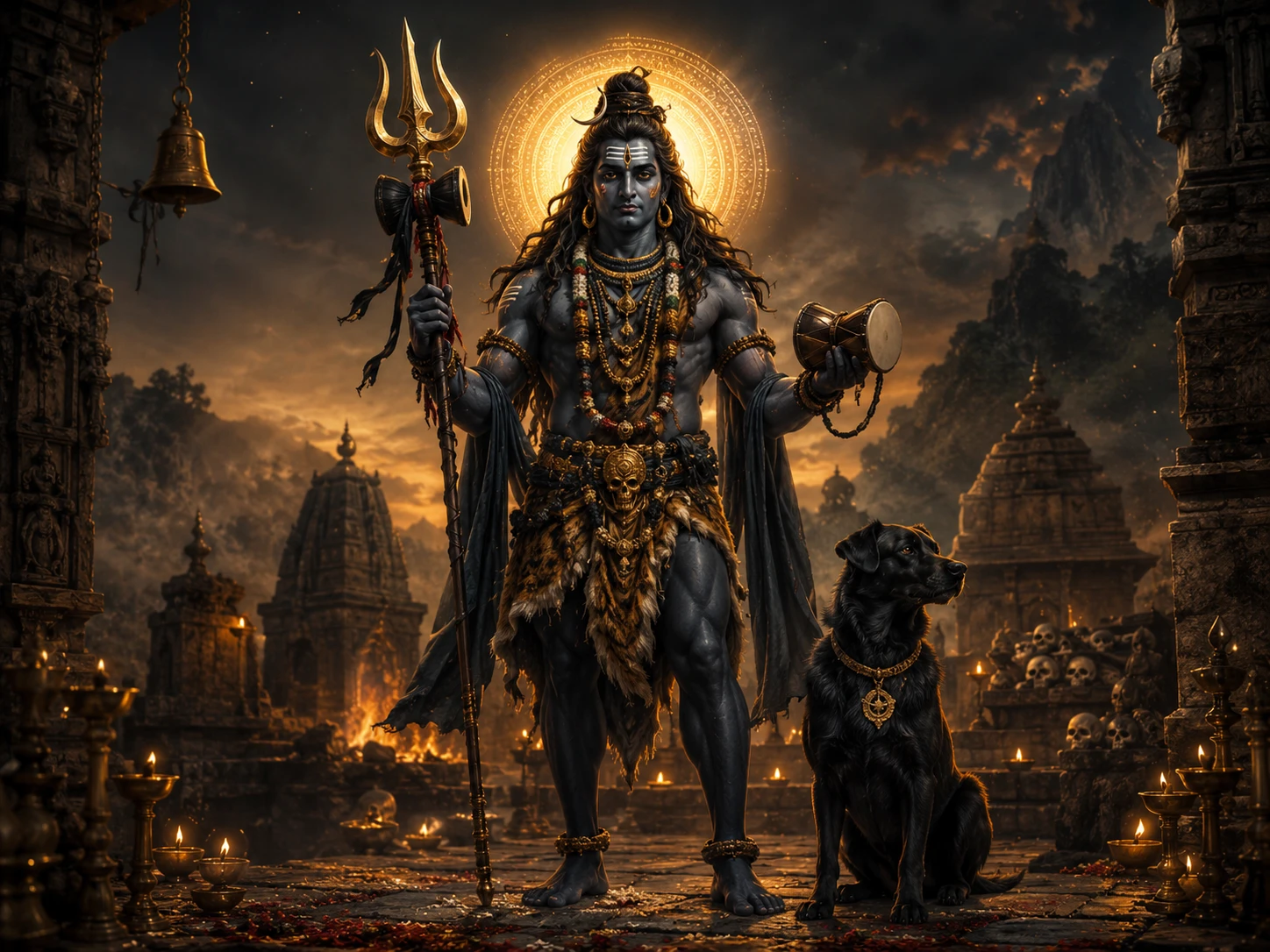
Bhairava -- Shiva's Fierce Form and the Guardian of Kashi
भैरव -- शिव का उग्र रूप और काशी के प्रहरी
'भैरव' नाम 'भीरु' -- भय -- मूल से आता है। किन्तु अर्थ उलटा है। भैरव का अर्थ 'भयंकर' नहीं। अर्थ है 'जो भय को नष्ट करे' या 'जिससे स्वयं भय भागे।' शिव पुराण तीन अक्षरों से नाम व्युत्पन्न करता है: 'भ' भरण (पालन) से, 'र' रवण (विलय) से, 'व' वमन (सृजन) से। भैरव, केवल नाम से, ब्रह्माण्ड का पूर्ण चक्र समेटता है।
हर हिन्दू परम्परा में उग्र देवता है। विष्णु का नरसिंह। देवी की काली। शिव का उग्र रूप भैरव -- और वे तीनों में सम्भवतः सबसे जटिल। क्योंकि भैरव केवल उग्र नहीं। उग्र और प्रायश्चित्ती दोनों। उन्होंने वह कृत्य किया जो वैदिक ब्रह्माण्ड सबसे गम्भीर पाप मानता है -- ब्रह्महत्या (ब्रह्मा का पाँचवाँ शिर काटना) -- और फिर उस पाप को प्रायश्चित्त यात्रा में रूपान्तरित किया जिसने हिन्दू धर्म की सबसे पवित्र तीर्थ प्रथाओं में से एक रची।
यह शिव का वह रूप है जो सान्त्वना नहीं देता। सामना कराता है। यदि दक्षिणामूर्ति वटवृक्ष के नीचे गुरु है (मौन, धैर्य, ज्ञान), भैरव श्मशान का गुरु है (तात्कालिकता, नश्वरता, कहीं छिपना नहीं)। ढोंग छीन लेता है। उनकी प्रतिमाविधि -- खोपड़ी, चिताभस्म, श्वान, मध्यरात्रि, मद्य -- 'शुद्ध' और 'अशुद्ध' के बीच हर सामाजिक सीमा तोड़ने हेतु रचित है। भैरव की उपस्थिति में श्रेणियाँ ढह जाती हैं। केवल चैतन्य शेष। नग्न, अनलंकृत, भस्मलिप्त चैतन्य।
उत्पत्ति: शिव ने ब्रह्मा का पाँचवाँ शिर क्यों काटा
शिव पुराण, लिंग पुराण और स्कन्द पुराण सभी उत्पत्ति कथा बताते हैं। ब्रह्मा के मूलतः पाँच शिर थे। अपने पाँचवें शिर (ऊपर की ओर) से उन्होंने शिव के समान -- या श्रेष्ठ -- होने का दावा करना आरम्भ किया। कुछ संस्करण कहते हैं कि उन्होंने अपमानजनक शब्द कहे। अन्य कहते हैं कि उन्होंने अपनी ही सृष्टि सन्ध्या (गोधूलि देवी) के प्रति कामना की। पाँचवाँ शिर अनियन्त्रित अहंकार था।
शिव ने इस ब्रह्माण्डीय अहंकार नष्ट करने हेतु भैरव रूप धारण किया और बाएँ अँगूठे के नख से ब्रह्मा का पाँचवाँ शिर काट दिया। कटा शिर भैरव की हथेली से चिपक गया -- कपाल (खोपड़ी पात्र) बनकर जो उनकी हस्ताक्षरी प्रतिमाविधि विशेषता है।
किन्तु कृत्य के परिणाम थे। ब्राह्मण का शिर काटना ब्रह्महत्या -- वैदिक धर्म का सबसे गम्भीर पाप। शिव भी अपवाद नहीं। खोपड़ी हाथ से जुड़ गई, गिरती नहीं। भैरव कापालिक (खोपड़ी-वाहक) के रूप में तीनों लोकों में भटके, खोपड़ी पात्र में भिक्षा माँगते। यह भटकता प्रायश्चित्त 'भिक्षाटन' कहलाता है -- दिव्य भिखारी शिव, निम्नतम सामाजिक स्थिति में, स्थान-स्थान भटकते उस एक स्थान की खोज में जहाँ खोपड़ी गिरे और पाप नष्ट हो।
वह स्थान काशी था -- वाराणसी। जिस क्षण भैरव काशी की पवित्र सीमा में प्रविष्ट हुए, खोपड़ी हाथ से गिर गई। पाप नष्ट हुआ। जहाँ खोपड़ी गिरी वह कपालमोचन तीर्थ कहलाता है, और आज भी तीर्थयात्री दर्शन करते हैं।
शिक्षा असाधारण है: परम प्रभु भी, जब धर्म के ढाँचे में कार्य करते हैं, अपने कृत्यों के परिणाम स्वीकार करते हैं। शिव ने दण्ड से बचने को सर्वशक्तिमत्ता प्रयोग नहीं की। प्रायश्चित्त का पूरा मार्ग चले। किसी UPSC अभ्यर्थी के लिए जो 'विधि का शासन' सिद्धान्त पढ़ रहा -- कि कोई कानून से ऊपर नहीं -- शिव पुराण की यह कथा पौराणिक आधार है: महादेव ने भी ब्रह्महत्या का मूल्य चुकाया।
देवराजसेव्यमानपावनाङ्घ्रिपङ्कजं व्यालयज्ञसूत्रमिन्दुशेखरं कृपाकरम्। नारदादियोगिवृन्दवन्दितं दिगम्बरं काशिकापुराधिनाथकालभैरवं भजे॥
devaraajasevyamaanapaavanaa~Nghri pa~Nkajam vyaalayaj~nasuutram indushekharam kR^ipaakaraam | naaradaadiyogivR^indavanditam digambaram kaashikaapuraadhiNaatha kaalabhairavam bhaje ||
मैं काशिकापुर के अधिनाथ काल भैरव की पूजा करता हूँ, जिनके पावन चरणकमलों की देवराज इन्द्र सेवा करते हैं, जो सर्प को यज्ञोपवीत और चन्द्रमा को शिरोभूषण धारते हैं, जो कृपा के सागर हैं, जिन्हें नारद आदि योगी वृन्द वन्दन करते हैं, जो दिगम्बर हैं।
— Kala Bhairava Ashtakam, Verse 1 (composed by Adi Shankaracharya)
अष्ट भैरव -- आठ उग्र रूप
| Bhairava | Attribute | Direction | Shakti (Consort) | Function |
|---|---|---|---|---|
| Asitanga Bhairava | Dark-limbed | East | Brahmani | Protector. Guards the Eastern quarter. Removes obstacles born of ignorance. |
| Ruru Bhairava | Dog-form / Ferocious | South-East | Maheshwari | Destroyer of evil tendencies. Invoked to eliminate mental impurities. |
| Chanda Bhairava | Fierce / Violent | South | Kaumari | Punisher of the wicked. Enforcer of cosmic justice. |
| Krodha Bhairava | Wrathful | South-West | Vaishnavi | Destroys anger in the devotee by absorbing it. Paradox: the wrathful one who removes wrath. |
| Unmatta Bhairava | Intoxicated / Ecstatic | West | Varahi | Dissolution of ego through divine madness. The sacred fool. Associated with Tantric left-hand paths. |
| Kapala Bhairava | Skull-bearer | North-West | Indrani / Aindri | Bearer of the Brahmahatya skull. Teaches that sin carried consciously becomes tapas. |
| Bhishana Bhairava | Terror-inducing | North | Chamunda | Destroys fear by embodying it completely. Face your terror and it dissolves. |
| Samhara Bhairava | Annihilator | North-East | Chandika | Total dissolution. Death of the ego-self. The final Bhairava before liberation. |
अष्ट भैरव सम्पूर्ण मण्डल रचते हैं -- आठ रूप आठ दिशाओं की रक्षा करते, प्रत्येक एक शक्ति से युग्मित, प्रत्येक एक विशिष्ट आध्यात्मिक बाधा सम्बोधित करता। कश्मीर शैवमत में भैरव शिव का केवल एक रूप नहीं -- वे परम सत्य (परब्रह्म) की सबसे प्रत्यक्ष, अमध्यस्थ अभिव्यक्ति हैं।
काल भैरव: काशी के कोतवाल
वाराणसी में भैरव मन्दिर के कोने में कोई गौण देवता नहीं। वे कोतवाल हैं -- नगर के प्रहरी, इसके आध्यात्मिक पुलिस प्रमुख। काल भैरव मन्दिर, विश्वनाथ गली (काशी विश्वनाथ मन्दिर की ओर जाने वाली गली) पर स्थित, नगर के सबसे अधिक दर्शित तीर्थों में से एक। परम्परा मानती है कि काशी में मरने वाला मोक्ष प्राप्त करता है, और काल भैरव इसका प्रशासन करते हैं -- मरणासन्न के कान में तारक मन्त्र (मुक्तिदायक मन्त्र) फुसफुसाते हैं।
वाराणसी आने वाले तीर्थयात्रियों को परम्परागत रूप से नगर छोड़ने से पहले काल भैरव दर्शन की सलाह दी जाती है। विश्वास: भैरव की अनुमति बिना जाओ तो काशी जाने नहीं देगी -- कोई बाधा, विलम्ब, या परिस्थिति रोक लेगी।
काल भैरव पूजा की सबसे विलक्षण विशेषता मदिरा (शराब) का अर्पण है। अधिकांश हिन्दू मन्दिरों में मद्य सख्त वर्जित। काल भैरव मन्दिर में यही प्राथमिक भोग। भक्त सीधे मूर्ति पर मदिरा डालते हैं। यह विपथन नहीं। तान्त्रिक सिद्धान्त है: भैरव शुद्ध/अशुद्ध द्वन्द्व से परे हैं। जो सामान्य पूजा को विष है वह उसे अमृत है जिसने सभी श्रेणियाँ जीत लीं।
श्वान भैरव का वाहन और निरन्तर साथी। रूढ़िवादी ब्राह्मणिक परम्परा में श्वान अशुद्ध माने जाते हैं। भैरव एक पर सवार होते हैं। वे मुख्यधारा से बाहर रहने वालों के देवता हैं -- तपस्वी, अघोरी, नाथ योगी, कापालिक, भटकने वाले, और जो कभी अनुभव करता कि सम्मानित समाज की सुव्यवस्थित श्रेणियाँ उसे नहीं समेटतीं। कोटा कोचिंग क्लास की पिछली पंक्ति के अकेले विद्यार्थी के लिए, परिवार के साँचे में न फिट होने वाले क्वीयर विद्यार्थी के लिए, ड्रॉप आउट होकर किराये के कमरे से काम करने वाले स्टार्टअप संस्थापक के लिए -- भैरव दिव्य कथन है कि हाशिया भी पवित्र भूमि है।
आदि शंकराचार्य -- वही दार्शनिक जिन्होंने चार मठ स्थापित किए, अद्वैत वेदान्त व्यवस्थित किया, और सामान्यतः हिन्दू चिन्तन की सबसे बौद्धिक रूप से परिष्कृत धारा से जुड़े हैं -- ने काल भैरव अष्टकम् रचा, काशी के प्रहरी के प्रति प्रचण्ड भक्ति का आठ-श्लोकी स्तोत्र। वही शंकराचार्य जिन्होंने शान्त निर्वाण षटकम् ('चिदानन्दरूपः शिवोऽहं शिवोऽहम्') भी रचा। विस्तार ही बात है। जिसने संस्कृत का सबसे शान्त दार्शनिक कथन लिखा, उसी ने शिव के सबसे भयंकर रूप का उन्मत्त स्तोत्र भी लिखा।
कश्मीर शैवमत -- हिन्दू दर्शन के सबसे दार्शनिक रूप से परिष्कृत विद्यालयों में से एक, अभिनवगुप्त (10वीं-11वीं शताब्दी) द्वारा विकसित -- में भैरव शिव का 'रूप' नहीं। वे स्वयं परम सत्य हैं। परम्परा का मूलभूत ग्रन्थ भैरव तन्त्र (विज्ञानभैरव तन्त्र भी कहा जाता है) 112 ध्यान विधियाँ (धारणाएँ) प्रस्तुत करता है जो भैरव अपनी शक्ति को सिखाते हैं। ग्रन्थ शक्ति के प्रश्न से खुलता है: 'तुम्हारा वास्तविक स्वभाव क्या है, हे भैरव?' 112 विधियाँ उत्तर हैं -- प्रत्येक परम चैतन्य के प्रत्यक्ष अनुभव का द्वार। इस ग्रन्थ ने न केवल हिन्दू ध्यान बल्कि विश्व भर में आधुनिक माइण्डफुलनेस और जागरूकता-आधारित साधनाओं को भी प्रभावित किया। कई विधियाँ (श्वास की जागरूकता, विचारों के बीच रिक्त स्थान की जागरूकता) 20वीं शताब्दी में पश्चिमी मनोविज्ञान द्वारा स्वतन्त्र रूप से 'खोजी' गईं।
काल भैरव अष्टकम् जपें
शंकराचार्य के आठ श्लोक। काशी के रक्षक। उनके रक्षक जिनके पास जाने को और कोई स्थान नहीं। शनिवार की सन्ध्या को -- भैरव का पवित्र समय -- इसका पाठ करो और भय को घुलते अनुभव करो।
Tags
Eternal Raga · शाश्वत राग
Institutional voice — scholarly articles on Sanatan Dharma
अपनी समझ गहरी करें
अपनी समझ और गहरी करें
deities avatars
Who is Shiva?
He is the ash-smeared ascetic who is also the ideal husband. The destroyer of the universe who is called 'The Auspicious One.' The god of death who drank poison to save all life. He sits in meditation on a Himalayan peak, and simultaneously dances the cosmos into existence and annihilation. No deity in Hinduism contains more contradictions -- and no deity resolves them more completely. This is not a mythology explainer. This is an attempt to stand at the foot of the mountain and look up.
deities avatars
Nine Forms of Shiva -- The Many Faces of Mahadeva
He is the silent teacher under a banyan tree and the screaming destroyer on a battlefield. He is half-woman and half-man. He drank the poison that would have ended the universe and his throat turned blue. Nine scripturally-attested forms of Shiva -- from Nataraja to Rudra -- and why each one exists.
deities avatars
Nataraja -- The Cosmic Dancer
One foot crushes a dwarf. The other is raised in liberation. A ring of fire frames the dance. A drum beats creation into existence. An open palm says 'do not fear.' This is Nataraja -- Shiva as the Lord of Dance -- and it is the single most replicated Indian bronze in the history of art. The physicists at CERN chose it to stand outside the world's largest particle accelerator. The Chola bronzesmiths of Tamil Nadu perfected it a thousand years ago. And every time a subatomic particle appears and disappears, the cosmic dance continues.
deities avatars
Kali -- The Fierce Mother Who Devours Time Itself
Black-skinned, wild-haired, wearing a garland of fifty severed heads and a skirt of severed arms, standing on Shiva's chest with her tongue extended in shock -- Kali is the most misunderstood deity in Hinduism and the most theologically radical. She is not a demon. She is not 'dark energy.' She is Time in feminine form, the cosmic mother who destroys everything so that everything can be reborn. Ramakrishna called her 'Ma.' Millions still do.
philosophy darshana
Kashmir Shaivism -- The Philosophy of Divine Recognition
What if liberation is not about gaining something new but recognising what you already are? Kashmir Shaivism says you are already Shiva -- infinite, free, blissful consciousness. You have simply forgotten. The entire universe is Shiva's dance of self-concealment and self-recognition. Your job is to remember.
tantra mantra yantra
Tantra, Mantra and Yantra -- The Three Pillars of Spiritual Practice
Tantra is the loom, Mantra is the thread, Yantra is the pattern. Together they form the complete technology of spiritual transformation that India gifted to the world -- and they are far more profound than popular culture imagines.
tantra mantra yantra
Dasha Mahavidya -- Ten Wisdom Goddesses Who Map the Entire Universe
One holds her own severed head. Another is an ugly old widow. A third paralyses enemies by seizing their tongues. The Dasha Mahavidya are not comfortable goddesses. They are the ten dimensions of reality that most religions are too afraid to acknowledge -- from transcendent beauty to terrifying destruction, from cosmic abundance to abject poverty. Together, they form the most complete map of feminine divinity ever conceived.
आदि शंकराचार्य -- वही दार्शनिक जिन्होंने चार मठ स्थापित किए, अद्वैत वेदान्त व्यवस्थित किया, और सामान्यतः हिन्दू चिन्तन की सबसे बौद्धिक रूप से परिष्कृत धारा से जुड़े हैं -- ने काल भैरव अष्टकम् रचा, काशी के प्रहरी के प्रति…
More in Deities & Avatars
33 Koti Devata -- Why Hinduism Has 33 Types of Gods, Not 33 Crore
13 मिनट पढ़ें
Agni -- The Fire God
19 मिनट पढ़ें
Annapurna -- Goddess of Food
19 मिनट पढ़ेंवही अनुवाद त्रुटि जिसने हिन्दू धर्म में '33 कोटि' को '33 करोड़' बनाया, बौद्ध धर्म में भी हुई। बौद्ध ग्रन्थों के चीनी अनुवाद ने 'सप्त कोटि बुद्ध' (7 श्रेष्ठ बुद्ध) का अनुवाद '7 करोड़ बुद्ध' कर दिया। तिब्बती अनुवाद ने सही …
Deities AvatarsCommunity Reflections
🕉️
Be the first to share your reflection.