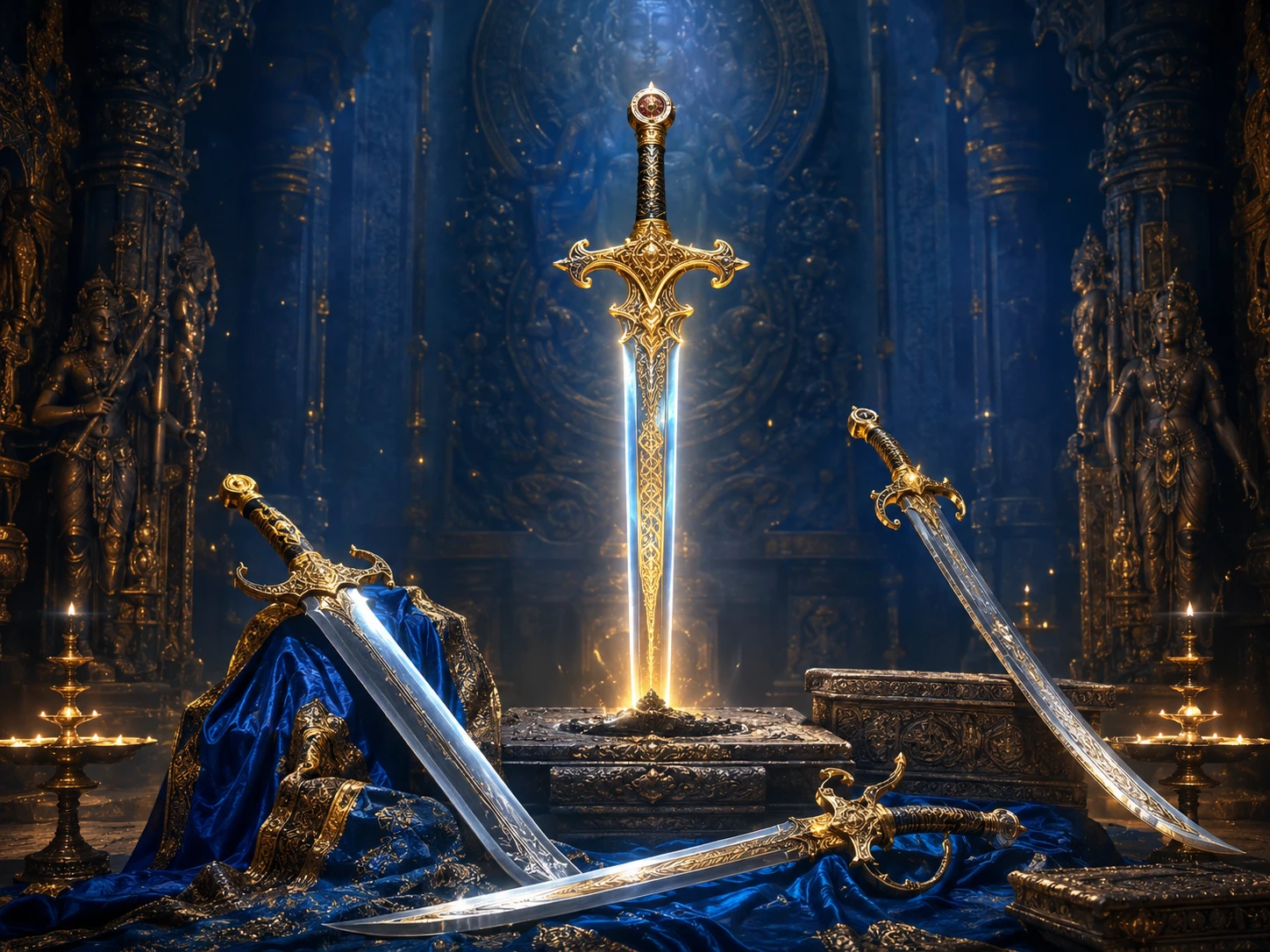
The Sacred Swords -- Chandrahasa, Nandaka, Asi, and the Wootz Steel Legacy
पवित्र खड्ग -- चन्द्रहास, नन्दक, असि, और वूट्ज़ इस्पात की विरासत
हिन्दू पौराणिक कथाओं में खड्ग एक ऐसा दार्शनिक स्थान रखती है जो किसी अन्य शस्त्र का नहीं। यह विवेक का शस्त्र है -- भ्रम को काटकर सत्य को असत्य से एक स्वच्छ प्रहार में पृथक करने की क्षमता। यही कारण है कि देवी दुर्गा अपने आठ हाथों में से एक में खड्ग धारण करती हैं: स्थूल हिंसा के लिए नहीं, बल्कि उस प्रज्ञा की शल्य-सटीकता के लिए जो बन्धन काटती है।
पर पौराणिक कथाओं की खड्गें एक अतिरिक्त परत भी रखती हैं: वे सीधे भारत की सबसे उल्लेखनीय वास्तविक उपलब्धियों में से एक से जुड़ती हैं -- वूट्ज़ इस्पात, वह क्रूसिबल स्टील प्रौद्योगिकी जो प्राचीन भारत ने विश्व को निर्यात की, और जो मध्ययुग का किंवदन्ती दमिश्क इस्पात बनी।
हिन्दू पौराणिक कथाओं की पवित्र खड्गें
| Sword | खड्ग | Bearer | Origin | Power & Symbolism | Defining Moment |
|---|---|---|---|---|---|
| Asi | असि | First wielded by Rudra, then passed through lineages | Created by Brahma from a sacrifice (Ashvamedha). Asi is described in Shanti Parva as a living being -- born from fire, with the form of a dark, blazing blade. | The FIRST sword ever created. Not forged by a smith but born from Vedic ritual fire. Represents the primordial act of cutting -- the first separation of order from chaos. | Brahma created Asi when demons threatened the cosmic order. The Shanti Parva dedicates an entire sub-chapter to Asi's genealogy -- it was passed from Rudra to Vishnu to Marichi to successive kings, making it the world's oldest recorded 'chain of custody' for a weapon. |
| Chandrahasa | चन्द्रहास | Ravana | Gifted to Ravana by Lord Shiva himself after Ravana's extreme tapasya. Name means 'laughter of the moon' -- referring to its crescent-shaped blade. | Infallible in Ravana's hands. The blade was said to flash like moonlight when swung, leaving a crescent arc in the air. Could cut through any material or armour. | Ravana used Chandrahasa to cut the wings of Jatayu when the vulture-king tried to stop Sita's abduction. This act -- using a Shiva-gifted weapon against a dharmic protector -- marked the beginning of Ravana's karmic downfall. The sword given by God was turned against God's order. |
| Nandaka | नन्दक | Vishnu | Emerged from Samudra Manthan alongside Kaumodaki. One of Vishnu's five eternal weapons (with Sudarshana, Sharanga, Kaumodaki, and Panchajanya). | The sword of joyful wisdom (Nanda = joy). Represents Vidya (knowledge) that cuts through Avidya (ignorance). Symbolises the discriminative power of divine intellect. | Vishnu carries Nandaka in his iconography alongside the Chakra, Shankha, and Gada. In the Vishnu Sahasranama, Nandaka is personified as one of the attendant weapons that serves Vishnu eternally. |
| Nakula's Sword | नकुल की खड्ग | Nakula | Nakula was trained as the finest swordsman among all Mahabharata warriors. His sword had no divine name because his skill WAS the weapon. | Nakula's swordsmanship was said to be flawless -- not a single wasted motion. He combined the grace of Ashwini Kumar heritage with lethal precision. | During the Virata Parva, when the Pandavas lived in disguise, Nakula served as a horse trainer -- but his sword skills surfaced in the cattle raid battle, where he fought with a grace that almost broke his cover. |
| Kalki's Sword | कल्कि की खड्ग | Kalki (future 10th avatar of Vishnu) | Prophecied in Kalki Purana. Kalki will ride a white horse named Devadatta and wield a blazing sword gifted by Shiva. | The sword that will end Kali Yuga and usher in a new Satya Yuga. Represents the final act of cosmic discrimination -- separating the last remnants of adharma from the world. | Has not yet occurred. The prophecy states Kalki will appear when dharma is at its absolute nadir, mounted on the white horse, sword raised -- the eschatological image of Hindu cosmology. |
शान्ति पर्व में असि की वंशावली असाधारण है: ब्रह्मा ने रचा, शिव ने पहले धारण किया, विष्णु ने वहन किया, फिर मरीचि, अंगिरा, उत्तरोत्तर मनुओं, इक्ष्वाकु राजाओं से होते हुए क्षत्रिय वंशों तक पहुँची। यह ब्रह्माण्डीय युगों तक फैला प्रलेखित 'वंशवृक्ष' रखने वाला शस्त्र है।
वूट्ज़ इस्पात -- जब पौराणिक कथा ने धातुकर्म से मिलाप किया
हिन्दू महाकाव्यों में वर्णित खड्गें पूर्णतः पौराणिक नहीं हैं। भारत कम से कम तीसरी शताब्दी ई.पू. से विश्व का सर्वश्रेष्ठ इस्पात -- वूट्ज़ (कन्नड़ और तमिल में उक्कु, यूनानियों के लिए सेरिक आयरन) -- उत्पादित कर रहा था।
वूट्ज़ एक उच्च-कार्बन क्रूसिबल इस्पात था जो सीलबन्द मिट्टी के क्रूसिबलों में 1,500 डिग्री सेल्सियस से अधिक तापमान पर लोहे को कार्बनयुक्त सामग्री के साथ पिघलाकर बनाया जाता था। दमिश्क तलवारें भारतीय वूट्ज़ से बनती थीं जो वर्तमान केरल के मुज़िरि बन्दरगाह से निर्यात होता था।
तमिलनाडु के कोडुमनल और तंजावूर के निकट मेल-सिरुवलुर से प्राप्त पुरातात्विक साक्ष्य कम से कम 300 ई.पू. की क्रूसिबल इस्पात उत्पादन सुविधाएँ दिखाते हैं। IIT कानपुर और जमशेदपुर की राष्ट्रीय धातुकर्म प्रयोगशाला के आधुनिक धातुविदों ने वूट्ज़ मैट्रिक्स में कार्बन नैनोट्यूब संरचनाएँ पाई -- 'नैनोटेक्नोलॉजी' शब्द के अस्तित्व से शताब्दियों पहले अनुभवजन्य परम्परा से प्राप्त नैनो-अभियान्त्रिकी।
जमशेदपुर -- जहाँ 1907 में भारत की इस्पात विरासत पुनर्जीवित करने के लिए टाटा स्टील की स्थापना हुई -- इसी परम्परा पर खड़ा है।
IIT कानपुर और जमशेदपुर की राष्ट्रीय धातुकर्म प्रयोगशाला में प्राचीन वूट्ज़ इस्पात नमूनों के आधुनिक विश्लेषण ने इस्पात मैट्रिक्स में कार्बन नैनोट्यूब संरचनाएँ उजागर की हैं। प्राचीन भारतीय लोहार अपनी क्रूसिबल प्रक्रिया से अनजाने में नैनोमटीरियल उत्पादित कर रहे थे -- ऐसे परिणाम प्राप्त करते हुए जिन्हें आधुनिक पदार्थ विज्ञान ने 21वीं शताब्दी में ही समझा।
अपना विवेक तीक्ष्ण करें -- एकाग्रता से ध्यान करें
खड्ग विवेक का प्रतीक है -- माया को काटने की शक्ति। प्रतिदिन कुछ मिनट के ध्यान से वह भीतरी धार विकसित करो। एटर्नल राग के ध्यान खण्ड में आरम्भ के लिए धारणा और प्राणायाम के अभ्यास हैं।
Eternal Raga · शाश्वत राग
Institutional voice — scholarly articles on Sanatan Dharma
अपनी समझ गहरी करें
अपनी समझ और गहरी करें
divine arsenal
Astra vs Shastra -- The Two Classes of Weapons in Hindu Warfare
One is hurled with mantras and divine invocation. The other is wielded by hand and muscle. Understanding the fundamental difference between Astra and Shastra unlocks the entire weapons philosophy of ancient India.
divine arsenal
The Thundering Mace -- Kaumodaki, Bhima's Gada, and the Art of Gada-Yuddha
The mace is the weapon of raw, unapologetic power. Vishnu carries one, Hanuman wields one, Bhima ended the war with one, and Duryodhana -- the finest mace-fighter alive -- died by one. This is the story of the weapon that decided the Mahabharata's final duel.
deities avatars
Dashavatara -- Why Vishnu Comes Back Ten Times
Fish, tortoise, boar, half-lion, dwarf, axe-warrior, prince, cowherd, enlightened teacher, future horseman. The ten avatars of Vishnu are not random folklore. Read them in sequence and you get something startling -- a narrative that mirrors evolutionary biology, tracks the rise and fall of political systems, and argues that God does not sit above history but enters it, gets dirty, and does the work. The Dashavatara is Hinduism's answer to the question every civilisation asks: why does the world keep breaking, and who fixes it?
vedic sciences
Ancient Indian Metallurgy -- The Iron Pillar That Refuses to Rust
A 7-metre iron pillar has stood in open Delhi air for 1,600 years without rusting. Wootz steel from Tamil Nadu became the legendary Damascus blade. From Vedic kṛṣṇāyas to Vagbhata's bell-metal recipe -- the textual and material evidence of how Bharat worked metal.
deities avatars
Devi Swaroopa -- Forms of the Goddess
She is Durga on the battlefield and Annapurna in the kitchen. She is Kali at the cremation ground and Lakshmi in the boardroom. She is Saraswati at the university and Parvati in the family. The Hindu Goddess is not one deity with accessories -- she is the entire spectrum of feminine power, from terrifying to tender, from cosmic to domestic. Understanding her forms is understanding the universe itself.
IIT कानपुर और जमशेदपुर की राष्ट्रीय धातुकर्म प्रयोगशाला में प्राचीन वूट्ज़ इस्पात नमूनों के आधुनिक विश्लेषण ने इस्पात मैट्रिक्स में कार्बन नैनोट्यूब संरचनाएँ उजागर की हैं। प्राचीन भारतीय लोहार अपनी क्रूसिबल प्रक्रिया से …
More in Divine Arsenal
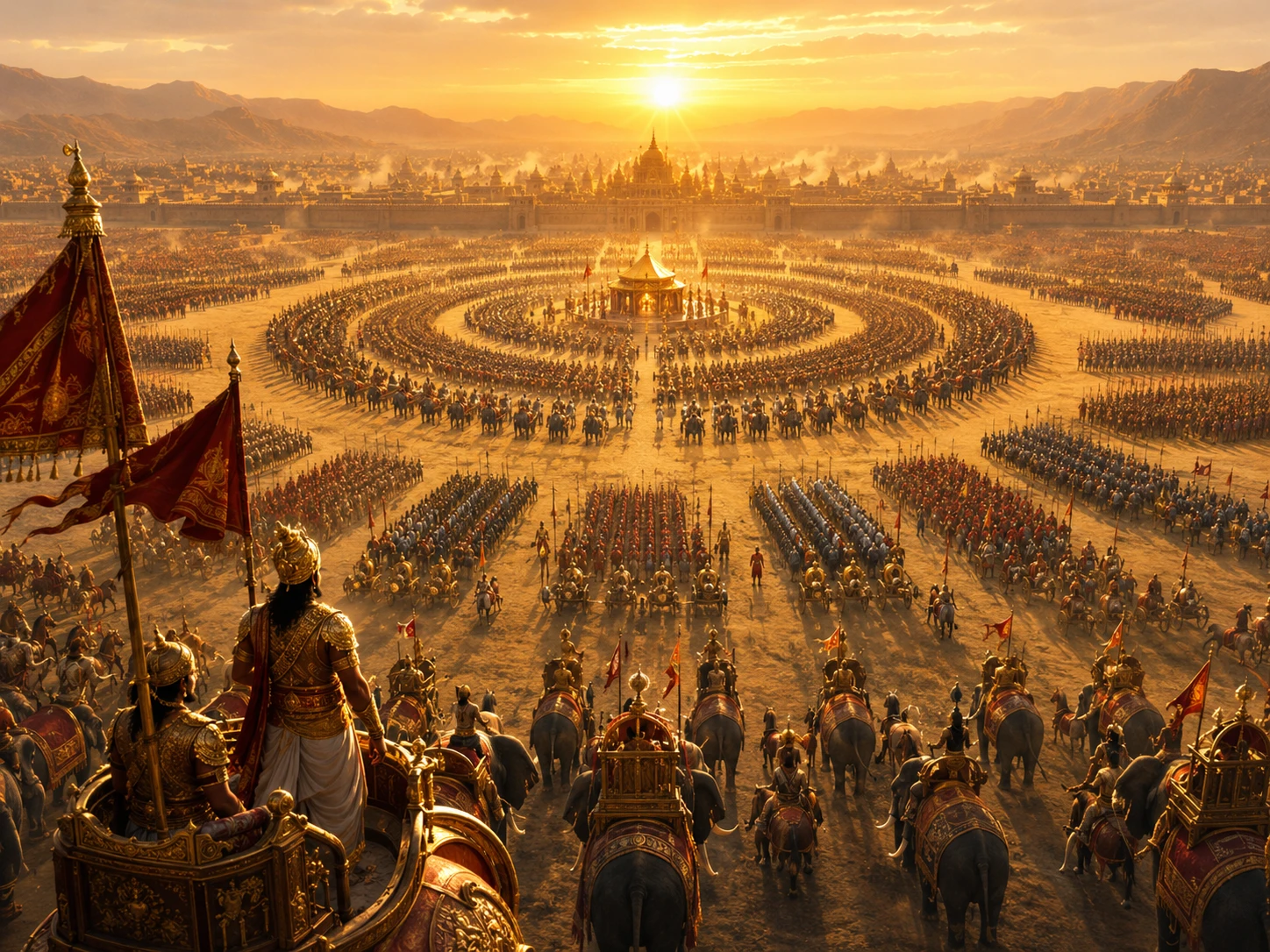
Akshauhini -- The Epic Army Structure Where Every Digit Sums to 18
14 मिनट पढ़ें
Ancient Indian Martial Arts -- Kalaripayattu to Malla-Yuddha
14 मिनट पढ़ें
Astra Invocation and Withdrawal -- The Ritual of Weapons
16 मिनट पढ़ेंवही अनुवाद त्रुटि जिसने हिन्दू धर्म में '33 कोटि' को '33 करोड़' बनाया, बौद्ध धर्म में भी हुई। बौद्ध ग्रन्थों के चीनी अनुवाद ने 'सप्त कोटि बुद्ध' (7 श्रेष्ठ बुद्ध) का अनुवाद '7 करोड़ बुद्ध' कर दिया। तिब्बती अनुवाद ने सही …
Deities AvatarsCommunity Reflections
🕉️
Be the first to share your reflection.