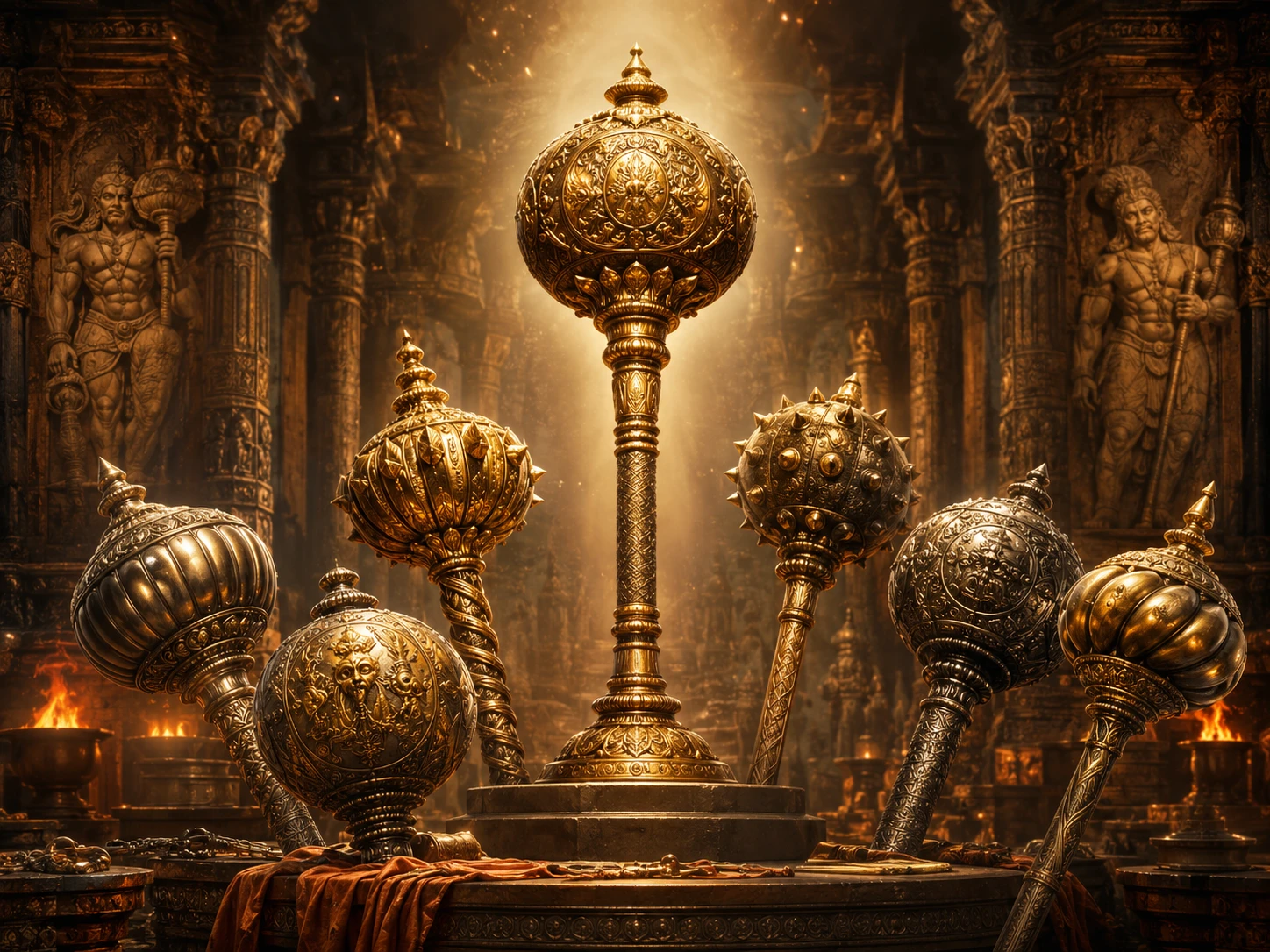
The Thundering Mace -- Kaumodaki, Bhima's Gada, and the Art of Gada-Yuddha
गर्जनशील गदा -- कौमोदकी, भीम की गदा, और गदायुद्ध की कला
हिन्दू युद्ध परम्परा के सभी शस्त्रों में गदा का स्थान अद्वितीय है। इसे न किसी सूक्ष्मता की आवश्यकता, न मांत्रिक आवाहन की, न सक्रिय करने के लिए दिव्य आशीर्वाद की। गदा निर्मम रूप से ईमानदार है: इसकी शक्ति पूर्णतः योद्धा के बल, कौशल और संकल्प से आती है।
यही कारण है कि गदा क्षत्रिय शक्ति का सबसे मौलिक प्रतीक बनी। विष्णु कौमोदकी इसलिए नहीं धारण करते कि यह उनका प्रमुख शस्त्र है, बल्कि एक कथन के रूप में: ब्रह्माण्ड के संरक्षक भी कच्चे बल को दिव्य मानते हैं।
महाभारत का अन्तिम युद्ध -- वह द्वन्द्व जो तकनीकी रूप से अठारह दिनों के युद्ध को समाप्त करता है -- ब्रह्मास्त्र या दिव्य बाणों से नहीं लड़ा जाता। यह गदाओं से लड़ा जाता है, भीम और दुर्योधन के बीच, एक सरोवर में, छाती तक जल में, केवल बल, प्रशिक्षण और तेरह वर्षों के वनवास का संचित क्रोध लिए। पौराणिक कथाओं का सबसे परिष्कृत युद्ध सबसे आदिम शस्त्र से समाप्त होता है।
प्रसिद्ध गदाएँ और उनके धारक
| Mace | गदा | Bearer | Origin / Creator | Power & Significance | Defining Moment |
|---|---|---|---|---|---|
| Kaumodaki | कौमोदकी | Vishnu | Emerged from Samudra Manthan (churning of ocean). One of the 14 divine treasures. | Personified as a goddess (Gadadevi) in some Puranas. Represents the cosmic force of knowledge that destroys ignorance. Never misses when thrown by Vishnu. | Vishnu wields it in every avatar where combat is needed. In the Varaha avatar, he used it to strike Hiranyaksha during the cosmic battle to rescue Earth from the ocean floor. |
| Bhima's Gada | भीम की गदा | Bhima | No single divine origin -- Bhima's gada was an extension of his own colossal strength. Some texts say it was gifted by his father Vayu. | So heavy that no other Pandava could lift it. Bhima could swing it with one hand. The sound of its impact was compared to thunder. | The final duel with Duryodhana at Dvaipayana Lake. Bhima struck Duryodhana's thigh -- violating the rules of mace combat (hitting below the waist) but fulfilling his oath from the dice game. The war's moral complexity crystallised in a single blow. |
| Hanuman's Gada | हनुमान की गदा | Hanuman | Hanuman's gada is less about origin and more about symbolism -- he carries it as a marker of his role as protector and warrior-devotee. | In battle, Hanuman's gada is superfluous -- he can uproot mountains with bare hands. He carries it as a dharmic symbol: even unlimited power must be channeled through the discipline of a weapon. | Used in the Lanka war. But Hanuman's true weapon is his devotion (bhakti) -- the gada is the visible form of his invisible strength. |
| Duryodhana's Gada | दुर्योधन की गदा | Duryodhana | Trained by Balarama himself -- the god of agricultural and martial strength. Duryodhana was considered the finest mace-fighter in the world. | Balarama declared that in a fair mace duel, Duryodhana was superior to Bhima. His technique was flawless, his footwork unmatched. | Lost to Bhima only because Bhima struck below the waist -- a foul in gada-yuddha rules. Balarama was furious and nearly attacked Bhima. The moment asks: can adharmic means serve dharmic ends? |
| Balarama's Gada | बलराम की गदा | Balarama (Krishna's elder brother) | Balarama is the avatar of Shesha Naga and the patron deity of agriculture and strength. His gada represents productive power. | Balarama also carried the plough (hala) as his primary weapon -- unique among warriors. His gada represented martial authority while his plough represented agrarian civilisation. | Refused to fight in the Mahabharata war because his two students (Bhima and Duryodhana) were on opposite sides. His neutrality is one of the most underrated moral positions in the epic. |
| Yamaraja's Gada | यमराज की गदा | Yama (god of death) | Yama's gada is the instrument of cosmic justice. It strikes the soul, not the body. | Cannot be evaded by any being whose time has come. Represents the inevitability of death and the impartiality of dharmic justice. | Yama tested Yudhishthira at the Yaksha Prashna (the riddle episode at the lake). The gada of death yields to the one who answers with truth -- dharma is the only weapon against death. |
भीम-दुर्योधन द्वन्द्व महाभारत का केन्द्रीय प्रश्न उठाता है: जब शत्रु ने तेरह वर्षों तक हर नियम तोड़ा हो, तो क्या धर्मी योद्धा उसे निष्पक्ष लड़ाई का ऋणी है? कृष्ण ने कहा नहीं। बलराम ने कहा हाँ। महाकाव्य निर्णय आप पर छोड़ता है।
गदां कौमोदकीं दिव्यां विष्णोर्बाहुबलैर्धृताम्। नमामि सर्वलोकानां भयनाशनकारिणीम्॥
gadaam kaumodakiim divyaam vishNor baahu-balair dhritaam namaami sarva-lokaanaam bhaya-naashana-kaariNiim
मैं दिव्य कौमोदकी गदा को नमन करता हूँ जो विष्णु की बलशाली भुजाओं में धारित है और समस्त लोकों के भय का नाश करती है।
— Vishnu Sahasranama Bhashya (Shankaracharya's commentary)
गदायुद्ध -- गदा युद्ध की कला
गदायुद्ध प्राचीन भारत की औपचारिक युद्धकलाओं में से एक था, अपने नियमों, तकनीकों और प्रशिक्षण विधि सहित। यह प्रत्येक गुरुकुल में क्षत्रिय विद्यार्थियों को पढ़ाए जाने वाले व्यापक धनुर्विद्या पाठ्यक्रम का अंश था।
नियम विशिष्ट थे: कमर से नीचे प्रहार वर्जित (इसीलिए भीम का जंघा प्रहार विवादास्पद था)। दोनों योद्धाओं को समान भार की गदा प्रयोग करनी होती। बलराम इस कला के सर्वोच्च गुरु माने जाते थे।
आज गदा प्रशिक्षण भारतीय पारम्परिक कुश्ती (कुश्ती) अखाड़ों में जीवित है। कोल्हापुर, वाराणसी या मथुरा के किसी अखाड़े में जाइए और आप पहलवानों को दैनिक व्यायाम में भारी गदाएँ घुमाते देखेंगे -- 5,000 वर्ष पुरानी प्रशिक्षण विधि भारत भर के मिट्टी के अखाड़ों में आज भी जीवित। गदा स्विंग अब विश्वभर में आधुनिक क्रॉसफिट समुदायों द्वारा अपनाया जा रहा है, प्रायः इसकी सनातन जड़ों से अनभिज्ञ।
पारम्परिक गदा स्विंग व्यायाम, जो भारतीय अखाड़ों में सहस्रों वर्षों से प्रचलित है, अब विश्व स्तर पर सबसे तेज़ी से बढ़ते कार्यात्मक फिटनेस आन्दोलनों में से एक है। कैलिफोर्निया से लन्दन तक क्रॉसफिट जिम 'स्टील मेस ट्रेनिंग' सिखाते हैं -- सीधे उन भारी गदा अभ्यासों से उत्पन्न जो कोल्हापुर और वाराणसी के पहलवान हर सुबह करते हैं।
आन्तरिक बल बनाएँ -- हनुमान चालीसा
हनुमान की गदा उनकी अदृश्य भक्ति का दृश्य रूप है। वही बल अपने भीतर जगाने के लिए हनुमान चालीसा का पाठ करो; यह अर्थ सहित एटर्नल राग पर है।
Eternal Raga · शाश्वत राग
Institutional voice — scholarly articles on Sanatan Dharma
अपनी समझ गहरी करें
अपनी समझ और गहरी करें
divine arsenal
Astra vs Shastra -- The Two Classes of Weapons in Hindu Warfare
One is hurled with mantras and divine invocation. The other is wielded by hand and muscle. Understanding the fundamental difference between Astra and Shastra unlocks the entire weapons philosophy of ancient India.
deities avatars
Hanuman -- The Perfect Devotee
He could lift mountains, leap oceans, and burn Lanka to the ground -- yet his greatest power was this: he never forgot whose work he was doing. Hanuman is not just a mythological hero. He is the operating system of selfless devotion that India still runs on.
deities avatars
Dashavatara -- Why Vishnu Comes Back Ten Times
Fish, tortoise, boar, half-lion, dwarf, axe-warrior, prince, cowherd, enlightened teacher, future horseman. The ten avatars of Vishnu are not random folklore. Read them in sequence and you get something startling -- a narrative that mirrors evolutionary biology, tracks the rise and fall of political systems, and argues that God does not sit above history but enters it, gets dirty, and does the work. The Dashavatara is Hinduism's answer to the question every civilisation asks: why does the world keep breaking, and who fixes it?
divine arsenal
The Celestial Bows -- Pinaka, Gandiva, Sharanga, Vijaya and the Sacred Art of Dhanurvidya
Five bows shaped the fate of two great epics. Forged by Vishwakarma and Brahma, wielded by Shiva, Rama, Arjuna, Vishnu, and Karna -- these were not mere weapons but extensions of cosmic will. Know their origins, their powers, and the warriors who earned them.
deities avatars
Krishna Leela -- Why God Chose to Play
He stole butter, broke pots, lied to his mother's face, danced with married women under the full moon, and lifted an entire mountain on his little finger. The Bhagavata Purana's Tenth Skandha -- the most popular 4,000 verses in all of Hindu literature -- is not a biography. It is a theological argument that the Supreme Being's highest expression is not creation, destruction, or cosmic governance. It is play. Krishna Leela is the radical idea that God's truest nature is joy.
पारम्परिक गदा स्विंग व्यायाम, जो भारतीय अखाड़ों में सहस्रों वर्षों से प्रचलित है, अब विश्व स्तर पर सबसे तेज़ी से बढ़ते कार्यात्मक फिटनेस आन्दोलनों में से एक है। कैलिफोर्निया से लन्दन तक क्रॉसफिट जिम 'स्टील मेस ट्रेनिंग' …
More in Divine Arsenal
Akshauhini -- The Epic Army Structure Where Every Digit Sums to 18
14 मिनट पढ़ें
Ancient Indian Martial Arts -- Kalaripayattu to Malla-Yuddha
14 मिनट पढ़ें
Astra Invocation and Withdrawal -- The Ritual of Weapons
16 मिनट पढ़ेंवही अनुवाद त्रुटि जिसने हिन्दू धर्म में '33 कोटि' को '33 करोड़' बनाया, बौद्ध धर्म में भी हुई। बौद्ध ग्रन्थों के चीनी अनुवाद ने 'सप्त कोटि बुद्ध' (7 श्रेष्ठ बुद्ध) का अनुवाद '7 करोड़ बुद्ध' कर दिया। तिब्बती अनुवाद ने सही …
Deities AvatarsCommunity Reflections
🕉️
Be the first to share your reflection.