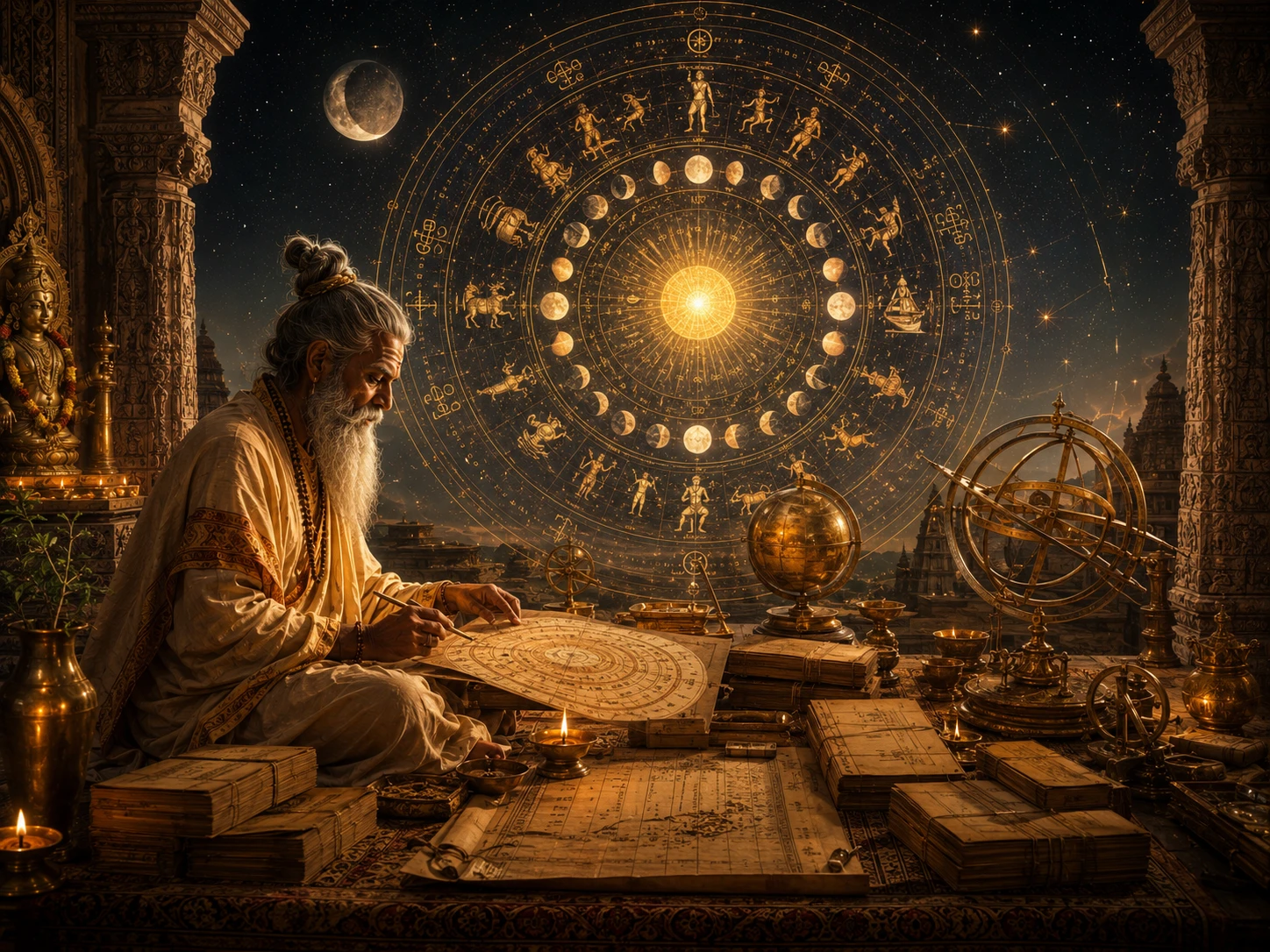
Vedanga Jyotisha -- The Oldest Indian Calendar Science and the Eye of the Veda
वेदांग ज्योतिष -- प्राचीनतम भारतीय पंचांग विज्ञान और वेद का नेत्र
वेदांग ज्योतिष भारतीय बौद्धिक इतिहास में अद्वितीय स्थान रखता है। यह एक साथ प्राचीनतम जीवित भारतीय खगोलीय ग्रन्थ, भारतीय पंचांग परम्परा का मूल दस्तावेज़, और वह ग्रन्थ है जिसने ज्योतिष को छह वेदांगों -- वेद के 'अंगों' -- में से एक के रूप में स्थापित किया। ग्रन्थ स्वयं को वेदों का 'नेत्र' (चक्षु) कहता है, क्योंकि खगोलीय काल के सटीक ज्ञान के बिना वैदिक कर्मकाण्ड सही क्षणों पर नहीं किए जा सकते -- और गलत समय पर किया कर्मकाण्ड केवल निष्प्रभावी नहीं, आध्यात्मिक रूप से खतरनाक है।
ग्रन्थ ऋषि लगध को श्रेय है और दो संस्करणों में जीवित: ऋग्वेद संस्करण (ऋग्ज्योतिष, 36 श्लोक) और यजुर्वेद संस्करण (यजुर्ज्योतिष, 44 श्लोक)। ग्रन्थ के भीतर खगोलीय आँकड़े -- विशेषकर शीतकालीन अयनान्त की नक्षत्र श्रविष्ठा (धनिष्ठा) पर और ग्रीष्म अयनान्त की अश्लेषा के मध्यबिन्दु पर स्थिति -- विद्वानों को अयनचलन गणनाओं के आधार पर प्रेक्षणों को लगभग 1400-1200 ई.पू. का बताने देती है। यह वेदांग ज्योतिष को परवर्ती वैदिक संहिताओं का समकालीन और किसी जीवित यूनानी खगोलीय ग्रन्थ से काफ़ी प्राचीन बनाता है।
मूल ढाँचा युग है -- पंचवर्षीय चक्र जो सौर वर्ष, चान्द्र मास, और नाक्षत्रिक दिवस को दोहराते pattern में समकालिक करता है। प्रत्येक पंचवर्षीय युग में: 1,830 दिन (सावन), 62 चान्द्र मास (सिनोडिक), 67 नाक्षत्रिक चान्द्र मास, 1,860 तिथियाँ (चान्द्र दिवस), और 5 सौर वर्ष। यह पंचवर्षीय युग सबसे छोटी इकाई है जो सौर और चान्द्र पंचांगों को उचित सटीकता से मिलाती है -- वही मूलभूत समस्या जो हर सभ्यता की हर पंचांग प्रणाली को हल करनी पड़ी। जूलियन पंचांग ने leap year से हल किया। इस्लामी पंचांग ने छोड़कर शुद्ध चान्द्र अपनाया। वेदांग ज्योतिष ने युग से हल किया।
वेदा हि यज्ञार्थमभिप्रवृत्ताः कालानुपूर्वा विहिताश्च यज्ञाः। तस्मादिदं कालविधानशास्त्रं यो ज्योतिषं वेद स वेद यज्ञान्॥
vedā hi yajñārtham abhipravṛttāḥ kālānupūrvā vihitāś ca yajñāḥ | tasmād idaṁ kāla-vidhāna-śāstraṁ yo jyotiṣaṁ veda sa veda yajñān ||
वेद यज्ञ के लिए प्रवृत्त हैं, और यज्ञ काल के उचित क्रम में विहित हैं। इसलिए यह काल-विधान-शास्त्र (ज्योतिष) -- जो इसे जानता है, वह यज्ञों को जानता है।
— Vedanga Jyotisha, Verse 3 (Rig Jyotisha recension)
वेदांग ज्योतिष दो प्राथमिक खगोलीय चक्र ट्रैक करता है: सूर्य की क्रान्तिवृत्त में वार्षिक यात्रा (अयन -- उत्तरायण और दक्षिणायन) और चन्द्रमा की 27 नक्षत्रों में मासिक यात्रा। प्रणाली तिथि को वह समय परिभाषित करती है जो चन्द्रमा सूर्य से 12 अंश आगे बढ़ने में लेता है। नक्षत्र दिवस वह समय है जो चन्द्रमा 27 चान्द्र भवनों में से एक में बिताता है। इन चक्रों का संयोजन पंचांग उत्पन्न करता है -- पाँच-अंगी पंचांग जो आज भी भारत में त्यौहार तिथियाँ, शुभ मुहूर्त, और कर्मकाण्ड-अनुसूची निर्धारित करने में उपयोग होता है।
पंचांग के पाँच अंग: तिथि (चान्द्र दिवस), वार (सप्ताह का दिन), नक्षत्र (चान्द्र भवन), योग (चान्द्र-सौर संयोजन), और करण (अर्ध-तिथि)। ये पाँचों परवर्ती ग्रन्थों में औपचारिक हुए पर इनकी प्रेक्षणात्मक नींव वेदांग ज्योतिष में है। आज छपा हर हिन्दू पंचांग -- दिल्ली का पण्डित सूरजराम पंचांग से मुम्बई का निर्णय सागर पंचांग तक -- लगध द्वारा शुरू की गणनात्मक परम्परा का सीधा वंशज है।
ग्रन्थ जल-घड़ी ('नाडिका') का समय-मापन उपकरण के रूप में उपयोग भी दर्ज करता है। एक नाडिका लगभग 24 मिनट। वर्ष का सबसे लम्बा दिन 18 नाडिका दिनप्रकाश; सबसे छोटा 12। यह प्रेक्षण ग्रन्थ के काल-निर्धारण की कुंजी -- सबसे लम्बे और छोटे दिन के बीच 3:2 अनुपात लगभग 35°N अक्षांश (गान्धार या कश्मीर क्षेत्र) से मेल खाता है, उत्तर-पश्चिमी भारत जहाँ प्रारम्भिक वैदिक सभ्यता केन्द्रित थी।
आधुनिक छात्र के लिए वेदांग ज्योतिष इसलिए महत्त्वपूर्ण है क्योंकि यह उद्गम बिन्दु है। हर परवर्ती भारतीय खगोलीय ग्रन्थ -- सूर्य सिद्धान्त, आर्यभटीय, बृहत्संहिता -- यहाँ प्रथम अभिव्यक्त पंचांग-ढाँचे पर बनता है। युग अवधारणा, तिथि-नक्षत्र प्रणाली, अयन विभाजन -- ये सब संरचनाएँ, अभी भी हर हिन्दू परिवार के दैनिक जीवन में जो विवाह तिथि या नया व्यवसाय शुरू करने से पहले पंचांग जाँचता है, अपना वंश तीन हज़ार वर्ष पहले रचित 36 श्लोकों के इस सघन ग्रन्थ तक ट्रैक करती हैं।
वेदांग ज्योतिष बनाम परवर्ती भारतीय खगोलीय ग्रन्थ
| Parameter | Vedanga Jyotisha (~1400-1200 BCE) | Surya Siddhanta (~4th-5th c. CE) | Aryabhatiya (499 CE) |
|---|---|---|---|
| Primary Purpose | Ritual calendar -- when to perform Vedic sacrifices | Comprehensive planetary computation and eclipse prediction | Mathematical astronomy -- earth rotation, planetary models, algebra |
| Scope | Sun and moon only; no planets | Sun, moon, 5 visible planets, Rahu and Ketu | Sun, moon, 5 planets; algebraic solutions |
| Calendar System | Five-year Yuga with intercalary months | Full sidereal and tropical year computation | Sidereal year accurate to 3 min 20 sec |
| Verse Count | 36 (Rig) or 44 (Yajur) | 500+ verses (varies by recension) | 121 verses in 4 chapters |
| Mathematical Tools | Arithmetic ratios; water-clock measurements | Trigonometric sine tables; epicyclic geometry | Sine tables; indeterminate equations; pi = 3.1416 |
| Key Innovation | Synchronisation of solar and lunar calendars in a repeating cycle | Algorithm for predicting eclipses; planetary mean motions | Earth rotates daily; heliocentric hint; algebraic astronomy |
| Living Legacy | Panchang structure (tithi, nakshatra, ayana) still used daily | Festival and muhurta calculations across India | ISRO satellite 'Aryabhata' (1975); computational methods |
वेदांग ज्योतिष आदिम पूर्ववर्ती नहीं। यह उद्देश्य-निर्मित कर्मकाण्ड-काल उपकरण है -- और उस उद्देश्य में यह सटीक रूप से अभियन्त्रित है। परवर्ती ग्रन्थों ने विस्तार किया पर इसकी पंचांग-नींव अक्षत रखी।
वेदांग ज्योतिष के खगोलीय आँकड़े प्रारम्भिक भारतीय सभ्यता के काल-निर्धारण उपकरण के रूप में उपयोग हुए हैं। ग्रन्थ में दर्ज शीतकालीन अयनान्त की श्रविष्ठा (धनिष्ठा) नक्षत्र पर स्थिति अयनचलन गणना से लगभग 1400-1200 ई.पू. से मेल खाती है -- परवर्ती वैदिक काल के लिए कुछ खगोलीय रूप से दिनांकनीय लंगरों में से एक। वेदांग ज्योतिष का पंचवर्षीय युग अभी भी कुछ क्षेत्रीय भारतीय पंचांगों का संरचनात्मक आधार है -- विशेषकर तमिल और केरल पंचांग। ग्रन्थ में वर्णित जल-घड़ी (नाडिका) दक्षिण एशियाई इतिहास के सबसे प्रारम्भिक दर्ज समय-मापन उपकरणों में से एक है। 20वीं शताब्दी में भारतीय पंचांग सुधार प्रस्तावों ने, जिसमें 1957 में ग्रेगोरियन पंचांग के साथ अपनाया गया भारतीय राष्ट्रीय पंचांग शामिल, एकीकृत राष्ट्रीय पंचांग रचने के लिए वेदांग ज्योतिष के तिथि-नक्षत्र ढाँचे को सन्दर्भ बिन्दु के रूप में स्पष्ट रूप से प्रयोग किया।
एटर्नल राग पर आज का पंचांग देखो
लगध के वेदांग ज्योतिष ने जिस पंचांग को सम्भव बनाया, वही आज भी हिन्दू जीवन को चलाने वाला कैलेण्डर है। एटर्नल राग पंचांग पर आज की तिथि, नक्षत्र और मुहूर्त देखो, जो पुणे के लिए गणना किए गए हैं। वेदांग ज्योतिष स्वयं साइट के वेदांग पुस्तकालय में है।
Tags
Eternal Raga · शाश्वत राग
Institutional voice — scholarly articles on Sanatan Dharma
अपनी समझ गहरी करें
अपनी समझ और गहरी करें
vedic sciences
Shad Vedangas -- The Six Limbs of the Veda
The Vedas are not a single book you can pick up and read. They are a living system with six auxiliary sciences -- phonetics, metre, grammar, etymology, astronomy, and ritual procedure -- that function like limbs of a body. Without them, the Vedas are a voice without a mouth, a path without eyes. Here is the operating manual India's knowledge system ran on for three thousand years.
vedic sciences
Kaal Ganana -- The Hindu Measure of Time
From a single blink of the eye (Nimesha) to one Day of Brahma (4.32 billion years) -- explore the complete cosmic time hierarchy of Hindu cosmology, anchored in Vishnu Purana 1.3, with its remarkable parallels to modern science.
vedic sciences
Panchang -- The Five-Limbed Hindu Calendar That Runs on the Moon and the Sun
Your phone uses the Gregorian calendar. Your grandmother uses the Panchang. One tracks the Sun. The other tracks the Sun AND the Moon AND the stars AND something called Yoga AND something called Karana. Five moving parts, one unified system -- and it determines every wedding date, every festival, and every 'shubh muhurat' in a billion Hindu lives.
vedic sciences
Surya Siddhanta -- The Ancient Astronomy Text That Got the Year Right to 1.4 Seconds
Before Copernicus, before Galileo, before the telescope existed -- an Indian text calculated the tropical year as 365.2421756 days. The modern value is 365.2421904. The difference is 1.4 seconds per year. The Surya Siddhanta also described gravity, computed planetary diameters within 1% accuracy, and invented the sine function. It did all this in Sanskrit verse.
vedic sciences
Jyotish Shastra -- The Vedic System of Astronomy and Astrology That India Never Stopped Using
Every year, millions of Indian marriages are fixed only after the kundali matches. ISRO times its satellite launches on muhurtas. JEE students wear navagraha rings. Real-estate agents check Rahu-Ketu transits before closing deals. Whether you believe in it or not, Jyotish Shastra -- the Vedic science of light, time, and celestial influence -- is the most actively practised ancient knowledge system in India today. It spans 9 Grahas, 12 Rashis, 27 Nakshatras, and 2,500 years of continuous mathematical and observational tradition. This article explains the system as the texts describe it -- not as a prediction engine, but as a framework for understanding time, cycles, and the relationship between the cosmos and human life.
vedic sciences
How Vedic Astronomers Mapped the Planets -- Before Telescopes, Before Copernicus
A thousand years before Copernicus proposed that the earth moves, Aryabhata wrote in Pataliputra: the earth rotates on its own axis daily, and the apparent motion of the stars is an illusion caused by that rotation. He calculated the sidereal year to within 3 minutes and 20 seconds of the modern value. The Surya Siddhanta described planetary orbits using epicyclic models. Varahamihira compiled five competing astronomical schools into one text. And Sawai Jai Singh built stone observatories so massive they are still the world's largest sundials. Indian astronomy was not folklore. It was precision science -- conducted in Sanskrit, computed by hand, and accurate enough to predict eclipses centuries in advance.
vedic sciences
The Invention of Zero -- India's Gift That Made Modern Civilisation Possible
Without zero, there is no binary code, no computers, no GPS, no banking system, no physics equation that works. The number that represents nothing is the single most important invention in the history of mathematics -- and it came from India. Not as a sudden discovery but as a centuries-long evolution: from a philosophical concept of 'shunya' (void) in Sanskrit thought, to a placeholder dot in the Bakhshali manuscript, to Aryabhata's positional number system, to Brahmagupta's formal arithmetic rules for zero in 628 CE. From India it travelled through Arab scholars to Europe, replacing Roman numerals and igniting the Scientific Revolution. This is the story of how nothing changed everything.
वेदांग ज्योतिष के खगोलीय आँकड़े प्रारम्भिक भारतीय सभ्यता के काल-निर्धारण उपकरण के रूप में उपयोग हुए हैं। ग्रन्थ में दर्ज शीतकालीन अयनान्त की श्रविष्ठा (धनिष्ठा) नक्षत्र पर स्थिति अयनचलन गणना से लगभग 1400-1200 ई.पू. से मे…
More in Vedic Sciences

Agnichayana -- The Falcon-Shaped Fire Altar That Survived 3,000 Years
12 मिनट पढ़ें
Ancient Indian Metallurgy -- The Iron Pillar That Refuses to Rust
13 मिनट पढ़ेंAryabhata -- The Astronomer Who Said the Earth Turns
3 मिनट पढ़ेंवही अनुवाद त्रुटि जिसने हिन्दू धर्म में '33 कोटि' को '33 करोड़' बनाया, बौद्ध धर्म में भी हुई। बौद्ध ग्रन्थों के चीनी अनुवाद ने 'सप्त कोटि बुद्ध' (7 श्रेष्ठ बुद्ध) का अनुवाद '7 करोड़ बुद्ध' कर दिया। तिब्बती अनुवाद ने सही …
Deities AvatarsCommunity Reflections
🕉️
Be the first to share your reflection.