Aryankavu Sastha
आर्यनकावु शास्ता
The fulfilled Sastha — Ayyappa with his consorts at the mountain pass
Aryankavu, Kerala, India
Āryaṅkāvu ŚāstāAlso known as: Aryankavu Dharmasastha Temple, Poornashastar, Sashasthan Aryankavu, Aryankavu Appan
युग
Pre-modern (Aryankavu Pass guardian tradition; current structure 20th century)
वास्तुकला
Kerala Nāḷu-kettu tradition with Tamil Dravidian stylistic influence at the pass location
खुला
05:30 – 20:30
आरती
05:30 · 10:30 · 18:00 · 20:00
विशेष
All devotees — including women of all ages — are welcome for darshan. No mandatory vow required for general darshan. The Mandala season and Ashtami Rohini festival see significantly increased pilgrimage attendance.
पवित्र कथा · पवित्र कथा
At Aryankavu, in the mountain pass where the Western Ghats open between Kerala and Tamil Nadu, Ayyappa is worshipped not as the eternal celibate of the Sabarimala summit but in his complete householder form — flanked by his consorts Poorna and Pushkala, the divine feminine presences whose names mean 'completeness' and 'abundance'. This is the Sashasthan, the fulfilled Sastha: the form of the deity who has accepted the fullness of cosmic responsibility, encompassing both renunciation and relationship. The theological consequence is profound and practical — where Sabarimala's tradition restricts entry to protect the brahmachari's spiritual environment, Aryankavu opens its doors to all devotees without exception, women of every age included. Pilgrims seeking blessings for marriage, household, fertility, and family wholeness have come to this pass-temple for generations, making Aryankavu the Pancha Sastha site where Ayyappa's grace meets the full breadth of human life.
Sacred Designationपवित्र पदनाम
Sacred Origin Storyपवित्र उत्पत्ति कथा
Source: Shaiva-Vaishnava composite (Hariharaputra tradition); Aryankavu Sastha Sthala Purana
The tradition of Aryankavu holds that after Ayyappa had slain Mahishi and established his eternal celibate seat at Sabarimala, two divine women — Poorna and Pushkala — undertook profound tapas (austerities) seeking union with him. Their names carry cosmological weight: Poorna, meaning completeness or fullness, and Pushkala, meaning abundance and luxuriance. In some traditions, they are daughters of the Sun deity (Surya) or of a king associated with the southern passes; in others they are eternal devotees of Ayyappa who through the power of their austerities earned the right to be his consorts.
Ayyappa, though established in his naishtika brahmachari form at Sabarimala, accepted their devotion and took the householder form — the Sashasthan — at Aryankavu, at the mountain pass where the southern Kerala forests open toward the Pandya country of Tamil Nadu. Here he sits between Poorna and Pushkala as the Poornashastar: the complete Sastha whose divinity encompasses not only the renunciant's liberation but the householder's fullness, the married couple's joy, the family's prosperity, and the protection of those who travel through the passes of the world.
The Aryankavu Pass itself is integral to the temple's identity: this has been a crossing-point between Kerala and Tamil Nadu for traders, pilgrims, and armies for centuries. Ayyappa as the guardian of this pass — protecting travelers as they move between the forest-world and the plains — is another face of the Sashasthan's comprehensive care.
उद्धृत स्रोत:
- Aryankavu Sastha Sthala Purana (Malayalam oral tradition)
- Bhuta Purana (regional Kerala Purana — Ayyappa narrative framework)
- Travancore Devaswom Board documentation on Pancha Sabari Sastha temples
- Kerala Tourism — Pancha Sastha circuit pilgrimage literature
Historyइतिहास
Aryankavu's sacred history is shaped as much by its geography as its mythology. The Aryankavu Pass — a natural gap in the Western Ghats at approximately 400–500 metres elevation — has been one of the principal crossing-points between Kerala and the Tamil plains for centuries, used by traders, pilgrims travelling between Kerala and the Pandya and Madurai kingdoms, and armies moving between the two regions. A guardian deity at such a pass would have served both devotional and practical purposes — blessing the passage and protecting travelers. The temple's identity as a Sashasthan Sastha site, with consorts Poorna and Pushkala, positioned it also as a deity of household blessing and prosperity, drawing worshippers seeking blessings for marriages, fertility, and family welfare from both Kerala and Tamil Nadu. The opening of the metre-gauge Kollam–Shencottah–Tirunelveli railway line in the early 20th century, with a station at Shencottah on the Tamil Nadu side of the pass, significantly expanded the temple's accessibility to Tamil devotees — a cross-border pilgrimage catchment that continues today. The Aryankavu Sastha Devaswom administers the temple. As one of the two Sashasthan seats in the Pancha Sabari Sastha circuit, Aryankavu is consistently included in the devotional itinerary of pilgrims who undertake the full five-temple circuit alongside or separately from the Sabarimala yatra.
Historical Timelineऐतिहासिक कालक्रम
Aryankavu established as a pass-guardian Sastha shrine: the temple tradition identifies the Aryankavu Pass as a site of ancient Sastha veneration, functioning as a guardian deity for travelers crossing between Kerala's Western Ghats forests and the Tamil plains. The Sashasthan form — with consorts Poorna and Pushkala — becomes the defining theological identity of this site, distinguishing it from the brahmachari Sabarimala form.
Founding date is traditional and not inscriptionally confirmed.
Opening of the metre-gauge Kollam–Punalur–Shencottah railway: the rail connection through the Aryankavu Pass area, with a station at Shencottah (Tamil Nadu side), significantly expanded the temple's accessibility to pilgrims from both Kerala and Tamil Nadu. The Tamil devotee base — drawing on the Pandya-region Ayyappa tradition — became an established part of the Aryankavu pilgrimage community.
Precise opening year of the Shencottah rail section requires verification against Southern Railway historical records. The Punalur–Sengottai section was part of the London Mission/South Indian Railway expansion in the early 20th century.
Formal recognition of Aryankavu as a Sashasthan seat within the Pancha Sabari Sastha circuit: the five-temple Ayyappa circuit becomes formalised in Kerala pilgrimage literature, with Aryankavu's identity as one of the two consort-present (Sashasthan) temples — alongside Achankovil — clearly articulated. The devaswom administration consolidates the temple's management.
What You'll Seeदर्शन में
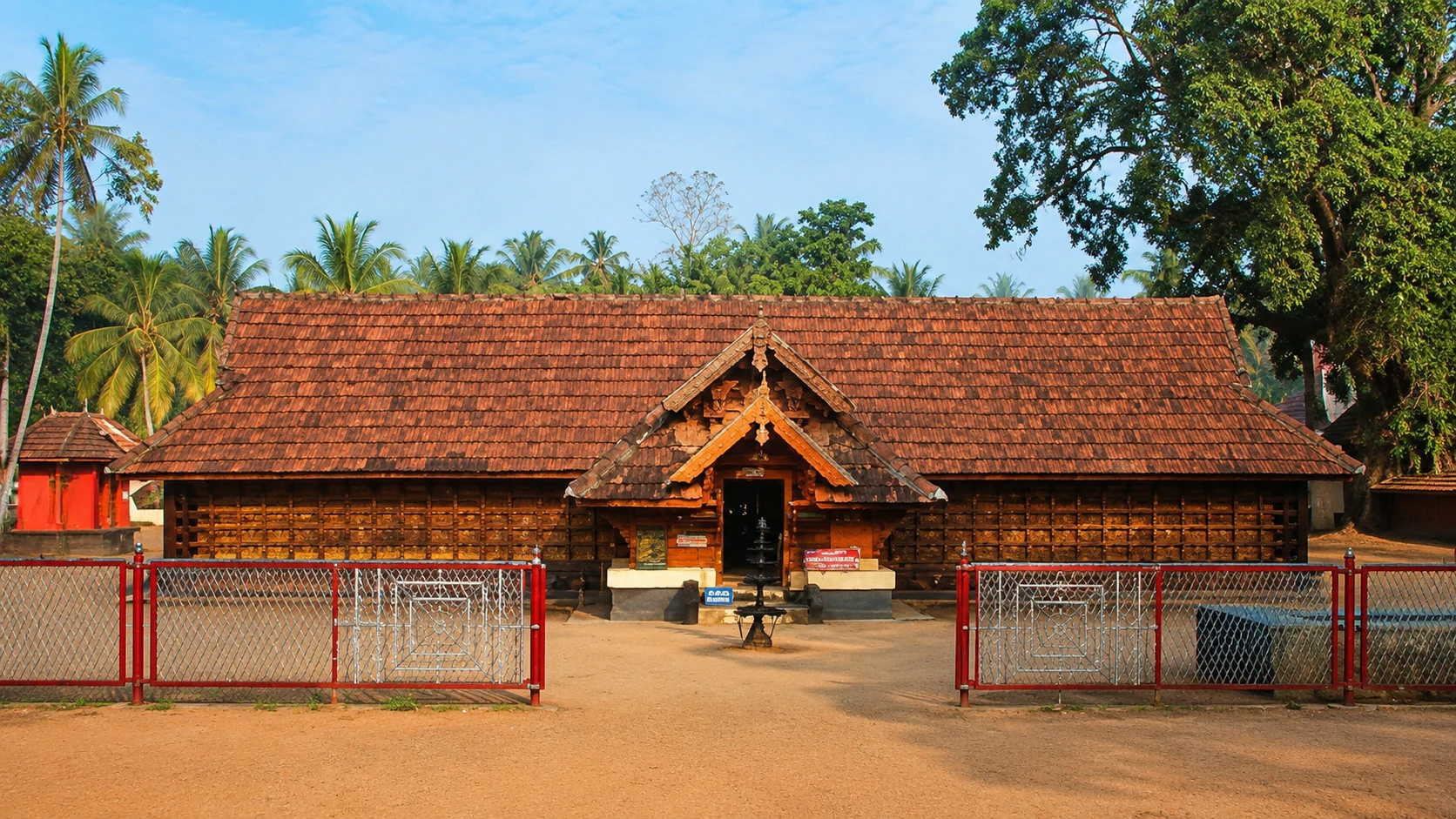
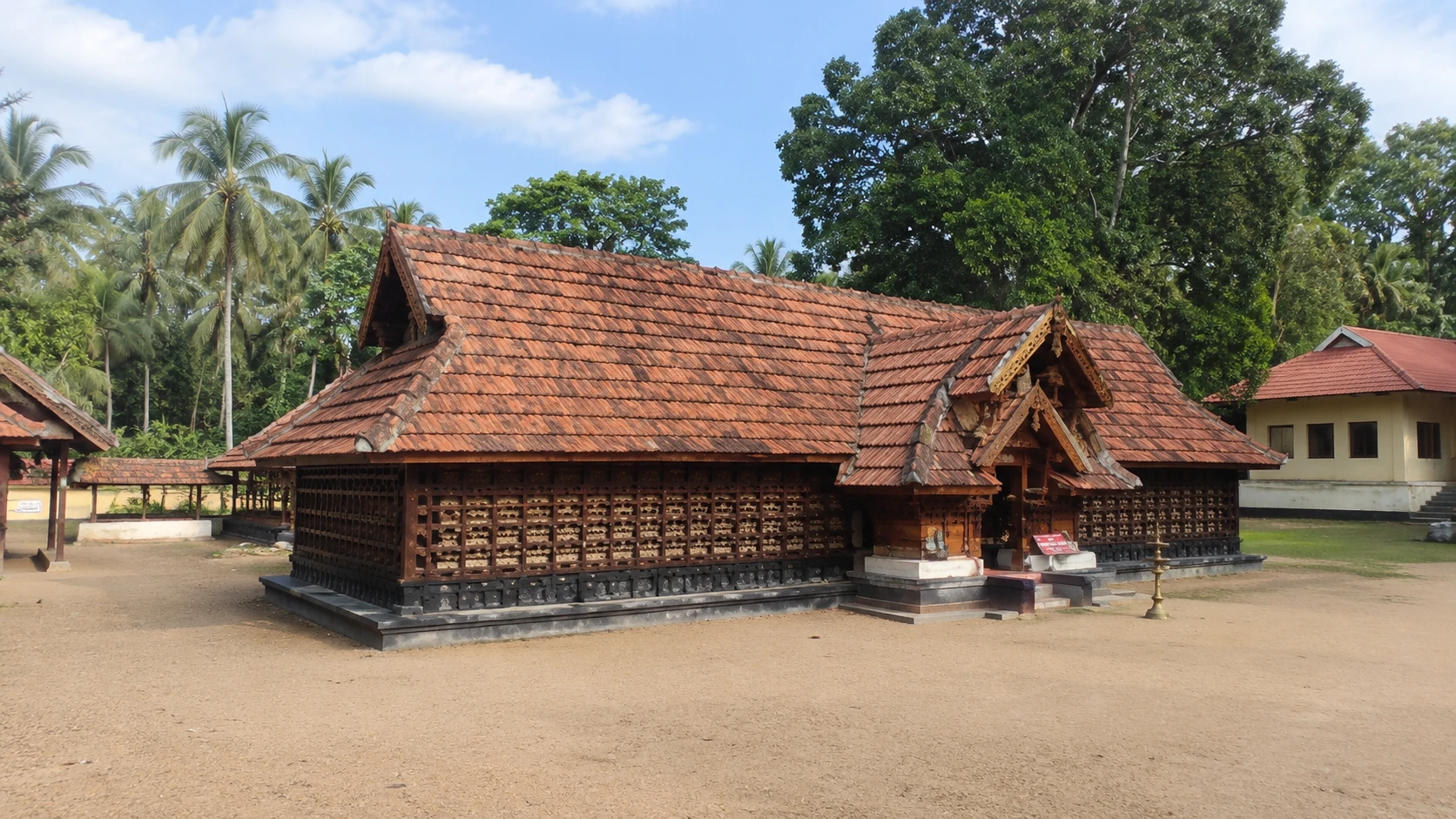
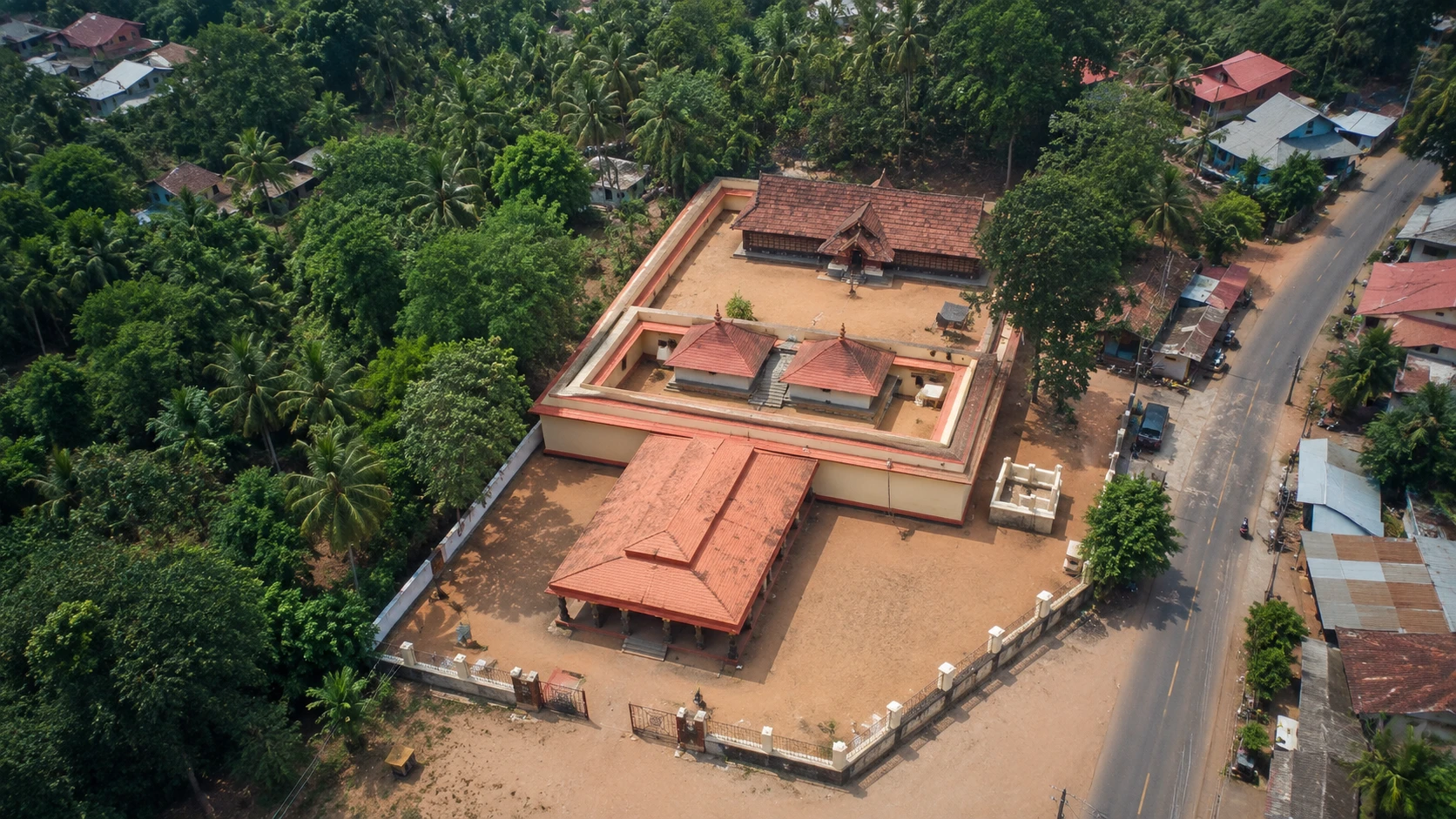
The Aryankavu Sastha is enshrined in a seated posture between his two consorts, Poorna and Pushkala. The presiding murti of Ayyappa is flanked by the goddess figures on either side — Poorna to the right and Pushkala to the left in most accounts — making this the most visually complete expression of the Sashasthan theology among the five Pancha Sastha temples. The consorts embody complementary principles: Poorna is the aspect of fullness and completion — theologically resonant with the Lakshmi principle of Vaishnava devotion — while Pushkala is the aspect of luxuriance and abundance, associated with the Parvati/Shakti dimension of the Shaiva tradition. Together they frame the Hariharaputra deity's full nature: the son of both Shiva and Vishnu holds, in this form, the feminine complements of both traditions simultaneously. Photography inside the inner sanctum is not permitted.
Distinctive Practicesविशिष्ट परंपराएँ
Thiruvananthapuram–Aryankavu Pilgrimage Circuit
तिरुवनंतपुरम–आर्यनकावु तीर्थयात्रा श्रृंखला
Year-round, with peak during Mandala season and Ashtami Rohini
A well-established devotional practice combines Aryankavu darshan with Sree Padmanabhaswamy Temple in Thiruvananthapuram — the Vishnu temple whose Ananthashayana form (Vishnu reclining on Ananta Shesha) is theologically linked to the Hariharaputra synthesis. Devotees seeking the full Vaishnava-Shaiva blessing circuit often combine the two, making Thiruvananthapuram the starting point, Aryankavu the forest-pass destination, and sometimes proceeding onwards to Achankovil. This circuit is particularly favoured by devotees seeking blessings for marriage and family welfare.
The Padmanabhaswamy–Aryankavu circuit enacts the Hariharaputra theology in pilgrimage form: the devotee first approaches Vishnu/Hari in his supreme reclining form at Thiruvananthapuram, then moves to meet the son of Hari and Hara in his consort-present, householder form at the mountain pass. The progression from the ocean-reclining Vishnu to the forest-pass Sashasthan traces the divine's movement from cosmic rest into engaged, relational presence — the same arc that the Ayyappa mythology enacts.
Did You Know?क्या आप जानते हैं?
Aryankavu is one of only two temples in the Pancha Sabari Sastha circuit where women of all ages — including those in the traditionally restricted menstruating-age group — are explicitly and unconditionally welcome. The theological basis is the Sashasthan theology itself: the deity's consort-presence is understood as altering the sanctum's spiritual register from the brahmacharya-protected space of Sabarimala to a space of complete, inclusive divine presence. Devotees who cannot undertake the Sabarimala pilgrimage due to age or physical condition often choose Aryankavu as their primary Ayyappa darshan.
Aryankavu Sastha Sthala Purana; Travancore Devaswom Board documentation on Sashasthan temples; Kerala Tourism pilgrimage literature
The Aryankavu Pass is one of only three major natural passes through the Western Ghats in southern Kerala and northern Tamil Nadu — the others being the Palakkad Gap (the broadest and historically most significant) and the Shencottah Pass being the same geographic feature as the Aryankavu Pass seen from the Tamil Nadu side. The pass sits at approximately 400–500 metres and connects the Kallada basin of Kerala with the Tamraparni basin of Tamil Nadu, making it a watershed boundary as well as a cultural and political frontier for centuries.
Geological Survey of India Western Ghats documentation; Kerala geographic surveys
The two consorts of the Aryankavu Sastha — Poorna and Pushkala — are also worshipped at Achankovil Sastha, the fifth temple of the Pancha Sabari Sastha circuit. The presence of identical consorts at both the Aryankavu and Achankovil temples has led some scholars of the Ayyappa tradition to interpret the two Sashasthan seats as a single theological unit: together they represent the complete householder form, with Aryankavu on the northern pass and Achankovil deeper in the forest to the east serving complementary geographic and devotional functions.
Comparative analysis in Kerala pilgrimage literature; Travancore Devaswom Board documentation on Pancha Sastha theological framework
The Aryankavu Sastha temple draws a significant cross-border Tamil Nadu pilgrimage constituency — particularly from Tirunelveli, Tenkasi, and Madurai districts — because of its location near the Shencottah railway station on the Tamil Nadu side of the pass. This makes Aryankavu one of the few temples in the Pancha Sastha circuit with a substantial non-Malayalam-speaking devotee base, and the temple's festival culture has been influenced by both Kerala and Tamil devotional traditions over the centuries.
Kerala Tourism documentation; Southern Railway pilgrimage traffic records; ethnographic observations on cross-border Ayyappa devotion
Visitor Accessप्रवेश जानकारी
Aryankavu Sastha temple has no entry restrictions based on gender or age. All devotees — including women of all ages, including those in the menstruating age group — are welcome for darshan. No mandatory vow or special clothing is required for general darshan, though pilgrims undertaking the full Pancha Sastha circuit alongside a Sabarimala vow traditionally continue wearing their vow-clothing. The theological basis for the absence of restriction is the Sashasthan form itself: this deity's consort-presence establishes a different spiritual register than the brahmachari-protected sanctum of Sabarimala.
No advance registration or booking is required for general darshan. Arrive during puja timings for the full devotional experience. Dress modestly — traditional Kerala attire (mundu/saree) or simple, clean clothing is appropriate.
Festivalsत्योहार
Ashtami Rohini Utsavam
अष्टमी रोहिणी उत्सवम्
Aug–Sep (Rohini nakshatra on Ashtami tithi, Chingam/Bhadra month)
The principal annual festival of Aryankavu, celebrated as Ayyappa's birth anniversary. The festival sees special abhishekam for all three deities — Ayyappa and both consorts Poorna and Pushkala — decorated processions, the singing of Ayyappa compositions, and a significant gathering of devotees from both Kerala and Tamil Nadu. The festival's cross-border character reflects the temple's position at the pass between the two regions.
Mandala Vilakku
मण्डल विलक्कू
Nov–Dec (coinciding with Sabarimala Mandala season)
During the forty-one-day Mandala season, Aryankavu observes its own Mandala Vilakku with daily lamp ceremonies. Pilgrims undertaking the full Pancha Sastha circuit alongside their Sabarimala yatra include Aryankavu in their route, creating a significant increase in footfall during this season.
Meenam Utsavam (Spring Festival)
मीनम उत्सवम् (वसंत उत्सव)
Mar–Apr (Malayalam month Meenam)
The Meenam Utsavam is the temple's major annual processional festival, involving multiple days of special pujas, the decoration of all three deities in festival regalia, elephant processions, and traditional performing arts from both the Kerala and Tamil Nadu traditions. The festival's timing in Meenam — the final month before the Malayalam New Year — gives it a character of seasonal completion and renewal, resonant with the consorts' names of Poorna (completeness) and Pushkala (abundance).
Traditional Offeringsपारंपरिक अर्पण
प्राथमिक अर्पण
Tulsi and Lotus (Offerings to Poorna and Pushkala)
तुलसी और कमल (पूर्णा और पुष्कला को अर्पण)
At Aryankavu, where Ayyappa is present with both Vaishnava (Poorna) and Shaiva (Pushkala) feminine energies, the offerings traditionally include both tulsi — sacred to the Vaishnava tradition, associated with Poorna's Lakshmi dimension — and lotus, associated with the divine feminine in both Vaishnava and Shaiva contexts. Offering both to the same deity acknowledges the Hariharaputra synthesis: the son of Hari and Hara is honoured through the sacred substances of both his divine parents.
Neyyabhishekam Coconut
नेय्याभिषेकम् नारियल
The ghee-filled coconut offering — central to all five Pancha Sastha circuit temples — is offered here as part of the irumudi by pilgrims undertaking the full circuit alongside the Sabarimala vow. At Aryankavu, the offering takes on an additional dimension of fullness: the ego offered in surrender not before an ascetic solitary deity, but before the complete householder form flanked by Poorna and Pushkala.
Kumkum and Turmeric for the Consorts
देवियों के लिए कुमकुम और हल्दी
The presence of Poorna and Pushkala as consort goddesses means Aryankavu accepts offerings specifically intended for the divine feminine — kumkum (red turmeric powder, auspicious for married women in the Hindu tradition) and turmeric, offered to the goddesses by women devotees. This is a distinctive feature of the Sashasthan temples: the goddess-consorts receive their own devotional offerings, making the temple a full Shakti-inclusive worship site alongside the Ayyappa darshan.
Offerings for all three deities — Ayyappa, Poorna, and Pushkala — are available from vendors near the temple entrance. Women devotees traditionally offer kumkum and bangles to the goddess consorts, particularly when seeking blessings for marriage or fertility. The temple priests can advise on appropriate sevas for specific devotional intentions.
How to Reachकैसे पहुँचें
Aryankavu is most conveniently approached from two directions. From Kerala: Kollam Junction to Punalur by rail or road, then by road via Punalur through the Shencottah Pass area to Aryankavu, a total journey of approximately 100 km from Kollam (2.5–3 hours by road). From Tamil Nadu: Shencottah (Sengottai) railway station on the Kollam–Madurai metre-gauge line is approximately 10–15 km from the temple via the Aryankavu Pass road, making Aryankavu easily reachable from Tirunelveli, Tenkasi, and Madurai by train to Shencottah and then taxi or auto.
Trivandrum–Aryankavu direct is approximately 120 km by road, taking 2.5–3 hours via the Punalur–Shencottah route. From Madurai by road, the distance is approximately 165–175 km via the Shencottah Pass.
The approach road through the pass area is scenic Western Ghats terrain. There are no significant forest sanctuary entry restrictions on the main approach road (unlike Kulathupuzha), though the surrounding forests are part of the Agasthyamala Biosphere Reserve. Accommodation is available in Punalur (~55 km, Kerala side) and in Shencottah/Tenkasi (~15–25 km, Tamil Nadu side).
Book a Pujaपूजा बुक करें
Aryankavu Sastha Devaswom does not operate an online booking portal. Verify current puja timings and entry conditions directly with the temple before travel. No booking URLs or verified phone numbers are currently available for publication.
Managed by: Aryankavu Sastha Devaswom Trust (local administration)
Abhishekam and archana for all three deities (walk-in)
तीनों देवताओं के लिए अभिषेकम् और अर्चना (वॉक-इन)
Booking information verified: 2026-05-23
Sacred Soundsपवित्र ध्वनि
क्या आप जानते हैं? · Did You Know?
वही अनुवाद त्रुटि जिसने हिन्दू धर्म में '33 कोटि' को '33 करोड़' बनाया, बौद्ध धर्म में भी हुई। बौद्ध ग्रन्थों के चीनी अनुवाद ने 'सप्त कोटि बुद्ध' (7 श्रेष्ठ बुद्ध) का अनुवाद '7 करोड़ बुद्ध' कर दिया। तिब्बती अनुवाद ने सही किया: 7 प्रकार, 7 करोड़ नहीं। एक संस्कृत शब्द, दो प्रमुख विश्व धर्मों में गलत पढ़ा गया, ने दो एकसमान भ्रम स्वतन्त्र रूप से उत्पन्न किए।
Related Contentसंबंधित सामग्री
Related Scriptures
Community Reflections
🕉️
Be the first to share your reflection.