Sabarimala
सबरीमाला
The 41-day vow that becomes the deity
Pathanamthitta, Kerala, India
ŚabarīmalaAlso known as: Sabarimala Sree Dharmasastha Temple, Ayyappan Kovil, Sannidhanam, Mahashasthan, Dharmasastha Temple, Hariharaputra Kshetram
युग
Pre-16th century (earliest documented references); current sanctum structure post-1984 reconstruction
वास्तुकला
Kerala Sopana Dravidian (Thazhamon tantri tradition)
आरती
04:30 · 06:00 · 10:30 · 18:00 · 20:30
विशेष
Seasonal opening only: Mandala Season (41 days, mid-November to late December), Makaravilakku (January 14/15), Vishu (April), and the first day of each Malayalam calendar month (~5 days). All darshan requires a valid irumudi kettu. Virtual queue (SPOTIX) booking mandatory during Mandala and Makaravilakku seasons.
पवित्र कथा · पवित्र कथा
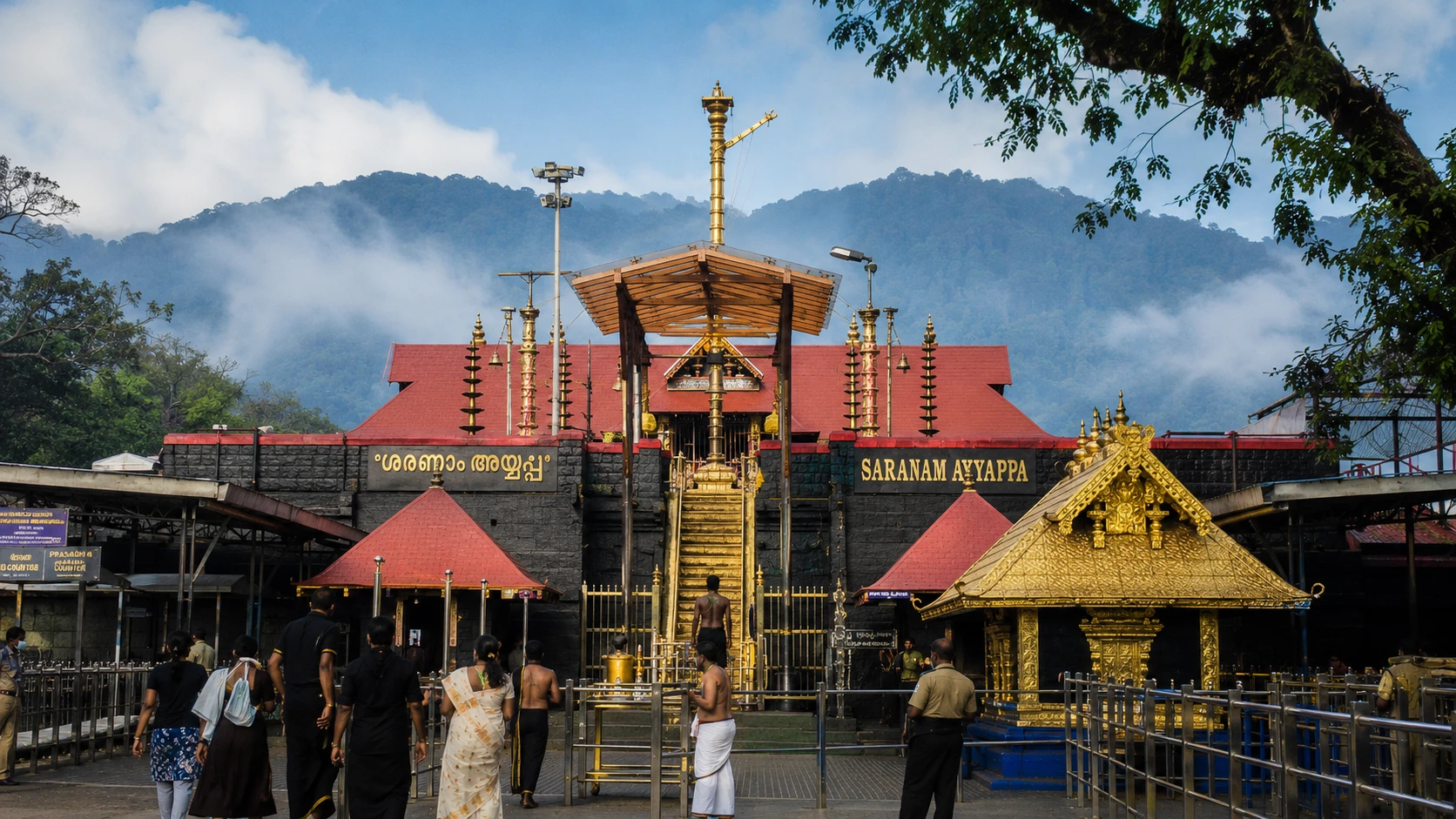
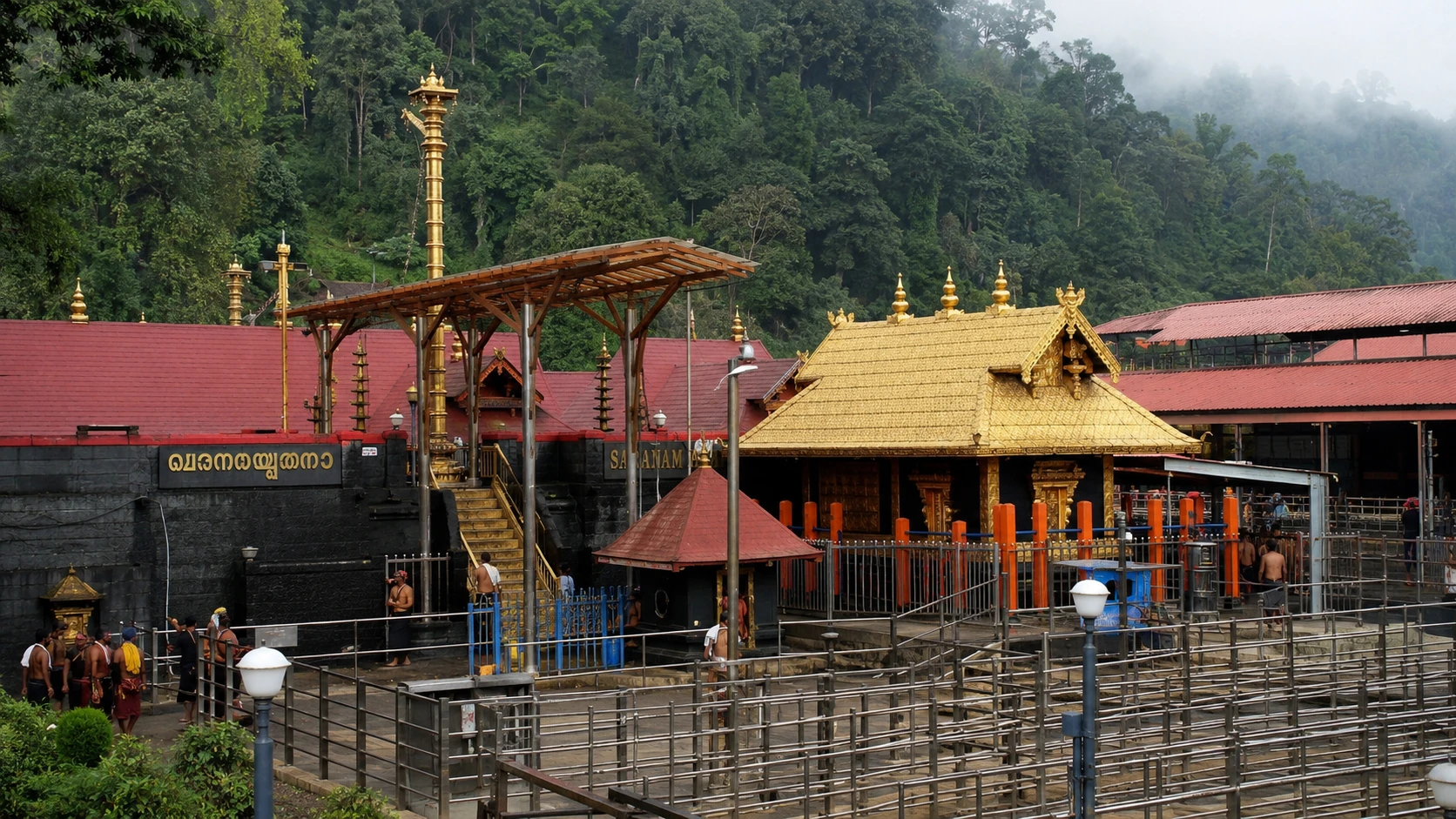
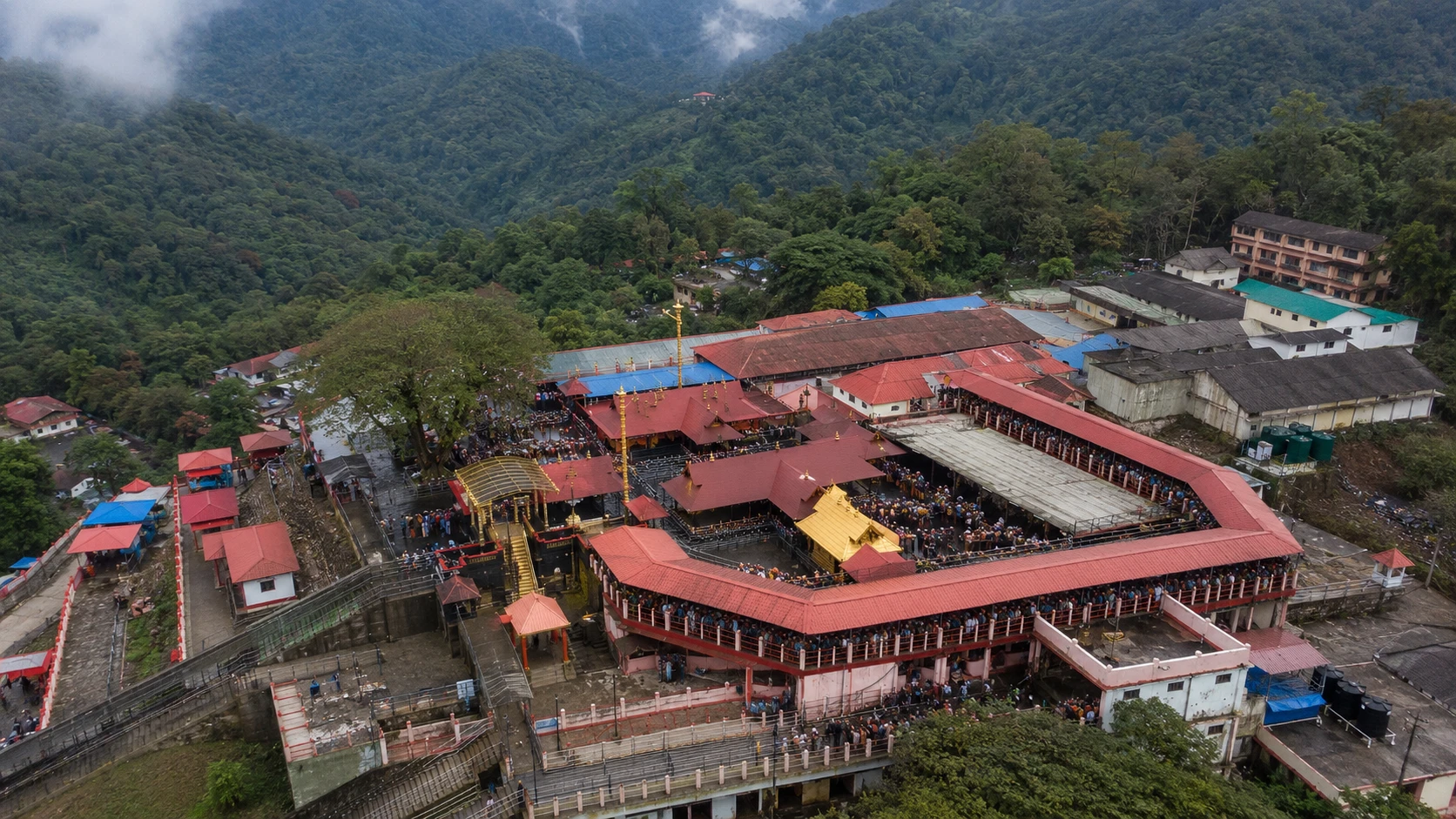
Sabarimala does not receive pilgrims — it transforms them. Nested at 914 metres in the Western Ghats within the Periyar Tiger Reserve, the temple is open fewer than eighty days a year and accessible only on foot through four kilometres of protected forest. What draws forty to fifty million pilgrims annually — making it arguably the largest annual pilgrimage gathering on earth — is not the building but the vow: forty-one days of the Mandala vratam, during which the devotee wears black or dark blue, addresses every fellow pilgrim as 'Swami' (the word means 'God'), abstains from meat, liquor, and worldly comfort, and becomes — through the discipline of the body — a living embodiment of Ayyappa himself. Every pilgrim carries the irumudi kettu, the sacred two-compartment bundle that is the only entry pass to the eighteen golden steps. At Sabarimala, theology is worn on the body and walked through the forest. The deity is not merely found inside the sanctum; the deity is the vow made flesh.
Sacred Designationपवित्र पदनाम
Sacred Origin Storyपवित्र उत्पत्ति कथा
Source: Shaiva-Vaishnava composite (Hariharaputra tradition); Kerala Shaiva Tantra
Ayyappa — known also as Hariharaputra (son of Hari and Hara), Manikanta, and Dharmasastha — was born from the union of Shiva and Vishnu in the Mohini form, conceived specifically to destroy the buffalo-demoness Mahishi. Mahishi had received a boon from Brahma granting invincibility against all beings except one born simultaneously of both Shiva and Vishnu — a birth Brahma believed impossible. When Mahishi's terror threatened the three worlds, the gods beseeched Vishnu, who had taken the Mohini form during the churning of the cosmic ocean. At their entreaty, Shiva united with Mohini, and from this singular union a radiant infant was born, wearing a golden bell (mani) around his neck. The infant was placed on the banks of the Pampa River at the foot of the Sahyadri hills.
The childless King Rajashekara of Pandalam found the infant while hunting and, reading the golden bell as an auspicious sign, raised him as his own son and named him Manikanta. The boy grew in divine grace, excelling in every art and discipline. When Rajashekara's own son was born later, the court — fearing Manikanta's claim to the throne — conspired against him. The queen feigned a mortal illness that, her advisors declared, could only be cured by the milk of a tigress. Manikanta volunteered. He entered the forest — and returned on the back of the very Mahishi, now transformed into a tigress, leading a retinue of tigers to the palace gates. The vision shattered the conspiracy and revealed his divine nature to all.
Before departing the palace forever, Manikanta revealed himself as Ayyappa, the eternal celibate dharma-protector, and instructed Rajashekara to build a temple at the summit of the hill Sabarimala — where he had already slain Mahishi — with eighteen sacred steps. He prescribed that pilgrims must prepare with forty-one days of austere vow, carry the irumudi (the two-compartment ritual bundle), and begin their journey at Erumeli, where his companion Vavar — a Muslim warrior whom Ayyappa had defeated in battle and who had become his most devoted follower — would bless their passage. On the summit of Sabarimala, Ayyappa established himself in the yoga-pattam posture of eternal meditation, guardian of dharma and protector of all who approach with sincere preparation.
उद्धृत स्रोत:
- Bhuta Purana (regional Kerala Purana, primary textual source for the Ayyappa legend; circulates in Malayalam)
- Skanda Purana, Sahyadri Khanda (references to Dharmashastha in the Western Ghats)
- Sthala Purana of Sabarimala (Malayalam oral and written tradition, transmitted within the Thazhamon tantri lineage)
- G. Bhaskaran Nair, 'Sabarimala: A Study' (1965)
- K.K. Marar, works on the Sabarimala Shastha tradition (Malayalam scholarship)
अन्य परंपराएँ · अन्य परंपराएँ
Adivasi / tribal tradition (Mala Arayan and Mala Pandaram communities of the Sabara hills)
The indigenous hill communities of the Sabara hills — including the Mala Arayan and Mala Pandaram — hold traditions of Sastha veneration predating the Pandalam dynasty narrative. In these accounts the deity is a forest guardian (Katu Sastha or Vana Sastha) whose sacred grove on the hilltop was known and revered by tribal communities for generations before the Brahminic temple complex was established. Some scholars note that the very name 'Sabarimala' may derive from 'Sabara' — the ancient Sabara tribal people — combined with 'mala' (hill in Malayalam), suggesting the hill was held sacred by forest-dwelling communities long before the current mythological framework was formalised.
विद्वत संदर्भ
The Ayyappa cult centred at Sabarimala presents a distinctive theological synthesis: the deity's identity as Hariharaputra (son of both Hari/Vishnu and Hara/Shiva) makes him uniquely positioned between the two major Brahminic traditions. Scholars including M.S.S. Pandian and Filippo Osella have argued that the Sabarimala pilgrimage democratised Hindu sacred practice in Kerala by creating a vow-based pilgrimage that is, in theory, accessible across caste lines. The growth from a regional shrine serving perhaps one million pilgrims annually in the 1960s to an estimated forty to fifty million by the early 21st century is among the most dramatic pilgrimage-growth stories in modern religious history, and has itself become a subject of sociological study. The Vavar tradition — in which Sabarimala pilgrims historically sought blessings at a mosque at Erumeli before ascending — exemplifies the complex interfaith dimensions of the cult.
Historyइतिहास
The documented history of Sabarimala is inseparable from the Pandalam royal house of south-central Kerala, which maintains a hereditary theological and ritual relationship with the temple to the present day. While inscriptional evidence for the earliest temple structure on the hill remains limited, Portuguese and later British colonial travel accounts from the 16th and 18th centuries record an active pilgrimage to a shrine in the Sahyadri hills identifiable with Sabarimala. The Travancore kingdom's patronage, formalised in records from the 17th century onwards, confirmed the Thazhamon Thampurakkal family — a Brahmin family of the Panadikkara lineage from Pandalam — as the hereditary tantris (ritual priests and temple technicians) of the temple, a role that family retains exclusively today: only the Thazhamon tantri can perform the consecration, the daily pujas, and the tantric ceremonies of Sabarimala.
The temple came under the administration of the Travancore Devaswom Board (TDB) following the Travancore-Cochin Hindu Religious Institutions Act of 1950, which centralised the management of major temples across the former Travancore and Cochin principalities. A devastating fire on July 6, 1984 destroyed the inner sanctum (sreekovil). Reconstruction under the Thazhamon tantris' supervision restored the temple to its current form; the sanctum was re-consecrated. The late 20th and early 21st centuries saw exponential growth in pilgrimage numbers — from approximately one million pilgrims annually in the 1970s to an estimated forty to fifty million — necessitating the development of Pampa base camp infrastructure, crowd management systems, and the launch of the SPOTIX virtual queue system. The Supreme Court's 2018 ruling on entry restrictions and its subsequent referral to a nine-judge constitutional bench has introduced a formally unresolved legal dimension to the temple's modern history.
Historical Timelineऐतिहासिक कालक्रम
Legendary founding: according to the Sthala Purana, King Rajashekara of Pandalam discovered the infant Manikanta (Ayyappa) on the banks of the Pampa River and raised him as a prince. Following Ayyappa's divine self-revelation, Rajashekara constructed the first temple on the Sabarimala summit under divine instruction, installing the deity in the yoga-pattam posture with eighteen sacred steps.
The 9th–10th century dating is a traditional ascription from the Pandalam dynasty's legendary genealogy. No contemporary inscriptional evidence directly confirms this founding date. The Pandalam royal family maintains an active ceremonial role in Sabarimala's key rituals — notably the Makaravilakku festival — but the founding date remains in the domain of tradition rather than verified epigraphy.
Travancore kingdom patronage formally documented: records from the Travancore kingdom reference the Sabarimala temple and confirm the Thazhamon Thampurakkal family of the Panadikkara lineage as the hereditary tantris responsible for the temple's ritual system, consecrations, and daily ceremonies — a status these records formalise and the family retains to the present day.
The Thazhamon Thampurakkal family's tantri rights have been consistently upheld by the Travancore Devaswom Board and Kerala courts. The family retains the exclusive right to perform the temple's consecration (pratishtha) and is the sole authority on the temple's tantric ritual procedures. No other person may perform these rites regardless of administrative changes.
The Travancore-Cochin Hindu Religious Institutions Act, 1950 brought Sabarimala under the administration of the newly constituted Travancore Devaswom Board (TDB). The TDB assumed responsibility for temple management, annual pilgrimage operations, and infrastructure, while the Thazhamon Thampurakkal family retained their hereditary tantri rights unaffected.
A fire on July 6, 1984 severely damaged the inner sanctum (sreekovil) of the Sabarimala temple. The principal deity's murti was rescued. Reconstruction under the supervision of the Thazhamon tantris and the Travancore Devaswom Board restored the temple; the inner sanctum was re-consecrated in its current form.
The fire's precise origin was the subject of official inquiry. The reconstruction of the inner sanctum, executed under strict tantric guidelines as specified by the Thazhamon family, is the direct basis for the temple's current architectural form — the current structure is therefore a post-1984 rebuilding of what had stood in earlier form.
On January 14, 1999 — Makaravilakku day — a stampede on the Neelimala trekking path resulted in approximately 52 pilgrims being killed. The tragedy prompted a significant institutional review of crowd management at the temple and eventually led to the introduction of structured virtual queue systems and phased entry reforms.
Death toll figures vary slightly across sources; the range in official and press records is 51–53 fatalities. The event became a catalyst for institutional reforms in pilgrimage crowd management at Sabarimala and influenced crowd safety policy at major pilgrimage sites across India.
On September 28, 2018, a five-judge Supreme Court bench delivered a 4–1 majority ruling in Indian Young Lawyers Association v. State of Kerala, holding that the centuries-old restriction on the entry of women between approximately ages 10 and 50 to the Sabarimala temple was unconstitutional as it violated Articles 14, 15, 17, and 25 of the Constitution of India. The sole dissent was by Justice Indu Malhotra, who held that the matter constituted an essential religious practice protected under Article 26.
The ruling generated widespread public debate. The Kerala government announced steps to implement the ruling but faced large-scale protests from devotees and Hindu organisations. Entry of women in the traditional restricted age group remained practically contested during and after the 2018 season. The Travancore Devaswom Board filed a review petition. The practical situation at the temple continued to be governed primarily by traditional practice during the interim period. Pilgrims should consult the TDB's official website for current entry guidelines before travel.
On November 14, 2019, the Supreme Court of India, by a 3–2 majority, referred nine constitutional questions — including the nature of 'essential religious practices', the scope of denominational rights under Article 26, and the interplay between individual fundamental rights and group religious rights — to a nine-judge constitutional bench. As of the knowledge cutoff of this record, the matter remains pending before that bench and the 2018 judgment's operative effect is formally held in abeyance.
The referral to a nine-judge bench means the 2018 judgment is formally held in abeyance pending resolution of the larger constitutional questions. Current practical access conditions at Sabarimala are governed by the traditional restriction as observed by the Travancore Devaswom Board during this interim. Pilgrims should consult current Kerala government and TDB advisories and verify entry guidelines directly with the TDB before planning a visit. This record should be reviewed for updates when the nine-judge bench issues its ruling.
What You'll Seeदर्शन में
The Ayyappa murti at Sabarimala is installed in the yoga-pattam posture (also called yogasana or the seated meditating posture), in which the deity sits with legs crossed and bound by the yoga-pattam — a yogic band across the knees that holds the contemplative posture. This is the posture of eternal, unbroken meditation and corresponds precisely to the theological identity of this form of Ayyappa as the naishtika brahmachari — the ascetic who never breaks his celibacy or his meditation. The murti faces east. In his hands Ayyappa holds a chinamudra or chin mudra (the gesture of supreme knowledge, forefinger and thumb forming a circle), conveying that the deity is in the state of jnana — pure awareness.
The deity is adorned with gold ornaments and a kireetam (crown) during festival seasons. The iconic golden crown (ponnambalamedu kireetam) is among the most venerated adornments of the temple. The main murti is flanked by the idols of Malikapurathamma (a devi figure associated with the Sabarimala complex, linked to the Mahishi narrative as her transformed benevolent form) and smaller shrines to Ganapati and other deities within the sannidhanam complex.
Photography inside the inner sanctum is strictly prohibited. The deity's direct form is seen by pilgrims from the top of the eighteen sacred steps (pathinettampadi) — the brief darshan moment at the close of the arduous journey is central to the pilgrimage's spiritual logic: the preparation is the worship; the darshan is the confirmation.
Distinctive Practicesविशिष्ट परंपराएँ
Mandala Vratam — The 41-day Vow
मण्डल व्रतम् — इकतालीस दिन का व्रत
Annual, beginning 41 days before the close of the Mandala season (typically early November, ends with Mandalapooja in late December)
The Mandala vratam is the central spiritual technology of the Sabarimala pilgrimage. From the day a devotee takes the vow — receiving the mala (sacred tulsi or rudraksha bead necklace) from an initiated guru or elder — they adopt a strict regimen for forty-one consecutive days: wearing black or dark blue clothing, abstaining from meat, fish, eggs, alcohol, tobacco, and sexual activity, sleeping on the floor without a pillow or mattress, bathing twice daily in cold water, visiting a Shiva or Ayyappa temple daily if possible, and addressing every person encountered as 'Swami' — an act of recognising the divine in all. The devotee does not cut hair or nails during this period. At the end of the forty-one days, the pilgrim undertakes the forest journey to Sabarimala carrying the irumudi kettu.
The vow transforms the devotee's body and conduct into a direct embodiment of Ayyappa's attributes: celibacy (brahmacharya), austerity (tapas), non-violence (ahimsa through vegetarianism), and equanimity (treating all beings as divine). By the time the pilgrim reaches the eighteen steps, the preparation itself has made them, in the tradition's understanding, worthy of darshan — not by merit, but by discipline. The greeting 'Swami' among pilgrims is one of the most radical egalitarian acts in pilgrimage culture: a brahmin and a sweeper, a politician and a farmer, all address each other by the name of God. The tradition holds that during this period the devotee does not merely seek Ayyappa — they become Ayyappa.
Irumudi Kettu — The Two-Compartment Sacred Bundle
इरुमुड़ी केट्टु — दो-कक्षीय पवित्र थैला
Carried by every pilgrim throughout the forest journey; mandatory for ascending the 18 steps
The irumudi kettu ('two bundles' in Malayalam) is the mandatory ritual article every Sabarimala pilgrim must carry on their head from the base of the forest trail through the entire journey to the temple. It consists of two compartments tied together in a cloth bundle: the front compartment (munmudi or the 'head') contains the sacred items for offering — most importantly a coconut filled with ghee (neyyabhishekam coconut) for the abhishekam of the deity, along with camphor, vibhuti, sandalwood paste, and other ritual materials; the rear compartment (pinmudi or the 'tail') holds the pilgrim's personal provisions for the journey — food, water, change of clothes. The coconut in the front compartment serves as the symbolic head of the pilgrim's offering body; pouring its ghee over the deity is the climactic act of the pilgrimage.
The irumudi is not a bag — it is a ritual body. The ghee-filled coconut in the front compartment represents the pilgrim's own head and ego offered at the feet of the deity. The act of carrying the irumudi on the head throughout the forest trek — rather than on a shoulder or in the hands — means the pilgrim's entire body becomes a vessel of offering, the head bowing under the weight of surrender. Only a pilgrim carrying the irumudi may ascend the eighteen sacred steps. This condition is absolute: the irumudi is the credential of preparation, not merely a container of offerings.
Pathinettampadi — The Eighteen Sacred Steps
पतिनेट्टांपडी — अठारह पवित्र सीढ़ियाँ
Climbed only by pilgrims carrying the irumudi kettu, during all pilgrimage seasons
The eighteen steps leading to the Sabarimala sanctum — called the Pathinettampadi — are among the most charged ritual thresholds in Hindu pilgrimage. Clad in gold, they must be climbed barefoot, carrying the irumudi on the head, and only by pilgrims who have completed the Mandala vow. The steps are steep, narrow, and worn smooth by millions of feet over centuries. At the foot of the steps stand the Valiya Kaduthasery lamp pillars. The first step is touched with the right foot while chanting 'Swamiye Saranam Ayyappa' — the Sabarimala mahavakya, the great utterance, which is repeated with each step upwards.
The eighteen steps are variously interpreted in the tradition: as the eighteen Puranas (Ashtadasha Puranas), as the eighteen hills of the Sabarimala complex, as the eighteen weapons of Ayyappa's divine mission, and as the eighteen steps of inner purification corresponding to the five senses, eight passions, three gunas, and the two letters of the divine name. No single interpretation is canonical — the multiplicity itself is significant, as the steps serve as a surface for accumulated meaning across generations of devotees. The physical act of climbing on bare feet while bent under the weight of the irumudi enacts the internal posture of surrender (sharanagati) that is the theological heart of the Ayyappa tradition.
Makarajyoti — The Celestial Light of Makaravilakku
मकरज्योति — मकरविलक्कू का दिव्य प्रकाश
Annual, on Makaravilakku day (Makara Sankranti, approximately January 14/15)
On the night of Makaravilakku — the most sacred night of the Sabarimala calendar, coinciding with Makara Sankranti — a star (jyoti) appears in the sky to the northeast of the Sabarimala summit and is visible to pilgrims gathered on the hillside. This appearance, known as the Makarajyoti, is the celestial centrepiece of the Makaravilakku festival and is received by hundreds of thousands of pilgrims with the collective cry of 'Swamiye Saranam Ayyappa'. Simultaneously, the ceremonial star-shaped lamp (Makaravilakku) in the inner sanctum is lit, its light carried out to the gopuram for pilgrims to see.
In the devotional tradition, the Makarajyoti is understood as Ayyappa himself — or his divine messenger — appearing in the sky to bless the assembled pilgrims on the most auspicious night of the year. The star's appearance marks the moment of grace (prasad) for which the entire pilgrimage has been undertaken. The tradition holds that seeing the Makarajyoti, having completed the forty-one-day vow and made the forest journey, is the culminating moment of darshan — not a darshan of stone, but of light itself.
Did You Know?क्या आप जानते हैं?
Sabarimala is widely estimated to receive between 40 and 50 million pilgrims annually during its open seasons, making it a strong contender for the world's largest annual pilgrimage. For comparison, the Hajj receives approximately 2.5 million pilgrims annually; Kumbh Mela (the largest single gathering) draws larger crowds but meets only every 3–6 years. Sabarimala's scale has grown from roughly one million pilgrims in the 1960s — a fifty-fold increase in under sixty years.
Travancore Devaswom Board annual pilgrimage statistics; academic estimates in Filippo Osella and Caroline Osella, 'Social Mobility in Kerala' (2000); The Hindu reporting on pilgrimage seasons
The Ayyappa vow is, uniquely among major Hindu pilgrimage vows, a full-body equaliser: during the forty-one days, pilgrims of all castes, religions, and backgrounds wear identical black or dark blue, eat the same food, sleep on the same floor, and greet each other as 'Swami'. Non-Hindu pilgrims — notably Muslims from Tamil Nadu and Kerala, and a small number of Christians — have historically undertaken the vow, particularly in the Erumeli tradition. The pilgrimage has long served as one of the most documented examples of caste-transcending and even interfaith practice in living Hinduism.
M.S.S. Pandian, 'Sabarimala and Its Contexts', EPW (2000); Filippo Osella and Caroline Osella on Ayyappa cult in Kerala
The Makarajyoti — the celestial star that appears on Makaravilakku night — was identified in 2010 by a Travancore Devaswom Board official as an artificially lit star arranged by forest department personnel. The statement caused major controversy and was subsequently retracted. The star's identification with the astronomical star Canopus (Agastya nakshatra), which rises to its highest point in the Kerala sky on approximately Makara Sankranti, is a matter of ongoing discussion. The Kerala High Court took up the matter in 2011. No definitive judicial ruling on the nature of the Makarajyoti has been published as of this record's knowledge cutoff.
Kerala High Court proceedings, 2011; The Hindu archival coverage of the 2010 controversy; astronomical identification of Canopus via Indian astronomical tradition
The greeting 'Swamiye Saranam Ayyappa' ('I take refuge in you, O Swami Ayyappa') is the mahavakya — the great utterance — of the Sabarimala tradition. During the Mandala season, this phrase is chanted by millions of pilgrims simultaneously across the forest routes to the temple. The chant's rhythm has been described by sociologists of religion as a form of mass synchrony — millions of individual voices merging into a single collective invocation that continues for hours as pilgrims move up the hillside.
Ayyappa tradition primary sources; scholarly documentation by Osella and Osella
The Sabarimala temple is unusual among major Hindu pilgrimage sites in having no permanent population at the summit — no village, no town, no permanent residents. The entire sannidhanam (temple precinct) on the hill is vacated between pilgrimage seasons, when the forest reclaims the silence. The hill lies within the Periyar Tiger Reserve; wildlife — elephants, leopards, gaur, and the rare Nilgiri tahr — move through the area between seasons. The pilgrimage's ecological footprint in a biodiversity hotspot is a subject of ongoing environmental study.
Periyar Tiger Reserve management records; Kerala Forest Department documentation; The Hindu coverage of ecological studies
The Pandalam royal family maintains a hereditary ceremonial role at Sabarimala to this day, even though the temple is administered by the Travancore Devaswom Board. During Makaravilakku, a procession led by a representative of the Pandalam family carrying the sacred jewels (thiruvabharanam) of Ayyappa travels from the Pandalam palace to Sabarimala. The jewels are believed to be the actual ornaments that the divine child Manikanta wore when he was found by King Rajashekara. The thiruvabaranam procession, arriving on Makaravilakku eve, is one of the most emotionally charged moments in the festival calendar.
Pandalam royal house ceremonial records; Travancore Devaswom Board accounts of Makaravilakku observances; The Hindu coverage
Unlike virtually every other major Hindu pilgrimage site in India, Sabarimala has no permanent priest caste attached to it in the conventional sense. The tantric authority belongs exclusively to the Thazhamon Thampurakkal family from Pandalam — a single family, not a caste group. The routine priests (melshantis and kashta melshantis) who perform daily pujas are appointed through a lottery system administered by the TDB. This combination of hereditary tantric authority and democratically appointed daily priests is unique in the architecture of temple governance.
Travancore Devaswom Board governance documentation; Kerala High Court proceedings related to tantri rights
Visitor Accessप्रवेश जानकारी
The Sabarimala temple has a centuries-old tradition of restricting the entry of women in the menstruating age group — traditionally described as women between approximately 10 and 50 years of age — based on the deity's identity as a naishtika brahmachari (eternal celibate). In September 2018, the Supreme Court of India ruled this restriction unconstitutional. In November 2019, the Supreme Court referred the matter to a nine-judge constitutional bench, which had not issued its ruling as of this record's knowledge cutoff. The practical situation at the temple has continued to be governed primarily by the traditional restriction as observed by the Travancore Devaswom Board during this interim period. The legal matter remains formally unresolved. Pilgrims must verify current entry guidelines directly with the Travancore Devaswom Board before planning travel.
आध्यात्मिक आधार
The tradition holds that Ayyappa at Sabarimala is a naishtika brahmachari — an ascetic who has taken an eternal, unbreakable vow of celibacy. The presence of women of menstruating age is held, within this tradition, to be incompatible with the spiritual environment that the brahmachari deity's presence requires. This is not a statement about women's spiritual worth — Ayyappa's consorts Poorna and Pushkala are worshipped at the Aryankavu and Achankovil temples within the same Pancha Sastha circuit, where women of all ages are welcomed. The restriction at Sabarimala is held by the tradition to be specific to this form (the naishtika brahmachari) and this site, not a general principle.
समकालीन संदर्भ
The Supreme Court of India ruled on September 28, 2018 (Indian Young Lawyers Association v. State of Kerala, AIR 2019 SC 1) that the restriction was unconstitutional, with a 4–1 majority. The sole dissenting justice, Indu Malhotra, held it to be an essential religious practice protected under Article 26. On November 14, 2019, the Supreme Court by a 3–2 majority referred the matter to a nine-judge constitutional bench to address broader questions about essential religious practices and the relationship between individual and denominational religious rights. The nine-judge bench's ruling had not been issued as of this record's knowledge cutoff. During this interim period, the traditional restriction has continued to be observed by the Travancore Devaswom Board. The Kerala government's position has varied across administrations.
व्यावहारिक मार्गदर्शन
Pilgrims planning a visit to Sabarimala must verify current entry guidelines, access conditions, and the status of the nine-judge bench proceedings directly with the Travancore Devaswom Board (official website: www.travancore-devaswom.com) and Kerala government advisories before travel. All pilgrims, regardless of other conditions, must complete the 41-day Mandala vrat, obtain the mala from a guru, carry the irumudi, and register through the SPOTIX virtual queue system during the Mandala and Makaravilakku seasons. Photography inside the inner sanctum is prohibited for all pilgrims.
Festivalsत्योहार
Mandalapooja and Mandala Season
मण्डलपूजा और मण्डल मौसम
Nov–Dec (41 days culminating in Mandalapooja on the final day)
The Mandala season is the primary pilgrimage season of Sabarimala, spanning forty-one days from the first day of the Malayalam month Vrischikam (typically mid-November) and culminating in the Mandalapooja on the forty-first day. The season is the theological heart of the pilgrimage: it is the period for which the forty-one-day vow (Mandala vratam) is specifically designed, and it sees the largest concentration of pilgrims of the year. Mandalapooja — the ceremonial closing puja on the forty-first day — involves special abhishekam and rituals performed by the Thazhamon tantri, and is considered one of the most auspicious moments in the entire pilgrimage calendar.
Makaravilakku
मकरविलक्कू
January (Makara Sankranti, approximately January 14/15)
Makaravilakku is the most sacred single day in the Sabarimala calendar. It coincides with Makara Sankranti — the day the sun enters Capricorn — which marks the beginning of the Uttarayana (the sun's northward journey). On this night, the Makarajyoti — the celestial star or light — appears in the sky to the northeast of the Sabarimala summit. The Pandalam royal family's representative arrives on this day carrying the thiruvabharanam (sacred jewels of Ayyappa) in a ceremonial procession from the Pandalam palace. The simultaneous appearance of the sky-jyoti and the lighting of the Makaravilakku lamp in the inner sanctum constitutes the single most dramatic ritual moment of the pilgrimage year.
Vishu Opening
विषु उद्घाटन
April (Vishu — Malayalam New Year, approximately April 14)
The Vishu season marks the third major annual opening of Sabarimala. Vishu — the astronomical new year of Kerala, marking the sun's entry into Aries — carries associations of new beginnings and prosperity. The temple's opening on Vishu is shorter than the Mandala or Makaravilakku seasons but draws significant pilgrims, particularly from Kerala, who combine the New Year festival with a Sabarimala yatra.
Monthly Openings (Maasapuja)
मासिक उद्घाटन (मासपूजा)
Monthly, on the first day of each Malayalam calendar month
Beyond the three major seasons, Sabarimala opens for five days on the first day of each Malayalam calendar month (approximately monthly). These monthly openings — called maasapuja — allow pilgrims who cannot attend the major seasons to undertake the yatra. They are less crowded than the Mandala or Makaravilakku seasons, making them a preferred option for those seeking a less crowded darshan while still fulfilling the forty-one-day vow.
Traditional Offeringsपारंपरिक अर्पण
प्राथमिक अर्पण
Neyyabhishekam — Ghee Ablution
नेय्याभिषेकम् — घृत अभिषेक
The central offering of the Sabarimala pilgrimage is the neyyabhishekam — the pouring of ghee over the Ayyappa murti. Every pilgrim carries a coconut filled with ghee (the neyyabhishekam coconut) in the front compartment of the irumudi from Pampa to the sanctum. At the top of the eighteen steps, the coconut is broken open and its ghee is offered in abhishekam — the ritual bathing of the deity. This act is understood as the total offering of the self: the coconut is the pilgrim's own skull (the seat of the ego), the ghee is the stored heat of forty-one days' discipline, and the breaking and pouring is the dissolution of the individual self before the divine. The Shiva Purana (Kotirudra Samhita, Chapter 13) extols ghee abhishekam as among the highest forms of worship; the Sabarimala tradition has made this a mass ritual experience without equivalent in Hindu pilgrimage.
Vibhuti (Sacred Ash)
विभूति (पवित्र भस्म)
विभूति
Vibhuti — the sacred ash of burnt cow dung patties, camphor, or other sanctified material — is among the most important offerings carried in the irumudi. Applied to the forehead as a tilak and offered to the deity, vibhuti embodies the Shaiva principle of the body's ultimate impermanence: all matter returns to ash. For an Ayyappa devotee who has spent forty-one days in austerity, offering vibhuti is an acknowledgement that the vow itself — all the discipline, all the effort — is also ultimately ash in the divine presence, offered without attachment to its own merit.
Tulsi Mala (Sacred Basil Bead Garland)
तुलसी माला (पवित्र तुलसी मनकों की माला)
तुलसीमाला
The tulsi mala — a necklace of beads made from the sacred basil (Ocimum tenuiflorum) — is the outward sign of the Mandala vrat. The pilgrim receives it from a guru or elder at the commencement of the forty-one-day vow and wears it throughout. It is removed only at the end of the pilgrimage after returning home and completing the final puja. Tulsi is associated with Vishnu-Hari, and its presence in the Ayyappa tradition reflects the Hariharaputra synthesis: the mala worn at the chest carries both the Shaiva (Ayyappa as Shiva's son) and Vaishnava (Ayyappa as Vishnu's son) devotional lineage simultaneously.
Camphor (Karpooram)
कपूर (कर्पूरम्)
कर्पूर
Camphor is burned in the sanctum as part of the aarti and is also carried in the irumudi as an offering. Camphor burns completely — leaving no residue — and the Ayyappa tradition interprets this as the ideal of the devotee's ego: to burn entirely in the fire of devotion, leaving nothing behind. The Shaiva tradition specifically prizes camphor for its complete combustion (Shiva Purana, Jnanapada); in the Hariharaputra synthesis at Sabarimala, camphor burning is one of the most potent moments of sensory worship — the white smoke, the penetrating fragrance, and the complete disappearance of matter.
Coconut (Thenga / Nariyal)
नारियल (नारियल)
नारिकेल
Beyond the ghee-filled neyyabhishekam coconut, whole coconuts are offered at the foot of the eighteen steps and at various subsidiary shrines in the sannidhanam. The breaking of a coconut — its hard outer shell representing the hard casing of the ego, the white flesh the purity within, the water the life-essence — is among the most universal of all Hindu offerings. At Sabarimala it carries additional weight: the sound of thousands of coconuts being broken simultaneously in the sannidhanam on peak days creates a thunder that reverberates through the forest.
इस मंदिर की विशेषता
Aravana Payasam
अरवण पायसम्
The aravana payasam is the iconic prasad of Sabarimala — a sweet rice pudding (kheer) made with raw rice, jaggery, ghee, coconut, cardamom, and dry fruits, prepared in large copper vessels in the temple's kitchen (anappanthal) by the Travancore Devaswom Board. Aravana is distributed to every pilgrim who reaches the sannidhanam and is among the most sought-after prasads in Kerala devotional life. The preparation is considered sacred and the recipe proprietary; only the TDB's designated cooks prepare it. It is available in sealed containers for pilgrims to carry home, making it among the few Sabarimala sacred experiences that can be shared with those who could not make the journey.
Thiruvabharanam Darshan (Viewing of Ayyappa's Sacred Jewels)
तिरुवाभरणम् दर्शन (अयप्पा के पवित्र आभूषणों का दर्शन)
On Makaravilakku day, the thiruvabharanam — the sacred jewels of Ayyappa — are brought in ceremonial procession from the Pandalam palace to Sabarimala by the Pandalam royal family's representative. These ornaments are held by tradition to be the actual jewels worn by the divine child Manikanta when found by King Rajashekara on the banks of the Pampa. Seeing the thiruvabharanam arrive — in the procession that covers the journey from Pandalam to Sabarimala over several days — is considered among the highest forms of darshan available during the Makaravilakku festival, distinct from and supplementary to darshan of the deity himself.
The irumudi kettu itself is the primary offering vehicle at Sabarimala — virtually all ritual offerings are carried inside it from Pampa. The Travancore Devaswom Board operates counters near the sannidhanam where aravana payasam and other prasad items are available for purchase. Pilgrims who have completed the vow traditionally bring aravana payasam home for family members and friends who could not make the journey. Flowers, fruits, and other standard temple offerings are accepted at the subsidiary shrines in the sannidhanam complex but are not the central focus of the Sabarimala offering tradition, which is dominated by the neyyabhishekam coconut.
How to Reachकैसे पहुँचें
Sabarimala is approached in stages. The first leg is reaching the Pampa base camp (also called Pamba), the last motorable point before the forest trek. From Kochi or Thiruvananthapuram, state buses and private taxis run to Pampa via Kottayam or Pathanamthitta, a journey of 4–5 hours from Kochi. The nearest railway stations are Chengannur (80 km) and Kottayam (114 km), both on the main Chennai–Thiruvananthapuram trunk line, from which shared jeeps, KSRTC buses, and taxis are available to Pampa.
From Pampa, pilgrims begin the forest trek: the traditional route is approximately 4 km through the Periyar Tiger Reserve forest, involving a climb of roughly 1,000 feet through forest paths. The path goes via Pamba Ganapati shrine (where pilgrims seek Ganapati's blessing before the trek), through the Neelimala viewpoint, and up to the Sannidhanam. The trek typically takes 1.5–3 hours depending on crowd density and fitness.
A helicopter service to a point near the sannidhanam operates on select days during peak season, available through advance booking. An alternative route from Erumeli (approx. 60 km from Kottayam) involves a longer forest trek of approximately 50 km — this is the traditional 'pada yatra' route preferred by pilgrims who wish to complete the full traditional journey, including the Petta Thullal at Erumeli.
During Mandala and Makaravilakku seasons, all pilgrims must book their darshan slot through the SPOTIX virtual queue system on the official TDB website before travel. Pampa is subject to heavy congestion; arrive at off-peak hours where possible and carry sufficient water and provisions for the trek.
Plan Your Visitयात्रा की योजना
🌤 सर्वोत्तम मौसम
The Mandala season (mid-November to late December) offers the richest pilgrimage experience but sees the largest crowds — often 200,000+ pilgrims per day at peak. Makaravilakku (January 14/15) is the single most sacred day. Monthly openings (first day of each Malayalam month) offer the same darshan with significantly smaller crowds. Sabarimala is closed between seasons; do not attempt the trek on closed days. November to January is also the post-monsoon season in Kerala — cooler, with occasional rain possible.
👘 पहनावे का नियम
Black or dark blue clothing is mandatory for pilgrims who have taken the Mandala vrat. Pilgrims must be barefoot from Pampa onwards. Non-devotional visitors in ordinary clothing are not admitted to the sannidhanam. Children accompanying adults should also wear black. Traditional dhoti or mundu is acceptable in addition to modern black clothing.
📱 फोन और फोटोग्राफी
Mobile phones are permitted on the trek and at the sannidhanam precinct, but photography inside the inner sanctum (sreekovil) is strictly prohibited. Video recording in the sannidhanam area is also restricted. Exercise discretion with phones throughout the pilgrimage — the tradition requests that pilgrims remain in a meditative state.
🏨 आवास
At Pampa base camp, the Travancore Devaswom Board operates dormitory facilities and cottages bookable through the TDB website. During peak season (Mandala and Makaravilakku), accommodation at Pampa is under extreme pressure — book well in advance or plan to arrive, trek, and return the same day from a base in Kottayam, Pathanamthitta, or Chengannur. The TDB also runs facilities at Nilackal and at the sannidhanam itself. At the hilltop, the sannidhanam has limited accommodation managed by the TDB. Private accommodation is available in Pathanamthitta town.
Book a Pujaपूजा बुक करें
Booking links and phone numbers are verified periodically but may change without notice. Always confirm the destination URL belongs to the official Travancore Devaswom Board before payment. Multiple fraudulent websites impersonate Sabarimala booking portals — this is a documented and persistent fraud risk. Only book through www.sabarimalaonline.org or the official TDB website www.travancore-devaswom.com. Phone numbers listed here are sourced from the TDB's publicly available contact information; verify on the TDB website before calling. Eternal Raga has no commercial relationship with the Travancore Devaswom Board.
Managed by: Travancore Devaswom Board (TDB), Government of Kerala
Virtual Queue (SPOTIX) — Darshan Slot Booking
वर्चुअल कतार (स्पॉटिक्स) — दर्शन स्लॉट बुकिंग
Neyyabhishekam (Ghee Abhishekam seva)
नेय्याभिषेकम् (घृत अभिषेक सेवा)
Aravana Payasam Prasad Booking
अरवण पायसम् प्रसाद बुकिंग
Booking information verified: 2026-05-23
Sacred Soundsपवित्र ध्वनि
क्या आप जानते हैं? · Did You Know?
वही अनुवाद त्रुटि जिसने हिन्दू धर्म में '33 कोटि' को '33 करोड़' बनाया, बौद्ध धर्म में भी हुई। बौद्ध ग्रन्थों के चीनी अनुवाद ने 'सप्त कोटि बुद्ध' (7 श्रेष्ठ बुद्ध) का अनुवाद '7 करोड़ बुद्ध' कर दिया। तिब्बती अनुवाद ने सही किया: 7 प्रकार, 7 करोड़ नहीं। एक संस्कृत शब्द, दो प्रमुख विश्व धर्मों में गलत पढ़ा गया, ने दो एकसमान भ्रम स्वतन्त्र रूप से उत्पन्न किए।
Related Contentसंबंधित सामग्री
Related Scriptures
Community Reflections
🕉️
Be the first to share your reflection.