Bagalamukhi Mandir (Datia)
बगलामुखी मंदिर
Eighth Mahavidya — the yellow goddess who paralyzes enemies and stills the storm of creation
Datia, Madhya Pradesh, India
BagalāmukhīAlso known as: Pitambara Devi, Pitambara Peeth Devi, Brahmastra Vidya, Bagala Devi, Stambhini, Datia Wali Mata
युग
Ancient site tradition; Pitambara Peeth institution established early 20th century
वास्तुकला
North Indian vernacular with Pitambara Peeth complex additions (20th century)
खुला
05:00 – 21:00
आरती
05:30 · 08:00 · 12:00 · 19:00
विशेष
Tuesdays and Fridays — peak days; Navratri sees very large gatherings; yellow dress traditionally worn by devotees
पवित्र कथा · पवित्र कथा
Bagalamukhi is the Mahavidya of the power that stops. In the primordial account, a storm of annihilation arose and threatened to consume the universe. The gods gathered at a golden lake — Haridra Sarovar — and propitiated Adi Shakti, who rose from its waters blazing yellow, turmeric-gold, the colour of arrested time. With a single glance she stilled all creation: wind ceased, fire stopped burning, water stood motionless, the sun and moon froze in their courses. Everything was paralyzed by her will. This is her gift: stambhana — immobilization. At the Datia temple in Madhya Pradesh, in the remarkable Pitambara Peeth complex that houses both Bagalamukhi and Dhumavati under one institutional roof, this power is sought in the most human of registers. Before examinations, court cases, competitive elections, and every contest in which an adversary must be overcome, devotees in yellow come to the yellow goddess. She holds the tongue of the enemy; she strikes with her club; she stops what threatens to destroy. The entire complex blazes gold.
Sacred Designationपवित्र पदनाम
Sacred Origin Storyपवित्र उत्पत्ति कथा
Source: Shakta Tantra / Dasha Mahavidya tradition; Bagalamukhi Tantra and Meru Tantra lineage
The Devi Bhagavata Purana and the Bagalamukhi Tantra describe the goddess's origin at a place called Haridra Sarovar — the Golden Lake, the lake of turmeric — located in the Saurashtra region. In the time of a great cosmic crisis, a terrible storm (vata) of unprecedented violence arose and threatened to consume all of creation. The gods, terrified and helpless, gathered at the edge of Haridra Sarovar during the night of Haridra-Tritiya (the third day of the bright fortnight, associated with this lake and this goddess) and began to propitiate Adi Shakti with intense meditation. The goddess arose from the lake blazing yellow — the colour of turmeric, of gold, of the crane (bagala) that gives her name — and she applied the great stambhana: immobilization. With a single act of divine will, all motion ceased. Wind was frozen mid-gust. Fire stopped burning in mid-flame. Water stood still in mid-flow. The sun and moon were arrested in the sky. The storm that had been destroying creation was paralyzed before it could complete its work. The universe was saved not through combat — not through force meeting force — but through the power of absolute stillness imposed from a position of complete authority. This is the teaching of Bagalamukhi: the highest power is not the power to destroy but the power to stop. In the deeper Tantric reading, stambhana is not merely a weapon against external enemies but the spiritual capacity to paralyze the inner storm of uncontrolled thought, desire, and reactivity — to still the vrittis (fluctuations) of the mind so completely that pure consciousness shines unobstructed. The crane (bagala/baka) whose name she carries is the perfect symbol of this teaching: the bird that can stand motionless in water for extended periods, absolutely still, waiting — and then strikes with sudden precision. She holds the enemy's tongue, preventing false speech and harmful action; she strikes with her club, not to kill but to arrest. The enemy is not destroyed but immobilized — which is the more complete victory.
उद्धृत स्रोत:
- Devi Bhagavata Purana, Skanda 7 (Haridra Sarovar episode)
- Bagalamukhi Tantra (Shakta Tantric text specific to Bagalamukhi)
- Meru Tantra (stambhana vidhi section)
- Shakta Pramoda (composite Shakta ritual compendium)
- David Kinsley, 'Tantric Visions of the Divine Feminine: The Ten Mahavidyas' (1997), University of California Press — Chapter 9
विद्वत संदर्भ
Kinsley (1997, Chapter 9) notes that Bagalamukhi is among the most frequently invoked of the Mahavidyas in practical, non-philosophical Tantric contexts — her primary appeal is to devotees seeking specific worldly results rather than liberation. This makes her unusual among the Mahavidyas, most of whom are primarily liberation-oriented. The tradition of seeking her blessing before legal disputes, competitive examinations, and political contests is well-documented in the Shakta Tantric texts and in contemporary pilgrimage practice. The name Bagalamukhi is analyzed variously: the most common derivation is from the bird bagala (crane, baka) combined with mukhi (faced), giving 'crane-faced' — the crane being a symbol of patience, stillness, and sudden precise action. An alternative derivation from 'valga' (bridle/rein) is also cited in some texts, giving 'she who holds the bridle that restrains.' Both etymologies converge on the same theological meaning: the one who checks, restrains, and immobilizes. The Datia Pitambara Peeth is notable in the institutional history of Shakta Tantra for housing both Bagalamukhi and Dhumavati within a single complex — an unusual pairing that brings together the Mahavidya of immobilization and the Mahavidya of destitution-and-void under one roof.
Historyइतिहास
The Bagalamukhi tradition at Datia participates in the ancient Bundela religious landscape of central India. Datia, situated in the Bundelkhand plateau, was the seat of the Bundela Rajput dynasty from the early 17th century, and the city retains some of the finest examples of Bundela architecture — most notably the Govind Mandir (also known as the Datia Palace or Vir Singh Deo Palace), built by the Bundela king Vir Singh Deo (r. 1605–1627). The Bundela rulers were active patrons of temple construction and goddess worship across their territory. The Bagalamukhi shrine at Datia participated in this landscape of Bundela devotional patronage, though the precise history of the temple's establishment is not fully documented in publicly available sources. The transformative event in the modern history of the Datia shrine is the formation of the Pitambara Peeth — a formal Tantric institution that brought both the Bagalamukhi and Dhumavati shrines under one institutional umbrella and significantly elevated the site's prominence across north India. The Peeth's formation is associated with Tantric teachers in the early-to-mid 20th century. Under the Peeth's stewardship, the site developed the elaborate yellow-offering tradition that distinguishes it today — the prescribed use of turmeric, saffron, yellow flowers, and yellow clothing that makes the Datia complex visually distinctive among Indian temple sites. The Pitambara Peeth has become one of the most visited Shakta Tantric institutions in north India, with a particularly strong draw from politicians, lawyers, military officers, and students seeking the goddess's blessing for competitive engagements. The co-presence of Dhumavati — the Mahavidya of destitution and void — alongside Bagalamukhi — the Mahavidya of immobilizing power — creates a theologically coherent pair: the two faces of the goddess that exist beyond conventional auspiciousness, one active (stilling all through power) and one passive (still through having consumed all).
Historical Timelineऐतिहासिक कालक्रम
Bundela king Vir Singh Deo, who built the spectacular Govind Mandir (Datia Palace) and was an active patron of religious construction across his territory, rules Datia. The Bundela kingdom's broader patronage of Shakta worship in the Bundelkhand region provides the historical context in which the Datia Bagalamukhi tradition develops.
Attribution of Bundela patronage specifically to the Bagalamukhi shrine at Datia (as distinct from the broader temple-building programme) is inferred from the general pattern of Bundela religious patronage and is not directly documented in the sources consulted for this entry. This event should be verified with local historical records before final publication.
The Pitambara Peeth at Datia is formally established as a Tantric institutional center, housing both the Bagalamukhi (Pitambara Devi) and Dhumavati shrines under one organizational umbrella. The Peeth's foundation is associated with Tantric teachers of the period and marks the transformation of the site from a local sacred place to a pan-north Indian pilgrimage institution.
The precise founding date and founding teacher of the Pitambara Peeth requires verification with institutional records. Early 20th century is a general estimate based on the institution's own historical claims; exact dates and founding figures should be confirmed with the Peeth's management before publication.
Following Indian independence, the Datia Pitambara Peeth experiences a significant growth in its all-India prominence. The political context — senior figures from the freedom movement and early post-independence governments are associated in popular tradition with seeking Bagalamukhi's blessing — amplifies the Peeth's reputation as a seat of power-conferring Tantric worship.
The tradition of political figures visiting the Datia Bagalamukhi temple for blessings before elections and important decisions is well-attested in popular tradition and journalism; its precise documentation as formal historical record is limited. This event entry captures the institutional trajectory rather than a single documented event.
The Pitambara Peeth develops extensive pilgrimage infrastructure — puja booking systems, dharamshalas, prasad distribution, and formal institutional management. The temple's association with competitive success draws a distinctive devotee base of students, lawyers, politicians, and military personnel. Infrastructure improvements across Datia district improve accessibility for pilgrims.
What You'll Seeदर्शन में
Bagalamukhi's form is the most chromatically unified of all the Mahavidyas — every element is yellow. The Bagalamukhi Tantra and Meru Tantra describe her complexion as brilliant golden-yellow (pita — the colour of turmeric, saffron, and gold). She is dressed entirely in yellow garments (pitambara) and adorned with yellow ornaments. She sits on a golden throne. She has two principal arms in the most common form: the right hand holds a club (gada) or mace with which she strikes a demon; the left hand pulls the demon's tongue — the tongue of the enemy of truth, of the enemy of the devotee — seizing the very organ of false speech and harmful intention. The demon is shown prostrate and helpless, not destroyed but arrested: this is stambhana in visual form, the paralysis that is more complete than killing because the enemy remains, utterly unable to act. Some text traditions depict her with four arms, carrying the noose (pasha), the mace, and making the abhaya and varada mudras, with a demon still held by the tongue. Her three eyes blaze with power. The crane (bagala) is her emblem — the patient, motionless hunter who waits and then strikes with devastating precision. At the Datia Pitambara Peeth, the murti is elaborately adorned in yellow and gold, and the surrounding shrine space is suffused with the colour: yellow marigolds, yellow offerings, turmeric smeared on every surface. Photography is not permitted inside the inner sanctum.
Distinctive Practicesविशिष्ट परंपराएँ
Yellow dress and offering tradition (Peeta Vastram)
पीत वस्त्र और अर्पण परंपरा
At every visit; mandatory on auspicious days and during special puja
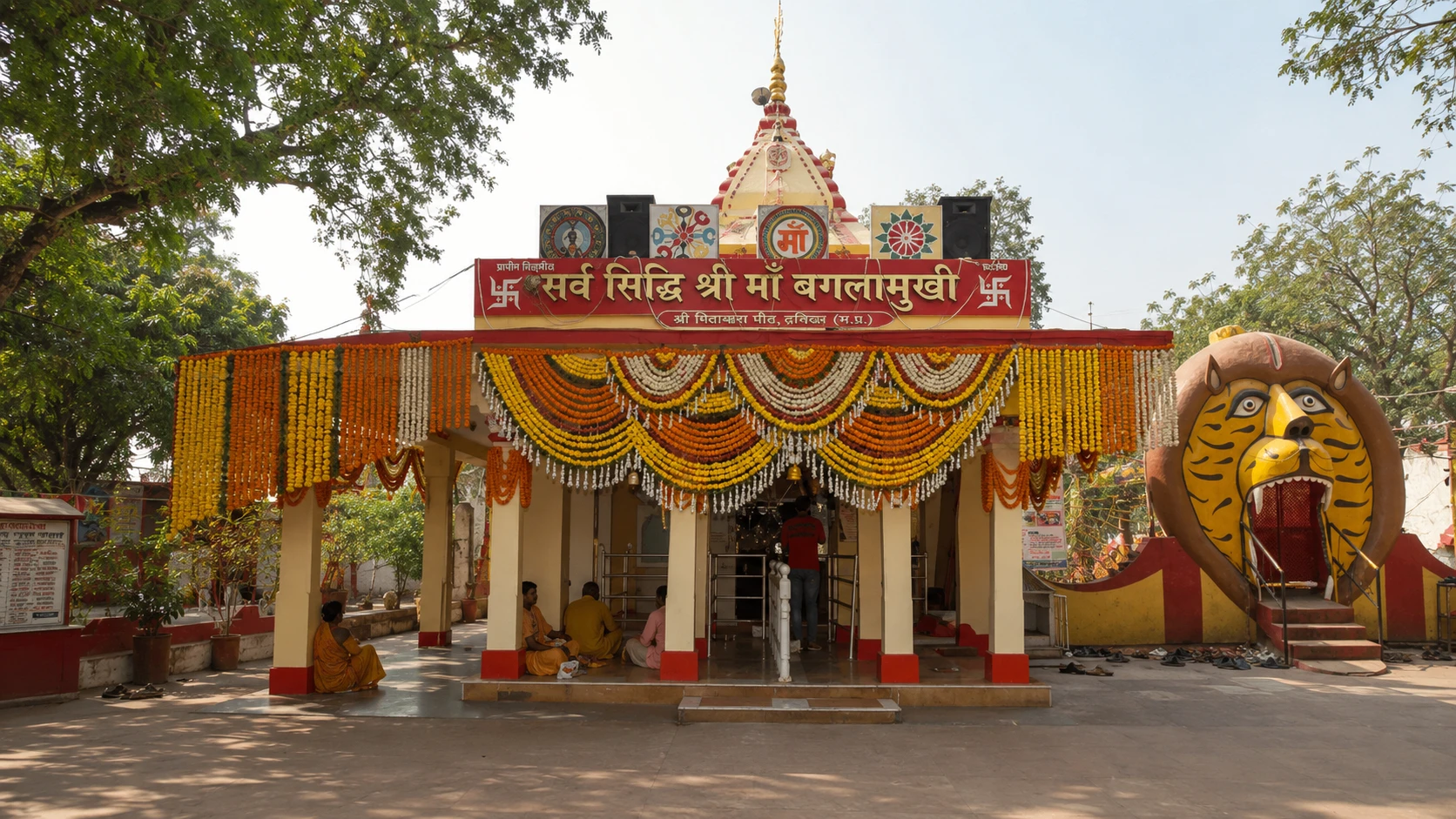
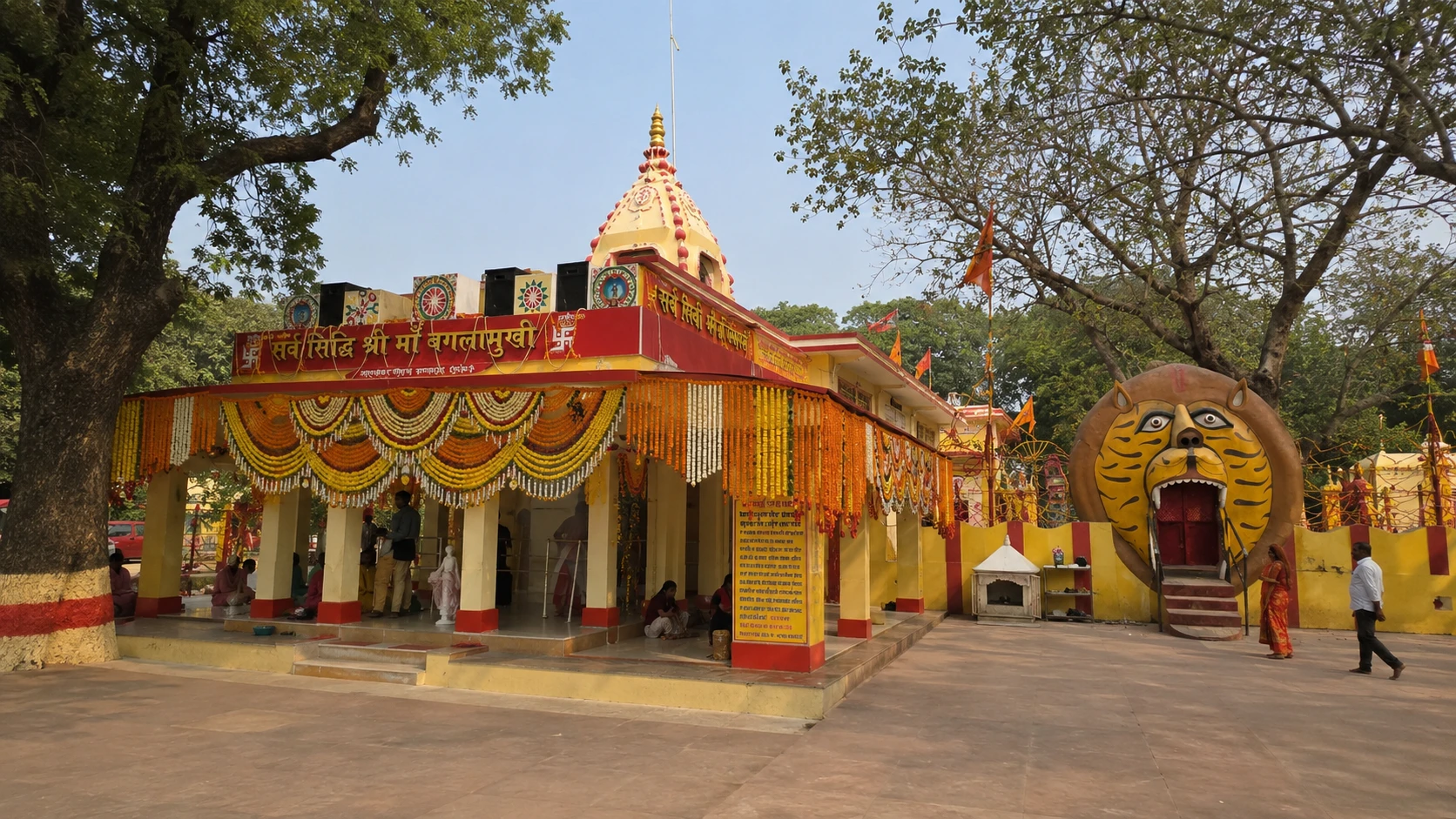
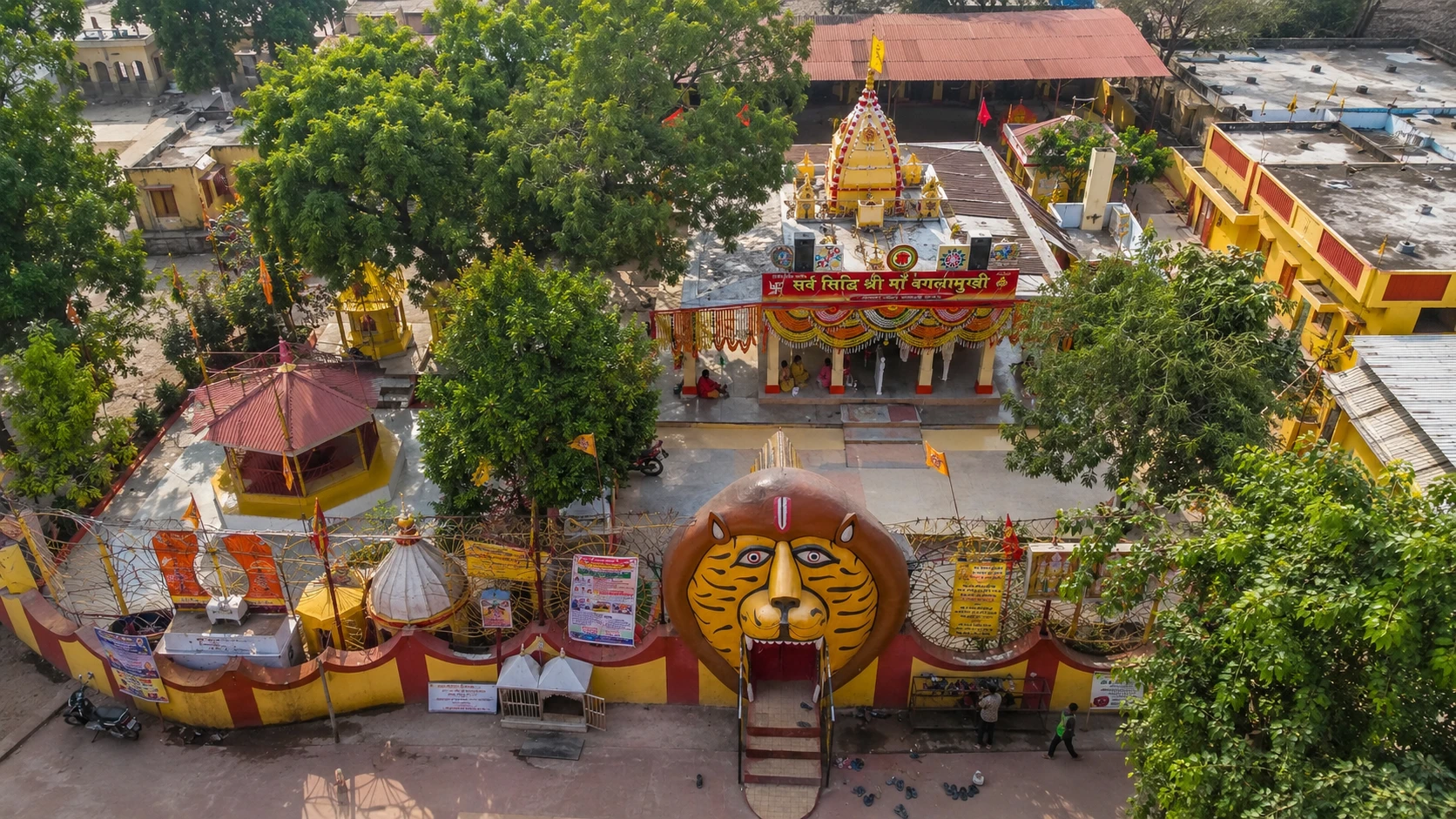
The most visually arresting feature of the Pitambara Peeth at Datia is the total commitment to yellow. Devotees are traditionally encouraged to wear yellow clothing before entering the temple complex. Offerings brought to the goddess are yellow — marigold flowers, turmeric (haldi), yellow sweets, saffron (kesar), yellow cloth. Even the puja paraphernalia — threads, dais, flower garlands — maintains the colour. The result is that the entire complex, on a busy day, moves in waves of yellow and gold.
Yellow (pita) is Bagalamukhi's elemental colour — the colour of turmeric, which is auspicious, purifying, and the colour of Haridra Sarovar from which she arose. Wearing yellow before the goddess is a form of self-identification with her energy — clothing oneself in the colour of her power before entering her presence. In the Tantric tradition, this alignment of the devotee's external form with the deity's elemental colour is understood as a preparation of the body-vehicle for receiving the deity's transmission.
Bagalamukhi Sahasranama Yajna
बगलामुखी सहस्रनाम यज्ञ
Special occasion puja; available on request at the Peeth
The Pitambara Peeth conducts formal homa (fire ritual) with recitation of the Bagalamukhi Sahasranama (thousand names). This is a major, multi-hour Tantric ritual conducted by initiated priests, typically commissioned by devotees seeking significant results — resolution of a major legal dispute, success in a significant political contest, overcoming a serious adversary. The ritual involves yellow offerings cast into fire, including turmeric, sesame, and specific Tantric substances.
The Sahasranama yajna at Bagalamukhi's shrine concentrates her immobilizing power through the repeated invocation of her thousand names — each name a different aspect of her stambhana capacity. The fire (agni) consecrates the offerings and carries the prayer directly to the goddess; the thousand names, recited without pause, build a sustained field of the goddess's presence that is believed to project her power into the specific situation the devotee has offered.
Did You Know?क्या आप जानते हैं?
The Pitambara Peeth at Datia is one of the very few sites in India where two Mahavidyas — Bagalamukhi and Dhumavati — are housed together in a single institutional complex and receive formal worship as a pair. The theological pairing is striking: Bagalamukhi is the Mahavidya of active immobilization (stilling everything by imposing power), while Dhumavati is the Mahavidya of passive stillness (still because she has consumed everything). Together they represent the two faces of divine stillness — the stillness of power and the stillness of exhaustion — both of which lead to the same liberation.
Kinsley, 'Tantric Visions of the Divine Feminine' (1997), Chapters 8–9; Pitambara Peeth institutional tradition
The Sanskrit name Bagalamukhi carries a deliberately ambiguous etymology that encodes her dual nature. The word 'bagala' (or 'baka') means the crane bird — famous in Sanskrit literature for its capacity to stand motionless in water for extended periods before striking with precision. But 'bagala' also connects to 'valga,' meaning the bridle or rein used to check a horse. Both meanings — the patient motionless hunter and the restraining bridle — describe Bagalamukhi's power of stambhana (immobilization) from different angles. She is simultaneously the stillness that hunts and the rein that stops.
Monier-Williams Sanskrit Dictionary (bagala, baka, valga entries); Kinsley, 'Tantric Visions' (1997), Chapter 9
The Datia Pitambara Peeth has an unusual concentration of devotees from specific professional categories — lawyers, competitive examination candidates, politicians, and military officers — who seek Bagalamukhi's blessing specifically before confrontational engagements. This practical, result-oriented devotion is documented in Tantric texts: the Meru Tantra and Bagalamukhi Tantra both contain extensive sections on the ritual procedures for defeating specific types of adversaries. The goddess's power of stambhana (immobilization of enemies and obstacles) is the most practically sought-after of all the Mahavidya powers.
Meru Tantra; Bagalamukhi Tantra; Kinsley, 'Tantric Visions' (1997)
Datia's Govind Mandir — built by Bundela king Vir Singh Deo between 1620 and 1627 — is considered one of the most sophisticated examples of Bundela-era palace architecture and is located minutes from the Bagalamukhi temple. The palace is a seven-storey structure built entirely without mortar, using an interlocking stone system, and features a complex of interconnected galleries, courts, and residential chambers designed as a self-contained royal city. A visit to the Bagalamukhi temple can be naturally combined with the architectural heritage of the Govind Mandir.
ASI, 'Datia' site documentation; Percy Brown, 'Indian Architecture (Islamic Period)' (1943)
Visitor Accessप्रवेश जानकारी
The Pitambara Peeth at Datia is open to all devotees. Wearing yellow clothing is strongly encouraged as per the temple tradition, though it is not formally mandatory for entry. Standard decorum applies: modest attire, footwear removed at the entrance, photography prohibited inside sanctums. The Peeth manages a formal puja booking system for special sevas; walk-in darshan is available during standard hours. During Navratri and major festivals, large crowds gather — plan accordingly.
Contact the Pitambara Peeth Datia trust directly for current puja booking, timing, and seva pricing. The Peeth has an established institutional management; verify the official website and contact details before booking. Wearing yellow is highly encouraged — many vendors near the temple sell yellow cloth and yellow offering items.
Festivalsत्योहार
Navratri (Chaitra and Ashwin)
नवरात्रि (चैत्र और आश्विन)
Mar–Apr (Chaitra) and Sep–Oct (Ashwin)
Both Navratri cycles are major events at the Pitambara Peeth — among the highest-attended festivals in Madhya Pradesh's Shakta temple circuit. As the eighth Mahavidya, Bagalamukhi receives special puja on the eighth day (Ashtami), which falls near the festival's climax. The combination of Navratri energy with Bagalamukhi's stambhana power makes this one of the most sought-after darshan periods in the year. Special homa and sahasranama yajnas are conducted throughout both Navratri cycles.
Bagalamukhi Jayanti
बगलामुखी जयंती
Apr–May (Vaishakh, Shukla Ashtami)
Bagalamukhi Jayanti, observed on the eighth day of the bright fortnight of Vaishakh, is the most significant festival specific to this goddess. At the Pitambara Peeth, the day is marked by pre-dawn rituals, elaborate homa with yellow offerings, extended recitation of the Bagalamukhi Sahasranama, and large congregations of devotees who have specifically come for this occasion. Initiated practitioners from across north and central India gather here.
Tuesday and Friday darshan
मंगलवार और शुक्रवार का दर्शन
Weekly
Tuesdays and Fridays are the weekly peak days at the Pitambara Peeth, as at most goddess temples. On these days the Peeth receives a particularly high proportion of devotees seeking specific blessings — students about to sit examinations, lawyers about to appear in court, candidates before elections. The goddess's power of stambhana is most actively sought on these days.
Traditional Offeringsपारंपरिक अर्पण
प्राथमिक अर्पण
Turmeric (Haldi)
हल्दी
हरिद्रा
Turmeric — haldi, haridra in Sanskrit — is the most characteristic and theologically loaded offering at Bagalamukhi's shrine. The goddess arose from Haridra Sarovar, the golden lake of turmeric; her complexion is turmeric-gold; the entire temple tradition is built around this colour. Offering turmeric to Bagalamukhi is not incidental but essential — the devotee offers the goddess the substance from which she was born, the colour of her nature, the matter of her sacred origin. Turmeric is also antiseptic, purifying, and protective — qualities consonant with the goddess's power to stop what threatens the devotee.
Yellow marigold (Genda phool)
पीला गेंदा
स्थलपद्म
Yellow marigold flowers — the most abundant yellow flower in the north Indian ritual context — are the primary floral offering at the Pitambara Peeth. Garlands of yellow marigold adorn the deity, the entrance arches, and the puja spaces. The flower's vibrant yellow precisely matches the goddess's elemental colour, and its strong fragrance fills the complex on busy days. At Bagalamukhi's shrine, the marigold's colour is not merely decorative — it is devotional identification with the goddess's energy.
Saffron (Kesar)
केसर
कुङ्कुम / केसर
Saffron — the most precious of spices, with its distinctive golden-yellow colour — is offered to Bagalamukhi as a substance that embodies the preciousness of her power. In Tantric ritual, saffron is used in puja to the goddess as a costly, concentrated form of the yellow colour that defines her tradition. It is dissolved in water and used for abhishekam, or offered dry. The golden colour of saffron water spread across the murti is one of the most visually resonant ritual moments in Bagalamukhi's worship.
Yellow cloth (Peela vastra)
पीला वस्त्र
पीतवस्त्र
Yellow cloth — pitambara — is the offering that most directly mirrors the goddess's own form. Pitambara Devi is named for her yellow garment; offering yellow cloth is an act of dressing the goddess in her own essential nature. Fine yellow silk or cotton is placed before the deity and used to drape the murti. This offering is also used as the ceremonial wrapper for the prasad distributed to devotees — the blessing literally goes home wrapped in the goddess's colour.
Yellow sweets (Peeli mithai — besan ke laddoo)
पीली मिठाई (बेसन के लड्डू)
Gram flour (besan) sweets — particularly besan ke laddoo, which are naturally golden-yellow — are the standard prasad offering at the Pitambara Peeth. In the puja tradition, offering food of the deity's colour completes the devotional circuit: the devotee offers yellow sweets, the goddess accepts the offering, and the prasad — now consecrated — returns to the devotee as the goddess's own nourishment. The yellow of the besan laddoo connects the offering directly to the goddess's elemental identity.
इस मंदिर की विशेषता
Yellow (turmeric) paste abhishekam
हल्दी लेपन अभिषेक
A distinctive seva at the Pitambara Peeth is the abhishekam of the deity with turmeric paste — the murti is anointed with a yellow paste made from turmeric, saffron, and ritual water. This is not offered at ordinary Shakta temples; it is specific to Bagalamukhi's tradition, physically bathing the goddess in the substance of her own mythological origin (Haridra Sarovar). The yellow paste turns the murti a vivid, luminous gold during the anointing, making the deity temporarily visible as her own primordial colour made flesh.
Yellow offerings in all forms are available from vendors lining the approach to the Pitambara Peeth — turmeric, yellow flowers, yellow cloth, saffron, and besan sweets. The Peeth trust also distributes official prasad. Devotees wishing yellow clothing to wear during darshan will find vendors selling yellow sarees, dupattas, and kurtas in the surrounding market. The yellow offering tradition is not merely decorative — it is the devotional practice, and approaching the temple in yellow is considered part of the act of worship itself.
How to Reachकैसे पहुँचें
Datia is well-connected by rail and road. By rail: Datia Railway Station is on the main Delhi–Agra–Gwalior–Bhopal line (Central Railway), approximately 2 km from the temple. Multiple daily trains connect Datia to Gwalior (approximately 1 hour), Agra (approximately 2.5 hours), and Bhopal (approximately 4 hours). The Shatabdi and other express trains stop at Gwalior; from Gwalior, Datia is a 1-hour road or rail journey. By road: NH-44 passes through Gwalior, from which Datia is approximately 75 km on SH-19; the road journey from Gwalior takes approximately 1.5 hours. Private taxis, state buses, and shared vehicles connect the two cities frequently. By air: Gwalior Airport (GWL) receives flights from Delhi and other cities; from Gwalior, hire a taxi to Datia. The Pitambara Peeth itself is located approximately 2 km from Datia Railway Station; auto-rickshaws and taxis are readily available. The Govind Mandir (Datia Palace), a significant architectural heritage site, is within walking distance of the temple complex.
Plan Your Visitयात्रा की योजना
🌤 सर्वोत्तम मौसम
October to March is the most comfortable season for Datia. The winter months are cool and ideal for the physical demands of a major pilgrimage site. Avoid peak summer (April–June) unless visiting for Bagalamukhi Jayanti in Vaishakh, when the religious significance outweighs the heat. Both Navratri periods bring large gatherings — plan well in advance for accommodation.
👘 पहनावे का नियम
Yellow clothing is strongly encouraged and is traditional at the Pitambara Peeth — many devotees travel specifically wearing yellow. White, saffron, or other modest attire is also acceptable. Footwear is removed at the temple entrance. Yellow cloth is available from vendors near the Peeth for those who wish to conform to the tradition.
📱 फोन और फोटोग्राफी
Mobile phones permitted in outer areas of the complex. Photography not allowed inside the sanctums of Bagalamukhi or Dhumavati. Follow posted instructions from Peeth management.
🏨 आवास
Datia has basic guesthouses and dharamshalas, including accommodation managed by the Pitambara Peeth trust itself for pilgrims. For better accommodation options, Gwalior (75 km) has a full range of hotels. Advance booking is essential during both Navratri periods and Bagalamukhi Jayanti.
Book a Pujaपूजा बुक करें
Booking links and phone numbers are verified periodically but may change without notice. The Pitambara Peeth has an institutional puja booking system; however, the specific official portal URL, current pricing, and contact details have not been independently verified for this entry. Verify all booking details directly with the Pitambara Peeth Trust, Datia before proceeding. Be cautious of third-party websites claiming to offer puja bookings on behalf of the Peeth.
Managed by: Pitambara Peeth Trust, Datia
Bagalamukhi Sahasranama Yajna (special homa)
बगलामुखी सहस्रनाम यज्ञ
Vishesh Puja (Special Puja)
विशेष पूजा
Navratri special darshan and puja
नवरात्रि विशेष दर्शन और पूजा
Booking information verified: 2026-05-23
Sacred Soundsपवित्र ध्वनि
क्या आप जानते हैं? · Did You Know?
वही अनुवाद त्रुटि जिसने हिन्दू धर्म में '33 कोटि' को '33 करोड़' बनाया, बौद्ध धर्म में भी हुई। बौद्ध ग्रन्थों के चीनी अनुवाद ने 'सप्त कोटि बुद्ध' (7 श्रेष्ठ बुद्ध) का अनुवाद '7 करोड़ बुद्ध' कर दिया। तिब्बती अनुवाद ने सही किया: 7 प्रकार, 7 करोड़ नहीं। एक संस्कृत शब्द, दो प्रमुख विश्व धर्मों में गलत पढ़ा गया, ने दो एकसमान भ्रम स्वतन्त्र रूप से उत्पन्न किए।
Related Contentसंबंधित सामग्री
Related Scriptures
Related Temples
Dhumavati Mandir (Varanasi)
धूमावती मंदिर
Varanasi, Uttar Pradesh
Bhuvaneshwari Mata (Gauhati)
भुवनेश्वरी माता
Gauhati, Assam
Bhairavi Mata Temple
भैरवी माता मंदिर
Tezpur, Assam
Chinnamasta Mandir (Rajrappa)
छिन्नमस्ता मंदिर
Rajrappa, Jharkhand
Matangeshwar Mandir (Khajuraho)
मातंगेश्वर मंदिर
Khajuraho, Madhya Pradesh
Kamala Devi (Bishnupur)
कमला देवी मंदिर
Bishnupur, West Bengal
Shodashi Tripurasundari (Kanchipuram)
षोडशी त्रिपुरसुंदरी
Kanchipuram, Tamil Nadu
Community Reflections
🕉️
Be the first to share your reflection.