Bhuvaneshwari Mata (Gauhati)
भुवनेश्वरी माता
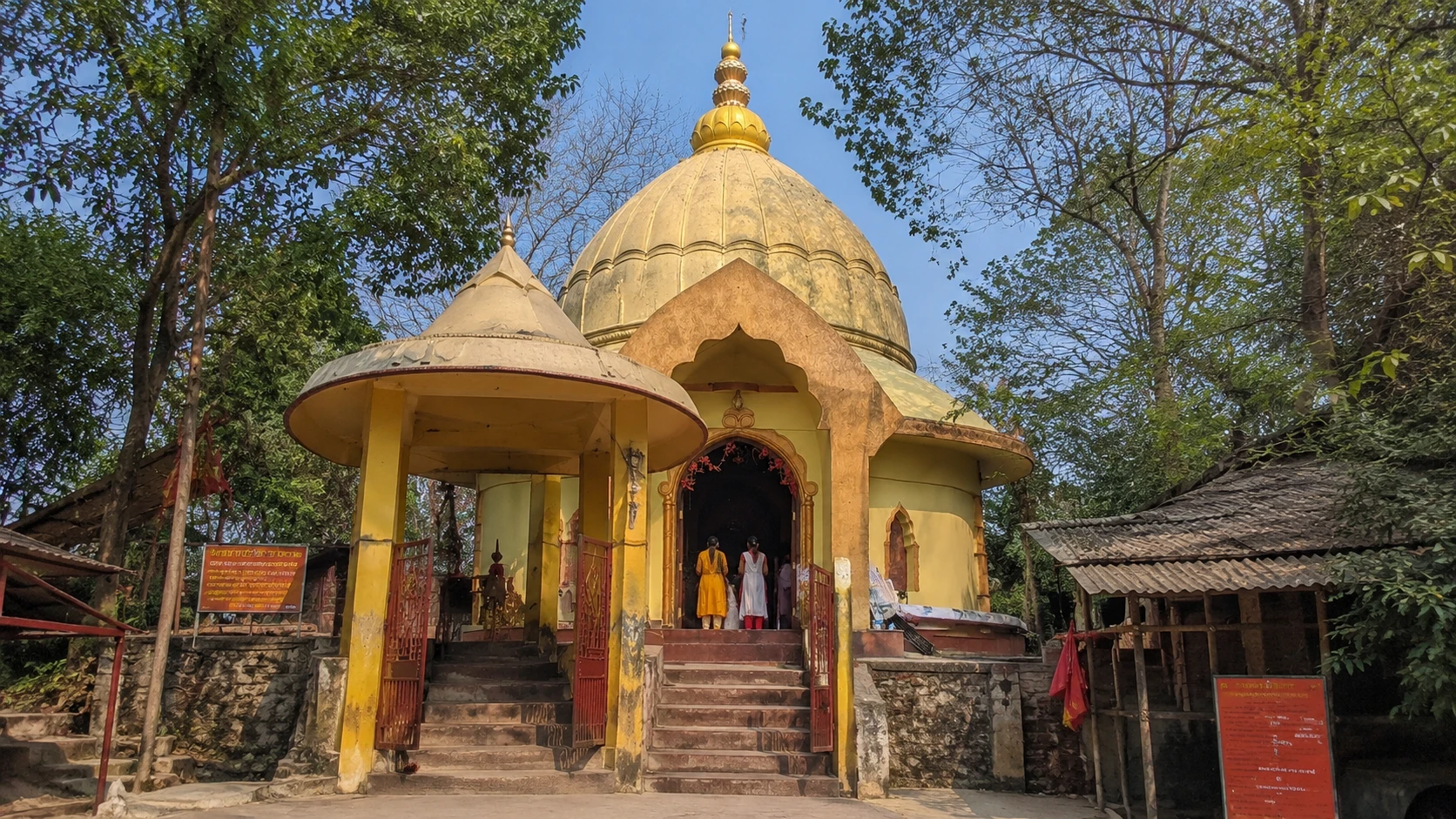
Fourth Mahavidya — the goddess whose body is the universe itself
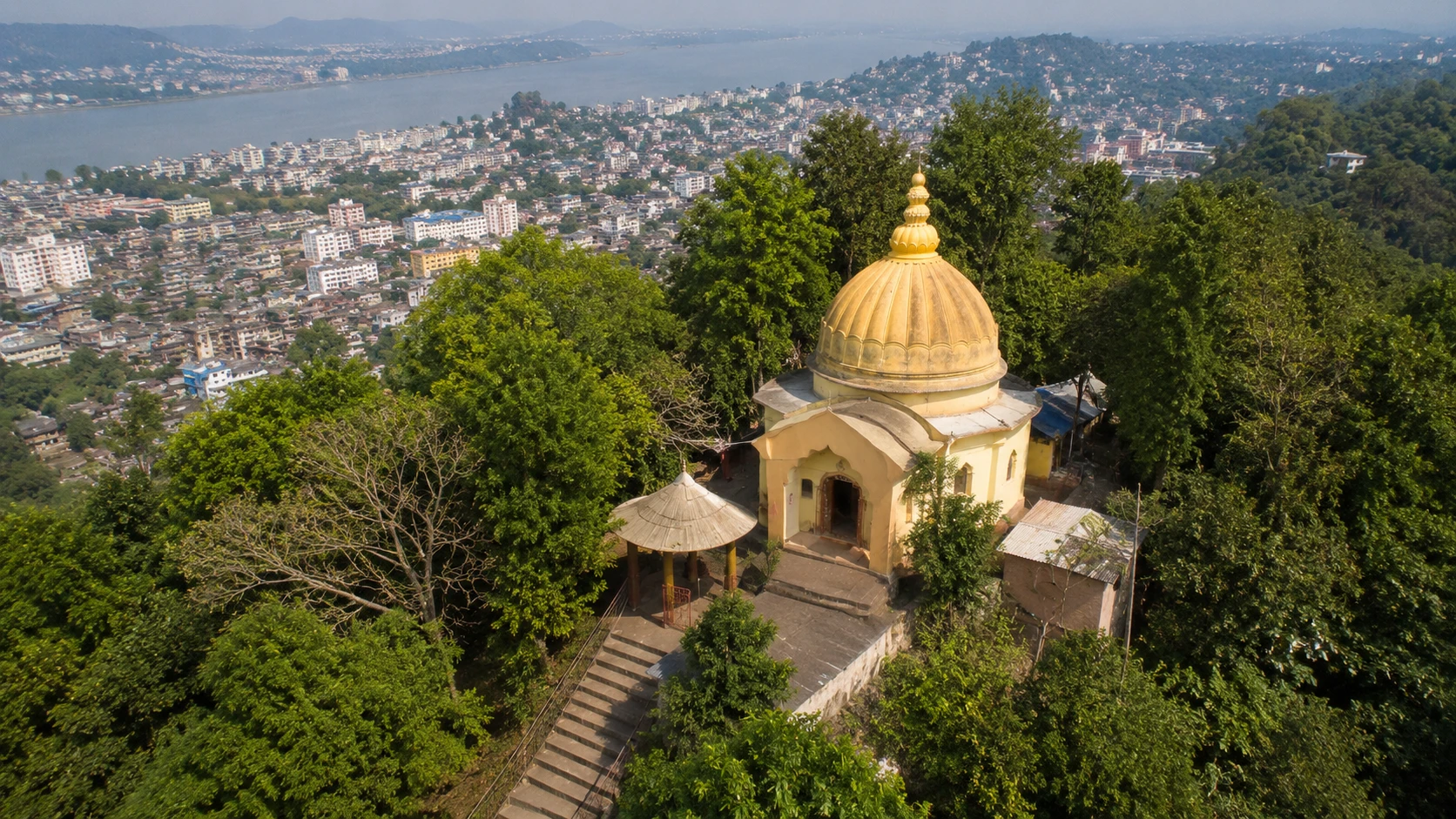
Gauhati, Assam, India
BhuvanēśvarīAlso known as: Bhuvaneshwari Devi, Bhuvaneswari Mata, Adi Shakti Bhuvaneshwari, Jagat Janani, Bhuvaneshwari Mandir Guwahati
युग
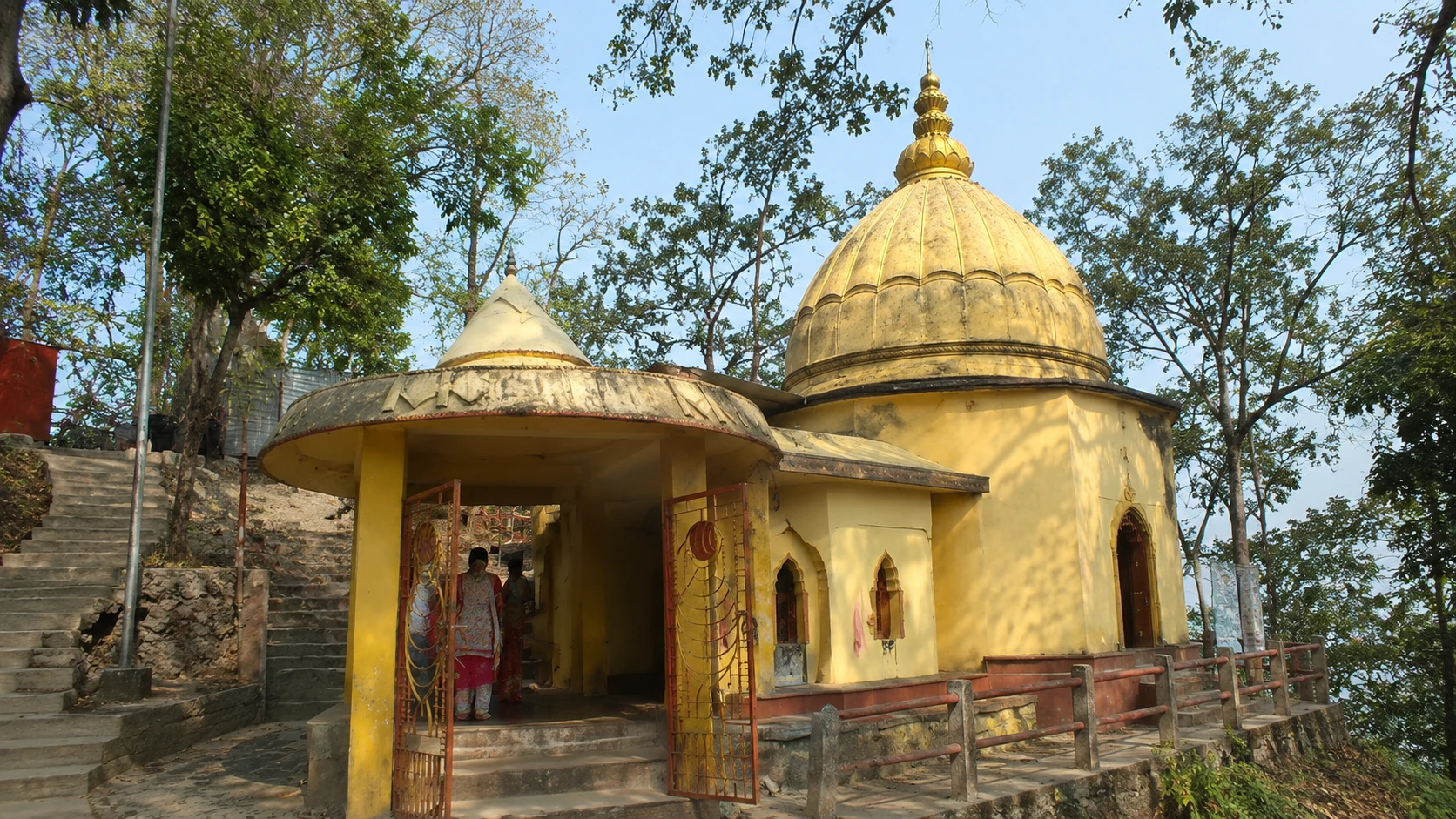
Medieval tradition; current structure 20th century
वास्तुकला
Assamese (vernacular Nagara variant)
खुला
06:00 – 20:00
आरती
06:00 · 12:00 · 18:00
पवित्र कथा · पवित्र कथा
Bhuvaneshwari is the Mahavidya who is the universe. Not a deity who rules it, not one who created it — but the one whose body is it. The three worlds are her form; space itself is her nature. At her Guwahati shrine, set within the charged Shakta landscape of Assam where the Mahavidya tradition runs deepest in all of India, she is worshipped as the fourth of the ten great wisdom-goddesses — the one whose crimson complexion glows like the rising sun, who holds the noose of attachment and the goad of liberation in her upper hands, and who offers fearlessness and grace with her lower two. In Tantric understanding, every act of perception is her act; every experience of the world is the devotee resting in her body. The mantra Hreem — a single syllable — is said to contain her entire cosmological reality.
Sacred Designationपवित्र पदनाम
Sacred Origin Storyपवित्र उत्पत्ति कथा
Source: Shakta Tantra / Dasha Mahavidya tradition (Bengal–Assam lineage)
In the Shakta Pramoda and the Tantrasara, Bhuvaneshwari is described as the fourth of the ten Mahavidyas who arose from the primordial body of Adi Shakti when Shiva sought to prevent her from attending Daksha's yajna. She is the goddess of space (akasha) and the embodiment of the three worlds — bhur, bhuvah, and svah — hence her name: Bhuvaneshwari, the Lady of the Worlds. She is identified with Maya, the creative power through which Brahman projects the universe. The Devi Bhagavata Purana (Skanda 7) identifies her with Adi Shakti herself — the primordial energy whose womb holds all creation. Her complexion is crimson-gold like the rising sun; her three eyes blaze with knowledge. The crescent moon on her forehead marks her as co-extensive with time itself. In her four hands she holds the pasha (noose representing the bonds of samsara), the ankusha (goad representing discipline that leads to liberation), and makes the abhaya and varada gestures — offering both fearlessness and the fulfillment of desire. Tantric texts describe her as the one in whom the universe dissolves and from whom it re-emerges in an endless cycle. The Nilachal Hill region of Guwahati, already sanctified as one of the most powerful Shakta seats on earth through the presence of Kamakhya, is the fitting seat for Bhuvaneshwari — whose cosmic scope encompasses all Shakta geography.
उद्धृत स्रोत:
- Shakta Pramoda (composite Shakta ritual compendium; references to Bhuvaneshwari puja vidhi)
- Tantrasara, Krishnananda Agamavagisha (16th–17th century, Bengal Tantric tradition)
- Devi Bhagavata Purana, Skanda 7 (on Adi Shakti and the ten Mahavidyas)
- David Kinsley, 'Tantric Visions of the Divine Feminine: The Ten Mahavidyas' (1997), University of California Press — Chapter 5
विद्वत संदर्भ
David Kinsley's 'Tantric Visions of the Divine Feminine' (1997) remains the standard scholarly treatment of the Mahavidyas as a group. He notes that Bhuvaneshwari's identification with space (akasha) and with Maya reflects a philosophical synthesis of Shakta cosmology and Advaita Vedanta — the world is not illusion to be discarded but the goddess's own body to be reverenced. The Mahavidya sequence as a canonical group of ten is attested from approximately the 10th–12th centuries in Bengal–Assam Tantric manuscripts; the precise canonical ordering, which places Bhuvaneshwari fourth, varies slightly by text tradition (some texts place her third, exchanging her position with Shodashi). The Guwahati location reflects Assam's regional Shakta tradition, which has historically maintained strong Tantric lineages and where the Kamakhya complex functions as a complete Dasha-Mahavidya Kshetra — a concentration of all ten Mahavidya shrines without parallel elsewhere in India. Bhuvaneshwari is also closely associated with the Sri Vidya tradition, where she is sometimes aligned with Lalita Tripurasundari as complementary expressions of the cosmic feminine.
Historyइतिहास
The worship of Bhuvaneshwari in the Guwahati region is inseparable from Assam's profound Shakta identity, which stretches back to the earliest known layers of Tantric practice in the subcontinent. Ancient Kamarupa — the Sanskrit name for the Assam region — is identified in the Kalika Purana (c. 10th century CE) as the foremost Shakta land in all of creation, and the Nilachal Hill area of Guwahati as its most potent spiritual concentration. Within the broader Kamakhya pilgrimage circuit, multiple Mahavidya shrines exist at various points on and around Nilachal Hill, each dedicated to one of the ten wisdom goddesses and collectively making the complex a Dasha-Mahavidya Kshetra — a complete geography of all ten Mahavidyas. The Bhuvaneshwari shrine is understood in the local tradition as one of these satellite seats that collectively complete the circuit. The Koch dynasty rulers of Assam (16th–17th centuries), who undertook the major reconstruction and expansion of the Kamakhya complex following earlier neglect, are generally credited in local tradition with extending royal patronage to the associated Mahavidya shrines in the area. The devastating earthquake of June 1897 (magnitude approximately 8.1) caused widespread structural damage across the Guwahati region, necessitating substantial rebuilding at many sacred sites. The current structure at the Bhuvaneshwari shrine is a product of 20th-century reconstruction. The Assam Shakta tradition preserves detailed puja vidhis for all ten Mahavidyas, and worship at this shrine follows Tantric protocols compiled in texts such as the Shakta Pramoda and the Tantrasara.
Historical Timelineऐतिहासिक कालक्रम
Composition of the Kalika Purana in the Kamarupa region establishes the theological framework for Nilachal Hill as the supreme Shakta kshetra, providing scriptural legitimacy for all temple worship in the area including Mahavidya shrines.
Koch king Naranarayan and general Chilarai undertake major reconstruction of the Kamakhya complex on Nilachal Hill. Royal patronage during this period is understood in local tradition to have extended to associated Mahavidya shrines in the vicinity.
The Kamakhya main temple's 1565 reconstruction under Naranarayan is the well-documented event. Attribution of Koch patronage specifically to the Bhuvaneshwari satellite shrine is based on the established general programme; documentary evidence for individual satellite shrines is less complete and should be treated as traditional attribution pending archival research.
The great earthquake of 12 June 1897 (estimated magnitude 8.1), centred in the Shillong Plateau, caused widespread structural damage to temple buildings across Assam and the Brahmaputra valley. Sites in the Guwahati area including the Nilachal Hill complex required significant repair or rebuilding in subsequent decades.
Current temple structure at the Bhuvaneshwari shrine results from 20th-century reconstruction and renovation. Exact construction dates and patrons for the present structure are unverified in this entry and should be confirmed with local temple authorities.
Operational and construction details for this specific shrine require on-ground verification. This event entry should be updated with sourced information from the temple trust or local Assam Shakta documentation.
What You'll Seeदर्शन में
Bhuvaneshwari is depicted in a distinctly regal form. Her complexion is described in the Tantrasara as the red of the rising sun — vivid, luminous, life-giving. She is three-eyed (tri-netra), signifying perception beyond ordinary sight. The crescent moon (ardha-chandra) adorns her forehead, marking her as transcendent over cyclical time. In her four hands she carries: the pasha (noose) in the upper right — representing the bonds of material existence; the ankusha (elephant goad) in the upper left — the instrument of discipline that leads the devotee out of those bonds; the lower right makes the abhaya mudra (gesture of fearlessness); and the lower left makes the varada mudra (gesture of boon-giving). She is typically depicted seated on a lotus or on the recumbent form of Shiva, indicating her primacy over even the masculine divine principle. Dressed as a queen with fine ornaments, her expression is simultaneously maternal and omnipotent — the face of the universe looking at its own creation with love. Photography is not permitted inside the inner sanctum.
Distinctive Practicesविशिष्ट परंपराएँ
Hreem Japa
ह्रीं जप
Daily, particularly at dawn and dusk aarti periods
The single-syllable bija mantra of Bhuvaneshwari is Hreem — one of the most potent bija mantras in the Shakta Tantric tradition. Devotees at this shrine perform repetitive japa of this syllable, particularly during the morning and evening aarti periods, believing the sound to embody the goddess's cosmic creative power in its most concentrated form.
In the Tantrasara and the Shakta Pramoda, Hreem is described as the Maya-bija — the seed-sound of the goddess's cosmic creative power. Japa of Hreem is said to gradually dissolve the practitioner's sense of separation from the universe, leading to the recognition that the world and the self are both expressions of the goddess's body. It is the mantra of expansion — of consciousness opening to identify with the cosmos rather than contract around a limited self.
Did You Know?क्या आप जानते हैं?
Bhuvaneshwari is the only Mahavidya explicitly identified with space (akasha) as her primary element. While other Mahavidyas are associated with states of consciousness, transformative processes, or aspects of time, Bhuvaneshwari represents the field in which all phenomena occur — the pure spatial capacity of the universe. This makes her philosophical position unique among the ten: she is not a force within the cosmos but the container that makes the cosmos possible.
David Kinsley, 'Tantric Visions of the Divine Feminine: The Ten Mahavidyas' (1997), UC Press, Chapter 5
The bija mantra Hreem is analyzed in the Tantrasara as a sonic architecture of the universe. Its three phonetic components carry cosmological meaning: Ha represents space and Shiva; Ra is fire and energy (Shakti's heat); Ii is Mahamaya herself; and the bindu (the nasal dot at the end) represents the point of dissolution where all distinctions collapse. The mantra is thus not a word describing the goddess — it is a sound that enacts her.
Tantrasara (Krishnananda Agamavagisha, 16th–17th century); Arthur Avalon (John Woodroffe), 'The Garland of Letters' (1922)
Assam's Kamarupa region is unique in India as the only geography where all ten Mahavidyas have dedicated shrines within a concentrated pilgrimage circuit centred on and around the Kamakhya complex in Guwahati. This makes the region a complete Dasha-Mahavidya Kshetra — the sacred geography of all ten wisdom goddesses in one place. No comparable geographic concentration of all ten Mahavidyas exists anywhere else in the subcontinent.
B.K. Kakati, 'The Mother Goddess Kamakhya' (1948), Gauhati University; Diana Eck, 'India: A Sacred Geography' (2012), pp. 228–229
The name Bhuvaneshwari is a Sanskrit compound: bhuvana (world or universe, from the root bhu meaning to be or to exist) and ishwari (the feminine form of ishvara, meaning lord or sovereign). The name does not describe an attribute of the goddess — it describes her identity. She does not rule the world as a sovereign rules a territory; she is the being of the world. The name is thus among the most philosophically precise in the Shakta pantheon.
Monier-Williams Sanskrit Dictionary (1899); Kinsley, 'Tantric Visions of the Divine Feminine' (1997)
Visitor Accessप्रवेश जानकारी
The Bhuvaneshwari Mata temple in Guwahati is open to devotees of all backgrounds. Standard temple decorum applies: traditional or modest attire is expected, footwear is removed before entry, and photography is not permitted inside the inner sanctum. Devotees are advised to verify current visiting timings directly with local temple management before travel, as hours may vary seasonally.
Contact local temple management in Guwahati directly for current timings and seva options. The nearby Kamakhya Devalaya Trust's official website (kamakhyatemple.org) provides contextual information for the Nilachal Hill complex.
Festivalsत्योहार
Navratri (Chaitra and Ashwin)
नवरात्रि (चैत्र और आश्विन)
Mar–Apr (Chaitra) and Sep–Oct (Ashwin)
Both the spring and autumn Navratri are observed at this shrine. As the fourth Mahavidya, Bhuvaneshwari receives special puja on the fourth day of each Navratri cycle. The Kamakhya complex's Navratri draws pilgrims from across Assam and Northeast India, and the Mahavidya shrines form an integral part of the traditional pilgrimage circuit during these nine nights.
Ambubachi Mela
अम्बुबाची मेला
Jun (Ashadha, 3 days)
While the Ambubachi Mela is centred on the Kamakhya temple — marking the three days when the goddess is believed to be in her menstrual cycle and the main sanctum closes — all Mahavidya shrines in the Nilachal complex carry deep significance during this period. Tantric practitioners (sadhus, Tantrikas, and initiated devotees) who gather from across India for Ambubachi typically include visits to the satellite Mahavidya shrines in their sadhana circuit. The Bhuvaneshwari shrine sees heightened activity during this gathering.
Durga Puja
दुर्गा पूजा
Sep–Oct (Ashwin, 10 days)
Durga Puja is the defining festival of the Bengali and Assamese communities and is celebrated with great fervour across Guwahati. Mahavidya shrines in the city receive special attention during this period, as Bhuvaneshwari — the universe-as-goddess — is deeply consonant with the Durga Puja theology of celebrating the goddess's cosmic victory. Extended puja schedules and special decorations mark the Puja days at the shrine.
Traditional Offeringsपारंपरिक अर्पण
प्राथमिक अर्पण
Red hibiscus (Jaba flower)
जवा पुष्प (लाल हिबिस्कस)
जपापुष्प
The red hibiscus is the preeminent floral offering to Shakti across the Assam–Bengal Shakta tradition. Its deep crimson colour resonates with the goddess's own red complexion and with the life-giving solar energy she embodies. In the Devi Bhagavata and regional Shakta puja vidhis, the jaba flower is described as especially beloved of the goddess in her fierce-benevolent Tantric forms. For Bhuvaneshwari — whose complexion is identified with the rising sun — the jaba flower's colour is a direct devotional echo.
Red cloth (Lal vastra)
लाल वस्त्र
रक्तवस्त्र
Red fabric is the traditional offering to Bhuvaneshwari and most Shakta Mahavidya deities. In the Tantric tradition, the colour red represents Shakti's creative energy (rajoguna), the vitality of life, and the colour of the rising sun with which Bhuvaneshwari's complexion is specifically identified. Offering red cloth is an act of recognising and venerating the goddess's own essential nature — clothing the universe in its own colour.
Kumkum (vermilion powder)
कुमकुम
कुङ्कुम
Kumkum — red vermilion — is placed at the feet of the goddess and applied to the forehead of the devotee during darshan. In the Shakta tradition it represents the goddess's activated energy, the opening of the ajna chakra (third eye), and the passage of her blessing into the devotee. It is among the most fundamental offerings across all Devi traditions and carries particular resonance at Bhuvaneshwari's shrine given her identification with the colour of the sun.
Betel leaf with areca nut (Tambula)
पान-सुपारी (ताम्बूल)
ताम्बूल
Betel leaf with areca nut (tambula) is a traditional offering across Assamese Shakta worship, considered both auspicious and pleasing to the goddess. In the local puja tradition it functions as a symbol of welcome hospitality — treating the goddess as an honored guest to whom tambula is offered at the conclusion of a formal reception. Its use in ritual mirrors its use in human social life, bridging the ordinary and the sacred.
Coconut
नारियल
नारिकेल
The coconut is offered across nearly all Hindu temple traditions, but in Shakta contexts it carries additional significance. Breaking a coconut before the goddess represents the breaking open of the ego (the hard outer shell) to reveal the sweetness of devotion within. In Tantric iconography the coconut is also associated with the kapala (skull-bowl), connecting it to the goddess's acceptance of all aspects of existence — from birth to dissolution.
Offering items including flowers, red cloth, kumkum, and coconuts are available from vendors near the approach to the Nilachal Hill temple area. Devotees may bring offerings from outside. The specific prasad distribution practice of the Bhuvaneshwari shrine should be confirmed with local temple management.
How to Reachकैसे पहुँचें
Guwahati is the primary gateway for pilgrimage in Northeast India and is well connected by all three modes of transport. By air: Lokpriya Gopinath Bordoloi International Airport (IATA: GAU) receives flights from Delhi, Kolkata, Mumbai, Bangalore, Chennai, and Hyderabad. Taxis and app-based cabs connect the airport to the city in approximately 40–60 minutes depending on traffic. By rail: Kamakhya Railway Station (on the Northeast Frontier Railway) is the closest station to the Nilachal Hill complex at approximately 3 km — auto-rickshaws and taxis from the station serve the temple area directly. Guwahati Railway Station (7 km) handles the major long-distance trains including Rajdhani Express from Delhi (approximately 36–40 hours) and express services from Kolkata (12–14 hours). By road: Guwahati is connected by NH-27 and other national highways to Assam's major towns; state buses and private coaches run from Shillong, Tezpur, Jorhat, and Dibrugarh. Within the city, the Nilachal Hill area is reachable by city bus (Kamakhya routes), taxi, or auto-rickshaw. The hill involves a short climb; pilgrims with mobility concerns may use the ropeway service available at the Kamakhya complex.
Plan Your Visitयात्रा की योजना
🌤 सर्वोत्तम मौसम
October to March offers the most comfortable visiting conditions — post-monsoon clarity, pleasant temperatures (15–28°C), and clear skies. The Ambubachi Mela in June draws the largest gatherings of Tantric practitioners and pilgrims; if this is the purpose of a visit, expect very large crowds and plan accommodation well in advance. Monsoon (June–September) brings heavy rainfall but also lush greenery across the Brahmaputra valley.
👘 पहनावे का नियम
Traditional or modest attire is expected at all Shakta temples in the Guwahati area. Western-style shorts and sleeveless tops are generally not appropriate for temple entry. Sarees, salwar kameez, or dhoti-kurta are appropriate. Footwear is removed at the entrance to the temple premises.
📱 फोन और फोटोग्राफी
Mobile phones are generally permitted in the outer areas of the temple complex. Photography is not permitted inside the inner sanctum (garbhagriha). Follow posted signage and instructions from temple staff at all times.
🏨 आवास
Guwahati has a full range of accommodation from budget guesthouses to mid-range hotels, concentrated in Paltan Bazar, Fancy Bazar, and Dispur. The Assam Tourism Development Corporation (ATDC) operates state guesthouses. Dharamshalas catering to pilgrims are available in the Kamakhya area. Most pilgrims to the Nilachal Hill complex stay in the main city given limited accommodation directly on the hill.
Sacred Soundsपवित्र ध्वनि
क्या आप जानते हैं? · Did You Know?
वही अनुवाद त्रुटि जिसने हिन्दू धर्म में '33 कोटि' को '33 करोड़' बनाया, बौद्ध धर्म में भी हुई। बौद्ध ग्रन्थों के चीनी अनुवाद ने 'सप्त कोटि बुद्ध' (7 श्रेष्ठ बुद्ध) का अनुवाद '7 करोड़ बुद्ध' कर दिया। तिब्बती अनुवाद ने सही किया: 7 प्रकार, 7 करोड़ नहीं। एक संस्कृत शब्द, दो प्रमुख विश्व धर्मों में गलत पढ़ा गया, ने दो एकसमान भ्रम स्वतन्त्र रूप से उत्पन्न किए।
Related Contentसंबंधित सामग्री
Related Scriptures
Related Temples
Kamakhya Temple
कामाख्या मंदिर
Guwahati, Assam
Bhairavi Mata Temple
भैरवी माता मंदिर
Tezpur, Assam
Chinnamasta Mandir (Rajrappa)
छिन्नमस्ता मंदिर
Rajrappa, Jharkhand
Dhumavati Mandir (Varanasi)
धूमावती मंदिर
Varanasi, Uttar Pradesh
Bagalamukhi Mandir (Datia)
बगलामुखी मंदिर
Datia, Madhya Pradesh
Matangeshwar Mandir (Khajuraho)
मातंगेश्वर मंदिर
Khajuraho, Madhya Pradesh
Kamala Devi (Bishnupur)
कमला देवी मंदिर
Bishnupur, West Bengal
Shodashi Tripurasundari (Kanchipuram)
षोडशी त्रिपुरसुंदरी
Kanchipuram, Tamil Nadu
Community Reflections
🕉️
Be the first to share your reflection.