Dhumavati Mandir (Varanasi)
धूमावती मंदिर
Seventh Mahavidya — the widow goddess who consumed Shiva and dwells in the city of his body
Varanasi, Uttar Pradesh, India
DhūmāvatīAlso known as: Dhumavati Mata, Dhuma Devi, Alakshmi, Jyeshtha, Nirrti, Kashi Dhumavati
युग
Ancient tradition; current structure details unverified — temple embedded in the old city fabric
वास्तुकला
North Indian vernacular temple (old city lane construction)
खुला
05:00 – 21:00
आरती
05:30 · 12:00 · 19:00
विशेष
Ashtami (eighth day of lunar fortnight) is particularly auspicious for Dhumavati worship
पवित्र कथा · पवित्र कथा
Dhumavati is the goddess that conventional religion turns away from. She is old, gaunt, and smoke-gray — riding a horseless chariot with a crow as her companion and a winnowing basket in her hand. She is a widow: the only major deity in the Hindu pantheon depicted without a consort, because she consumed her own husband. When Shiva would not feed her, hunger drove her beyond patience and beyond propriety, and she swallowed him. Smoke rose from that act — dhuma — and she emerged: autonomous, uncontained, magnificently free of everything considered auspicious. In Varanasi — the city of Shiva, the city of death, the city where liberation itself is said to be dispensed at the moment of dying — her shrine is not a peripheral curiosity but a theological necessity. She who consumed Shiva must have her temple in Shiva's own city. She is the goddess who reveals that beneath all the beauty, wealth, and fulfilment that religion ordinarily promises, there is a prior truth: this, too, will go. And in that going, she is present.
Sacred Designationपवित्र पदनाम
Sacred Origin Storyपवित्र उत्पत्ति कथा
Source: Shakta Tantra / Dasha Mahavidya tradition; Mundamala Tantra and Prapanchasara Tantra lineage
The Mundamala Tantra and the Shakta Pramoda describe Dhumavati's origin in an act of divine hunger that breaks every social convention. The primordial Shakti was overcome by a ravenous hunger and requested Shiva to provide food. Shiva repeatedly denied her. When the hunger became unbearable — when desire exceeded all limits and all propriety — she consumed Shiva himself. The act was total: she swallowed the divine masculine into herself. Smoke (dhuma) arose from this consumption, billowing out from her in vast clouds, and she emerged as Dhuma-vati — she in whom smoke dwells, she who is the residue of what the feminine devours when the masculine fails to sustain her. Because she had consumed her own husband, she became a widow — no longer defined by conjugal relationship, no longer contained within the auspicious frame of marriage. She became autonomous in the most radical sense. In the deeper Tantric reading, Dhumavati represents the state of pure, unfulfilled desire — the awareness that remains when every object of desire has been consumed and nothing is left. She is Shunya (void), Nirrti (disorder), the state that precedes creation. She is not a stage to pass through but the underlying reality that is always present beneath the surface of apparent fulfilment. The Prapanchasara Tantra adds another layer: Dhumavati is the consciousness that sees the impermanence of all phenomena — not with despair but with clarity. The winnowing basket (sup) she carries separates grain from chaff; what she winnows is the practitioner's experience, removing the illusory value from things that seem desirable until only the essential remains.
उद्धृत स्रोत:
- Mundamala Tantra (Shakta Tantric text; primary source for Dhumavati's mythology and iconography)
- Prapanchasara Tantra (Shankaracharya tradition attribution; Dhumavati section)
- Shakta Pramoda (composite Shakta ritual compendium)
- David Kinsley, 'Tantric Visions of the Divine Feminine: The Ten Mahavidyas' (1997), University of California Press — Chapter 8
- Devi Bhagavata Purana, Skanda 7
अन्य परंपराएँ · अन्य परंपराएँ
Dhumavati as Sati's grief-form (Shakta Pramoda alternate passage)
A secondary account in the Shakta tradition identifies Dhumavati with the form Sati took after her immolation in Daksha's yajna — not as a vengeful act but as a grief-laden one. Having sacrificed herself, having lost the conjugal bond that defined her existence in that incarnation, and preceding the reconstitution of identity in the next birth, Sati existed in an intermediate state of desolation, smoke, and formlessness. This is the state Dhumavati embodies: the grief between loss and renewal, the smoke between the fire that was and the flame that will come. This alternate account emphasises Dhumavati's compassion for those in grief, particularly those who have lost spouses or loved ones.
विद्वत संदर्भ
Kinsley (1997, Chapter 8) identifies Dhumavati as the most unconventional of the Mahavidyas — a goddess who embodies everything the mainstream Hindu tradition defines as inauspicious (poverty, old age, widowhood, the crow, smoke, hunger). Yet she is worshipped in the Tantric tradition precisely for this unconventionality: her domain is the domain of what conventional religion refuses to face. She represents the Tantric principle that liberation comes not from avoiding the inauspicious but from encountering it directly and recognising it as divine. Kinsley notes her identification with Alakshmi (the anti-Lakshmi), with Nirrti (destruction), and with the void (shunya) — all aspects of the divine feminine that represent exhaustion, privation, and the absence of conventional blessing. His reading of her winnowing basket as the instrument of spiritual discernment — separating illusion from reality — is the most theologically productive interpretation. The Varanasi location is particularly resonant: Diana Eck's analysis of Kashi in 'India: A Sacred Geography' (2012) describes the city as the body of Shiva himself; Dhumavati's presence in this body is the smoking residue of what she consumed. Varanasi's dense Tantric landscape — with its cremation grounds (Manikarnika Ghat), its Shakti Peetha (Vishalakshi), and its centuries of Tantric practice — makes it the most appropriate city for her worship.
Historyइतिहास
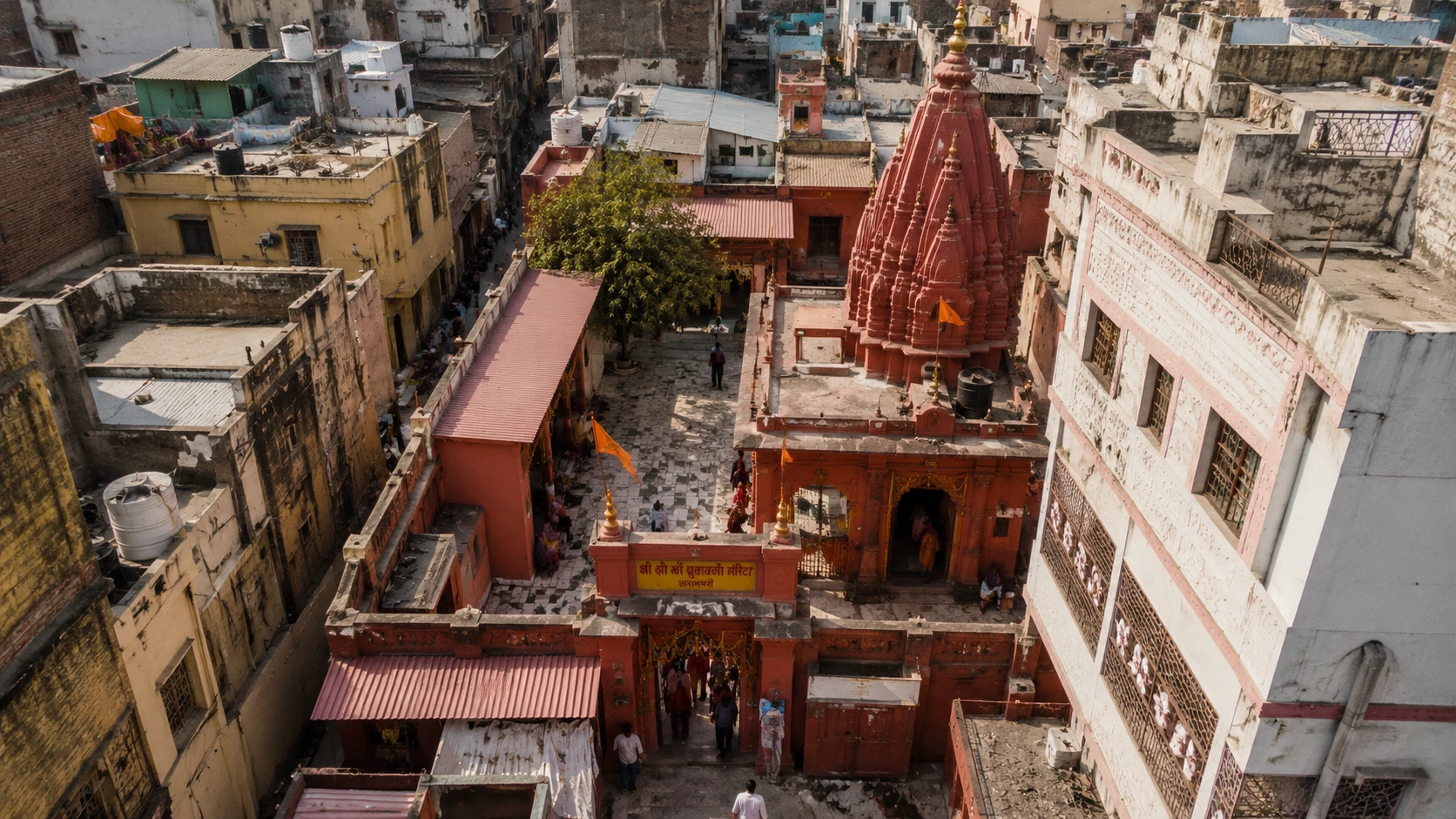
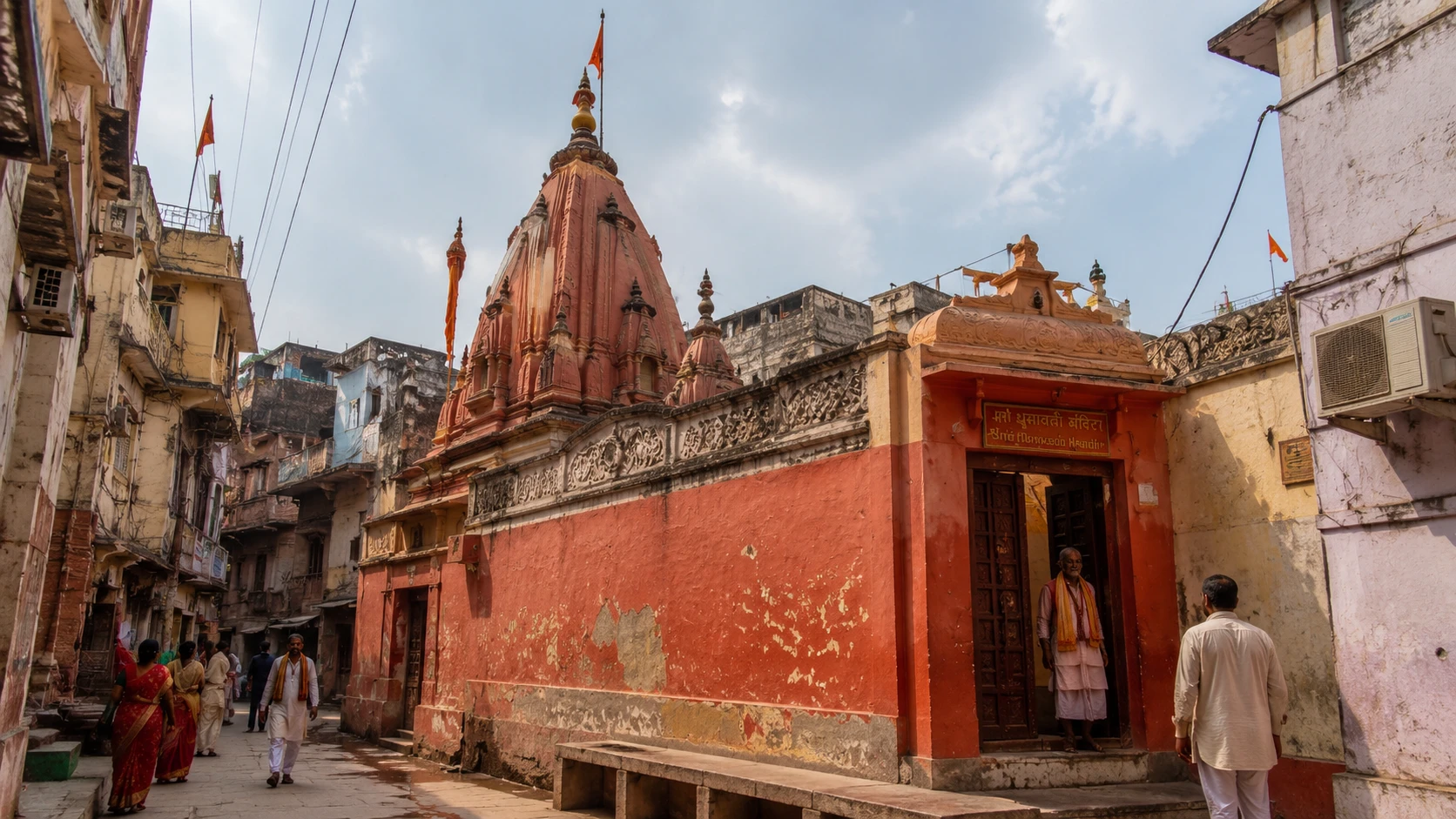
The Dhumavati temple in Varanasi is embedded in the most ancient urban Tantric landscape in India. Varanasi — Kashi, the Luminous — has been continuously inhabited for at least three thousand years and is considered in the Shaiva and Shakta traditions to be the body of Shiva himself, a city so charged with sacred energy that death within its precincts guarantees liberation (moksha). It is also, crucially, a city of cremation grounds — Manikarnika Ghat, the great burning ghat of Kashi, is considered the supreme cremation ground in the Hindu world, the place where Shiva himself is said to whisper the taraka mantra (liberation formula) into the ear of the dying. This is Dhumavati's territory: the city of death, of smoke, of the threshold between worlds. The Kashi Khanda of the Skanda Purana (considered one of the most authoritative texts on Varanasi's sacred geography) describes an elaborate sacred map of the city with hundreds of divine presences; Dhumavati's place in the Tantric sub-map of Kashi is well-established in practitioner tradition even where formal textual citations are less specific. Varanasi is also home to one of the 51 canonical Shakti Peethas — the Vishalakshi temple, where Sati's earring (mani, in some versions) or her eyes (in others) fell — and the city has historically been one of the most active centres of Shakta Tantric practice in north India. The Dhumavati shrine in the old city's lane tradition participates in this ancient Tantric fabric. The Mundamala Tantra explicitly identifies Varanasi/Kashi as a primary seat of Dhumavati worship. The temple was substantially unaffected by the series of temple destructions that razed many of Varanasi's more prominent Brahminical shrines, in part because Dhumavati's temple, embedded in narrow lanes, has never been a prominent landmark — her inauspicious associations may have made her shrine less visible to those who sought conspicuous targets.
Historical Timelineऐतिहासिक कालक्रम
The Mundamala Tantra, composed in the Bengal–Varanasi Tantric sphere, establishes Varanasi (Kashi) as a primary seat of Dhumavati worship. The text describes her iconography in detail and identifies her puja vidhi, providing the canonical framework for her veneration at this location.
Precise dating of the Mundamala Tantra is uncertain; 10th–12th century is a standard scholarly estimate. The text's identification of Varanasi as a Dhumavati peetha is accepted across Shakta Tantric traditions.
Varanasi suffers repeated episodes of temple destruction across this period — most documented are the raids of Mahmud of Ghazni (1033–34 attack on Varanasi's region), the Ghuri invasions, and most devastatingly the Mughal period including Aurangzeb's demolition of the original Kashi Vishwanath and other major temples (1669). Dhumavati's shrine, being a small Tantric temple in a narrow lane associated with inauspiciousness, is less prominent as a target and survives these episodes in practitioner tradition.
The claim that Dhumavati's temple specifically survived these periods due to its inauspicious associations and low visual prominence is traditional attribution and logical inference rather than documented historical record. No specific destruction or reconstruction of this temple during the medieval period has been independently documented in the sources consulted for this entry.
Aurangzeb's orders demolish the original Kashi Vishwanath temple and many prominent Brahminical temples in Varanasi. This episode reshapes the city's sacred landscape and drives significant Tantric practice further into the interior lanes and private shrines of the old city, where Dhumavati's tradition is embedded.
The 1669 demolition of the main Kashi Vishwanath is the best-documented episode of Varanasi's temple destruction history. Its effect on smaller Tantric shrines like the Dhumavati temple is inferred from the general pattern of the period rather than from specific documentation of this temple.
The current structure of the Dhumavati temple in Varanasi reflects 20th-century renovation within the constraints of its old-city lane location. The temple continues to function as a living Tantric shrine with an active priestly lineage. Specific renovation dates, trust details, and management structure have not been independently verified for this entry.
Operational and structural history for this specific shrine requires on-ground verification with local temple management. This entry should be updated with sourced information before final publication.
What You'll Seeदर्शन में
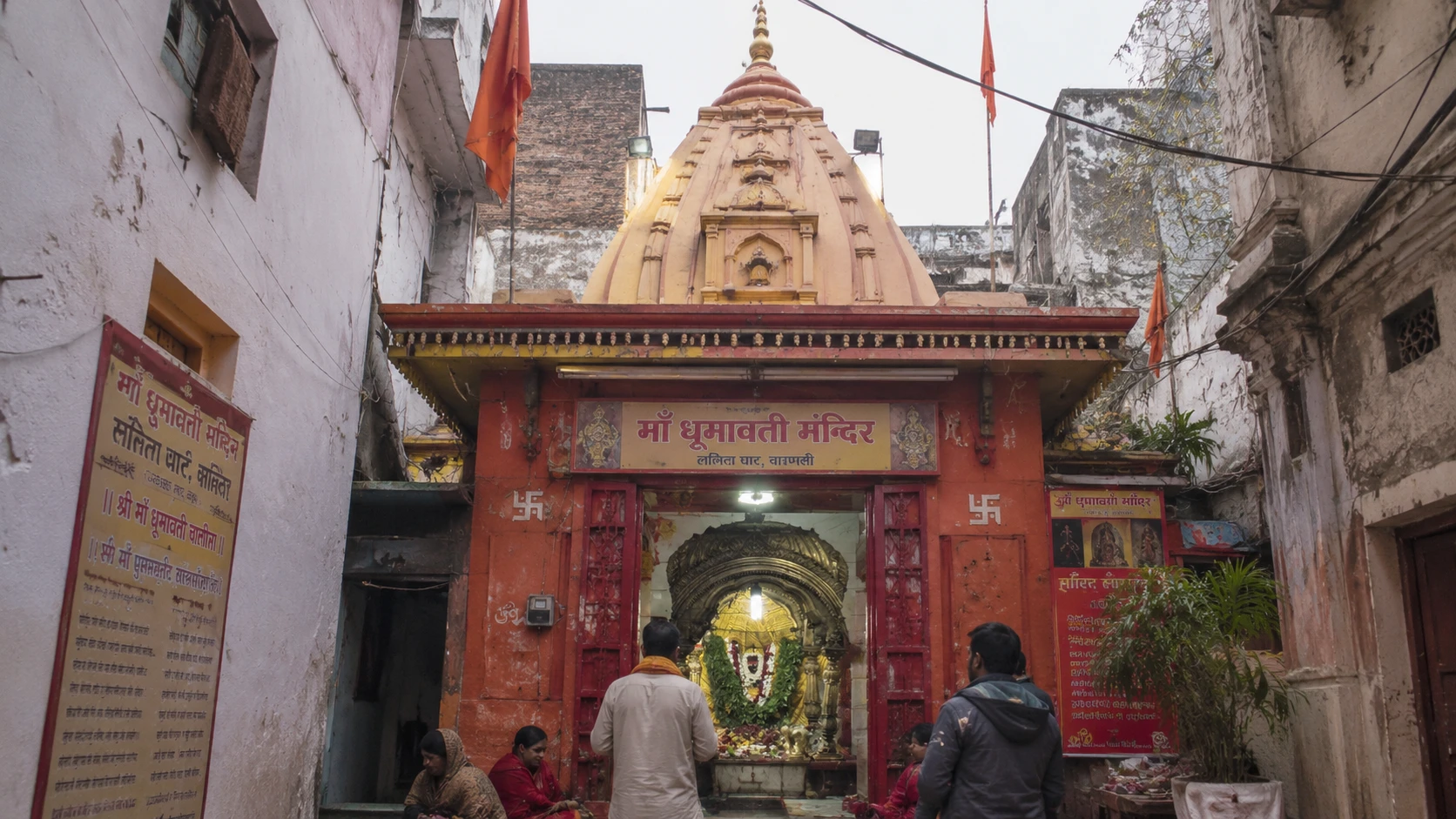
Dhumavati's form demands a different kind of looking than any other deity in the Hindu sacred imagination. The Mundamala Tantra describes her as tall and gaunt, with sagging breasts, dirty pale or ash-gray garments, and disheveled white hair. Her eyes are dull and wandering; her nose is long and protruding; she is toothless. She is old. She sits in a horseless chariot — a vehicle with no motive force, no source of movement, no direction imposed from outside — beneath a flag bearing a crow. In one hand she holds a winnowing basket (sup) — the tool used to separate grain from chaff — and often the other hand is raised in a gesture that some texts describe as granting boons and others as indicating menace: both readings are considered correct, since her gift is the menacing one of stripping away illusion. She has no ornaments and no consort. She is nakedness itself, not the nakedness of the sky-clad goddess who transcends clothing, but the nakedness of the destitute who has nothing left. The crow (kaka or vayasa) that accompanies her is the bird of ancestors, of omens, of the liminal space between worlds — the same bird that Hinduism considers inauspicious in most ritual contexts is elevated to Dhumavati's vahana. Her entire iconography is a systematic inversion of every visual marker of the auspicious in Hindu art: beauty inverted to ugliness, abundance to gauntness, the presence of consort to its complete absence, ornament to bareness, the horse to the crow. This systematic inversion is not rejection of Hindu values but their radical unmasking — she shows what lies beneath the attractive surface of the auspicious. Photography is not permitted in the inner sanctum.
Distinctive Practicesविशिष्ट परंपराएँ
Ashtami puja (eighth lunar day worship)
अष्टमी पूजा
Each eighth day of the lunar fortnight (waxing and waning)
The eighth day of the lunar fortnight (Ashtami) is traditionally the most auspicious day for Dhumavati worship across Shakta temples, and at the Varanasi shrine this rhythm is observed with heightened puja activity. Both the waxing Ashtami (shukla paksha) and the waning Ashtami (krishna paksha) are observed. The practice requires pre-dawn preparation, ritual purification, and specific offerings of sesame, mustard oil lamps, and coarse cloth.
The eighth day in the Tantric tradition is associated with the fierce-form goddesses — it falls between the full moon and the new moon in each direction, in the zone of neither-fullness-nor-emptiness that Dhumavati embodies. Her Ashtami worship is a deliberate practice of sitting with what is incomplete, with what is still hungry, without resolving it into false satisfaction. It is one of the rare spiritual practices that directly cultivates the capacity to be with deprivation rather than escape it.
Dhuma Deepa (mustard oil lamp offering)
धूम दीपा (सरसों के तेल का दीपक)
Daily; intensified on Ashtami and Dhumavati Jayanti
The offering of mustard oil lamps — dhuma deepa — is the defining ritual practice at Dhumavati's shrine. Unlike the clarified ghee lamps offered at most goddess temples, mustard oil burns with a distinctive smoke (dhuma), sending a thick, pungent plume that is itself an invocation of the goddess's smoky presence. The smoke fills the inner sanctum and is considered an active manifestation of Dhumavati rather than incidental combustion.
The smoke is not a byproduct but the substance of the offering. In offering smoke to the Smoky One, the devotee presents the goddess with herself — an act that dissolves the distance between worshipper and worshipped. The pungent smell of mustard oil smoke has no pretence to the elegant fragrance of incense or ghee; it is an honest smell, the smell of what is simple and coarse. Dhumavati's tradition insists on honesty about what reality is, rather than the perfumed version.
Did You Know?क्या आप जानते हैं?
Dhumavati is the only Mahavidya — and one of the very few major deities in any living religious tradition globally — who is permanently depicted as a widow. There is no form of her that is married, no iconography in which a consort appears, no mythology in which she is restored to conjugal status. This permanent widowhood is not a state of loss in the Tantric reading but of autonomy: she is the divine feminine that needs no masculine principle for definition, completion, or activation. She is the complete, self-sufficient reality that remains when even the god is consumed.
David Kinsley, 'Tantric Visions of the Divine Feminine' (1997), Chapter 8
The crow (kaka) accompanying Dhumavati is one of the most theologically deliberate animal associations in the Mahavidya pantheon. In Hindu ritual tradition, the crow is the bird of ancestors (pitrs) and of inauspiciousness — it appears in death-associated rituals (shraddha), and its cawing near a house is traditionally considered an ill omen. By making the crow her vahana, Dhumavati elevates what every other ritual context denigrates. This is the governing logic of her entire iconography: whatever conventional religion stigmatises, she consecrates.
Kinsley, 'Tantric Visions of the Divine Feminine' (1997); Mundamala Tantra
Varanasi's Manikarnika Ghat — the great cremation ground of Kashi, where fires have reportedly burned continuously for centuries and where thousands of bodies are cremated each year — is considered Dhumavati's primary domain. The smoke that rises from Manikarnika is in the devotional imagination the goddess's own presence made visible. Pilgrims at Varanasi who visit the burning ghat and then proceed to the Dhumavati temple are following a coherent Tantric circuit: the ghat shows the fact of dissolution; the temple shows its presiding deity.
Diana Eck, 'India: A Sacred Geography' (2012), Varanasi chapter; Kinsley, 'Tantric Visions' (1997)
Dhumavati is one of the few Hindu goddesses specifically associated with the wellbeing of widows. In the traditional Hindu social order, widows were among the most marginalized figures — forbidden remarriage, stripped of ornaments, dressed in white or plain cloth, and associated with inauspiciousness. Dhumavati's iconography replicates every visual marker of traditional widowhood and then places this figure at the apex of divine power. Her temple in Varanasi has historically been a place where widows could worship a goddess who shares their visual and social condition — a rare reversal of the social order's stigmatisation.
Kinsley, 'Tantric Visions of the Divine Feminine' (1997), Chapter 8; Lina Fruzzetti, 'The Gift of a Virgin' (1982) — on Bengali widow traditions
Visitor Accessप्रवेश जानकारी
The Dhumavati temple in Varanasi is open to devotees of all backgrounds. The temple is a living Tantric shrine in the narrow lanes of the old city; visitors should be prepared for the dense, atmospheric conditions of Varanasi's old lane tradition. Standard temple decorum — modest attire, footwear removed — applies. Photography is not permitted inside the inner sanctum. The temple's location in interior lanes means it is best reached on foot or by auto-rickshaw from the main ghat roads; confirm exact location from local guides or the Kashi Vishwanath Temple trust.
The temple is located in interior lanes of the Varanasi old city (Shivala / Dhumavati Gali area). It is advisable to hire a local guide familiar with the Tantric temples of Kashi for first-time visitors. The temple is a working Tantric shrine with resident priests; approach with the same devotional decorum as any major Shakta shrine. Visiting Manikarnika Ghat before or after the temple is a common practice among Tantric pilgrims.
Festivalsत्योहार
Dhumavati Jayanti
धूमावती जयंती
May–Jun (Jyeshtha, Shukla Ashtami)
Dhumavati Jayanti — observed on the eighth day of the bright fortnight of Jyeshtha — is the most significant annual observance specific to this goddess. At the Varanasi temple, the day is marked by pre-dawn puja, special sesame and mustard oil lamp offerings, and extended darshan. Initiated practitioners and widows traditionally observe special fasts and rituals on this day. The date places her jayanti in the hottest, driest month of the north Indian year — a season that carries the energy of scarcity and intensity that is Dhumavati's domain.
Navratri (Ashwin)
नवरात्रि (आश्विन)
Sep–Oct (Ashwin, 9 days)
The autumn Navratri is observed at the Dhumavati shrine with special puja on the seventh day (Saptami), as Dhumavati occupies the seventh position in the Mahavidya sequence. The broader Navratri season in Varanasi is one of the city's most intense religious periods, and the Dhumavati shrine participates in this season's energy.
Kali Puja / Diwali night
काली पूजा / दीपावली रात्रि
Oct–Nov (Kartik Amavasya)
The new moon night of Kartik — Diwali in the mainstream tradition, Kali Puja in the Shakta tradition — is a significant occasion for Dhumavati worship. At her Varanasi shrine, the night of total darkness (before the Diwali lamps are lit) is considered Dhumavati's moment: the void, the darkness, the destitution that precedes all light. Special night puja marks this occasion at the temple.
Traditional Offeringsपारंपरिक अर्पण
प्राथमिक अर्पण
Mustard oil lamp (Sarson ka tel diya)
सरसों के तेल का दीपक
सर्षप तैल दीप
The mustard oil lamp is the defining offering at Dhumavati's shrine and is distinct from the ghee lamps typically offered at other goddess temples. Mustard oil burns with visible smoke — dhuma — making the lamp not merely an offering of light but an offering of smoke, the very substance of the goddess's name and essence. The pungent smell of burning mustard oil has no aspiration to elegance; it is the honest smell of what is plain, simple, and real. Presenting this lamp to Dhumavati is an act of honesty: offering the goddess exactly what she is, rather than something more beautiful or fragrant.
Sesame seeds (Til)
तिल
तिल
Sesame is the offering associated with Dhumavati above all other grains — used in homa (fire ritual) at her shrine and in the Ashtami observances. In Hindu ritual tradition, sesame is the grain of transition: it is offered to ancestors (pitrs) in shraddha rituals, used in death-associated rites, and associated with the passage between states of existence. Offering sesame to Dhumavati acknowledges her as the presiding deity of all transitions, endings, and the spaces between. The Mundamala Tantra specifically prescribes sesame in Dhumavati's puja vidhi.
Coarse white cloth (Mota safed vastra)
मोटा सफेद वस्त्र
Where other goddess shrines receive fine red silk or embroidered cloth, the offering at Dhumavati's shrine is coarse, plain, white fabric — the cloth of widows and of the destitute. This is not poverty of devotion but radical honesty: offering Dhumavati exactly what she wears, without beautification or social pretence, is the most congruent act of worship at this shrine. The white of the cloth also resonates with ash and smoke — the palette of dissolution.
Black sesame (Kala til)
काला तिल
कृष्ण तिल
Black sesame — darker than the standard white variety — is specifically associated with Dhumavati in many practitioner traditions and in Tantric puja prescriptions. The darker colour aligns with her tamas-associated domain, with the energy of night and of dissolution. Black sesame is used in the Ashtami homa at her shrine and in the tarpanam (water offering) for the deceased that is often performed in Varanasi's cremation ground context.
Winnowing basket offering (Sup daan)
सूप दान
सूप
A small winnowing basket (sup) — the defining attribute Dhumavati carries — is offered at her shrine as a replica of her own instrument. The offering is both a recognition of her iconographic identity and a spiritual request: the devotee asks the goddess to apply her winnowing action to their own life — to separate what is real and essential from what is illusory and inessential. In this sense, offering a sup to Dhumavati is the most active, engaged offering in her puja: asking to be separated from one's own attachments.
Offerings at the Dhumavati temple in Varanasi are deliberately plain and coarse — this is not a temple for elaborate offering baskets or fine materials. Mustard oil, black sesame, coarse white cloth, and small winnowing baskets are available from vendors near the temple entrance and in the lanes approaching it. The smoke from mustard oil lamps fills the shrine throughout the day; those with respiratory sensitivities should be aware of this. Widows have traditionally found particular welcome at this shrine — the goddess's iconography and mythology speak directly to their experience.
How to Reachकैसे पहुँचें
Varanasi is one of India's most connected pilgrimage cities. By air: Lal Bahadur Shastri International Airport (VNS) is approximately 25 km from the city and receives direct flights from Delhi, Mumbai, Kolkata, Hyderabad, and other major cities. By rail: Varanasi Junction (BSB) and Manduadih Station are major junctions with connections to all significant cities. From either station, auto-rickshaws, cycle-rickshaws, and cabs navigate to the old city and the ghat areas. The Dhumavati temple is in the old city's interior lanes — the nearest ghat access points are in the Shivala Ghat area. The temple is accessible on foot from the main ghat road; the lanes leading to it are narrow. It is strongly advised to hire a local guide familiar with the Tantric shrine circuit of Kashi, as the interior lanes of the old city are labyrinthine and GPS navigation is unreliable. Within Varanasi, the old city is best explored on foot or by cycle-rickshaw; motor vehicles cannot access most inner lanes.
Plan Your Visitयात्रा की योजना
🌤 सर्वोत्तम मौसम
October to March offers pleasant visiting conditions in Varanasi. The Dev Deepawali celebration in November (Kartik Purnima) — when the entire ghat line is lit with lakhs of lamps — is Varanasi's most spectacular annual event and coincides with a period when the Dhumavati shrine is also highly active. Summer (April–June) is intense in Varanasi — Dhumavati Jayanti in Jyeshtha falls in this season, making it significant despite the heat.
👘 पहनावे का नियम
Modest attire is required. The old city of Varanasi involves extensive walking on uneven surfaces and narrow lanes; practical footwear is recommended even though it will be removed at temple entrances. White clothing is considered appropriate and resonant with Dhumavati's tradition, though it is not mandatory.
📱 फोन और फोटोग्राफी
Mobile phones permitted in outer areas. Photography not allowed inside the inner sanctum. The atmospheric conditions of the old city lanes and the smoke-filled shrine interior mean that photography opportunities are limited in any case.
🏨 आवास
Varanasi has accommodation at all price points — from ashrams and dharamshalas along the ghat front to mid-range hotels in the Godowlia and Cantonment areas and upscale properties near Lanka and Sarnath. Staying in the ghat-front area gives immediate access to the devotional atmosphere of the old city; the narrow lanes mean that motor vehicle access is limited but the experience is maximally immersive.
Sacred Soundsपवित्र ध्वनि
क्या आप जानते हैं? · Did You Know?
वही अनुवाद त्रुटि जिसने हिन्दू धर्म में '33 कोटि' को '33 करोड़' बनाया, बौद्ध धर्म में भी हुई। बौद्ध ग्रन्थों के चीनी अनुवाद ने 'सप्त कोटि बुद्ध' (7 श्रेष्ठ बुद्ध) का अनुवाद '7 करोड़ बुद्ध' कर दिया। तिब्बती अनुवाद ने सही किया: 7 प्रकार, 7 करोड़ नहीं। एक संस्कृत शब्द, दो प्रमुख विश्व धर्मों में गलत पढ़ा गया, ने दो एकसमान भ्रम स्वतन्त्र रूप से उत्पन्न किए।
Related Contentसंबंधित सामग्री
Related Scriptures
Related Temples
Kashi Vishwanath
काशी विश्वनाथ
Varanasi, Uttar Pradesh
Bhuvaneshwari Mata (Gauhati)
भुवनेश्वरी माता
Gauhati, Assam
Bhairavi Mata Temple
भैरवी माता मंदिर
Tezpur, Assam
Chinnamasta Mandir (Rajrappa)
छिन्नमस्ता मंदिर
Rajrappa, Jharkhand
Bagalamukhi Mandir (Datia)
बगलामुखी मंदिर
Datia, Madhya Pradesh
Matangeshwar Mandir (Khajuraho)
मातंगेश्वर मंदिर
Khajuraho, Madhya Pradesh
Kamala Devi (Bishnupur)
कमला देवी मंदिर
Bishnupur, West Bengal
Shodashi Tripurasundari (Kanchipuram)
षोडशी त्रिपुरसुंदरी
Kanchipuram, Tamil Nadu
Community Reflections
🕉️
Be the first to share your reflection.