Dwaraka Sharada Peetham
द्वारका शारदा पीठम्
The western seat of Shankara's four, guardian of the words 'That thou art'
Dwarka, Gujarat, India
Dvārakā Śāradā PīṭhamAlso known as: Dwaraka Sharada Peetham, Kalika Matha, Paschimamnaya Matha, Dwaraka Peeth
युग
Founded by Adi Shankaracharya as the western (Paschimamnaya) matha of his four cardinal seats; the institution's continuous succession dates from that founding, with the buildings rebuilt across periods
वास्तुकला
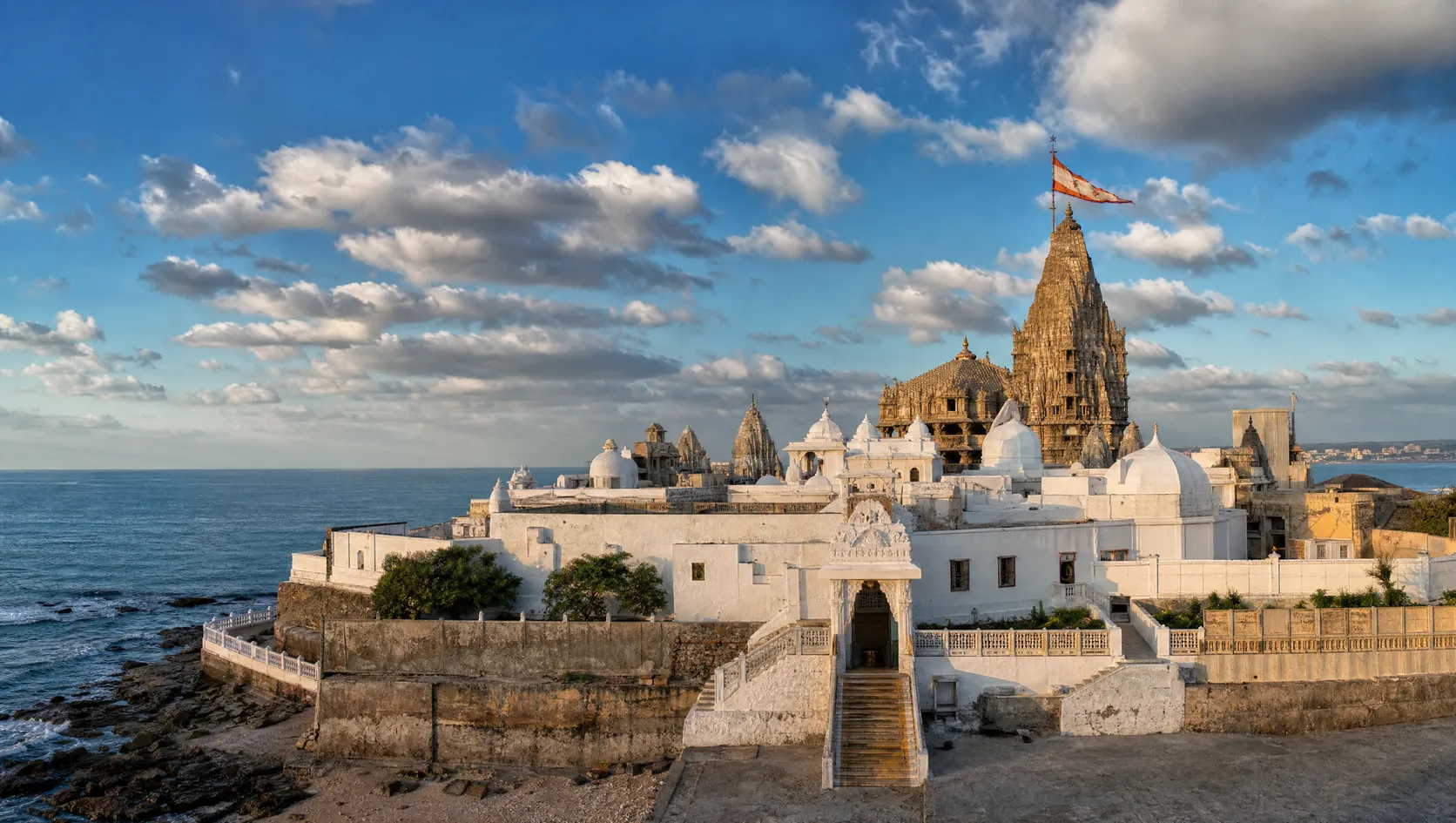
A functioning matha complex beside the Sharada shrine, in the coastal Gujarati idiom, near the great Dwarkadhish temple
विशेष
The matha maintains a daily ritual schedule alongside its shrines, and the Shankaracharya's public audience is observed at set times. Timings are set by the matha and vary with the ritual calendar.
पवित्र कथा · पवित्र कथा
When Adi Shankaracharya set out to bind the subcontinent into a single field of Advaita Vedanta, he established four mathas at its cardinal points, and to each he entrusted one Veda and one mahavakya, one of the great sentences in which the Upanishads state the identity of the self and the absolute. Dwaraka is the western seat, the Paschimamnaya, and the sentence it guards is Tattvamasi: That thou art. Three words, and they are among the most consequential in Indian thought. Tat, that, the absolute; tvam, thou, the individual; asi, art. The teaching of Advaita in a single breath: what you are and what everything is are not two things. The western matha was made the keeper of that sentence, and its acharyas its transmitters. So Dwaraka is not only a place of pilgrimage on the Arabian Sea, beside Krishna's own city. It is one of four points at which Shankara pinned a philosophy to a map, and the point assigned the sentence that the whole philosophy comes down to.
Sacred Designationपवित्र पदनाम
Sacred Origin Storyपवित्र उत्पत्ति कथा
Source: The Shankara Digvijaya biographical tradition and the matha's own institutional records, set against the older sanctity of Dwaraka as Krishna's city
The place was sacred long before the matha. Dwaraka is Krishna's city, the capital he is said to have raised on the Saurashtra coast and to have ruled from, and which the sea reclaimed after him. To establish a seat of Advaita here was to place the philosophy of non-duality in the city most associated with the personal, embodied god of the Bhagavata tradition, a juxtaposition the tradition does not treat as a tension.
Shankara, in the account of his life, travelled the length and breadth of the subcontinent in debate, defeating rival schools and establishing Advaita, and at the four quarters he founded mathas to hold the ground he had won. To the western seat he assigned the Samaveda, the Veda of chant and melody, and the mahavakya Tattvamasi, drawn from the Chandogya Upanishad, where a father teaches it to his son nine times over, in nine images, until the boy understands.
He appointed his disciple Hastamalaka as the first acharya of the western matha. Hastamalaka's name means the one for whom the truth is as clear as a fruit held in the palm of the hand, and the tradition tells of him as a disciple who had realised the Self so completely that he spoke of it without hesitation. To make such a disciple the first keeper of the sentence That thou art is the tradition's way of saying the sentence was understood before it was handed on.
उद्धृत स्रोत:
- Shankara Digvijaya biographical tradition
- Dwaraka Sharada Peetham institutional records and guru parampara
- Chandogya Upanishad (the mahavakya Tattvamasi)
विद्वत संदर्भ
The traditional dating of Adi Shankaracharya, and therefore of the four mathas, is debated. The mathas' own reckoning places Shankara considerably earlier than the eighth-century date most modern scholars accept, and the two chronologies coexist without resolution, as they do at Sringeri, the southern seat. What is not disputed is the antiquity and the continuous institutional life of the four-matha system as the organising framework of the Advaita tradition. The assignment of one Veda and one mahavakya to each of the four seats is the framework's distinctive feature. Dwaraka holds the Samaveda and Tattvamasi; Sringeri the Yajurveda and Aham Brahmasmi; the other two seats their own. Scholars treat the scheme as the tradition's own map of itself, a way of distributing the whole of Vedic authority and the core teaching across the four quarters of the land. Dwaraka's setting beside Krishna's city places the western Advaita seat in the heart of Vaishnava devotional territory, which is characteristic of how the mathas were positioned: not in isolation but at the major existing centres of pilgrimage.
Historyइतिहास
The Dwaraka Sharada Peetham is the western of the four cardinal mathas established by Adi Shankaracharya, and its life as an institution is inseparable from the four-matha framework in which it sits. To it Shankara assigned the Samaveda, the Veda of chant, and the mahavakya Tattvamasi, and he appointed his disciple Hastamalaka as its first acharya, from whom the lineage of Shankaracharyas of the western seat has continued.
The matha stands in Dwarka on the Saurashtra coast, one of the most sacred cities of the Vaishnava tradition as Krishna's own capital and the site of the great Dwarkadhish temple. Its placement at a major existing centre of pilgrimage is typical of the four mathas, each of which was set at a corner of the land already thick with sanctity.
As an Advaita institution the matha's work is the transmission of the tradition through its lineage of acharyas: the study and teaching of the Vedanta, the maintenance of its shrines, and the authority of the Shankaracharya of the western seat in matters of Advaita doctrine and practice. Like the other mathas it maintains associated shrines, including a Sharada shrine to the goddess of learning and a shrine of the goddess in a fierce protective form.
The buildings have been rebuilt and extended across the centuries, but the continuity the matha claims is not of stone but of succession: an unbroken line of teachers from Hastamalaka to the present, holding the western quarter's Veda and sentence. In the modern period the matha continues as a functioning centre of Advaita, with educational and religious activity beyond the shrines alone.
Historical Timelineऐतिहासिक कालक्रम
Adi Shankaracharya establishes the western matha at Dwaraka as one of his four cardinal seats, assigning it the Samaveda and the mahavakya Tattvamasi, and appointing his disciple Hastamalaka as its first acharya.
The matha's own chronology places Shankara considerably earlier than the eighth-century dating most modern scholars accept; the two reckonings coexist without resolution.
Hastamalaka, whose name means one for whom the truth is as clear as a fruit in the palm, becomes the first acharya, establishing the lineage of Shankaracharyas of the western seat.
The four-matha scheme distributes the four Vedas and four mahavakyas across the cardinal seats, with Dwaraka holding the Samaveda and Tattvamasi, part of the tradition's map of its own authority.
Each seat is assigned one Veda and one mahavakya; the scheme is the tradition's own framework for the four quarters.
The matha continues its lineage through the medieval centuries alongside the great Dwarkadhish temple, the western Advaita seat coexisting with the major Vaishnava pilgrimage of Krishna's city.
The coexistence of an Advaita seat and a major Vaishnava temple at one site is characteristic of how the four mathas were positioned, at established centres of pilgrimage rather than in isolation.
The matha's associated shrines take shape, including the shrine of Sharada, the goddess of learning, and a shrine of the goddess in a fierce protective form held as the guardian of the seat.
The matha's buildings are rebuilt and extended across periods, while the continuity it claims remains that of succession, an unbroken line of acharyas rather than of masonry.
The matha and the wider sanctity of Dwarka are recorded in colonial-era accounts of the Saurashtra coast, which note its standing as one of Shankara's four seats.
The matha continues as a functioning Advaita institution under its Shankaracharya, maintaining its shrines and its educational and religious activity, and taking positions in matters of Advaita doctrine.
The matha remains one of the four principal seats of Advaita authority, and pilgrims to Dwarka commonly visit it alongside the Dwarkadhish temple, joining the western Advaita seat to the Vaishnava pilgrimage of Krishna's city.
What You'll Seeदर्शन में
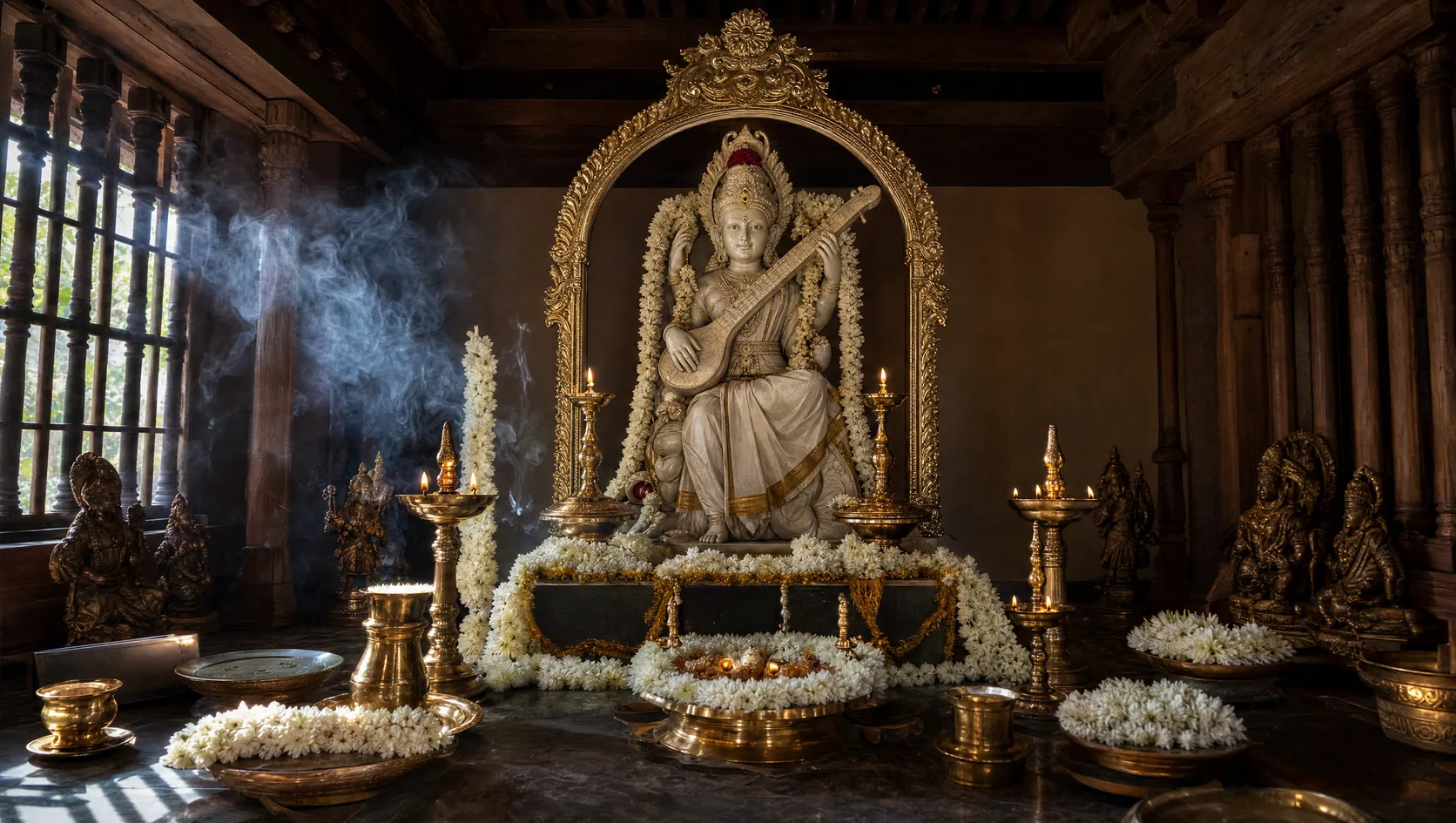
As a matha rather than a single temple, Dwaraka's sanctity is carried less in one presiding image than in the institution and its associated shrines. The peetham venerates Sharada, the goddess of learning, as at the other Shankara seats, and the goddess also in a fierce protective form, held as the guardian of the matha.
The controlling image, in a sense, is not a figure at all but the mahavakya itself: Tattvamasi, the sentence assigned to the western seat, which the acharyas hold and transmit. In an Advaita institution the object of highest regard is the teaching, and the deity images serve the teaching rather than displacing it.
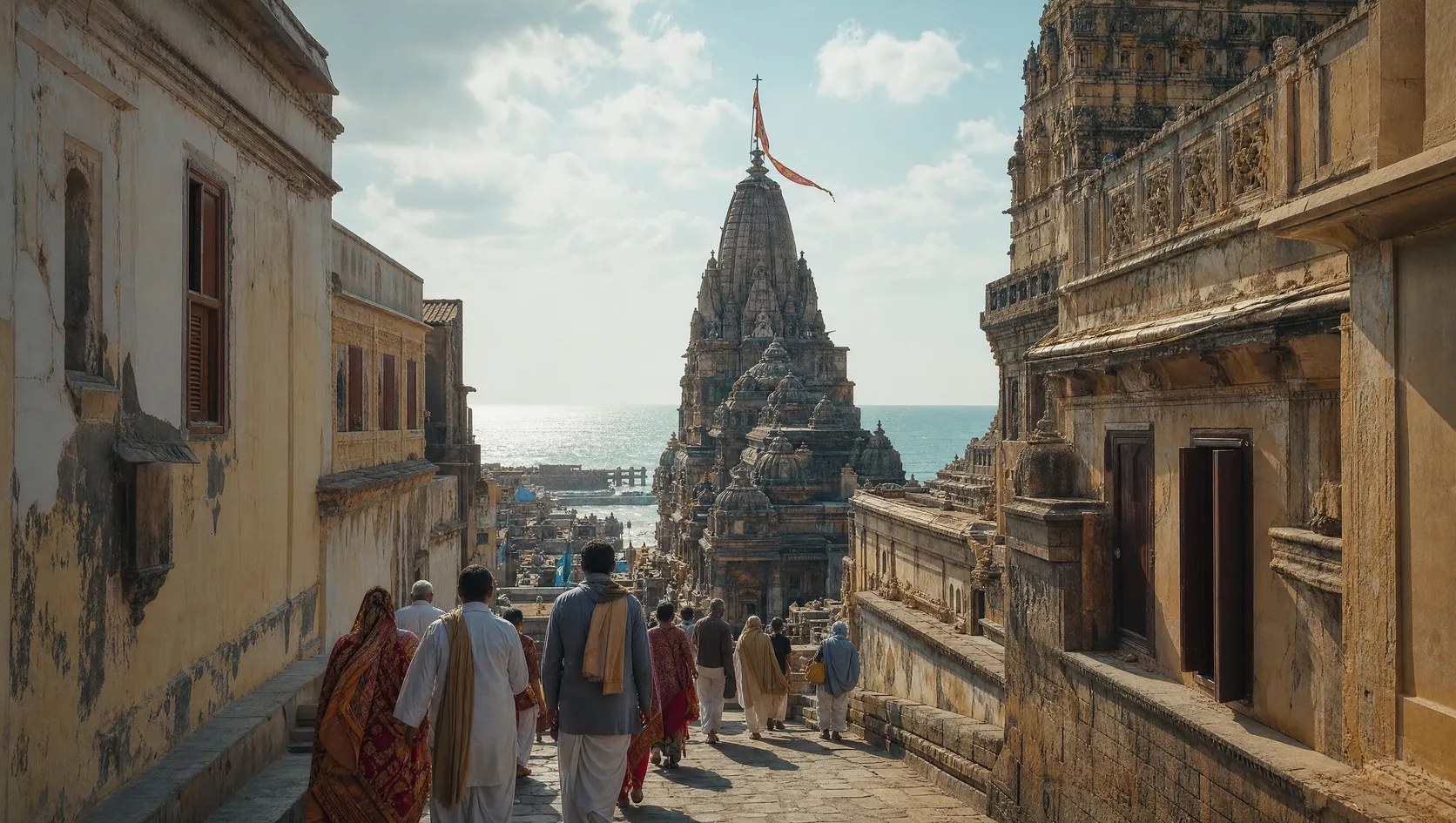
The matha stands beside the far larger Dwarkadhish temple, the towering shrine of Krishna as the lord of Dwarka, whose flag is changed several times a day and is visible across the city. The two together hold the characteristic pairing of the site: the personal god of the Bhagavata tradition in the great temple, and the philosophy of the one Self without a second in the matha beside it, the tradition keeping both without asking the visitor to choose.
Distinctive Practicesविशिष्ट परंपराएँ
The Guardianship of Tattvamasi
तत्त्वमसि की रक्षा
Continuous, in the teaching of the matha
As the western seat, Dwaraka is the keeper of the mahavakya Tattvamasi, That thou art, and of the Samaveda. The transmission and exposition of this sentence and its Veda through the lineage of acharyas is the matha's defining work.
The mahavakyas are the compressed essence of the Upanishadic teaching, and to assign one to each seat is to make each matha the custodian of a portion of the whole. Tattvamasi is the sentence of instruction, spoken by a teacher to a pupil, and the western matha's work of teaching it enacts the sentence's own form: it is a truth that must be transmitted, not merely stored.
The Shankaracharya's Audience
शंकराचार्य का दर्शन
At set times, according to the matha's schedule
The Shankaracharya of the western seat gives audience at set times, and devotees come for his darshan and blessing. As with the other mathas, this is an extension of the teaching relationship rather than a public service, scheduled around the day's obligations.
The authority of a Shankaracharya rests on the lineage, the unbroken transmission from Shankara through Hastamalaka to the present holder. To take his darshan is to stand in the presence of that transmission, and the audience is treated with the gravity due to a living link in a chain reaching back to the founder.
Worship Alongside the Dwarkadhish Temple
द्वारकाधीश मंदिर के साथ उपासना
For pilgrims to Dwarka
Pilgrims to Dwarka commonly visit the matha alongside the great Dwarkadhish temple of Krishna, so that the western Advaita seat and the Vaishnava pilgrimage of Krishna's city are taken together in a single visit.
The pairing is the site's own teaching. The Dwarkadhish temple offers the personal, embodied god of devotion, and the matha the philosophy of the one Self without a second; the tradition sets them side by side and treats the two not as rivals but as the same truth approached by different roads, the very point Advaita makes about the personal god.
Study and Recitation of the Samaveda
सामवेद का अध्ययन और पाठ
In the matha's ongoing scholarly work
As the seat assigned the Samaveda, the Veda of chant and melody, the matha maintains the study and recitation of that Veda as part of its scholarly and ritual life.
The Samaveda is the Veda in which the mantras are set to melody, the sung Veda, and its association with the western seat gives that matha a particular relation to the musical dimension of the tradition. To keep a Veda is not to archive it but to keep it sounding, which is why the matha's charge is recitation as much as study.
Did You Know?क्या आप जानते हैं?
Dwaraka is the western of Adi Shankaracharya's four cardinal mathas, guardian of the Samaveda and the mahavakya Tattvamasi, That thou art, one of the great sentences of Advaita.
Advaita tradition on the four amnaya mathas
Its first acharya was Hastamalaka, whose name means one for whom the truth is as clear as a fruit held in the palm of the hand, a disciple said to have realised the Self completely.
Shankara Digvijaya tradition; matha records
The matha stands beside the great Dwarkadhish temple of Krishna, so the western seat of the philosophy of the one Self sits in the heart of Vaishnava devotional territory.
Site tradition; pilgrimage practice at Dwarka
The mahavakya Tattvamasi comes from the Chandogya Upanishad, where a father teaches it to his son nine times over, in nine images, until the boy understands.
Chandogya Upanishad
Each of the four mathas holds one Veda and one mahavakya; Dwaraka's are the Samaveda, the Veda of chant, and Tattvamasi, so the sung Veda and the sentence of instruction are kept at the western seat.
Advaita tradition on the four amnaya mathas
The continuity the matha claims is not of buildings but of succession: an unbroken line of acharyas from Hastamalaka to the present holder of the western seat.
Matha guru parampara records
Dwaraka itself is Krishna's city, said to have been raised on the Saurashtra coast and reclaimed by the sea after him, so the matha sits on ground sacred long before the philosophy came to it.
Puranic tradition of Dwaraka
Visitor Accessप्रवेश जानकारी
The matha is open to devotees, and traditional dress is expected as at a working religious institution. Footwear is removed at the shrines. Most visitors come to Dwarka principally for the great Dwarkadhish temple of Krishna and visit the matha alongside it. The Shankaracharya's audience is held at set times and is not continuous through the day. Dwarka is a well-developed pilgrimage town on the coast, so facilities are good, and the matha is easily reached within the city. Timings and audience hours are set by the matha and should be confirmed before travelling.
Combine the matha with the Dwarkadhish temple, which is the reason most pilgrims come to Dwarka; the two are close within the city. Check the Shankaracharya's audience hours in advance if that is part of the reason for visiting. Dress traditionally and remove footwear at the shrines. Dwarka is well served by rail and road and has ample accommodation, so the visit is straightforward; allow for crowds around Krishna festivals. Many pilgrims also take in Bet Dwarka and Nageshwar, the Jyotirlinga nearby, in the same trip.
Festivalsत्योहार
Shankara Jayanti
शंकर जयंती
Apr-May (Vaishakha Shukla Panchami)
The appearance day of Adi Shankaracharya, the founder of the matha, observed with particular solemnity, with worship and discourses on Advaita. For a Shankara seat this is the day on which the lineage's origin is at the centre.
Guru Purnima
गुरु पूर्णिमा
Jun-Jul (Ashadha Purnima)
The day dedicated to the guru is of particular importance at a matha whose authority rests on the guru-lineage, observed with worship of the Shankaracharya and of the tradition of teachers reaching back to Shankara.
Janmashtami
जन्माष्टमी
Aug-Sep (Bhadrapada Krishna Ashtami)
The birth of Krishna is the great festival of Dwarka, his city, and the matha shares in the observance that fills the town, joining the Advaita seat to the Vaishnava celebration around the Dwarkadhish temple.
Navaratri
नवरात्रि
Sep-Oct (Ashwin)
As the matha venerates the goddess, including in her fierce protective form, Navaratri is observed with worship of the goddess over its nine nights, tying the seat of learning to the worship of the divine feminine.
Traditional Offeringsपारंपरिक अर्पण
प्राथमिक अर्पण
Study offered to Sharada
शारदा को अर्पित अध्ययन
As at the other Shankara seats, the goddess venerated is Sharada, the goddess of learning, and the offering most proper to her is study itself. Students and scholars seek her blessing on their learning, and the tools of study are placed before her.
White flowers
श्वेत पुष्प
White, the colour of Sharada, is offered in flowers, read as clarity and the stillness of a mind fit for knowledge. The offering follows the same association as at the other seats of the goddess of learning.
Offerings to the goddess in her protective form
रक्षक रूप में देवी को भेंट
The matha venerates the goddess also in a fierce protective form as its guardian, and offerings are made to her for the protection of the institution and of those who seek its shelter.
Lamps and incense
दीप और धूप
Lamps and incense are offered in the matha's daily worship, as at any shrine, marking the ritual rhythm of an institution whose life is one of study and observance carried on continuously. The daily worship is not incidental to the teaching but its frame: the study of the Vedanta is set within an ordered round of ritual, so that the intellectual and the devotional are kept together rather than separated.
इस मंदिर की विशेषता
The Offering of Learning at a Shankara Seat
शंकर पीठ पर विद्या की भेंट
What is particular to a matha, as against a temple, is that its highest offering is not a substance but the study and transmission of the teaching. At Dwaraka, the western seat charged with the Samaveda and the mahavakya Tattvamasi, the proper offering is attention to that teaching: the recitation of the Veda, the exposition of the sentence, the discipline of a mind turned toward the identity of the self and the absolute. A pilgrim brings flowers and lamps as at any shrine, but the tradition holds that what the matha most receives, and most gives, is the teaching itself, handed from acharya to acharya since Hastamalaka. The offering and the blessing are the same thing: understanding, passed on.
As a matha, Dwaraka's worship centres on its shrines and on the study and transmission of the teaching rather than on elaborate individual offering rituals. Pilgrims may offer flowers, lamps and their reverence at the shrines, and seek the Shankaracharya's blessing at the appointed times. Those visiting principally for the Dwarkadhish temple should note that its offering arrangements are separate from the matha's. Eternal Raga presents the matha's practices as a devotional and philosophical tradition.
How to Reachकैसे पहुँचें
The matha stands in the city of Dwarka on the Saurashtra coast of Gujarat, and is reached as part of a visit to the pilgrimage town.
By air: Jamnagar Airport is roughly 130 km away and is the nearest, with limited connections; Rajkot Airport is a larger alternative further inland, and a new airport at the region has been developed to improve access.
By rail: Dwarka has its own railway station on the line toward Okha, connected to Ahmedabad and the wider network, which makes the town directly reachable by train.
By road: Dwarka is connected by state highway along the Saurashtra coast, served by buses and taxis from Jamnagar, Rajkot and Ahmedabad. Within the town the matha is close to the Dwarkadhish temple and easily reached on foot or by autorickshaw.
Most pilgrims come to Dwarka for the Dwarkadhish temple and visit the matha alongside it, often extending the trip to Bet Dwarka and the Nageshwar Jyotirlinga nearby.
Plan Your Visitयात्रा की योजना
🌤 सर्वोत्तम मौसम
October to March is the most comfortable period on the Saurashtra coast, with mild temperatures and low humidity. April to June is hot, and the coast can be humid. The monsoon, roughly July to September, brings rain to the region but the town remains accessible. Janmashtami, in August or September, is the great festival of Dwarka and by far the busiest time, when the town fills for Krishna's birth; those seeking a quieter visit should avoid it. Early morning, around the Dwarkadhish temple's first darshan and flag-changing, is the most atmospheric time to be in the town, and the matha is best visited in the same part of the day.
👘 पहनावे का नियम
Traditional and modest dress is expected at the matha, as at a working religious institution. Men commonly wear a dhoti or trousers with a shirt; women a saree or salwar kameez. Footwear is removed at the shrines. The adjacent Dwarkadhish temple has its own conventions, so a visit that takes in both is best made in traditional dress throughout.
📱 फोन और फोटोग्राफी
Photography is restricted within the shrines, and phones should be silenced across the matha premises. The Shankaracharya's audience is not a photo opportunity, and recording during it should not be attempted without explicit permission. The adjacent Dwarkadhish temple has its own, generally strict, photography rules.
🏨 आवास
Dwarka is a well-developed pilgrimage town with a full range of accommodation, from dharamshalas and guest houses to hotels, much of it near the Dwarkadhish temple. Some is administered by trusts associated with the temple and the pilgrimage. Demand rises sharply around Janmashtami and other Krishna festivals, when booking well ahead is necessary. Outside those periods the town absorbs its visitors comfortably.
Sacred Soundsपवित्र ध्वनि
क्या आप जानते हैं? · Did You Know?
वही अनुवाद त्रुटि जिसने हिन्दू धर्म में '33 कोटि' को '33 करोड़' बनाया, बौद्ध धर्म में भी हुई। बौद्ध ग्रन्थों के चीनी अनुवाद ने 'सप्त कोटि बुद्ध' (7 श्रेष्ठ बुद्ध) का अनुवाद '7 करोड़ बुद्ध' कर दिया। तिब्बती अनुवाद ने सही किया: 7 प्रकार, 7 करोड़ नहीं। एक संस्कृत शब्द, दो प्रमुख विश्व धर्मों में गलत पढ़ा गया, ने दो एकसमान भ्रम स्वतन्त्र रूप से उत्पन्न किए।
Related Contentसंबंधित सामग्री
Related Scriptures
Community Reflections
🕉️
Be the first to share your reflection.