Guruvayur Temple
गुरुवायुर मंदिर
The Vaikuntha on earth — where an idol from Dwaraka arrived on the wings of Guru and Wind
Guruvayur, Kerala, India
GuruvāyūrAlso known as: Guruvayur Sri Krishna Temple, Bhuloka Vaikuntham, Guruvayurappan Temple, Guruvāyūrappan Kṣētram
युग
Traditionally ancient; historically documentable from c. 14th–15th century CE; current temple structure renovated over successive centuries
वास्तुकला
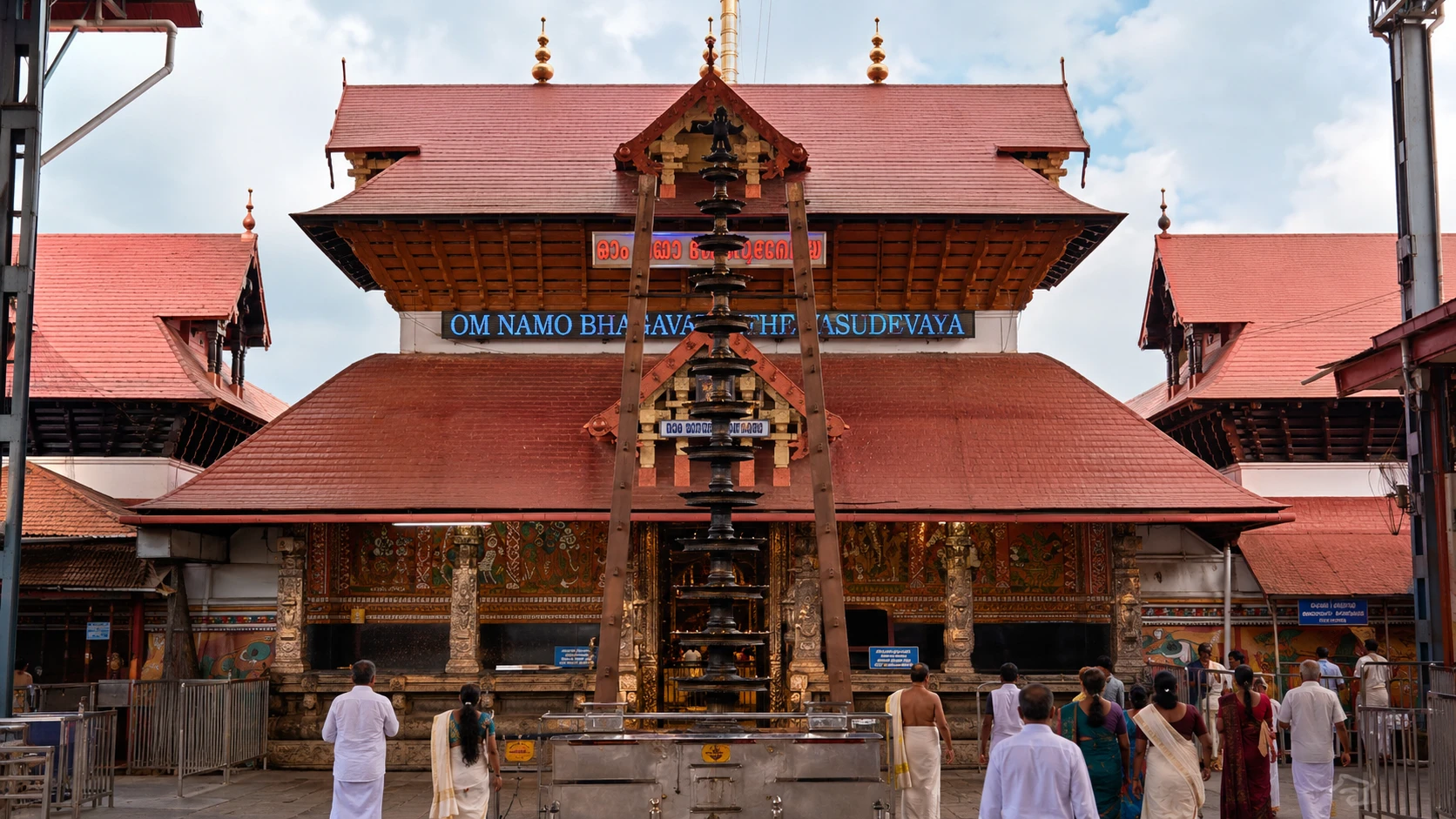
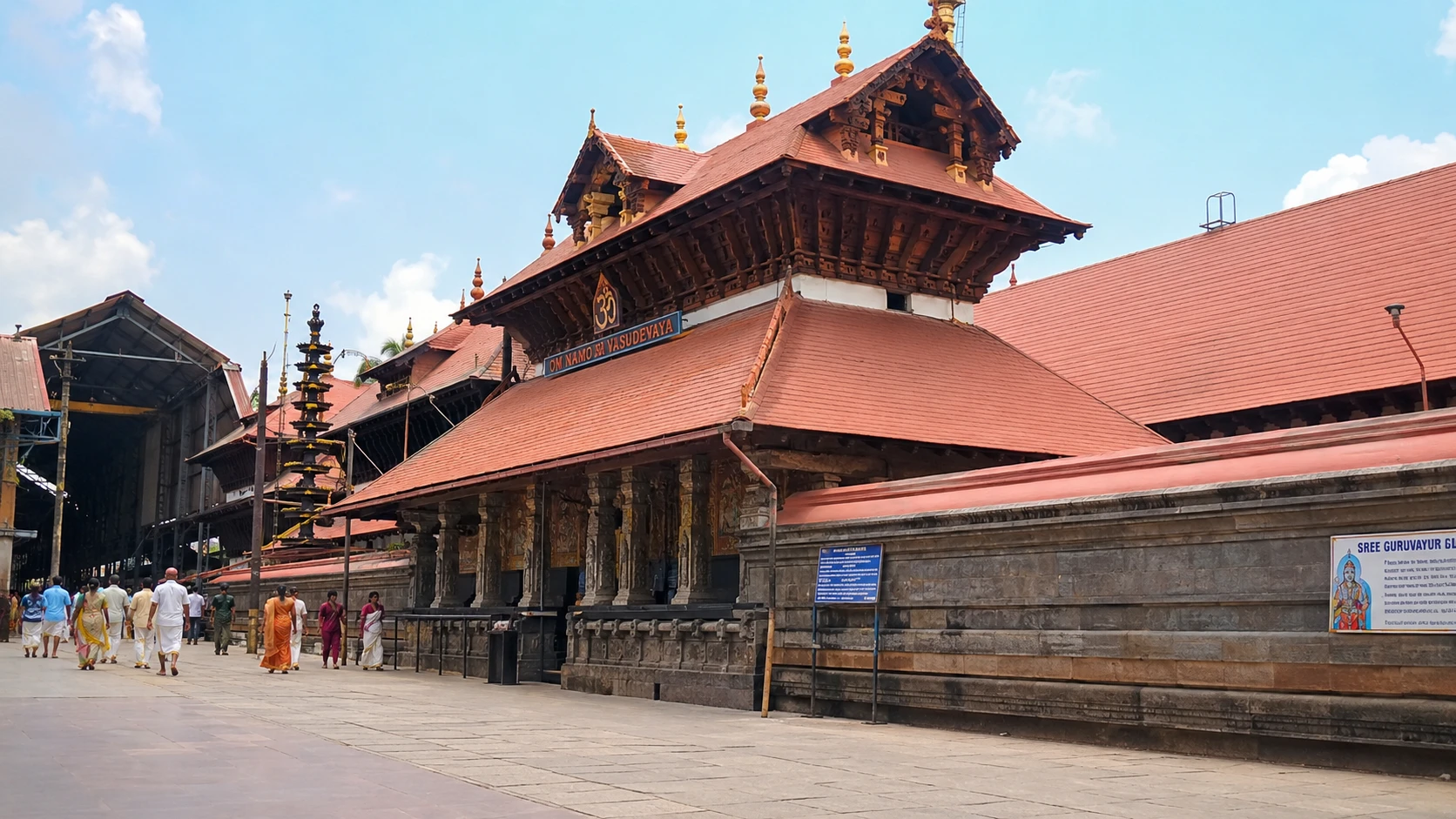
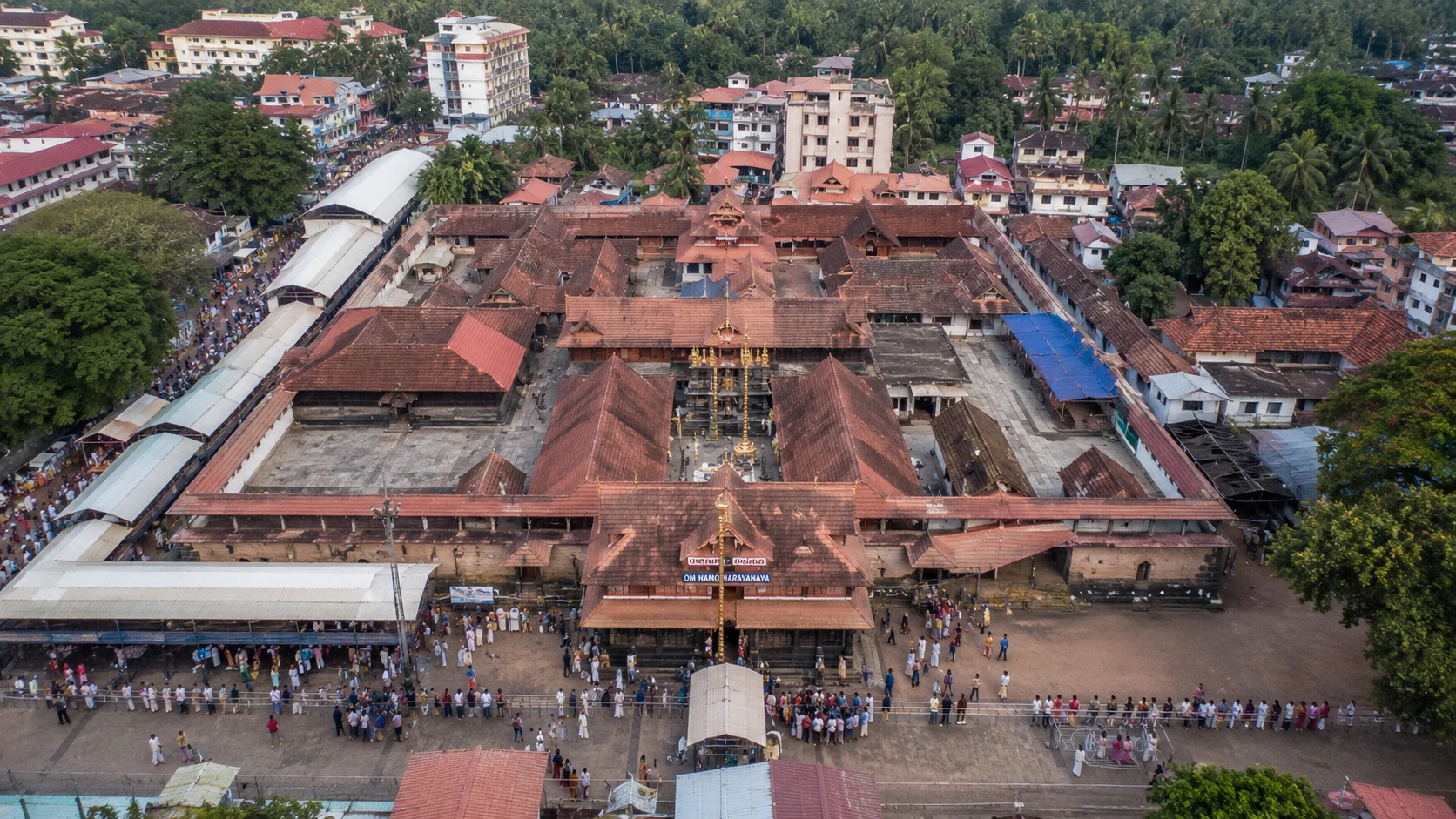
Kerala temple architecture (Thachu Shastra style) — circular sanctum (sreekovil) with copper-tiled conical roof, low-rise construction, no towering gopuram
खुला
03:00 – 22:00
आरती
03:00 · 05:30 · 07:00 · 10:00 · 12:30 · 17:00 · 19:00 · 21:00
विशेष
The temple has a midday break (approx. 12:30–16:30) for Uchabali and related rites; darshan resumes in the afternoon. Temple opens at 3:00 AM for Nirmalyam (the first rite). All timings approximate and subject to seasonal and ritual adjustment; verify current schedule with Guruvayur Devaswom (www.guruvayurdevaswom.in) before visiting.
पवित्र कथा · पवित्र कथा
When the holy city of Dwaraka slipped beneath the sea at the close of the Mahabharata age, the divine idol that Devaki and Vasudeva had worshipped as their very child — the four-armed Chaturbhuja form of Vishnu in which Krishna first revealed himself at his birth — could not be allowed to sink with it. According to the Narayaneeyam, the great Sanskrit devotional text composed at this temple in 1586 CE by Melpathur Narayana Bhattathiri, the sage Brihaspati (Guru, the preceptor of the gods) and Vayu (the wind god) received the idol from Uddhava and carried it south, searching for a land pure enough for the Lord to abide. They found it here — a forest already sanctified by Parasurama, on the western shore of Kerala. The place took its name from its two bearers: Guru and Vayu — Guruvayur. Today the four-armed Guruvayurappan stands in his eternal posture inside what the tradition calls Bhuloka Vaikuntham — the Vaikuntha on earth, the nearest point in this world to Vishnu's celestial abode.
Sacred Origin Storyपवित्र उत्पत्ति कथा
Source: Kerala Vaishnava tradition; primary source is the Narayaneeyam of Melpathur Narayana Bhattathiri (1586 CE), which summarises the Bhagavata Purana's theology as a prayer to Guruvayurappan
The Narayaneeyam begins with a cosmic genealogy of the Guruvayur idol, tracing it through the full arc of creation. It was first worshipped by Brahma at the beginning of the present cosmic cycle; Brahma gave it to the sage Sutapas and his wife Prishni, who worshipped it across immense spans of time in different yugas, being reborn in successive ages as Devaki and Vasudeva so that they might worship their Lord in his most intimate form as their child. When Vasudeva crossed the Yamuna on the night of Krishna's birth, carrying the divine infant in a basket, this was in a sense the idol's own journey — the four-armed Chaturbhuja form of Vishnu stepping into the world as its own beloved child.
As the Mahabharata era drew to a close and Krishna prepared to return to his eternal abode, he instructed Uddhava to preserve the idol that his parents had worshipped. When Dwaraka was submerged, Brihaspati — Guru, the preceptor of the gods — and Vayu, the wind god, came to Uddhava and received the idol. They traveled south, guided by divine instruction, searching for a place sufficiently pure to be the Lord's earthly abode. In the forest near the western shore of Kerala, they found such a place — land that had been sanctified by the sage Parasurama, who had reclaimed it from the sea as an act of penance. Brihaspati and Vayu installed the idol here, consecrated the site, and gave it their own names: Guru-Vayu-r — the place of Guru and Vayu.
The Narayaneeyam records the tradition that the idol Brihaspati and Vayu brought is the very form in which the Lord stood before Devaki at the moment of Krishna's birth — the form described in the Bhagavata Purana (Tenth Canto, Chapter 3) with four arms, the Srivatsa mark on the chest, the Kaustubha gem at the neck, the Vaijayanti forest-garland, the Panchajanya conch, the Sudarshana chakra, the Kaumodaki mace, and the lotus — the complete and sovereign form of Vishnu, identical to that worshipped in the celestial Vaikuntham.
उद्धृत स्रोत:
- Melpathur Narayana Bhattathiri, 'Narayaneeyam', Dashakam 1–2 (composed 1586 CE at Guruvayur) — primary narrative of the idol's origin and journey
- Bhagavata Purana, Canto 10, Chapter 3 — description of the Chaturbhuja form of Vishnu revealed to Devaki and Vasudeva at Krishna's birth
- Bhagavata Purana, Canto 11 — Uddhava Gita and the departure of Krishna / submersion of Dwaraka
- K.K. Marar, 'Guruvayur' (Guruvayur Devaswom publication) — temple history and tradition
विद्वत संदर्भ
The Narayaneeyam (1586 CE) is the principal textual source for the Guruvayur idol's origin narrative. As a devotional composition of the late 16th century, it synthesises Bhagavata Purana cosmology with the specific tradition of the Guruvayur site; it is not an independent historical chronicle. The earliest epigraphic evidence for the Guruvayur temple dates from approximately the 14th–15th century CE, when it is mentioned in inscriptions connected to the Zamorin of Calicut's patronage. Scholars of Kerala temple history (such as M.G.S. Narayanan, 'Calicut: The City of Truth Revisited', 2006) treat the temple's documented history as beginning in the medieval period, while acknowledging the tradition's deep roots in earlier Vaishnavism of the Malabar coast.
Historyइतिहास
The historical record of the Guruvayur temple extends from the medieval period, when inscriptions associate it with the patronage of the Zamorin of Calicut (Samoothiri), through the transformative events of the modern era. The temple enjoyed sustained royal support and was enriched through the contributions of the Malabar chieftains and later the Cochin royal family. In 1586 CE, the devotee-poet Melpathur Narayana Bhattathiri — suffering from severe rheumatic disease — composed the Narayaneeyam: 1036 Sanskrit verses addressed directly to Guruvayurappan, summarising the Bhagavata Purana as a prayer for healing. Tradition holds he was cured by the time the last verse was composed. The Narayaneeyam remains among the most celebrated Sanskrit devotional works of Kerala and is recited daily in the temple. In 1789 CE, Tipu Sultan's Malabar campaign reached the region; the Guruvayur idol was removed to Ambalapuzha for safe-keeping and the temple suffered damage. After the withdrawal of Tipu's forces, the deity was reinstalled and the temple restored with contributions from devotees and royal patrons. The 20th century brought social reform: the Guruvayur Satyagraha (1931–32), led by A.K. Gopalan, P. Krishna Pillai, and other activists, was a sustained movement demanding the right of all Hindus — across caste — to enter the temple. The movement contributed to Kerala's broader temple entry movement and the eventual implementation of all-Hindu entry. The temple is today governed under the Guruvayur Devaswom Act (1978, Kerala Legislature), administered by an elected board of trustees. Non-Hindu entry continues to be prohibited in accordance with the tradition's religious parameters.
Historical Timelineऐतिहासिक कालक्रम
Melpathur Narayana Bhattathiri (1560–1646 CE), a renowned Kerala Sanskrit scholar afflicted with severe rheumatic disease, composed the Narayaneeyam at Guruvayur — 1036 verses addressed to Guruvayurappan as a prayer for healing and a condensation of the Bhagavata Purana's devotional theology. Tradition holds that he was cured by the completion of the 100th dashakam. The Narayaneeyam remains the foundational devotional text of the Guruvayur tradition.
The biographical account of Bhattathiri's composition — including his illness and miraculous cure — is documented in the Narayaneeyam's own colophon and in subsequent Malayalam literary tradition. The miraculous healing is a devotional claim; the date of composition (1586 CE, corresponding to Kollavarsham 761) is accepted by scholars of Kerala literature.
During Tipu Sultan's Malabar campaign, the Guruvayur temple was attacked. The principal idol was removed to Ambalapuzha (in present-day Alappuzha district) for safe-keeping. The temple suffered structural damage. Following Tipu Sultan's withdrawal and subsequent British-Mysorean treaties, the deity was reinstated at Guruvayur and the temple restored.
The 1789 attack is documented in historical records of Tipu Sultan's Malabar campaign. The specific circumstances of the idol's removal and the extent of temple damage are recorded in local Kerala chronicles and administrative records of the period.
The Guruvayur Satyagraha — a temple entry movement demanding the right of all Hindus, including those from oppressed communities, to enter the temple — was launched by activists including A.K. Gopalan and P. Krishna Pillai, with significant participation from the Indian National Congress. The movement was sustained for months before being suspended following negotiations. It became a landmark episode in Kerala's temple entry reform history.
The Guruvayur Satyagraha of 1931–32 is well-documented in modern historical scholarship on Kerala's social reform movement. Gandhi visited Kerala during this period and expressed support for temple entry but did not directly lead the Guruvayur agitation. The formal implementation of unrestricted Hindu entry at the temple came through subsequent state legislation rather than as a direct result of the 1931–32 movement.
The Kerala Legislature enacted the Guruvayur Devaswom Act (1978), establishing the current statutory framework for the management of the temple. The Guruvayur Devaswom Board — elected and appointed under the Act — administers the temple's affairs, including the management of the Punnathur Kotta elephant sanctuary and temple properties.
What You'll Seeदर्शन में
The Guruvayurappan murti is the Chaturbhuja (four-armed) standing form of Vishnu — the complete, sovereign form of the Lord as distinct from the flute-playing, two-armed Krishna of Vrindavan. The four arms hold the four principal emblems of Vishnu: the Panchajanya conch (shankha) in the upper left hand, the Sudarshana chakra (discus) in the upper right, the Kaumodaki gada (mace) in the lower right, and the Padma lotus in the lower left. The murti bears the Srivatsa mark (a curl of golden hair) on the chest, the Kaustubha gem at the neck, and wears the Vaijayanti garland of five fragrant forest flowers. The complexion is the deep shyama (blue-black) of Vishnu, and the figure stands in a majestic samabhanga (balanced, upright) posture rather than the tribhanga of Braj Krishna. This is Mahavishnu in his fullest sovereignty — the form in which he appeared before Devaki and Vasudeva at Krishna's birth, as described in the Bhagavata Purana's Tenth Canto, Chapter 3. Photography of the sanctum interior is not permitted.
Distinctive Practicesविशिष्ट परंपराएँ
Non-Hindu entry restriction
गैर-हिंदुओं के प्रवेश पर प्रतिबंध
At all times
Entry to the Guruvayur temple is restricted to Hindus only. This is strictly enforced at the main entrance, where visitors are required to declare their religious identity. Non-Hindu scholars, journalists, and visitors — regardless of purpose — are not permitted beyond the outer boundary of the temple complex. Devotees of other faiths who wish to offer respects may do so at the perimeter.
The restriction is rooted in the temple's Agamic framework, which regards the sanctified space of the temple as a ritual field whose integrity requires the presence of those committed to the tradition's devotional practice. This is a traditional position of many Kerala temples and is not unique to Guruvayur; it is maintained under the Guruvayur Devaswom Act as a matter of religious governance.
Kerala dress code — the strictest in South India
केरल परिधान संहिता — दक्षिण भारत में सबसे कड़ी
At all times; strictly enforced at the entrance
Guruvayur enforces one of the strictest dress codes of any major Indian temple. Men must wear a dhoti or mundu (traditional Kerala lower garment), folded or wrapped in the traditional style. The upper body must be bare or covered only with a thin angavastram (shoulder cloth) — shirts, kurtas, and Western attire are not permitted for men inside the temple. Women must wear a traditional Kerala-style mundum-neriyathum (set mundu / Kerala sari) or a full sari. Salwar-kameez and other dress styles are subject to periodic policy review; devotees are advised to confirm current policy with the Devaswom before visiting.
Traditional Kerala temple dress is understood as an expression of the equality of all worshippers before the Lord — the removal of markers of social status in favour of a common garment of devotion. The practice also reflects the Agamic principle that bodily purity and simplicity are prerequisites for proximity to the sanctum.
Punnathur Kotta — the elephant sanctuary of Guruvayurappan
पुन्नत्तूर कोट्टा — गुरुवायुरप्पन का हाथी अभयारण्य
Year-round; elephants participate in the annual Guruvayur Utsavam (Nov-Dec)
The Guruvayur Devaswom manages one of India's largest captive elephant herds at Punnathur Kotta, approximately 4 km from the main temple. Devotees gift elephants to the temple as acts of devotion, and the herd (numbering approximately 55–60 as of recent years) lives in the sanctuary, participating in the annual Guruvayur Utsavam festival procession. The most celebrated of the Guruvayur elephants was Kesavan (died 1976), venerated in his lifetime as a devotee-elephant who would prostrate before the deity; a life-size statue of Kesavan stands at the temple entrance.
Did You Know?क्या आप जानते हैं?
Melpathur Narayana Bhattathiri composed the Narayaneeyam's 1036 verses at Guruvayur in 1586 CE while suffering from severe rheumatism. The text is a condensation of the Bhagavata Purana's 18,000 verses into 1036 Sanskrit verses, composed as a direct prayer to Guruvayurappan for healing. It is considered one of the greatest Sanskrit devotional poems of the medieval period and is recited daily in the temple.
Narayaneeyam, Dashakam 100 (colophon); A.A. Ramanathan, 'Narayaneeyam: A Critical Study' (Calicut, 1970)
Kesavan, the temple elephant who died in 1976, is venerated as a devotee-saint of Guruvayurappan. According to temple tradition, he would prostrate before the idol during festival processions. His life-size bronze statue stands at the temple entrance. Kesavan received an official state funeral when he died, unprecedented for an animal in modern Kerala.
Guruvayur Devaswom records; V.M. Nair, 'Kesavan: The Devotee Elephant' (Thrissur, 1977)
The Guruvayur Devaswom is one of the wealthiest temple trusts in India. The annual Guruvayur Ekadasi — observed in the Malayalam month of Vrischikam (November–December) — is the temple's most important festival, drawing approximately a million devotees for the day's darshan and utsavam.
Guruvayur Devaswom official documentation; Thrissur district records
The Guruvayur idol is one of four traditionally associated with Parasurama — the brahmin-warrior avatar of Vishnu who, according to tradition, reclaimed the land of Kerala from the sea as an act of penance. These four temples (Guruvayur, Thirunavaya, Mammiyur, and Thriprangode) are held to have been established by Parasurama to install idols he received directly from Vishnu.
Kerala temple tradition; K.K. Marar, 'Guruvayur' (Guruvayur Devaswom publication)
Visitor Accessप्रवेश जानकारी
Entry is restricted to Hindus only — strictly enforced at all times. Non-Hindus are not permitted inside the temple complex. Traditional Kerala dress is mandatory for all visitors: men must wear a dhoti/mundu with bare or angavastram-covered upper body; Western dress is not permitted. Footwear must be removed at the perimeter.
आध्यात्मिक आधार
The entry restriction derives from the temple's Agamic framework governing ritual purity and the integrity of the consecrated space. This is a long-standing tradition maintained under the Guruvayur Devaswom Act.
समकालीन संदर्भ
The non-Hindu entry restriction at Guruvayur has been the subject of occasional public debate in Kerala, particularly in the context of religious pluralism. The Guruvayur Devaswom maintains the restriction as a matter of religious law and practice under its governing statute.
व्यावहारिक मार्गदर्शन
Hindu devotees from outside Kerala are strongly advised to arrange traditional Kerala dress before arrival. Dhoti/mundu rental services are available near the temple. Visitors should bring proof of identity if asked to declare their religious identity at the entrance.
Festivalsत्योहार
Guruvayur Ekadasi
गुरुवायुर एकादशी
Nov-Dec (Vrischikam Ekadasi, Malayalam calendar)
The single most important festival at Guruvayur, observed on the Ekadasi (eleventh lunar day) of the Malayalam month of Vrischikam. Approximately a million devotees arrive for this day, making it among the most attended single-day temple events in India. The day involves continuous darshan, elaborate utsavam (festival) rites, and the procession of the Devaswom elephants. The Guruvayur Utsavam — an eight-day festival building to the Ekadasi — precedes it.
Janmashtami
जन्माष्टमी
Jul-Aug (Bhadra Krishna Ashtami)
Krishna's birth is celebrated with particular theological resonance at Guruvayur, because the Guruvayurappan murti is specifically identified with the form in which Krishna revealed himself to Devaki and Vasudeva at the moment of his birth (Bhagavata Purana, Canto 10, Ch. 3). The midnight aarti and extended darshan draw large crowds.
Vishu — Kerala New Year
विषु — केरल नववर्ष
Apr (Medam 1, Malayalam calendar)
Vishu, the Malayalam New Year, is a major festival at Guruvayur — the first sight of the day (Vishukkani) traditionally consists of auspicious objects including the idol of Guruvayurappan, flowers, rice, and gold. Devotees seek darshan at Guruvayur on Vishu as the most auspicious way to begin the new year.
Guruvayur Utsavam (eight-day festival)
गुरुवायुर उत्सवम् (आठ-दिवसीय उत्सव)
Nov-Dec (preceding Vrischikam Ekadasi)
The eight-day Guruvayur Utsavam features elaborate elephant processions from the Punnathur Kotta herd, which is the primary public appearance of the temple elephants each year. Decorated and caparisoned elephants carry the festival idol (utsava murti) in processions, accompanied by percussion ensembles in the Kerala tradition (chenda melam, panchavadyam).
Traditional Offeringsपारंपरिक अर्पण
प्राथमिक अर्पण
Tulsi (Holy Basil)
तुलसी
तुलसी
Tulsi is indispensable to all Vaishnava worship and holds particular significance at Guruvayur, whose deity is Maha Vishnu — the Bhagavata Purana repeatedly records Vishnu's declaration that tulsi is dearer to him than any other plant or offering. The Guruvayur tradition places tulsi at the apex of the puja materials hierarchy; no bhog offering is presented without tulsi leaves.
Unakkalari (Kerala rice) — for Nivedyam
उनक्कलरि (केरल चावल) — निवेद्यम के लिए
अन्न-निवेद्यम्
The primary bhog at Guruvayur is the Kerala rice offering called Nivedyam — cooked rice, prepared according to the Agamic prescriptions of the Kerala temple tradition, offered to the Lord as the central food offering of the day. This is the specific tradition of the Kerala Namboodiri Brahmin ritualists who conduct the temple's puja. The rice is offered with clarified butter (ghee) and various accompaniments according to the daily ritual schedule.
Thiruvathira Puzha (Kalaripayyattu-style flower offering)
थिरुवातिरा पुझा
Kerala temple floral offerings (pushpabhishekam and archana with flowers) follow the regional pattern of using locally available blossoms — champak (champaka), lotus (padma), jasmine (malati), and kanna (Indian shot flower). The daily pushpabhishekam — the bathing of the murti in flowers — is a signature devotional act at Kerala's major Vaishnava temples, including Guruvayur.
Panchamrit — five nectars for abhishekam
पंचामृत
पञ्चामृत
Panchamrit abhishekam — the ritual bathing of the Lord in a mixture of milk, curd, honey, ghee, and sugar — is performed on auspicious occasions and specific aarti sessions at Guruvayur. Each element of the panchamrit carries theological significance in Vaishnava scripture.
इस मंदिर की विशेषता
Elephant donation (Gajasamarppanam)
हाथी दान (गजसमर्पणम्)
The tradition of gifting an elephant to the Guruvayur Devaswom — called Gajasamarppanam — is unique to Guruvayur among all Indian temples. Devotees who can afford the considerable cost (elephant purchase, transport, and lifetime veterinary care) gift elephants to the temple trust, where they join the Punnathur Kotta herd and participate in annual festivals. This is among the most distinctive forms of dana (gift) in the Kerala Vaishnava tradition.
Offering materials (tulsi, flowers, camphor for aarti) are available from vendors immediately outside the temple entrance. The Guruvayur Devaswom distributes prasad (primarily a sweet rice preparation) after major aarti sessions. Devotees wishing to sponsor specific sevas or nivedyam offerings should contact the Devaswom through the official seva booking system.
How to Reachकैसे पहुँचें
Guruvayur has its own railway station (Guruvayur Railway Station) on the Thrissur-Guruvayur branch line of the Southern Railway, connected to Thrissur Junction (29 km). From Thrissur, frequent trains and KSRTC buses serve the town throughout the day (45–60 minutes by bus, 30–45 minutes by train). By road from Thrissur: approximately 29 km on NH-544; the route is well-served by private taxis and auto-rickshaws. Nearest airports: Calicut International Airport (Kozhikode, ~80 km; approximately 1.5 hours) and Cochin International Airport (~100 km; approximately 2 hours). Pre-paid taxi services are available at both airports to Guruvayur.
Plan Your Visitयात्रा की योजना
🌤 सर्वोत्तम मौसम
October to March (cool, dry weather). Vrischikam Ekadasi (November–December) and Vishu (April) are the peak festival periods. Summer (April–June) is hot and humid; avoid midday visits. The temple has a midday break approximately 12:30–16:30 PM — plan arrival before 11:30 AM or after 5 PM.
👘 पहनावे का नियम
Strictly enforced. Men: dhoti/mundu (traditional Kerala style), upper body bare or with angavastram. Shirts, kurtas, lungis worn non-traditionally, shorts, trousers all not permitted. Women: mundum-neriyathum (Kerala set sari) or full sari. Current policy on salwar-kameez should be verified with the Devaswom on arrival. Dhoti rental is available near the temple.
📱 फोन और फोटोग्राफी
Photography inside the temple complex is generally not permitted; verify current policy at the entrance. Mobile phones should be kept silenced.
🏨 आवास
Guruvayur has extensive pilgrim accommodation — the Guruvayur Devaswom itself operates several guest houses and dharamshalas near the temple. Numerous private lodges and hotels are available in the town. Advance booking during Vrischikam Ekadasi and Guruvayur Utsavam is essential. Thrissur (29 km) provides additional accommodation options with better transport connectivity.
Book a Pujaपूजा बुक करें
Booking links and phone numbers are verified periodically but may change without notice. The Guruvayur Devaswom website (guruvayurdevaswom.in) is the official and only legitimate source for seva bookings and donations. Fraudulent websites mimicking the Devaswom portal have been reported; always verify the URL before making any payment. The Devaswom does not operate ticket-based entry.
Managed by: Guruvayur Devaswom
Udayastamana Puja (full-day special puja)
उदयास्तमान पूजा
Sahasrakalasabhishekam (thousand-pot abhishekam)
सहस्रकलसाभिषेकम्
Elephant donation (Gajasamarppanam)
गजसमर्पणम्
Booking information verified: 2026-05-23
Sacred Soundsपवित्र ध्वनि
108 Japa Practice
Om Namo Bhagavate Vasudevaya
Chant 108 times in the spirit of this temple
क्या आप जानते हैं? · Did You Know?
वही अनुवाद त्रुटि जिसने हिन्दू धर्म में '33 कोटि' को '33 करोड़' बनाया, बौद्ध धर्म में भी हुई। बौद्ध ग्रन्थों के चीनी अनुवाद ने 'सप्त कोटि बुद्ध' (7 श्रेष्ठ बुद्ध) का अनुवाद '7 करोड़ बुद्ध' कर दिया। तिब्बती अनुवाद ने सही किया: 7 प्रकार, 7 करोड़ नहीं। एक संस्कृत शब्द, दो प्रमुख विश्व धर्मों में गलत पढ़ा गया, ने दो एकसमान भ्रम स्वतन्त्र रूप से उत्पन्न किए।
Related Contentसंबंधित सामग्री
Related Scriptures
Community Reflections
🕉️
Be the first to share your reflection.