Udupi Krishna
उडुपी कृष्ण
The Lord who turned to face a saint through a wall — the window that love broke open
Udupi, Karnataka, India
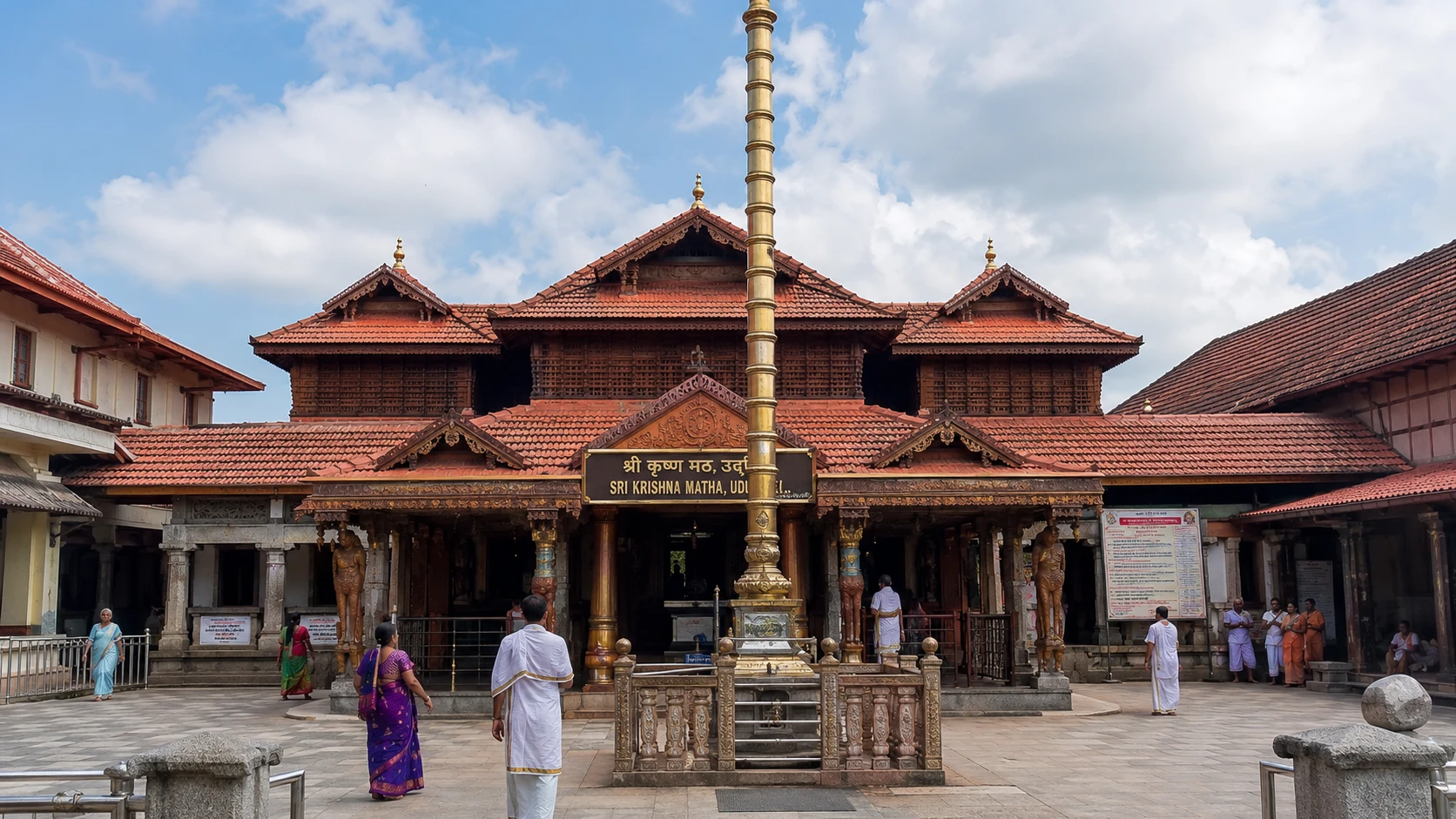
Uḍupi Śrī Kṛṣṇa MaṭhaAlso known as: Udupi Sri Krishna Temple, Udupi Srikrishna Matha, Kanakana Kindi, Sri Krishna Matha Udupi
युग
Temple established c. 13th century CE by Madhvacharya; current structural form evolved over successive centuries
वास्तुकला
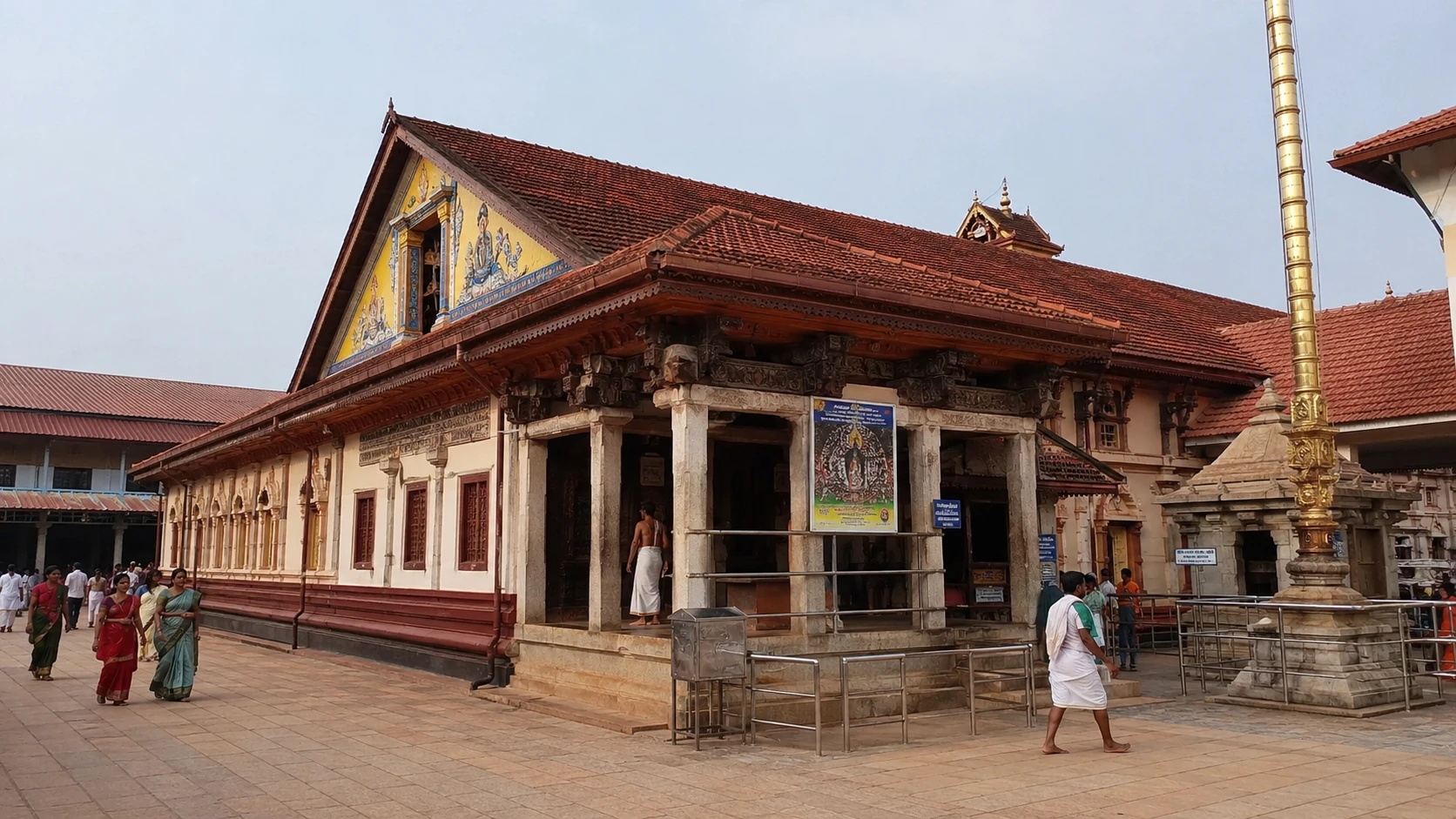
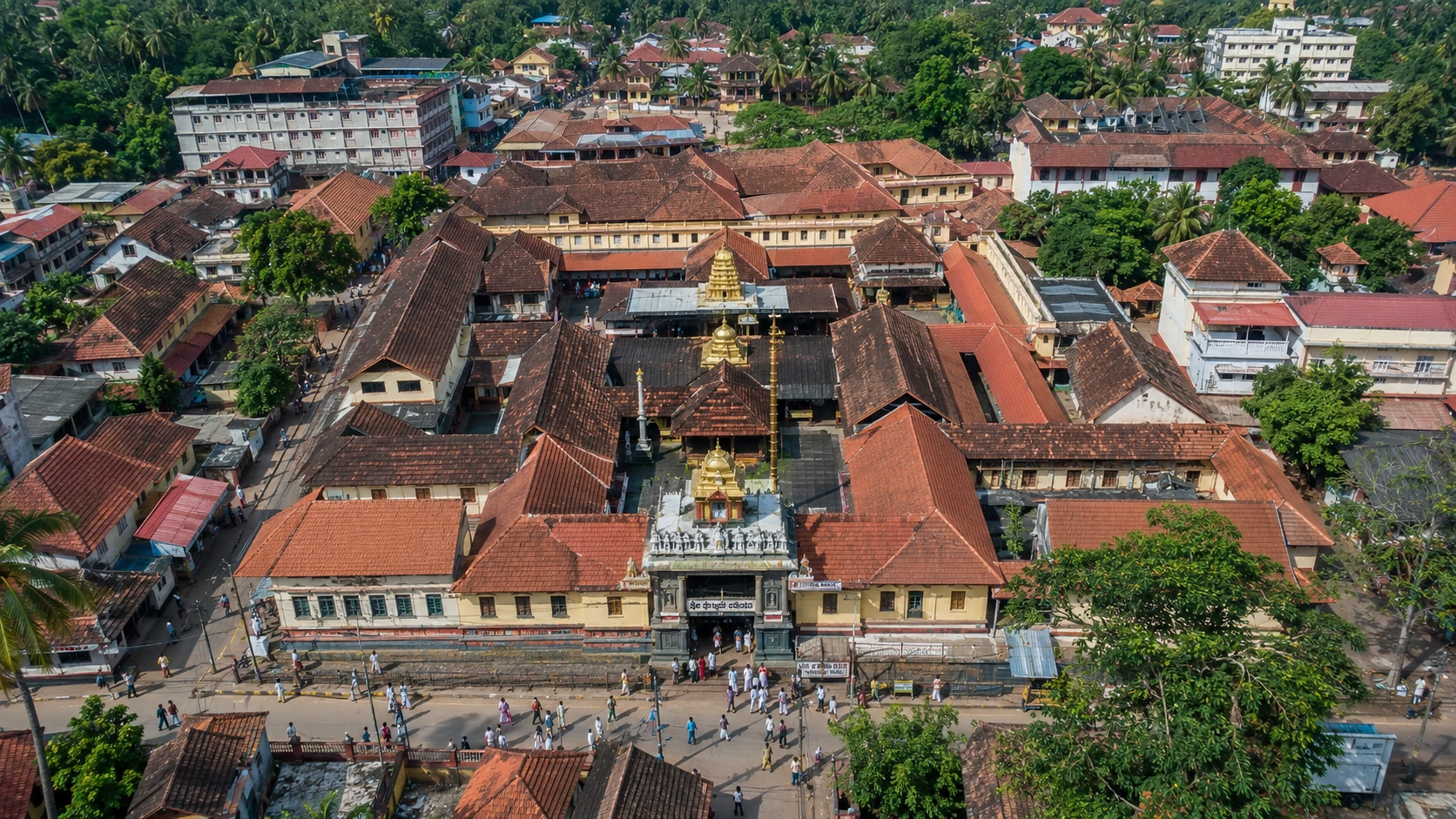
Tulu Nadu / Dakshina Kannada Kerala-Karnataka vernacular — sloping terracotta-tiled roofs, whitewashed stone construction, the Ananthasana (temple tank) at the centre of the matha complex
खुला
06:00 – 20:30
आरती
06:00 · 08:00 · 12:00 · 17:00 · 19:30
विशेष
Darshan at Udupi is through the Kanakana Kindi — the nine-hole latticed window — for most of the day. The nine-hole silver lattice is the standard darshan point. The Paryaya changeover ceremony (biennial, January) involves special extended darshan and utsavam. Timings may vary slightly depending on which of the eight mutts currently holds Paryaya; verify with the current Paryaya mutt.
पवित्र कथा · पवित्र कथा
In the 15th century, a poet-saint named Kanakadasa walked from Karnataka's Kumarakom hills to Udupi, drawn by the fame of the Krishna murti that Madhvacharya had installed two centuries earlier. At the temple gate, he was turned away — his community, the Kurubas, was not permitted entry. He did not argue. He sat on the ground outside the temple's rear wall and began to sing. He sang for days in the Kannada language, compositions of such aching devotion that the tradition holds the Krishna inside could not remain unmoved. According to the Kanakadasa story, the rear wall of the temple cracked open of its own accord — a small opening, barely large enough to see through — and through it, the murti of Krishna turned to face the saint outside. That crack became the Kanakana Kindi: Kanaka's window, now framed in silver and still the devotional heart of Udupi for millions who believe that love, when pure enough, breaks the walls that orthodoxy builds.
Sacred Origin Storyपवित्र उत्पत्ति कथा
Source: Dvaita Vedanta / Madhva Vaishnava tradition; founded by Sri Madhvacharya (1238–1317 CE)
Sri Madhvacharya — the founder of Dvaita Vedanta, the philosophical tradition that holds the distinction between the individual soul and Brahman as fundamental and eternal — established the Udupi Krishna Matha as the spiritual headquarters of his lineage in the 13th century CE. According to the temple's founding tradition, Madhvacharya encountered a ship in distress off the Udupi coast. He calmed the seas through divine intervention, and the grateful merchants offered him cargo as a gift. Among the cargo were large clay balls used as ballast — and Madhvacharya, through spiritual insight, knew that one of these contained a divine form. The clay was broken open, revealing a murti of Krishna that had been hidden within — a child form, Bala Krishna, of extraordinary natural beauty, approximately eighteen inches tall, holding a churning staff.
Madhvacharya recognised the murti as the Dwapara-yuga form of Krishna — the same child who had churned butter in Gokul and revealed the cosmic to his mother Yashoda within his open mouth. He brought the murti to Udupi, installed it in a consecrated matha (monastery-temple), and established the system of eight mathas around it — each governed by a pontiff in the Madhva Brahmin lineage — with the Krishna temple at the centre as the shared sacred object of all eight. The eight-mutt rotation (Paryaya) that governs the temple's administration was established to ensure that no single institution monopolised proximity to the Lord — Krishna, in this theology, belongs equally to all eight branches of Madhvacharya's lineage.
उद्धृत स्रोत:
- Narayana Panditacharya, 'Madhva Vijaya' (13th–14th century) — primary biographical source on Madhvacharya's life and the founding of Udupi
- B.N.K. Sharma, 'History of the Dvaita School of Vedanta and its Literature' (Delhi: Motilal Banarsidass, 2000)
- Udupi Sri Krishna Matha official documentation and temple records
- S. Settar, 'The Hoysala Temples' (Karnataka, 1992) — contextual reference for Karnataka Vaishnava traditions
विद्वत संदर्भ
The traditional account of Madhvacharya's discovery of the Krishna murti from clay ballast is the founding narrative of the Udupi tradition, documented in the Madhva Vijaya and subsequent biographical literature of the Dvaita school. B.N.K. Sharma's authoritative scholarly work on the Dvaita tradition treats Madhvacharya's founding of the Udupi matha (traditionally dated to 1265–1285 CE) as historically credible within the framework of 13th-century Karnataka Vaishnavism, while noting that the specific miracle narrative of the murti's discovery belongs to sacred biography rather than secular historiography. The Kanakadasa tradition is separately documented in Karnataka literary history; Kanakadasa's dates are debated by scholars (ranging c. 1487–1609 CE in different scholarly estimates), but the existence of the Kanakana Kindi and the murti's turned orientation toward the north are physical facts of the present temple.
Historyइतिहास
The Udupi Sri Krishna Matha was established by Madhvacharya (1238–1317 CE), the Dvaita Vedanta philosopher, in the 13th century CE as the central institution of his philosophical and devotional lineage. Madhvacharya founded eight mathas — monastic institutions governed by pontiffs in the Brahmin tradition of his lineage — around the central Krishna temple, establishing the Paryaya system whereby each mutt assumes temple management on a biennial rotational basis. This system has operated continuously since its establishment, making it one of the longest-running institutional governance systems in South Asian religious history. The Kanakadasa episode — in which the devotee-poet of the Kuruba community sat outside the temple and sang until the rear wall cracked open to offer him darshan — is documented in Karnataka literary tradition (the Kanakana Kindi is a physical reality of the present temple) and is dated to approximately the 15th–16th century CE, when Kanakadasa lived. The temple complex today includes the central Krishna shrine, the eight matha compounds, the Madhva Sarovar (sacred tank), and the Kanakana Kindi on the northern wall of the sanctum. The Udupi temple's prasada — specifically the Krishna temple's cuisine tradition, which gave rise to the Udupi restaurant style (vegetarian South Indian cooking) now famous internationally — is an indirect cultural legacy of the matha's traditions of Brahminical vegetarian cooking.
Historical Timelineऐतिहासिक कालक्रम
Sri Madhvacharya establishes the Krishna Matha at Udupi, installing the Bala Krishna murti recovered (according to tradition) from a merchant ship's clay ballast. He founds the eight mathas around the central temple and establishes the Paryaya rotational governance system.
The founding date of the Udupi matha is placed by Dvaita tradition scholars in the period 1265–1285 CE, based on internal evidence in Madhvacharya's works and the Madhva Vijaya. The exact date of the murti's installation is not independently verifiable through external historical sources.
Kanakadasa — a Kannada poet-saint of the Kuruba community — visits Udupi for darshan and is denied temple entry. He sings devotional compositions outside the rear wall for days. According to tradition, the rear wall of the sanctum cracked open, forming the Kanakana Kindi (Kanaka's window), and the murti of Krishna turned to face him. The opening is today framed in silver and remains a primary darshan point.
Kanakadasa's dates are debated; scholarly estimates range from c. 1487–1609 CE. The Kanakana Kindi exists as a physical feature of the present temple; the murti's current orientation (facing north, toward where Kanakadasa sat) is a verifiable physical fact. The miracle narrative is the devotional account of how this came to be.
The Paryaya ceremony — the biennial transfer of temple management from one of the eight mathas to the next in the rotation — has been observed continuously since Madhvacharya's establishment of the system. Every two years in January, a new seer takes charge of the Krishna temple in an elaborate ceremonial transfer. The Paryaya is among South Asia's oldest continuously practised institutional rotations.
The Udupi matha tradition gave rise to the globally famous 'Udupi cuisine' — the vegetarian South Indian cooking style originating in the matha's Brahminical kitchen traditions, which spread through Udupi restaurant workers who migrated to Indian cities and abroad from the late 19th century onward. Today 'Udupi restaurant' is a category of South Indian vegetarian cooking recognised worldwide.
What You'll Seeदर्शन में
The Udupi Krishna murti is a Bala Krishna (child Krishna) form — approximately eighteen inches in height, self-possessed in the proportion and naturalness that the tradition attributes to its miraculous origin. The murti depicts the young Krishna as the churner of butter: the primary hand holds a churning staff (maththu), the gesture and posture capturing the eternal child of Gokul mid-motion, caught between mischief and divinity. The complexion is dark — the deep blue-black of Vishnu, the colour of the monsoon sky. The murti wears elaborate ornaments and seasonal silks, adorned daily according to the precise protocols of the eight mathas in their Paryaya rotation.
What makes the Udupi darshan experience iconographically unique is the medium through which it is received: the Kanakana Kindi — a small window with a nine-hole silver lattice through which the devotee looks at the murti. The window's nine openings are set in a decorative silver frame; the devotee stands before the kindi, looks through one or more of the nine holes, and receives darshan of the murti within. The murti faces north — the direction from which Kanakadasa, the poet-saint, is said to have received darshan when the wall opened toward him. Photography of the murti through the Kanakana Kindi is not permitted.
Distinctive Practicesविशिष्ट परंपराएँ
Kanakana Kindi — darshan through the saint's window
कनकन किंडी — संत की खिड़की से दर्शन
Daily; this is the primary darshan mode for most of the day
At Udupi, the primary experience of darshan occurs not through an open sanctum entrance but through the Kanakana Kindi — a small silver-latticed window with nine holes set into the northern wall of the sanctum. Devotees queue before this window and receive their view of the murti through the lattice. The nine holes are said to correspond symbolically to the nine forms of bhakti (nava-vidha bhakti) outlined in the Bhagavata Purana. The murti faces north toward the window — toward where Kanakadasa once sat and sang, his devotion sufficient to break through stone. Darshan through the kindi creates an intimate, focused experience quite unlike the sweeping view of a conventional open sanctum.
The Kanakana Kindi is simultaneously a devotional miracle-site and a living memorial to the theology of inclusive bhakti — the idea that the Lord is accessible to anyone whose love is genuine, regardless of the social barriers that human institutions may erect. To take darshan through the kindi is, for many devotees, an act of solidarity with Kanakadasa's unwavering devotion and a reminder that the divine's attention is not gatekeeping but grace.
Paryaya — the biennial transfer of temple governance
पर्याय — मंदिर शासन का द्विवार्षिक हस्तांतरण
Every two years in January; the current Paryaya seer's tenure lasts exactly two years
Every two years, on a fixed date in January, the administration of the Udupi Krishna temple formally transfers from one of the eight Madhva mathas to the next in the established rotation. The ceremony — called Paryaya (literally: 'turn') — involves a public procession, formal handover rites, and celebrations that draw tens of thousands to Udupi. The eight mathas are: Palimaru, Adamaru, Krishnapura, Puttige, Shirur, Sodhe, Kaniyur, and Pejavara. Each mutt's seer serves as the chief celebrant and administrator of all temple rituals and sevas for their two-year period. This system has been in continuous operation since Madhvacharya established it in the 13th century — one of the longest continuously maintained institutional practices in Indian religious history.
The Paryaya system embodies the Dvaita Vedanta principle that the Lord (Vishnu/Krishna) is the only ultimate authority — not any individual institution, family, or pontiff. By rotating custody of the deity among all eight mathas with perfect regularity, Madhvacharya prevented any single human authority from establishing permanent dominion over the sacred. The Lord, in this system, is served — not owned.
Did You Know?क्या आप जानते हैं?
The Udupi restaurant tradition — the internationally recognised style of South Indian vegetarian cooking (idli, dosa, sambar, rasam, uttapam) — traces its origins to the vegetarian Brahminical cooking traditions of the Udupi matha. Workers who cooked in the matha's kitchen migrated to Indian cities from the late 19th century, establishing 'Udupi hotels' and restaurants. The Udupi cuisine category is now one of the most recognised in global South Indian cooking.
K.T. Achaya, 'Indian Food: A Historical Companion' (Delhi: OUP, 1994); Colleen Taylor Sen, 'Food Culture in India' (2004)
The Paryaya system of biennial governance — established by Madhvacharya in the 13th century and continuously observed ever since — is among the oldest institutional rotational systems in South Asian history. The eight mathas complete one full rotation every sixteen years, and the current rotation cycle has been running without documented interruption for approximately 700 years.
B.N.K. Sharma, 'History of the Dvaita School of Vedanta and its Literature' (2000); Udupi Sri Krishna Matha official documentation
Kanakadasa (c. 15th–16th century) is one of Karnataka's most celebrated Haridasa (devotee-composer) saints, whose Kannada compositions — Mohanatarangini, Nalesabiruva, and numerous kirtanas — remain living parts of Karnataka's classical music tradition. His kirtanas are sung during Carnatic music concerts and religious ceremonies across Karnataka today. The Kanakana Kindi at Udupi is his most visible monument.
R. Narasimhacharya, 'History of Kannada Literature' (Mysore, 1940); Karnataka Sahitya Parishat documentation
The Pejavara Adokshaja Swamiji — pontiff of the Pejavara Mutt, one of the eight mathas — was a prominent advocate of temple entry for all Hindus across caste, consistent with the Dvaita tradition's emphasis on bhakti as accessible to all. His activism (particularly his symbolic visits to Dalit communities) drew national attention in the late 20th and early 21st centuries.
Press documentation, Indian Express and The Hindu, late 20th–early 21st century
Festivalsत्योहार
Paryaya Utsava — biennial ceremonial handover
पर्याय उत्सव — द्विवार्षिक औपचारिक हस्तांतरण
January (biennial; next occurrence varies by rotation year)
The Paryaya Utsava is the single most spectacular event in the Udupi calendar — a biennial ceremonial transfer of temple governance from one mutt to the next, celebrated with a public procession (the new Paryaya seer arriving in a palanquin), elaborate pujas, and celebrations lasting several days. Tens of thousands arrive in Udupi for the event. The arrival of a new Paryaya seer also traditionally triggers charitable acts — feeding programmes, educational grants — from the incoming mutt.
Janmashtami
जन्माष्टमी
Jul-Aug (Bhadra Krishna Ashtami)
At Udupi, Janmashtami is celebrated as the Lord's birthday in his Bala Krishna (child) form — a particularly intimate festival at a temple whose murti is itself a child form. Midnight aarti and special shringar of the Bala Krishna murti mark the occasion.
Madhvanavami — Madhvacharya's birthday
मध्वनवमी — मध्वाचार्य का जन्मदिन
Jan-Feb (Magh Shukla Navami)
The birth anniversary of the temple's founder Madhvacharya is observed with recitation of his works, special sevas, and the gathering of scholars from the eight matha traditions. It is a day of particular theological significance for the Dvaita tradition.
Kanakadasara Aradhana — Kanakadasa commemoration
कनकदासर आराधना — कनकदास स्मरणोत्सव
Nov-Dec (Karthika, date varies)
The death anniversary of Kanakadasa — the saint who received darshan through the Kanakana Kindi — is observed with kirtan recitations of his Kannada compositions and special prayers at the Kanakana Kindi. Karnataka's Haridasa music tradition is particularly visible on this day.
Traditional Offeringsपारंपरिक अर्पण
प्राथमिक अर्पण
Tulsi (Holy Basil)
तुलसी
तुलसी
Tulsi is the supreme offering of all Vaishnava worship in the Madhva tradition as in all branches of Vaishnavism. The Haribhaktivilasa and the Madhva tradition's own ritual manuals prescribe tulsi as essential to every puja and bhog offering. Offering tulsi at Udupi is an act that transcends the divisions of caste and community that once governed temple access — the plant's sanctity is available to all who approach the Kanakana Kindi.
Makhan and Mishri (Butter and rock candy) — Bala Krishna's primary offering
माखन और मिश्री — बाल कृष्ण का प्राथमिक अर्पण
नवनीत और मिश्री
Because the Udupi murti is specifically the Bala Krishna (child Krishna) form — the butter-churner, the Makhan-chor of Gokul — makhan-mishri carries a particularly direct resonance here. To offer butter and rock candy to the Udupi murti is to enter the specific theological register of the murti's own narrative: we are back in Gokul, the butter has been found, and the child who holds the churning staff is being offered what he reached for.
Panchamrit abhishekam
पंचामृत अभिषेकम्
पञ्चामृत
Panchamrit (milk, curd, honey, ghee, sugar) is used for ritual bathing (abhishekam) of the murti on auspicious occasions and as prescribed in the Madhva tradition's liturgical calendar. The Madhva Brahmin ritualists of the eight mathas follow precise prescriptions from the Haribhaktivilasa for the preparation and application of panchamrit.
Flowers — Lotus, Jasmine, Marigold
पुष्प — कमल, चमेली, गेंदा
Fresh flowers are offered in each of the daily puja sessions. The Dakshina Kannada coast's tropical climate provides an abundance of lotus, jasmine, and marigold year-round. The floral adornment of the Bala Krishna murti changes with each season and festival, the specific arrangements varying according to the Paryaya mutt's tradition.
इस मंदिर की विशेषता
Matha-kitchen prasada — the Udupi vegetarian offering tradition
मठ-रसोई प्रसाद — उडुपि शाकाहारी अर्पण परंपरा
The Udupi matha's daily cooking tradition — strictly vegetarian, following Madhva Brahmin dietary prescriptions (no onion, garlic, root vegetables) — produces the bhog offerings that become prasada for devotees. The matha kitchen's traditions are the direct ancestor of the Udupi restaurant cuisine style. Receiving prasada from the Udupi matha kitchen is itself a participation in a tradition of hospitality that has been maintained for seven centuries.
Offering materials (flowers, tulsi, camphor) are available from vendors near the temple entrance. Prasada from the matha kitchen is distributed to devotees after major puja sessions. The matha also operates annadana (free meal) programmes for pilgrims — check with the current Paryaya mutt for current schedules.
How to Reachकैसे पहुँचें
Udupi is well-connected by rail via the Konkan Railway — Udupi Railway Station (on the Roha-Mangalore Konkan Railway line) is approximately 2 km from the temple, served by trains from Mumbai (approximately 9–10 hours), Mangalore (approx. 1 hour), and Goa (approximately 3–4 hours). By road, Udupi is 65 km north of Mangalore on the coastal NH-66 (Mumbai-Kanyakumari National Highway); regular KSRTC and private buses connect Mangalore and Udupi. Nearest airports: Mangalore International Airport (65 km; approximately 1 hour by road), Goa International Airport Dabolim (160 km; approximately 3 hours). Pre-paid taxis from Mangalore airport to Udupi are available.
Plan Your Visitयात्रा की योजना
🌤 सर्वोत्तम मौसम
October to March (pleasant weather on the Karnataka coast). Paryaya years (every two years in January) are the peak pilgrimage period — check the Paryaya calendar before planning. Monsoon (June–September) brings heavy rainfall on the Dakshina Kannada coast; visiting is possible but roads may be affected.
👘 पहनावे का नियम
Traditional, modest dress required. Men: dhoti or trousers (Western-style trousers are generally permitted here, unlike at Guruvayur). Women: sari or salwar-kameez. Footwear removed at the temple entrance. The Udupi dress code is generally more flexible than Guruvayur; verify current requirements with the Paryaya mutt.
📱 फोन और फोटोग्राफी
Photography of the murti through the Kanakana Kindi is not permitted. Photography of the temple exterior and grounds is generally allowed.
🏨 आवास
Udupi has a range of accommodation from budget lodges near the temple to mid-range hotels. The eight mathas operate dharamshalas for pilgrims, particularly during Paryaya. Mangalore (65 km) provides wider accommodation options with better airport connectivity.
Sacred Soundsपवित्र ध्वनि
108 Japa Practice
Om Namo Bhagavate Vasudevaya
Chant 108 times in the spirit of this temple
क्या आप जानते हैं? · Did You Know?
वही अनुवाद त्रुटि जिसने हिन्दू धर्म में '33 कोटि' को '33 करोड़' बनाया, बौद्ध धर्म में भी हुई। बौद्ध ग्रन्थों के चीनी अनुवाद ने 'सप्त कोटि बुद्ध' (7 श्रेष्ठ बुद्ध) का अनुवाद '7 करोड़ बुद्ध' कर दिया। तिब्बती अनुवाद ने सही किया: 7 प्रकार, 7 करोड़ नहीं। एक संस्कृत शब्द, दो प्रमुख विश्व धर्मों में गलत पढ़ा गया, ने दो एकसमान भ्रम स्वतन्त्र रूप से उत्पन्न किए।
Related Contentसंबंधित सामग्री
Related Scriptures
Community Reflections
🕉️
Be the first to share your reflection.