Nathdwara (Shrinathji)
नाथद्वारा
The cart that would not move — and where it stopped, the Lord chose to stay
Nathdwara, Rajasthan, India
Śrīnāthajī Haveli, NāthdvārāAlso known as: Shrinathji Temple, Nathdwara Mandir, Shrinathji Haveli, Pushtimarg Peeth Nathdwara
युग
Murti installed at Nathdwara 1669–1672 CE; haveli built by the Mewar state; Pushti Marg tradition founded by Vallabhacharya c. 1493 CE
वास्तुकला
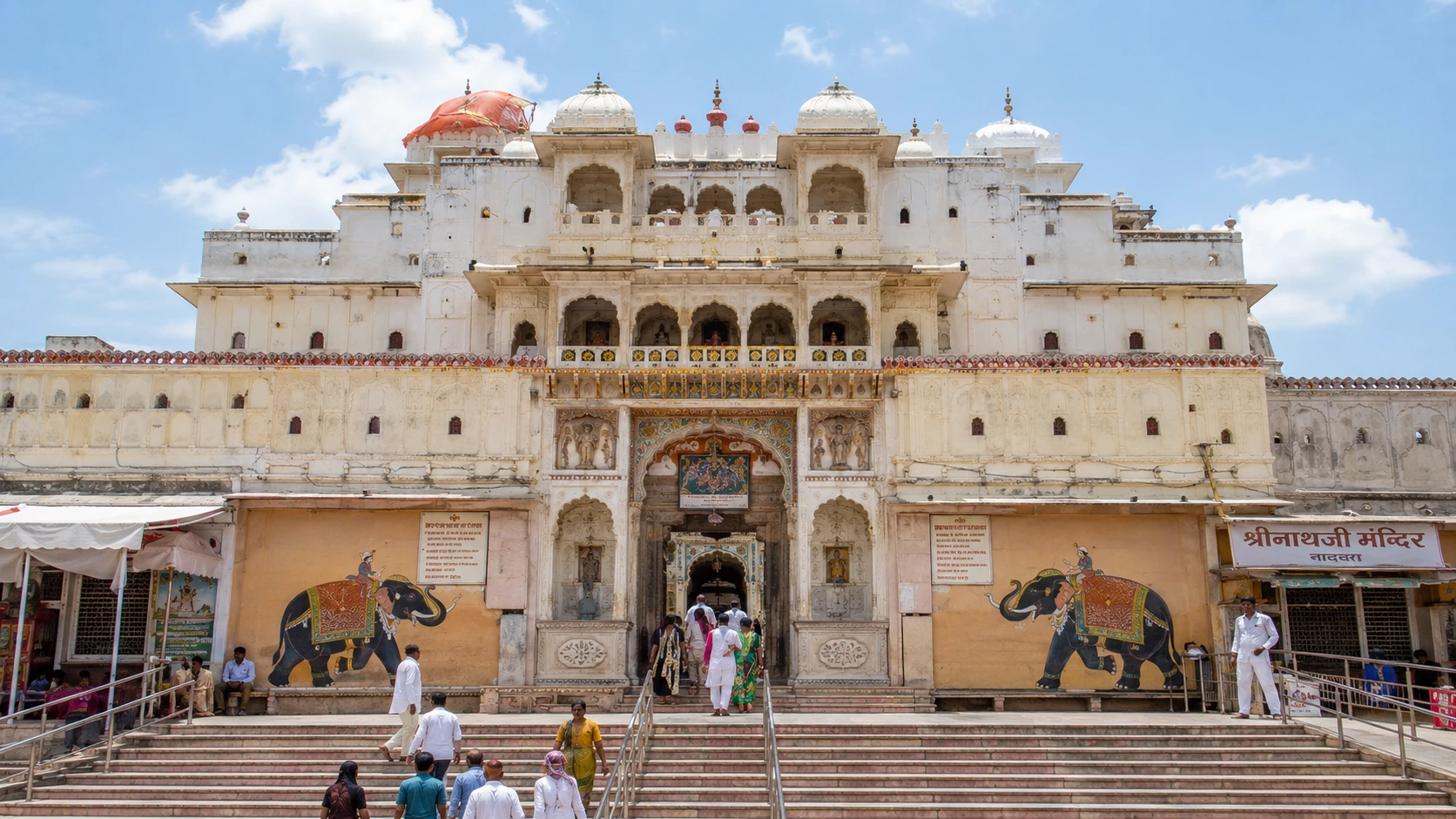
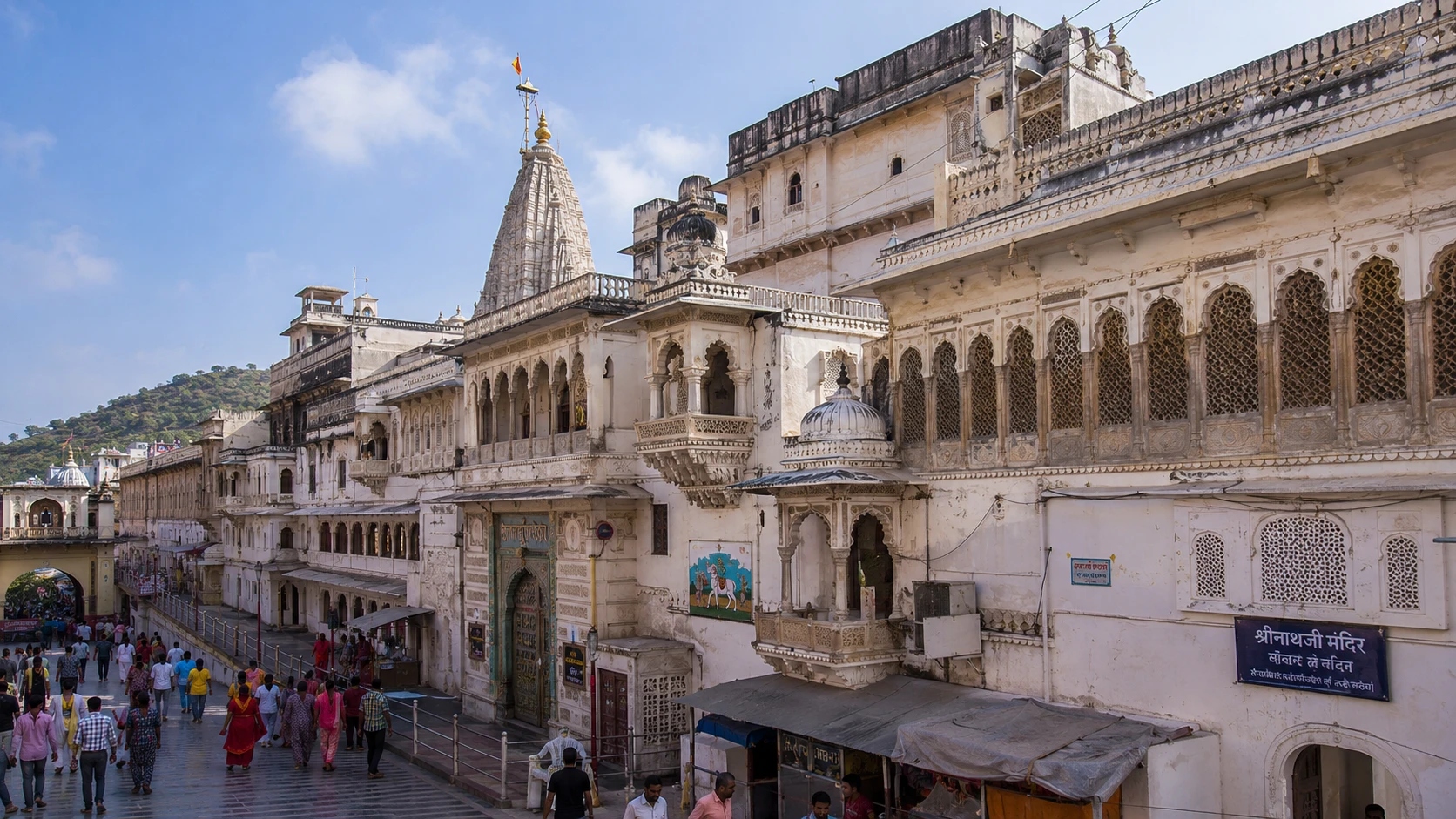
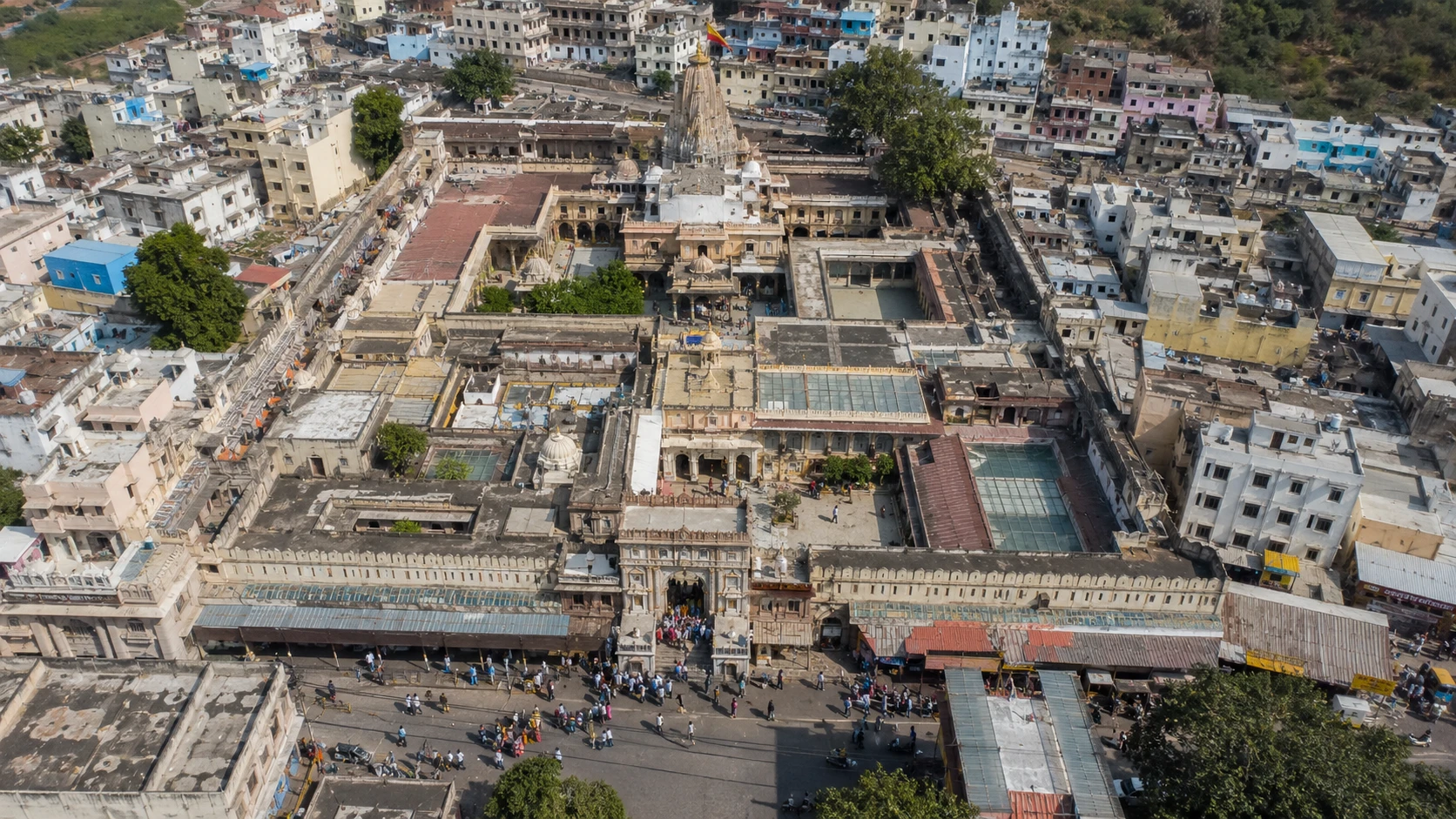
Rajput haveli style — whitewashed multi-storey structure enclosing the deity's living quarters rather than a conventional temple; the Lord is treated as the master of the house
खुला
05:30 – 21:30
आरती
05:30 · 07:30 · 10:30 · 12:00 · 15:30 · 17:00 · 18:30 · 20:30
विशेष
Eight daily darshan windows (ashtayama seva) following the Pushti Marg schedule — Mangala, Shringar, Gwal, Raj Bhog, Utthapan, Bhog, Aarti (Sandhya), Shayan. Each darshan has specific dress, pichwai (cloth painting backdrop), and bhog for Shrinathji. Timings are seasonal and subject to adjustment by the current temple management. Verify the current schedule before visiting.
पवित्र कथा · पवित्र कथा
In 1669 CE, as Mughal authority hardened against the temples of Braj, the custodians of Shrinathji — the sacred child-form of Krishna that Vallabhacharya had established at Govardhan Hill — loaded the murti onto a cart and headed south, searching for a sanctuary beyond the reach of imperial attention. The Rana of Mewar, a devoted Pushti Margi, had offered the protection of his kingdom. The cart moved south through Rajasthan, day after day, until one morning at a village called Sinhad, it stopped. The cart's wheels sank into the mud. The oxen pulled and would not move. Every attempt to shift the cart failed. The custodians understood: this was not mud. This was the Lord choosing his place. A message was sent to the Rana. Word came back: install Shrinathji here. The village of Sinhad became Nathdwara — the Gateway of the Lord — and the murti of the child Krishna with his left arm raised, mid-motion in the act of lifting Govardhan Hill, has stood here for three and a half centuries. The cart that carried him across Rajasthan is no longer needed. He is home.
Sacred Origin Storyपवित्र उत्पत्ति कथा
Source: Pushti Marg (Path of Grace); founded by Sri Vallabhacharya (1479–1531 CE); the tradition follows the shuddhadvaita (pure non-dualism) philosophy with seva (loving service) as the primary devotional mode
Shrinathji — the murti at Nathdwara — depicts Krishna at the age of seven, in the moment described in the Bhagavata Purana's Tenth Canto (Chapters 24–25): the moment when Krishna lifted Govardhan Hill to protect the people and animals of Vraja from the wrathful downpour sent by Indra, whose pride in being the lord of rains had been challenged by Krishna's instruction that the villagers worship the hill instead of him. The seven-year-old boy planted his feet, raised his left arm, and casually balanced the massive hill on his little finger for seven days while the entire population of Vrindavan sheltered beneath it. The murti captures this posture: the left arm raised, the right arm at ease, the weight of a mountain held as lightly as a flower.
The Pushti Marg tradition, founded by Vallabhacharya, understands this specific form of Krishna as the highest expression of divine grace (pushti). Not the cosmic, four-armed Vishnu of philosophical abstraction, not even the teenage lover of Vrindavan, but the child — playful, direct, immediate, a child who holds up a mountain to protect his people the way a parent shelters a child from rain. Vallabhacharya received the vision of this form at Govardhan Hill during one of his pilgrimage circuits and established the worship of Shrinathji ('the Lord of the mountain') as the central practice of his tradition.
The Pushti Marg seva is designed to serve Shrinathji as a beloved child: waking him with gentle music at dawn, bathing and dressing him, feeding him eight meals through the day, entertaining him with music and poetry in the afternoon, putting him to rest with a lullaby at night. The entire day of the Lord is staged in the haveli — not a temple in the conventional sense but a house, because the Lord is not a god to be worshipped from a distance but a child to be loved at close range.
उद्धृत स्रोत:
- Bhagavata Purana, Canto 10, Chapters 24–25 (Govardhan Lila — primary scriptural source for the Shrinathji iconographic programme)
- Vallabhacharya, 'Shodasha Granthas' (sixteen foundational texts of Pushti Marg)
- Goswami Dwarakadasji, 'Shrinathji Prakat Prakarsh' — Pushti Marg account of the murti's manifestation and history
- Tryna Lyons, 'The Artists of Nathdwara: The Practice of Painting in Rajasthan' (Bloomington: Indiana University Press, 2004) — on the pichwai tradition
विद्वत संदर्भ
The Pushti Marg origin narrative of Shrinathji traces the murti to a self-manifestation at Govardhan Hill during Vallabhacharya's time (early 16th century), connected to a vision described in the Shodasha Granthas. The historical account of the murti's migration from Govardhan/Mathura to Nathdwara in 1669–1672 CE is documented in Mewar court records and the Pushti Marg's own chronicles. B.N.K. Sharma's 'History of the Dvaita School of Vedanta' and related scholarly literature on the Bhakti traditions of Rajasthan treat the migration as a well-documented historical event, noting that the Aurangzeb-era pressure on Braj temples is corroborated by multiple historical sources.
Historyइतिहास
The history of Nathdwara is bound to two inseparable stories: the founding of Pushti Marg by Vallabhacharya (1479–1531 CE), and the migration of Shrinathji from Braj to Rajasthan in the late 17th century. Vallabhacharya — born at Champaran in what is today Chhattisgarh — was a Sanskrit scholar and devotee who undertook three pilgrimage circuits of India, during one of which he received a vision of Krishna in the Govardhan hill form (Shrinathji) and established the Pushti Marg philosophy and seva system at Mathura and Govardhan. His son Vitthalnath (Gusainji, 1515–1585 CE) further systematised the tradition, establishing the seven branches (Saptapeethas) of Pushti Marg and developing the theology of seva as the primary devotional mode. In 1669 CE, as Mughal imperial orders pressed against the Braj temples, the custodians of Shrinathji — the Goswami descendants of Vallabhacharya's line — transported the murti southward. After passing through several halting places, the cart bearing the murti stopped at a village called Sinhad in Rajasthan, near Udaipur. The Rana of Mewar, Raj Singh I, provided the land and patronage for the permanent installation of Shrinathji at the site, which was renamed Nathdwara (Gateway of the Lord). The haveli was built by Mewar craftsmen; the Maharanas of Udaipur remained the primary royal patrons for the next two centuries. Nathdwara today is among the wealthiest and most visited religious sites in Rajasthan, drawing several million pilgrims annually. The Nathdwara pichwai painting tradition — the distinctive large-scale cloth paintings that serve as the backdrop for Shrinathji's daily darshan — has developed here into one of India's most sophisticated devotional art forms.
Historical Timelineऐतिहासिक कालक्रम
Sri Vallabhacharya undertakes his three pilgrimage circuits of India, during which he receives a divine vision of the Govardhan hill form of Krishna at Govardhan Hill (Braj). He establishes the Pushti Marg philosophy — shuddhadvaita and the theology of divine grace (pushti) as the basis of liberation — and installs the worship of Shrinathji at Govardhan, founding the lineage of Goswami custodians from his own family.
The dates of Vallabhacharya's pilgrimage circuits are reconstructed from internal evidence in his writings and the Pushti Marg biographical tradition. Scholars of the Bhakti tradition (R.K. Barz, 'The Bhakti Sect of Vallabhacharya', 1976) treat c. 1493–1516 CE as the period of the tradition's foundational establishment.
Vitthalnath (Gusainji, c. 1515–1585 CE), Vallabhacharya's second son and principal successor, further develops the Pushti Marg. He establishes the ashtayama (eight-period) seva system, organises the seven branches (Saptapeethas) of the tradition, and institutionalises the role of the Goswami custodians. The pichwai painting tradition begins to take form during this period as part of the elaborate visual-devotional environment of Shrinathji's seva.
Mughal imperial pressure on the Braj/Mathura region intensifies. The Goswami custodians of Shrinathji transport the murti from Govardhan Hill southward. After several halting places, the cart bearing the murti stops and will not move at Sinhad village in Rajasthan. The Rana of Mewar, Raj Singh I, provides land and patronage for the permanent installation. The haveli at Nathdwara is built; Sinhad is renamed Nathdwara ('Gateway of the Lord'). Installation is dated variously to 1669 or 1672 CE in different Pushti Marg sources.
The Aurangzeb-era pressure on Braj temples is well documented in Mughal administrative records and multiple independent sources. The specific date of Shrinathji's installation at Nathdwara varies in Pushti Marg sources between 1669 and 1672 CE; the Mewar court patronage is historically documented.
Nathdwara flourishes under the sustained patronage of the Maharanas of Mewar (Udaipur). The haveli is expanded and the pichwai painting tradition reaches its classical peak — the Nathdwara school of painting, with its distinctive large-format cloth paintings of Shrinathji's leelas in Vrindavan, becomes one of Rajasthan's most important devotional art traditions. Nathdwara becomes the primary pilgrimage centre of the Pushti Marg throughout north India.
What You'll Seeदर्शन में
The Shrinathji murti at Nathdwara is a child-form (Bala Krishna) of approximately seven years of age — not the teenager of Vrindavan's rasalila, not the cosmic Chaturbhuja Vishnu of Guruvayur, but a child, caught in the specific moment of the Govardhan Lila. The left arm is raised above the head, as if supporting the weight of a mountain with casual ease — the ease of a child showing off to his friends, which is exactly the theological register the Pushti Marg intends. The right arm is at ease at the side or waist. The figure is dark in complexion — the deep shyama of the monsoon sky — and wears elaborate seasonal sringara (adornment) that changes at each of the eight daily darshan sessions.
The Nathdwara darshan is distinguished not only by the murti but by the pichwai — large-scale cloth paintings placed as backdrops behind Shrinathji, changed daily and seasonally to create a specific devotional environment for each darshan. The Sharad Poornima pichwai shows Shrinathji surrounded by the moonlight of autumn; the Monsoon pichwai depicts him in the rains of Vrindavan; the Annakuta pichwai shows the mountain of food offerings. Each pichwai is an act of devotional imagination — the recreation of Vrindavan's seasons and leelas in the world of the haveli. The pichwai tradition of Nathdwara is one of India's most sophisticated living devotional art traditions. Photography of the murti and sanctum interior is not permitted.
Distinctive Practicesविशिष्ट परंपराएँ
Pichwai — the living paintings behind the Lord
पिछवाई — प्रभु के पीछे जीवंत चित्रकारी
Daily; changed at each darshan session and seasonally
Pichwai (from Sanskrit 'prishtha' — behind, and 'vai' — hanging) are large-scale devotional cloth paintings placed as a backdrop directly behind the Shrinathji murti during darshan. At Nathdwara, the pichwai is not a static decorative element but a living part of the worship: it changes with each of the eight daily darshan sessions, and the choice of pichwai for each occasion follows a liturgical calendar based on Braj seasons, festivals, and the daily schedule of Shrinathji's life. The monsoon pichwai shows Vrindavan in rains; the Annakuta pichwai shows the mountain of food; the Sharad Poornima pichwai shows moonlit Vrindavan. The pichwai painters of Nathdwara — hereditary artist families who have worked here since the 17th century — are among India's most skilled traditional artists. The Nathdwara pichwai tradition, documented in depth by Tryna Lyons ('The Artists of Nathdwara', 2004), is one of the last active traditions of large-scale devotional painting in South Asia.
In Pushti Marg theology, the haveli of Shrinathji is not a temple but the Lord's actual home — and a home has a living environment, not a fixed one. The pichwai creates the seasons and occasions of Vrindavan within the haveli, so that every darshan is not merely a visit to a murti but an entrance into a specific moment of Krishna's eternal lila. The pichwai is the devotee's gift of Vrindavan to the Lord who left Vrindavan for Rajasthan.
Ashtayama seva — the Lord's full day
अष्टयाम सेवा — प्रभु का पूरा दिन
Eight fixed darshan windows throughout each day, from pre-dawn to late night
Nathdwara follows the full ashtayama (eight-period) seva codified by Vitthalnath (Gusainji) in the 16th century — treating each day as the Lord's actual day, from waking to sleeping. The eight windows are: Mangala (pre-dawn waking and first darshan), Shringar (morning bath, dress, and adornment), Gwal (milk-distribution time — the Lord as cowherd), Raj Bhog (the royal midday meal, the most elaborate darshan), Utthapan (waking from afternoon rest), Bhog (evening meal offering), Aarti / Sandhya (twilight devotions), and Shayan (the Lord's retirement for the night). Each window has its own specific sringara (seasonal dress), bhog (specific foods), and pichwai. The ashtayama transforms the haveli into a living enactment of Krishna's eternal day in Vrindavan.
Pushti Marg seva theology, as articulated by Vallabhacharya in the Shodasha Granthas, holds that the devotee's relationship with Krishna is not that of supplicant and king but of intimate companions — and that the highest form of devotion is to participate in the Lord's daily life by loving him through his day. The ashtayama is the schedule of that love: a complete day of attendance on the Lord, as a mother attends a beloved child.
Haveli theology — the Lord's house, not a temple
हवेली धर्मशास्त्र — मंदिर नहीं, प्रभु का घर
Ongoing; the architectural and devotional principle of Pushti Marg worship
The Shrinathji complex at Nathdwara is structured as a haveli — a traditional Rajput mansion — not a conventional temple with a towering shikhara and public concourse. In Pushti Marg theology, the Lord is not a god to be worshipped in a public ritual space but a beloved child (Lala) to be served in an intimate home. Devotees who come to Nathdwara are not pilgrims visiting a god; they are guests visiting the Lord's house. The seva (service) performed in the haveli — cooking, dressing, singing to, entertaining, and putting to sleep the Lord — is modelled on the intimate household service of a parent to a child. This domestic theology is the most distinctive feature of Pushti Marg among India's Vaishnava traditions.
Did You Know?क्या आप जानते हैं?
The Nathdwara pichwai tradition produces some of the largest sacred cloth paintings in India — a single Annakuta (mountain of food) pichwai can measure 15–20 feet in height, hand-painted with natural pigments and gold by hereditary artist families. Tryna Lyons's study ('The Artists of Nathdwara', 2004) documented the traditional families who have maintained this art form since the 17th century.
Tryna Lyons, 'The Artists of Nathdwara: The Practice of Painting in Rajasthan' (Indiana University Press, 2004)
Shrinathji's left arm is permanently raised — a posture unique among all Krishna murtis in India. The raised arm represents the Govardhan lila (lifting of Govardhan Hill, Bhagavata Purana, Canto 10, Chapters 24–25). What makes the murti remarkable is that it does not show the extraordinary act of lifting a mountain as supernatural or effortful — the child-form holds up the hill with the same casual ease with which a 7-year-old picks up a toy.
Bhagavata Purana, Canto 10, Chapters 24–25; Pushti Marg iconographic tradition
The Nathdwara pichwai has entered international fine art markets and museum collections. Major pichwais are held in the collections of the Victoria and Albert Museum (London), the Philadelphia Museum of Art, and Indian private collections. The living tradition at Nathdwara is thus simultaneously a functioning devotional practice and an internationally recognised art form.
Tryna Lyons, 'The Artists of Nathdwara' (2004); Victoria and Albert Museum collections catalogue
Vallabhacharya's Pushti Marg is the tradition that produced some of India's greatest devotional poets: the Ashtachap — eight poets (including Surdas and Kumbhandas) who composed in Braj Bhasha under Vitthalnath's patronage. Surdas's Sur Sagar — over 100,000 verses on Krishna's life — is the largest and most celebrated devotional work in Braj Bhasha and was composed as seva to Shrinathji.
K.E. Bryant, 'Poems to the Child-God: Structures and Strategies in the Poetry of Surdas' (Berkeley, 1978); R.K. Barz, 'The Bhakti Sect of Vallabhacharya' (1976)
Festivalsत्योहार
Annakuta — mountain of food
अन्नकूट — अनाज का पर्वत
Oct-Nov (Kartika Shukla Pratipad, day after Diwali)
Annakuta is Nathdwara's most spectacular festival — a mountain of food, literally, piled before Shrinathji in re-enactment of the day after the Govardhan lila, when the people of Vrindavan expressed their gratitude to Krishna by cooking every food they could and offering it as a mountain. Hundreds of different dishes are prepared by the temple kitchen and arranged in a massive pile before the murti. The Annakuta pichwai — one of the largest pichwais in the tradition — is displayed. Tens of thousands gather for this darshan.
Janmashtami
जन्माष्टमी
Jul-Aug (Bhadra Krishna Ashtami)
At Nathdwara, Janmashtami involves the most elaborate midnight shringar (adornment) of the year — the midnight birth moment of Krishna is marked by special dress, pichwai depicting the birth scene, and an extended darshan. Because Shrinathji is specifically the child-form of the Govardhan period, the birth narrative carries particular resonance.
Govardhan Puja (Diwali+1)
गोवर्धन पूजा
Oct-Nov (Kartika Shukla Pratipad)
Because Shrinathji is the Govardhan form, Govardhan Puja carries supreme significance at Nathdwara — more than at any other Krishna temple. The festival celebrates the day Krishna lifted Govardhan Hill: the very act the murti perpetually depicts. The Annakuta festival follows immediately.
Sharad Poornima
शरद पूर्णिमा
Oct (Ashwin Purnima)
The autumn full moon night is observed at Nathdwara with the Sharad Poornima pichwai — moonlit Vrindavan in silk — and extended late-night darshan. In Braj theology, Sharad Poornima is the night of the rasalila; at Nathdwara, Shrinathji is adorned in the moonlight-evoking silks of that night and the devotees' singing echoes the gopas' songs.
Traditional Offeringsपारंपरिक अर्पण
प्राथमिक अर्पण
Tulsi (Holy Basil)
तुलसी
तुलसी
Tulsi is foundational to all Vaishnava worship, and the Pushti Marg tradition — which follows the Haribhaktivilasa's prescriptions — places tulsi as the supreme offering material. Every bhog at Nathdwara is presented with tulsi leaves; the Goswami priests maintain tulsi plants in the haveli compound as part of the sacred environment.
Ashtayama bhog — eight daily meal offerings
अष्टयाम भोग — आठ दैनिक भोजन अर्पण
अष्टयाम भोग
The bhog at Nathdwara is the most elaborate daily food offering in the Krishna temple tradition — eight separate meals prepared for Shrinathji through the day, each specific to the time and season. Morning bhog features light foods (fruits, butter, milk); midday Raj Bhog is the most elaborate (dozens of dishes, prepared fresh in the haveli kitchen); afternoon and evening bhog are progressively lighter. The foods are prepared strictly according to Vaishnava dietary laws — no onion, garlic, or root vegetables — by Brahmin cooks trained in the Pushti Marg kitchen tradition.
Makhan and Mishri
माखन और मिश्री
नवनीत और मिश्री
Fresh white butter (makhan) and rock candy (mishri) are among Shrinathji's most beloved offerings — because the murti is specifically the butter-loving child of Gokul in his Govardhan-lifting guise. The Pushti Marg theological literature is full of references to makhan-mishri as the substance of the devotee's love, the simplest and most direct expression of intimacy with the child-Lord.
Seasonal flowers and fragrant garlands
मौसमी पुष्प और सुगंधित मालाएँ
The floral adornment of Shrinathji is coordinated with the pichwai — the choice of flowers at each darshan session reflects the season being depicted behind the murti. Monsoon darshans feature kadamba and champa flowers evoking the Vrindavan rains; winter darshans use heavier, warming florals. The flower offering at Nathdwara is a multi-sensory devotional act.
इस मंदिर की विशेषता
Annakuta — mountain of food (Kartika Shukla Pratipad)
अन्नकूट — भोजन का पर्वत
The Annakuta offering — literally a mountain of cooked food presented to Shrinathji on the day after Diwali — is the most spectacular single devotional offering in the Nathdwara calendar. Hundreds of dishes prepared by the temple kitchen and contributions from devotees are arranged in a towering pile before the murti, re-enacting the gratitude of the people of Vrindavan after Govardhan was set down. The Annakuta pichwai, one of the largest produced in the tradition, is displayed simultaneously.
Offering materials (tulsi, flowers, makhan-mishri) are available from vendors in the Nathdwara bazaar surrounding the haveli. Prasada — primarily sweets and a rice-based offering — is distributed after Raj Bhog and Aarti darshans. The temple does not accept cooked food brought from outside; all bhog is prepared in the haveli kitchen.
How to Reachकैसे पहुँचें
Nathdwara is located 48 km northeast of Udaipur on National Highway 58. By road from Udaipur (48 km, approximately 1 hour), frequent buses (RSRTC and private) and taxis make the journey. By rail, Udaipur City Railway Station (48 km) is the nearest major station, connected to Delhi (approximately 12 hours on Mewar Express), Mumbai, and Jaipur. By air, Maharana Pratap Airport (Udaipur, 55 km) has daily flights from Mumbai, Delhi, Jaipur, and Bengaluru. Pre-paid taxis from the Udaipur airport to Nathdwara are available.
Plan Your Visitयात्रा की योजना
🌤 सर्वोत्तम मौसम
October to March (mild Rajasthan winters; Annakuta in October–November, the most spectacular festival). Monsoon (July–September) brings the Vrindavan-evoking pichwais; a beautiful season to experience the haveli in rain. Summer (April–June) is hot but manageable with morning visits.
👘 पहनावे का नियम
Modest dress required. Men: dhoti or clean trousers with kurta. Women: sari or salwar-kameez. Footwear removed at the entrance. The Pushti Marg tradition does not impose the extreme dress code of Guruvayur, but traditional attire is appropriate and respectful.
📱 फोन और फोटोग्राफी
Photography of the Shrinathji murti inside the haveli is not permitted. Photography in the outer courtyard and bazaar areas is generally allowed.
🏨 आवास
Nathdwara town has numerous dharamshalas, guest houses, and hotels catering to pilgrims. The Goswami Pushti Peeth Trust operates accommodation. Udaipur (48 km) offers a much wider range of hotels and resorts and is a comfortable base for day trips to Nathdwara.
Book a Pujaपूजा बुक करें
Booking links and phone numbers are verified periodically but may change without notice. The nathdwara.com URL is the known official portal — verify before payment. The eight ashtayama darshan timings are subject to seasonal and ritual adjustment; confirm the current schedule with the temple management on arrival. Fraudulent travel agents offering 'guaranteed VIP darshan' at Nathdwara should be approached with caution.
Managed by: Shrinathji Mandir / Goswami Pushti Peeth Trust, Nathdwara
Raj Bhog darshan (special timed access to the midday darshan)
राज भोग दर्शन
Annakuta seva sponsorship
अन्नकूट सेवा प्रायोजन
Booking information verified: 2026-05-23
Sacred Soundsपवित्र ध्वनि
Shrinathji Mangala Aarti — Pushti Marg pre-dawn waking aarti; the Lord's daily awakening
aarti
Surdas Kirtanas — Sur Sagar compositions to Shrinathji; Braj Bhasha poetry of the Ashtachap tradition
bhajan
Pushti Marg Dhrupad compositions — classical Dhrupad tradition developed for Shrinathji's seva
stotram
108 Japa Practice
Om Namo Bhagavate Vasudevaya — Pushti Marg tradition also uses 'Shri Krishnah Sharanam Mama' (Vallabhacharya's mantra)
Chant 108 times in the spirit of this temple
क्या आप जानते हैं? · Did You Know?
वही अनुवाद त्रुटि जिसने हिन्दू धर्म में '33 कोटि' को '33 करोड़' बनाया, बौद्ध धर्म में भी हुई। बौद्ध ग्रन्थों के चीनी अनुवाद ने 'सप्त कोटि बुद्ध' (7 श्रेष्ठ बुद्ध) का अनुवाद '7 करोड़ बुद्ध' कर दिया। तिब्बती अनुवाद ने सही किया: 7 प्रकार, 7 करोड़ नहीं। एक संस्कृत शब्द, दो प्रमुख विश्व धर्मों में गलत पढ़ा गया, ने दो एकसमान भ्रम स्वतन्त्र रूप से उत्पन्न किए।
Related Contentसंबंधित सामग्री
Related Scriptures
Community Reflections
🕉️
Be the first to share your reflection.