Banke Bihari
बांके बिहारी
Where the curtain falls so devotees don't drown in the divine
Vrindavan, Uttar Pradesh, India
Bāṃke BihārīAlso known as: Banke Bihari Temple, Thakur Banke Bihari, Bihari Ji, Nidhivan Bihari, Shri Banke Bihari Mandir
युग
Murti manifested c. 1535 CE; current temple structure built 1864
वास्तुकला
Rajasthani Haveli / Braj vernacular
खुला
07:45 – 21:30
आरती
07:45 · 12:00 · 17:30 · 20:00
विशेष
Mangala Aarti performed only on Akshaya Tritiya (once annually, not daily — distinctively absent here). Parda (curtain) drawn every few minutes during all darshan sessions. Seasonal timing variations: summer and winter schedules differ; verify current hours with temple management before visiting.
पवित्र कथा · पवित्र कथा
In the sacred groves of Nidhivan — where Krishna is said to dance with Radha every moonlit night, and no human is permitted to remain after dusk — a 16th-century saint-musician sang with such total devotion that the divine could no longer stay hidden. When Swami Haridas composed his pada calling upon the divine couple, the murti of Banke Bihari emerged from the earth: Krishna forever bent in the posture of perfect love, a tribhanga that has captivated Braj Bhoomi for nearly five centuries. So direct and consuming is Bihari Ji's gaze that the priests draw a curtain every few minutes during darshan — not to deny devotees the sight, but because the tradition holds that no human heart can bear the full weight of that love without a moment to breathe. To stand before Banke Bihari is, in the language of Braj, to be looked at by the Lord before you have had time to look at him.
Sacred Origin Storyपवित्र उत्पत्ति कथा
Source: Haridasi Sampradaya, founded by Swami Haridas (c. 1512–1607)
Swami Haridas, the founder of the Haridasi sampradaya, made his home in Nidhivan — the primordial forest at the heart of Vrindavan where, by ancient tradition, the divine lila of Radha and Krishna continues each night behind sealed gates that no mortal eyes witness. Haridas was a man who had dissolved entirely into devotion, composing padas in Braj Bhasha of such intensity that later tradition placed him as the teacher of Tansen, the legendary musician of Emperor Akbar's court — though this relationship, while accepted within the tradition, is not corroborated by contemporary historical records.
One evening at Nidhivan, as Haridas sat composing a devotional pada addressed to the divine couple, his yearning reached a depth that the divine could not leave unanswered. The earth of the sacred grove opened, and the murti of Banke Bihari emerged — Krishna in the eternal tribhanga posture: bent at the neck, the waist, and the knee, the triple-curve that signifies a being so full of divine grace that straight lines cannot contain it. The name given to the murti in that moment encodes his nature: 'Banke' from 'vakra,' meaning bent or crooked; 'Bihari' from 'vihari,' meaning one who revels and takes delight — together, 'the crooked one who revels in his own divine mischief.' It is said that the murti's gaze was so overwhelming that Haridas himself had to ask Bihari Ji to half-close his eyes — and the deity complied, fixing his gaze in the half-lidded, inward-looking expression that devotees encounter today.
The murti was initially worshipped at Nidhivan itself. As the Haridasi tradition grew and pilgrims multiplied, it was moved to its present location and installed in a formal temple structure built in 1864, where it has remained the living heart of Braj devotion ever since.
उद्धृत स्रोत:
- Haridasi sampradaya oral and manuscript tradition; documented in Ramakali Sharan, 'Braj Ke Mandir' (Mathura, 1985)
- Alan Entwistle, 'Braj: Centre of Krishna Pilgrimage' (Groningen: Egbert Forsten, 1987), Chapter 4 — on Vrindavan sacred sites and Haridasi tradition
- Diana Eck, 'India: A Sacred Geography' (New York: Harmony Books, 2012), Chapter on Vrindavan
विद्वत संदर्भ
The date of manifestation is given within the Haridasi tradition as occurring during Swami Haridas's lifetime (c. 1512–1607); the circa 1535 CE date is commonly cited in temple literature but has not been independently corroborated through archival sources. Modern scholarship on Braj devotional traditions — Alan Entwistle's 'Braj: Centre of Krishna Pilgrimage' (1987) being the most comprehensive academic survey — treats these origin narratives as expressions of the living devotional geography of Vrindavan rather than accounts subject to conventional archival verification. The Tansen-Haridas guru-shishya relationship is accepted in North Indian classical music tradition (both Hindustani and Dhrupad lineages) but is noted by musicologists as a biographically uncertain claim; its importance lies in the cultural status it confers on the Haridasi lineage's musical contributions.
Historyइतिहास
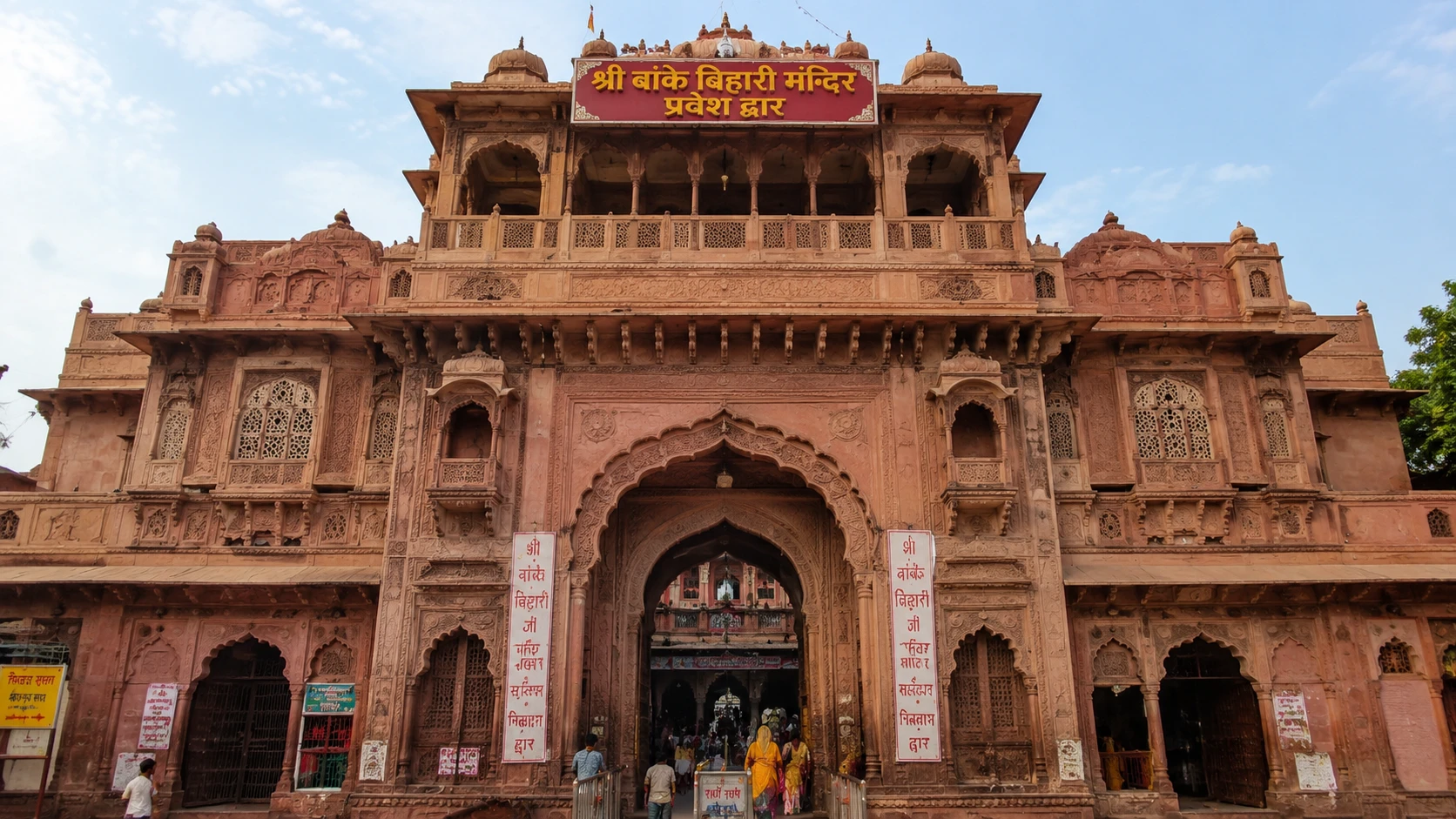
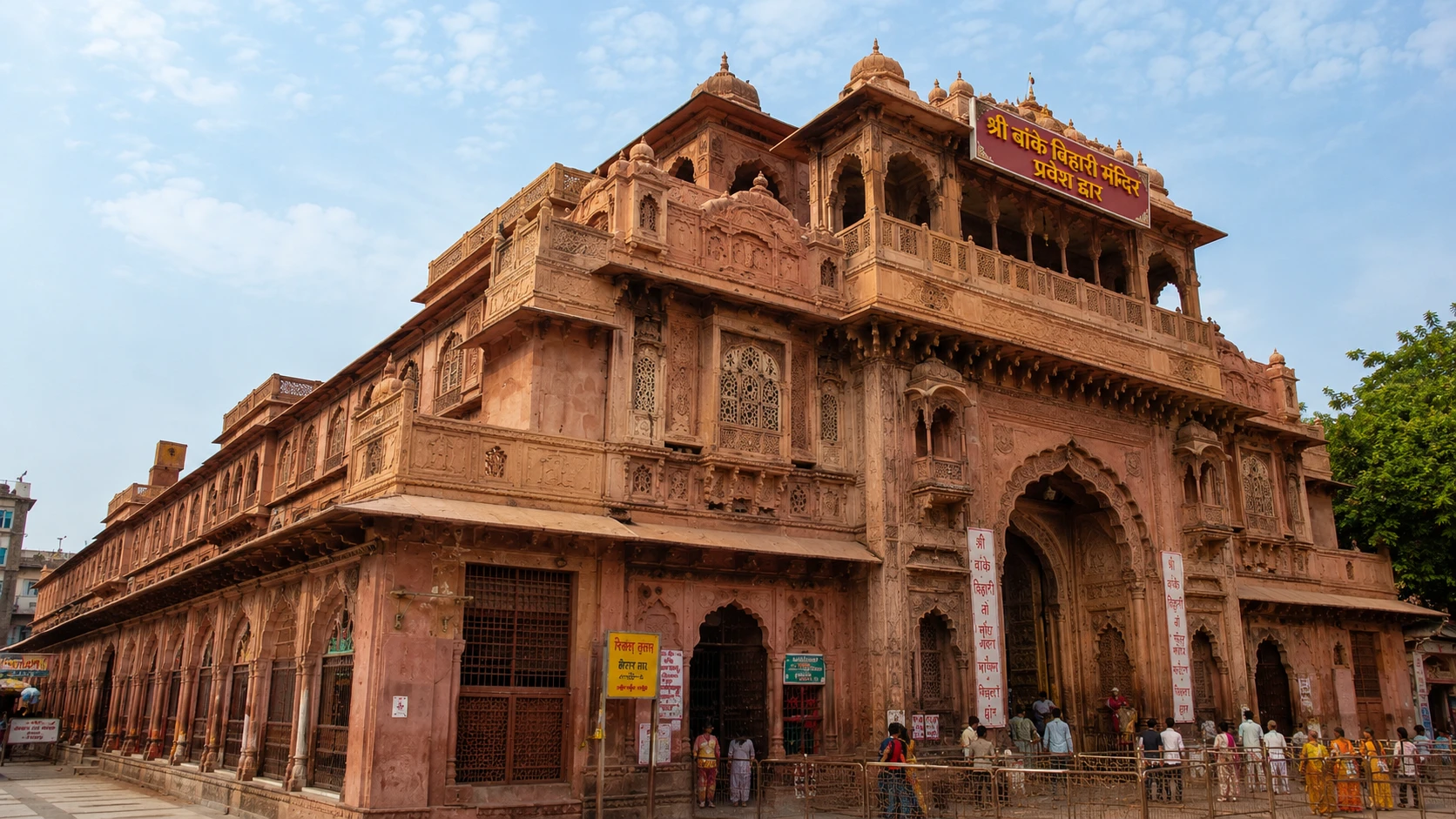
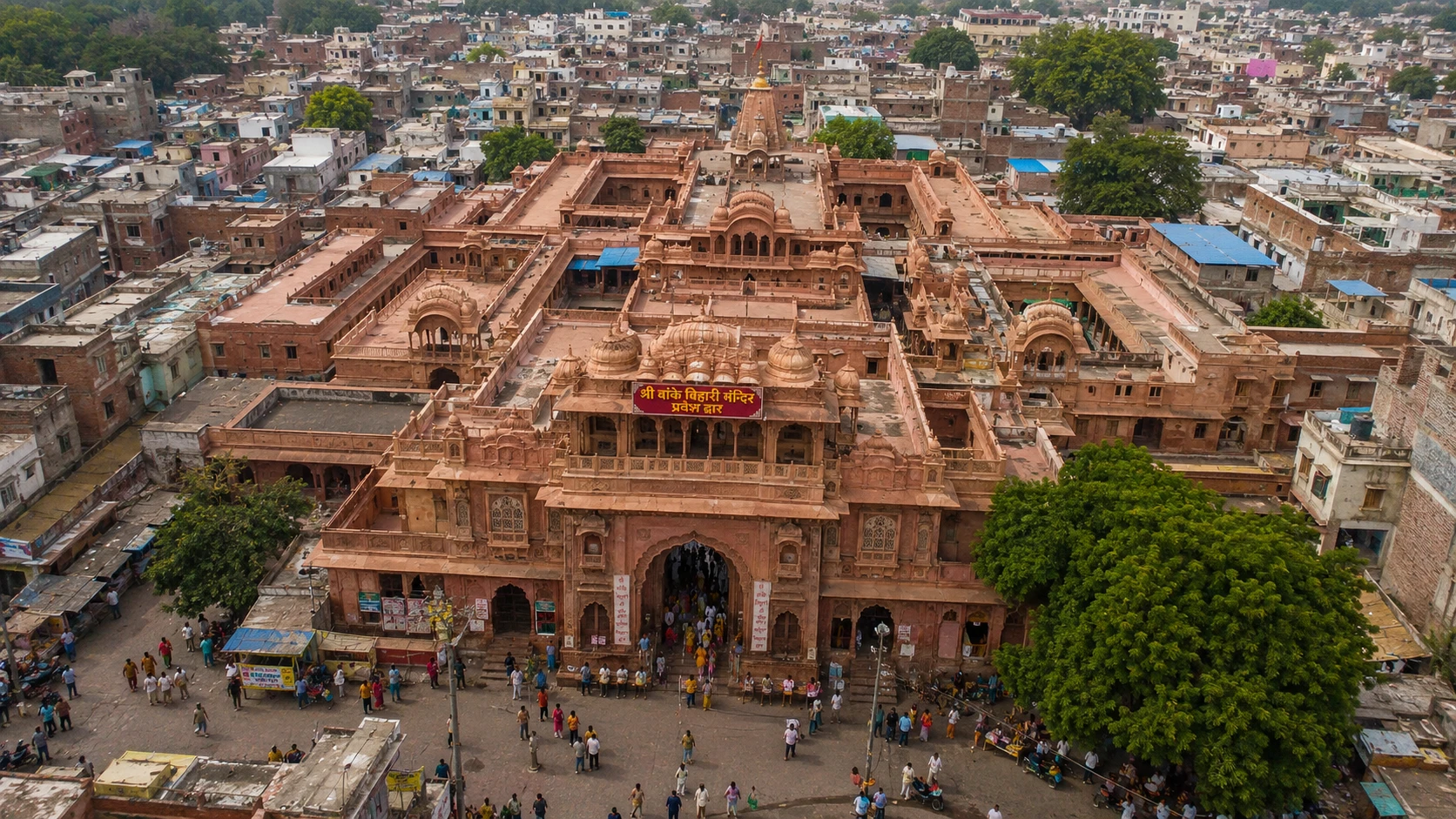
The history of Banke Bihari temple is inseparable from the person of Swami Haridas (c. 1512–1607), the founder of the Haridasi sampradaya and among the most revered musician-saints of the Braj tradition. Haridas composed nearly a thousand devotional padas in Braj Bhasha — verse-compositions of such spiritual intensity that they became the liturgical corpus of the sect he founded. The murti he is credited with manifesting remained at Nidhivan, tended by Goswamis of the Haridasi line, for approximately three centuries. In 1864, the caretaker Goswamis constructed the present temple building in central Vrindavan — a structure built in the Rajasthani haveli style, with its enclosed courtyard, its ornate arched niches, and its double-storeyed galleries — to provide a permanent home for the growing tide of pilgrims. Over the following century, the Banke Bihari temple established itself as one of the most visited shrines in all of Braj, drawing several hundred thousand devotees for Janmashtami and earning particular fame for its Holi celebrations, during which the packed courtyard fills with cascades of gulal (coloured powder) days before the formal festival. The temple is today managed by the Goswami family, custodians who are direct descendants of the Haridasi lineage, maintaining the sect's two most distinctive protocols: the near-total absence of daily Mangala Aarti — an act of love toward the sleeping Lord, not performed save once a year on Akshaya Tritiya — and the continuous parda tradition, the curtain that falls and rises through every darshan session like the breath of the divine encounter itself.
Historical Timelineऐतिहासिक कालक्रम
Swami Haridas, founder of the Haridasi sampradaya, is credited with the manifestation of the Banke Bihari murti at Nidhivan, Vrindavan, during a session of devotional singing. The murti was initially installed and worshipped at Nidhivan itself.
No external contemporary document corroborates the date or event. The manifestation narrative is foundational to the Haridasi tradition and is treated as sacred history within the sampradaya; modern scholarship on Braj pilgrimage traditions treats it as a devotional origin account rather than a datable historical event.
The present temple structure was built in central Vrindavan by the Goswami caretakers of the Haridasi lineage, relocating the Banke Bihari murti from Nidhivan to a permanent haveli-style building. This remains the temple's physical structure today.
The 1864 date is cited consistently in temple literature. The principal builder is named in temple tradition as Goswami Shyamlal; this has not been independently verified through archival sources consulted for this entry.
The temple's Janmashtami and Holi celebrations grew to national prominence, drawing hundreds of thousands of devotees annually. The midnight parda-lifting on Janmashtami — revealing Bihari Ji at the moment of Krishna's birth — became one of north India's most iconic festival moments.
What You'll Seeदर्शन में
The Banke Bihari murti is of dark complexion — the blue-black (shyama) hue associated with the deepest sky at midnight, the colour of Krishna at his most divine. The figure stands in the tribhanga (triple-bent) posture: the head tilted to one side, the waist curved in the opposite direction, and one knee slightly bent — a stance so alive with movement that it seems on the verge of stepping off the altar and into the courtyard. The eyes are famously half-closed, their gaze directed simultaneously inward and outward, as though Bihari Ji is looking at the entire gathered congregation through a kind of divine peripheral vision — the result, tradition says, of Swami Haridas's own request that the Lord soften the full force of his gaze. The murti wears elaborate seasonal silks (pitambara — traditionally yellow, though seasonal celebrations bring silks of every colour) and is adorned with a tall mukuta (crown), heavy floral garlands, and jewelled ornaments. Photography of the murti is strictly prohibited inside the temple; what devotees carry away is not an image but a memory of that half-closed gaze.
Distinctive Practicesविशिष्ट परंपराएँ
Parda — the curtain of mercy
पर्दा — कृपा का परदा
Throughout all darshan sessions, every few minutes
Unlike in any other major Vaishnava temple, the curtain before Banke Bihari is drawn and lifted continuously throughout every darshan session — approximately every one to two minutes. The devotee glimpses the murti, the curtain falls, a breath is taken, and the curtain rises again. The effect is of a divine encounter conducted in pulses: sight, withdrawal, sight, withdrawal — the rhythm of longing.
The tradition of the Haridasi sampradaya holds that Bihari Ji's unmediated gaze is of such potency that prolonged eye contact can cause devotees to enter states of overwhelming bhava — ecstatic absorption that leaves the body and ordinary consciousness behind. The parda protects the devotee while also dramatising the fundamental dynamic of bhakti: the lover and the beloved, glimpsed and hidden, reached for and withdrawn, the perpetual ache of nearness that is the very texture of Braj devotion.
Absence of daily Mangala Aarti — the sleeping Lord
दैनिक मंगला आरती का अभाव — सोते हुए प्रभु
Daily (notably absent); performed only on Akshaya Tritiya (once annually)
Banke Bihari is one of the only major Vaishnava temples in India where the Mangala Aarti — the pre-dawn aarti that wakes the deity for the day's worship — is not performed on a daily basis. On almost every morning of the year, Bihari Ji is allowed to sleep. Once a year, on Akshaya Tritiya, the Mangala Aarti is performed with great ceremonial fanfare, drawing huge crowds who come specifically to witness this once-yearly event.
Swami Haridas, the tradition teaches, loved Bihari Ji with the love of a sakha — an intimate companion — and considered it an act of supreme devotion to leave the Lord undisturbed in his morning rest. The absence of Mangala Aarti is therefore not a liturgical omission but a devotional statement: love knows when not to knock on the door.
Did You Know?क्या आप जानते हैं?
The Banke Bihari temple is one of the only major Vaishnava temples in India where the Mangala Aarti is not performed daily — it is conducted just once a year, on Akshaya Tritiya, reflecting the Haridasi tradition's belief that the devotee's supreme duty is to protect the Lord's rest.
Haridasi sampradaya tradition; Alan Entwistle, 'Braj: Centre of Krishna Pilgrimage' (1987)
The Nidhivan grove in Vrindavan — where the Banke Bihari murti is said to have originally manifested — is sealed every evening at sunset. No human being, not even temple priests, is permitted to remain inside after dark. The tradition holds that Radha and Krishna perform their nocturnal rasalila there each night, and any mortal presence would constitute an intrusion.
Braj devotional tradition; documented in Alan Entwistle, 'Braj: Centre of Krishna Pilgrimage' (1987)
Swami Haridas is credited in the North Indian classical music tradition as the teacher of Tansen — one of the nine gems (Navratna) of Emperor Akbar's court and arguably the most famous musician in Indian history. Though the guru-shishya relationship is accepted within musical and devotional tradition, it has not been corroborated by contemporary historical documents.
North Indian Dhrupad and Hindustani classical music tradition; see also Emmie te Nijenhuis, 'Musicological Literature' (Wiesbaden: Harrassowitz, 1977)
Banke Bihari's Holi celebrations begin days before the official Holi festival and are among the most atmospheric in Vrindavan — the packed temple courtyard fills with cascades of gulal (coloured powder) thrown by priests and devotees alike, a tradition that draws tens of thousands to Vrindavan specifically for this temple's celebration.
Vrindavan Tourism Board documentation; general observational record
Visitor Accessप्रवेश जानकारी
Photography and video recording are strictly prohibited inside the Banke Bihari temple, including mobile phones. The temple is open to devotees of all backgrounds. During peak festival periods (Janmashtami, Holi, Radhashtami), crowds are extremely large; entry may be managed through queuing systems.
आध्यात्मिक आधार
The prohibition on photography inside the sanctum is rooted in the temple's understanding that darshan — the mutual gaze between deity and devotee — is a living spiritual transaction. Photography extracts and commodifies a moment that belongs only to the devotee present. The parda tradition itself reflects how seriously this encounter is taken.
व्यावहारिक मार्गदर्शन
Mobile phones should be kept in pockets or bags before entering the main hall. The temple management may request that phones be stored at the entrance. Shoe-keeping stalls are available outside the temple complex.
Festivalsत्योहार
Janmashtami
जन्माष्टमी
Jul-Aug (Bhadra Krishna Ashtami)
At midnight on Janmashtami, the parda before Banke Bihari is drawn back to reveal the deity at the exact moment of Krishna's birth — normally the parda rises and falls every few minutes, but at this moment it remains open, the full gaze of Bihari Ji falling on the gathered multitude. Hundreds of thousands fill Vrindavan for this singular, overwhelming darshan.
Holi
होली
Feb-Mar (Phalgun Purnima)
The Banke Bihari Holi begins days before the main festival with priests and devotees throwing cascades of gulal within the temple courtyard. The event is one of north India's most viscerally joyful — an indoor Holi inside a packed Braj temple, colour clouds filling every corner.
Phulera Dooj
फुलेरा दूज
Feb-Mar (Phalgun Shukla Dwitiya)
Unique to the Braj calendar, Phulera Dooj marks the day Krishna played Holi with flowers before the colour festival. Garlands and floral offerings flood the temple. It is considered an auspicious day for all beginnings, and the Banke Bihari celebration is particularly vibrant.
Radhashtami
राधाष्टमी
Aug-Sep (Bhadra Shukla Ashtami)
The birth of Radha is celebrated with special shringar (adornment) of Bihari Ji, elaborate bhog offerings, and extended darshan windows. In the Haridasi tradition, Radha is understood as inseparable from the Banke Bihari murti itself.
Traditional Offeringsपारंपरिक अर्पण
प्राथमिक अर्पण
Tulsi (Holy Basil)
तुलसी
तुलसी
Tulsi is the most sacred offering in all Vaishnava worship — the plant is herself considered a goddess, Vrinda Devi, and her leaves are inseparable from the worship of Vishnu and Krishna. No bhog (food offering) to a Vaishnava deity is considered complete without a tulsi leaf placed upon it. The Bhagavata Purana (Third Canto) records that Vishnu holds tulsi as dearer than any other offering.
Makhan and Mishri (Fresh butter and rock candy)
माखन और मिश्री
नवनीत और मिश्री
Makhan (fresh white butter) and mishri (crystalline rock candy) are the offerings most intimately associated with the child Krishna of Gokul and Vrindavan — the Makhan-chor (butter thief) whose childhood stories pervade the Bhagavata Purana's Tenth Canto. Offering makhan-mishri is an act of re-enacting that intimacy, placing before the eternal Lord what he himself reached out to steal as a child. In Braj temples, no offering is more emotionally resonant.
Yellow flowers — Kadamba, Marigold, Champa
पीले पुष्प — कदंब, गेंदा, चंपा
Yellow (pita) and orange flowers are the primary colours of Krishna worship in the Braj tradition — they mirror the pitambara (yellow silk) that Krishna wears and evoke the mustard-flower fields of Braj in which, according to the Bhagavata Purana (Tenth Canto), Krishna played with the gopis. Kadamba flowers hold a special significance: the kadamba tree was Krishna's favourite perch in Vrindavan, and the arrival of the kadamba's blooming rains is the season of Krishna's most intense separation from devotees.
Chandan (Sandalwood paste)
चंदन
चन्दन
Sandalwood paste applied to the deity's forehead and chest is a cooling, purifying offering. In Vaishnava theology, chandan application is associated with the anointing of a beloved — one of the sixteen upacharas (service offerings) of puja. The fragrance of sandalwood is considered pleasing to Vishnu and his avatars, and its cooling nature is offered as a gesture of the devotee's desire to bring ease to the Lord.
Panchamrit (Five nectars for abhishekam)
पंचामृत
पञ्चामृत
Panchamrit — the five sacred liquids of milk, curd, honey, ghee, and sugar — is the canonical abhishekam offering across Vaishnava traditions. Each element carries symbolic weight: milk represents purity and nourishment; curd the transformation of raw into refined; honey the sweetness of devotion; ghee the clarifying flame of knowledge; sugar the bliss of liberation. Together they are used to bathe the deity in an act of loving service.
इस मंदिर की विशेषता
Mishri Bhog — the signature Braj offering of crystalline sugar
मिश्री भोग
At Banke Bihari, mishri (rock candy) holds a particular pride of place among bhog offerings — it is the sweetness that Krishna himself could not resist as the butter-thief of Gokul, and the Haridasi tradition emphasises the offering of sweet, crystalline mishri as the purest form of devotional love: uncomplicated, bright, and completely given over.
Offering materials — tulsi leaves, flower garlands, makhan-mishri packets — are available from vendors lining the lanes approaching the temple. The temple trust distributes prasad (typically mishri and tulsi) after darshan sessions. Devotees may bring offerings from outside; items are received by temple staff before the parda sessions.
How to Reachकैसे पहुँचें
Vrindavan is reached most conveniently by rail to Mathura Junction (12 km from Vrindavan), served by frequent trains from Delhi (approx. 2–2.5 hours), Agra, Jaipur, and most major north Indian cities. From Mathura Junction, shared and private auto-rickshaws, e-rickshaws, and taxis make the 20–30 minute journey to Vrindavan continuously. The Banke Bihari temple is in the heart of old Vrindavan's bazaar lanes, best reached on foot or by e-rickshaw from the town's main bus stand. By road, Vrindavan is approximately 150 km from Delhi via NH-19 and the Yamuna Expressway; the Vrindavan exit is clearly signposted. Agra Airport (Pandit Deen Dayal Upadhyaya Airport) is the nearest functional airstrip (approx. 70 km), though most visitors fly into Delhi IGI (approx. 175 km) and travel onward by road or rail.
Plan Your Visitयात्रा की योजना
🌤 सर्वोत्तम मौसम
October to March for comfortable weather. Peak festival periods — Janmashtami (July–August) and Holi (February–March) — bring the most spiritually charged atmosphere but also the largest crowds. Avoid midday visits in summer (April–June); the temple is hottest and most crowded then.
👘 पहनावे का नियम
Modest dress required; traditional Indian attire preferred. Head covering is not mandatory but is respectful practice. Footwear must be removed before entering the temple; shoe-keeping stalls line the lanes outside.
📱 फोन और फोटोग्राफी
Mobile phones and cameras are not permitted inside the temple. Phones should be pocketed or stored before entering the main hall.
🏨 आवास
Vrindavan has extensive pilgrim accommodation ranging from budget dharamshalas (ISKCON Vrindavan guest house, Rangji Temple dharamshala) to mid-range hotels near the main bazaar. Most pilgrims also stay in Mathura (12 km), which has better transport links and a wider range of accommodation options.
Sacred Soundsपवित्र ध्वनि
108 Japa Practice
Om Namo Bhagavate Vasudevaya
Chant 108 times in the spirit of this temple
क्या आप जानते हैं? · Did You Know?
वही अनुवाद त्रुटि जिसने हिन्दू धर्म में '33 कोटि' को '33 करोड़' बनाया, बौद्ध धर्म में भी हुई। बौद्ध ग्रन्थों के चीनी अनुवाद ने 'सप्त कोटि बुद्ध' (7 श्रेष्ठ बुद्ध) का अनुवाद '7 करोड़ बुद्ध' कर दिया। तिब्बती अनुवाद ने सही किया: 7 प्रकार, 7 करोड़ नहीं। एक संस्कृत शब्द, दो प्रमुख विश्व धर्मों में गलत पढ़ा गया, ने दो एकसमान भ्रम स्वतन्त्र रूप से उत्पन्न किए।
Related Contentसंबंधित सामग्री
Related Scriptures
Community Reflections
🕉️
Be the first to share your reflection.