Govind Dev Ji (Jaipur)
गोविंद देव जी मंदिर
The murti that left Vrindavan — and the city that was built so a king could see him from bed
Jaipur, Rajasthan, India
Govinda Deva Jī Mandira, JayapuraAlso known as: Govind Dev Ji Temple Jaipur, Govindaji Mandir, Radha Govind Dev Ji Temple, Govind Devji ka Mandir
युग
Murti originally installed at Vrindavan by Rupa Goswami c. 1535 CE; moved to Jaipur c. 1727–1735 CE; Jai Niwas Govind Dev Ji temple built by Maharaja Jai Singh II
वास्तुकला
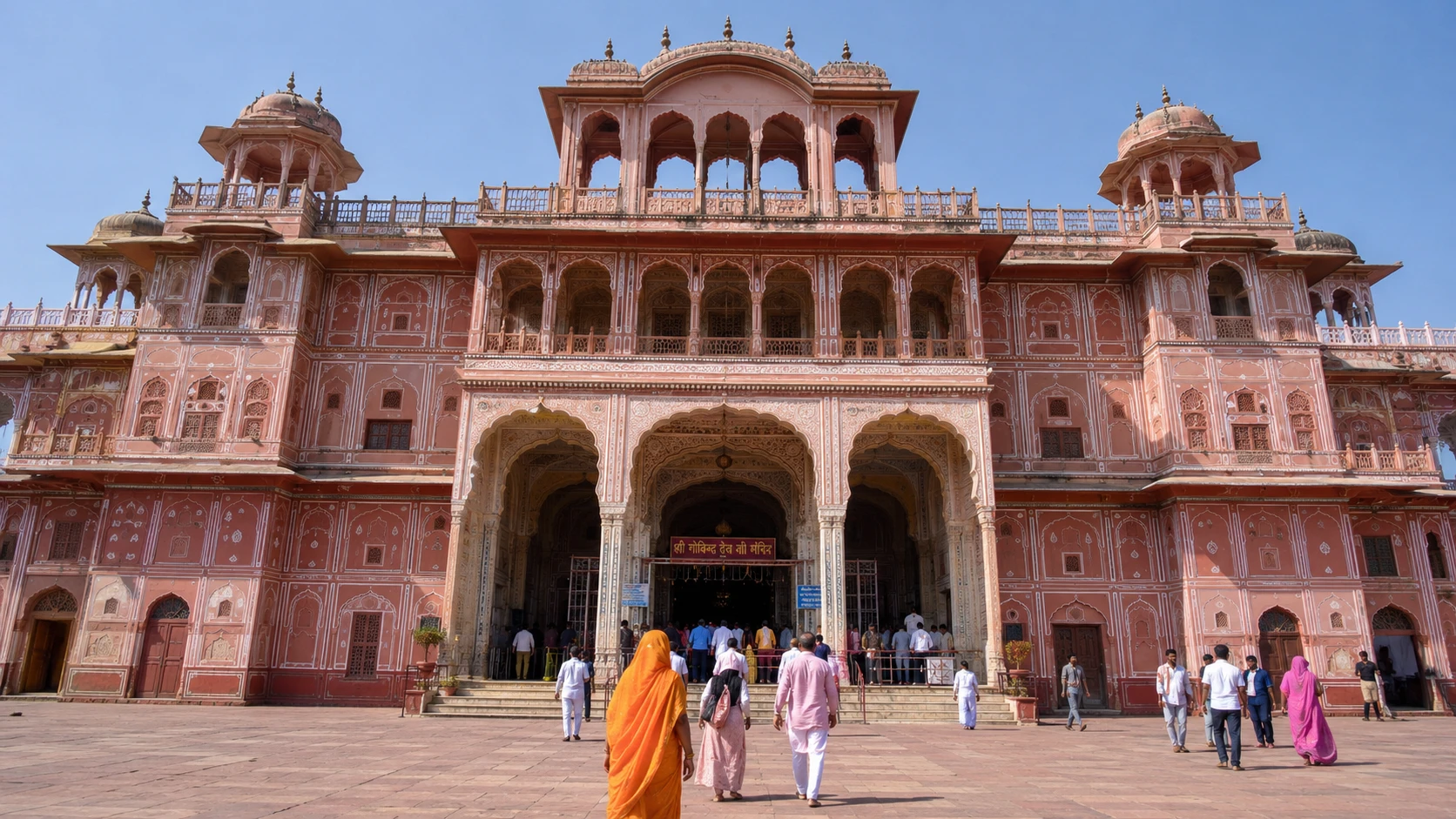
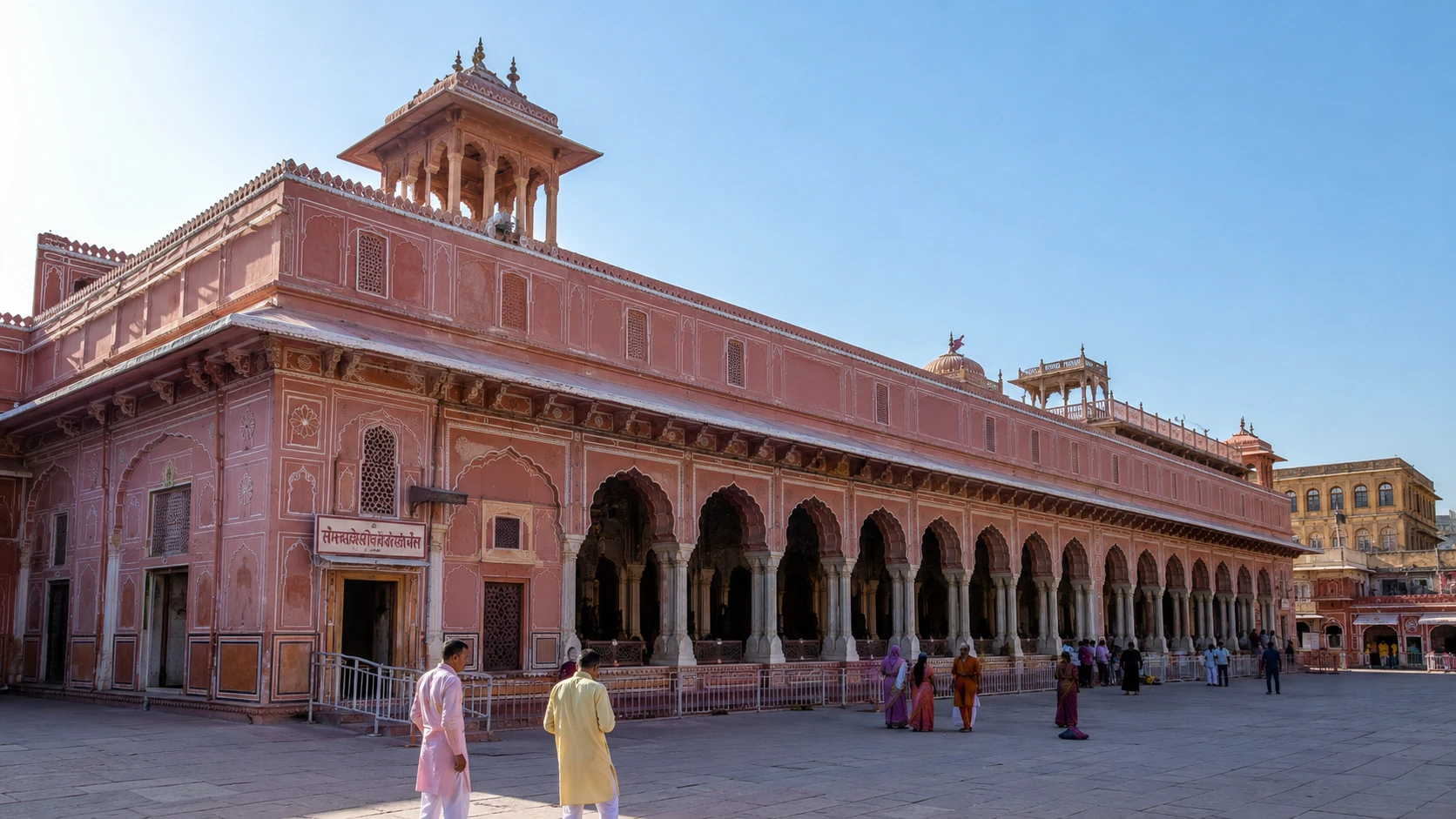
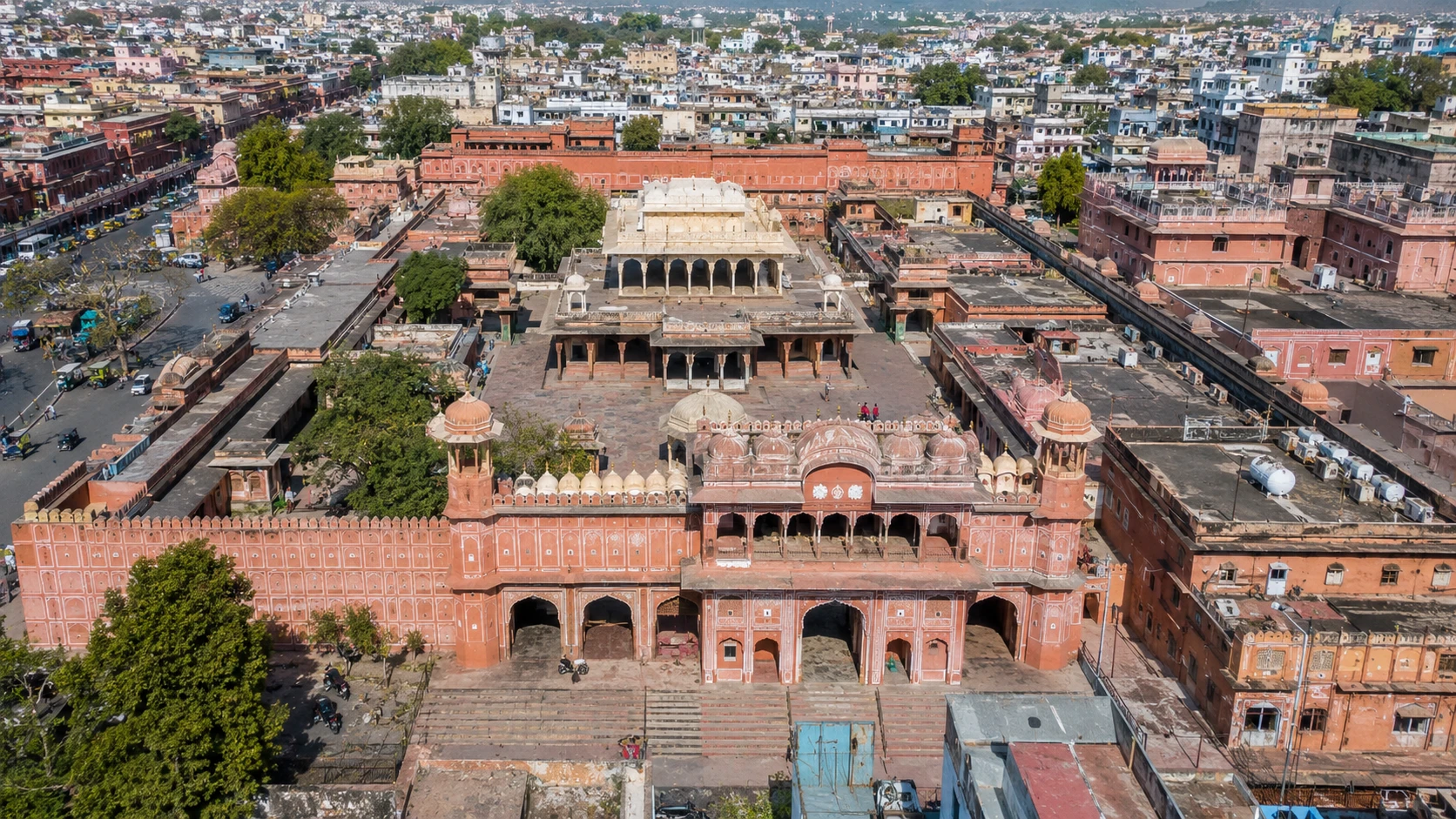
Open-air courtyard shrine within the Jai Niwas Garden — a Rajput garden complex adjacent to the City Palace; the shrine itself is a pavilion structure, not a conventional enclosed temple
खुला
04:30 – 21:00
आरती
04:30 · 07:30 · 09:30 · 11:00 · 17:30 · 18:45 · 20:30
विशेष
Seven daily jhanki (darshan windows) following Gaudiya Vaishnava schedule. Temple closes from approximately 12:30 PM to 5:30 PM for midday rest (Raj Bhog) period — verify current timings on arrival. Evening Sandhya Aarti draws the largest daily crowd. Seasonal timing variations apply.
पवित्र कथा · पवित्र कथा
In the late 17th century, as Aurangzeb's orders began to press against the temples of Braj, the priests and custodians of Vrindavan's most magnificent temple — the seven-storied Govindaji, built by Maharaja Man Singh of Amber in 1590 CE to house a murti discovered by Rupa Goswami, one of Chaitanya Mahaprabhu's closest disciples — loaded the deity onto a cart and moved south toward Amber, and then toward a new city. When Maharaja Jai Singh II laid out Jaipur in 1727 CE — the first planned city of modern India, drawn on a grid, built in pink sandstone — he made a single inviolable decision about its orientation: the Chandra Mahal of the City Palace, where he would sleep, would face the garden where Govindaji would be installed. Every morning the king opened his windows and saw the Lord. Every evening before the king retired, he saw the Lord. Jaipur was not planned around a market or a fort. It was planned around a darshan.
Sacred Origin Storyपवित्र उत्पत्ति कथा
Source: Gaudiya Vaishnava; the murti was discovered and installed by Rupa Goswami (c. 1489–1564 CE), one of the Six Goswamis of Vrindavan and a principal disciple of Sri Chaitanya Mahaprabhu
Rupa Goswami — formerly a minister at the court of the Sultan of Bengal, who renounced his position to become one of Chaitanya Mahaprabhu's most important disciples and the principal architect of Gaudiya Vaishnava theology — arrived in Vrindavan around 1516 CE on Chaitanya's instruction. His mission was to rediscover the sacred sites of Krishna's life that had been forgotten over the centuries: the places where Krishna was born, where he played, where he herded cows, where he danced with the gopis.
At Vrindavan, Rupa Goswami also discovered the murti of Govinda — the name 'Govinda' (one who gives pleasure to the cows and their keepers) being one of Krishna's most intimate epithets, evoking the pastoral world of Vrindavan in which the child and teenage Krishna of the Bhagavata Purana's Tenth Canto lived. The murti was installed in a temporary structure; it was later enshrined in the magnificent Govindaji temple that Maharaja Man Singh I of Amber built in 1590 CE — a seven-storied building of red and white sandstone that was, at its peak, the tallest structure in Vrindavan.
The theological content of the Govindaji murti is Radha-Krishna together: Krishna in the tribhanga posture of his Vrindavan youth, Radha beside him. The specific form is that of the two-armed lover-Krishna of Braj — playful, immediate, intimate — rather than the cosmic four-armed Vishnu. This is the Krishna who plays with the gopis under the kadamba trees, who steals butter from the neighbours, who plays his flute by the Yamuna at dusk.
उद्धृत स्रोत:
- Narahari Chakravarti, 'Bhakti-ratnakara', Chapter 5 (17th century) — on the Six Goswamis and the Vrindavan temples
- Krishnadasa Kaviraja, 'Chaitanya-caritamrta', Madhya-lila (on Rupa Goswami's mission to Vrindavan)
- Abul Fazl, 'Ain-i-Akbari' — reference to the Vrindavan Govindaji temple (built under Akbar's court patronage via Man Singh)
- James Tod, 'Annals and Antiquities of Rajasthan' (1829–1832) — on Jaipur's founding and Govindaji's installation
विद्वत संदर्भ
The Govindaji murti at Jaipur is documented in multiple historical sources as having been removed from Vrindavan during the period of Mughal pressure in the late 17th century. James Tod's 'Annals and Antiquities of Rajasthan' (1829) and subsequent Rajput historical scholarship (R.C. Sharma, 'History of Jaipur', 1978) confirm the murti's installation in Jaipur under Jai Singh II's patronage. The original Govindaji temple at Vrindavan — partially damaged in the Mughal period — still stands and is maintained, though the principal murti is in Jaipur. The identification of Rupa Goswami as the discoverer of the murti is accepted by scholars of the Gaudiya tradition (S.K. De, 1961).
Historyइतिहास
The history of the Govind Dev Ji temple at Jaipur begins in Vrindavan, where Rupa Goswami (c. 1489–1564 CE) — principal disciple of Chaitanya Mahaprabhu and one of the Six Goswamis — discovered and installed the Govindaji murti in the early 16th century. In 1590 CE, Maharaja Man Singh I of Amber — a general in Akbar's Mughal court and a devout Vaishnava — built the monumental Govindaji temple at Vrindavan, which was at the time the tallest structure in Braj. In the late 17th century, as Mughal pressure on Vrindavan's temples increased, the Govindaji murti was transferred to Amber for protection, and eventually to a new city. Maharaja Jai Singh II — astronomer, mathematician, and city planner — founded the city of Jaipur in 1727 CE on a geometric grid plan, the first planned city of modern India. He placed the Govind Dev Ji temple at Jai Niwas Garden, within the City Palace complex, in a specific position: facing the Chandra Mahal (the king's private residence), so that the king could see the deity from his window without leaving the palace. This alignment — the ruler's bedchamber facing the deity's shrine — made the king Govindaji's first devotee and Jaipur his court. The Jaipur Govind Dev Ji temple has been managed by the Jaipur royal family trust since its founding; the relationship between the Maharajas of Jaipur and Govindaji is among the most intimate royal-devotional relationships in Rajasthan's history.
Historical Timelineऐतिहासिक कालक्रम
Rupa Goswami (c. 1489–1564 CE), one of the Six Goswamis of Vrindavan and Chaitanya Mahaprabhu's principal literary disciple, discovers and installs the Govindaji murti in Vrindavan. The murti is housed initially in a modest structure before the grand temple is built in 1590 CE.
The date of the murti's installation at Vrindavan is given in traditional sources as approximately 1535–1540 CE, based on the timeline of Rupa Goswami's arrival in Vrindavan (c. 1516 CE) and the period of the temple's construction. The exact date has not been independently established through archival sources.
Maharaja Man Singh I of Amber — a leading general of Emperor Akbar's court — builds the magnificent Govindaji temple at Vrindavan. The seven-storied red and white sandstone structure was the tallest building in Braj and one of the most important monuments of 16th-century Krishna devotional architecture. Man Singh's patronage reflects the Amber/Jaipur royal family's deep Gaudiya Vaishnava devotion.
The 1590 CE construction date for the Vrindavan Govindaji temple is accepted by scholars and supported by inscriptional evidence. Abul Fazl's account in the Ain-i-Akbari references the temple's construction during Man Singh's tenure as governor of regions under Akbar.
As Mughal pressure on Vrindavan's principal temples intensifies during Aurangzeb's reign (1658–1707 CE), the Govindaji murti is transferred from Vrindavan to Amber for protection. The timeline of the exact transfer is not precisely dated in surviving records; the murti passed through several locations before its permanent installation at Jaipur.
The exact date of the murti's transfer from Vrindavan to Amber is not definitively established in surviving records. James Tod's account (1829) and subsequent Rajput historical scholarship place the transfer in the Aurangzeb era; the original Vrindavan Govindaji temple was not fully destroyed but was partially damaged and reduced in height.
Maharaja Jai Singh II founds the city of Jaipur (1727 CE) on a geometric grid plan and establishes the Govind Dev Ji temple at Jai Niwas Garden within the City Palace complex. The Chandra Mahal — the king's private residence — is oriented to face the deity's shrine, establishing the alignment that allows the king to see Govindaji from his windows. The murti is permanently installed at Jai Niwas, where it remains today.
What You'll Seeदर्शन में
The Govind Dev Ji murti is Radha-Govindaji together — Radha and Krishna in the central Vrindavan posture of their divine love, the tribhanga Krishna with Radha beside him in complementary stance. The murti follows the Gaudiya Vaishnava aesthetic: Krishna is two-armed, dark-complexioned, wearing his Vrindavan dress (a peacock feather in his crown, a flute in hand), intimate and accessible rather than cosmic and sovereign — the beloved of the Yamuna riverbank rather than the Lord of Vaikuntham. Radha stands beside him, equal and inseparable. The murtis are adorned daily in elaborate sringara according to the seven jhanki (darshan window) schedule, with seasonal fabrics, flowers, and ornaments changing throughout the year to reflect the Braj calendar.
The shrine is an open-air pavilion structure within Jai Niwas Garden — unlike most major temples, Govind Dev Ji has no towering shikhara or enclosed sanctum in the conventional sense. The deity stands under a pavilion open to the garden sky, giving the darshan an unusually informal, intimate quality — as if the Lord has stepped from the Vrindavan forest into the Jaipur garden and is accessible in the open air. The specific sightline from the Chandra Mahal palace windows to the deity — the axis Jai Singh II designed into the city plan — is one of the most remarkable acts of devotional architecture in Rajasthan. Photography inside the main shrine is not permitted.
Distinctive Practicesविशिष्ट परंपराएँ
Seven jhanki — the darshan windows of Govind Dev Ji
सात झाँकी — गोविंद देव जी के दर्शन की खिड़कियाँ
Daily, at fixed times throughout the day and early evening
Govind Dev Ji's daily worship is structured around seven jhanki (literally 'glimpses' or 'peeks') — timed openings of the deity's darshan, each corresponding to a different moment in Govindaji's daily life in Vrindavan. Mangala (pre-dawn waking), Dhoop (morning brightness), Shringar (adornment), Raj Bhog (royal midday meal), Gwala (cowherd return, late afternoon), Sandhya (twilight), and Shayan (night). Between Raj Bhog and Gwala, the shrine closes for a midday rest period of approximately four to five hours — the Lord sleeps, and devotees wait. The evening Sandhya and Shayan jhankis draw the largest crowds, filling the open-air courtyard with thousands of pilgrims. The strict jhanki schedule — with no continuous open-door darshan — creates the experience of awaiting the Lord's appearance, which is itself a devotional discipline.
The Chandra Mahal alignment — the king's morning darshan
चंद्र महल संरेखण — राजा की प्रातः झाँकी
Permanent architectural feature; the sightline exists today as a heritage relationship
When Maharaja Jai Singh II built Jaipur in 1727 CE, he oriented the Chandra Mahal — his private palace within the City Palace complex — to face the Govind Dev Ji shrine at Jai Niwas Garden. The alignment was deliberate: the king's bedroom window faced the deity's pavilion directly, so that the first sight of the king's waking day was Govindaji, and the last sight before sleep was the same. This architectural commitment made the king of Jaipur not the owner of the city but its first devotee — a man for whom the city's entire geometric order was oriented toward a religious encounter. The Jaipur Maharajas have maintained the role of Govindaji's principal caretakers ever since.
Vrindavan lineage — the murti of Rupa Goswami
वृंदावन वंश — रूपा गोस्वामी की मूर्ति
Historical lineage; the connection to the Sapta Devalayas is a devotional distinction
The Govind Dev Ji murti at Jaipur is not merely a Krishna image — it is the specific murti installed by Rupa Goswami in Vrindavan in the 16th century, one of the seven principal images (Sapta Devalayas) established by the Six Goswamis on Chaitanya Mahaprabhu's instruction. This lineage connects the Jaipur deity directly to the 16th-century Gaudiya Vaishnava foundational project at Vrindavan — to the same tradition as the Radha Raman murti, the Madan Mohan murti, and the other Vrindavan Goswami-established deities. Devotees who know the lineage understand that they are seeing at Jaipur not a copy but the original, the same form that Rupa Goswami met in Vrindavan five centuries ago.
Did You Know?क्या आप जानते हैं?
The original Govindaji temple at Vrindavan, built by Maharaja Man Singh I in 1590 CE, was originally seven stories tall. During the Aurangzeb era, the upper stories were reportedly demolished or damaged; the remaining structure (approximately four stories) still stands in Vrindavan as one of the most important examples of 16th-century Braj temple architecture. The murti has been in Jaipur since the late 17th or early 18th century.
Abul Fazl, 'Ain-i-Akbari'; Alan Entwistle, 'Braj: Centre of Krishna Pilgrimage' (1987)
Maharaja Jai Singh II of Jaipur was not only a devout Vaishnava but one of the foremost astronomers of 18th-century India. He built the Jantar Mantar astronomical observatory complexes at Jaipur, Delhi, Ujjain, Varanasi, and Mathura — the Jaipur Jantar Mantar is now a UNESCO World Heritage Site. The same mind that calculated the movements of celestial bodies oriented the entire plan of Jaipur's grid city around the daily darshan of Govindaji.
V.N. Sharma, 'Sawai Jai Singh and His Astronomy' (Delhi: Motilal Banarsidass, 1995); UNESCO World Heritage documentation
The Govind Dev Ji temple is within the walled City Palace compound in old Jaipur, surrounded by one of the most architecturally coherent planned cities in India. The City Palace museum (adjacent to the temple) requires a separate paid entry ticket; however, the Govind Dev Ji temple itself is accessible for religious worship through a separate entrance, free of charge. Visitors should clarify their purpose (darshan vs museum visit) at the main gate.
Jaipur City Palace official documentation; Jaipur Tourism
Rupa Goswami — the discover of the Govindaji murti — was also the author of 'Bhakti-rasamrita-sindhu' (Ocean of the Nectar of Devotion), the most systematic treatise on Gaudiya Vaishnava devotional aesthetics and the classification of the rasas (emotional registers) of bhakti. His 'Ujjvala-nilamani' classified the erotic devotional sentiment of Radha-Krishna love. Together, these works make him the principal theologian of the tradition whose murti is now at Jaipur.
Rupa Goswami, 'Bhakti-rasamrita-sindhu' (16th century); S.K. De, 'Early History of the Vaishnava Faith' (1961)
Festivalsत्योहार
Janmashtami
जन्माष्टमी
Jul-Aug (Bhadra Krishna Ashtami)
Jaipur's Janmashtami celebrations at Govind Dev Ji are among the most elaborate in Rajasthan — the city fills with pilgrims and the Sandhya and Shayan jhankis on Janmashtami night draw enormous crowds to the open-air courtyard for the midnight moment of Krishna's birth. The Govind Dev Ji murti receives an especially elaborate midnight shringar, and the surrounding garden is illuminated.
Holi — Phag Mahotsav
होली — फाग महोत्सव
Feb-Mar (Phalgun)
Govind Dev Ji's Holi — celebrated as Phag Mahotsav — involves specially adorned murtis in the colours of spring and a flower-and-colour celebration in the temple courtyard. The Jaipur Holi traditions, centred on the City Palace complex and the Govind Dev Ji courtyard, are among the most visually distinctive in Rajasthan.
Govindaji Jhulan (Swing Festival)
गोविंदाजी झूलन (झूला उत्सव)
Jul-Aug (Shravan, before Janmashtami)
The Jhulan Utsava — the swing festival, when the deity is placed on decorated swings and devotees sing and sway in the monsoon season — is observed with particular affection at Govind Dev Ji. The open-air pavilion setting is particularly well-suited to the monsoon romanticism of the Jhulan, which evokes the Braj tradition of Krishna and Radha on swings beneath the kadamba trees.
Radhashtami
राधाष्टमी
Aug-Sep (Bhadra Shukla Ashtami)
The birth of Radha is particularly meaningful at a temple where the murti is Radha-Govindaji together — the relationship of Radha and Krishna is the iconographic and theological centrepiece. Radhashtami at Govind Dev Ji involves special adornment of Radha's form, extended darshan, and bhog offerings reflecting the occasion.
Traditional Offeringsपारंपरिक अर्पण
प्राथमिक अर्पण
Tulsi (Holy Basil)
तुलसी
तुलसी
Tulsi is indispensable in all Gaudiya Vaishnava worship. The Govind Dev Ji temple follows the full Gaudiya puja protocol established by the Six Goswamis — including the Haribhaktivilasa (composed by Gopala Bhatta Goswami, discoverer of the Radha Raman murti) — in which tulsi is the primary offering material for every bhog and puja.
Seven jhanki bhog — seasonal Rajasthani-Gaudiya cuisine
सात झाँकी भोग — मौसमी राजस्थानी-गौड़ीय व्यंजन
At Govind Dev Ji, the seven jhanki correspond to seven different bhog offerings through the day. The cuisine follows Vaishnava dietary prescriptions (no onion, garlic, or root vegetables) but reflects the Rajasthani cultural context — the bhog includes Rajasthani sweets (mawa kachori, ghevars in season) alongside the standard Gaudiya Vaishnava items. The Raj Bhog (midday) is the most elaborate, with a full meal of several preparations.
Marigold and seasonal flowers
गेंदे के फूल और मौसमी पुष्प
Marigold garlands (genda) are the signature offering at most Rajasthani Vaishnava temples, including Govind Dev Ji. The elaborate seasonal sringara of the Radha-Govindaji murtis changes the floral palette with each jhanki and each season — winter shringar features heavier, warmer flowers; summer adorns with cooling champa and jasmine.
Makhan and Mishri
माखन और मिश्री
नवनीत और मिश्री
The universal Braj-Krishna offering of fresh butter and rock candy, carried through the Gaudiya tradition from Vrindavan to Jaipur. Offering makhan-mishri to Govindaji connects the present-day Jaipur temple to the theological soil of 16th-century Vrindavan where Rupa Goswami discovered the murti.
Offering materials (tulsi, marigold garlands, makhan-mishri) are available from vendors surrounding the Jai Niwas Garden entrance. Prasada from Govind Dev Ji — primarily sweets and distributed after the evening jhankis — is available at the distribution point near the temple exit. The temple does not charge for darshan.
How to Reachकैसे पहुँचें
Govind Dev Ji temple is located within the City Palace complex in the heart of old Jaipur, approximately 5 km from Jaipur Junction railway station and 12 km from Jaipur International Airport. By road, the City Palace area is accessible by auto-rickshaw, taxi, or e-rickshaw from anywhere in Jaipur. Entry for religious darshan is through a separate entrance from the City Palace museum; devotees should proceed to the Govind Dev Ji darshan gate specifically. Jaipur is connected to Delhi (300 km, approximately 4–5 hours by road or train), Mumbai (~1300 km, overnight trains available), and Jodhpur (~350 km).
Plan Your Visitयात्रा की योजना
🌤 सर्वोत्तम मौसम
October to March (cool and pleasant Jaipur winters). Janmashtami (July–August) and Holi (February–March) are the most spiritually vibrant periods. Avoid the midday closure (approximately 12:30–5:30 PM) — plan for morning jhankis (Mangala, Shringar, Raj Bhog) or the evening ones (Gwala, Sandhya, Shayan). Evening Sandhya aarti is the most atmospherically charged.
👘 पहनावे का नियम
Traditional modest dress preferred. Men: dhoti or kurta-pyjama/churidar. Women: sari or salwar-kameez. Footwear removed at the temple entrance. Western dress is generally tolerated for tourists but traditional attire is strongly preferred.
📱 फोन और फोटोग्राफी
Photography inside the main shrine is not permitted. Photography in the garden and outer courtyard is generally allowed.
🏨 आवास
Jaipur has extensive accommodation ranging from budget guesthouses in the old city to luxury heritage hotels. The City Palace area has numerous mid-range and heritage hotel options. Jaipur is a major tourist destination with abundant accommodation at all price points.
Sacred Soundsपवित्र ध्वनि
Govind Dev Ji Jhanki Aarti — traditional Rajput-Gaudiya devotional form; sung at each of the seven daily darshan sessions
aarti
Rupa Goswami compositions — 'Stavamala' and other Sanskrit hymns; the poetry of the Govindaji murti's discoverer
stotram
Gaudiya Vaishnava kirtan in Braj style — Six Goswami compositions for Radha-Govindaji
bhajan
108 Japa Practice
Om Namo Bhagavate Vasudevaya
Chant 108 times in the spirit of this temple
क्या आप जानते हैं? · Did You Know?
वही अनुवाद त्रुटि जिसने हिन्दू धर्म में '33 कोटि' को '33 करोड़' बनाया, बौद्ध धर्म में भी हुई। बौद्ध ग्रन्थों के चीनी अनुवाद ने 'सप्त कोटि बुद्ध' (7 श्रेष्ठ बुद्ध) का अनुवाद '7 करोड़ बुद्ध' कर दिया। तिब्बती अनुवाद ने सही किया: 7 प्रकार, 7 करोड़ नहीं। एक संस्कृत शब्द, दो प्रमुख विश्व धर्मों में गलत पढ़ा गया, ने दो एकसमान भ्रम स्वतन्त्र रूप से उत्पन्न किए।
Related Contentसंबंधित सामग्री
Related Scriptures
Community Reflections
🕉️
Be the first to share your reflection.