Radha Raman Mandir
राधा रमण मंदिर
The self-born Lord — and the stone from which he came, still beside him after five centuries
Vrindavan, Uttar Pradesh, India
Rādhā RamaṇaAlso known as: Radha Raman Temple, Radharaman Mandir, Shri Radha Raman Ji
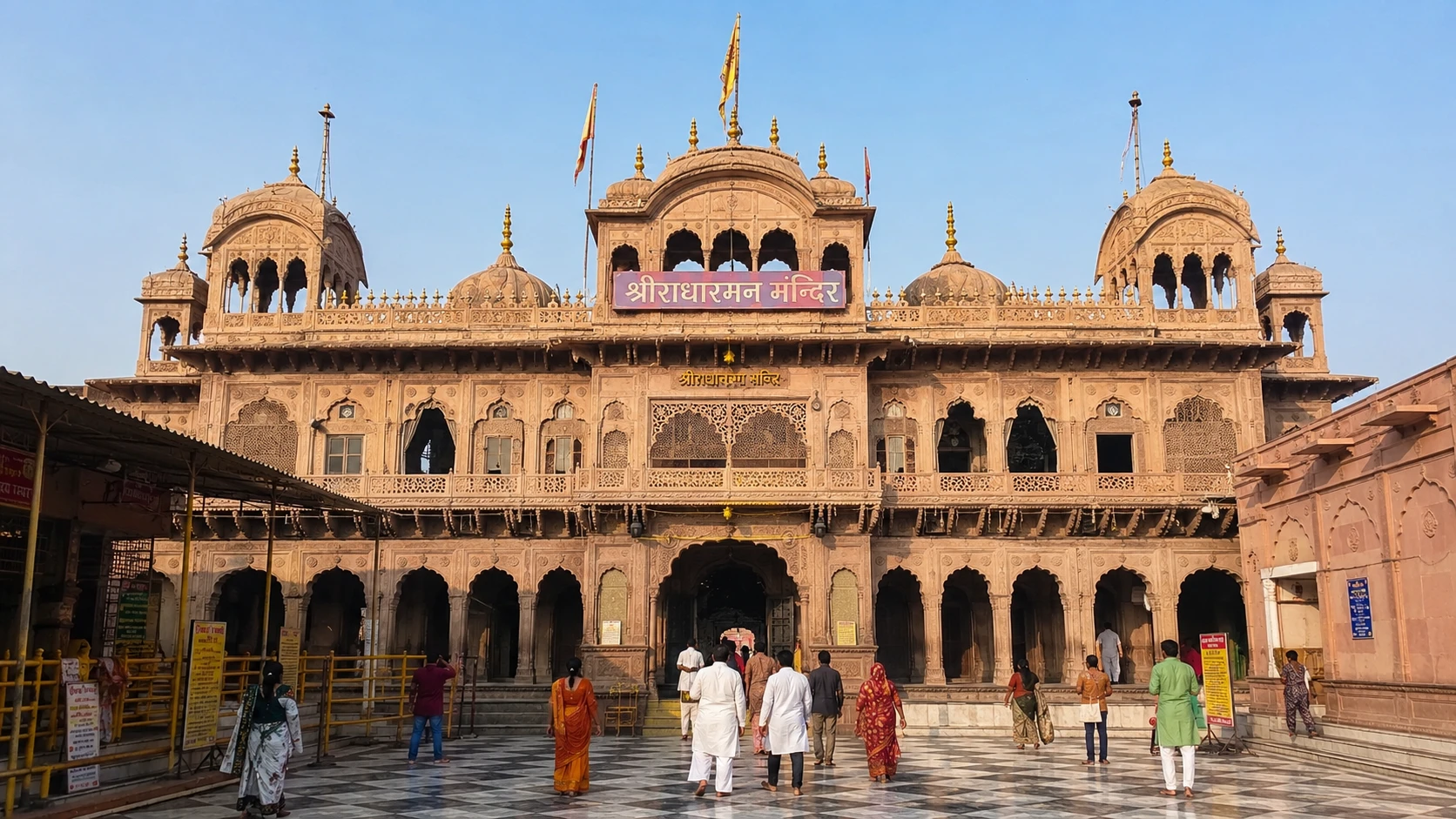
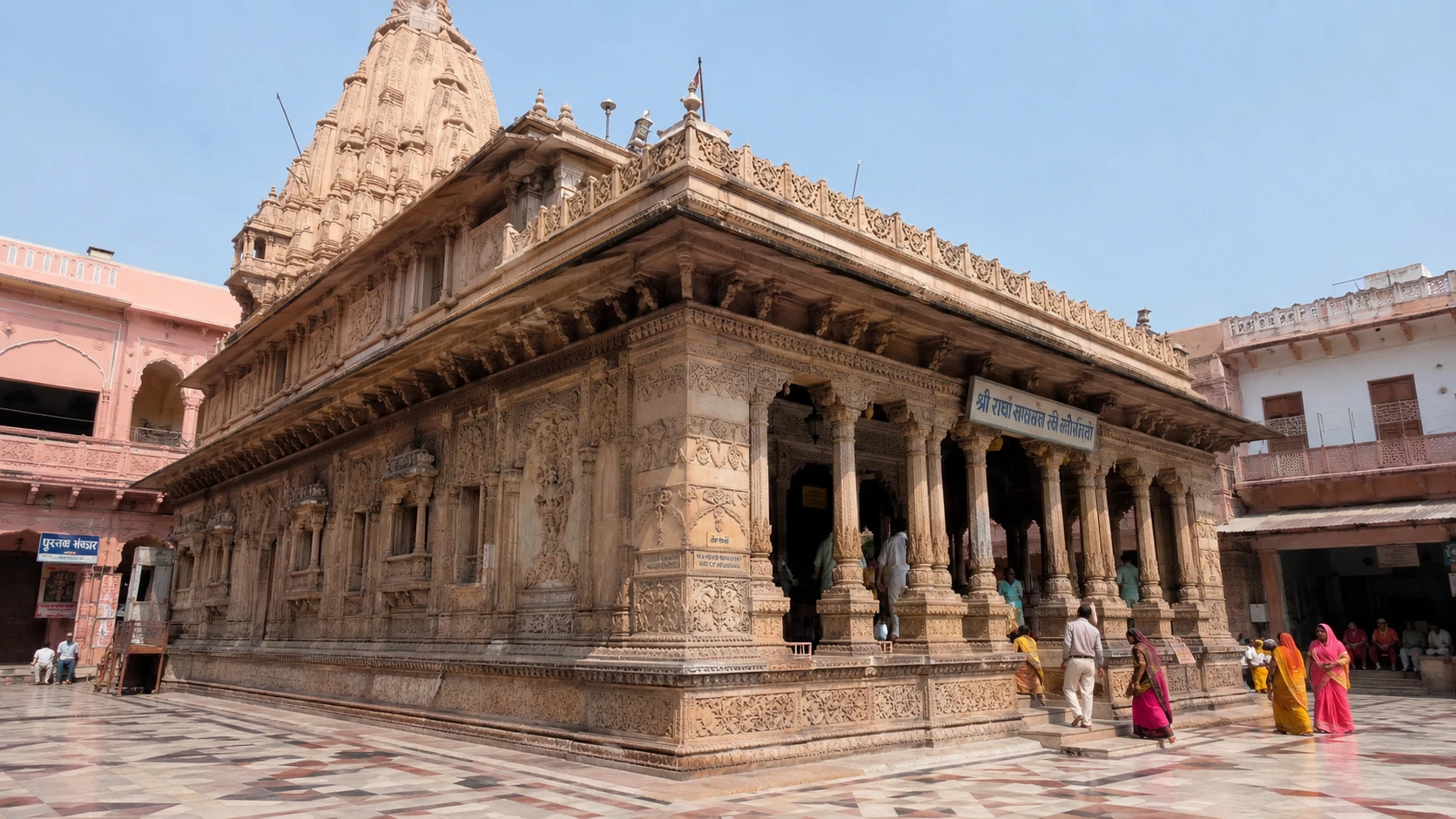
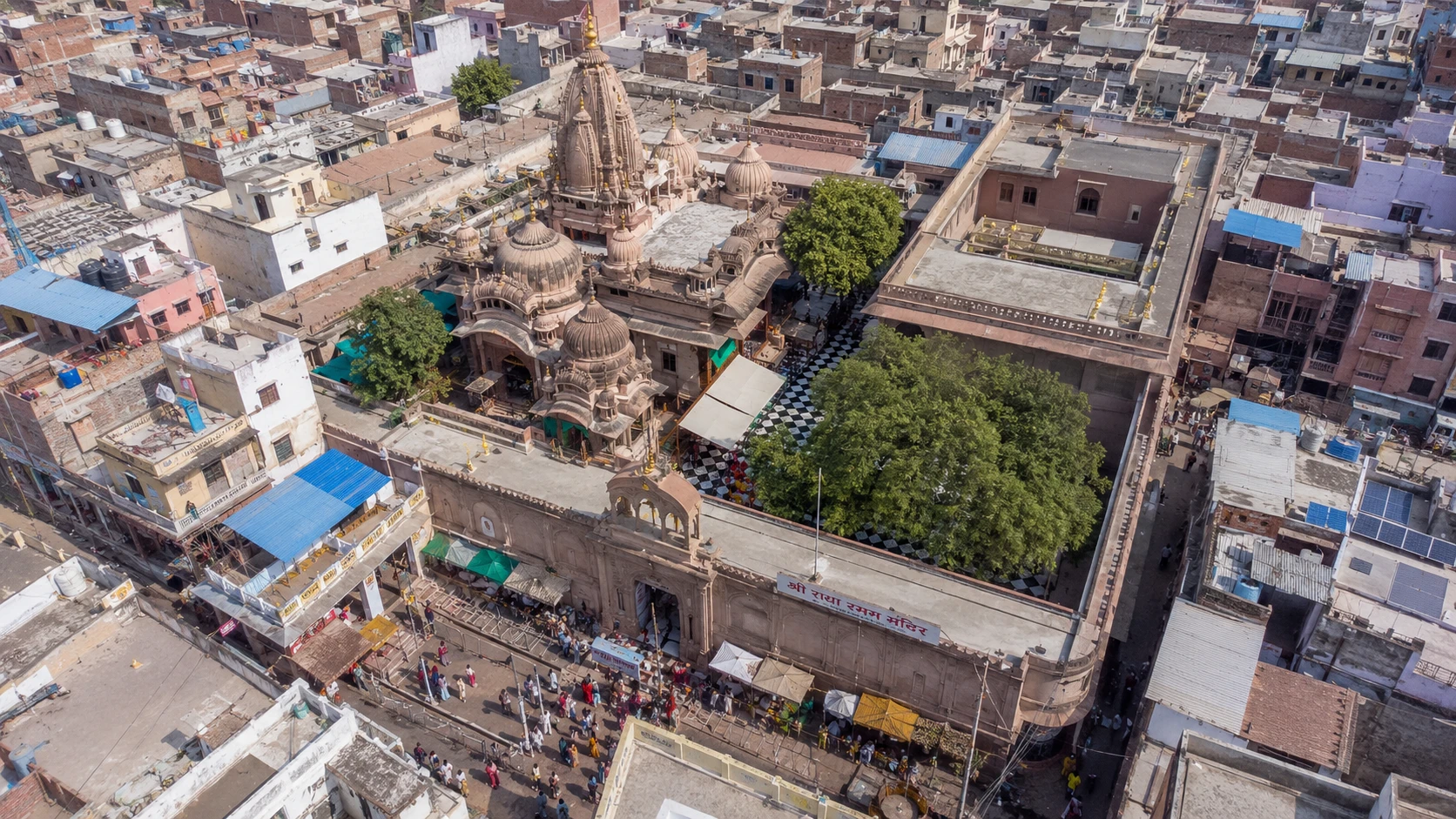
युग
Murti self-manifested Phalguna Poornima, Vikram Samvat 1599 (= 1542 CE); one of the oldest continuously worshipped Vrindavan svarupas
वास्तुकला
Braj / Vrindavan vernacular; traditional stone construction
खुला
06:00 – 21:00
आरती
06:00 · 07:30 · 10:30 · 12:00 · 16:00 · 18:30 · 20:00
विशेष
Eight daily seva sessions (ashtakala seva) following strict Gaudiya Vaishnava schedule. Phalguna Poornima (anniversary of the murti's self-manifestation) observed with special aarti and extended darshan. Confirm current schedule with temple management.
पवित्र कथा · पवित्र कथा
In 1542, a South Indian brahmin named Gopala Bhatta Goswami — one of Chaitanya Mahaprabhu's closest disciples, who had walked from Tamil Nadu to Vrindavan to help rediscover its lost sacred geography — placed twelve shaligrama shilas before him in worship and fell asleep aching to see Krishna not as an abstraction but as a form his eyes could meet. When he awoke, one of the twelve stones had become a murti: Krishna in perfect tribhanga posture, complete in every feature, self-manifested from the sacred shila. The name rose in Gopala Bhatta Goswami's heart at once — Radha Raman, 'he who delights Radha.' The shaligrama from which the Lord emerged has never been moved. It sits beside the murti today, the closest thing in Vrindavan to a physical record of a deity's birth — the original stone, the divine ancestor, honoured as among the rarest relics in all of Braj.
Sacred Origin Storyपवित्र उत्पत्ति कथा
Source: Gaudiya Vaishnava; following the Six Goswamis of Vrindavan, disciples of Sri Chaitanya Mahaprabhu (16th century)
Gopala Bhatta Goswami was born in Srirangam — in what is today Tamil Nadu — into the family of Vyenkatta Bhatta, a devout Vaishnava of the Srirangam tradition, worshippers of Ranganatha (Vishnu). When Chaitanya Mahaprabhu undertook his South India pilgrimage (c. 1511–1515 CE), he stayed for four months at the home of Vyenkatta Bhatta. The young Gopala Bhatta was deeply captivated by Chaitanya Mahaprabhu and, after his parents' deaths, eventually made his way north to join the community of Vaishnava saints gathering in Vrindavan at Chaitanya's instruction — the mission to rediscover the sacred sites of Krishna's childhood and adolescence that had been forgotten for centuries.
In Vrindavan, Gopala Bhatta Goswami took up the life of a renunciant scholar and devotee, composing the foundational Vaishnava text Haribhaktivilasa (compiled with Sanatana Goswami) and devoting himself entirely to the service of the divine. He worshipped twelve shaligrama shilas — the naturally formed fossil-stones of Gandaki river, each one considered an aniconic form of Vishnu — as his beloved Lord. But he ached for a murti with a form, eyes, features — a divine presence he could dress and look upon as a mother dresses a child.
On the night of Phalguna Poornima in Vikram Samvat 1599 (1542 CE), after completing his nightly worship, Gopala Bhatta Goswami set the twelve shilas before him and slept in longing. When he awoke before dawn for the Mangala Aarti, one of the twelve shilas had transformed: from it had emerged a complete and perfect murti of Krishna — Tribhanga Murari, standing in the eternal triple-bent posture of divine love, with the conch, lotus, mace, and chakra, and the flute tucked at his waist. The shila from which he had emerged was still there, unchanged beside him, the ancestral stone now become the origin-witness of the Lord.
Gopala Bhatta Goswami gave the murti the name that rose in his heart: Radha Raman — 'he who delights (ramana) Radha.' He wished to install a murti of Radha beside him but considered himself unworthy to perform such an installation. Instead, a small golden crown (mukuta) was placed to the left of Radha Raman — the presence of Radha acknowledged but not presumed to be installed by human hand. The crown remains there to this day.
उद्धृत स्रोत:
- Narahari Chakravarti, 'Bhakti-ratnakara' (17th century), Chapter 5 — primary narrative of Gopala Bhatta Goswami's life and the Radha Raman manifestation
- Krishnadasa Kaviraja, 'Chaitanya-caritamrta', Antya-lila, Chapter 6 — Chaitanya Mahaprabhu's South India tour and Srirangam stay
- Rupa Goswami and Sanatana Goswami, 'Haribhaktivilasa' — foundational Gaudiya Vaishnava text compiled by Gopala Bhatta Goswami
- S.K. De, 'Early History of the Vaishnava Faith and Movement in Bengal' (Calcutta, 1961) — scholarly documentation of the Six Goswamis and the Vrindavan tradition
विद्वत संदर्भ
The self-manifestation of the Radha Raman murti on Phalguna Poornima 1542 CE (VS 1599) is attested by multiple Gaudiya Vaishnava sources, most notably Narahari Chakravarti's 17th-century 'Bhakti-ratnakara.' Modern scholarship on the Gaudiya Vaishnava tradition (S.K. De, 1961; Jan Brzezinski, 'Gopāla Bhaṭṭa Gosvāmin's Haribhaktivilāsa', Journal of Vaishnava Studies, 1993) treats the manifestation as the founding moment of an institutional tradition whose historical parameters are reasonably well-documented, while acknowledging the event itself is described in terms of sacred rather than ordinary history.
Historyइतिहास
The Radha Raman temple is among the oldest and most theologically significant temples in Vrindavan. It is one of the Sapta Devalayas — the seven principal temples established by the Six Goswamis, the circle of scholar-saints sent by Chaitanya Mahaprabhu (1486–1534) to Vrindavan to rediscover its sacred geography and establish systematic Vaishnava worship in the Braj region. Gopala Bhatta Goswami (c. 1503–1578), who founded the Radha Raman tradition, was himself a South Indian brahmin from the Srirangam Vaishnava tradition who came north as a disciple of Chaitanya. His intellectual contributions — particularly the Haribhaktivilasa (compiled with Sanatana Goswami), the foundational Gaudiya Vaishnava liturgical manual — were as significant as his devotional role in establishing the temple. The murti's self-manifestation in 1542 CE inaugurated a tradition of worship that has continued unbroken for nearly five centuries. During the period of Mughal pressure on Vrindavan temples in the late 17th century (associated with Aurangzeb's reign), the major svarupas of other temples — most notably the Govindaji murti — were moved to Jaipur for safety. The Radha Raman murti reportedly remained in Vrindavan, protected by the devotion of its caretakers. Today the temple is managed by the hereditary Goswamis of the Gopala Bhatta Goswami lineage, who maintain the full ashtakala (eight-period) daily worship protocol with the same ritual precision established five centuries ago.
Historical Timelineऐतिहासिक कालक्रम
Sri Chaitanya Mahaprabhu undertakes his South India pilgrimage and stays for four months at the home of Vyenkatta Bhatta in Srirangam. The young Gopala Bhatta is profoundly influenced; he later becomes a disciple and eventually one of the Six Goswamis of Vrindavan.
The precise dates of Chaitanya Mahaprabhu's South India tour are debated; c. 1511–1515 CE is the scholarly consensus range based on internal evidence in the Chaitanya-caritamrta and Chaitanya-bhagavata.
On Phalguna Poornima of Vikram Samvat 1599, one of the twelve shaligrama shilas worshipped by Gopala Bhatta Goswami self-manifests as a complete murti of Krishna. Gopala Bhatta names the deity Radha Raman — 'he who delights Radha.' This is the founding event of the Radha Raman temple and tradition.
The date of Phalguna Poornima VS 1599 = 1542 CE is consistently reported across Gaudiya Vaishnava sources and is accepted by scholars as the traditional founding date of the temple. The event is described in sacred-historical terms rather than as a naturalistic occurrence.
Gopala Bhatta Goswami compiles the Haribhaktivilasa — the foundational Gaudiya Vaishnava liturgical manual, written in collaboration with Sanatana Goswami. The text codifies the rituals and regulations of Vaishnava worship that the Radha Raman temple still follows.
The precise date of composition is uncertain; scholars place it between the 1540s and 1580s. The Haribhaktivilasa is the most comprehensive early Gaudiya Vaishnava text on ritual practice.
During the period of Mughal pressure on Vrindavan's temples associated with Aurangzeb's reign, the major murtis of several principal Vrindavan temples — most notably the Govindaji svarupa — were moved to Jaipur for protection. The Radha Raman murti reportedly remained in Vrindavan, protected by the dedication of its caretaker Goswamis.
The precise circumstances of the Radha Raman murti's protection during the Aurangzeb period are described in temple tradition rather than documented in surviving historical records. The relocation of the Govindaji murti to Jaipur is historically documented; the corresponding account of Radha Raman's remaining in Vrindavan is consistent with temple management tradition.
What You'll Seeदर्शन में
The Radha Raman murti is small in physical stature — traditional accounts describe him as around two feet tall — yet the Gaudiya Vaishnava tradition consistently holds that he is among the most beautiful of all Vrindavan's svarupas (divine forms), possessed of a natural perfection of proportion that no human sculptor could have achieved and that reflects his self-manifested origin. The murti stands in the tribhanga posture — the triple-bend at head, waist, and knee that is the bodily grammar of Krishna's eternal dance — and is dark in complexion, the deep shyama (blue-black) of the monsoon sky. He holds the traditional four emblems of Vishnu — conch, lotus, mace, and chakra — with the flute tucked at his side, signifying the complete avatar and the specific Krishna of Vrindavan simultaneously.
What sets the Radha Raman iconographic arrangement apart from every other Vrindavan temple is twofold: first, the original shaligrama shila from which the murti self-manifested in 1542 CE sits beside the murti still, displayed as a sacred relic — the physical origin-stone, the ancestor of the divine form. Second, there is no Radha murti. To the left of Radha Raman stands a small golden crown (mukuta), acknowledging Radha's presence beside her beloved without presuming to install an image by human hands — Gopala Bhatta Goswami's act of supreme humility, preserved for five centuries.
Distinctive Practicesविशिष्ट परंपराएँ
Shaligrama darshan — the origin-stone beside the Lord
शालिग्राम दर्शन — प्रभु के पास उनकी उद्गम-शिला
Daily, as part of regular darshan
Uniquely among all Vrindavan temples, Radha Raman displays the original shaligrama shila from which the murti self-manifested in 1542 CE beside the deity in the sanctum. Devotees may take darshan of both the murti and the shila simultaneously — the living form and its physical origin-stone, together as they have been for nearly five centuries. The shila is considered among the most sacred relics in all of Braj: the physical witness, the inanimate ancestor of the divine form.
The shaligrama shila is not merely a relic in the conventional sense — it is the direct physical precedent of the murti, the form the Lord inhabited before the form the Lord chose. To worship both is to participate in the full arc of the divine's self-revelation: from the aniconic, fossil-born presence of the shaligrama to the fully formed, gaze-meeting beauty of the svayambhu murti.
Ashtakala nitya seva — eight daily service periods
अष्टकाल नित्य सेवा — आठ दैनिक सेवा काल
Throughout each day, from pre-dawn Mangala Aarti to evening Shayana Seva
The Radha Raman temple follows the full ashtakala (eight-period) nitya seva prescribed by Gopala Bhatta Goswami in the Haribhaktivilasa — treating the daily worship of the Lord as a complete day in his life: waking, bathing, dressing, feeding, playing, resting, and sleeping. Each period involves specific offerings, adornments, bhog (food offerings), and aartis following the protocols established in the 16th century. This rigour — maintained without interruption for nearly five centuries — is among the reasons the Radha Raman temple is considered a living exemplar of classical Gaudiya Vaishnava ritual practice.
The ashtakala theology, developed by the Six Goswamis from the Bhagavata Purana's descriptions of Krishna's daily life in Vrindavan, treats the divine not as an eternal abstraction but as a living beloved with an intimate daily rhythm. The devotee who participates in the ashtakala seva is, in the Gaudiya theological frame, joining the eternal companions of Vrindavan in serving their Lord at each moment of his perpetual day.
Did You Know?क्या आप जानते हैं?
The original shaligrama shila from which the Radha Raman murti self-manifested in 1542 CE is still displayed beside the murti in the sanctum — one of the rarest instances in all of Indian temple tradition where a murti's physical point of origin can be pointed to and venerated as a discrete relic alongside the deity itself.
Narahari Chakravarti, 'Bhakti-ratnakara', Chapter 5; Radha Raman temple management tradition
There is no Radha murti at Radha Raman Mandir. Gopala Bhatta Goswami considered himself spiritually unworthy to install a separate Radha image. Instead, a small golden crown (mukuta) placed to the left of the murti represents Radha's presence — a gesture of divine love expressed through the devotee's own sense of unworthiness, preserved for nearly five centuries.
Narahari Chakravarti, 'Bhakti-ratnakara'; Radha Raman temple tradition
Radha Raman Mandir is one of the Sapta Devalayas — the seven principal temples of Vrindavan established by the Six Goswamis. The other six are: Govindaji (murti now in Jaipur), Madan Mohan, Gopinath, Radha Damodara, Radha Shyamasundara, and Jugal Kishore. Together, the seven temples constitute the foundational layer of sacred Vrindavan.
Entwistle, 'Braj: Centre of Krishna Pilgrimage' (1987); S.K. De, 'Early History of the Vaishnava Faith' (1961)
Gopala Bhatta Goswami was South Indian — born near Srirangam in what is today Tamil Nadu, into the tradition of Ranganatha Vaishnava worship — yet he became one of the founding figures of the distinctly Bengali-origin Gaudiya Vaishnava movement. The Radha Raman temple is thus a point where the deep currents of South Indian Vishnu worship and North Indian Braj devotion converge.
Krishnadasa Kaviraja, 'Chaitanya-caritamrta'; S.K. De (1961)
Festivalsत्योहार
Phalguna Poornima — Prakatya Utsav
फाल्गुन पूर्णिमा — प्राकट्य उत्सव
Feb-Mar (Phalgun Purnima)
The anniversary of the Radha Raman murti's self-manifestation in 1542 CE is the temple's founding festival — observed as Prakatya Utsav (Festival of Manifestation). Special aarti, elaborate shringar (adornment), and extended darshan mark the day. This is among the most important days in the Gaudiya Vaishnava calendar specifically for Vrindavan pilgrims.
Janmashtami
जन्माष्टमी
Jul-Aug (Bhadra Krishna Ashtami)
Krishna's birth is observed with particularly elaborate ashtakala seva on this night — the eight-period worship compressed into a single night of devotion, culminating in the midnight aarti. The atmosphere at the ancient temple is more intimate and traditionally intense than at the newer large-scale temples in Vrindavan.
Radhashtami
राधाष्टमी
Aug-Sep (Bhadra Shukla Ashtami)
The birth of Radha is given special attention at Radha Raman — the golden mukuta representing Radha's presence is adorned with particular care and offered special bhog. The festival carries a layered significance here: Radhashtami honours the very presence whose implicit acknowledgement the golden crown embodies.
Gopala Bhatta Goswami's Disappearance Day
गोपाल भट्ट गोस्वामी की तिरोभाव तिथि
May-Jun (Ashadha, date varies)
The day marking the passing of the temple's founder Gopala Bhatta Goswami is observed with special worship, kirtan, and recitation of his literary works — particularly the Haribhaktivilasa. The hereditary Goswamis of the temple lineage participate in elaborate commemorative seva.
Traditional Offeringsपारंपरिक अर्पण
प्राथमिक अर्पण
Tulsi (Holy Basil)
तुलसी
तुलसी
Tulsi is the indispensable offering of all Vaishnava worship, venerated as Vrinda Devi — and her name, notably, is the origin of 'Vrindavan' itself. The Bhagavata Purana and the Haribhaktivilasa (composed by Gopala Bhatta Goswami) both prescribe tulsi as essential to all Vaishnava ritual. In the ashtakala seva of the Radha Raman tradition, tulsi leaves accompany every bhog offering placed before the Lord.
Ashtakala bhog — eight daily food offerings
अष्टकाल भोग — आठ दैनिक भोजन अर्पण
अष्टकाल भोग
At Radha Raman, the bhog (food offering) is not a single event but eight daily presentations corresponding to the eight periods of the ashtakala seva — each meal offered at a specific time of day matching Krishna's activities: morning breakfast (raj bhog), mid-day full meal, afternoon snack, evening sweets, and so on. The theology is explicit: the Lord is treated as a living beloved who eats, rests, and plays. The bhog at each session is cooked fresh in the temple kitchen according to traditional Vaishnava dietary prescriptions (no onion, garlic, or root vegetables).
Makhan and Mishri (Butter and rock candy)
माखन और मिश्री
नवनीत और मिश्री
Universal across Braj Krishna temples, makhan-mishri carries the specific emotional register of Gokul's butter-thief — the intimate, playful, childhood form of the Lord. In the Radha Raman ashtakala framework, makhan-mishri figures particularly in the morning offerings (prabhat bhog), evoking the dawn in Vrindavan when the child Krishna was discovered raiding the butter-pots.
Yellow and fragrant flowers — Kadamba, Champa, Marigold
पीले और सुगंधित पुष्प — कदंब, चंपा, गेंदा
Flowers in the Radha Raman tradition are offered with particular attention to fragrance — the Bhagavata Purana's accounts of Vrindavan describe it as a forest perpetually perfumed with the blooms of kadamba and champa. Flower offerings are changed at each of the eight daily seva sessions, the murti's adornment refreshed throughout the day.
इस मंदिर की विशेषता
Shaligrama abhishekam — ritual bathing of the origin-stone
शालिग्राम अभिषेकम् — उद्गम-शिला का अनुष्ठानिक स्नान
The original shaligrama shila displayed beside the Radha Raman murti receives its own ritual bathing (abhishekam) in panchamrit and Yamuna jal on auspicious occasions. This is unique to Radha Raman — no other major Vrindavan temple performs a separate abhishekam for the physical antecedent of its deity.
Offering materials — tulsi, flowers, makhan-mishri — are available from vendors in the lanes approaching the temple. The temple does not accept cooked food brought from outside; all bhog is prepared in the temple kitchen. Devotees may make offerings of raw ingredients for the temple kitchen through the Goswami management.
How to Reachकैसे पहुँचें
Radha Raman Mandir is located in the interior lanes of Vrindavan near Loi Bazaar — in the oldest part of the town, a 10–15 minute walk from the central Vrindavan bus stand. From Mathura Junction (12 km), shared and private auto-rickshaws and e-rickshaws run continuously to Vrindavan (20–30 minutes). By road from Delhi (approx. 150 km via NH-19 and Yamuna Expressway), the Vrindavan exit is clearly marked. The temple lanes are narrow; private vehicles must be parked at the edges of the old town and the remaining distance covered on foot. Mathura Junction remains the most practical rail access point for most visitors.
Plan Your Visitयात्रा की योजना
🌤 सर्वोत्तम मौसम
October to March. The Phalguna Poornima festival (February–March) is the single most significant annual occasion; Janmashtami (July–August) brings the largest crowds. The ancient temple's intimate scale makes it more comfortable to visit in smaller groups or at non-peak hours.
👘 पहनावे का नियम
Traditional, modest dress required. Footwear must be removed before the temple complex. The inner lanes of the temple area require respectful conduct.
📱 फोन और फोटोग्राफी
Photography inside the sanctum is not permitted. Devotees should store cameras and phones before entering the darshan area.
🏨 आवास
Vrindavan has extensive pilgrim accommodation ranging from dharamshalas to mid-range hotels. The Radha Raman temple area itself has several traditional dharamshalas associated with the Goswami lineage.
Sacred Soundsपवित्र ध्वनि
108 Japa Practice
Om Namo Bhagavate Vasudevaya
Chant 108 times in the spirit of this temple
क्या आप जानते हैं? · Did You Know?
वही अनुवाद त्रुटि जिसने हिन्दू धर्म में '33 कोटि' को '33 करोड़' बनाया, बौद्ध धर्म में भी हुई। बौद्ध ग्रन्थों के चीनी अनुवाद ने 'सप्त कोटि बुद्ध' (7 श्रेष्ठ बुद्ध) का अनुवाद '7 करोड़ बुद्ध' कर दिया। तिब्बती अनुवाद ने सही किया: 7 प्रकार, 7 करोड़ नहीं। एक संस्कृत शब्द, दो प्रमुख विश्व धर्मों में गलत पढ़ा गया, ने दो एकसमान भ्रम स्वतन्त्र रूप से उत्पन्न किए।
Related Contentसंबंधित सामग्री
Related Scriptures
Community Reflections
🕉️
Be the first to share your reflection.