Prem Mandir
प्रेम मंदिर
A monument to divine love, carved in white marble for all who seek it
Vrindavan, Uttar Pradesh, India
Prema MandiraAlso known as: Prem Mandir Vrindavan, Temple of Divine Love, Jagadguru Kripalu Maharaj Mandir
युग
Inaugurated January 17, 2012; construction commenced 2001
वास्तुकला
Vrindavani / Neo-Braj Mangalacharan style; white marble throughout
खुला
05:30 – 21:00
आरती
05:30 · 08:00 · 12:00 · 17:00 · 20:00
विशेष
Illuminated fountain and light show (evening, approximate timings: 19:30–20:00 in summer, 18:30–19:00 in winter — verify seasonal schedule at temple). Entry is free at all times.
पवित्र कथा · पवित्र कथा
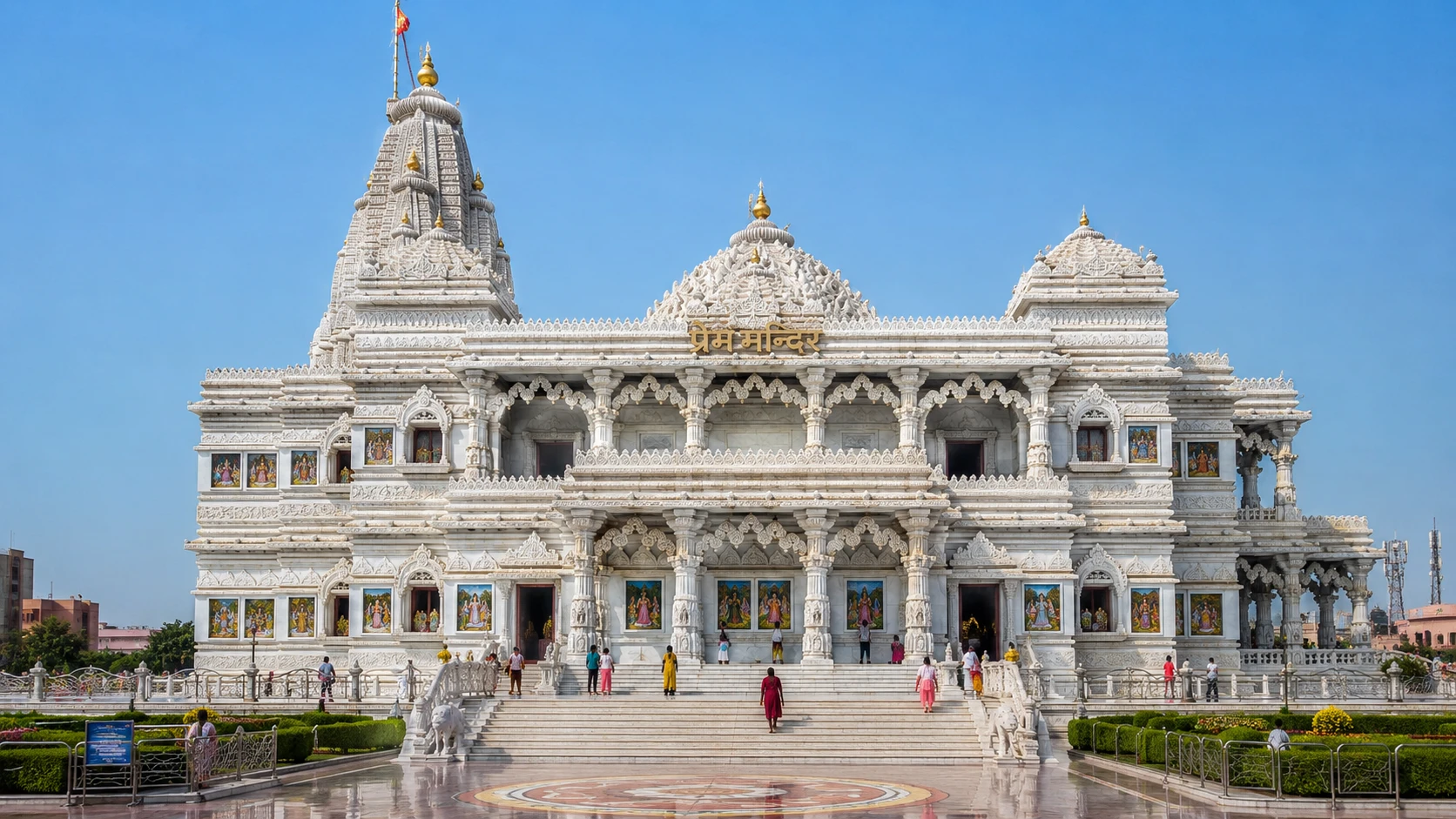
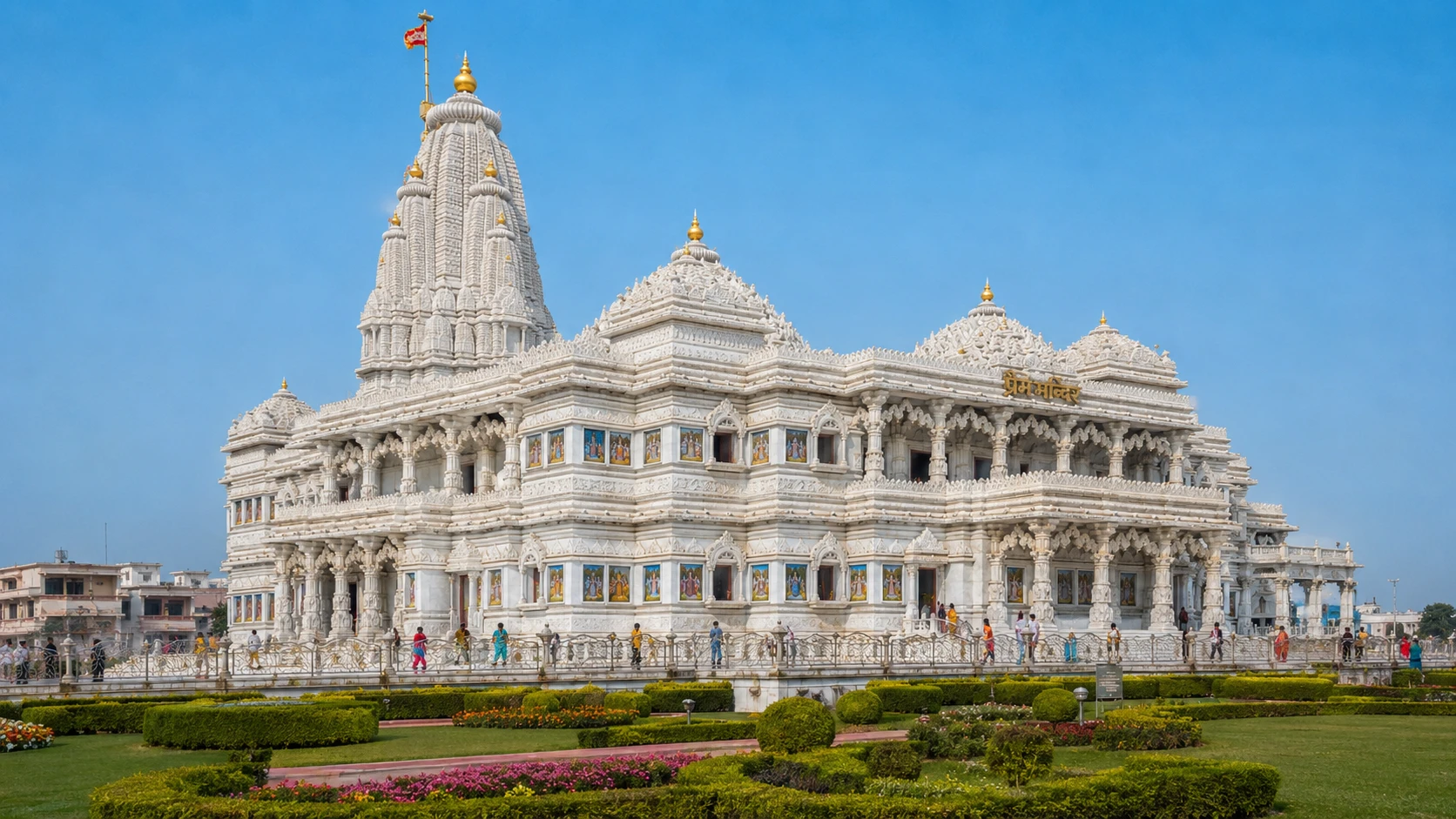
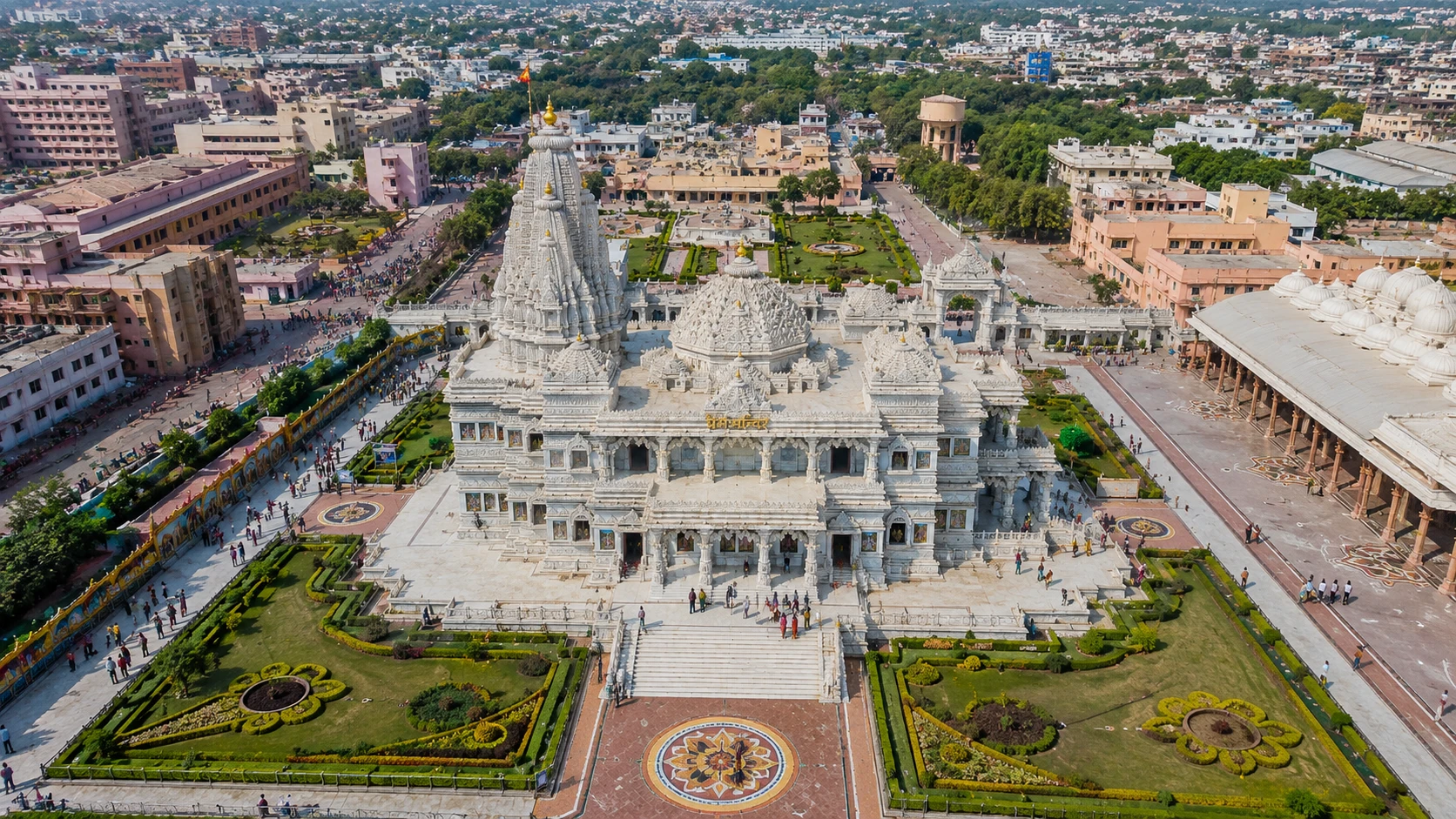
In a corner of Vrindavan that once lay undeveloped, a 20th-century Jagadguru commissioned a monument to divine love on a scale not seen in the Braj region in centuries. Prem Mandir — the Temple of Divine Love — rose over eleven years in pure white marble, its outer walls carved with the entire sweep of Krishna's lila from the Bhagavatam, its gardens staging his stories in three dimensions. When the fountains illuminate at night and the white marble takes on colour from the light display, the temple becomes what its founder Jagadguru Kripalu Maharaj intended: not a building to be admired from a distance, but an immersive experience of divine love available to anyone who enters, free of charge, regardless of background.
Sacred Origin Storyपवित्र उत्पत्ति कथा
Source: Vaishnava Bhakti tradition; Jagadguru Kripalu Parishat's theological framework based on the Bhagavata Purana
Prem Mandir is dedicated not to a single origin narrative but to the totality of Krishna's love — the divine romance that the Bhagavata Purana (Tenth Canto) describes as the highest expression of the divine. Its founder, Jagadguru Kripalu Maharaj, taught that prema — unconditional divine love — is not an emotion but a state of being into which the soul evolves through devotion. The temple's architecture embodies this theology: every surface tells a story from Krishna's life, every garden tableau recreates a moment of divine intimacy, every fountain illuminated at night is an invitation to abandon the calculating mind and simply feel.
The ground floor shrine houses Radha Madhav — Radha and Krishna together in the posture of their eternal love, the divine couple whose romance is the central subject of Braj devotion. The upper floor houses Sita Ram — Rama and Sita, embodiments of the complementary ideal of conjugal devotion expressed through duty and sacrifice. The two shrines together present the Vaishnava theology of divine love in its two principal expressions: the passionate, intimate love of Vrindavan, and the steadfast, duty-bound love of Ayodhya.
उद्धृत स्रोत:
- Bhagavata Purana, Canto 10 (Dashama Skandha) — the primary scriptural basis for the Radha-Krishna lila depicted in the temple's iconography
- Jagadguru Kripalu Maharaj's teachings, published by Jagadguru Kripalu Parishat (www.jkp.org.in)
- Temple documentation, Prem Mandir Trust, Vrindavan
विद्वत संदर्भ
Prem Mandir is a 21st-century devotional monument rather than an ancient sacred site, and its theological claims are those of its founder's contemporary teaching rather than contested scholarly terrain. Jagadguru Kripalu Maharaj's designation as the 'fifth Jagadguru' (after Adi Shankaracharya, Ramanujacharya, Nimbarkacharya, and Madhvacharya) was conferred by Kashi Vidvat Parishat in 1957 — this recognition has been acknowledged within certain Vaishnava circles but has also been contested; it is presented here as Kripalu Maharaj's traditional institutional identity, not as a settled scholarly claim.
Historyइतिहास
Jagadguru Kripalu Maharaj (1922–2013) was born Ramakripalu Tripathi in Mangarh, a village in what is today Uttar Pradesh. He began giving public spiritual discourses in his twenties, and in 1957 was brought before the Kashi Vidvat Parishat — an assembly of 500 scholars in Varanasi — whose recognition elevated him to the designation of Jagadguru. He founded the Jagadguru Kripalu Parishat (JKP), a global spiritual organisation whose activities span educational institutions, temples, and relief work across India. In 2001, Kripalu Maharaj laid the foundation for Prem Mandir — his most ambitious architectural project — on a large plot of land in Vrindavan. Construction employed approximately 1,000 artisans from Rajasthan's traditional stone-carving communities over eleven years, working in white marble throughout. The temple was formally inaugurated on January 17, 2012, in a ceremony attended by hundreds of thousands. Kripalu Maharaj passed away on November 15, 2013, just over a year after the inauguration. The temple today is managed by the Jagadguru Kripalu Parishat under the guidance of Kripalu Maharaj's successors and continues to draw millions of visitors annually, making it among the most visited new-construction temples in north India.
Historical Timelineऐतिहासिक कालक्रम
Birth of Jagadguru Kripalu Maharaj (born Ramakripalu Tripathi) on January 5, in Mangarh village, Allahabad district (now Uttar Pradesh). He would go on to found the Jagadguru Kripalu Parishat and commission Prem Mandir.
Kashi Vidvat Parishat — an assembly of 500 scholars in Varanasi — conferred on Kripalu Maharaj the designation of Jagadguru. He was described in the conferral as the fifth Jagadguru, placing him in the lineage of Adi Shankaracharya, Ramanujacharya, Nimbarkacharya, and Madhvacharya.
The designation of Kripalu Maharaj as 'fifth Jagadguru' has been acknowledged within certain Vaishnava communities and organisations affiliated with his lineage. The traditional four Jagadgurus are the founders of the principal Vedantic sampradayas; Kripalu Maharaj's conferral by a Varanasi scholars' assembly represents an institutional act within the Hindu scholarly establishment but is not a universally accepted designation across all Hindu traditions.
Foundation of Prem Mandir laid by Jagadguru Kripalu Maharaj in Vrindavan. Construction began with artisans from Rajasthan, working in white marble.
Prem Mandir was formally inaugurated on January 17, 2012, in a ceremony attended by hundreds of thousands of devotees. Jagadguru Kripalu Maharaj presided over the consecration of the Radha Madhav and Sita Ram shrines.
Jagadguru Kripalu Maharaj passed away on November 15, 2013, at the age of 91. The temple and Jagadguru Kripalu Parishat's institutions continue under the guidance of his successors.
What You'll Seeदर्शन में
Prem Mandir's iconographic programme operates on two levels: the intimate deity within, and the encyclopaedic narrative carved around the exterior. Inside, the ground floor shrine houses Radha Madhav — Radha and Krishna depicted together in the posture of divine love, both murtis dressed in elaborate seasonal silks and jewelled ornaments. The tableau of their togetherness is the physical heart of the Bhakti theology Kripalu Maharaj taught: prema is not something you feel toward the divine; it is the divine, encountered as presence. The upper floor shrine presents Sita Ram — Rama and Sita standing together, embodying the love that is devotion through duty, the counterpoint to Vrindavan's passionate intimacy. Outside, 150 panels of carved marble bas-relief trace the arc of Krishna's life from the Bhagavata Purana: the miraculous birth in Mathura prison, the crossing of the Yamuna by Vasudeva, the childhood in Gokul and Vrindavan (stealing butter, defeating Kaliya, lifting Govardhan), and the rasalila beneath the kadamba trees. The temple grounds contain several three-dimensional garden tableaux — scenes from both Krishna's and Rama's stories — illuminated with coloured lights after dark.
Did You Know?क्या आप जानते हैं?
Prem Mandir was built by approximately 1,000 artisans from Rajasthan's traditional stone-carving communities over eleven years (2001–2012). The entire structure — inside and out — is constructed in white marble.
Jagadguru Kripalu Parishat official documentation; Prem Mandir Trust construction records
The temple compound encompasses approximately 54 acres — one of the largest modern temple complexes in Vrindavan — and includes formal gardens, three-dimensional depictions of Krishna's and Rama's stories, and a large open forecourt that hosts major festival gatherings.
Prem Mandir Trust documentation; Vrindavan Tourism Board
Prem Mandir houses two separate shrines on two floors: the ground floor is dedicated to Radha Madhav (Radha and Krishna), representing the passionate devotional love of Vrindavan; the upper floor to Sita Ram (Sita and Rama), representing devotion expressed through duty and fidelity. Together, the two shrines present Vaishnava theology's two principal models of divine love.
Temple documentation, Prem Mandir Trust; Jagadguru Kripalu Parishat published materials
Entry to Prem Mandir is completely free of charge at all times — the temple follows a dana (donation) model rather than ticketed entry, in keeping with Jagadguru Kripalu Maharaj's teaching that divine love cannot be sold.
Prem Mandir Trust policy; Jagadguru Kripalu Parishat documentation
Festivalsत्योहार
Janmashtami
जन्माष्टमी
Jul-Aug (Bhadra Krishna Ashtami)
The scale of Prem Mandir's compound makes it a major festival venue — tens of thousands gather in the open forecourt for midnight celebrations. The illuminated exterior and elaborate light show run through the night. The carved panels of Krishna's birth story on the outer walls take on special resonance during Janmashtami.
Holi
होली
Feb-Mar (Phalgun Purnima)
Prem Mandir's large open grounds host one of Vrindavan's more spacious Holi celebrations — the white marble compound becomes a canvas for colour. The contrast of coloured powder against the white marble exterior is visually striking.
Radhashtami
राधाष्टमी
Aug-Sep (Bhadra Shukla Ashtami)
The birth of Radha is observed with special adornment of the Radha Madhav shrine on the ground floor. Extended darshan and special bhog offerings mark the day.
Ram Navami
राम नवमी
Mar-Apr (Chaitra Shukla Navami)
Uniquely among major Vrindavan temples, Prem Mandir celebrates Ram Navami with particular elaboration at the upper floor Sita Ram shrine — the dual-shrine architecture makes Prem Mandir one of the few Braj temples where Ram's festival is as central as Krishna's.
Traditional Offeringsपारंपरिक अर्पण
प्राथमिक अर्पण
Tulsi (Holy Basil)
तुलसी
तुलसी
Tulsi is indispensable in all Vaishnava worship. The plant is venerated as Vrinda Devi herself, and the Bhagavata Purana records that Vishnu holds tulsi as his most beloved offering. No bhog at a Vaishnava temple is complete without a tulsi leaf placed upon it. Offering tulsi is an act of offering the most precious of all natural things — the plant that chose to devote herself entirely to the divine.
Makhan and Mishri (Butter and rock candy)
माखन और मिश्री
नवनीत और मिश्री
The offering of fresh white butter (makhan) and crystalline rock candy (mishri) is the quintessential Braj offering to Krishna — recalling the Makhan-chor of Gokul whose childhood stories in the Bhagavata Purana's Tenth Canto are among the most beloved in all of Hindu literature. To offer makhan-mishri is to say: Lord, we know you. We know what you love.
Yellow and white flowers — Marigold, Jasmine, Rose
पीले और सफेद पुष्प — गेंदा, चमेली, गुलाब
At Prem Mandir, flowers are offered to both Radha Madhav and Sita Ram. Marigold garlands represent the abundance of Braj's fields; jasmine's fragrance evokes the night-blooming flowers of Vrindavan that perfumed Krishna's rasalila. White flowers for Sita Ram recall the purity of the Ayodhya dharma.
Chandan (Sandalwood paste)
चंदन
चन्दन
Sandalwood paste — cool, fragrant, applied to the deity's forehead and chest — is one of the sixteen upacharas of Vaishnava puja. Its cooling quality is offered as an expression of the devotee's desire to cool the divine with their attention and care, as a lover cools a beloved's brow.
Prem Mandir's large compound includes stalls near the entrance where flowers, tulsi, makhan-mishri, and other offering materials are available. Entry is free; donations to the Jagadguru Kripalu Parishat are welcomed and may be made at donation counters inside the complex or through jkp.org.in.
How to Reachकैसे पहुँचें
Prem Mandir is located on Bhakti Mandir Road in Vrindavan, approximately 2 km southwest of the town's main bazaar area. From Mathura Junction (14 km), shared auto-rickshaws and e-rickshaws continuously ply to Vrindavan; from Vrindavan's central area, the temple is accessible by e-rickshaw (5 minutes) or a 20-minute walk. By road from Delhi (approx. 150 km via NH-19 and Yamuna Expressway), the Vrindavan exit is clearly marked and Prem Mandir's signage is visible from the main road. The temple has a large car park on site.
Plan Your Visitयात्रा की योजना
🌤 सर्वोत्तम मौसम
October to March for comfortable weather. The light show and fountains are particularly atmospheric in cool evenings. Summer evenings (April–June) remain pleasant after 7 PM.
👘 पहनावे का नियम
Modest dress required; traditional Indian attire preferred. Footwear must be removed before entering the main temple. The large compound allows comfortable movement.
📱 फोन और फोटोग्राफी
Mobile phone photography is permitted in the grounds and exterior. Photography policy inside the main shrines should be confirmed with temple staff on arrival.
🏨 आवास
Prem Mandir is a 5-minute e-rickshaw ride from central Vrindavan. Pilgrim accommodation is widely available in Vrindavan; the Jagadguru Kripalu Parishat also operates some accommodation in connection with the temple complex — verify current availability through jkp.org.in.
Sacred Soundsपवित्र ध्वनि
108 Japa Practice
Om Namo Bhagavate Vasudevaya
Chant 108 times in the spirit of this temple
क्या आप जानते हैं? · Did You Know?
वही अनुवाद त्रुटि जिसने हिन्दू धर्म में '33 कोटि' को '33 करोड़' बनाया, बौद्ध धर्म में भी हुई। बौद्ध ग्रन्थों के चीनी अनुवाद ने 'सप्त कोटि बुद्ध' (7 श्रेष्ठ बुद्ध) का अनुवाद '7 करोड़ बुद्ध' कर दिया। तिब्बती अनुवाद ने सही किया: 7 प्रकार, 7 करोड़ नहीं। एक संस्कृत शब्द, दो प्रमुख विश्व धर्मों में गलत पढ़ा गया, ने दो एकसमान भ्रम स्वतन्त्र रूप से उत्पन्न किए।
Related Contentसंबंधित सामग्री
Related Scriptures
Community Reflections
🕉️
Be the first to share your reflection.