Dwarkadhish Haveli (Kankroli)
द्वारकाधीश हवेली कांकरोली
Where the Lord of Dwarka watches the lake — and the lake was built to be worthy of him
Kankroli, Rajasthan, India
Dvārakādhīśa Haveli, KaṅkarolīAlso known as: Dwarkadheesh Temple Kankroli, Kankroli Devasthan, Kankroli Haveli, Shrinathji Haveli Kankroli, Tilakayata Haveli
युग
Haveli established c. 1662–1676 CE under Maharana Raj Singh I of Mewar; Pushti Marg Saptapeeth; the Rajsamand Lake completed 1676 CE
वास्तुकला
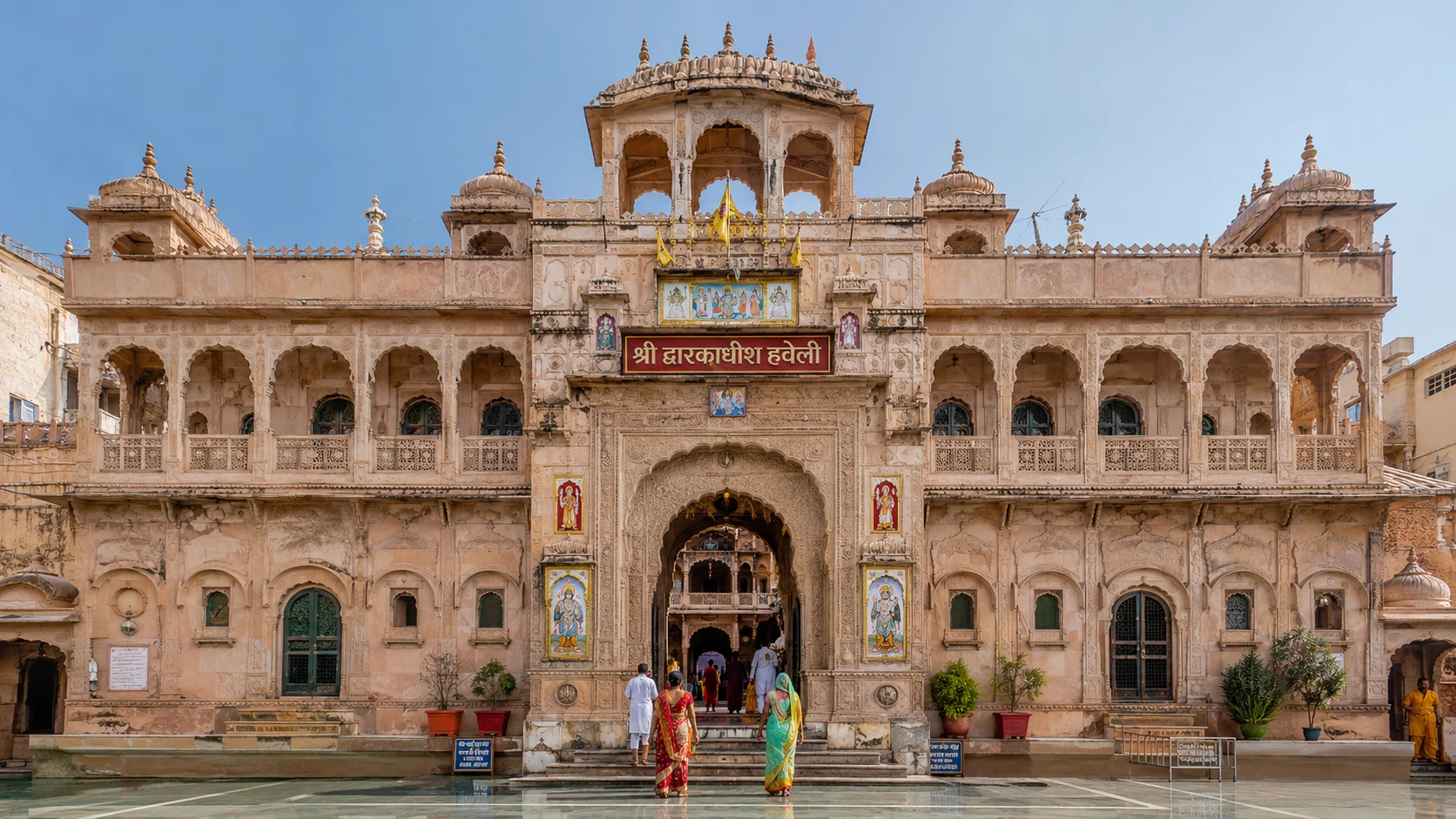
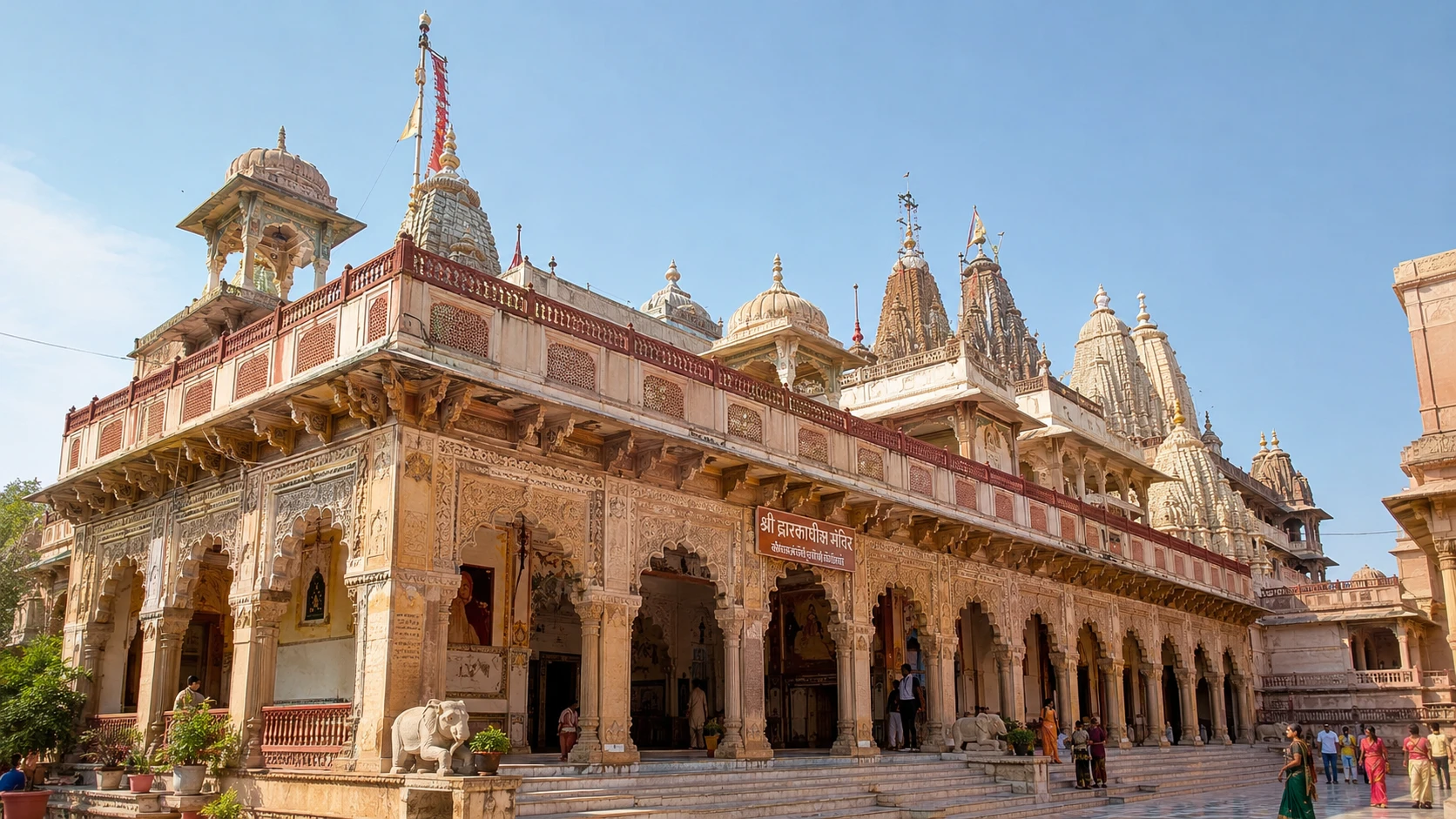
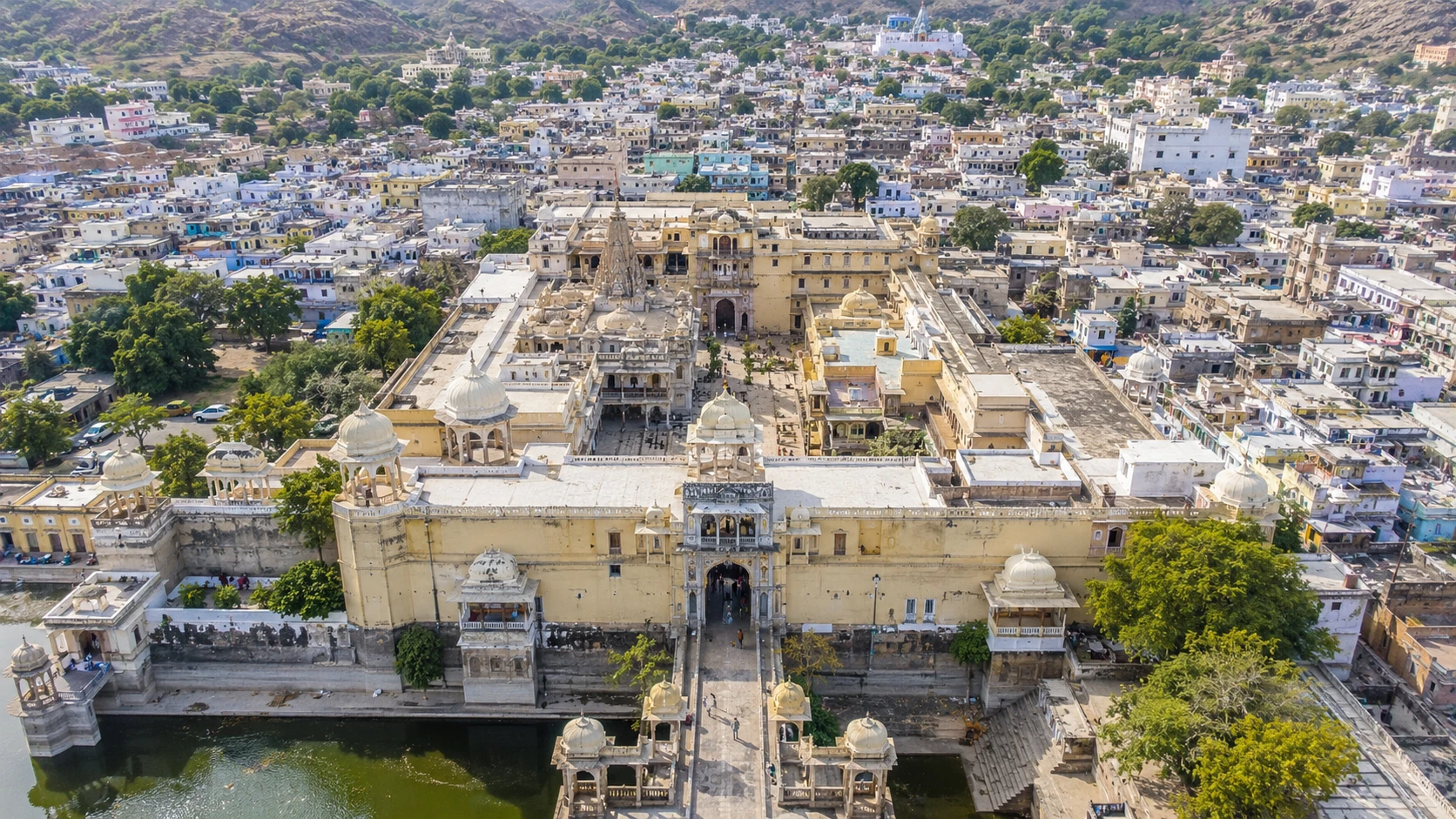
Rajput haveli tradition — similar to Nathdwara's Pushti Marg haveli style; lakeside setting on Rajsamand Lake's western embankment; the Nauchowki (nine pavilion) embankment with the Raj Prashasti inscriptions is immediately adjacent
खुला
05:30 – 21:30
आरती
05:30 · 07:30 · 10:30 · 12:00 · 15:30 · 17:00 · 18:30 · 20:30
विशेष
Eight daily darshan windows (ashtayama seva) following the Pushti Marg protocol — the same eight-period schedule as Nathdwara (Shrinathji Haveli). Timings are subject to seasonal adjustment; the midday closure between Raj Bhog and Utthapan should be confirmed on arrival. Festival periods (Annakuta, Janmashtami) see extended darshans and special pichwai displays.
पवित्र कथा · पवित्र कथा
In the 1660s, Maharana Raj Singh I of Mewar — the Rajput king who was simultaneously building one of Rajasthan's grandest lakes and providing refuge to the Pushti Marg's Shrinathji murti as it fled Mughal pressure in Braj — chose the western bank of his new lake at Kankroli for the installation of Dwarkadheesh, the Lord of Dwarka. The choice was deliberate: a deity whose name invokes the golden city that sank beneath the sea deserved a shoreline, a view of water, a lake that could hold at least the memory of that departed ocean. Rajsamand lake today stretches three and a half miles in each direction, and Dwarkadheesh gazes across it from his haveli as he once gazed across the sea from his golden city. The stone embankment below the haveli is carved with 25 marble slabs of Sanskrit verse — the Raj Prashasti, one of India's longest stone inscriptions — recording a king's effort to make his reign as permanent as stone. Permanence, the lake says, is possible. The Lord has been here since.
Sacred Origin Storyपवित्र उत्पत्ति कथा
Source: Pushti Marg (Path of Grace); founded by Sri Vallabhacharya (1479–1531 CE); the Kankroli Dwarkadheesh Haveli is one of the seven Saptapeethas of the Pushti Marg tradition
Dwarkadheesh — the Lord of Dwarka — is Krishna in his sovereign, royal aspect: the king of the golden city that Vishvakarma built on the edge of the sea, the husband of Rukmini and 16,107 wives, the master of a domain so glorious that the Bhagavata Purana's Tenth Canto devotes chapter after chapter to describing its towers, its harbours, its streets of gold and silver. The Bhagavata Purana (Canto 10, Chapters 50–69) gives the full account of Dwaraka's establishment: after Krishna killed Kamsa at Mathura and the threat from Jarasandha made Mathura unsafe, Krishna led his people — the Yadavas — westward across the Indian subcontinent to the shore of the sea, where he established Dwaraka on land reclaimed from the ocean by Vishvakarma at his command. Dwaraka was simultaneously a political capital and a theological statement: the Lord governing the world, maintaining dharma, present in his fullness as king, husband, father, warrior, and diplomat.
The Pushti Marg tradition holds Dwarkadheesh as one of the most complete expressions of Krishna's sovereignty — the same Krishna who played with cowherd boys in Vrindavan and stole butter from neighbours is here the master of a divine city, worshipped with the full protocol of a sovereign. The form of the Kankroli Dwarkadheesh murti reflects this dual identity: the murti has the recognisable features of Krishna (dark complexion, peacock feather, flute) but is installed in the mode of royal seva — the full ashtayama protocol of a sovereign's day — rather than the pastoral informality of Vrindavan.
उद्धृत स्रोत:
- Bhagavata Purana, Canto 10, Chapters 50–69 — the establishment of Dwarka and Krishna's royal life
- Bhagavata Purana, Canto 11 — the final days of Dwaraka and Krishna's departure
- Vallabhacharya, 'Shodasha Granthas' — foundational Pushti Marg texts
- Shyamaldas, 'Veer Vinod' (19th century Mewar court chronicle) — on Raj Singh I's patronage and the Kankroli establishment
विद्वत संदर्भ
The Kankroli Dwarkadheesh Haveli's establishment under Maharana Raj Singh I's patronage (c. 1660s–1670s CE) is documented in Mewar court chronicles, most comprehensively in Shyamaldas's 'Veer Vinod' (19th century). R.K. Barz's scholarly study of the Pushti Marg ('The Bhakti Sect of Vallabhacharya', 1976) places the Kankroli Haveli within the Saptapeeth system established by the Vallabhacharya tradition's expansion into Mewar under royal patronage. The Raj Prashasti inscriptions at the adjacent Nauchowki embankment — composed in 1676 CE — are extensively documented in epigraphic literature (D.R. Bhandarkar, 'Inscriptions of the Corpus Inscriptionum Indicarum', Vol. VI).
Historyइतिहास
The Kankroli Dwarkadheesh Haveli is one of the Pushti Marg's seven Saptapeethas — the principal pilgrimage centres of the Vallabhacharya tradition established in the Mewar region under the patronage of Maharana Raj Singh I (r. 1652–1680 CE) of the Mewar royal house. Raj Singh I was one of the most significant royal patrons of Pushti Marg, simultaneously providing refuge for Shrinathji (at Nathdwara, 25 km to the northeast) and establishing the Kankroli Haveli on the banks of his newly constructed Rajsamand Lake. The Rajsamand Lake itself — begun around 1662 CE and completed in 1676 CE — is one of the largest artificial lakes in Rajasthan at the time of its construction, built partly for irrigation and partly as a monument to Mewar's cultural and devotional life. The adjacent Nauchowki (nine pavilions) embankment contains the Raj Prashasti inscriptions: 25 marble slabs engraved with Sanskrit verse by the poet Ranchhod Bhatt, commissioned by Raj Singh I in 1676 CE, recording the history of Mewar and the king's reign. These inscriptions are among the longest stone inscriptions in India and represent a deliberate assertion of Sanskrit cultural identity against the Mughal court's Persian-language intellectual dominance. The Kankroli Haveli today continues as an active Pushti Marg pilgrimage site, following the same ashtayama seva protocols as Nathdwara, with the distinctive backdrop of Rajsamand Lake behind the daily darshans.
Historical Timelineऐतिहासिक कालक्रम
Maharana Raj Singh I of Mewar begins construction of Rajsamand Lake (begun c. 1662 CE, completed 1676 CE) and establishes the Kankroli Dwarkadheesh Haveli on the western bank as part of his programme of Pushti Marg patronage in the Mewar region. This is contemporaneous with his provision of land and support for the Shrinathji Haveli at Nathdwara (25 km away).
The precise founding date of the Kankroli Haveli within the 1662–1676 CE period is not precisely fixed in surviving records; it is contemporaneous with the Rajsamand Lake's construction and Raj Singh I's broader Pushti Marg patronage.
Completion of Rajsamand Lake and the Raj Prashasti inscriptions: 25 marble slabs on the Nauchowki (nine pavilions) embankment, engraved with Sanskrit verse by court poet Ranchhod Bhatt at Raj Singh I's commission. The inscriptions record the history of Mewar and constitute one of the longest stone inscriptions in India — a deliberate assertion of Sanskrit cultural authority against the Mughal court's Persian-language textual dominance.
The Raj Prashasti is one of the most extensively cited Sanskrit inscriptions of the medieval period in Rajasthan scholarship. Its language and political context — asserting Rajput sovereignty and cultural continuity in a Mughal-dominated period — have been analysed by historians of Rajput political identity (Ramya Sreenivasan, 'The Many Lives of a Rajput Queen', 2007; Cynthia Talbot, 'The Last Hindu Emperor', 2016).
The Kankroli Dwarkadheesh Haveli maintains its role as one of the Pushti Marg Saptapeethas — the seven principal pilgrimage sites of the Vallabhacharya tradition. The ashtayama seva (eight-period daily worship) continues unbroken, following the same protocols as Nathdwara's Shrinathji Haveli. The temple draws Pushti Marg pilgrims from across Gujarat, Rajasthan, and Maharashtra throughout the year, with peak pilgrimages during Annakuta, Govardhan Puja, and Janmashtami.
What You'll Seeदर्शन में
The Dwarkadheesh murti at Kankroli depicts Krishna in his Dwarka-king aspect — standing, dark-complexioned, bearing the recognisable marks of his Vrindavan identity (peacock feather in his crown, flute at his waist) but dressed and adorned in the mode of a sovereign rather than a cowherd. He holds the four emblems of Vishnu — conch, chakra, mace, lotus — in his four arms, acknowledging the full Vishnu theology behind the form of Krishna as cosmic king. The deity is titled 'Tilakayata' in some Pushti Marg sources — a reference to the distinctive tilak (forehead mark) that the murti bears, marking it as sovereign and consecrated. The sringara (adornment) of Dwarkadheesh follows the same ashtayama seasonal calendar as Nathdwara — eight changes of dress, flowers, and pichwai backdrop through the day, each coordinated with a specific moment in the Lord's perpetual Vrindavan-Dwarka day. The lakeside setting of the Kankroli Haveli creates a unique darshan atmosphere: the water of Rajsamand Lake visible beyond the temple precincts gives the Dwarkadheesh darshan a quality of openness and reflection — the Lord of a sunken city, still watching the water. Photography inside the main shrine is not permitted.
Distinctive Practicesविशिष्ट परंपराएँ
Lakeside darshan — Dwarkadheesh watching Rajsamand
झील-किनारा दर्शन — द्वारकाधीश राजसमंद को देखते हुए
Permanent; the lake backdrop is present at all darshan sessions
The Kankroli Dwarkadheesh Haveli is positioned on the western bank of Rajsamand Lake, and the view from the haveli — or from the Nauchowki embankment immediately below it — is one of the most visually distinctive in all of Pushti Marg: a vast blue lake stretching to the horizon, the water reflecting the sky, the Lord of a sunken city gazing at a living one. During major festivals (particularly Annakuta in autumn), the lake's reflection amplifies the illumination of the haveli, creating an atmosphere not found at any other Pushti Marg site. The Rajsamand Lake is also used for ritual immersion during festivals — a practice that connects the Dwarkadheesh tradition specifically to the water, honouring the deity's association with the sea.
Ashtayama seva — the Lord's full sovereign day
अष्टयाम सेवा — प्रभु का पूरा शाही दिन
Eight fixed darshan sessions throughout each day, from pre-dawn to late evening
Kankroli follows the complete Pushti Marg ashtayama (eight-period) seva — the same protocol as Nathdwara's Shrinathji Haveli, codified by Vitthalnath (Gusainji) in the 16th century. Each of the eight sessions — Mangala, Shringar, Gwal, Raj Bhog, Utthapan, Bhog, Aarti, Shayan — has specific dress, bhog, pichwai, and liturgy for Dwarkadheesh. The Kankroli ashtayama applies the protocols of the Vrindavan-Dwarka theological day: the same Vitthalnath-codified seva that structures Shrinathji's pastoral world at Nathdwara here structures Dwarkadheesh's royal world at Kankroli.
Raj Prashasti — the inscribed history beside the haveli
राज प्रशस्ति — हवेली के पास उत्कीर्ण इतिहास
Permanent; the Nauchowki embankment is immediately adjacent to the haveli
The Nauchowki (nine pavilions) embankment on the northern shore of Rajsamand Lake — immediately adjacent to the Kankroli Haveli — contains the Raj Prashasti: 25 marble slabs engraved with 1,017 Sanskrit verses, commissioned by Maharana Raj Singh I in 1676 CE. The inscriptions record the history of Mewar, the construction of Rajsamand Lake, and a deliberate refutation (in Sanskrit) of the Mughal court's Persian-language narratives of Indian history. Raj Singh I's choice to combine the Pushti Marg haveli with this inscription project — spiritual centre and historical statement, side by side — makes Kankroli uniquely a site where devotion and political identity are literally carved into the same stone embankment.
Did You Know?क्या आप जानते हैं?
The Raj Prashasti inscriptions at Rajsamand — 25 marble slabs with 1,017 Sanskrit verses composed by Ranchhod Bhatt in 1676 CE — are among the longest stone inscriptions in India. They were deliberately composed in Sanskrit (rather than Persian, the Mughal court's preferred language for royal chronicles) as a cultural and political statement of Rajput sovereignty. The inscriptions cover the entire northern embankment of Rajsamand Lake and are visible immediately adjacent to the Kankroli Haveli.
D.R. Bhandarkar, 'Corpus Inscriptionum Indicarum', Vol. VI; Ranchhod Bhatt, Raj Prashasti (1676 CE); James Tod, 'Annals and Antiquities of Rajasthan' (1829)
Kankroli lies just 25 km from Nathdwara, making it possible to visit both Pushti Marg Saptapeethas on the same pilgrimage. Pushti Marg devotees traditionally undertake a circuit of the seven Saptapeethas; the Mewar cluster (Nathdwara and Kankroli) represents two of the seven in close proximity, and the Udaipur-Nathdwara-Kankroli route is one of Rajasthan's most rewarding devotional journeys.
Pushti Marg pilgrimage tradition; Rajasthan Tourism documentation
Rajsamand Lake — on whose western bank the Kankroli Haveli stands — was built partly for irrigation but also as a deliberate act of cultural patronage by Maharana Raj Singh I, who commissioned the Raj Prashasti inscriptions on its embankment. The lake is one of the largest man-made lakes in Rajasthan at the time of its construction and today provides water to the surrounding agricultural region while serving as the backdrop for Kankroli's devotional life.
James Tod, 'Annals and Antiquities of Rajasthan' (1829); Rajasthan Irrigation Department records
In Pushti Marg theology, the Kankroli Dwarkadheesh is associated with the Dwarka aspect of Krishna — the mature, sovereign form of the Lord who has established his kingdom, governed his people, and fulfilled his worldly dharma — as distinct from the child-playful Shrinathji of Nathdwara (the Govardhan-lifter) or the intimate Braj Krishna of Vrindavan. The Saptapeeth circuit thus traces the arc of Krishna's own life: from the pastoral world of Braj to the sovereign world of Dwarka.
R.K. Barz, 'The Bhakti Sect of Vallabhacharya' (1976); Pushti Marg theological tradition
Festivalsत्योहार
Annakuta — the mountain of food at the lakeside
अन्नकूट — झील के किनारे भोजन का पर्वत
Oct-Nov (Kartika Shukla Pratipad, day after Diwali)
Annakuta at Kankroli has a particular visual impact that Nathdwara cannot replicate: the mountain of food offerings before Dwarkadheesh, the illuminated haveli behind, and the reflection of both in the dark water of Rajsamand Lake — the Lake of Kings, the Lord of a sunken city, the memory of Dwarka in the Rajasthani hills. The Annakuta pichwai is displayed; special pichwai painters produce Kankroli-specific compositions that use the lake as an iconographic motif.
Janmashtami
जन्माष्टमी
Jul-Aug
Janmashtami at Kankroli is particularly resonant because Dwarkadheesh is the mature Krishna who was born at Mathura, grew up in Vrindavan, and established Dwarka — the full biographical arc of the deity whose birth is celebrated. The midnight aarti and the illuminated lakeside haveli create an atmosphere specific to this site.
Govardhan Puja
गोवर्धन पूजा
Oct-Nov (Kartika Shukla Pratipad)
While Govardhan Puja has its primary expression at Nathdwara (where Shrinathji is the Govardhan-lifting form), Kankroli's celebration honours the event that preceded Dwarka: the act of protection that demonstrated Krishna's sovereign authority over the natural world, before he established his sovereign authority over the human world at Dwarka.
Sharad Purnima
शरद पूर्णिमा
Oct (Ashwin Purnima)
The autumn full moon, when the Rajsamand Lake surface reflects the full moon and the illuminated haveli simultaneously, is one of the most atmospherically distinctive nights at Kankroli — a quality unique to a Pushti Marg haveli on a lakeside. The Sharad Purnima pichwai, depicting the moonlit rasalila, is displayed against the actual moonlit lake.
Traditional Offeringsपारंपरिक अर्पण
प्राथमिक अर्पण
Tulsi (Holy Basil)
तुलसी
तुलसी
Tulsi is the primary offering of all Pushti Marg worship. The Haribhaktivilasa's protocols, followed at Kankroli as at all Pushti Marg sites, prescribe tulsi as essential to every bhog and puja. At Kankroli, the tradition of growing tulsi plants within the haveli compound connects the offering to the deity's own living environment.
Ashtayama bhog — eight daily offerings coordinated with the Dwarka-day
अष्टयाम भोग — द्वारका-दिवस के साथ समन्वित आठ दैनिक अर्पण
अष्टयाम भोग
The Kankroli bhog follows the same Pushti Marg protocol as Nathdwara — eight daily meals for the Lord, each specific to a moment in the devotional day. The Dwarkadheesh context inflects the bhog slightly differently from Shrinathji: the royal aspect of Dwarkadheesh means the bhog leans toward more elaborate, courtly preparations for Raj Bhog — a reflection of a king's midday meal rather than a cowherd child's lunch.
Lotus flowers and fragrant garlands
कमल पुष्प और सुगंधित मालाएँ
पद्म
Lotus flowers are particularly appropriate for Dwarkadheesh, whose name and theology echo Vishnu's lotus iconography. The Rajsamand Lake provides fresh lotus in the monsoon and post-monsoon season — a natural offering from the water that provides the Lord's backdrop.
Panchamrit abhishekam
पंचामृत अभिषेकम्
पञ्चामृत
Panchamrit abhishekam is performed at Kankroli on festival occasions following the Pushti Marg protocols of the Haribhaktivilasa. The five substances — milk, curd, honey, ghee, and sugar — are offered in sequence, bathing the Dwarkadheesh murti in the sweetness and purity of divine love.
इस मंदिर की विशेषता
Lake water offerings — Rajsamand Jal as teertha
झील जल अर्पण — तीर्थ के रूप में राजसमंद जल
The water of Rajsamand Lake — sanctified by its proximity to the Dwarkadheesh Haveli and the Raj Prashasti inscriptions — is used in ritual contexts as a teertha (sacred water) at Kankroli, acknowledging the theological resonance of the Lake with Dwarka's sea. This practice is specific to Kankroli within the Pushti Marg Saptapeeth and connects the devotional tradition to the site's actual water.
Offering materials (tulsi, lotus where available, marigold garlands, camphor) are available from vendors near the Kankroli Haveli. The haveli kitchen follows strict Pushti Marg dietary norms (no onion, garlic, or root vegetables); prasad is distributed after the Raj Bhog and Aarti darshans.
How to Reachकैसे पहुँचें
Kankroli is in Rajsamand district, approximately 65 km north of Udaipur on NH-58 (Udaipur–Ajmer highway). From Udaipur, regular RSRTC buses and private taxis make the approximately 90-minute journey. Many Pushti Marg pilgrims combine a Nathdwara–Kankroli circuit from Udaipur, as Nathdwara is only 25 km from Kankroli. By rail, Udaipur City Station (65 km) is the nearest major railhead, with connections to Delhi (approximately 12 hours on Mewar Express) and Mumbai. By air, Maharana Pratap Airport (Udaipur, 65 km) has daily flights from Delhi, Mumbai, and Jaipur.
Plan Your Visitयात्रा की योजना
🌤 सर्वोत्तम मौसम
October to March (mild Rajasthan winters). Annakuta (October–November) is the most visually spectacular time — the combination of festival illuminations and the lake creates an extraordinary atmosphere. Sharad Purnima (October) is also exceptional at this lakeside site. Monsoon (July–September) sees the lake at its fullest; a dramatic setting for darshan.
👘 पहनावे का नियम
Modest dress required. Traditional Rajasthani attire is common among pilgrims. Footwear removed at the haveli entrance. The lakeside setting makes lightweight layers advisable — the lake breeze is cooling in the evenings.
📱 फोन और फोटोग्राफी
Photography inside the main shrine is not permitted. Photography of the Rajsamand Lake, the Nauchowki embankment, and the Raj Prashasti inscriptions is generally allowed.
🏨 आवास
Kankroli town has basic guesthouses; the Pushti Marg tradition maintains some pilgrim accommodation near the haveli. Udaipur (65 km) provides the nearest comprehensive accommodation options, from budget guesthouses in the old city to luxury heritage hotels and resorts. A same-day Nathdwara–Kankroli circuit from Udaipur is feasible for visitors with limited time.
Sacred Soundsपवित्र ध्वनि
108 Japa Practice
Om Namo Bhagavate Vasudevaya — also 'Shri Krishnah Sharanam Mama' (Vallabhacharya's Pushti Marg mantra)
Chant 108 times in the spirit of this temple
क्या आप जानते हैं? · Did You Know?
वही अनुवाद त्रुटि जिसने हिन्दू धर्म में '33 कोटि' को '33 करोड़' बनाया, बौद्ध धर्म में भी हुई। बौद्ध ग्रन्थों के चीनी अनुवाद ने 'सप्त कोटि बुद्ध' (7 श्रेष्ठ बुद्ध) का अनुवाद '7 करोड़ बुद्ध' कर दिया। तिब्बती अनुवाद ने सही किया: 7 प्रकार, 7 करोड़ नहीं। एक संस्कृत शब्द, दो प्रमुख विश्व धर्मों में गलत पढ़ा गया, ने दो एकसमान भ्रम स्वतन्त्र रूप से उत्पन्न किए।
Related Contentसंबंधित सामग्री
Related Scriptures
Community Reflections
🕉️
Be the first to share your reflection.