Kanchi Kamakoti Peetham
काञ्ची कामकोटि पीठम्
The Shankara seat at Kanchi, held by its tradition as the Throne of Omniscience beside the goddess Kamakshi
Kanchipuram, Tamil Nadu, India
Kāñcī Kāmakoṭi PīṭhamAlso known as: Kanchi Kamakoti Peetham, Kanchi Mutt, Kanchi Sarvajna Pitha, Sri Kanchi Kamakoti Peetham, Kamakoti Peetham
युग
Held by its own tradition to have been founded by Adi Shankaracharya at Kanchipuram as the Sarvajna Pitha; its status as a Shankara foundation is contested, and the peetham operated for a long period from Kumbakonam before returning to Kanchipuram
वास्तुकला
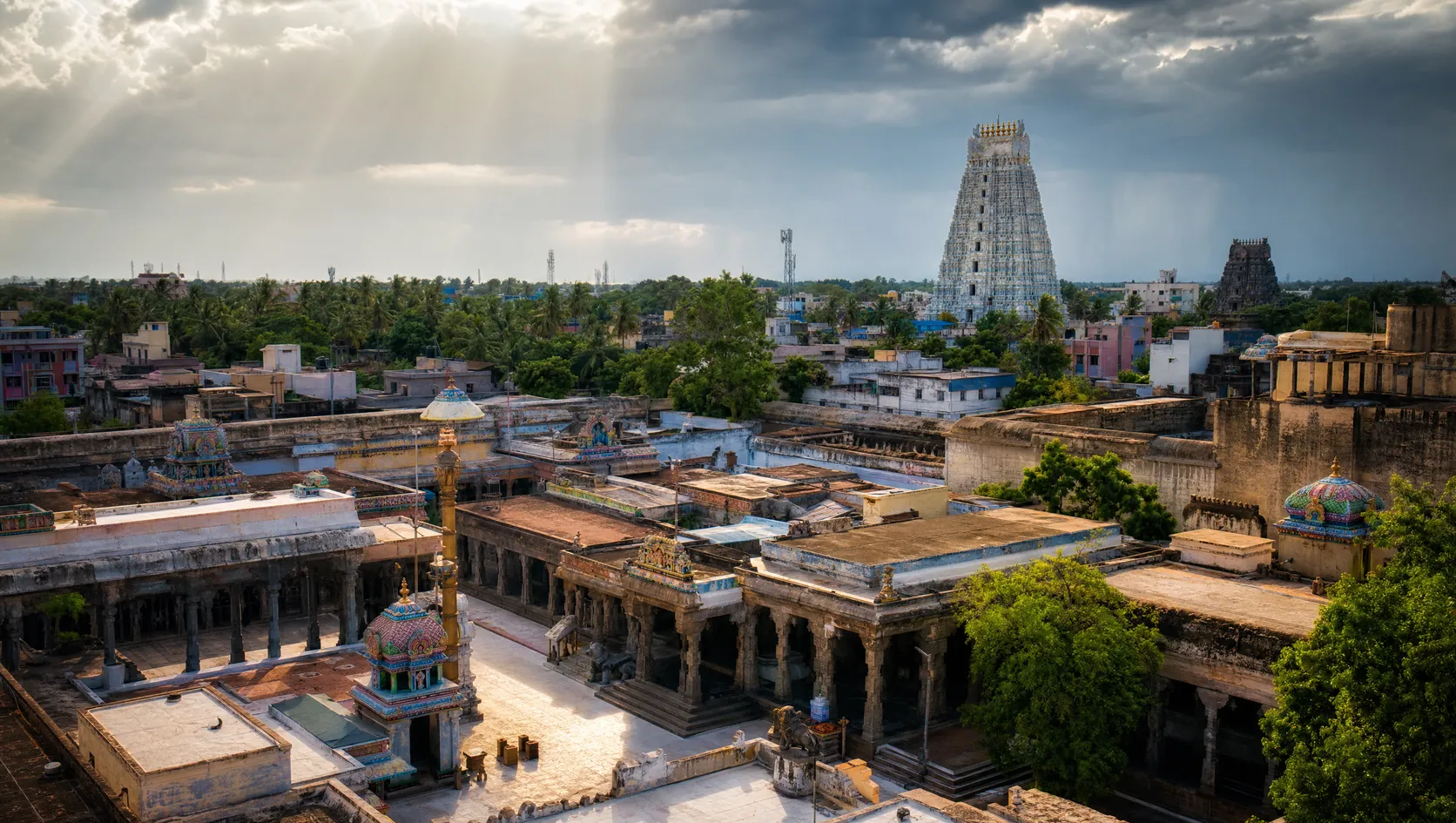
A functioning matha complex at Kanchipuram, close to the Kamakshi Amman temple, in the Tamil temple-town idiom
विशेष
The matha maintains a daily ritual schedule alongside its shrines and the worship of the Sri Chakra and the Chandramauleeshwara, and the Acharya's public audience is observed at set times. Timings are set by the matha and vary with the ritual calendar.
पवित्र कथा · पवित्र कथा
Adi Shankaracharya established mathas to hold the ground of Advaita Vedanta across the land, and the four cardinal seats at Sringeri, Dwaraka, Puri and Jyotirmath are recognised throughout the tradition as his. The Kanchi Kamakoti Peetham stands a little apart from this scheme: its own tradition holds that Shankara established a fifth and principal seat here at Kanchipuram, the ancient temple city, and that it is the Sarvajna Pitha, the Throne of Omniscience, which the tradition says Shankara ascended after defeating all rivals in debate. Whether Kanchi is one of Shankara's own foundations is one of the enduring disputes of the Advaita world. The peetham holds an unbroken lineage of some seventy acharyas reaching back to Shankara himself as its first, and its acharyas of the modern era, above all the revered Paramacharya, have made it one of the most influential religious institutions of southern India. The four cardinal mathas, and many modern scholars, do not accept its claim to be a Shankara foundation of the same order. Eternal Raga sets out the peetham's tradition as the peetham holds it, and notes clearly where that tradition is contested, without adjudicating between them. What is not in dispute is the peetham's living importance, its deep bond with the goddess Kamakshi of Kanchi, and the reverence in which its acharyas are held.
Sacred Designationपवित्र पदनाम
Sacred Origin Storyपवित्र उत्पत्ति कथा
Source: The Kanchi Kamakoti Peetham's own institutional tradition and guru parampara, set in the sanctity of Kanchipuram and its goddess Kamakshi, with the contested question of the seat's origin noted
Kanchipuram was a great centre of sanctity and learning long before any matha. One of the seven cities held to give liberation, it is a rare place sacred to Vishnu, Shiva and the goddess alike, and its Kamakshi Amman temple is among the foremost seats of the goddess in the south, a place of Sri Vidya, the esoteric worship of the divine feminine through the Sri Chakra.
The peetham's tradition places Shankara at the heart of this. It holds that when he came to Kanchi he found the goddess Kamakshi in a fierce, overwhelming aspect, and that he installed the Sri Chakra before her to draw her fierceness into benevolence, fixing her worship in the ordered form of Sri Vidya. In this account Shankara established the peetham here as his principal seat, the Sarvajna Pitha, the Throne of Omniscience that he ascended after defeating every rival school in debate, and the tradition holds further that he spent his last years and attained his final release at Kanchi.
These are the peetham's own claims, and they are contested. The tradition of the four cardinal mathas does not count Kanchi among Shankara's foundations, and other traditions place his final days elsewhere, at Kedarnath in the Himalaya. What both sides share is the reverence for Shankara and for the goddess of Kanchi; where they differ is on the seat's origin. The peetham venerates as its first acharya Shankara himself, and traces an unbroken line of some seventy teachers from him to the present, a lineage whose modern holders have been among the most revered figures of Hindu India.
उद्धृत स्रोत:
- Kanchi Kamakoti Peetham institutional tradition and guru parampara
- Tradition of the Kamakshi Amman temple and Sri Vidya at Kanchipuram
- Shankara biographical tradition (with the Kanchi and Kedarnath accounts of his final days both noted)
अन्य परंपराएँ · अन्य परंपराएँ
The tradition of the four cardinal mathas and much modern scholarship
विद्वत संदर्भ
The status of the Kanchi Kamakoti Peetham is among the most debated questions in the modern study of the Advaita mathas. The peetham holds that it is a fifth seat, indeed the principal seat or Sarvajna Pitha, established by Adi Shankaracharya at Kanchipuram, with an unbroken lineage of some seventy acharyas from Shankara himself. The four amnaya mathas, and a significant body of scholarship, hold that Shankara established four seats and not a fifth, and that the Kanchi peetham's prominence and its specific claims about Shankara arose later than the tradition asserts. The debate turns on the reading of the biographical texts, the guru-parampara lists, and the historical record of the peetham, including a long period during which it functioned from Kumbakonam rather than Kanchipuram. It is bound up with the wider dispute over where Shankara passed his final days, which the Kanchi tradition places at Kanchi and other traditions at Kedarnath. Eternal Raga does not adjudicate this; it presents the peetham's tradition as the peetham holds it and marks clearly that it is contested. What is beyond dispute is the peetham's living reality and influence. Its twentieth-century acharya Chandrashekharendra Saraswati, known as the Paramacharya or the Sage of Kanchi, was among the most widely revered religious figures of modern India, and the peetham remains a major centre of Advaita and Sri Vidya, deeply bound to the goddess Kamakshi of Kanchipuram.
Historyइतिहास
The Kanchi Kamakoti Peetham is an Advaita matha at Kanchipuram, held by its own tradition to have been established by Adi Shankaracharya as a fifth and principal seat, the Sarvajna Pitha or Throne of Omniscience, bound to the goddess Kamakshi and to the Sri Vidya worship of the Sri Chakra. It venerates Shankara himself as its first acharya and traces an unbroken lineage of some seventy teachers to the present.
The peetham's status as a Shankara foundation is contested. The tradition of the four amnaya mathas, headed by Sringeri, holds that Shankara established four cardinal seats and not a fifth at Kanchi, and much modern scholarship places the peetham's rise to prominence, and its specific claims about Shankara, later than the tradition asserts. The dispute is long-running and unresolved, and it extends to the question of where Shankara spent his final days, which the Kanchi tradition places at Kanchi against the account that places them at Kedarnath.
Whatever its origin, the peetham has a long and documented institutional life. For an extended period it operated from Kumbakonam, further south, before its return to Kanchipuram, and across the medieval and modern centuries it maintained its lineage, its worship of the Sri Chakra and the Chandramauleeshwara, and its bond with the Kamakshi temple.
In the twentieth century the peetham became one of the most influential religious institutions of southern India under its acharya Chandrashekharendra Saraswati, the Paramacharya, revered across sectarian lines as a living saint through his very long tenure. His successors have continued the line, and the peetham today is a major centre of Advaita and Sri Vidya, its acharyas widely honoured and its worship inseparable from the goddess of Kanchi. Eternal Raga presents the peetham's tradition as it holds it, marking the contested question of its origin without taking a side.
Historical Timelineऐतिहासिक कालक्रम
By the peetham's own tradition, Adi Shankaracharya establishes the Kamakoti Peetham at Kanchipuram as a fifth and principal seat, the Sarvajna Pitha, and becomes its first acharya; this founding is not recognised by the four amnaya mathas.
The peetham's claim to be a Shankara foundation and a fifth seat is contested by the four amnaya mathas and by much modern scholarship; Eternal Raga records the tradition without adjudicating it.
The peetham's tradition holds that Shankara installs the Sri Chakra before the goddess Kamakshi to draw her fierce aspect into benevolence, fixing her worship in the ordered form of Sri Vidya at Kanchi.
The installation of the Sri Chakra before Kamakshi is central to the peetham's bond with the goddess and to the Sri Vidya tradition of Kanchi.
By the peetham's tradition Shankara ascends the Sarvajna Pitha, the Throne of Omniscience, after defeating every rival school in debate, and the seat at Kanchi is identified with that throne.
The Sarvajna Pitha appears in the Shankara biographical tradition; its identification with the Kanchi seat is the peetham's own and is contested.
The peetham's tradition holds that Shankara spent his final years and attained his release at Kanchi, a claim set against the tradition that places his last days at Kedarnath in the Himalaya.
Where Shankara passed his final days is itself disputed; the Kanchi and Kedarnath traditions differ, and Eternal Raga notes both without resolving them.
The peetham maintains an unbroken lineage of some seventy acharyas by its own reckoning, holding its worship of the Sri Chakra and the Chandramauleeshwara across the generations.
The length and continuity of the parampara list are, like the foundation, part of what the four mathas and scholars contest.
For an extended period the peetham operates from Kumbakonam, further south in the Tamil country, before its return to Kanchipuram, a documented feature of its institutional history.
The Kumbakonam period is often cited in the scholarly discussion of the peetham's history and the dating of its return to Kanchipuram.
The peetham and its acharyas are recorded in colonial-era accounts of the religious institutions of the Tamil country, and its standing as a major matha at Kanchipuram is noted.
Chandrashekharendra Saraswati, the acharya known as the Paramacharya or the Sage of Kanchi, holds the seat through a very long tenure and becomes one of the most widely revered religious figures of modern India, giving the peetham enormous influence.
The Paramacharya's reverence extended far beyond sectarian lines and is central to the peetham's modern standing, whatever the view taken of its origin.
The line continues through his successors, and the peetham remains a major centre of Advaita and Sri Vidya, active in religious, educational and charitable work across southern India and beyond.
The peetham remains an influential Advaita institution at Kanchipuram, its worship inseparable from the Kamakshi Amman temple, and pilgrims commonly take the two together, whatever the standing of the seat's disputed origin.
What You'll Seeदर्शन में
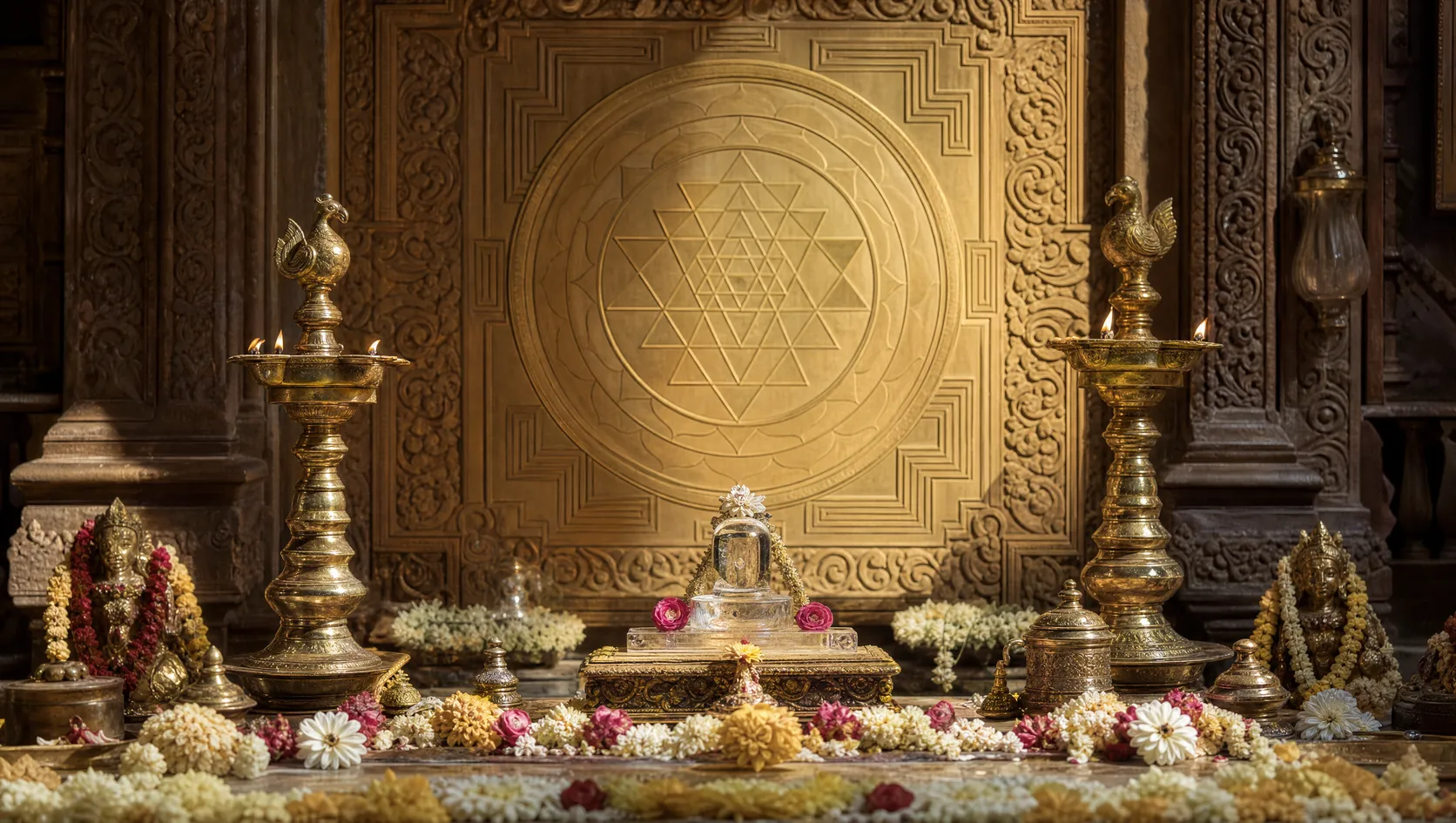
As a matha rather than a single temple, the sanctity of the Kanchi Kamakoti Peetham is carried in the institution, its acharyas, and the objects of its worship rather than in one presiding image. Central to its worship are the Sri Chakra, the geometric emblem of the goddess in the Sri Vidya tradition, and the Chandramauleeshwara, a crystal linga of Shiva carried and worshipped by the acharya, a form of worship the peetham keeps at the heart of its daily ritual.
The peetham's devotional centre of gravity, though, is the goddess Kamakshi of Kanchi, whose Kamakshi Amman temple stands close by. The tradition holds that Shankara installed the Sri Chakra before her to draw her overwhelming aspect into the benevolent form in which she is worshipped, and the bond between the peetham and the goddess is the living heart of its identity. Kamakshi is the eye of desire, the goddess who governs by her glance, and her worship through the ordered geometry of the Sri Chakra is the peetham's particular inheritance.
The controlling image, in the Advaita sense, remains the teaching held by the lineage; but at Kanchi that teaching is inseparable from the worship of the goddess, and the peetham holds the two together, the non-dual philosophy of Shankara and the esoteric worship of the divine feminine, as a single tradition. In the modern period the image of the Paramacharya himself, the Sage of Kanchi, has become an object of the deepest reverence, his photograph and his memory venerated across southern India.
Distinctive Practicesविशिष्ट परंपराएँ
Worship of the Chandramauleeshwara
चंद्रमौलीश्वर की उपासना
Daily, in the acharya's personal worship
At the heart of the peetham's daily ritual is the worship of the Chandramauleeshwara, a crystal linga of Shiva that the acharya worships personally, a practice held to descend from Shankara himself and kept unbroken through the lineage.
The crystal linga is worshipped as a form of Shiva kept in the acharya's own care, so that the highest ritual of the peetham is not a public spectacle but a personal daily worship carried on by the head of the lineage. That the same worship is held to have passed unbroken from Shankara makes each day's ritual a re-enactment of the founder's own, and ties the peetham's continuity to a daily act rather than to stone.
Sri Chakra and Sri Vidya Worship of Kamakshi
कामाक्षी की श्री चक्र और श्री विद्या उपासना
Continuous, in the peetham's bond with the goddess
The peetham holds the worship of the goddess Kamakshi through the Sri Chakra, the esoteric geometry of Sri Vidya, which the tradition credits Shankara with installing before her at Kanchi to fix her worship in its benevolent, ordered form.
Sri Vidya is the worship of the goddess as the ordering power of the whole cosmos, approached through the Sri Chakra, a diagram in which her creative and dissolving energies are held in a single figure. To install the Sri Chakra before a fierce goddess is, in the tradition, to give her power a form through which it can be approached with safety and love, turning overwhelming energy into grace. The peetham's keeping of this worship binds Shankara's non-dual philosophy to the most refined tradition of goddess worship in the south.
The Acharya's Audience and Blessing
आचार्य का दर्शन और आशीर्वाद
At set times, according to the peetham's schedule
The acharya of the peetham gives audience at set times, and devotees come in great numbers for his darshan and blessing. In the era of the Paramacharya this drew enormous crowds, and the audience remains central to the peetham's life.
The authority of the acharya rests on the lineage, and to take his darshan is to stand in the presence of that transmission. At Kanchi the reverence for the acharya reached, in the person of the Paramacharya, a height rare even among the heads of mathas, so that his darshan was sought as that of a living saint. The audience is treated with the gravity due to a link in a chain the tradition traces to Shankara himself.
Worship Alongside the Kamakshi Amman Temple
कामाक्षी अम्मन मंदिर के साथ उपासना
For pilgrims to Kanchipuram
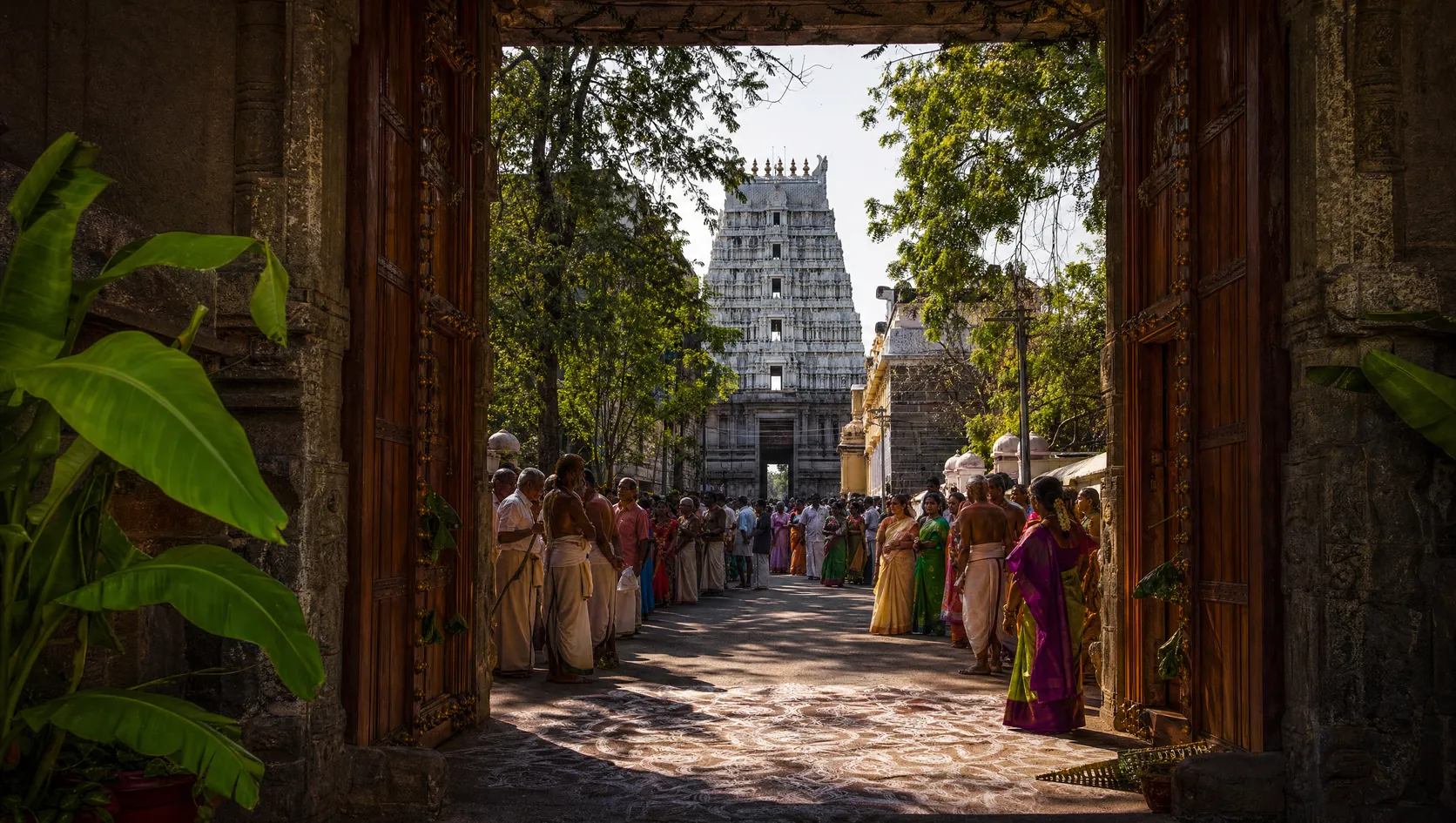
Pilgrims to Kanchipuram commonly visit the peetham alongside the Kamakshi Amman temple, so that the Shankara seat and the great temple of the goddess are taken together in a single visit, as the tradition binds them.
The peetham's identity is inseparable from the goddess Kamakshi, and to visit the seat without the temple, or the temple without the seat, is to take only half of what the tradition holds together. The pairing enacts the peetham's own claim: that Shankara's philosophy and the worship of the goddess of Kanchi are one inheritance, the non-dual absolute and the ordering power of the goddess approached as a single truth.
Did You Know?क्या आप जानते हैं?
The Kanchi Kamakoti Peetham is held by its own tradition to be a fifth and principal Shankara seat, the Sarvajna Pitha or Throne of Omniscience, at Kanchipuram, a claim the four cardinal mathas and many scholars do not accept.
Kanchi Kamakoti Peetham tradition; scholarly discussion of the Advaita mathas
The tradition holds that Shankara installed the Sri Chakra before the fierce goddess Kamakshi at Kanchi to draw her into benevolence, fixing her worship in the ordered form of Sri Vidya.
Tradition of the Kamakshi Amman temple and Sri Vidya
At the heart of the peetham's daily worship is the Chandramauleeshwara, a crystal linga of Shiva that the acharya worships personally, held to descend from Shankara himself.
Kanchi Kamakoti Peetham ritual tradition
Its twentieth-century acharya Chandrashekharendra Saraswati, the Paramacharya or Sage of Kanchi, was revered across sectarian lines as a living saint through a tenure of a hundred years.
Records and biographies of the Paramacharya
For a long period the peetham operated not from Kanchipuram but from Kumbakonam, further south, before returning to Kanchi, a documented turn in its history often cited in the scholarly debate.
Institutional records of the Kanchi peetham
The peetham claims an unbroken lineage of some seventy acharyas from Shankara himself, a continuity that is, like its foundation, part of what the four mathas contest.
Kanchi Kamakoti Peetham guru parampara
Kanchipuram, where the peetham stands, is one of the seven cities held to give liberation and a rare place sacred to Vishnu, Shiva and the goddess alike.
Puranic tradition of the seven mokshapuris
Visitor Accessप्रवेश जानकारी
The peetham is open to devotees, and traditional dress is expected as at a working religious institution. Footwear is removed at the shrines. Most visitors come to Kanchipuram for its many great temples, above all the Kamakshi Amman temple, and visit the peetham alongside them. The acharya's audience is held at set times and is not continuous through the day. Kanchipuram is a well-developed temple city, easily reached from Chennai, so facilities are good and the peetham is easily reached within the city. Timings and audience hours are set by the peetham and should be confirmed before travelling.
Combine the peetham with the Kamakshi Amman temple, to which its tradition binds it, and with the other great temples of Kanchipuram, the city of a thousand temples; all lie close within the city. Check the acharya's audience hours in advance if that is part of the reason for visiting. Dress traditionally and remove footwear at the shrines. Kanchipuram is easily reached from Chennai by road and rail and has ample facilities, so the visit is straightforward. Many pilgrims combine it with the Ekambareshwara, Varadaraja Perumal and Kailasanathar temples, taking in the Shaiva, Vaishnava and goddess shrines of the city together, in the spirit of a place sacred to all three.
Festivalsत्योहार
Shankara Jayanti
शंकर जयंती
Apr-May (Vaishakha Shukla Panchami)
The appearance day of Adi Shankaracharya, whom the peetham venerates as its first acharya, is observed with particular solemnity, with worship and discourses on Advaita. For the Kanchi seat this is the day on which its claimed origin in Shankara is at the centre.
Navaratri
नवरात्रि
Sep-Oct (Ashwin)
As a seat bound to the goddess Kamakshi and to Sri Vidya, the peetham observes Navaratri with particular richness, the nine nights of the goddess being central to a tradition whose devotional heart is the divine feminine and the Sri Chakra.
Guru Purnima
गुरु पूर्णिमा
Jun-Jul (Ashadha Purnima)
The day dedicated to the guru is of particular importance at a peetham whose authority rests on the guru-lineage, observed with worship of the acharya and of the tradition of teachers the peetham traces to Shankara.
Aradhana of the Paramacharya
परमाचार्य की आराधना
Varies (the acharya's memorial day)
The memorial observance of Chandrashekharendra Saraswati, the Paramacharya, draws great numbers in reverence for the Sage of Kanchi, and is among the most deeply felt observances of the peetham's modern life.
Traditional Offeringsपारंपरिक अर्पण
प्राथमिक अर्पण
Worship of Kamakshi through the Sri Chakra
श्री चक्र के माध्यम से कामाक्षी की उपासना
The peetham's central offering is the worship of the goddess Kamakshi through the Sri Chakra, the geometry of Sri Vidya, in the form the tradition credits Shankara with fixing at Kanchi. Devotees offer kumkum, flowers and the recitation of the goddess's names within this Sri Vidya frame.
Kumkum offered to the goddess
देवी को अर्पित कुमकुम
Kumkum, the red powder of the goddess, is the offering most proper to Kamakshi as to the goddess across the south, marking her as the married, auspicious and life-giving power. It is offered and received back as her prasada.
Reverence to the acharya
आचार्य को श्रद्धा
Devotees offer their reverence to the acharya of the peetham and seek his blessing, an act central to the life of a seat whose authority rests on its lineage of teachers, and one that in the era of the Paramacharya reached extraordinary depth.
Lamps and incense
दीप और धूप
Lamps and incense are offered in the peetham's daily worship, as at any shrine, marking the ritual rhythm of an institution whose life is one of study, worship and observance carried on continuously. The daily worship is not incidental to the teaching but its frame: the study of the Vedanta and the worship of the goddess are held within an ordered round of ritual, so that the philosophical, the devotional and the esoteric are kept together rather than separated.
इस मंदिर की विशेषता
The Offering of Learning and Devotion at a Shankara Seat of the Goddess
देवी के शंकर पीठ पर विद्या और भक्ति की भेंट
What is particular to the Kanchi peetham is that its highest offering joins two things the tradition holds as one: the study and transmission of Advaita, and the worship of the goddess through Sri Vidya. The proper offering here is attention to that double inheritance, the non-dual teaching Shankara is held to have brought and the ordered worship of Kamakshi he is held to have fixed. A devotee brings kumkum, flowers and lamps as at any shrine of the goddess, but the tradition holds that what the peetham most receives, and most gives, is the teaching and the worship together, handed through its lineage of acharyas. The offering and the blessing are the same: the recognition of the one Self, and the grace of the goddess, given as a single truth. In the modern era, reverence for the acharya, above all the Paramacharya, has become itself among the most heartfelt of offerings at Kanchi.
As a matha, the Kanchi peetham's worship centres on its shrines, the worship of the Sri Chakra and the Chandramauleeshwara, its bond with the Kamakshi temple, and the study and transmission of the teaching, rather than on elaborate individual offering rituals at the peetham itself. Devotees offer kumkum, flowers, lamps and their reverence, and seek the acharya's blessing at the appointed times. Those visiting principally for the Kamakshi Amman temple should note that its offering arrangements are separate from the peetham's. Eternal Raga presents the peetham's practices as a devotional and philosophical tradition, and notes the contested question of the seat's origin without adjudicating it.
How to Reachकैसे पहुँचें
The peetham stands in the temple city of Kanchipuram in northern Tamil Nadu, close to the Kamakshi Amman temple, and is reached as part of a visit to the city.
By air: Chennai International Airport is the nearest, roughly 75 km away, well connected to the rest of India and abroad, from which Kanchipuram is reached by road.
By rail: Kanchipuram has its own railway station, and the larger junction of Chengalpattu is nearby, both connected to Chennai and the wider network.
By road: Kanchipuram is well connected by road to Chennai, Chengalpattu and the towns of northern Tamil Nadu, served by frequent buses and taxis. Within the city the peetham is close to the Kamakshi Amman temple and easily reached on foot or by autorickshaw.
Most pilgrims come to Kanchipuram for its many temples and visit the peetham alongside the Kamakshi Amman temple, often taking in the Ekambareshwara, Varadaraja Perumal and Kailasanathar temples in the same trip.
Plan Your Visitयात्रा की योजना
🌤 सर्वोत्तम मौसम
October to March is the most comfortable period in Kanchipuram, with milder temperatures and lower humidity, the best time for a visit that takes in the peetham and the city's temples. Navaratri, in September or October, is a particularly rich time at a seat bound to the goddess, though also a busier one. April to June is hot in this part of Tamil Nadu, and the middle of the day is best avoided for temple visits in that season. The northeast monsoon, roughly October to December, brings rain to the region but the city remains accessible. Early morning and evening are the most atmospheric times to be in Kanchipuram, when the temples and the peetham are at their most active and the heat is least.
👘 पहनावे का नियम
Traditional and modest dress is expected at the peetham, as at a working religious institution. Men commonly wear a dhoti or trousers with a shirt; women a saree or salwar kameez. Footwear is removed at the shrines. The temples of Kanchipuram, above all the Kamakshi Amman temple, have their own conventions, so a visit that takes in both the peetham and the temples is best made in traditional dress throughout.
📱 फोन और फोटोग्राफी
Photography is restricted within the shrines, and phones should be silenced across the peetham premises. The acharya's audience and the personal worship of the Chandramauleeshwara are not photo opportunities, and recording should not be attempted without explicit permission. The Kamakshi Amman temple and the other temples of Kanchipuram have their own, generally strict, photography rules.
🏨 आवास
Kanchipuram is a well-developed temple city with a full range of accommodation, from guest houses and lodges to hotels, much of it geared to pilgrims visiting its many temples. Some is administered by trusts associated with the temples and the peetham. Demand rises around Navaratri and other festivals of the goddess, and around the peetham's major observances, when booking ahead is advisable. Its proximity to Chennai also makes a day visit feasible for those based in the city, though the temples and the peetham reward a longer stay.
Sacred Soundsपवित्र ध्वनि
क्या आप जानते हैं? · Did You Know?
वही अनुवाद त्रुटि जिसने हिन्दू धर्म में '33 कोटि' को '33 करोड़' बनाया, बौद्ध धर्म में भी हुई। बौद्ध ग्रन्थों के चीनी अनुवाद ने 'सप्त कोटि बुद्ध' (7 श्रेष्ठ बुद्ध) का अनुवाद '7 करोड़ बुद्ध' कर दिया। तिब्बती अनुवाद ने सही किया: 7 प्रकार, 7 करोड़ नहीं। एक संस्कृत शब्द, दो प्रमुख विश्व धर्मों में गलत पढ़ा गया, ने दो एकसमान भ्रम स्वतन्त्र रूप से उत्पन्न किए।
Related Contentसंबंधित सामग्री
Related Scriptures
Community Reflections
🕉️
Be the first to share your reflection.