Konark Sun Temple
कोणार्क सूर्य मंदिर
The chariot of the Sun God, frozen in stone
Konark, Odisha, India
Koṇārka Sūrya MandiraAlso known as: Konarka, Ark Kshetra, Black Pagoda, Surya Deul, Mitravana, Arka Tirtha

युग
13th century (c. 1238–1264 CE); Eastern Ganga dynasty
वास्तुकला
Kalinga (Odishan Nagara) — Rekha Deula and Pidha Deula forms; chariot (ratha) conception
खुला
06:00 – 20:00
विशेष
Magha Saptami (Jan–Feb): the rising sun illuminates the east-facing entrance for three consecutive dawns. Konark Dance Festival: December 1–5, classical dance in the open-air Natya Mandapa against the illuminated jagamohana.
पवित्र कथा · पवित्र कथा
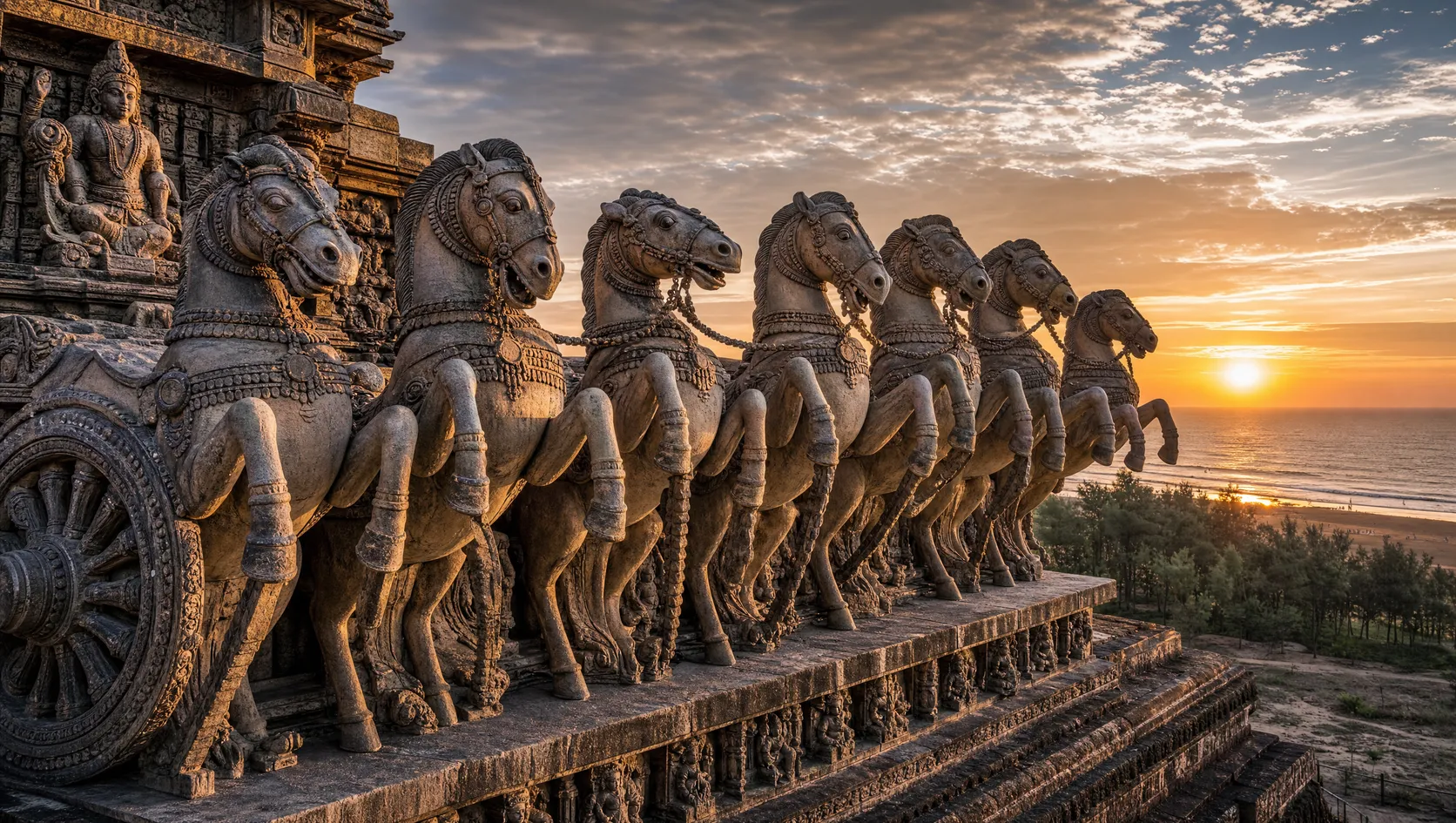
Imagine a chariot so vast it could only have been meant for a god — twenty-four stone wheels, each taller than a person, carved with such precision that their spokes still function as sundials eight centuries later; seven rearing horses frozen mid-gallop in the act of drawing the sun across the sky; every surface alive with sculpture of celestial musicians, erotic couples, warriors in procession, elephants in battle, and at the cardinal points three giant images of Surya, each positioned to catch the dawn light, the high noon sun, and the sinking evening fire. Konark was built in the thirteenth century by Narasimhadeva I of the Eastern Ganga dynasty as the cosmic vehicle of the Sun God himself, materialised in chlorite and khondalite on the Odisha coast. European sailors called it the Black Pagoda and steered by its silhouette from the Bay of Bengal. Today the main tower has collapsed, the inner sanctum sealed under Archaeological Survey of India protection, the jagamohana hall filled with sand to prevent its own ruin. But every January at Magha Saptami, the rising sun sends its first rays precisely through the eastern gateway and holds that alignment for three consecutive days — and the old arithmetic between this stone monument and the living star it was built to honour still holds.
Sacred Designationपवित्र पदनाम
Sacred Origin Storyपवित्र उत्पत्ति कथा
Source: Bhavishya Purana (Brahma Parva) and Samba Purana — widely attested in Odishan and pan-Indian traditions
Long before stone was laid at Konark, the site bore a name: Mitravana — the grove of Mitra, one of the twelve Ādityas of the Vedic solar tradition. It was to this grove, on the banks of the Chandrabhaga river where it meets the sea, that a young man came seeking an impossible cure.
Samba, the son of Krishna and the princess Jambavati, was beautiful and reckless. One day he was discovered in an improper situation — in some versions he had intruded, disguised as a woman, upon Krishna's wives at their bath — and Krishna, whose sight encompassed all things, was enraged. He cursed his own son with kushtha, the white consuming disease that disfigures the skin and devastates the spirit.
Samba, stricken with shame and lesions both, sought the counsel of Narada Muni. Narada pointed him unequivocally toward Surya — the Sun God, healer of diseases, the deity whose gaze burns away darkness and impurity alike. 'Go to Mitravana,' Narada told him. 'Bathe each dawn in the Chandrabhaga where it meets the sea. Stand in the sun's rays and worship Surya without cessation. Do this for twelve years.'
Samba came to this coast. For twelve years he stood at dawn, arms raised in Surya namaskara, reciting the Āditya Hridayam, allowing the first light of each day to fall directly on his diseased skin. At the end of the twelfth year, while performing his dawn ablution in the Chandrabhaga, he felt the disease lift from him like a weight removed — his skin was smooth and whole. Surya appeared before him in the river's golden light and pronounced his cure complete.
In gratitude, Samba built a temple at Mitravana and installed within it a sacred image of Surya that, according to the Samba Purana, he had received from the divine craftsmen — or that had emerged from the sacred waters of the Chandrabhaga itself. This original Samba-Surya shrine was venerated at the site for centuries. When Narasimhadeva I of the Eastern Ganga dynasty chose this ground in the thirteenth century to build his monumental temple, he was not creating a new sacred site; he was consecrating one that had been recognised since Samba's time as among the most potent places of Surya's grace on earth.
उद्धृत स्रोत:
- Bhavishya Purana, Brahma Parva — Samba narrative (Saptami section)
- Samba Purana (Upa-Purana dedicated to Samba and Surya worship)
- Skanda Purana, references to Arka Kshetra and Mitravana
विद्वत संदर्भ
The Samba legend belongs to a wider network of Surya shrines whose mythological founding narratives follow a consistent pattern: a protagonist afflicted with disease, directed to a solar tirtha, healed after sustained worship, and thereafter establishing the temple. Diana Eck ('India: A Sacred Geography', 2012) identifies this as characteristic of the solar pilgrimage tradition. Separately, historians have noted a possible political dimension to the 13th-century construction — Narasimhadeva I's documented military campaigns against Delhi Sultanate forces have led some scholars to propose that the temple celebrated these victories as much as it expressed devotion. The Dharakote inscription provides the primary epigraphic evidence for the reign and patronage but does not explicitly state a commemorative military purpose. The devotional and martial interpretations are not mutually exclusive.
Historyइतिहास
The recorded history of Konark begins in the thirteenth century, though the site's sanctity as Mitravana predates the existing structure by many centuries. The Madalapanji — the ancient chronicle maintained at the Jagannath temple in Puri — and the Dharakote stone inscription together establish that the Sun Temple was built by Narasimhadeva I (r. c. 1238–1264 CE), the most powerful king of the Eastern Ganga dynasty. The Eastern Gangas had been ardent temple-builders for generations; their earlier commission at Puri — the Jagannath Temple — had established their identity as patrons of monumental religious architecture. Konark was conceived on a different scale entirely.
The construction is one of the great organisational feats of medieval Indian architecture. Artisans transported and carved chlorite and khondalite from quarries more than thirty-five kilometres distant. The design was without precedent: the entire complex was conceived as the ratha, the sun's chariot, with a main tower (deul) estimated to have stood approximately seventy metres high before its collapse, a jagamohana (audience hall) that still stands at thirty-nine metres, a natamandira (dance hall), and a bhoga-mandapa (hall of offerings). Twenty-four intricately carved wheels, each approximately three metres in diameter, lined the plinth; seven rearing horses were positioned to pull the chariot eastward, toward the rising sun. Every surface was covered in sculpture executing three registers of imagery: celestial (the divine realm), natural (animals, foliage), and human (court scenes, erotic couples, warriors, musicians). The erotic sculptures — which have attracted the most commentary from later observers — are understood by scholars as representing the full spectrum of human experience that Surya witnesses in his daily passage across the sky.
Three Surya images, each approximately 2.5 metres tall, were positioned on the north, south, and west projections of the main tower to receive the morning, noon, and evening sun respectively. Carved from green chlorite, they show Surya in the northern fashion: wearing knee-high boots (a marker of the Maga priestly community, likely of Central Asian origin), holding lotuses, flanked by his attendants Danda and Pingala.
The collapse of the main deul is one of Konark's great unresolved questions. European travelers from the sixteenth and seventeenth centuries describe the structure in varying states of completeness, making the timeline of failure difficult to establish. By the time British surveys were conducted in the eighteenth and early nineteenth centuries, only the jagamohana was standing. The popular folk account — that a lodestone at the apex was removed by a Portuguese sailor, destabilising the tower — is not supported by archaeological evidence; ASI investigations point to structural failure over centuries from the deul's immense weight relative to its coastal sandy foundation, possibly compounded by subsidence and periodic flooding.
The colonial period brought systematic documentation. R.L. Mitra's 'Antiquities of Orissa' (1875) was the first rigorous scholarly assessment. ASI under John Marshall undertook emergency consolidation in 1901, including the decisive intervention of filling the jagamohana entirely with sand to prevent its imminent collapse — a measure that preserved the structure but sealed its interior permanently.
Konark was inscribed on the UNESCO World Heritage List in 1984, recognised as an outstanding achievement of the Kalinga school of temple architecture and as an expression of the cosmological vision that placed the sun at the centre of religious and temporal order. Today the site is administered by the Archaeological Survey of India, Bhubaneswar Circle.
Historical Timelineऐतिहासिक कालक्रम
Construction of the Sun Temple at Konark commissioned by Narasimhadeva I of the Eastern Ganga dynasty. The Dharakote stone inscription and the Madalapanji chronicle place the construction firmly within his reign. Conceived as a colossal chariot of Surya with a main tower (deul) estimated at approximately 70 metres, the complex employed thousands of artisans over an estimated decade.
Gradual collapse of the main deul (tower). The precise timeline remains one of the most debated questions in Konark scholarship. European navigational charts and travelers' accounts from the 17th–18th centuries show only the jagamohana standing; by this point the deul was either fully collapsed or reduced to a structural stump.
The cause of the collapse is actively debated. The widely-circulated folk account — that a lodestone or magnetic iron mechanism at the apex was removed by a Portuguese sailor, destabilising the structure — has no archaeological support. ASI investigations favour structural failure over centuries: the deul's massive weight relative to its coastal sandy foundation, possibly compounded by subsidence, seismic activity, and the corrosive effect of sea air on the mortar. The exact date of the collapse remains unresolved in the historical and archaeological record.
R.L. Mitra publishes 'Antiquities of Orissa' (Vol. II), providing the first systematic scholarly assessment of Konark's architecture, iconography, and preservation state. This marks the opening of sustained modern academic engagement with the site.
ASI under John Marshall undertakes emergency consolidation. The jagamohana — the principal surviving standing structure — is filled entirely with sand to arrest its imminent structural collapse. The intervention preserves the hall but permanently seals its interior, including whatever survives of the original sanctum's contents.
Marshall's decision to fill the jagamohana with sand remains controversial among conservation architects. It successfully prevented the hall's collapse — the jagamohana still stands — but rendered interior archaeological investigation impossible without dismantling the consolidation. ASI has not reversed this intervention.
Konark Sun Temple inscribed on the UNESCO World Heritage List. The site is recognised for 'outstanding universal value' as an exemplar of the Kalinga school of temple architecture and one of the greatest artistic achievements of medieval India.
What You'll Seeदर्शन में
The inner sanctum of the Konark Sun Temple is no longer accessible for darshan — it was sealed by the Archaeological Survey of India during the 1901 consolidation, and the original main sanctum image was long removed. What the visitor encounters at Konark is instead an unusually public and encyclopaedic iconographic programme spread across the entire exterior surface — a theology of Surya legible to all, requiring no inner access.
Three large chlorite-stone images of Surya, each approximately 2.5 metres tall, occupy the north, south, and west projections of what was once the main tower, positioned to receive the light of dawn, noon, and dusk respectively. Each follows the canonical northern form of Surya: the god stands erect, wearing knee-high boots — a distinctive marker linking him to the Maga priests, a community of likely Central Asian origin who served Surya temples and brought their own solar liturgical practices into the Indian tradition. He holds red lotuses in both hands, is flanked by his attendants Danda and Pingala who carry fly-whisks, and is surmounted by the prabhamandala (halo of radiance).
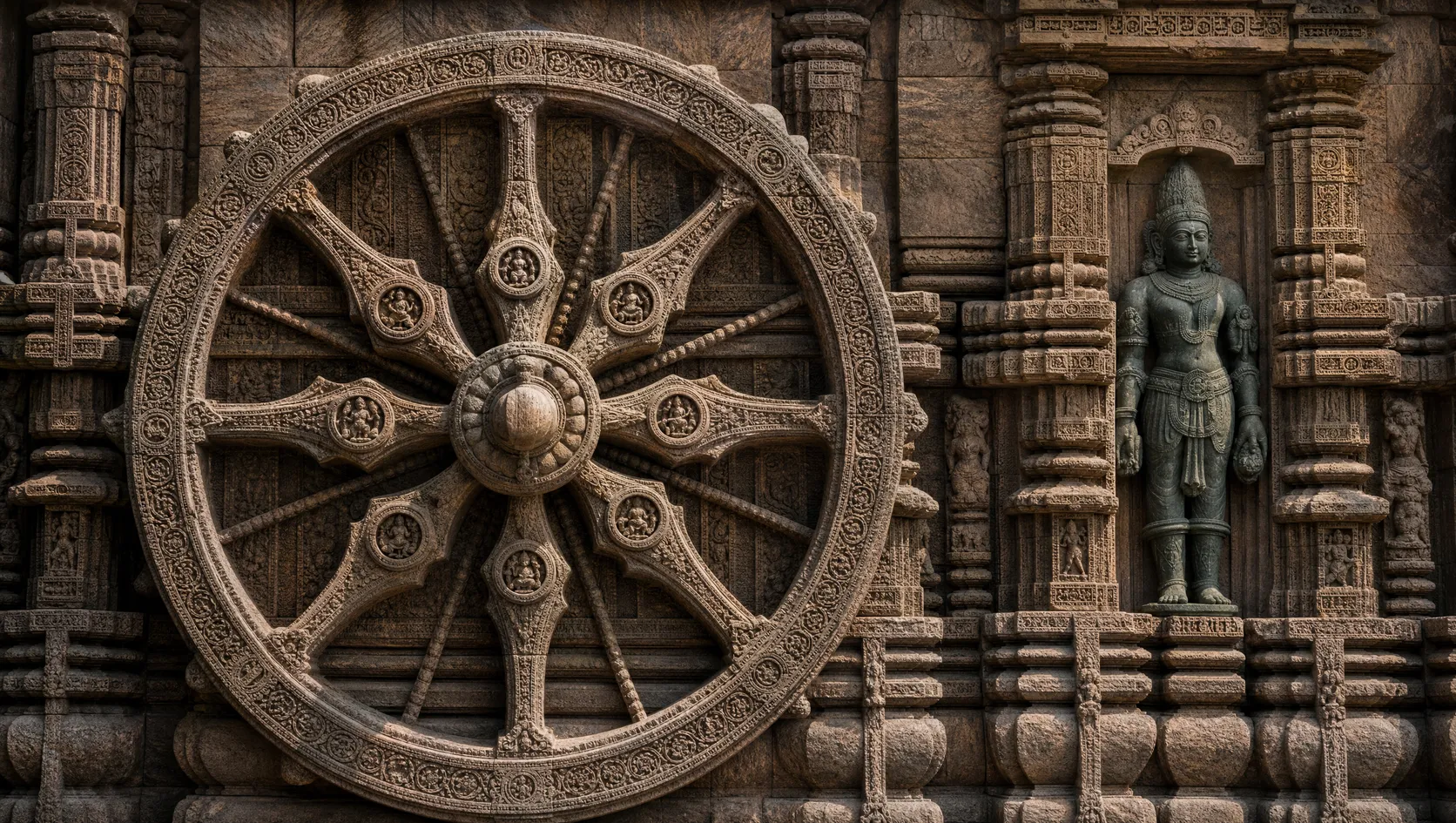
The twenty-four chariot wheels are themselves objects of the highest iconographic order. Each is approximately three metres in diameter, divided into eight major and eight minor spokes — sixteen in all, representing the active hours of day and the resting hours of night. The spokes are so precisely inclined at mathematically calibrated angles that the shadow cast by any spoke at any hour tells the correct time, functioning as fully operational sundials. The hub of each wheel is carved with a lotus; the rim is decorated with eight medallions showing figures in occupation, ritual, and devotion.
The three-register sculptural programme of the exterior khondalite walls presents the universe as witnessed by the all-seeing sun. The lowest register is occupied by elephants — symbol of stability and earth — and horses symbolising time and speed. The middle register is the human realm: court life, hunting, warfare, erotic couples in mithuna, gandharvas and apsaras, musicians. The upper register is the divine: gods, nagas, kinnaras, celestial attendants. The erotic mithuna sculptures of the middle register have attracted the most commentary from later periods; scholars interpret them variously as initiation imagery for the householder stage of life, as protective iconography whose energy guards the sacred precinct, and as the complete representation of human experience that falls under Surya's impartial and encompassing gaze.
The original Surya image from the main sanctum — along with several key sculptures — is now preserved in the Odisha State Museum in Bhubaneswar and the Indian Museum in Kolkata.
Distinctive Practicesविशिष्ट परंपराएँ
Magha Saptami Sunrise Alignment
माघ सप्तमी सूर्योदय संरेखण
Annual, Magha Shukla Saptami (January–February); three consecutive dawns
On Magha Saptami — the seventh day of the bright fortnight in the month of Magha, typically falling in late January or early February — the rising sun's rays enter the eastern gateway of the jagamohana at precisely the angle needed to illuminate what was once the sanctum's inner precincts. This alignment holds for three consecutive dawns. Simultaneously, tens of thousands of pilgrims gather at the Chandrabhaga beach — the river mouth a few kilometres from the temple — for ritual bathing at sunrise. This bathing festival, called the Chandrabhaga Mela, is the largest gathering of the year at Konark.
Surya's movement through the year is not merely astronomical — in the solar tradition it is the movement of divine consciousness through time. Magha Saptami marks the point in the solar calendar when Uttarayana is fully established and the sun's strength is gaining. To bathe in the Chandrabhaga at dawn on this day, in the direct sight of the rising sun, is held to confer the same spiritual fruit as bathing in all the sacred rivers simultaneously — a teaching recorded in the Bhavishya Purana's account of this site. The temple's alignment was not accidental: it was theological precision, ensuring that at the most sacred solar moment of the annual calendar, the temple and the star were in perfect correspondence.
Konark Dance Festival
कोणार्क नृत्य महोत्सव
Annual, December 1–5
Each December, for five evenings, the open-air Natya Mandapa adjacent to the Konark complex — with the illuminated jagamohana as backdrop — hosts one of India's premier classical dance events. Odissi, Bharatanatyam, Kathak, Kuchipudi, Manipuri, and Mohiniattam practitioners perform on a stage framed by the ancient stone. Organised by the Odisha Tourism Development Corporation, the festival has been held since the 1980s.
The Odishan temple tradition accorded great prominence to the natamandira — the dance hall — as a space of divine offering (seva). Classical dance performed in the deity's presence was not entertainment but transmission: what the dancer enacts, the god receives. The Konark Dance Festival continues this logic in contemporary form: classical artists offering their art to Surya in the setting his temple was built to provide.
Did You Know?क्या आप जानते हैं?
The twenty-four chariot wheels of Konark function as precision sundials. Each wheel's spokes are inclined at mathematically calibrated angles so that the shadow of any spoke at any hour of the day indicates the correct time. Horological experts and engineers who have studied the wheels confirm their accuracy to within a few minutes — an extraordinary feat of astronomical engineering embedded in religious architecture.
Archaeological Survey of India technical studies; Thomas Donaldson, 'Hindu Temple Art of Orissa', Vol. I (1985)
European sailors named the temple the 'Black Pagoda' to distinguish it from the 'White Pagoda' — the whitewashed Jagannath temple at Puri, 35 km away — and used both structures as navigational landmarks when approaching the Odisha coast from the Bay of Bengal. The name appears on European navigational charts from at least the seventeenth century.
European navigational charts (17th–18th century); R.L. Mitra, 'Antiquities of Orissa', Vol. II (1875)
The three Surya images at Konark wear knee-high boots — an iconographic feature unique to Surya across the entire Hindu pantheon. The boots are a marker of the Maga priests, a community of likely Central Asian or Persian origin who traditionally served Surya temples in the Indian northwest and later spread east. Their presence in the iconography at Konark documents the Maga tradition's reach into the Eastern Ganga kingdom.
Thomas Donaldson, 'Hindu Temple Art of Orissa', Vol. I (1985); R.L. Mitra, 'Antiquities of Orissa' (1875)
The main deul (tower) of the Konark temple, estimated to have stood approximately 70 metres high, would have been among the tallest structures in the medieval world at the time of its construction in the 13th century. The jagamohana, still standing, rises 39 metres and remains one of the great examples of pyramidal Odishan architecture.
ASI technical surveys; Thomas Donaldson, 'Hindu Temple Art of Orissa', Vol. I (1985)
The entire Konark complex encodes a calendar in stone. The seven horses represent the seven days of the week. The twenty-four wheels represent the twenty-four hours of the day — or in an alternate tradition, the twelve months counted twice, once for the waxing and once for the waning lunar fortnight. The temple is an astronomical instrument as much as a place of worship.
Bhavishya Purana, Brahma Parva; Thomas Donaldson, 'Hindu Temple Art of Orissa'; ASI interpretive documentation
The original Surya image from the Konark sanctum is now housed in the Odisha State Museum in Bhubaneswar. The sanctum was sealed with sand in 1901 (an ASI emergency measure to prevent the jagamohana's collapse), and the image had been removed before that. No deity is actively worshipped within the main Konark complex today.
Odisha State Museum catalogue; ASI site documentation
The Chandrabhaga river, at whose coast Samba worshipped Surya for twelve years in the founding legend, flows near Konark and meets the sea at a point a few kilometres from the temple. The river's name means 'half-moon shaped,' describing its curved course at the coast. Its mouth is the site of the Chandrabhaga Mela bathing festival on Magha Saptami each year.
Samba Purana; local geographic tradition; Bhavishya Purana, Brahma Parva
Visitor Accessप्रवेश जानकारी
Konark Sun Temple is an ASI protected monument and UNESCO World Heritage Site — not an active place of worship with daily puja. The jagamohana interior is physically inaccessible, having been filled with sand in 1901. There are no restrictions based on faith, gender, or caste — the complex is open to all visitors. Footwear must be removed before entering the main monument area (standard ASI rule). Professional photography and tripod use require advance written ASI permission.
समकालीन संदर्भ
The monument is administered under the Ancient Monuments and Archaeological Sites and Remains Act (AMASR Act). Commercial activity, new construction, and certain forms of worship within the protected zone require ASI permissions. Puja conducted inside an ASI-protected monument requires specific prior approval.
व्यावहारिक मार्गदर्शन
Purchase ASI entry tickets at the main gate (Indian nationals and international visitors have different rates — verify current fees at asi.nic.in before visiting). Allow 2–3 hours minimum for a complete visit. Guided tours available at the site. Sound and Light Show timings vary seasonally — check with OTDC or ASI Bhubaneswar for current schedule.
Festivalsत्योहार
Magha Saptami (Chandrabhaga Mela)
माघ सप्तमी (चंद्रभागा मेला)
Jan–Feb (Magha Shukla Saptami)
The most sacred day in Konark's devotional calendar. Tens of thousands of pilgrims gather at the Chandrabhaga beach for ritual bathing at sunrise. The occasion fuses two sacred dimensions: a solar festival at the height of Uttarayana, and the site of Samba's twelve-year cure. The temple's eastern gateway aligns with the rising sun for three consecutive days, reactivating its ancient astronomical purpose.
Konark Dance Festival
कोणार्क नृत्य महोत्सव
December (1–5)
Five evenings of classical Indian dance — Odissi, Bharatanatyam, Kathak, Kuchipudi, Manipuri, Mohiniattam — performed in the open-air Natya Mandapa against the backdrop of the illuminated jagamohana. One of eastern India's most distinguished arts events, organised by the Odisha Tourism Development Corporation. The festival revives the original purpose of Konark's own natamandira, which was built as a space for sacred dance performance.
Kartika Purnima
कार्तिक पूर्णिमा
Oct–Nov (Kartika full moon)
One of the holiest bathing occasions in the Odishan tradition. Pilgrims bathe at the Chandrabhaga beach near Konark on this full moon night, completing the kartika snana (month-long sacred bath series). The Chandrabhaga beach is among the primary sites in Odisha for this observance.
Traditional Offeringsपारंपरिक अर्पण
प्राथमिक अर्पण
Arghya (water offering in a copper vessel)
अर्घ्य
अर्घ्य
The pre-eminent offering to Surya, performed at sunrise, noon, and sunset — the three daily sandhyas. The devotee stands facing the sun and pours water from a copper vessel (tamba patra) through the fingers so the stream catches and refracts the light. The act of offering the sun's own element — light refracting through water — back to its source is the essential gesture of the Surya tradition. The Rig Veda identifies this correspondence between human practice and cosmic order as fundamental to solar worship. The Bhavishya Purana, which specifically addresses this site, prescribes arghya at the Chandrabhaga at dawn as the defining act of pilgrimage here.
Arka flowers (Calotropis gigantea, crown flower / madar)
अर्क पुष्प (आक / मदार)
अर्क
The most specific floral offering associated with Surya. The arka plant (Calotropis gigantea — the crown flower, also called madar or aak) shares its name with one of Surya's own epithets: 'arka' means 'sun' in Sanskrit. Its pale white or lavender flowers are offered directly to the solar deity. The Skanda Purana and Bhavishya Purana both reference arka flowers in prescriptions for Surya worship, and the Samba Purana specifically mentions their use at solar tirthas of the Chandrabhaga coast.
Red lotus (Rakta Kamala)
रक्त कमल
रक्त कमल
The lotus is Surya's primary iconographic attribute — as visible at Konark, where both the dawn and noon Surya images hold lotuses in each hand. The lotus opens at sunrise and closes at sunset, mirroring the sun's own rhythm; offering a lotus to Surya is offering him the flower that enacts his daily cycle. The red lotus specifically belongs to Surya's colour palette: red is the colour of the rising sun, of radiant solar fire, of the active solar principle. Red lotuses are prescribed for Surya worship in the Surya Purana and Bhavishya Purana.
Red sandalwood paste (Rakta Chandana)
रक्त चंदन
रक्त चन्दन
Red sandalwood paste is applied to the Surya image in the same devotional gesture as the teeka applied to a devotee's forehead — the cool, fragrant paste offered to the hot solar principle. The redness of rakta chandana resonates with Surya's solar nature and distinguishes the offering from white or yellow sandalwood paste, which is associated with the cooler lunar (Soma) tradition and Vishnu. Red sandalwood is among the standard items listed in the Bhavishya Purana's prescriptions for Surya puja.
Wheat and jaggery (Godhuma and Guda)
गेहूँ और गुड़
गोधूम और गुड
Wheat (godhuma) is the grain of Surya in the Vedic tradition — it ripens under the sun's direct power and was offered in Vedic fire sacrifices (homa) as a solar oblation. Jaggery (guda), the raw sweetness extracted from sugarcane by heat and sun, completes the offering. These two together form the basic naivedya (food offering) at Surya temples and are prescribed in the Bhavishya Purana's account of solar worship at Arka Kshetra.
Konark Sun Temple is an ASI-protected monument and not an active place of worship with a functioning daily puja. The traditional Surya offerings described here are drawn from the scriptural and ritual tradition of solar worship in India and are provided for devotional understanding; they are not administered within the Konark complex on a daily basis. Devotees who wish to perform Surya puja in association with a Konark pilgrimage may do so at the Chandrabhaga beach (sunrise arghya), which functions as the primary site of active devotional practice in the Konark sacred geography.
How to Reachकैसे पहुँचें
Konark lies 35 km northeast of Puri and 65 km southeast of Bhubaneswar. There is no railway station at Konark — the nearest rail heads are Puri Junction (35 km south) and Bhubaneswar (65 km northwest). From Puri, OSRTC (Odisha State Road Transport) buses run frequently to Konark throughout the day; journey time approximately 45–60 minutes. Private taxis and autos are readily available from Puri's hotel belt. Many pilgrims combine morning Jagannath darshan at Puri with an afternoon at Konark.
From Bhubaneswar, buses run from the main terminal to Konark via the coastal highway (approximately 90 minutes). Taxis are widely available from Bhubaneswar hotels. The Bhubaneswar–Puri–Konark day circuit is well-established.
By air: Biju Patnaik International Airport (BBI) at Bhubaneswar is the gateway, with connections from Delhi, Mumbai, Kolkata, Chennai, Bengaluru, and Hyderabad. Taxi to Konark from the airport takes 1.5–2 hours.
OTDC (Odisha Tourism Development Corporation) operates day-tour packages from both Bhubaneswar and Puri including Konark, which is the most convenient option for first-time visitors. The Puri–Konark Marine Drive is a scenic coastal route that adds little distance.
Plan Your Visitयात्रा की योजना
🌤 सर्वोत्तम मौसम
October to February is ideal — temperatures range 15–28°C, post-monsoon clarity enhances the visibility of Konark's sculptural detail, and the major festivals (Magha Saptami in Jan–Feb, Konark Dance Festival in December) fall within this window. March to May brings increasing heat with temperatures rising above 35°C. June to September is the monsoon season; the site remains open but humidity and occasional cyclonic activity on the Bay of Bengal coast affect the experience.
👘 पहनावे का नियम
No religious dress code (ASI monument). Modest, comfortable clothing suitable for walking an outdoor complex is recommended. Footwear must be removed before entering the main monument area — carry easily removable shoes. Sun protection (hat, sunscreen, water) is strongly advised; much of the complex is in open sun with minimal shade.
📱 फोन और फोटोग्राफी
Photography permitted throughout the complex. Tripods and professional or commercial photography equipment require prior written ASI permission from the Bhubaneswar Circle office. No flash restrictions for exterior sculpture. The jagamohana interior is physically inaccessible and therefore cannot be photographed.
🏨 आवास
Most visitors stay in Puri (35 km) and day-trip to Konark. At Konark itself, the OTDC Yatri Niwas (approximately 3 km from the temple) provides budget to mid-range rooms; a few private guesthouses are available near the bazaar. Puri offers extensive accommodation across all price points — dharamshalas, budget lodges, and mid-range hotels along the Marine Drive. Bhubaneswar (65 km) has the widest range, including international-brand hotels.
Sacred Soundsपवित्र ध्वनि
क्या आप जानते हैं? · Did You Know?
वही अनुवाद त्रुटि जिसने हिन्दू धर्म में '33 कोटि' को '33 करोड़' बनाया, बौद्ध धर्म में भी हुई। बौद्ध ग्रन्थों के चीनी अनुवाद ने 'सप्त कोटि बुद्ध' (7 श्रेष्ठ बुद्ध) का अनुवाद '7 करोड़ बुद्ध' कर दिया। तिब्बती अनुवाद ने सही किया: 7 प्रकार, 7 करोड़ नहीं। एक संस्कृत शब्द, दो प्रमुख विश्व धर्मों में गलत पढ़ा गया, ने दो एकसमान भ्रम स्वतन्त्र रूप से उत्पन्न किए।
Related Contentसंबंधित सामग्री
Related Scriptures
Community Reflections
🕉️
Be the first to share your reflection.