Suryanar Kovil (Sun)
सूर्यनार कोविल
The one Navagraha temple where the Sun is not a side shrine
Suryanar Kovil, Tamil Nadu, India
Sūryanār KōvilAlso known as: Sri Suryanar Temple, Sivasurya Perumal Temple, Kolar Suryanar Kovil
युग
Attributed to Kulothunga Chola I, with construction placed in the late eleventh to early twelfth century; later additions and renovations across subsequent periods
वास्तुकला
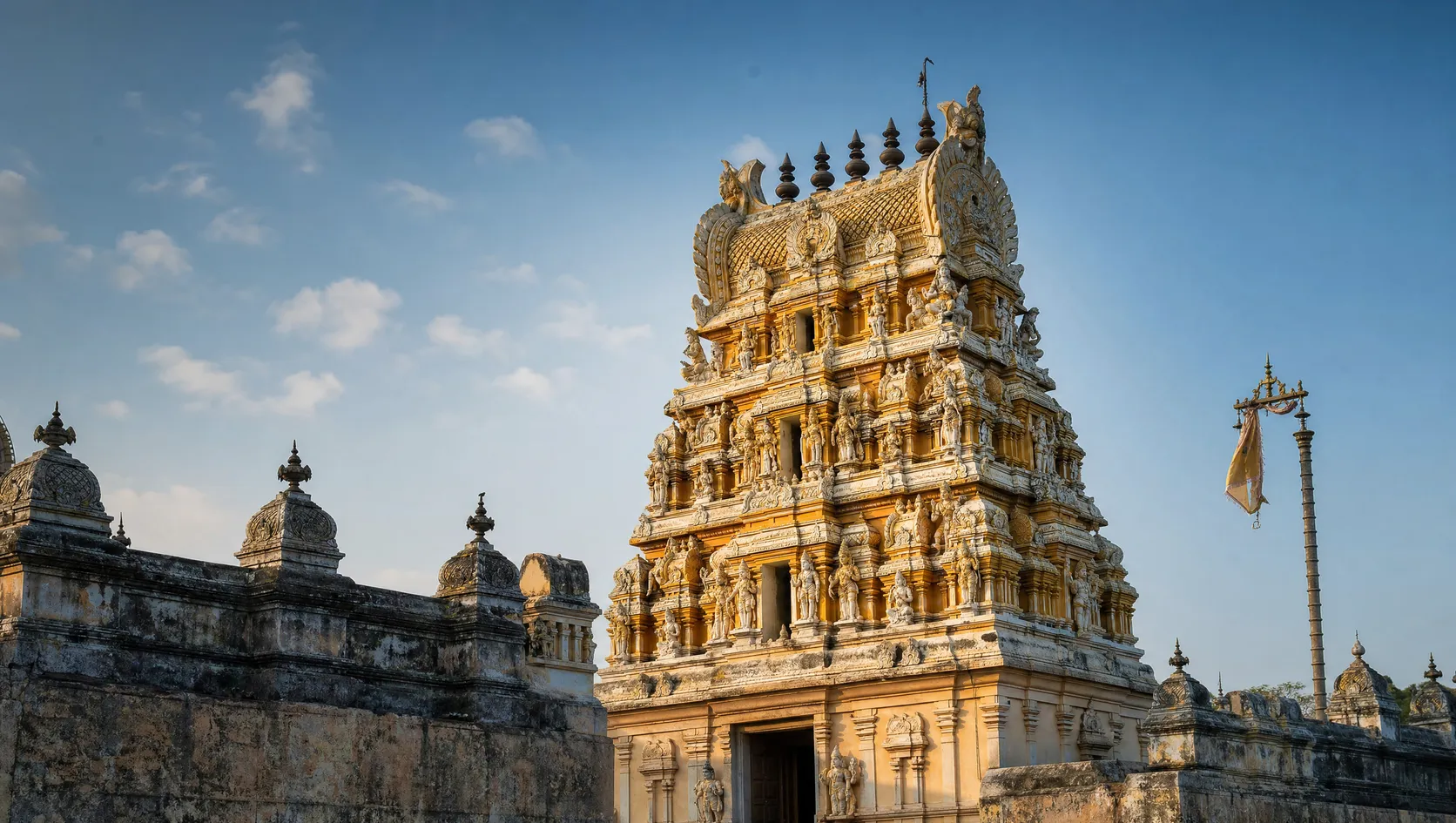
Chola, with a gopuram over the entrance and separate shrines for each of the nine grahas within the enclosure
विशेष
Worship here follows a prescribed sequence beginning at the Guru shrine, then Surya, then the remaining grahas. Sundays and Ratha Saptami draw the largest gatherings.
पवित्र कथा · पवित्र कथा
In almost every South Indian temple, the Navagrahas sit in a corner. Nine small figures on a raised platform, worshipped in a quick circuit on the way to the main shrine, arranged so no planet directly faces another. At Suryanar Kovil that arrangement is dissolved. Surya is the presiding deity with his own sanctum, and each of the other eight planets has a shrine of its own rather than a slot on a platform. The subsidiary cast becomes the entire company. And one detail inverts the usual order completely. Guru, Brihaspati, faces Surya directly, which the grammar of Navagraha placement normally forbids. Devotees here approach Guru first and Surya after. In the one temple built to give the Sun a sanctum of his own, the tradition still asks you to greet the teacher before the king.
Sacred Designationपवित्र पदनाम
Navagraha
ग्रह:
Sacred Origin Storyपवित्र उत्पत्ति कथा
Source: The Kalava Rishi account preserved in the temple's sthala purana and the Navagraha circuit tradition of the Cauvery delta
The sage Kalava was a devotee of long standing, and his sons with him. The account holds that the Navagrahas, displeased with the family for reasons the tradition does not dwell on, afflicted them with leprosy.
What the sons did next is the point of the story. They did not appeal to Shiva or to Vishnu to overrule the planets, which would have been the obvious recourse and would have made this a story about a higher power correcting a lower one. They worshipped the planets themselves. They addressed the nine who had afflicted them, directly, and asked for relief from the same hands that had inflicted it.
The Navagrahas were satisfied and lifted the affliction.
But in cursing a sage's family they had exceeded what was theirs to do, and Brahma is said to have been displeased in turn. He ordained that the nine should leave their usual stations and reside in this place in the form in which they are worshipped here, granting boons to those who come to them.
So the temple exists because the planets were punished. The nine are here not as a favour to devotees but as a consequence of their own overreach, and the boons they grant are, in the logic of the story, a sentence being served.
उद्धृत स्रोत:
- Temple sthala purana (Kalava Rishi account)
- Navagraha circuit tradition of the Cauvery delta
- Regional Tamil devotional literature on the graha temples
विद्वत संदर्भ
The Navagraha circuit of the Cauvery delta is a distinctively Tamil development and is not attested in this organised form outside the region. Elsewhere the nine planets are worshipped as a group in a corner of a larger temple; here they are distributed across nine separate temples within a manageable radius, each associated with one graha, and pilgrims travel between them to address specific afflictions identified in a horoscope. Suryanar Kovil's position within that circuit is anomalous in a way scholars have noted: it alone gives its graha a full sanctum as presiding deity, and it alone gathers shrines for all nine within a single enclosure. Its Chola foundation, attributed to Kulothunga Chola I, means it was conceived around the Navagrahas from the outset rather than acquiring planetary worship later, which distinguishes it from temples where graha shrines were added to an existing structure. Documentation for the temple specifically is thinner than for the great Chola foundations of the same delta, and much of what is known comes from the circuit tradition and from regional devotional literature rather than from an extensive inscriptional record.
Historyइतिहास
Suryanar Kovil is a Chola foundation, attributed to Kulothunga Chola I and placed in the late eleventh to early twelfth century. That dating matters for how the temple should be read: it is not an ancient site that gradually accumulated planetary shrines, but a temple conceived and built with the Navagrahas as its subject. The distinction is unusual. Most graha worship in South India is an addition to something older.
The Cauvery delta around Kumbakonam holds the Navagraha circuit, in which nine separate temples are each associated with one of the nine planets: Suryanar Kovil for the Sun, Thingalur for the Moon, Vaitheeswaran Koil for Mars, Thiruvenkadu for Mercury, Alangudi for Jupiter, Kanjanur for Venus, Thirunallar for Saturn, Thirunageswaram for Rahu and Keezhaperumpallam for Ketu. Devotees travel the circuit to address specific planetary afflictions identified in a horoscope, and the temples are close enough together to be covered in a day or two by road.
Within that circuit, this temple is the anomaly. It alone gives its graha a full sanctum as presiding deity, and it alone gathers shrines for all nine within a single enclosure. So it functions both as one station on the circuit and as a compressed version of the whole thing, which is why devotees who cannot complete the nine-temple journey often come here instead.
The temple received patronage across the periods that followed, under the Nayakas and later the Marathas of Thanjavur, and it has been renovated and reconsecrated at intervals as Tamil temples generally are. Colonial-era gazetteers record it as part of the delta's temple landscape. In the modern period it comes under the Tamil Nadu Hindu Religious and Charitable Endowments Department, and it remains an active centre of the astrological worship for which the region is known, drawing those seeking remedy for graha dosha.
Historical Timelineऐतिहासिक कालक्रम
The temple is built under Kulothunga Chola I, conceived from the outset around the Navagrahas rather than acquiring planetary shrines later. This makes it unusual among South Indian temples, where graha worship is typically an addition to an older foundation.
Documentation for this temple is thinner than for the great Chola foundations of the same delta; the attribution rests on temple and regional tradition more than on an extensive inscriptional record.
The distinctive arrangement is established: Surya as presiding deity with a full sanctum, separate shrines for the remaining eight grahas within the enclosure, and the Guru shrine facing the main sanctum directly.
The Guru-facing-Surya arrangement contradicts standard Navagraha placement convention and appears to be deliberate rather than incidental.
The Navagraha circuit of the Cauvery delta takes shape, distributing the nine planets across nine separate temples in the Kumbakonam region, with Suryanar Kovil as its Sun temple.
The organised nine-temple circuit is distinctively Tamil and is not attested in this form outside the region.
Endowments to the temple continue under later Chola and successor rule, and the practice of visiting the circuit for graha remedies becomes established regional custom.
Nayaka-period patronage supports additions and repairs, as across the Thanjavur delta's temple landscape during this period.
Under the Marathas of Thanjavur the temple continues to receive support, and the astrological practice associated with the circuit is sustained through the change of regional power.
Colonial-era gazetteers and surveys record the temple as part of the delta's religious landscape, providing some of the earliest external documentation of the Navagraha circuit as an organised pilgrimage.
Administration passes to the Tamil Nadu Hindu Religious and Charitable Endowments Department, and periodic renovation and kumbhabhishekam are carried out as at Tamil temples generally.
Improved road transport makes the full nine-temple circuit practical to complete in a day or two, and the Navagraha pilgrimage grows into an organised form of religious tourism served by dedicated tours from Kumbakonam.
The circuit's modern popularity has increased visitor numbers considerably at temples that were previously local in their draw.
What You'll Seeदर्शन में
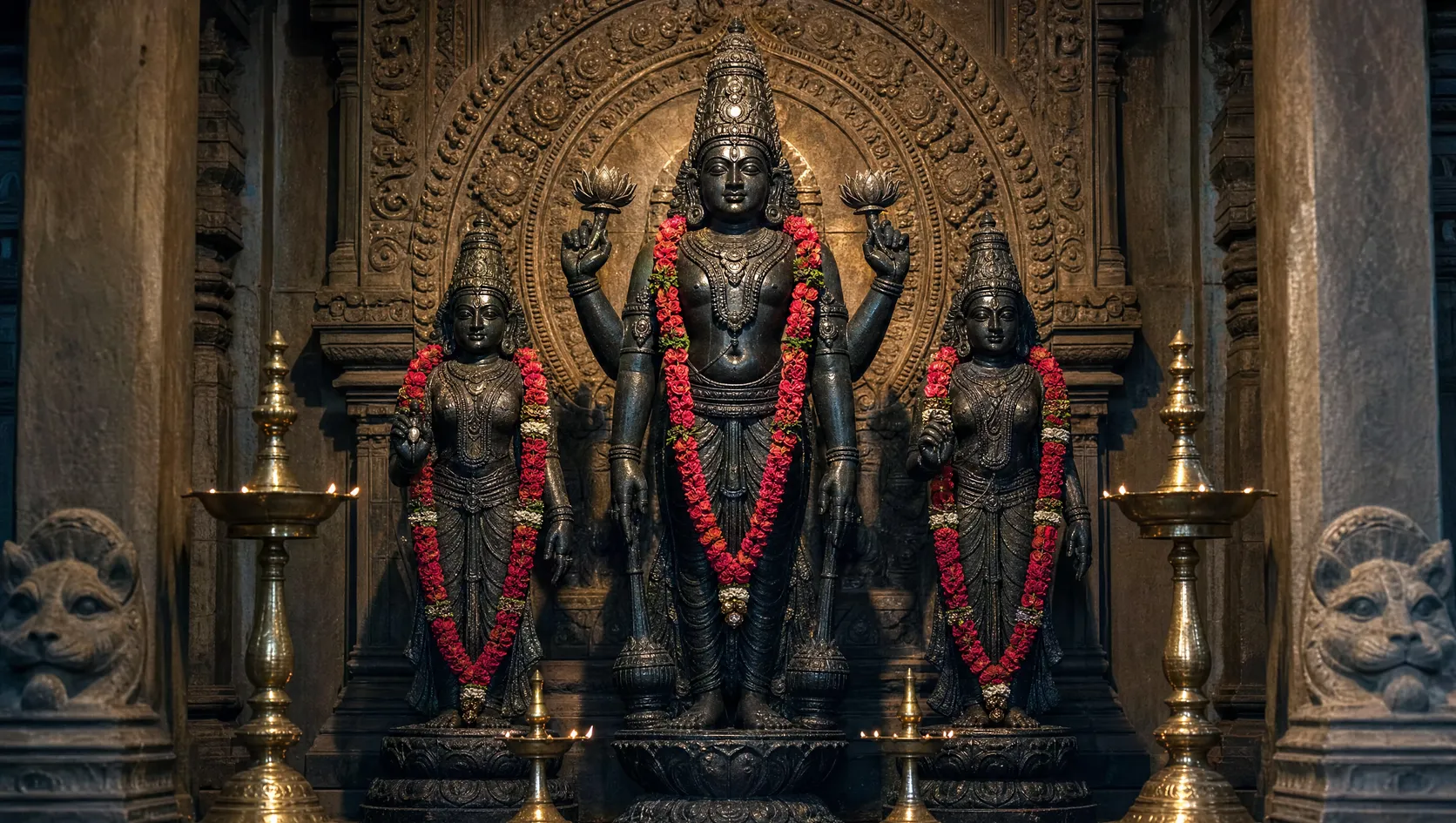
Surya stands in the sanctum, accompanied by his consorts Ushadevi and Pratyusha Devi, whose names mean dawn and the light that precedes dawn. He is depicted in the standing posture with lotuses in his hands, and he is addressed here as Sivasurya Perumal, a name that carries both Shaiva and Vaishnava registers rather than settling into either.
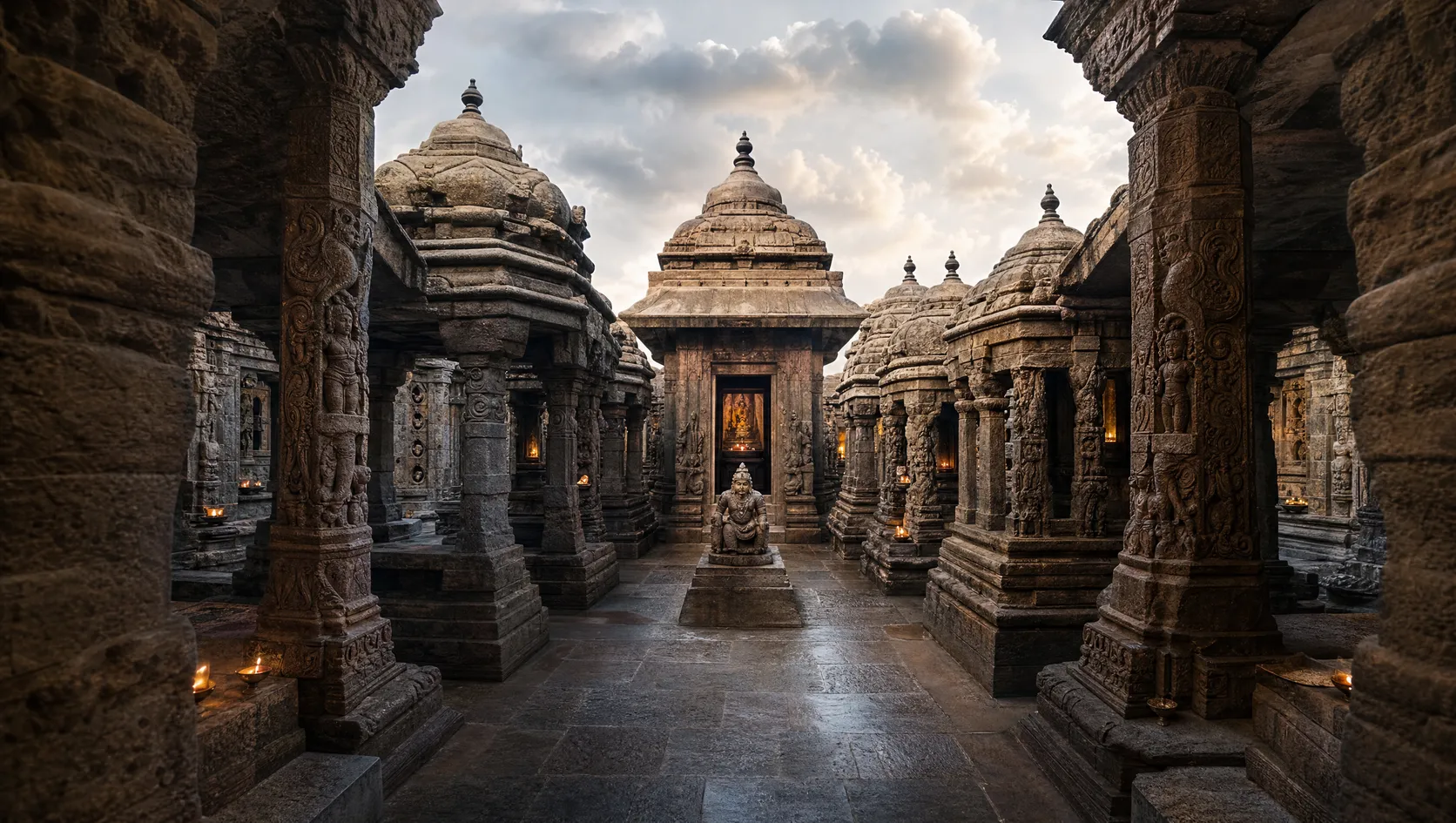
The temple's distinguishing arrangement is spatial rather than sculptural. Each of the remaining eight grahas has a separate shrine within the enclosure, so the visitor moves between nine buildings rather than circling a single platform. On a standard Navagraha platform the nine figures are set so that no planet looks directly at another, an arrangement understood to prevent the aggravation of planetary conflicts. Here that convention is set aside: the Guru shrine, dedicated to Brihaspati, faces the main sanctum directly.
Each graha carries its own associations of colour, grain, direction and day, and the shrines are approached accordingly. Surya's are red, wheat and Sunday.
The temple tank, the Surya Pushkarini, lies within the complex. The gopuram over the entrance is in the Chola idiom and of modest scale compared with the great Chola temples of the same delta, which suits a temple whose interest is in its arrangement rather than its magnitude.
Distinctive Practicesविशिष्ट परंपराएँ
Guru First, Then Surya
पहले गुरु, फिर सूर्य
Every visit
The prescribed sequence of worship here begins at the Guru shrine, dedicated to Brihaspati, before proceeding to Surya in the main sanctum and then to the remaining grahas. Priests will usually direct visitors accordingly, and the order is not treated as optional.
Guru is the teacher of the gods, and the ordering places instruction ahead of power even in a temple built to honour the Sun. It is also the one arrangement where Guru is permitted to face the presiding deity directly, which the usual grammar of graha placement forbids: the convention exists to keep planets from aggravating one another, and here it is deliberately suspended.
Graha Dosha Remedy
ग्रह दोष निवारण
Undertaken according to horoscope, often on prescribed days
Devotees come to address specific planetary afflictions identified in a horoscope, offering lamps, cloth and grain associated with the relevant graha at that planet's own shrine. Each graha has its assigned colour, grain, direction and weekday, and the offering follows those correspondences.
The Kalava Rishi account establishes the logic: the planets afflicted and the planets relented, so the remedy is addressed to them directly rather than appealing over their heads to a higher deity. The theology here is unusually flat. There is no appeal to a court above the one that passed the sentence.
Sunday Worship
रविवार की उपासना
Weekly, and on Ratha Saptami
Sundays are the principal day of worship, the day governed by Surya, and gatherings are largest then. Ratha Saptami is the year's most significant observance at the temple, and the two together give the calendar its shape.
Each graha governs a day of the week, and worshipping a planet on its own day is held to be most effective. At a temple where the Sun presides, the weekly calendar itself becomes part of the ritual structure, and the week is not a convenience of scheduling but a map of the nine.
Arghya to the Sun
सूर्य को अर्घ्य
At sunrise, particularly on Sundays and Ratha Saptami
Water is offered from cupped hands toward the rising sun, poured so that the light passes through the falling stream. The practice requires no priest, no materials beyond water, and no permission.
Arghya is among the oldest surviving forms of worship in the tradition, older than temples, and it needs nothing that a person does not already have. At a shrine dedicated to the Sun the gesture connects the elaborate graha ritual inside the enclosure to something anyone can do at any dawn anywhere.
Did You Know?क्या आप जानते हैं?
This is the only temple in the Navagraha circuit where a planet is the presiding deity with a full sanctum. Elsewhere the nine are worshipped as small figures on a platform in a corner of a larger temple.
Navagraha circuit tradition of the Cauvery delta
Guru faces Surya directly here, which the conventional grammar of Navagraha placement avoids: on a standard platform the nine figures are arranged so that no planet looks at another, in order to prevent planetary conflicts being aggravated.
Navagraha placement conventions; temple's own arrangement
In the founding story the temple exists because the planets were punished. Brahma ordained that the nine reside here after they overreached in cursing a sage's family, so the boons they grant are, in the logic of the account, a sentence being served.
Temple sthala purana (Kalava Rishi account)
The temple was conceived around the Navagrahas from the start under Kulothunga Chola I, rather than being an older shrine that acquired planetary worship later. Most graha worship in South India is an addition to something older.
Chola-period attribution of the temple's construction
Because all nine grahas have shrines within this single enclosure, devotees who cannot complete the nine-temple circuit across the delta often come here instead, treating it as a compressed version of the whole pilgrimage.
Regional pilgrimage practice
Surya's consorts here are Ushadevi and Pratyusha Devi, whose names mean dawn and the light that precedes dawn, so the deity is flanked by two degrees of morning.
Temple iconographic tradition
The nine temples of the circuit are Suryanar Kovil, Thingalur, Vaitheeswaran Koil, Thiruvenkadu, Alangudi, Kanjanur, Thirunallar, Thirunageswaram and Keezhaperumpallam, all within a radius that can be covered by road in a day or two.
Navagraha circuit itinerary
Visitor Accessप्रवेश जानकारी
The temple is open to devotees without entry restriction. Traditional dress is customary, as at other temples in the Tamil delta, and footwear is removed at the entrance. The prescribed worship sequence begins at the Guru shrine rather than the main sanctum, and priests will usually direct visitors accordingly. Those coming specifically for graha dosha remedies often arrange archana in advance at the shrine of the relevant planet. The temple is small compared with the great Chola foundations nearby, and a visit does not take long unless a specific ritual has been arranged. It is commonly combined with the other Navagraha temples of the Kumbakonam circuit in a single day or two.
Begin at the Guru shrine, not the main sanctum; the priests will guide you, but knowing the order beforehand saves confusion. If you intend a specific graha archana, arrange it on arrival rather than assuming it can be done immediately, and bring or buy the materials associated with that planet. The temple is small and a visit takes under an hour without a scheduled ritual, so it is best combined with the rest of the circuit. Hiring a vehicle in Kumbakonam for a day or two is the usual arrangement and covers all nine comfortably. Mornings are cooler and the light on the sanctum is better; the delta gets hot from mid-morning through most of the year.
Festivalsत्योहार
Ratha Saptami
रथ सप्तमी
Jan-Feb (Magha Shukla Saptami)
The most significant observance of the year here, marking the Sun's turn toward the northern course. Special abhishekam and worship are performed, and the temple draws its largest gathering. The day is understood as the Sun's own chariot festival, and at a temple where he presides rather than sits in a corner, it is the one occasion when the calendar and the deity coincide exactly.
Vijayadashami
विजयदशमी
Sep-Oct
Observed at the temple with particular attention to the Guru shrine, in keeping with the site's association between planetary worship and learning. Brihaspati being the teacher of the gods, the day of beginnings in learning has a natural home here.
Chitra Pournami
चित्रा पौर्णमी
Apr-May (Chithirai full moon)
The full moon of the Tamil month of Chithirai is observed across the delta, and at a temple where the grahas preside it carries particular weight, marking as it does a specific configuration of Sun and Moon.
Sunday Sankalpam
रविवार संकल्पम्
Weekly, throughout the year
Not a festival in the ordinary sense but the temple's weekly rhythm. Sunday is the Sun's day, and the crowds, the archanas and the sequence of graha worship are all at their fullest then. For a shrine whose subject is the week's own structure, the recurring Sunday matters more than most annual festivals do elsewhere.
Traditional Offeringsपारंपरिक अर्पण
प्राथमिक अर्पण
Arghya (water offered to the sun)
अर्घ्य
अर्घ्य
Water offered from cupped hands toward the sun at dawn is the oldest and simplest form of Surya worship, requiring nothing but water and the sun itself. It predates temples and needs no priest, no image and no permission. At a shrine built to give the Sun a sanctum of his own, the persistence of this unmediated gesture is worth noticing: the most elaborate graha temple in the region venerates a deity who can be worshipped by anyone standing outside at daybreak.
Red flowers and red cloth
लाल पुष्प और लाल वस्त्र
Red is the colour assigned to Surya in graha worship, and red flowers, red cloth and red sandal are offered at his shrine. Each of the nine planets has its own colour, and the correspondences are followed strictly at the respective shrines. The colour system makes the nine shrines legible at a glance. A devotee moving through the enclosure can see which graha is being addressed from the offerings alone, without reading a single inscription.
Wheat and grain offerings
गेहूँ और अन्न की भेंट
Wheat is the grain assigned to Surya, and grain offerings are made at each graha shrine according to its own correspondence: rice for the Moon, toor dal for Jupiter, and so on through the nine. The grains are given afterwards rather than kept, and the practice of donating the assigned grain is itself often prescribed as part of a remedy, so the offering leaves the temple and enters someone's kitchen.
Ghee lamps at the graha shrines
ग्रह-मंदिरों पर घी के दीप
Lamps are lit at the shrine of the graha being addressed, with the number and the medium sometimes prescribed according to the affliction. The lamp is the most common single element of a graha remedy. Light offered to a planet of light has an obvious symmetry, but the practice extends across all nine: even the shadow grahas, Rahu and Ketu, receive lamps, which is a small statement that nothing among the nine is beyond address.
इस मंदिर की विशेषता
The Nine-Shrine Offering Sequence
नव-मंदिर भेंट क्रम
Because all nine grahas have shrines within this single enclosure, a devotee can make the full sequence of nine offerings here without travelling the circuit. Each shrine receives the colour, grain and lamp assigned to its planet, in the prescribed order beginning at Guru. This is what makes the temple function as a compressed pilgrimage. For those who cannot travel to nine towns, the whole remedial vocabulary is available in one courtyard, and the tradition treats the concentrated version as sufficient rather than as a lesser substitute.
Offering materials for each graha are sold near the temple, and it is simplest to buy them there rather than carry them, since the correspondences of colour and grain are specific and the vendors know them. If a specific remedy has been prescribed, arrange the archana on arrival and tell the priest which graha is intended; the sequence and materials will be adjusted accordingly. Eternal Raga presents these practices as devotional tradition and does not offer astrological advice.
How to Reachकैसे पहुँचें
Suryanar Kovil lies in the Cauvery delta, and Kumbakonam is the practical base for visiting it and the rest of the Navagraha circuit.
By air: Tiruchirappalli International Airport is roughly 95 km away and is the nearest useful airport, with domestic services and some connections to the Gulf and Southeast Asia. Chennai is considerably further, around 280 km, but far better connected.
By rail: Kumbakonam is the main railhead at roughly 15 km, well connected within Tamil Nadu and to Chennai. Aduthurai is nearer to the temple itself but served by fewer trains.
By road: The temple is about 15 km from Kumbakonam on the road toward Mayiladuthurai. Buses serve the route and taxis are readily hired in Kumbakonam, which is how most visitors arrive. The delta roads are flat and the driving is easy.
Most people visit as part of the Navagraha circuit rather than as a single destination. The nine temples are spread across the delta within a manageable radius, and hiring a vehicle for a day or two from Kumbakonam is the usual arrangement. Dedicated circuit tours also run from Kumbakonam and can be joined on the day.
Plan Your Visitयात्रा की योजना
🌤 सर्वोत्तम मौसम
November to February is the most comfortable period in the delta, with cooler air and manageable humidity. This is also when the Navagraha circuit is most pleasant to drive, since it involves several stops in a day. March to June is hot, often severely so, and the temple's association with the Sun does not make standing in it any easier. If visiting then, start early and finish the circuit before midday. The northeast monsoon, roughly October to December, brings rain to this region and can affect road travel across the circuit, though the delta roads recover quickly. Ratha Saptami (Jan-Feb) is the most significant time to visit and falls conveniently in the pleasant season. Sundays are busier than other days throughout the year.
👘 पहनावे का नियम
Traditional dress is customary, as at Tamil temples generally. Men commonly wear a dhoti or trousers with a shirt; in the inner areas a dhoti without an upper garment may be expected, following South Indian convention. Women wear saree or salwar kameez. Footwear is removed at the entrance. The stone underfoot gets hot in the delta by mid-morning, which is a practical argument for an early visit as much as a comfort one.
📱 फोन और फोटोग्राफी
Photography restrictions apply within the sanctum, as at Tamil temples generally; the outer areas and the graha shrines are usually less restricted, but check locally rather than assuming. Phones should be silenced. During a scheduled archana, particularly one arranged for a specific graha remedy, recording is inappropriate unless the priest has agreed to it.
🏨 आवास
There is no significant accommodation at the temple itself. Kumbakonam, 15 km away, is the practical base and offers a full range of hotels and lodges, and is well placed for the rest of the Navagraha circuit as well as for the great Chola temples of the delta. Thanjavur is a further option at around 40 km, with more choice at the upper end. Demand rises around Ratha Saptami and during the Mahamaham festival years at Kumbakonam, when booking ahead is necessary.
Sacred Soundsपवित्र ध्वनि
क्या आप जानते हैं? · Did You Know?
वही अनुवाद त्रुटि जिसने हिन्दू धर्म में '33 कोटि' को '33 करोड़' बनाया, बौद्ध धर्म में भी हुई। बौद्ध ग्रन्थों के चीनी अनुवाद ने 'सप्त कोटि बुद्ध' (7 श्रेष्ठ बुद्ध) का अनुवाद '7 करोड़ बुद्ध' कर दिया। तिब्बती अनुवाद ने सही किया: 7 प्रकार, 7 करोड़ नहीं। एक संस्कृत शब्द, दो प्रमुख विश्व धर्मों में गलत पढ़ा गया, ने दो एकसमान भ्रम स्वतन्त्र रूप से उत्पन्न किए।
Related Contentसंबंधित सामग्री
Related Scriptures
Community Reflections
🕉️
Be the first to share your reflection.