Ramaswamy Temple (Kumbakonam)
रामस्वामी मंदिर कुम्भकोणम्
Where the Ramayana lives on 108 walls — the Nayaka temple that made scripture visible
Kumbakonam, Tamil Nadu, India
Rāmasvāmin KōvilAlso known as: Sri Ramaswamy Temple Kumbakonam, Iramaswami Kovil, ஸ்ரீ இராமஸ்வாமி கோவில், Sri Ramaswami Kovil
युग
Late 16th century CE (Nayaka period, c. 1580–1600)
वास्तुकला
Dravidian — Nayaka (Thanjavur school)
खुला
06:00 – 21:00
आरती
06:00 · 12:00 · 18:00
विशेष
The 108-panel Ramayana mural corridor is the defining pilgrimage within the temple — walked as a full parikrama before inner sanctum darshan
पवित्र कथा · पवित्र कथा
In a town of nearly two hundred temples, Kumbakonam's Ramaswamy Temple stands apart for what covers its walls. Commissioned in the late 16th century by Govinda Dikshitar — minister, musicologist, and polymath in the court of the Thanjavur Nayaka kings — the temple's inner corridors carry 108 mural paintings telling the Ramayana in sequence: from Ayodhya to the Aranya, from the golden deer to Lanka's burning, from the bridge across the ocean back to the coronation, panel by panel, in pigments that have held for four centuries. This is not merely a place to worship Rama. It is a place to walk through his story.
Sacred Designationपवित्र पदनाम
Sacred Origin Storyपवित्र उत्पत्ति कथा
Source: Vaishnava — Ramayani (Nayaka / Tamil Vaishnava)
The Ramaswamy Temple's mythology follows both the Valmiki Ramayana and the Tamil Kamba Ramayanam — the two great scriptural pillars of Rama devotion in Tamil Nadu. The presiding deity is Rama (Ramaswami — Lord Rama) in his Kodanda (bow-bearing) form, the warrior-king who destroyed Ravana and restored dharma. The specific sanctity of this temple lies not in a unique Puranic origin but in the completeness of its devotional vision: the Nayaka patrons and Govinda Dikshitar conceived a temple where the entire Ramayana could be read on the walls — where the devotee who could not read Sanskrit or Tamil could nonetheless know the full story of the Lord by walking the corridor. The 108 panels begin at the Bala Kanda and close with the Uttara Kanda's Pattabhisheka (coronation of Rama), making the parikrama (circumambulation) a complete Ramayana reading.
उद्धृत स्रोत:
- Valmiki Ramayana (Sanskrit) — the primary narrative source
- Kamba Ramayanam (Tamil, 12th century CE) — the canonical Tamil Ramayana informing the temple tradition
- T.A. Gopinatha Rao, 'Elements of Hindu Iconography' (1914) — iconographic tradition of Kodanda Rama
- Archaeological Survey of India, Kumbakonam temple documentation
विद्वत संदर्भ
Govinda Dikshitar's identity and dates are sometimes confused in secondary literature with other scholars of the period. The Govinda Dikshitar who built the Ramaswamy and Kasi Viswanathar temples in Kumbakonam was minister to the Thanjavur Nayaka kings Achyutappa Nayak (r. 1561–1614) and Raghunatha Nayak (r. 1600–1634) and is the author of the Sangita Sudha (a musicological treatise) and the Sakalavajit (a dharmashastra work). He is distinct from later musicians named Govinda Dikshitar. The 16th-century Govinda Dikshitar's contributions to Kumbakonam's built heritage are well-attested in regional inscriptions and the Sahitya Ratnakara. The precise date of the Ramaswamy Temple's construction within his period of service has not been definitively established in published epigraphic scholarship.
Historyइतिहास
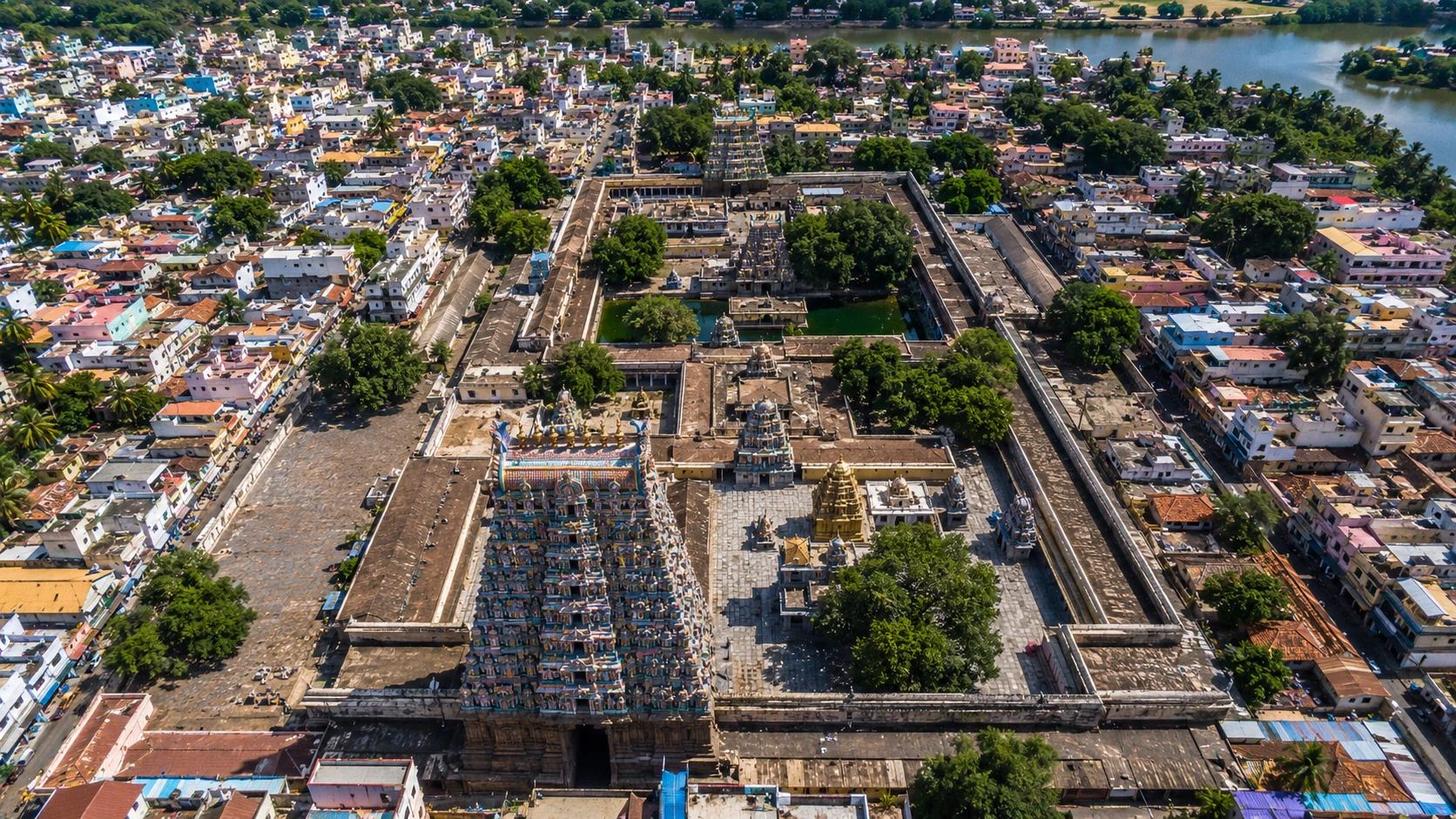
Kumbakonam has been a centre of Shaiva and Vaishnava learning and temple building since at least the Chola period (9th–13th centuries CE), when the Kaveri delta produced some of the richest temple architecture in the subcontinent. By the 16th century, under the Thanjavur Nayaka kings — themselves patrons of literature, music, and architecture — the town accumulated a density of temples unmatched anywhere in Tamil Nadu. The Ramaswamy Temple was built in this climate of abundance, commissioned by Govinda Dikshitar, the remarkable polymath who served as minister to Achyutappa Nayak and Raghunatha Nayak. Dikshitar was as much an intellectual as an administrator: he authored the Sangita Sudha (a treatise on classical music), works on dharmashastra, and literary texts — and he channelled the same completeness of vision into his temple-building programme at Kumbakonam. The Ramaswamy Temple's defining feature — the 108 Ramayana mural panels in the corridor — reflects his scholarly instinct: the temple is not just a place of worship but a complete pictorial transmission of the Ramayana narrative to every devotee who walks its corridor. The Thanjavur Nayaka kingdom eventually gave way to Maratha rule (from 1676 onward, under Venkoji, half-brother of Shivaji), and the Thanjavur Marathas continued to patronise the region's temples. In the 19th century, Serfoji II (r. 1798–1832), the polymath Maratha king, documented Kumbakonam's heritage extensively. The temple is now administered by the Tamil Nadu Hindu Religious and Charitable Endowments (HR&CE) Department.
Historical Timelineऐतिहासिक कालक्रम
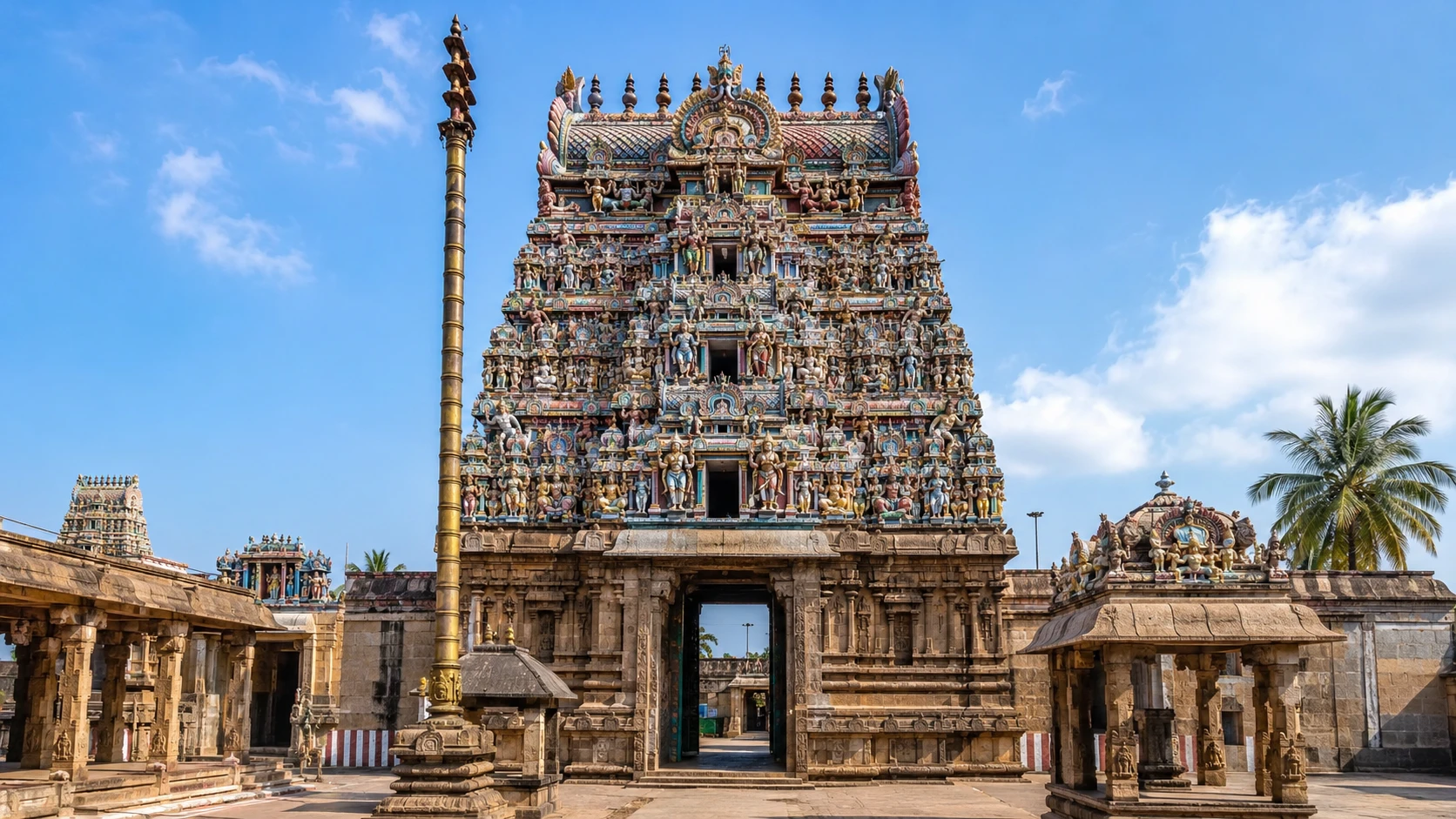
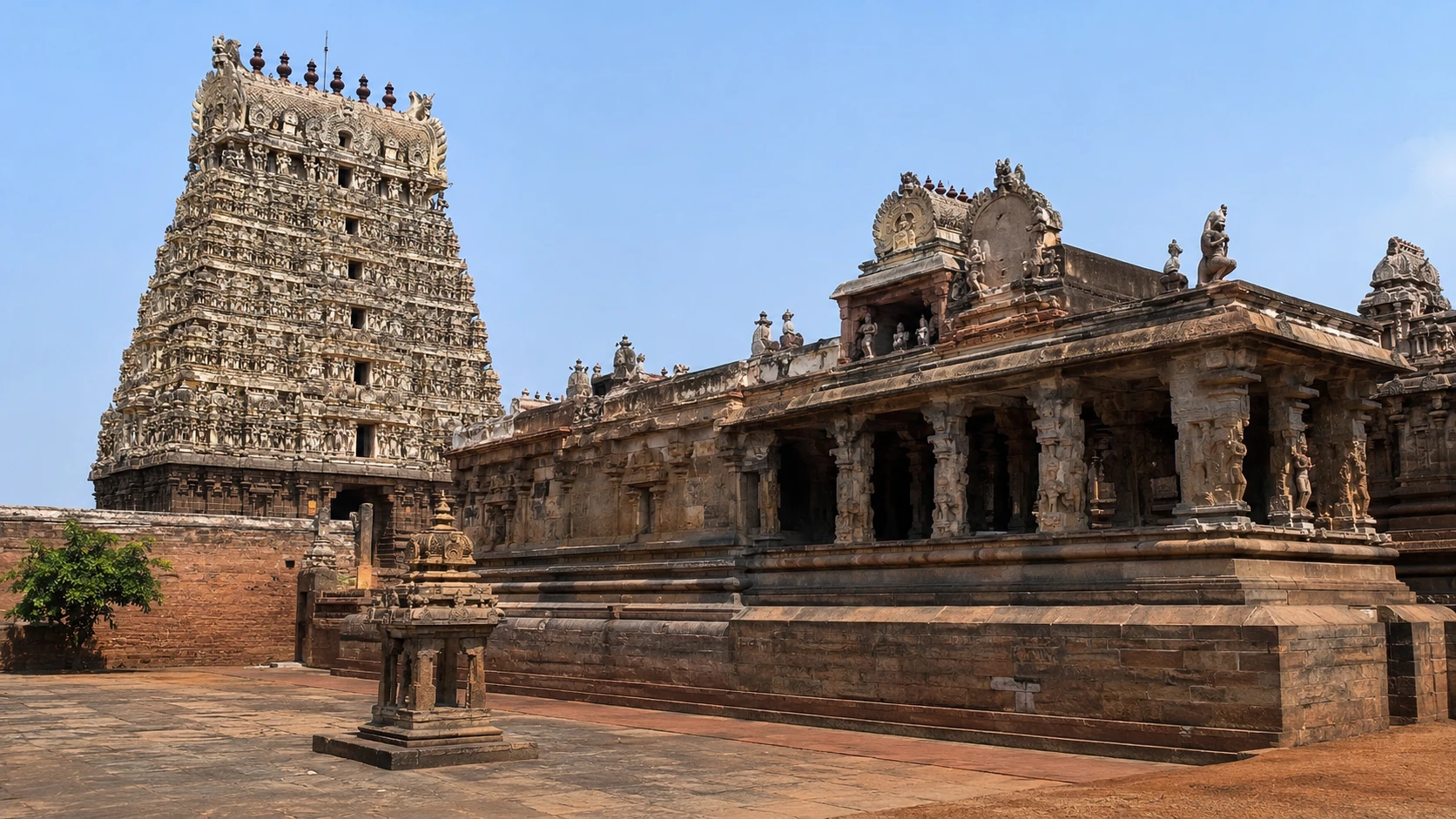
Govinda Dikshitar, minister to the Thanjavur Nayaka kings Achyutappa Nayak and Raghunatha Nayak, commissions and constructs the Ramaswamy Temple at Kumbakonam. The temple is built in the Dravidian Nayaka style with a five-tiered gopuram and features a multi-pillared mandapam.
The precise construction date within Govinda Dikshitar's period of service (spanning two Nayaka reigns, roughly 1561–1634) has not been definitively fixed by published epigraphic study. Scholarly estimates place the Ramaswamy Temple construction in the late 16th century. Regional secondary sources sometimes give the date as 1583 CE; this has not been confirmed by a primary inscription.
The 108 Ramayana mural paintings are executed in the temple's inner corridor (prakara) during or shortly after Govinda Dikshitar's tenure. The murals, painted in the Nayaka style using mineral and organic pigments, depict the complete Ramayana narrative from the Bala Kanda through the Uttara Kanda's Pattabhisheka. They constitute one of the most comprehensive pictorial Ramayanas in South Indian temple art.
The precise dating of the mural paintings relative to the temple's construction is not definitively established. Nayaka-period murals at comparable temples (Lepakshi, Suchindram) were typically executed during or shortly after the main construction phase, often under the same patron's commission. The stylistic attribution to the Nayaka period is well-supported by iconographic and technical analysis.
The Thanjavur Nayaka kingdom comes under Maratha rule following the accession of Venkoji (Ekoji), half-brother of Chhatrapati Shivaji, as king of Thanjavur. The Thanjavur Maratha rulers continue to patronise Kumbakonam's temple complex. Serfoji II (r. 1798–1832), the polymath Maratha king known for his Saraswathi Mahal library, documents the region's built heritage.
The Tamil Nadu Government's HR&CE (Hindu Religious and Charitable Endowments) Department assumes administrative oversight of the Ramaswamy Temple. Conservation efforts by the ASI and the HR&CE Department address the condition of the Nayaka-period mural paintings. The temple continues as one of Kumbakonam's major pilgrimage destinations.
What You'll Seeदर्शन में
The presiding deity is Ramaswami — Rama — in his Kodanda form: standing, holding the bow (kodanda) in his left hand, the right hand extended in the gesture of blessing (abhaya mudra) or reaching for an arrow. Sita stands to his left, Lakshmana to his right within the garbhagriha, completing the forest-hermitage household that is the iconic visual of the Ramayana's vanvas period. Additional shrines in the mandapam house Bharata, Shatrughna, and Hanuman. A large image of Hanuman stands at the temple entrance, facing the sanctum as devoted protector. The outer experience of iconography here, however, is the 108 mural panels: each approximately a metre wide, arranged in continuous sequence around the inner corridor (prakara), they form a visual Ramayana that a devotee walks through before reaching the main deity. The murals are in the Nayaka style — ochre backgrounds, elongated figures in rich garments, narrative detail dense with identifying iconography. The 108 panels open at the Bala Kanda (Ram's birth, his boyhood at Ayodhya, the Siddha ashrama episodes with Vishwamitra) and close at the Pattabhisheka — Ram enthroned as king of Ayodhya, the Uttara Kanda's triumphant return.
Distinctive Practicesविशिष्ट परंपराएँ
Ramayana Corridor Parikrama (108-panel circuit)
रामायण प्राकार परिक्रमा (108-पट्ट परिपथ)
Before inner sanctum darshan; year-round
Before taking darshan of the presiding deity, pilgrims walk the inner corridor (prakara) of the temple in parikrama, moving past all 108 Ramayana mural panels in the canonical sequence: Bala Kanda, Ayodhya Kanda, Aranya Kanda, Kishkindha Kanda, Sundara Kanda, Lanka Kanda, Uttara Kanda. The walk takes fifteen to thirty minutes depending on the pace of contemplation. Each panel is large enough to examine in detail — pilgrims who know the narrative by heart recognise each scene; those coming to the story for the first time find a visual Ramayana they can read without text.
In the Tamil Vaishnava tradition, approaching the deity through the complete telling of his story is itself a form of devotion. The mural parikrama enacts the principle of shravana (hearing the story) and manana (contemplating it) before darshana (beholding the deity). By the time the devotee reaches Rama in the garbhagriha, she has re-lived his entire life — the joy of Ayodhya, the sacrifice of the forest, the grief of Sita's loss, the war, and the return. The encounter with the murti is thus not a first meeting but a reunion.
Did You Know?क्या आप जानते हैं?
The 108 Ramayana mural paintings in the Ramaswamy Temple's inner corridor constitute one of the most complete pictorial Ramayanas in South Indian temple art — narrating every major episode from Ram's birth in Ayodhya to his coronation (Pattabhisheka), executed in the Nayaka period in vivid mineral pigments that have survived four centuries of incense, moisture, and time.
Archaeological Survey of India, Tamil Nadu Circle; Tamil Nadu HR&CE Department heritage documentation; Sivaramamurti, C., 'South Indian Paintings' (1968)
Govinda Dikshitar — the minister who commissioned the Ramaswamy Temple — was one of the most remarkable figures in 16th-century South India. He served two successive Thanjavur Nayaka kings, authored the Sangita Sudha (a treatise on Indian classical music), wrote on dharmashastra, and built multiple temples in Kumbakonam. The Ramaswamy and Kasi Viswanathar temples in Kumbakonam are both credited to his patronage.
V. Vriddhagirisan, 'The Nayaks of Tanjore' (1995); T.V. Mahalingam, 'Mackenzie Manuscripts'
Kumbakonam is known as the 'temple town of Tamil Nadu' and has approximately 188 temples within its municipal limits — a density virtually unmatched anywhere in India. The Ramaswamy Temple stands among major Shaiva and Vaishnava shrines including the Sarangapani, Chakrapani, and Kasi Viswanathar temples. The town is also the site of the Mahamaham tank — one of the holiest bathing tanks in South India — where a festival drawing millions occurs every twelve years.
Tamil Nadu Tourism Development Corporation; Archaeological Survey of India, Thanjavur district documentation
The number 108 is among the most sacred numbers in Hindu tradition — there are 108 Upanishads, 108 Divya Desam temples of Vishnu, 108 beads in a mala, and 108 names in the Ashtottara Shatanamavali (litanies of 108 names). Govinda Dikshitar's choice of 108 panels for the Ramayana cycle was deliberate — the entire narrative framed within the most sacred count in Vaishnava numerology.
Vaishnava liturgical tradition; numbered count documented in ASI Kumbakonam temple surveys
Visitor Accessप्रवेश जानकारी
The Ramaswamy Temple is open to all Hindu devotees. Non-Hindu visitors may be subject to entry restrictions as per Tamil Nadu HR&CE policy — verify with the temple administration before visiting. Photography inside the sanctum and of the murals may be restricted; check with temple staff. Footwear must be removed before entering.
Festivalsत्योहार
Ram Navami (Panguni Uthiram / Chithirai)
राम नवमी
March–April (Chithirai month in Tamil calendar)
Ram's birthday is the principal annual festival at the Ramaswamy Temple. Special pujas are performed from pre-dawn, the 108 mural corridor receives heightened devotional foot traffic, and the deity is adorned in elaborate vastra (ceremonial vestments). Kumbakonam's many temples celebrate in parallel, creating a town-wide devotional atmosphere.
Brahmotsavam (Annual temple festival)
ब्रह्मोत्सव
Varies (Tamil calendar — typically Panguni or Vaikasi month)
The annual Brahmotsavam is a ten-day festival during which the presiding deity is taken in procession (utsava murti) through the temple streets on various vahanas (divine vehicles) through successive days. The procession on the golden chariot (ther) is the culminating event. Kumbakonam's Brahmotsavam calendars are staggered across its many temples, making the town a near-continuous festival destination through much of the year.
Vaikunta Ekadashi
वैकुण्ठ एकादशी
December–January (Margazhi month, Shukla Ekadashi)
Vaikunta Ekadashi — the eleventh day of the waxing moon in the Tamil month of Margazhi — is the most important Ekadashi in the Vaishnava calendar, commemorating Vishnu's opening of the gates of Vaikunta (his celestial abode). At the Ramaswamy Temple, as at all Vaishnava shrines, this day draws large crowds, special pujas, and the symbolic opening of the Uttara Dwara (northern gateway).
Traditional Offeringsपारंपरिक अर्पण
प्राथमिक अर्पण
Tulsi (Holy Basil)
तुलसी
तुलसी
Tulsi — called Thiruththuzhai in Tamil — is the most sacred offering to Vishnu and his avatars in the South Indian Vaishnava tradition. The Padma Purana states that Vishnu holds Tulsi dearer than any other offering. At the Ramaswamy Temple, Tulsi garlands offered to Rama carry the same significance as at any Vishnu shrine, deepened here by the vanvas context: Tulsi was among the forest plants that surrounded Ram's hermitage at Panchavati and Chitrakoot.
Lotus flower (Thamarai)
कमल
पद्म
The lotus is the flower most closely associated with Vishnu in Tamil Vaishnava worship. Rama is frequently described as lotus-eyed (kamala-nayana) and lotus-footed (kamala-pada) in both the Valmiki Ramayana and the Kamba Ramayanam. The Kaveri delta in which Kumbakonam sits is historically rich in lotus — the flower grows in the temple tanks and is offered fresh. In temple liturgy, the lotus represents Lakshmi (Sita in the Rama tradition), beauty, and spiritual unfoldment.
Sandalwood paste (Srigandam / Chandanam)
चंदन (श्रीगंधम)
चन्दन
Sandalwood paste — called Srigandam in South Indian temple practice — is the classic offering for Vishnu and his avatars. Applied to the deity's forehead as tilak and offered as part of the Shodashopacharas (sixteen ritual services), its cooling fragrance is held to please the Lord. The Vishnu Purana lists chandana among the sixteen upacharas to be offered to Vishnu.
Vella (jaggery) and coconut (Naivethyam)
वेल्ला (गुड़) और नारियल
In Tamil temple tradition, jaggery (vella) and coconut together form a common naivethyam (food offering). The sweetness of jaggery is associated with devotion, the purity of intent, and the desired sweetness of liberation (moksha). The breaking of a coconut at the temple threshold is one of the oldest acts of offering in South Indian worship — a symbol of the ego being broken before the divine.
Fresh lotus and Tulsi are available from vendors near the temple entrance and at the Mahamaham tank ghats. Coconuts for breaking are sold at the temple complex. The temple's naivethyam prasadam is distributed after puja.
How to Reachकैसे पहुँचें
Kumbakonam is very well connected by rail. Kumbakonam Railway Station is on the Chennai–Thanjavur–Tiruchirappalli main line and on the Chennai–Nagapattinam line, with frequent express services from Chennai (approximately 5–6 hours), Tiruchirappalli (approximately 1.5 hours), and other Tamil Nadu cities. From the railway station, the Ramaswamy Temple is approximately 1 km — walkable or by auto-rickshaw. By road, Kumbakonam is 40 km from Thanjavur, 90 km from Tiruchirappalli, and 270 km from Chennai. The nearest major airport is Tiruchirappalli International Airport (approximately 90 km), which has direct flights from Chennai, Bengaluru, and select international destinations. Thanjavur Airport (approximately 40 km) has limited operations.
Plan Your Visitयात्रा की योजना
🌤 सर्वोत्तम मौसम
October to March. Kumbakonam's Tamil Nadu climate is warm year-round; the northeast monsoon (October–December) brings rain to the Kaveri delta but also cools the air. Avoid the peak summer months (April–June) when temple town crowds and heat combine. For the Mahamaham festival (every 12 years), confirm the date — the most recent was 2016 — and book accommodation months in advance.
👘 पहनावे का नियम
Traditional attire preferred. Men are typically expected to wear dhoti or traditional lower garments inside the sanctum; check with temple management for current requirements. Women: saree or salwar preferred. Footwear removed before entry.
📱 फोन और फोटोग्राफी
Photography inside the sanctum is generally not permitted. Photography of the 108 Ramayana murals may also be restricted — verify with temple staff before photographing the corridor. Mobile phones should be kept silent or switched off during puja.
🏨 आवास
Kumbakonam has a range of hotels, lodges, and dharamshalas near the temple town. TTDC (Tamil Nadu Tourism Development Corporation) guest houses are available. The town itself is compact and navigable on foot for the temple circuit. During Mahamaham (every 12 years), accommodation for the entire Kaveri delta region is overwhelmed — plan months in advance.
Sacred Soundsपवित्र ध्वनि
क्या आप जानते हैं? · Did You Know?
वही अनुवाद त्रुटि जिसने हिन्दू धर्म में '33 कोटि' को '33 करोड़' बनाया, बौद्ध धर्म में भी हुई। बौद्ध ग्रन्थों के चीनी अनुवाद ने 'सप्त कोटि बुद्ध' (7 श्रेष्ठ बुद्ध) का अनुवाद '7 करोड़ बुद्ध' कर दिया। तिब्बती अनुवाद ने सही किया: 7 प्रकार, 7 करोड़ नहीं। एक संस्कृत शब्द, दो प्रमुख विश्व धर्मों में गलत पढ़ा गया, ने दो एकसमान भ्रम स्वतन्त्र रूप से उत्पन्न किए।
Related Contentसंबंधित सामग्री
Related Scriptures
Related Temples
Community Reflections
🕉️
Be the first to share your reflection.