Triprayar Sri Rama Temple
त्रिप्रयार श्री राम मंदिर
Eldest of Kerala's four sacred brothers — Rama on the banks of the Triprayar River
Triprayar, Kerala, India
Triprayār Śrī Rāma KṣetramAlso known as: Triprayar Temple, ത്രിപ്രയാർ ശ്രീ രാമ ക്ഷേത്രം, Triprayar Sri Rama Temple, Prayar Rama Temple
युग
Ancient tradition; current structure — Kerala traditional, medieval
वास्तुकला
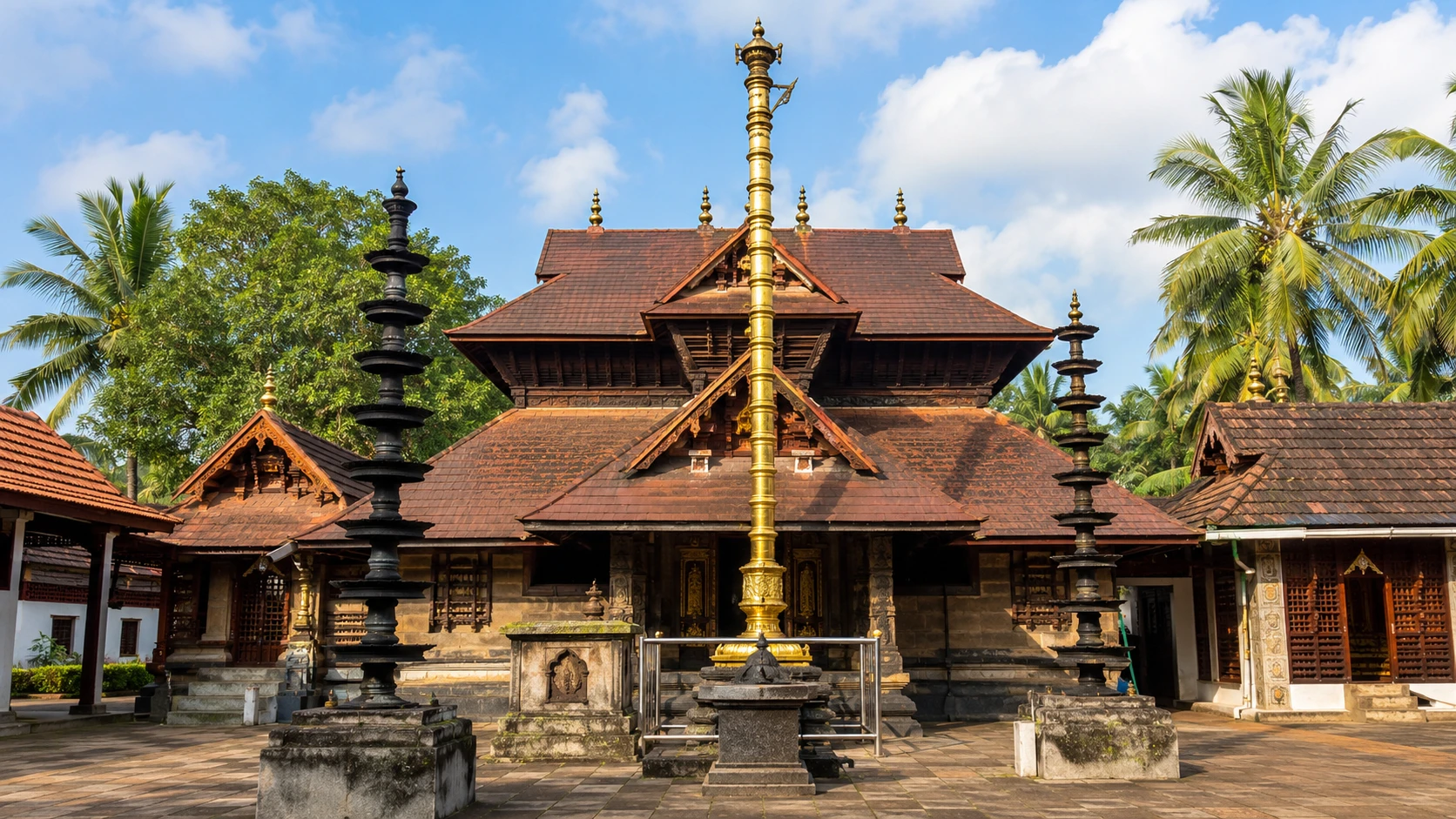
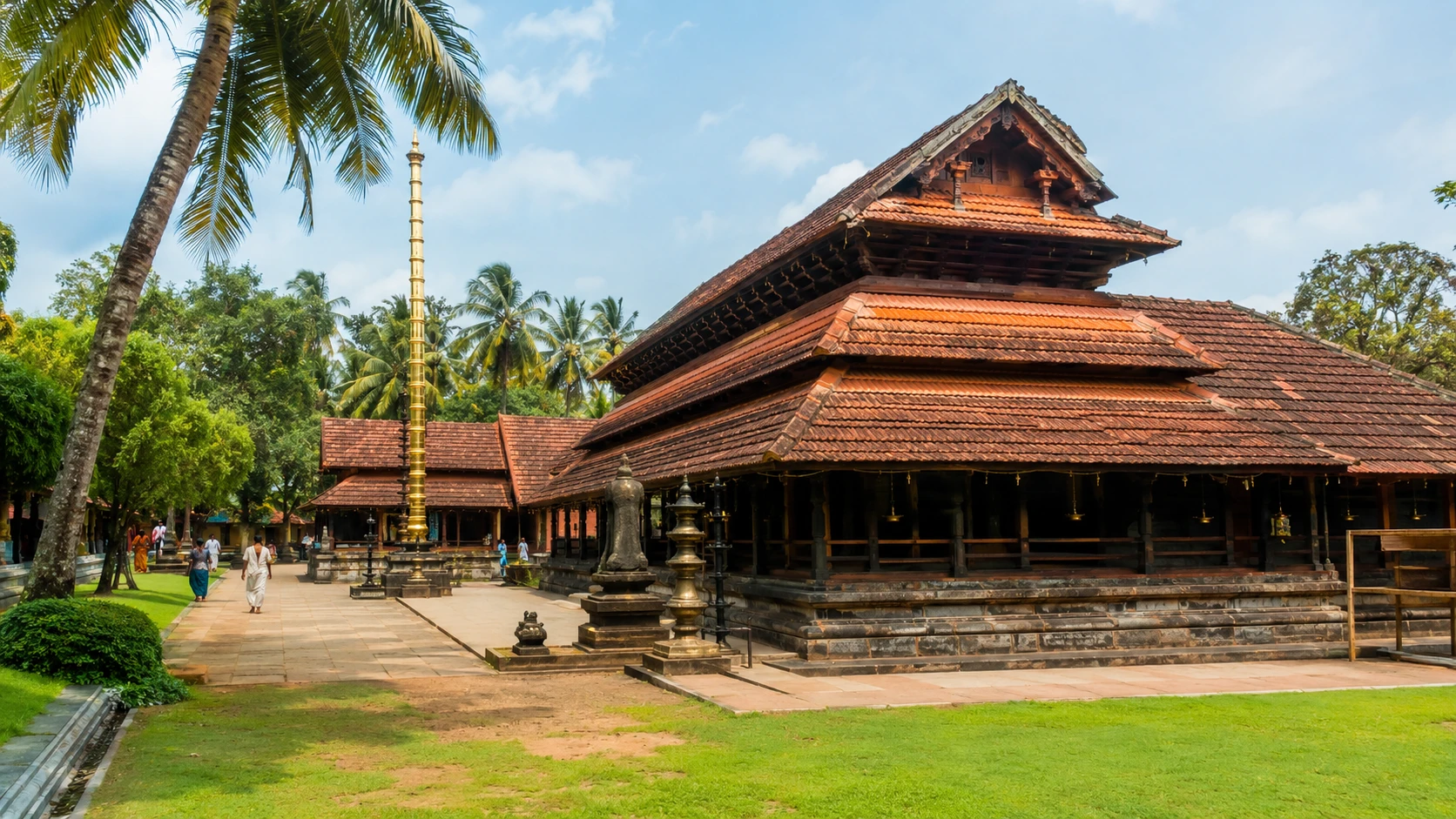
Kerala Thachu Shastra (Kerala traditional — circular srikovil, sloping tiled roofs)
खुला
04:30 – 20:00
आरती
04:30 · 07:00 · 12:00 · 17:30 · 19:30
विशेष
Karkidaka Ramayana reading (July–August, Karkidakam month) — nightly Adhyatma Ramayana parayanas by lamplight; the temple's most sacred month of the year
पवित्र कथा · पवित्र कथा
Kerala's four sacred Rama temples are not four independent shrines — they are a family. Triprayar, Moozhikkulam, Irinjalakuda, and Payammal enshrine the four sons of Dasharatha: Rama at Triprayar, Lakshmana at Moozhikkulam, Bharata at Irinjalakuda, Shatrughna at Payammal. Tradition holds that after the submersion of Dwaraka at the close of the Dwapara Yuga, the four idols came ashore on Kerala's Malabar coast, and the saint Vilwamangalathu Swamiyar installed them at these four river-bank sites. At Triprayar — the eldest, the chief — Rama has held court on the Triprayar River ever since. And every year when Karkidakam brings the heaviest rains of the monsoon, Kerala reads the Adhyatma Ramayana aloud by lamplight; Ezhuthachan's Malayalam verses fill this ancient courtyard, and the four brothers are honoured together across the four sites, separated by water and joined by devotion.
Sacred Designationपवित्र पदनाम
Sacred Origin Storyपवित्र उत्पत्ति कथा
Source: Vaishnava — Kerala Tantric (Thachu Shastra / Tantrasara tradition); Naalambalam sacred geography
At the close of the Dwapara Yuga, when Krishna departed from the world and Dwaraka sank beneath the ocean, four sacred idols of the Dasharatha brothers — Rama, Lakshmana, Bharata, and Shatrughna — were set adrift on the waves. The idols, made by Vishwakarma and consecrated by the divine, were carried by the sea to the Malabar coast of Kerala. There they were found — in some accounts, by the great saint-poet Vilwamangalathu Swamiyar (Vilwamangalam Swami), who was guided by a divine dream; in others, by fishermen who brought them ashore. Vilwamangalathu Swamiyar, one of the most revered figures in Kerala's medieval bhakti tradition, recognised their divinity and installed the four idols at four corresponding riverbank sites: Rama at Triprayar, Lakshmana at Moozhikkulam, Bharata at Irinjalakuda, and Shatrughna at Payammal. Together, these four temples — known as the Naalambalam (Malayalam: 'the four temples') — form a sacred mandala of devotion to the Raghu brothers, unique to Kerala. A parallel tradition associates the idols' arrival with Parasurama, Kerala's presiding sage-king, who is said to have consecrated them.
उद्धृत स्रोत:
- Triprayar Sthala Puranam (Kerala temple tradition text, Malayalam)
- Kerala Bhakti Marga traditions; referenced in P.T. Bhaskaran Nair, studies on Kerala temple traditions
- S.K. Nair, 'Kerala Kshetrangal' (Malayalam, various editions)
- Vilwamangalam Swamiyar hagiographic tradition documented in Kerala Purana studies
अन्य परंपराएँ · अन्य परंपराएँ
Parasurama tradition (Kerala foundational myth)
An alternate tradition holds that it was Parasurama — the brahmin-warrior-sage who is the presiding mythological figure of Kerala, credited with reclaiming the land from the sea — who received the four idols from the ocean and installed them at the Naalambalam sites. In this account, Vilwamangalathu Swamiyar is the figure who later re-consecrated or renovated the temples, rather than the original founder. The Parasurama tradition locates all of Kerala's major temple installations within his foundational act of land-creation.
विद्वत संदर्भ
The Naalambalam sacred geography — four temples representing four brothers of the Ramayana — is unique to Kerala and represents a distinctive regional theological contribution to the all-India Rama tradition. No analogous four-temple circuit representing the Dasharatha brothers exists elsewhere in the subcontinent. Vilwamangalathu Swamiyar is a historical figure whose dates are approximately placed in the 14th–15th century CE, though some traditions give earlier or later dates. His hagiography closely mirrors that of Melputtur Narayana Bhattathiri and is associated with the Guruvayur temple tradition as well. The claim that the Naalambalam idols came from Dwaraka echoes the Guruvayur idol's foundational legend, suggesting a coherent regional theological framework linking all four temples and Guruvayur as a sacred constellation in Kerala's Vaishnava geography.
Historyइतिहास
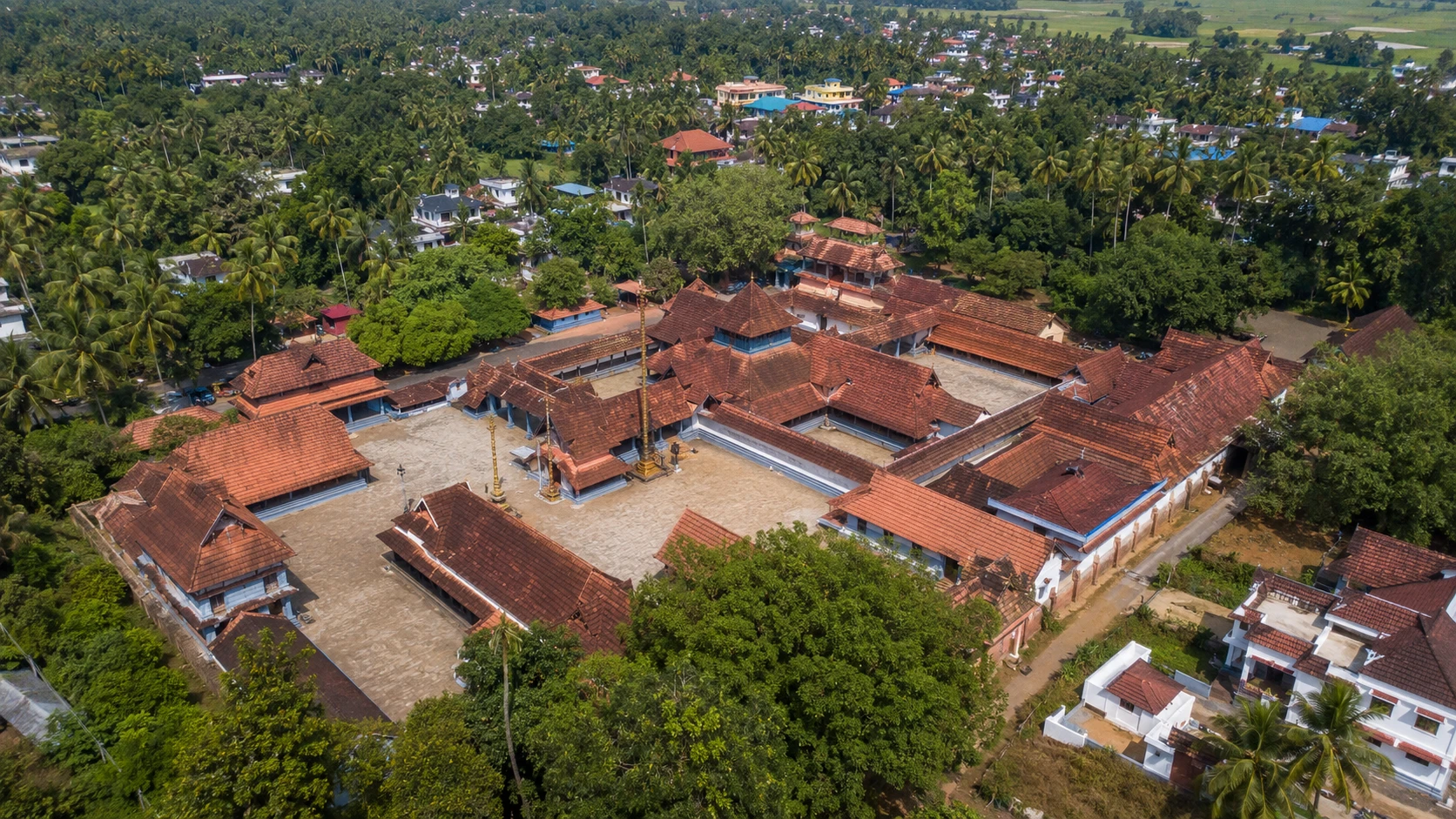
Triprayar's sanctity rests on twin foundations: the ancient sacred geography of the Naalambalam and the living devotional tradition of the Karkidaka Ramayana. The physical temple, built in the Kerala Thachu Shastra style, features the characteristic circular srikovil (inner sanctum), sloping tile-covered roofs, and carved woodwork of Kerala's traditional sacred architecture. The Tantri (hereditary head priest) lineage at Triprayar belongs to one of Kerala's established temple-priest families, who maintain the strict Tantric ritual traditions (Tantrasara) that govern worship at all Kerala's ancient temples. The temple's administrative history runs through the patronage of local ruling families in the Thalappilly and Cochin regions and, since Kerala's political reorganisation, under the Cochin Devaswom Board. The Karkidaka Ramayana tradition at Triprayar is inseparable from the legacy of Thunchathu Ramanujan Ezhuthachan (c. 16th century), considered the father of modern Malayalam literature, who composed the Adhyatma Ramayana Kilippattu — a devotional rendering of the Ramayana in Malayalam — for everyday recitation. Every year during Karkidakam, the complete Adhyatma Ramayana is read aloud in Kerala homes and temples, and Triprayar — with its Rama who came from Dwaraka — is among the most resonant settings for that ancient observance.
Historical Timelineऐतिहासिक कालक्रम
The four idols of the Dasharatha brothers arrive on Kerala's Malabar coast following the submersion of Dwaraka. Vilwamangalathu Swamiyar installs the four idols at the Naalambalam sites: Rama at Triprayar, Lakshmana at Moozhikkulam, Bharata at Irinjalakuda, Shatrughna at Payammal. The sacred geography of the Naalambalam is established.
The foundational legend of the Naalambalam belongs to the category of sthala purana (temple origin narrative) rather than verifiable historical record. Vilwamangalathu Swamiyar's approximate dates are placed in the 14th–15th century CE by most scholarly accounts, though hagiographic tradition is not always historically precise. The Naalambalam sacred geography itself — four temples representing four brothers — is unique to Kerala and is well-attested as a living tradition.
Thunchathu Ramanujan Ezhuthachan (c. 16th century CE), considered the father of modern Malayalam literature, composes the Adhyatma Ramayana Kilippattu — a devotional Malayalam rendering of the Ramayana in the kilippattu (parrot-song) metre. The text becomes the definitive Malayalam Ramayana for household and temple recitation, and the practice of reading it aloud during Karkidakam month becomes one of Kerala's most cherished annual devotional traditions, observed at Triprayar and across Kerala.
Ezhuthachan's precise dates are debated — scholarly estimates range from the 15th to the early 17th century. His Adhyatma Ramayana Kilippattu is an adaptation-composition rather than a translation of the Sanskrit Adhyatma Ramayana (attributed to Valmiki's tradition). The Karkidaka Ramayana reading tradition's formal association with Ezhuthachan's text developed over time; the practice is now pan-Kerala but is especially deeply observed at Vaishnava temples like Triprayar.
The Cochin (Kochi) royal family and local Thalappilly ruling clans extend patronage to the Triprayar temple. The temple's structural form — circular srikovil, nalambalam, and gopuram — is consolidated in its current configuration under this patronage. Tantric ritual procedures (Tantrasara) are formally established under the hereditary Tantri lineage.
Following the integration of Cochin State into Travancore-Cochin (1949) and subsequently the formation of Kerala state (1956), the Triprayar temple comes under the administration of the Cochin Devaswom Board. The Board maintains the temple's daily ritual programme, physical conservation, and the Karkidaka Ramayana observances. The Aarattu (annual river procession of the deity) continues as the temple's defining annual festival.
What You'll Seeदर्शन में
The presiding deity at Triprayar is Vishnu in the form of Rama — the standing Chaturbhuja (four-armed) form, holding the conch (shankha), discus (chakra), mace (gada), and the Sudarshana in the four hands according to the strict Tantric iconographic tradition. In Kerala's Tantrasara tradition, the precise iconographic form of the deity is considered a part of the temple's sacred knowledge and is not fully disclosed in public documentation — the description above represents the generally attested form. The srikovil (inner sanctum) is circular, following the Kerala tradition for Vishnu temples; the nalambalam (outer rectangular corridor) surrounds it. The entire structure is roofed in the characteristic Kerala style — sloping, metal-sheet or tile-covered roofs with wooden rafters and carved woodwork at the brackets and pillars. Hanuman is enshrined in a subsidiary shrine, facing the main deity. The lamp-lit inner sanctum — visible from the corridor through the pillared frame — is the devotional centrepiece; during darshan, the devotee sees the deity in the glow of oil lamps, which is the characteristic mode of Kerala temple viewing.
Distinctive Practicesविशिष्ट परंपराएँ
Karkidaka Ramayana (Adhyatma Ramayana Parayana)
कर्कटक रामायण (अध्यात्म रामायण पारायण)
Annual — entire Karkidakam month (mid-July to mid-August)
Throughout the month of Karkidakam — the final month of the Malayalam calendar, coinciding with the height of the southwest monsoon — Thunchathu Ezhuthachan's Adhyatma Ramayana Kilippattu is read aloud at Triprayar every evening by lamplight. In Kerala homes, the same text is read by families gathered around the lamp (nilavilakku). The month of Karkidakam is considered a lean, difficult month — the monsoon brings floods and hardship, and the ritual reading of the Ramayana is a communal act of seeking the Lord's protection. At Triprayar, the Karkidaka readings draw large gatherings and are performed with special lamp-lighting (nilavilakku puja) in the temple's outer hall.
Karkidakam is associated in Kerala tradition with hardship, diminishment, and the need for protection. The Ramayana — the story of Lord Rama who overcame every adversity and remained righteous — is read precisely in this month as a counterpoint to difficulty: the story of steadfastness in the face of loss. The month-long reading transforms Karkidakam from the year's hardest month into its most devotionally intense. At Triprayar, this practice carries additional weight: the Ram who came from Dwaraka to this shore is present in person.
Aarattu (Annual River Procession)
आराट्टु (वार्षिक नदी जुलूस)
Annual — date varies per Malayalam calendar; during the Brahmotsavam festival
The annual Aarattu (literally 'river bath') is the culminating ceremony of the Triprayar temple's Brahmotsavam festival, in which the utsava murti (processional deity) is carried in ceremonial procession to the Triprayar River for a ritual bathing. The procession moves through the temple town with elephants, percussion ensemble (panchavadyam), and torchbearers, before the deity is brought to the river's edge. The Aarattu at the Triprayar River is one of the most visually striking festival events in Thrissur district's temple calendar.
The Aarattu ritual expresses the conviction that the divine, though infinite, participates in the physical world. Taking the deity to the river and immersing the utsava murti in the running water is a purification and a renewal — the Lord bathes in the river that is, by tradition, the very river on whose banks he arrived from Dwaraka. The Triprayar River and the temple deity are, in this act, reunited with their origin.
Did You Know?क्या आप जानते हैं?
Triprayar Sri Rama Temple is one of the Naalambalam — a sacred circuit of four temples unique to Kerala that enshrine the four sons of Dasharatha: Rama at Triprayar, Lakshmana at Moozhikkulam, Bharata at Irinjalakuda, and Shatrughna at Payammal. No analogous four-temple circuit representing the Ramayana's four brothers exists anywhere else in India.
Kerala temple tradition; P.T. Bhaskaran Nair, studies on Kerala temple traditions; S.K. Nair, 'Kerala Kshetrangal'
The tradition that the Naalambalam idols came from Dwaraka closely mirrors the foundational legend of the Guruvayur temple — where Krishna's idol is also said to have been brought from Dwaraka after its submersion. This suggests that Triprayar, Moozhikkulam, Irinjalakuda, Payammal, and Guruvayur together form a coherent theological constellation in Kerala's Vaishnava geography, all linked to the end of the Dwapara Yuga and Dwaraka's fate.
Comparative analysis of Kerala Sthala Puranas; Kerala temple tradition scholarship
During Karkidakam (mid-July to mid-August), Triprayar hosts nightly readings of the Adhyatma Ramayana Kilippattu — composed by Thunchathu Ezhuthachan, considered the father of modern Malayalam literature. This practice is observed across all of Kerala simultaneously: the same text, the same month, in every Kerala home with a lamp and a family gathered around it. Triprayar is one of the most spiritually charged settings for this observance.
Kerala Sahitya Akademi; Karkidaka Ramayana tradition documented across Kerala state cultural institutions
The Triprayar River — on whose banks the temple stands — carries the same name as the temple town itself, suggesting that the sacred geography of the place and the deity's presence are considered inseparable. The annual Aarattu, when the processional deity is taken to the river for a ritual bath, re-enacts the moment of the deity's original arrival from the sea — a homecoming to the water that first brought him.
Triprayar temple tradition; Kerala sacred geography studies
Visitor Accessप्रवेश जानकारी
Triprayar Sri Rama Temple follows strict Kerala Tantric traditions that govern dress and conduct. Men are required to remove their shirts (bare upper body — referred to as 'mundu only' in Kerala temple parlance) when entering the inner temple area; lungis and dhotis are required; Western trousers are not permitted inside the sanctum area. Women must wear saree or Kerala traditional dress (mundum neriyathum). Footwear must be removed. Non-Hindu visitors are typically not permitted inside the inner precincts — verify with the temple administration or the Cochin Devaswom Board before visiting.
आध्यात्मिक आधार
The requirements of bare upper body and traditional lower garment express the principle of saucha (ritual purity) central to Kerala's Tantrasara tradition. Western dress is associated in this tradition with the exterior world; the transition to the traditional garment at the temple threshold is a literal act of crossing from the secular to the sacred domain. The Tantric rationale holds that fabric and material affect the subtle body's receptivity to darshan.
व्यावहारिक मार्गदर्शन
Mundu (Kerala dhoti) rental is often available near the temple entrance for male visitors who have not brought traditional clothing. Inquire at the temple entrance or at the Cochin Devaswom Board counter. The Cochin Devaswom Board's official channels are the most reliable source for current entry guidelines.
Festivalsत्योहार
Karkidaka Ramayana Month
कर्कटक रामायण मास
July–August (Karkidakam, Malayalam calendar)
The entire month of Karkidakam is a sustained festival of devotion at Triprayar — the most spiritually charged period of the year. Every evening, the Adhyatma Ramayana Kilippattu is read aloud in the temple by lamplight to gathered devotees. Special pujas are performed. The combination of the heavy monsoon, the difficult month, and the Ramayana's story of steadfastness in adversity makes this month at Triprayar — where Rama himself is present — the most powerful experience of the tradition.
Brahmotsavam and Aarattu
ब्रह्मोत्सव और आराट्टु
Date per Malayalam calendar; typically Vrischikam or Dhanu (November–January)
The annual Brahmotsavam — a multi-day temple festival — culminates in the Aarattu, the processional bathing of the deity at the Triprayar River. The procession includes caparisoned elephants, panchavadyam drum ensemble, and ceremonial torches moving through the town at night. The Aarattu draws the largest annual congregation to Triprayar and is the temple's most publicly spectacular observance.
Ekadashi
एकादशी
Twice monthly (Shukla and Krishna Ekadashi); Vaikunta Ekadashi (Vrishchikam/Dhanu) most important
Ekadashi — the eleventh day of each lunar fortnight — is the most important recurring observance at Vaishnava temples. At Triprayar, Ekadashi draws large numbers of fasting devotees. Vaikunta Ekadashi (in the Tamil/Malayalam month of Dhanu/Margazhi, December–January) is the most important single Ekadashi of the year — the day tradition holds that Vishnu opens the gates of Vaikunta — and is observed with the symbolic opening of the Uttara Dwara (northern gateway).
Traditional Offeringsपारंपरिक अर्पण
प्राथमिक अर्पण
Tulsi (Thiruththuzhai — Holy Basil)
तुलसी (तिरुत्तुझाय)
तुलसी
Tulsi — called Thiruththuzhai in the Kerala Vaishnava tradition and trutthuzhai in Malayalam — is the most sacred plant to Vishnu and all his avatars. The Padma Purana states that Vishnu holds Tulsi dearer than all other offerings: its fragrance purifies the offering, the space, and the offering mind. At Triprayar, Tulsi garlands and leaves are the foundational devotional offering, unchanged across centuries.
Lotus (Thamarai / Ambal)
कमल (थमराई / अम्बल)
पद्म
The lotus is the pre-eminent Vaishnava offering in Kerala temple practice. Vishnu is described as lotus-eyed, lotus-footed, and as holding the lotus in one of his four hands — the flower embodies the spiritual ideal of purity, rising unsullied from the water. Rama in the Valmiki Ramayana is described as kamala-nayana (lotus-eyed) and padma-charana (lotus-footed). Offering a lotus to Rama at Triprayar is an offering that aligns the gift to the Lord's own nature.
Kadalipazham (Kerala Banana — naivethyam)
कदलिप्पझम (केरला केला — नैवेद्यम)
The Kerala banana (kadalipazham) is the most traditional food naivethyam (food offering) at Kerala Vaishnava temples. Small, intensely sweet, and fragrant, the kadalipazham is offered in clusters at the sanctum and distributed as prasad. In Kerala temple liturgy, the banana represents the pure offering of the earth's sweetness — a food that grows without tilling, offered without artifice. It is considered especially appropriate for Vishnu's avatars.
Niramala (oil lamp offering)
निरमाल (तेल-दीपक अर्पण)
Niramala — literally 'pure garland' — is a Kerala-specific offering in which a series of small oil lamps are lit and offered to the deity in a garland formation, creating a ring of flame around the sanctuary. It is one of the most distinctive visual and spiritual experiences of Kerala temple worship: the deity seen through a halo of living flame. The Niramala symbolises the illumination that devotion brings — the outer darkness dispelled by the inner light of the Lord.
इस मंदिर की विशेषता
Abhishekam with Triprayar River water
त्रिप्रयार नदी जल से अभिषेक
Water drawn from the Triprayar River is used in the temple's ritual abhishekam — the sacred bathing of the deity. The river is the same river on whose banks the deity arrived from Dwaraka and on whose edge the Aarattu is performed each year. Using river water for abhishekam connects the ritual of bathing to the deity's own origin-water — a circularity that is deliberately theological: the Lord is bathed in the waters of his own arrival.
Tulsi and lotus are available from vendors near the temple entrance. Kadalipazham is sold both outside and at the temple trust counter inside. The Niramala seva is arranged by the temple and can be booked at the Cochin Devaswom Board counter or with temple staff on arrival. All offerings should be pure and undamaged — Kerala Tantric tradition is specific about the quality of items placed before the deity.
How to Reachकैसे पहुँचें
Triprayar is in Thalappilly taluk, Thrissur district, approximately 50 km south of Thrissur town and 50 km north of Ernakulam (Kochi). The nearest railway station is Irinjalakuda (approximately 10 km), on the Shoranur–Ernakulam line with services from Thrissur and Kochi. From Irinjalakuda, auto-rickshaws and taxis reach Triprayar in approximately 20–25 minutes. By road, Triprayar is accessible from Thrissur via Irinjalakuda (NH-544 to Irinjalakuda, then local road) and from Kochi via Kodungallur. Cochin International Airport at Nedumbassery is approximately 50 km from Triprayar. State transport buses connect Irinjalakuda to Triprayar.
Plan Your Visitयात्रा की योजना
🌤 सर्वोत्तम मौसम
November to February (post-monsoon and winter) for comfortable pilgrimage. Karkidakam (July–August) for the most spiritually intense experience — but the monsoon is heavy; bring rain gear. Brahmotsavam and Aarattu dates vary per year — check with the Cochin Devaswom Board for the current year's festival schedule.
👘 पहनावे का नियम
Strict dress code enforced. Men: mundu (Kerala dhoti) only, bare upper body. No trousers, shorts, or shirts permitted inside the inner temple. Women: saree or mundum neriyathum (Kerala traditional two-piece). Mundu rental is often available near the entrance. Footwear removed before entry.
📱 फोन और फोटोग्राफी
Photography is strictly prohibited inside the temple — including the outer corridors, the mandapam, and any view of the srikovil. This is standard protocol at traditional Kerala temples. Mobile phones should be switched off or left outside.
🏨 आवास
Triprayar town has limited accommodation; Irinjalakuda (approximately 10 km) has more options including KTDC and private hotels. Thrissur town (approximately 50 km) offers a full range of accommodation. For Karkidakam and Brahmotsavam-Aarattu, early booking is strongly recommended as the region draws large pilgrim numbers.
Sacred Soundsपवित्र ध्वनि
क्या आप जानते हैं? · Did You Know?
वही अनुवाद त्रुटि जिसने हिन्दू धर्म में '33 कोटि' को '33 करोड़' बनाया, बौद्ध धर्म में भी हुई। बौद्ध ग्रन्थों के चीनी अनुवाद ने 'सप्त कोटि बुद्ध' (7 श्रेष्ठ बुद्ध) का अनुवाद '7 करोड़ बुद्ध' कर दिया। तिब्बती अनुवाद ने सही किया: 7 प्रकार, 7 करोड़ नहीं। एक संस्कृत शब्द, दो प्रमुख विश्व धर्मों में गलत पढ़ा गया, ने दो एकसमान भ्रम स्वतन्त्र रूप से उत्पन्न किए।
Related Contentसंबंधित सामग्री
Related Scriptures
Related Temples
Ram Raja Mandir (Orchha)
राम राजा मंदिर ओरछा
Orchha, Madhya Pradesh
Kala Ram Mandir (Nashik)
काला राम मंदिर नाशिक
Nashik, Maharashtra
Ramaswamy Temple (Kumbakonam)
रामस्वामी मंदिर कुम्भकोणम्
Kumbakonam, Tamil Nadu
Guruvayur Temple
गुरुवायुर मंदिर
Guruvayur, Kerala
Ram Janmabhoomi
राम जन्मभूमि
Ayodhya, Uttar Pradesh
Community Reflections
🕉️
Be the first to share your reflection.