Thirukoshtiyur Sowmyanarayana
तिरुकोष्टियूर
The Divya Desam where Ramanuja climbed the temple tower and proclaimed the secret eight-syllable mantra aloud, so that all might be saved
Thirukoshtiyur, Tamil Nadu, India
Tirukkōṣṭiyūr (Saumya Nārāyaṇa)Also known as: Thirukkottiyur, Sowmya Narayana Perumal Temple, Uraga Mellanaiyan
युग
An ancient Divya Desam sung by the Alvars in the first millennium; associated above all with Ramanuja and his teacher Thirukkottiyur Nambi in the eleventh and twelfth centuries; endowed and renovated by the Cholas, Pandyas, Vijayanagara rulers and later patrons
वास्तुकला
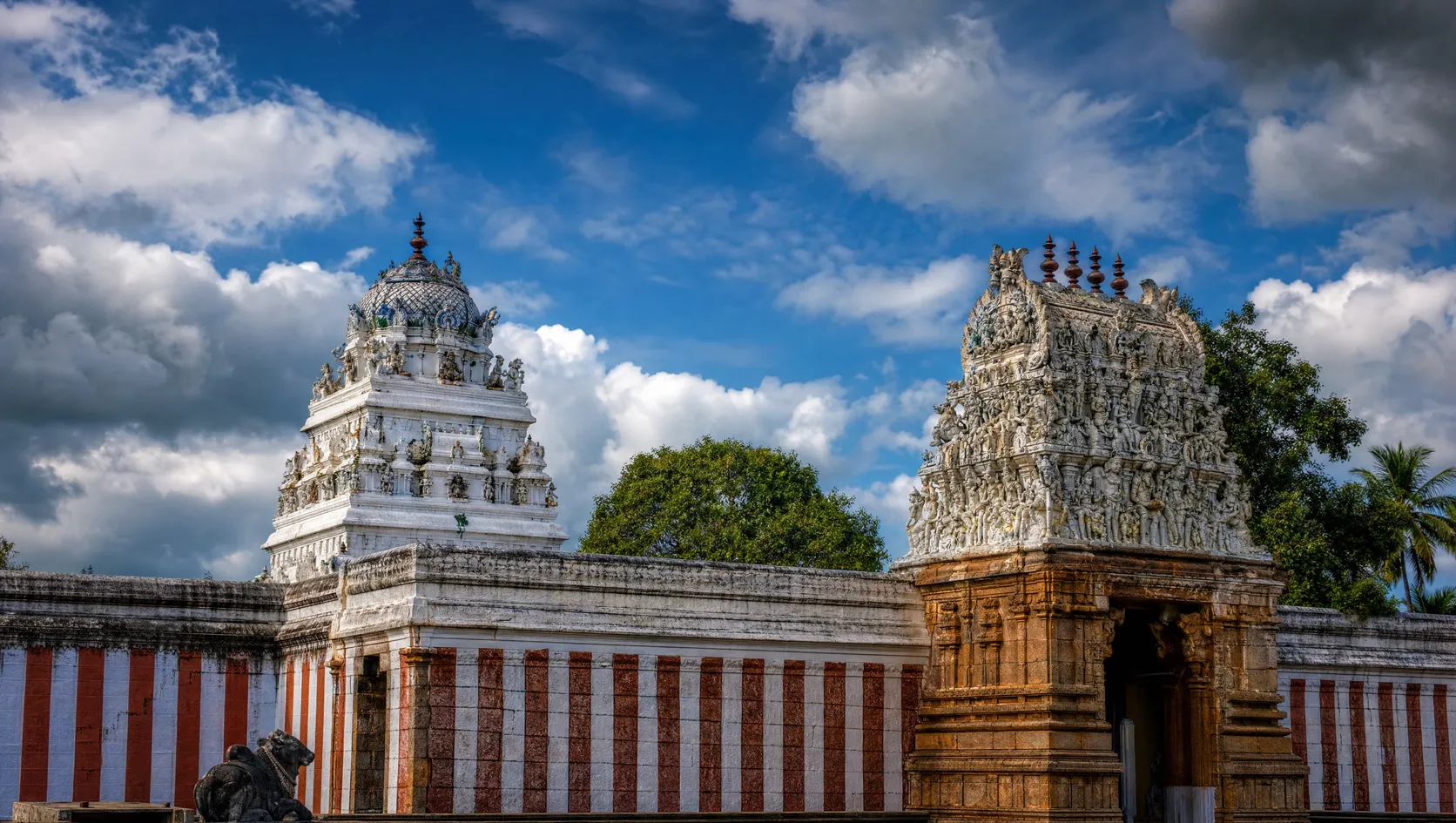
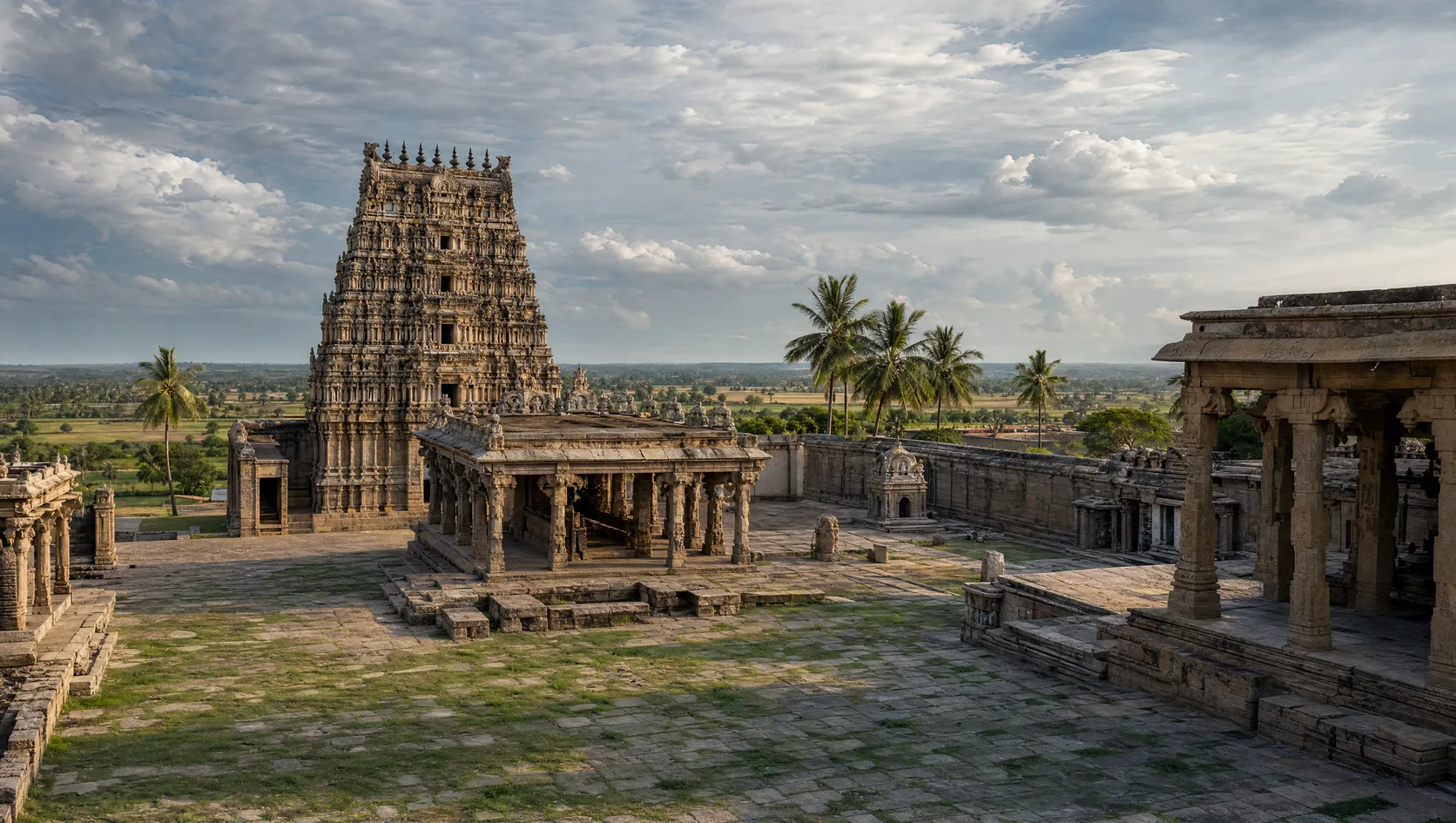
Dravidian, distinguished by the three-tiered Ashtanga Vimana over the sanctum on which the Lord is worshipped in three forms, standing, seated and reclining, with gopuram and prakara enclosures
खुला
07:00 – 20:00
विशेष
The temple observes the Srivaishnava round of worship to Sowmya Narayana, with the recitation of the Nalayira Divya Prabandham and the worship of the Lord in his three forms on the tiers of the Ashtanga Vimana. Timings run in morning and evening sessions with a midday break and vary with the festival calendar; they should be confirmed locally.
पवित्र कथा · पवित्र कथा
Among the hundred and eight Divya Desams, the abodes of Vishnu sung by the Alvar poet-saints, Thirukoshtiyur in the Sivaganga country is remembered above all for a single act of holy disobedience, one of the most beloved stories in the whole of Srivaishnavism. Here lived Thirukkottiyur Nambi, called Goshthipurna, one of the five teachers of Ramanuja, the great philosopher of Vishishtadvaita. Ramanuja longed to receive from him the Ashtakshara, the eight-syllable mantra, Om Namo Narayanaya, the Tirumantra held to carry the whole secret of surrender to Vishnu. But Nambi, guarding the mantra as too sacred to give lightly, sent him away again and again. Eighteen times, the tradition says, Ramanuja made the long journey to Thirukoshtiyur, and eighteen times he was turned back, until at last, seeing the depth of his disciple's yearning, Nambi imparted the mantra, but with a solemn condition: it was to be kept utterly secret, whispered only to the worthy, and whoever revealed it to the unworthy would fall into hell. Ramanuja received the mantra, and then did a thing that has echoed through the tradition ever since. He climbed the tower of the temple, gathered the people below, and proclaimed the sacred Ashtakshara aloud to all of them, high and low alike, so that everyone who heard it might be saved. When Nambi, aghast, asked whether he did not fear hell for breaking the condition, Ramanuja answered that he would gladly suffer hell himself if by it the countless souls who heard the mantra could reach liberation. Nambi, overcome, is said to have fallen at his disciple's feet, for the pupil had understood the deepest heart of the teaching better than the teacher who guarded it: that the grace of the Lord is for all, and that love which will bear another's hell to open heaven to the many is the very soul of surrender. So Thirukoshtiyur is the temple of the mantra given to the world. The Lord here is Sowmya Narayana, the gentle Narayana, Uraga Mellanaiyan, who reclines softly upon the serpent, and he is worshipped in three forms upon the three tiers of the temple's Ashtanga Vimana. But the story that draws the pilgrim up its steps is Ramanuja's, the compassion that opened the secret to all.
Sacred Designationपवित्र पदनाम
Sacred Origin Storyपवित्र उत्पत्ति कथा
Source: The Sthala Purana of Thirukoshtiyur and the Srivaishnava tradition
The name Thirukoshtiyur is traced by the tradition to koshti, an assembly or gathering, for here, the Sthala Purana holds, the celestials gathered in council to seek the Lord's help against the tyranny of the demon king Hiranyakashipu. When Hiranyakashipu had won a boon that seemed to make him unkillable, and had turned his fury even upon his own son Prahlada, the great devotee of Vishnu, the gods and sages could not by themselves see how the tyrant might be ended. They came together in this place, in a great assembly, to take counsel and to pray to Vishnu, and it is from that gathering, the goshthi of the celestials, that the town takes its name.
Vishnu, the tradition says, appeared to that assembly here and gave his assurance, and it was in fulfilment of it that he took the form of Narasimha, the man-lion, neither man nor beast, and slew Hiranyakashipu to save Prahlada. So Thirukoshtiyur is remembered as the place of the council that preceded that great deliverance, the place where the anxious gathering of the gods was met by the Lord's promise.
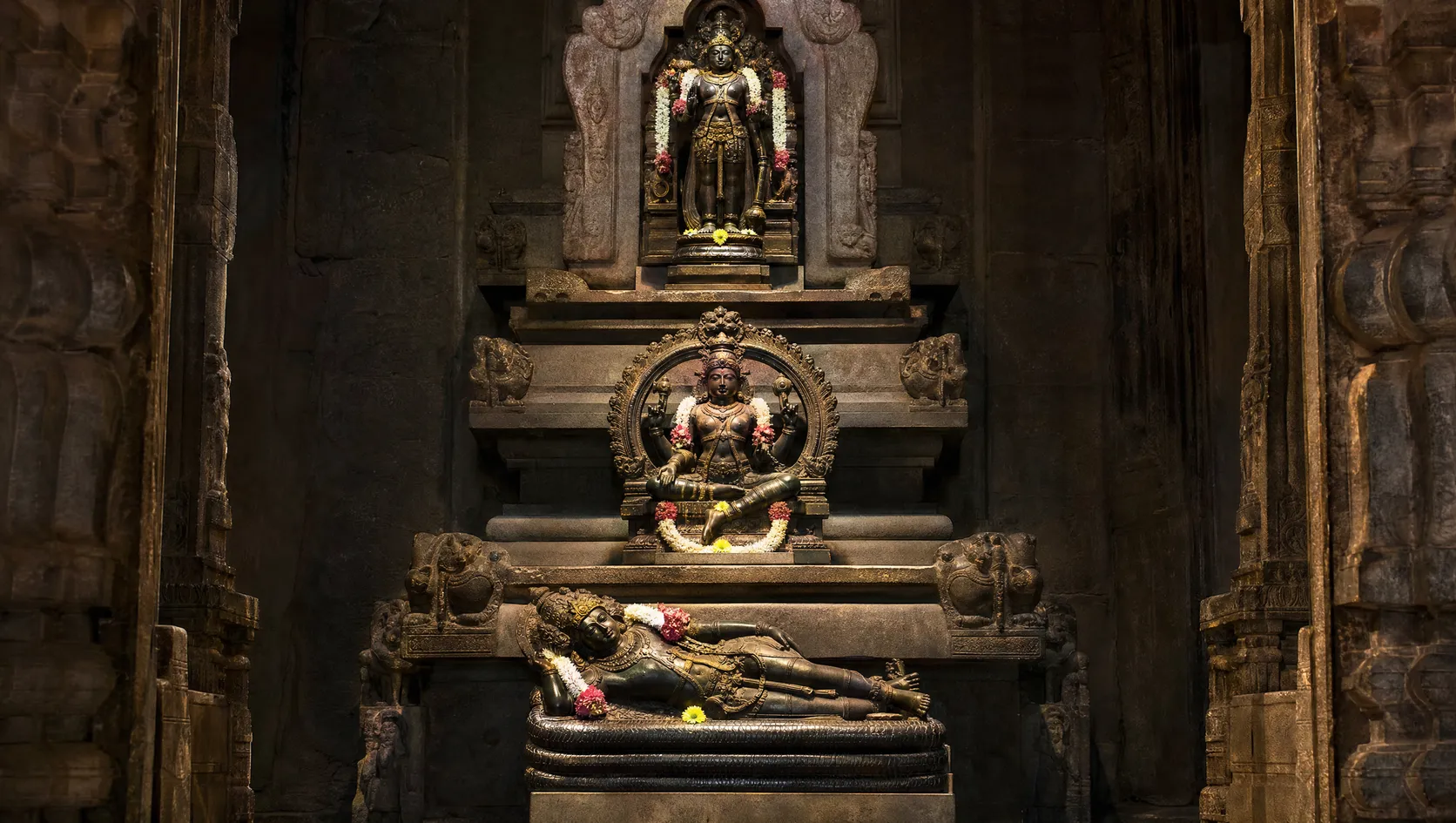
At Thirukoshtiyur the Lord is Sowmya Narayana, the gentle Narayana, and Uraga Mellanaiyan, he who reclines softly upon the serpent. Most strikingly, he is worshipped here in three forms upon the three ascending tiers of the Ashtanga Vimana, standing, seated and reclining, as though the one Lord showed himself in three postures to the assembled devotees, and the pilgrim climbs to behold each in turn. The three forms are held to answer the three states in which the Lord may be sought, and the whole vimana is a single image of Narayana revealed on rising levels to those who come to him.
उद्धृत स्रोत:
- Sthala Purana of Thirukoshtiyur
- Srivaishnava tradition and the Nalayira Divya Prabandham
- The Narasimha and Prahlada tradition of the Puranas
अन्य परंपराएँ · अन्य परंपराएँ
The Srivaishnava acharya tradition of Ramanuja and Thirukkottiyur Nambi
विद्वत संदर्भ
Thirukoshtiyur is one of the 108 Divya Desams, the Vishnu temples celebrated in the Tamil hymns of the Alvars gathered as the Nalayira Divya Prabandham, and its sanctity is attested from the period of that hymnody in the first millennium. It lies in the Pandya country of the far south, in what is now the Sivaganga district, and its history runs through the Chola, Pandya, Vijayanagara and Nayaka periods that shaped the temples of the region. What gives Thirukoshtiyur its exceptional place in the tradition, however, is its association with Ramanuja, the eleventh- to twelfth-century philosopher of Vishishtadvaita, qualified non-dualism, and with his teacher there, known as Thirukkottiyur Nambi or Goshthipurna, counted among the five acharyas from whom Ramanuja received his learning. The episode of the eighteen journeys and the proclamation of the Ashtakshara from the temple tower is one of the most cited stories of Ramanuja's life, preserved in the traditional biographies, the Guruparampara accounts, and repeated wherever the ideal of Srivaishnava compassion is taught. Scholars note the story's function within the tradition: it dramatises the tension between esoteric guarding of sacred knowledge and the universalist impulse of the bhakti movement, and resolves it decisively on the side of openness, making Ramanuja the figure who breaks the seal of secrecy out of love for all souls. The temple's architecture is itself distinctive, with its rare Ashtanga Vimana on which the Lord is worshipped in three forms, a feature that sets Thirukoshtiyur apart among the Divya Desams and draws students of southern temple building as well as devotees.
Historyइतिहास
Thirukoshtiyur is one of the 108 Divya Desams, the temples of Vishnu sung by the Alvar poet-saints in the Nalayira Divya Prabandham, and it stands in the Sivaganga district of Tamil Nadu, in the old Pandya country of the far south. Its sanctity reaches back to the age of the Alvars in the first millennium, and the Lord here, Sowmya Narayana, the gentle Narayana, is worshipped in a form found almost nowhere else, in three shapes, standing, seated and reclining, upon the three tiers of the rare Ashtanga Vimana that rises over the sanctum.
The Sthala Purana traces the town's name to koshti, the assembly of the gods who gathered here to seek Vishnu's aid against the tyrant Hiranyakashipu, an appeal answered by the Lord's incarnation as Narasimha to save the child devotee Prahlada. But the history that has made Thirukoshtiyur known across the whole Srivaishnava world belongs to a later age, to the eleventh and twelfth centuries and to Ramanuja, the philosopher of Vishishtadvaita.
Thirukoshtiyur was the home of one of Ramanuja's five teachers, Thirukkottiyur Nambi, honoured in Sanskrit as Goshthipurna. From him Ramanuja sought the Ashtakshara, the eight-syllable mantra Om Namo Narayanaya, the Tirumantra that carries the secret of surrender to the Lord. Nambi, guarding it as sacred, refused him again and again, and the tradition holds that Ramanuja made the long journey to Thirukoshtiyur eighteen times before the mantra was at last imparted to him, under the strict condition that it be kept secret and given only to the worthy, on pain of hell.
What Ramanuja did next became one of the defining stories of Srivaishnavism. He climbed the tower of the temple, called the people together, and proclaimed the sacred mantra aloud to all of them, so that everyone who heard it might attain liberation. When his teacher asked whether he did not fear the hell he had been warned of, Ramanuja said he would gladly bear hell himself if by it the many could be saved. Nambi, moved to the depths, is said to have honoured his disciple, seeing that Ramanuja had grasped the true heart of the teaching, that the Lord's grace is for all.
The temple was endowed and maintained through the Chola, Pandya, Vijayanagara and Nayaka periods, like the other Divya Desams of the region, and its distinctive vimana and shrines were kept and renewed across the centuries. In the modern period it has undergone renovation and consecration, and it remains a living Divya Desam, drawing pilgrims of the Srivaishnava tradition who come both to worship Sowmya Narayana in his three forms and to stand where Ramanuja opened the secret of the mantra to the world.
Historical Timelineऐतिहासिक कालक्रम
The Alvars, the Tamil poet-saints of Vishnu, sing Thirukoshtiyur in the hymns gathered as the Nalayira Divya Prabandham, establishing it as one of the 108 Divya Desams and giving it an attested sanctity of great antiquity.
The Alvars' activity is generally placed across the middle centuries of the first millennium; their hymns are the earliest firm evidence of Thirukoshtiyur's standing as a Divya Desam.
Under the Cholas and the Pandyas the temple is endowed and maintained, its shrines and enclosures built and kept, as the Divya Desams of the far south are woven into the religious life of the great southern dynasties.
The temples of the Pandya country, Thirukoshtiyur among them, were endowed across the centuries of Chola and Pandya rule.
Thirukkottiyur Nambi, honoured as Goshthipurna, lives and teaches at Thirukoshtiyur and becomes one of the five acharyas of Ramanuja, the great philosopher of Vishishtadvaita.
Thirukkottiyur Nambi is counted among the five teachers from whom Ramanuja received the different parts of his learning, according to the traditional accounts.
Ramanuja seeks the Ashtakshara, the eight-syllable mantra, from Thirukkottiyur Nambi, and the tradition holds that he is refused and made to journey to Thirukoshtiyur eighteen times before the teacher judges him ready to receive it.
The eighteen journeys are among the most repeated details of Ramanuja's life in the traditional biographies.
Having at last received the mantra under a vow of secrecy on pain of hell, Ramanuja climbs the temple tower and proclaims the Ashtakshara aloud to all the people below, declaring he would gladly bear hell himself so that the many might be saved.
The proclamation of the mantra from the tower is the defining episode associated with Thirukoshtiyur and one of the best-known stories of Ramanuja's compassion.
The tradition holds that Thirukkottiyur Nambi, far from condemning his disciple, honours him, recognising that Ramanuja had understood the true heart of the teaching, that the Lord's grace is meant for all, and giving him the name that acknowledges his greatness.
The teacher's honouring of the disciple is the tradition's way of resolving the tension between the guarding and the giving of the sacred mantra.
In the troubled fourteenth century, when the armies of the Delhi Sultanate reach the far south and many temples of the Tamil country are disrupted, the Divya Desams of the Pandya region including Thirukoshtiyur pass through a difficult age before the recovery under Vijayanagara.
The temples of the Pandya country shared in the disruption of the early fourteenth century and the subsequent revival.
Under the Vijayanagara empire and the Nayaka rulers who followed, the temples of the region are restored, endowed and maintained, and the worship of the Divya Desams of the Pandya country, Thirukoshtiyur among them, is renewed and continued.
The temple and the Divya Desams of the Sivaganga country are recorded in the surveys and gazetteers of the colonial era, which document the shrines of the Pandya region and their standing in the Srivaishnava tradition.
In the modern era the temple undergoes renovation and re-consecration (kumbhabhishekam), its Ashtanga Vimana and shrines maintained and renewed, keeping the ancient Divya Desam in living worship.
Periodic consecration keeps the temple in ritual use and its structures maintained.
Thirukoshtiyur remains a living Divya Desam, drawing pilgrims of the Srivaishnava tradition who come to worship Sowmya Narayana in his three forms on the Ashtanga Vimana and to stand at the place where Ramanuja proclaimed the Ashtakshara for the salvation of all.
What You'll Seeदर्शन में
The presiding deity of Thirukoshtiyur is Sowmya Narayana, the gentle Narayana, and Uraga Mellanaiyan, he who reclines softly upon the serpent, and the temple is distinguished among the Divya Desams by the way he is worshipped, in three forms upon the three ascending tiers of the rare Ashtanga Vimana that rises over the sanctum.
On the levels of the vimana the one Lord is seen in three postures, standing, seated and reclining, so that the pilgrim who climbs to behold him passes from one form to the next and worships Narayana revealed in the three states in which he may be sought. The reclining form is Uraga Mellanaiyan, Vishnu at rest upon the coils of the serpent Adishesha; the seated and standing forms complete the triad, the single god shown in the fullness of his aspects. This three-fold worship on a single vimana is found almost nowhere else and is the iconographic signature of Thirukoshtiyur.
The consort of the Lord here is Thirumamagal Nachiyar, the goddess Sri, Mahalakshmi, who is worshipped in her own shrine within the temple, so that the Lord and the Goddess are both present to the devotee. Around them the temple holds the shrines and the imagery proper to a Srivaishnava Divya Desam, the Alvars whose hymns sanctified the place and the acharyas of the tradition, above all the memory of Thirukkottiyur Nambi and of Ramanuja, whose act on the temple tower is inseparable from the place. To stand before the three forms of Sowmya Narayana and to remember the mantra proclaimed from the tower is to hold together the two things Thirukoshtiyur offers: the vision of the gentle Lord in his fullness, and the story of the grace opened to all.
Distinctive Practicesविशिष्ट परंपराएँ
Remembrance of the Ashtakshara Proclaimed from the Tower
मीनार से उद्घोषित अष्टाक्षर का स्मरण
Year-round, central to the temple's identity
At Thirukoshtiyur the pilgrim comes above all to stand where Ramanuja climbed the tower and proclaimed the Ashtakshara, the eight-syllable mantra Om Namo Narayanaya, aloud to all so that everyone might be saved. The story is retold, the tower is shown, and the devotee remembers the compassion that opened the secret of surrender to every soul, high and low alike.
The proclamation from the tower makes a doctrine into an event a pilgrim can stand within. The Ashtakshara is the Tirumantra, the mantra held to carry the whole secret of surrender to Narayana, and its giving away to all is the tradition's clearest statement that the Lord's grace is not the possession of a few but the birthright of every soul. To remember the story at Thirukoshtiyur is to receive again the assurance that the door to the Lord is open, and to honour the love that would bear another's hell so that the many might reach heaven.
Ascending the Ashtanga Vimana to Worship the Three Forms
तीन रूपों की उपासना को अष्टांग विमान पर चढ़ना
Year-round, according to the temple's arrangements
Sowmya Narayana is worshipped at Thirukoshtiyur in three forms, standing, seated and reclining, upon the three tiers of the Ashtanga Vimana, and the devotee ascends to behold the Lord in each of his postures, a rare arrangement found almost nowhere else among the Divya Desams.
The threefold vision on the ascending vimana is held to show the one Lord in the fullness of the states in which he receives his devotees. To climb from the standing to the seated to the reclining form is to worship Narayana not in a single aspect but in the completeness of his presence, and the ascent itself becomes a movement of the soul toward the Lord, each level a nearer approach to the god who shows himself whole to those who come.
Recitation of the Tirumantra and the Nalayira Divya Prabandham
तिरुमंत्र और नालायिर दिव्य प्रबंधम् का पाठ
Daily in worship, and centrally in the festival of Adhyayana Utsavam
The eight-syllable Tirumantra, Om Namo Narayanaya, given here to Ramanuja and through him to all, is cherished at Thirukoshtiyur, and the Tamil hymns of the Alvars, the Nalayira Divya Prabandham, are recited in the temple's worship beside the Sanskrit texts, keeping alive the twin scripture of the Srivaishnava tradition.
The Tirumantra is the heart of Srivaishnava practice, the mantra of surrender whose whole story is bound to this temple, and to recite it here is to take up the very words Ramanuja opened to the world. That the Tamil Prabandham is sung beside the Sanskrit is the defining claim of the tradition, that the hymns of the Alvars are Veda in Tamil, and at Thirukoshtiyur, where the mantra was given to all, the recitation of the hymns in the language of the land carries the same spirit of a grace meant for everyone who will receive it.
Veneration of Thirukkottiyur Nambi and the Acharyas
तिरुक्कोट्टियूर नंबि और आचार्यों की श्रद्धा
Year-round, with the acharyas' observances
The tradition honours Thirukkottiyur Nambi, Goshthipurna, the teacher of Ramanuja who both guarded the mantra and, in the end, honoured the disciple who gave it away, and the memory of the acharyas is kept at the temple as the living chain through which the teaching was handed down.
In Srivaishnavism the acharya is the door to the Lord, the one through whom the mantra and the surrender are received, and to honour Thirukkottiyur Nambi is to honour the teacher without whom the mantra would not have come to Ramanuja and through him to all. The tradition keeps both the guarding and the giving as parts of one teaching, and reverence for the acharya at the very place of the mantra's giving binds the teacher, the disciple and the grace into a single act of remembrance.
Did You Know?क्या आप जानते हैं?
Thirukoshtiyur is the Divya Desam where Ramanuja, after receiving the secret eight-syllable mantra, climbed the temple tower and proclaimed it aloud to all so that everyone might be saved, one of the most beloved stories in Srivaishnavism.
Srivaishnava tradition
The tradition holds that Ramanuja was made to journey to Thirukoshtiyur eighteen times before his teacher Thirukkottiyur Nambi would impart the Ashtakshara mantra to him.
Srivaishnava biographical tradition
Told that whoever revealed the mantra to the unworthy would fall into hell, Ramanuja answered that he would gladly bear hell himself if by it the many who heard it could reach liberation.
Srivaishnava tradition
The Lord here, Sowmya Narayana, is worshipped in three forms, standing, seated and reclining, upon the three tiers of the rare Ashtanga Vimana, an arrangement found almost nowhere else among the Divya Desams.
Temple tradition
The Lord is also called Uraga Mellanaiyan, he who reclines softly upon the serpent, a Tamil name evoking the gentle rest of Vishnu upon Adishesha.
Nalayira Divya Prabandham tradition
The name Thirukoshtiyur is traced to koshti, an assembly, for the Sthala Purana holds that the gods gathered here in council to seek Vishnu's help against the tyrant Hiranyakashipu, answered by his incarnation as Narasimha.
Sthala Purana of Thirukoshtiyur
Thirukkottiyur Nambi, honoured in Sanskrit as Goshthipurna, was one of the five acharyas from whom Ramanuja received the different parts of his learning.
Srivaishnava Guruparampara tradition
The consort of Sowmya Narayana here is Thirumamagal Nachiyar, the goddess Sri, Mahalakshmi, worshipped in her own shrine within the temple.
Temple tradition
Thirukoshtiyur stands in the Sivaganga district in the Chettinad country of the far south, one of the Divya Desams of the old Pandya land sung by the Alvars in the first millennium.
Divya Desam tradition
Visitor Accessप्रवेश जानकारी
The temple is open to Hindu worshippers, and the inner sanctum of Sowmya Narayana, on the tiers of the Ashtanga Vimana, is reached through the temple's enclosures. As at many Vaishnava temples of the south, entry to the innermost precinct is restricted to Hindus, and this is signposted at the temple. Worship of the Lord in his three forms involves ascending the vimana, and access to the upper levels may be regulated according to the temple's arrangements and the day; devotees should follow the guidance of the temple staff. A dress code of traditional attire applies, and footwear is left outside the temple. Timings run in morning and evening sessions with a midday closure, and vary with the festival calendar. Confirm current timings and any restrictions locally before visiting, especially if intending to worship all three forms on the vimana.
आध्यात्मिक आधार
The ascent of the vimana to worship the Lord in his three forms is itself a spiritual form, a graded approach in which the devotee rises from one aspect of Narayana to the next, and the restriction of the innermost precinct to Hindus follows the practice of the Vaishnava temples of the south, which preserve the ritual purity of the sanctum according to their tradition. Within these forms the Lord's accessibility is held to be real for all his devotees, and Thirukoshtiyur, of all places, is the temple where the tradition proclaims that the grace of the Lord is meant for everyone: the very story of the place is Ramanuja opening the secret mantra to all who would hear. The ordering of access serves the sanctity of the worship, while the heart of the temple's teaching is the openness of the Lord's grace.
समकालीन संदर्भ
Thirukoshtiyur is a much-visited Divya Desam, drawing pilgrims of the Srivaishnava tradition throughout the year and larger crowds at its festivals and on days sacred to Ramanuja. It lies in the Sivaganga district, in the Chettinad country, and is often visited as part of a circuit of the Divya Desams of the Pandya region. The temple is maintained in active worship, its Ashtanga Vimana and shrines kept and periodically re-consecrated. Pilgrims come both to worship Sowmya Narayana in his three forms and to stand at the place of Ramanuja's proclamation of the mantra, and many come especially on Ramanuja Jayanti and at the great festivals. On ordinary days the darshan is unhurried; on festival days and on days sacred to the acharya the crowds are larger.
व्यावहारिक मार्गदर्शन
Allow time to worship the Lord in all three of his forms on the tiers of the Ashtanga Vimana, following the temple's arrangements for the ascent, and to see the shrine of Thirumamagal Nachiyar. Ask about the timings for the worship of the upper forms, which may be regulated by the day and the hour. Dress traditionally and leave footwear outside. The temple lies in the Sivaganga district and is most easily reached from Madurai; it combines well with the other Divya Desams and temples of the Pandya country on a pilgrimage circuit. A visit on Ramanuja Jayanti or at the great festivals brings the fullest devotional atmosphere, though with larger crowds; an ordinary day allows a quieter darshan of the gentle Lord in his three forms.
Festivalsत्योहार
Vaikuntha Ekadasi
वैकुण्ठ एकादशी
Dec-Jan (Margazhi)
The great Vaishnava festival of the opened gate of heaven, observed at Thirukoshtiyur as at the Divya Desams generally, when devotees seek the vision of Vaikuntha and the grace of Sowmya Narayana on the most sacred of the year's Ekadasis.
Chithirai Brahmotsavam
चित्तिरै ब्रह्मोत्सवम्
Apr-May (Chithirai)
The great annual Brahmotsavam of the temple, over its days of which the processional Sowmya Narayana is taken in procession on the vahanas around the temple and streets, the fullest celebration of the Lord's public presence.
Ramanuja Jayanti
रामानुज जयंती
Apr-May (Chithirai)
The appearance day of Ramanuja, observed with particular reverence at Thirukoshtiyur, the temple where he received the Ashtakshara and proclaimed it to all, a place bound to the founder-teacher of the tradition more closely than almost any other.
Adhyayana Utsavam
अध्ययन उत्सवम्
Dec-Jan (Margazhi)
The festival of the recitation of the Nalayira Divya Prabandham, when the Tamil hymns of the Alvars are chanted through its days, a central observance of the Srivaishnava year kept at the Divya Desams including Thirukoshtiyur.
Narasimha Jayanti
नरसिंह जयंती
Apr-May (Vaikasi)
The appearance day of Narasimha, observed at Thirukoshtiyur in keeping with the Sthala Purana, which links the town's founding assembly of the gods to the Lord's incarnation as the man-lion to save Prahlada.
Traditional Offeringsपारंपरिक अर्पण
प्राथमिक अर्पण
Tulasi (holy basil)
तुलसी
तुलसी
Tulasi, the holy basil beloved of Vishnu, is the offering most proper to Sowmya Narayana as to any form of Vishnu, laid at his feet and woven into his garlands. No worship of Vishnu is complete without it, and at Thirukoshtiyur it is offered to the gentle Lord in his three forms.
Sacred food (naivedyam / prasadam)
नैवेद्य (प्रसाद)
नैवेद्यम्
Food is cooked and offered to Sowmya Narayana and then shared with the devotees as prasadam, the grace of the Lord made tangible. To receive the prasadam of the temple is to carry away a portion of the worship offered to the god.
Garlands of flowers
पुष्प-मालाएँ
पुष्पमाला
Garlands of flowers, with tulasi, are offered to Sowmya Narayana and to the goddess Thirumamagal Nachiyar, and garlands that have adorned the deity are returned to devotees as a blessing carrying the touch of the Lord.
Lamp offering (deepa aradhana)
दीप भेंट (दीपाराधना)
दीपाराधना
The waving of lamps before the Lord in his three forms is a central act of worship, the light offered to the god who is worshipped ascending the tiers of the vimana, and the devotee receives the blessing of the flame that has been shown to Sowmya Narayana.
Recitation of the eight-syllable mantra (Ashtakshara japa)
आठ-अक्षरी मंत्र का जप (अष्टाक्षर जप)
अष्टाक्षरमन्त्रजपः
Beyond material offerings, the recitation of the Ashtakshara, Om Namo Narayanaya, the Tirumantra given here to all through Ramanuja, is held the offering most proper to this temple, together with the hymns of the Alvars and the names of Vishnu. At Thirukoshtiyur, the temple of the mantra, the offering of the sacred syllables is the offering closest to its story.
इस मंदिर की विशेषता
The Offering of Surrender through the Tirumantra
तिरुमंत्र के माध्यम से शरणागति की भेंट
What is particular to Thirukoshtiyur is that its highest offering is the one its whole story is about: the surrender of the self to Narayana through the eight-syllable Tirumantra, the mantra Ramanuja opened to all from the temple tower. The pilgrim brings tulasi, flowers and food as at any shrine of Vishnu, but the offering the tradition holds highest here is the taking up of the Ashtakshara in trust, the casting of oneself upon the grace of the Lord whom the mantra names. The story of the temple is itself the teaching: that this offering of surrender is not the possession of a few but is meant for all, proclaimed aloud so that everyone might make it. To recite the Tirumantra at Thirukoshtiyur, where it was given to the world, is to enter the very act that Ramanuja performed for the sake of all souls, the offering of oneself answered by the promise of the Lord's grace.
Offerings at Thirukoshtiyur follow the Srivaishnava tradition, with tulasi, flowers, garlands, lamp offering and prasadam central, and the recitation of the Ashtakshara, the Prabandham and the names of Vishnu held as offerings of word. The temple's own story makes the offering of the Tirumantra and the surrender it carries the offering most proper to the place. Eternal Raga presents these practices as a devotional tradition; specific seva and offering arrangements should be confirmed with the temple.
How to Reachकैसे पहुँचें
Thirukoshtiyur lies in the Sivaganga district of Tamil Nadu, in the Chettinad country of the far south, near Tirupathur, and is reached most easily from Madurai.
By air: Madurai Airport is about 45 to 50 km away, connected to Chennai and other cities, and is the nearest airport to the temple.
By rail: The nearest towns are Tirupathur and Sivaganga, and Madurai Junction, one of the major railheads of the southern Tamil land, is the principal railway station of the region, connected to Chennai, Tiruchirappalli and the wider network.
By road: Thirukoshtiyur is reached by road from Madurai, Sivaganga and Tirupathur, served by buses and taxis through the Chettinad country. The temple is in the town, and local transport connects it to the surrounding towns of the district.
Many pilgrims visit Thirukoshtiyur as part of a circuit of the Divya Desams of the Pandya region, and it is often combined with the temples of Madurai and the other Vishnu shrines of the far south.
Plan Your Visitयात्रा की योजना
🌤 सर्वोत्तम मौसम
October to March is the most comfortable time to visit, with milder temperatures in the Pandya plain. The Margazhi month (December-January) brings Vaikuntha Ekadasi and the Adhyayana Utsavam, and the Chithirai month (April-May) brings the Brahmotsavam and Ramanuja Jayanti, the days most closely bound to the temple's founder-teacher. April to June is hot in the far south, though the Chithirai festivals fall in this period and are a major draw. The monsoon months bring rain but the temple remains accessible. Early morning and evening are the most atmospheric times, when the temple is active with worship and the heat is least. Days sacred to Ramanuja bring the fullest devotional atmosphere at this temple so closely bound to him.
👘 पहनावे का नियम
Traditional and modest dress is required. Men commonly wear a dhoti or trousers with a shirt; women a saree or salwar kameez. Footwear is left outside the temple. As a Vaishnava Divya Desam, Thirukoshtiyur expects respectful traditional attire throughout its enclosures.
📱 फोन और फोटोग्राफी
Photography is generally restricted within the inner shrines and on the vimana, and cameras and phones may need to be kept away in the innermost areas. Follow the posted rules and the directions of the temple staff, and keep phones silenced within the shrines.
🏨 आवास
Thirukoshtiyur is a small town, and most visitors stay at Madurai, a short distance away, which offers a full range of accommodation from budget lodges to hotels of all standards, or at Sivaganga and the nearby Chettinad towns. Basic lodging may be available closer to the temple. Demand rises around Ramanuja Jayanti, the Brahmotsavam and Vaikuntha Ekadasi, when booking ahead is advisable. Outside the festivals the area absorbs its pilgrims easily, and a day visit from Madurai is straightforward.
Sacred Soundsपवित्र ध्वनि
क्या आप जानते हैं? · Did You Know?
वही अनुवाद त्रुटि जिसने हिन्दू धर्म में '33 कोटि' को '33 करोड़' बनाया, बौद्ध धर्म में भी हुई। बौद्ध ग्रन्थों के चीनी अनुवाद ने 'सप्त कोटि बुद्ध' (7 श्रेष्ठ बुद्ध) का अनुवाद '7 करोड़ बुद्ध' कर दिया। तिब्बती अनुवाद ने सही किया: 7 प्रकार, 7 करोड़ नहीं। एक संस्कृत शब्द, दो प्रमुख विश्व धर्मों में गलत पढ़ा गया, ने दो एकसमान भ्रम स्वतन्त्र रूप से उत्पन्न किए।
Related Contentसंबंधित सामग्री
Related Scriptures
Community Reflections
🕉️
Be the first to share your reflection.