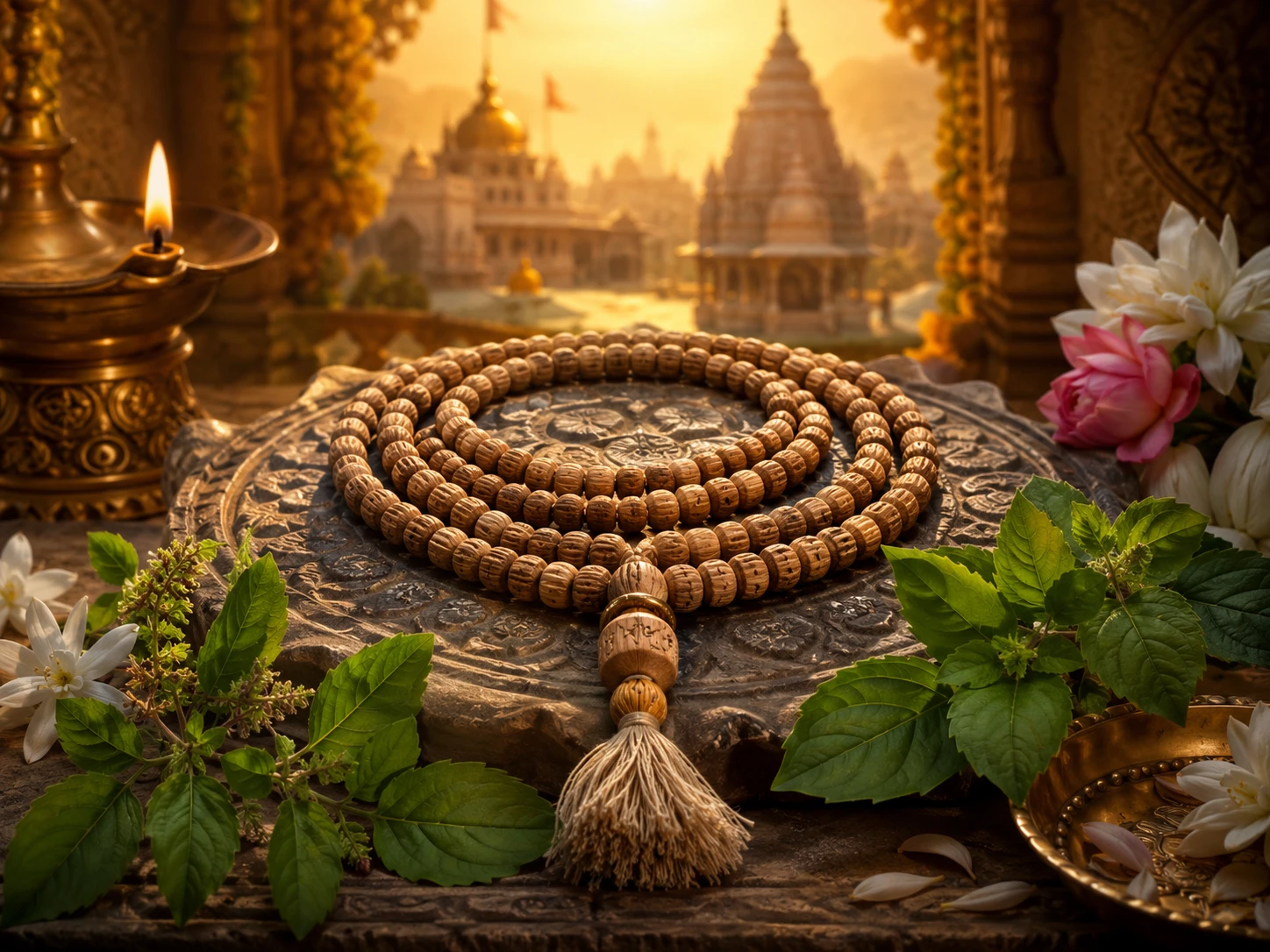
Tulasi Mala -- The Neckbeads That Mark You as Vishnu's Own
तुलसी माला -- वो गले के मनके जो तुम्हें विष्णु का अपना चिह्नित करते हैं
यदि तुमने कभी ISKCON भक्त देखा -- वृन्दावन में, मायापुर में, Manhattan या Melbourne की सड़कों पर, Frankfurt या Bangkok के हवाई अड्डे पर -- तुमने मनके सबसे पहले देखे। दो-तीन लड़ियाँ छोटे, हल्के-भूरे काठ के मनकों की गला घेरे, त्वचा पर सपाट, कुर्ते के ऊपर या शर्ट कॉलर के नीचे पर सदा दृश्य। ये तुलसी गलमनके -- कण्ठी माला -- और आधुनिक विश्व में वैष्णव भक्त का सबसे दृश्य बाह्य पहचानकर्ता।
लेकिन तुलसी माला ISKCON का आविष्कार नहीं। प्राचीन वैष्णव परम्परा, पद्म पुराण, गरुड पुराण, विष्णु धर्मोत्तर पुराण और हरि भक्ति विलास (16वीं शताब्दी में सनातन गोस्वामी का प्रामाणिक गौडीय वैष्णव अनुष्ठान ग्रन्थ) में प्रलेखित।
पद्म पुराण विशिष्ट स्पष्टता से: जो तुलसी की लकड़ी सहित चिता पर दाह संस्कार हों, या मृत्यु समय तुलसी मनके पहने हों, पुनर्जन्म-चक्र से मुक्त। यमदूत ऐसे व्यक्ति के पास नहीं आयेंगे। विष्णुदूत आयेंगे।
Whitefield बेंगलुरु के software engineer के लिए जो हर दिन office शर्ट के नीचे तुलसी कण्ठी पहनता है और काम पर कोई नहीं जानता, मनके निजी दिशासूचक -- निरन्तर स्पर्शज स्मारक कि भौतिक संसार, अपने sprint reviews और OKRs सहित, अन्तिम यथार्थ नहीं।
तुलसीकाष्ठसम्भूतां मालां यः कण्ठे धारयेत्। स गच्छेद्विष्णुसदनं यत्र गत्वा न शोचति॥
tulasīkāṣṭhasambhūtāṃ mālāṃ yaḥ kaṇṭhe dhārayet | sa gacchedviṣṇusadanaṃ yatra gatvā na śocati ||
जो तुलसी काष्ठ से बनी माला कण्ठ में धारण करे, वो विष्णु के धाम जाता है, जहाँ पहुँचकर कभी शोक नहीं करता।
— Padma Purana (Tulasi Mahatmya section)
दोनों रूप भिन्न कार्य पर एक पवित्र सामग्री।
**कण्ठी माला (गलमनके)**
कण्ठी स्थायी रूप से पहनी, दिन-रात, स्वेच्छा से कभी नहीं उतारी। प्रायः दो-तीन लड़ियाँ छोटे, चिकने तुलसी काष्ठ मनकों की मज़बूत धागे में पिरोयी। मनके स्वाभाविक रूप से मरे तुलसी पौधे की सूखी लकड़ी से -- पौधा काष्ठ के लिए कभी नहीं मारा जाना चाहिए। कण्ठी कण्ठ के पास, विशुद्ध चक्र पर।
कण्ठी माला प्राप्त करना वैष्णव दीक्षा का भाग। गौडीय वैष्णव परम्परा (ISKCON) में, गुरु दीक्षा-संस्कार में शिष्य के गले में कण्ठी रखता, हरे कृष्ण महामन्त्र सिखाता, आध्यात्मिक नाम देता। उस क्षण से कण्ठी शिष्य का स्थायी पहचान-चिह्न।
**जप माला (108-मनके प्रार्थना माला)**
तुलसी जप माला 108 मनके + एक बड़ा 'सुमेरु' या 'गुरु' मनका। 108 मनके 108 उपनिषदों, देवताओं के 108 नामों और पवित्र संख्या 108 से सम्बद्ध। भक्त दायें हाथ में, वस्त्र थैली (गोमुखी) में रखकर। प्रत्येक मनका एक सम्पूर्ण मन्त्र-पाठ।
एक सम्पूर्ण माला = 108 जप। गम्भीर साधक 16 माला दैनिक (ISKCON मानक, श्रील प्रभुपाद द्वारा निर्धारित), अर्थात् प्रतिदिन 1,728 मन्त्र। मनके-से-मनके की स्पर्शज गति भटकते मन के लिए भौतिक लंगर -- प्रत्येक मनके का स्पर्श ध्यान में सूक्ष्म-वापसी।
आज, तुलसी माला विश्वभर में लाखों वैष्णव पहनते -- तमिलनाडु के पारम्परिक अय्यंगार परिवारों से Moscow की ISKCON मण्डली, गुजरात के पुष्टिमार्गी से Nairobi के हरे कृष्ण समुदाय। जो मनके कभी केवल वृन्दावन और तिरुपति में दिखते थे, अब WeWork कार्यालयों में, Zoom कॉल्स पर और San Francisco की tech conferences में दिखते हैं।
कण्ठी माला बनाम जप माला -- प्रमुख भेद
| Aspect / पक्ष | Kanthi Mala / कण्ठी माला | Japa Mala / जप माला |
|---|---|---|
| Purpose / उद्देश्य | Identity + protection; worn permanently / पहचान + संरक्षण; स्थायी | Mantra counting during japa / जप में मन्त्र गणना |
| Bead count / मनके | Varies (usually 2-3 strands, small beads) / भिन्न (2-3 लड़ियाँ) | 108 + 1 sumeru bead / 108 + 1 सुमेरु |
| Worn / पहना | Around neck, always / गले में, सदा | Held in right hand inside gomukhi bag / दायें हाथ में गोमुखी थैली में |
| When used / कब | 24/7 -- never removed except to replace / 24/7 | During designated japa time / निर्धारित जप-काल में |
| Given by / किसके द्वारा | Guru at diksha (initiation) / गुरु दीक्षा पर | May be self-obtained or guru-given / स्वयं प्राप्त या गुरु-दत्त |
| Replacement / प्रतिस्थापन | When thread breaks or beads wear / धागा टूटे या मनके घिसें | When beads wear smooth / मनके चिकने घिसें |
| Disposal / विसर्जन | Placed at Tulasi base or river / तुलसी मूल या नदी में | Same -- never discarded casually / समान -- कभी लापरवाही से नहीं |
कुछ परम्पराएँ 27 मनके (चतुर्थांश-माला) या 54 मनके (अर्ध-माला) की तुलसी जप माला भी लघु साधना-काल के लिए प्रयोग करती हैं। चन्दन और रुद्राक्ष माला शैव और अन्य परम्पराओं में समान जप कार्य।
श्रील ए.सी. भक्तिवेदान्त स्वामी प्रभुपाद, ISKCON संस्थापक, ने 108-मनके तुलसी जप माला पर दैनिक 16 माला हरे कृष्ण महामन्त्र जप का मानक निर्धारित -- 1,728 व्यक्तिगत मन्त्र-पाठ। जब प्रभुपाद 1965 में 69 वर्ष की आयु में 40 रुपये और पुस्तकों का ट्रंक लेकर New York पहुँचे, अपने प्रथम अमेरिकी अनुयायियों को जो सबसे पहली चीज़ दी वो पुस्तक या प्रवचन नहीं -- तुलसी जप माला और जप का निर्देश। मनके दर्शन से पहले आये। आज ISKCON 100+ देशों में 800+ मन्दिर रखता है, और लगभग प्रत्येक दीक्षित सदस्य तुलसी कण्ठी पहनता और तुलसी जप माला पर जप करता।
आज अपनी जप साधना आरम्भ करो
तुलसी माला पर 108 के एक चक्र से आरम्भ करो, हरे कृष्ण महामन्त्र या ॐ नमो भगवते वासुदेवाय के साथ। एक चक्र स्थिर लगे तभी दूसरा जोड़ो। एटर्नल राग पर महामन्त्र का पृष्ठ अर्थ और जप-विधि बताता है।
Tags
Eternal Raga · शाश्वत राग
Institutional voice — scholarly articles on Sanatan Dharma
अपनी समझ गहरी करें
अपनी समझ और गहरी करें
sacred symbols
Tulasi -- The Only Plant in Hinduism That Gets Married to God
She has eight names. She gets a wedding ceremony. Vishnu refuses prasadam without her leaf. And she sits in the courtyard of 100 million Indian homes -- not as decoration but as a living deity. Tulasi is not a plant you worship. She is a goddess who chose to become a plant.
sacred symbols
Kalash -- The Sacred Pot That Contains Every Hindu Ritual Inside It
A brass pot, some water, mango leaves, a coconut on top. Looks simple. But the Purna Kumbha is a complete cosmological diagram -- the pot is Earth, the water is the life-force, the leaves are creation, the coconut is divine consciousness. No Hindu ritual begins without it. From Navratri to weddings to your griha pravesh -- the kalash was there first.
sacred symbols
Tilak Types -- The Hindu Forehead Mark That Tells Your Entire Spiritual Address
Before LinkedIn profiles and Instagram bios, Hindus had a one-glance identity system -- the tilak. A single mark on the forehead could tell you someone's deity, lineage, philosophy, and guru. Tripundra or Urdhva Pundra? Vibhuti or chandana? Each line is a declaration of cosmic allegiance.
sacred symbols
Yajnopavita -- The Sacred Thread That Made You Born Twice
Three cotton strands, nine deities, a knot that encodes your entire lineage. The Janeu is not a string -- it is a contract. A contract with your guru, your ancestors, and the Vedas. The Upanayana ceremony that gives it to you is called a second birth. And the thread you wear for the rest of your life is the receipt.
sacred artefacts
Samudra Manthan Treasures -- The 14 Things That Came Out When Gods and Demons Churned the Ocean Together
Poison came first. Immortality came last. In between: a goddess, a gem, a cow, a horse, a tree, a physician, a bow, a moon, and an elephant. The Samudra Manthan is not just a myth -- it is a startup pitch deck for the universe. Two rival teams. One impossible project. Fourteen deliverables. And a hostile takeover at the end.
sacred artefacts
Divine Gems -- Syamantaka, Kaustubha, and Chintamani
Hindu mythology's most precious stones are not mere ornaments -- they are plot devices, moral tests, and cosmic forces. The Syamantaka Mani turned Krishna into a detective. The Kaustubha emerged from the Ocean of Milk to sit forever on Vishnu's chest. The Chintamani fulfils every wish -- and teaches why that might be the worst thing that could happen to you.
श्रील ए.सी. भक्तिवेदान्त स्वामी प्रभुपाद, ISKCON संस्थापक, ने 108-मनके तुलसी जप माला पर दैनिक 16 माला हरे कृष्ण महामन्त्र जप का मानक निर्धारित -- 1,728 व्यक्तिगत मन्त्र-पाठ। जब प्रभुपाद 1965 में 69 वर्ष की आयु में 40 रुप…
More in Sacred Artefacts
Ashtadhatu -- The Sacred Eight-Metal Alloy of Indian Temples
12 मिनट पढ़ें
Banalinga -- The Stone God Made Himself in a River Over Millions of Years
13 मिनट पढ़ें
Celestial Trees -- Kalpavriksha and Parijata
12 मिनट पढ़ेंवही अनुवाद त्रुटि जिसने हिन्दू धर्म में '33 कोटि' को '33 करोड़' बनाया, बौद्ध धर्म में भी हुई। बौद्ध ग्रन्थों के चीनी अनुवाद ने 'सप्त कोटि बुद्ध' (7 श्रेष्ठ बुद्ध) का अनुवाद '7 करोड़ बुद्ध' कर दिया। तिब्बती अनुवाद ने सही …
Deities AvatarsCommunity Reflections
🕉️
Be the first to share your reflection.