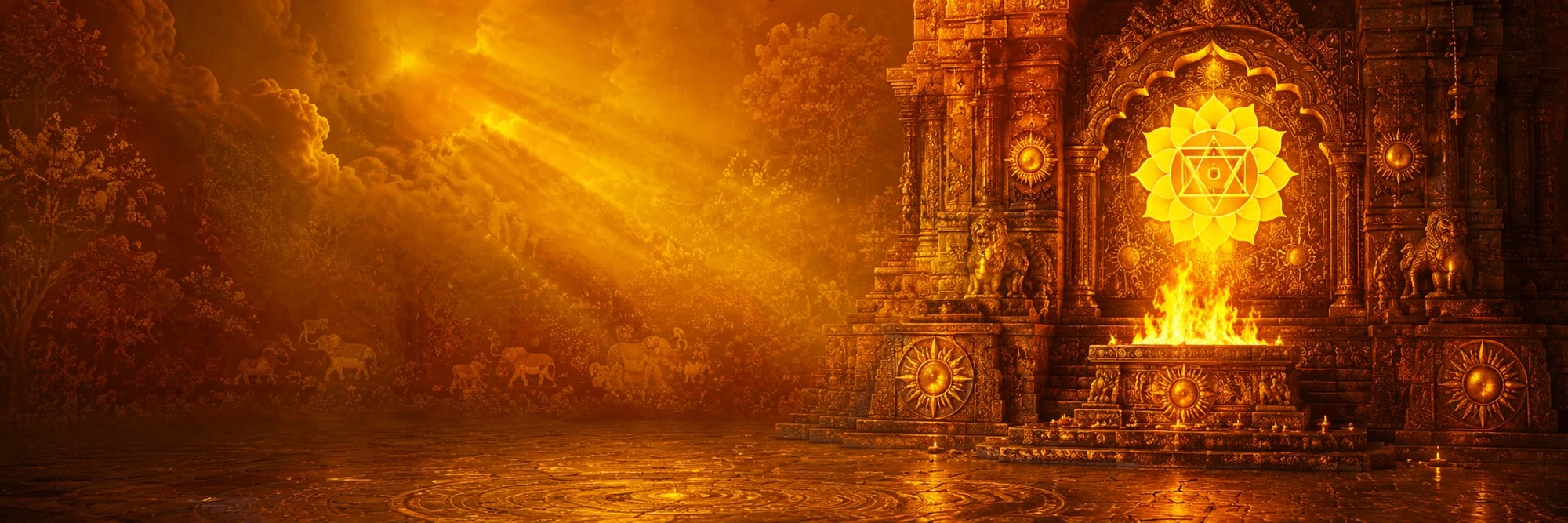
Chakra 3 of 7
Manipura Chakra
The Inner Sun
Maṇi means 'jewel.' Pūra means 'city' or 'dwelling place.' Together: 'the city of jewels.' This is the radiant centre where personal power glitters — the inner sun that lights the rest of the system. The classical texts describe it as a place so bright with internal flame that it appears bejewelled.
मणि का अर्थ है 'रत्न।' पूर का अर्थ है 'नगर' या 'निवास।' मिलकर: 'रत्नों का नगर।' यह वह तेजोमय केन्द्र है जहाँ व्यक्तिगत शक्ति रत्नों के समान दीप्तिमान होती है।
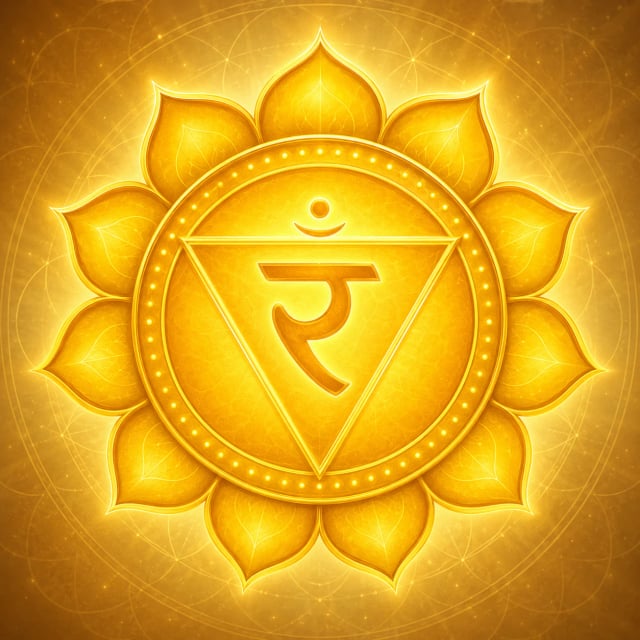
If Muladhara is the soil and Svadhisthana is the spring that rises from it, Manipura is the sun that warms both. It is the third chakra, located at the solar plexus above the navel, and the name itself means 'city of jewels' — maṇi (jewel) plus pūra (city, dwelling). The classical Tantric texts describe it as a yellow ten-petalled lotus with an inverted red triangle at its centre and the seed-syllable Raṃ glowing inside like a small steady flame.
This is the chakra of agni — fire. Inner fire, jathara-agni (digestive fire), the fire of will, the fire that transforms raw experience into wisdom and raw food into nourishment. Where Muladhara asked 'am I safe?' and Svadhisthana asked 'what do I feel?', Manipura asks the harder question: 'what will I do?' This is the chakra of agency. It governs the moment when feeling crystallises into decision, when desire takes the shape of action, when the half-formed wish to live a different life becomes the actual phone call or the actual letter of resignation.
The element governing Manipura is fire — Agni, Tejas — and the practices that strengthen it work with fire's qualities: heat, transformation, brightness, hunger. Surya Namaskar, the salutation to the sun, is in subtle terms a Manipura practice. The morning sun on the solar plexus is a Manipura practice. The willingness to feel hunger before the next meal rather than constantly grazing is a Manipura practice. The chakra responds to the disciplined edge in everything — the part of life that requires saying no to what wants to soften and yes to what wants to focus.
In the modern Indian context, Manipura supports every situation where willpower meets resistance. The Class 12 student preparing for JEE who must somehow stay focused through twenty-six months of doubt. The young woman returning to corporate work after maternity leave, walking into a room where everyone except her has been promoted. The senior facing retirement and the slow realisation that the title she held for thirty years no longer answers the question of who she is. The founder at year four when the runway is shrinking and every investor email feels like a referendum on her judgment. None of these require positivity or affirmation. They require the steady fire that does not need external validation, the inner authority that does not depend on permission.
The bija mantra Raṃ is chanted with attention placed at the solar plexus, above the navel and below the sternum. The 'R' is rolled if possible — the same rolled 'R' that Sanskrit and most Indian languages naturally produce. The closing nasal 'M' vibrates in the upper abdomen exactly where the chakra is seated. Practitioners often feel a warming in the belly within the first thirty repetitions. This is not imagination. Sustained vocalisation of the syllable produces measurable thermal and vagal effects in the abdominal region. The Tantric tradition called this jathara-agni stimulation. Modern science calls it parasympathetic activation of the celiac plexus. Both names point to the same physiological reality.
An important clarification: the bija Raṃ is not Lord Rama. The bija is a single syllable seed-sound carrying the fire element's vibration. Lord Rama is the seventh avatar of Vishnu, the dharma-king of Ayodhya. Chanting Sri Ram Jai Ram Jai Jai Ram is a devotional invocation of the deity. Chanting Raṃ as a Manipura bija is a tantric energetic practice. The sounds are related (Sanskrit has only so many root syllables) but the practices and intentions differ. Both are valid. They are not the same.
The presiding deity is Rudra, the fierce transformative aspect of Shiva, the one who burns away ignorance. For Indian householders, the most accessible devotional connection is Surya — the sun whose Gayatri mantra is itself an invocation of inner light — and Agni, the sacred fire of every yajna. The mid-morning sun, when it has risen above the horizon but not yet reached the heat of noon, is the Manipura sun. The sun that warms without burning. Stand facing east at that hour for eleven minutes daily, eyes gently closed, and you will have understood Manipura without reading another word about it.
maṇipūre sthito rudraḥ tejasā pātu māṃ sadā
May Rudra seated at Manipura protect me always with His brilliance.
Signs of Balance & Imbalance
When Balanced
- ✓Quiet inner authority that does not depend on title, role, or applause
वह आन्तरिक अधिकार जो पदनाम, भूमिका या प्रशंसा पर निर्भर नहीं
- ✓Strong, steady digestion — both of food and of difficult experience
सशक्त पाचन, भोजन का और कठिन अनुभवों का दोनों का
- ✓Healthy boundaries — able to say no with clarity and without aggression
स्वस्थ सीमाएँ, बिना आक्रामकता स्पष्ट अस्वीकार करने की क्षमता
- ✓Decisive action under pressure, without freezing or scattering
दबाव में निर्णायक कर्म, बिना जड़ता और बिना बिखराव
- ✓A baseline confidence that does not require constant reassurance
वह आधारभूत आत्मविश्वास जिसे निरन्तर पुष्टि की आवश्यकता नहीं
- ✓Steady metabolism, good morning hunger, balanced body weight
स्थिर चयापचय, प्रातः की स्वस्थ क्षुधा, सन्तुलित शरीर भार
When Imbalanced
- ✗Imposter syndrome despite real, documented achievement
वास्तविक उपलब्धियों के बावजूद स्वयं को अपात्र समझना
- ✗Chronic indecisiveness, or, opposite, controlling micromanaging behaviour
निरन्तर अनिर्णय अथवा अति-नियन्त्रण
- ✗Digestive issues — acidity, IBS, ulcers, bloating, GERD
पाचन समस्याएँ — अम्लता, IBS, अल्सर, उदर-वायु, GERD
- ✗Anger that erupts unexpectedly, or, opposite, silent simmering rage that never gets expressed
अकस्मात् क्रोध का विस्फोट अथवा कभी अभिव्यक्त न होने वाला मौन रोष
- ✗Difficulty starting things, or, opposite, starting many things and finishing none
कार्य प्रारम्भ करने की कठिनाई अथवा कई कार्य आरम्भ करके कोई पूर्ण न करना
- ✗Compulsive people-pleasing, fear of taking up space
अनिवार्य रूप से दूसरों को प्रसन्न रखने की प्रवृत्ति, अपना स्थान लेने का भय
- ✗Low energy in the late morning hours when solar fire should be peaking
देर प्रातः के घण्टों में निम्न ऊर्जा, जब सौर अग्नि चरम पर होनी चाहिए
Practices
Japa, visualization, mudra and timing for this chakra
Bija Mantra
Rung — rolled 'R' if possible (the natural Sanskrit and Indian-language R), short 'a' as in 'sun', closing with a nasal 'M' that hums in the upper abdomen
Japa Instructions
Sit in Sukhasana or Padmasana with the spine straight. Place both hands gently at the solar plexus, palms warm, fingers slightly interlaced. Close the eyes. Bring attention to the soft hollow above the navel and below the sternum. Chant Raṃ aloud one hundred and eight times, rolling the R if you can, allowing the closing nasal hum to vibrate where your palms rest. Visualize a small steady flame at the centre of an inverted red triangle, growing brighter with each repetition. Do not push for the flame to become bigger — allow it to become brighter.
सुखासन या पद्मासन में बैठें, रीढ़ सीधी। दोनों हाथ सौर जालिका पर रखें, हथेलियाँ उष्ण। आँखें बन्द करें। रं का १०८ बार जप करें, यदि सम्भव हो तो 'र' को घुमाते हुए। अधोमुखी लाल त्रिकोण के मध्य स्थिर ज्योति की कल्पना करें। ज्योति को बड़ा करने का प्रयास नहीं, अधिक उज्ज्वल होने दें।
Visualization
A ten-petalled bright yellow lotus at the solar plexus, like the petals of a marigold opening in mid-morning sun. Inside the lotus, an inverted red triangle pointing downward. Inside the triangle, a steady golden flame, no taller than the palm of a hand. With each repetition the flame brightens; with each silence between repetitions, the flame steadies.
Mudra
Surya Mudra (the gesture of the sun)
Bend the ring finger of each hand to touch the base of the thumb, then press the thumb gently down over the bent ring finger. The other three fingers stay extended. Rest the hands on the knees, palms up. This mudra in Ayurveda is said to stimulate the agni element directly, making it the natural pairing for Manipura japa.
Timing & Duration
Minimum
Ideal
Extended
Mid-morning (8–10 AM), when the sun is rising in strength but has not yet reached the heat of noon. This is the natural Manipura hour. A second strong window is sunrise itself, with the rising sun directly facing the solar plexus. Avoid practice immediately after meals — the digestive fire is already engaged with food.
Within the first thirty repetitions, expect a clear warming in the belly. This is the chakra responding correctly. Around chants 50 to 70, old patterns of self-doubt or fear-of-judgment may surface as mental sentences trying to interrupt. Meet them with the next repetition rather than the next argument. After completing 108 chants, sit straight and silent for at least one minute. Then drink warm water (not cold) to honour the fire element. The benefits of Manipura japa show up in the afternoon, not during the practice itself — in the meeting where you speak more clearly, the decision you make without second-guessing, the difficult conversation you initiate rather than postpone.
Cautions
- !Avoid intense RAM japa during acute acidity or ulcer flare-ups — gentle practice or pause until the inflammation settles
- !Practitioners with hypertension should avoid combining RAM japa with Bhastrika or Kapalbhati without supervision
- !Avoid the practice within two hours of a heavy meal — the digestive system needs that fire elsewhere
- !Postpartum women should wait at least 8 weeks before resuming intense Manipura practices
- !Do not practice in the heat of summer noon (12–3 PM) — the season already has too much fire
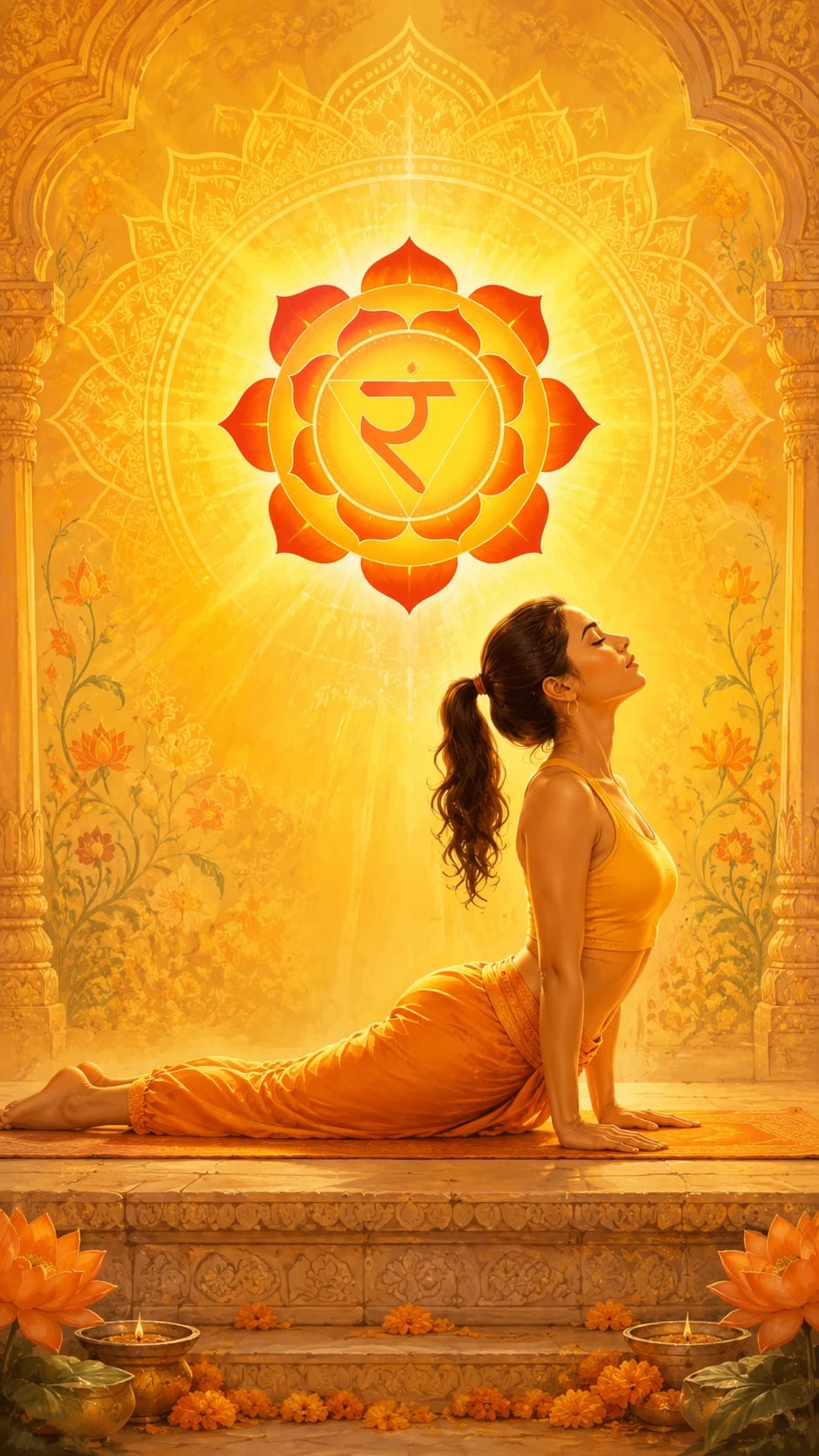
Yoga Pose
Modern India Context
How this chakra shows up in everyday Indian life
Recommended Asanas
Surya Namaskar (Sun Salutation)
सूर्य नमस्कार
The single most direct Manipura practice. Twelve cycles in the morning facing east engages every dimension of the chakra — fire element, solar deity, abdominal heat, willpower discipline. If only one practice is possible, choose this.
Navasana (Boat Pose)
नावासन
Sit balanced on the sit-bones with legs and torso raised in a V shape. Directly engages the abdominal core where Manipura is seated. Hold for 30 seconds, repeat three times.
Virabhadrasana III (Warrior III)
वीरभद्रासन III
Balance on one leg with the torso and other leg extended horizontally. Cultivates the focused will and steadiness that Manipura requires.
Dhanurasana (Bow Pose)
धनुरासन
Lie face down, hold the ankles, lift chest and thighs simultaneously. Stretches the entire front of the body and stimulates the abdominal organs and the Manipura region directly.
Paripurna Matsyendrasana (Half Lord of the Fishes Pose)
अर्ध मत्स्येन्द्रासन
A seated spinal twist that wrings out the abdominal organs and supports digestive fire. Hold each side for 30 seconds to one minute.
Pranayama
Kapalbhati (Skull-Shining Breath)
कपालभाति
Forceful exhalations through the nose with passive inhalations, generated by rhythmic contraction of the abdominal muscles. The most direct pranayama for stimulating Manipura. Begin with 30 cycles, build up gradually. Avoid in hypertension and pregnancy.
Bhastrika (Bellows Breath)
भस्त्रिका
Vigorous, equal-intensity inhalation and exhalation that ignites the inner fire. Builds heat throughout the body. Avoid in hypertension, heart conditions, and the third trimester of pregnancy.
Agnisara Kriya (Fire-Cleansing Action)
अग्निसार क्रिया
Rapid pumping of the abdominal wall during breath retention. The most explicitly Manipura-targeted kriya in the Hatha Yoga tradition.
Questions & Answers
What is the Manipura or Solar Plexus Chakra in simple terms?▾
Manipura is the third of the seven chakras, located at the solar plexus above the navel. In classical yogic terms, it is the seat of willpower, confidence, the digestive fire (jathara-agni), and personal agency. Where Muladhara handles survival and Svadhisthana handles aliveness, Manipura handles the question 'what will I do?' — the conversion of intention into action.
Is the RAM bija the same as Lord Rama?▾
No, although the sounds overlap. RAM (रं, Raṃ) is the seed-syllable of the fire element, a single-syllable tantric sound carrying the vibration of agni. Lord Rama (राम, Rāma) is the seventh avatar of Vishnu and the dharma-king of Ayodhya, invoked through devotional mantras like 'Sri Ram Jai Ram Jai Jai Ram'. Both are sacred and both are valid practices, but chanting Raṃ as a chakra bija and chanting Rama as a devotional invocation are different practices with different intentions. They share a syllable but they are not the same.
How do I know if my Manipura is blocked or imbalanced?▾
Common signs include imposter syndrome despite real achievement, chronic indecisiveness or its opposite (controlling micromanagement), digestive issues such as acidity, IBS, ulcers, or GERD, anger that either erupts unexpectedly or simmers silently without ever being expressed, and difficulty either starting things or finishing what you started. Compulsive people-pleasing and a fear of taking up space are also common modern Manipura imbalances.
How do I chant the RAM mantra correctly?▾
Sit cross-legged with the spine straight. Place both palms gently at the solar plexus, above the navel and below the sternum. Close the eyes. Chant Raṃ — roll the 'R' if possible (the natural Sanskrit and Indian-language R), short 'a' as in 'sun', closing with a nasal 'M' that hums in the upper abdomen. One hundred and eight repetitions is the traditional count. Within thirty chants you should feel a clear warming in the belly.
Can Manipura meditation help with imposter syndrome and confidence issues?▾
Yes, and this is one of the most direct uses of the practice for modern professional life. Imposter syndrome is not a thinking problem; you cannot reason your way out of it because the part of you that is feeling small is not the part that responds to argument. Manipura japa works at the energetic and somatic level where confidence is actually built — through the steady cultivation of inner fire that does not depend on external validation. Daily practice for a full quarter typically produces noticeable shifts in how you present yourself in meetings, negotiations, and difficult conversations.
Why is Manipura associated with digestion?▾
In classical Indian medicine, the chakra at the solar plexus and the digestive organs it sits over are not separate systems. The chakra governs jathara-agni, the digestive fire, which is also the same fire that transforms experience into wisdom and intention into action. A weak digestive fire and a weak will tend to appear together. A strong, balanced digestive fire and a clear sense of personal agency tend to appear together. Ayurveda has named this connection for two thousand years. Modern psychosomatic research is now beginning to verify it.
Can it help with anger management?▾
Indirectly yes, though the framing matters. Manipura is the fire chakra, and fire is not the enemy. Suppressed anger is a Manipura imbalance. Explosive anger is a Manipura imbalance. The goal is not the absence of fire but the steady control of it — the ability to bring the right intensity to the right situation. Daily RAM japa supports this by teaching the body the difference between contained agni and out-of-control agni. If anger has caused serious harm in relationships or work, combine this practice with appropriate therapy or counselling.
What is the connection between Manipura, Surya, and the Gayatri mantra?▾
The Gayatri mantra is in subtle terms an invocation of the inner sun — the same inner sun that Manipura embodies. While Surya is the literal cosmic sun and the popular devotional deity associated with this chakra, the Gayatri is the prayer that brings the cosmic sun's light into the inner body. Many practitioners chant Gayatri at dawn (the cosmic sun rising) and RAM at mid-morning (the inner sun stabilising). The two practices reinforce each other beautifully and are part of the same tradition.
Daily Affirmation
I am powerful. I am confident. I trust my inner fire.
मैं शक्तिशाली हूँ। मैं आत्मविश्वासी हूँ। मैं अपनी अन्तर-अग्नि पर भरोसा करता हूँ।
Explore Further
Classical Source
Shat-Chakra-Nirupana (षट्-चक्र-निरूपण) — Purnananda Swami (1577 CE (composed in Bengal)). Sir John Woodroffe (Arthur Avalon), 'The Serpent Power: The Secrets of Tantric and Shaktic Yoga' (1918).
The chakra system presented here follows the classical Tantric lineage. Modern wellness sources often translate Manipura as the seat of 'self-esteem' in flattened psychological language. The original tradition is more precise and more practical — it is about agni, the transformative fire, with consequences for both digestion and decision. Eternal Raga stays close to the classical sources while presenting the practice in language accessible to contemporary Indian life.
← Previous
Svadhisthana
Sacral Chakra
Next →
Anahata
Heart Chakra