Chakra 4 of 7
Anahata Chakra
The Hinge of the Subtle Body
Anāhata literally means 'not struck' or 'unstruck.' In Indian sound philosophy, every audible sound (āhata) is produced by two objects striking each other. Anāhata is the primordial sound that vibrates without any striking — the inner sound that arises when consciousness rests in its source. The chakra is named for this sound because the heart, when truly opened, hears it.
अनाहत का शाब्दिक अर्थ है 'न आहत,' अर्थात् 'जिसमें आघात न हुआ हो।' भारतीय नाद-दर्शन में, प्रत्येक श्रव्य ध्वनि दो वस्तुओं के टकराने से उत्पन्न होती है। अनाहत वह आदि-ध्वनि है जो बिना किसी आघात के स्पन्दित होती है। चक्र का यह नाम इसलिए है कि सच्चा खुला हृदय इस आन्तरिक ध्वनि को सुनता है।
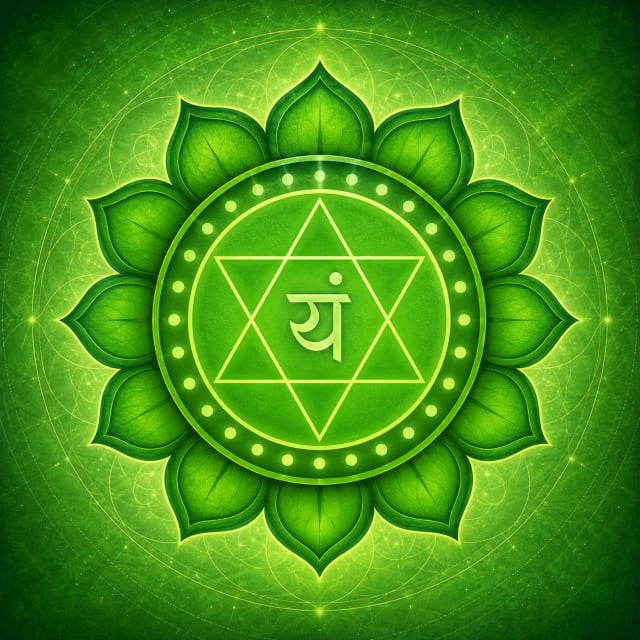
Anahata is the chakra of the unstruck sound. Anāhata literally means 'not struck' — the primordial vibration that exists before any two objects have touched, the inner sound that sounds when nothing outside has yet caused it. The Tantric texts describe Anahata as a green twelve-petalled lotus blooming at the centre of the chest, with a six-pointed star at its centre (two interlocked triangles representing the union of Shiva and Shakti) and the seed-syllable Yaṃ glowing softly inside.
This is the chakra of bhakti. Of love that does not require its object to perform anything in return. Of devotion that survives the death of every external assurance. The chakra sits exactly at the body's geometric centre — three chakras below it, three above it. It is the bridge between the lower triad (concerned with survival, feeling, will) and the upper triad (concerned with expression, intuition, transcendence). Nothing reaches the upper chakras without passing through the heart first. The chakra system, in this sense, is not a ladder. It is a hinge.
Where Muladhara asked 'am I safe?', Svadhisthana asked 'what do I feel?', and Manipura asked 'what will I do?', Anahata asks the question that softens all the others: 'whom do I love?' This is the question that has structured Indian civilisation's deepest art and philosophy. The Bhakti tradition that produced Mirabai, Tulsidas, Sant Tukaram, Andal, Akka Mahadevi, and the entire Vaishnava lineage from Chaitanya onward — all of it lives in this chakra. Eternal Raga itself, as a devotional space, is in essence an Anahata project.
The element governing Anahata is Vayu — air — and the practices that strengthen it work with air's qualities: movement, touch, expansion, the breath itself. Air is the most subtle of the four lower elements, occupying every space, touching every surface, carrying every vibration. The chakra responds to anything that opens the chest. Cobra Pose, Camel Pose, Fish Pose. It responds to the touch of one's own hand on the heart. It responds most powerfully to the kirtan tradition's call-and-response, which the heart recognises as community-amplified Yaṃ japa whether the singer has heard of chakra theory or not.
In the modern Indian context, the heart chakra carries layered weight. The joint family system creates a uniquely Indian texture of love — the daughter-in-law simultaneously honouring her own parents and the in-laws who became family on marriage, the son holding both his wife's truths and his mother's truths, the working professional navigating the sandwich generation where parents need care and children need attention and the spouse needs companionship and the career demands its own attention. None of this is dysfunction. It is what an Indian heart was structured to hold. But the holding becomes lighter when the chakra has been tended, and crushing when it has not.
The bija mantra Yaṃ is chanted with attention placed at the centre of the chest, the right palm resting gently over the heart. The 'Y' is soft, almost a welcoming sigh. The closing nasal 'M' vibrates exactly where the palm rests. Sustained Yaṃ japa often surfaces emotion that has been waiting for permission to move. Tears in the first fifty repetitions are common and welcome. They are the chakra clearing what has been stored, not weakness. The breath naturally deepens. Many practitioners report a sensation of warmth spreading from chest to arms after eighty repetitions, sometimes accompanied by the soft inner sound the Tantric texts called anāhata nāda — a low humming that seems to come from inside rather than outside the body. This is not imagination. It is the chakra confirming that the practitioner has arrived.
The formal presiding deity is Isha, the lord aspect of Shiva, but the popular devotional life of India has always associated this chakra with two figures more directly: Krishna with Radha, and Hanuman. Krishna and Radha embody divine love in its highest expression — the love that does not seek anything from the beloved except the beloved. Hanuman embodies bhakti as service, as steady devotion that does not require recognition, as the kind of love that opens its own chest to show the beloved already living inside. Chanting Hanuman Chalisa daily is, in subtle terms, a sustained Anahata practice. Singing Krishna-Radha bhajans is the same practice in a more melodic register. Chakra theory and popular devotion arrive at the same place by different paths, and Eternal Raga sits at exactly that meeting point.
anāhate sthitaḥ īśo hṛdaye mama virājate
May Ishvara seated at Anahata shine forth in my heart.
Signs of Balance & Imbalance
When Balanced
- ✓Capacity to love without losing the self in the loved one
स्वयं को खोए बिना प्रेम करने की क्षमता
- ✓Easy forgiveness, not as condoning but as release of one's own burden
सहज क्षमा, स्वीकृति नहीं अपितु अपने भार से मुक्ति
- ✓Compassion that extends equally to self and to others
स्व और पर के प्रति समान करुणा
- ✓Steady breath, open posture, an unguarded chest
स्थिर श्वास, खुली मुद्रा, असुरक्षित नहीं अपितु निरावरण वक्ष
- ✓Devotional practice that feels like coming home rather than duty
वह भक्ति-साधना जो कर्तव्य के स्थान पर अपने घर लौटने जैसी अनुभव हो
- ✓Sense of gratitude that arises spontaneously, not on command
वह कृतज्ञता जो आदेश पर नहीं, स्वयं उत्पन्न हो
When Imbalanced
- ✗Grief that has been pushed underground and is now leaking sideways into other emotions
वह शोक जो अब अन्य भावनाओं में बहक रहा है
- ✗Difficulty trusting after experiences of betrayal or loss
विश्वासघात या वियोग के बाद विश्वास की कठिनाई
- ✗Either smothering closeness or emotional walls that no one can cross
अति-लगाव अथवा भावनात्मक दीवारें जिन्हें कोई पार नहीं कर सकता
- ✗Shallow breathing, tight chest, the sensation of sighing often without relief
उथली श्वास, छाती में जकड़न, बार-बार आहें भरना
- ✗Inability to receive love offered by others — deflecting compliments, minimising care
दूसरों के प्रेम को स्वीकार करने की अक्षमता
- ✗Bhakti practice that has become mechanical, performed without feeling
वह भक्ति जो यांत्रिक हो गई है, बिना भाव की
- ✗Asthma, allergies, recurring respiratory issues, posture collapsed forward
श्वास रोग, एलर्जी, बार-बार श्वसन समस्याएँ, आगे की ओर झुकी मुद्रा
Practices
Japa, visualization, mudra and timing for this chakra
Bija Mantra
Yung — soft 'Y' that begins almost like a sigh of welcome, short 'a' as in 'sun', closing with a gentle nasal 'M' that vibrates exactly at the centre of the chest
Japa Instructions
Sit in Sukhasana or Padmasana with the spine straight. Place the right palm gently on the centre of the chest, the left palm just below the navel. The right palm covers the heart chakra, the left covers the sacral — this brings the two emotional chakras into conscious contact. Close the eyes. Bring attention to where the right palm rests. Chant Yaṃ aloud one hundred and eight times, allowing each soft 'Y' to dissolve into the nasal 'M' that vibrates beneath your palm. Allow tears if they arise. Allow warmth to spread. Do not force, do not resist.
सुखासन या पद्मासन में बैठें, रीढ़ सीधी। दायाँ हाथ वक्ष के मध्य में, बायाँ नाभि से नीचे। आँखें बन्द करें। यं का १०८ बार जप करें, नासिक्य गूँज को दायीं हथेली के नीचे अनुभव करते हुए। आँसू आएँ तो आने दें, गर्माहट फैले तो फैलने दें। न दबाएँ, न प्रतिरोध करें।
Visualization
A glowing green twelve-petalled lotus at the centre of the chest, opening with each repetition. At the centre of the lotus, a six-pointed star formed by two interlocked triangles, one pointing upward, one pointing downward. The star is golden, soft as candlelight, not bright as the sun. Inside the star, the syllable Yaṃ glows like a single small lamp.
Mudra
Hridaya Mudra (the gesture of the heart)
Bring the tip of the index finger to the base of the thumb. Bring the tips of the middle and ring fingers to touch the tip of the thumb. The little finger stays extended. Rest both hands on the knees, palms facing upward. This mudra in Hatha Yoga is said to redirect prana away from the hands and back toward the heart, intensifying Yaṃ japa significantly.
Timing & Duration
Minimum
Ideal
Extended
Pre-dawn (4–5:30 AM) for opening practice — the heart is naturally tender after sleep. Evening twilight (6–7 PM) for healing work — the day's accumulation has gathered and is ready to be released. Anahata responds to liminal hours, the times of day that themselves are transitional.
Yaṃ japa often softens long-held emotional armour. Tears in the first 30 to 50 repetitions are common and welcome — they are the chakra clearing what has been stored, not failure of practice. The breath naturally deepens around chant 60. Many practitioners report a sensation of warmth spreading from chest to arms after 80 repetitions. Some begin to hear a low inner humming sound, the anāhata nāda the Tantric texts describe. After completing 108, sit silently for at least three minutes with both hands on the heart. This is when the chakra absorbs what the practice has offered. The benefits show up in the next conversation, the next difficult moment, the next time someone offers you love and you find yourself able to receive it instead of deflecting.
Cautions
- !If you are in active grief from a recent loss (less than 6 weeks), keep sessions short — 5 to 8 minutes — and have water nearby; do not push for catharsis
- !If you have a known heart condition, consult your physician before deep heart-opening practices; gentle Yaṃ japa with hand on the heart is generally safe but adjust based on your cardiologist's input
- !Avoid practicing immediately before or after emotionally heavy conversations — give the system 15 minutes either side
- !If old grief is surfacing in waves and feels destabilising, consider supplementing chakra work with appropriate therapy or counselling, especially if it relates to childhood loss or trauma
Yoga Pose
Modern India Context
How this chakra shows up in everyday Indian life
Recommended Asanas
Anahatasana (Heart-Melting Pose / Puppy Pose)
अनाहतासन
The literal namesake pose. Knees and hips stacked over each other, chest melts toward the floor, arms extended forward. The chest opens deeply without strain on the lower back. Hold for 2 to 3 minutes with slow breath.
Ustrasana (Camel Pose)
उष्ट्रासन
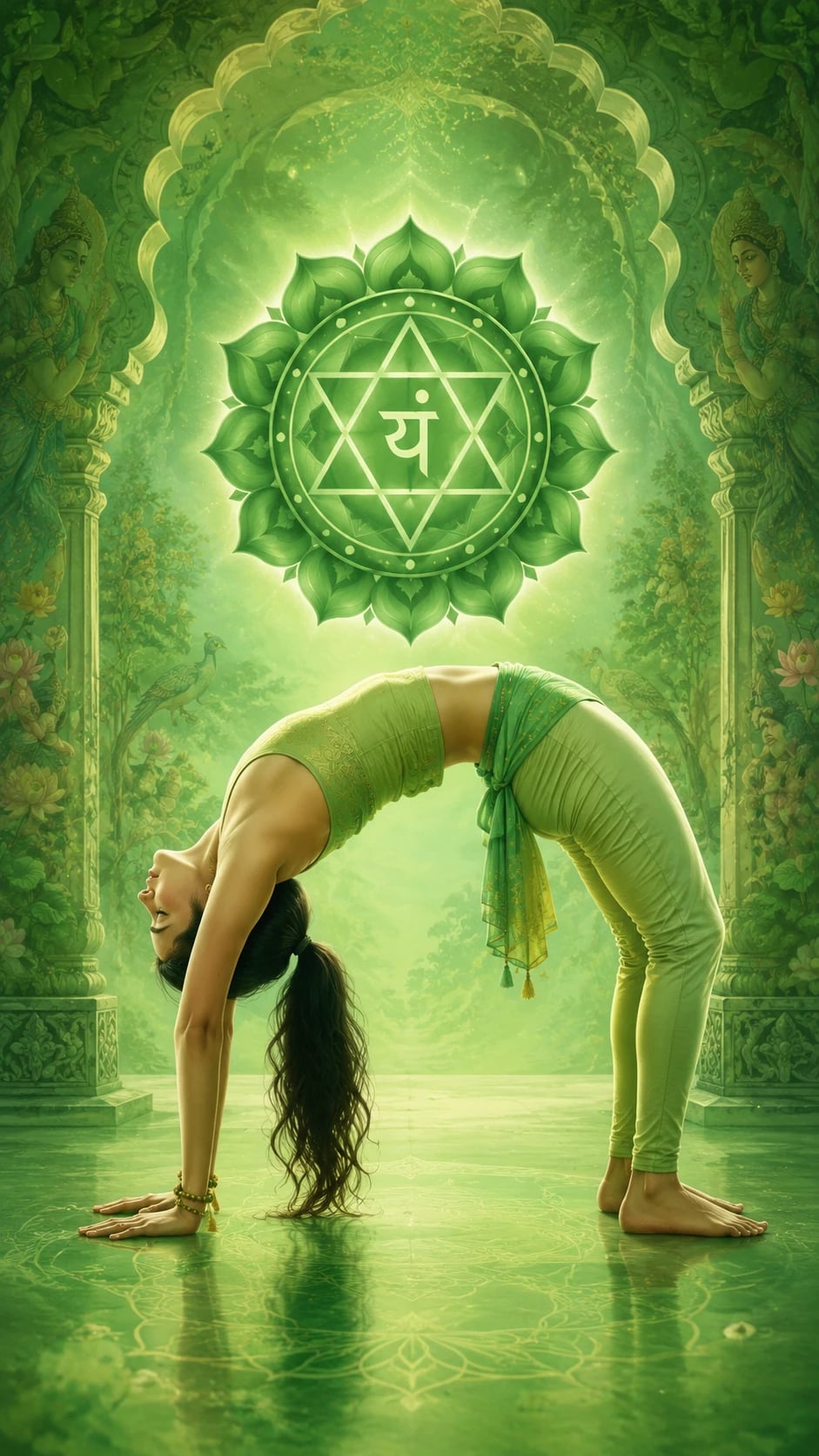
Kneeling backbend with hands reaching for the heels. The deepest heart-opener in standard practice. Approach gradually; tears are common in this pose and welcome. Hold for 30 seconds to 1 minute.
Bhujangasana (Cobra Pose)
भुजङ्गासन
Lie face down, press up onto the hands lifting the chest. The most accessible heart-opener for beginners and for those with limited mobility. Hold for 30 seconds, repeat 3 times.
Matsyasana (Fish Pose)
मत्स्यासन
Lie on the back with a bolster or rolled blanket beneath the upper back, chest lifts passively. Restorative heart-opener — ideal at the end of a practice session or before sleep.
Setu Bandhasana (Bridge Pose)
सेतुबन्धासन
Lie on the back with knees bent, lift the hips. Opens the chest while strengthening the back. Gentle and accessible. Hold for 30 seconds, repeat 3 times.
Pranayama
Anulom Vilom (Alternate Nostril Breathing)
अनुलोम-विलोम
Alternating breath through left and right nostrils balances Ida and Pingala, the two channels that meet at the heart. Fundamentally a heart-balancing practice. 11 cycles is the ideal daily count.
Bhramari (Humming Bee Breath)
भ्रामरी
Close the ears with the index fingers, hum a long bee-like sound on the exhale. The vibration soothes the heart and pairs perfectly with Yaṃ japa. 7 to 11 rounds is sufficient.
Dirgha Pranayama (Three-Part Breath)
दीर्घ प्राणायाम
Slow conscious breath that fills the belly, the ribs, and the upper chest in sequence. Trains the lungs to fully open and brings air directly to the heart chakra region.
Questions & Answers
What is the Anahata or Heart Chakra in simple terms?▾
Anahata is the fourth of the seven chakras, located at the centre of the chest behind the sternum. In classical yogic terms, it is the seat of love, compassion, devotion (bhakti), and the meeting point of consciousness and energy (the shatkona symbolism). It is the geometric middle of the chakra system — three chakras below, three above — and serves as the hinge between the body-mind concerns of the lower triad and the consciousness concerns of the upper triad.
What does 'Anahata' literally mean?▾
Anāhata literally means 'not struck' or 'unstruck.' In Indian sound philosophy, every audible sound (āhata, struck) is produced by two objects coming into contact. Anāhata is the primordial sound that vibrates without any striking — the inner sound (anāhata nāda) that arises when consciousness rests in its source. The chakra is named for this inner sound because the heart, when truly opened, hears it. Many sustained Yaṃ japa practitioners report hearing a soft inner humming after extended practice.
How do I know if my Anahata is blocked or imbalanced?▾
Common signs include grief that has been pushed underground and is leaking sideways into other emotions, difficulty trusting after experiences of betrayal or loss, either smothering closeness with others or emotional walls that no one can cross, shallow breathing and a tight chest, the inability to receive love offered by others (deflecting compliments, minimising care), and devotional practice that has become mechanical and performed without feeling. Asthma, allergies, and recurring respiratory issues are physical signs that often accompany emotional imbalance here.
How do I chant the YAM mantra correctly?▾
Sit cross-legged with the spine straight. Place the right palm gently at the centre of the chest, the left palm just below the navel. Close the eyes and bring attention to where the right palm rests. Chant Yaṃ aloud one hundred and eight times — soft 'Y' that begins like a sigh of welcome, short 'a' as in 'sun', closing with a nasal 'M' that vibrates beneath your palm. Allow tears if they arise. Do not force, do not resist.
Can heart chakra meditation actually help with grief?▾
Yes, though the framing matters. Yaṃ japa does not shorten grief or bypass it. It makes grief sacred. The Indian tradition has always understood that bereavement work belongs in the heart chakra, which is why funeral and shraaddha rituals are centred on the chest. For active recent loss (less than 6 weeks), keep sessions short (5 to 8 minutes) and gentle. Combine with reading Bhagavad Gita Chapter 2 verses 13, 20, and 22 — Krishna's teaching on the eternal soul. The grief does not disappear. Your capacity to hold it grows.
Why are Krishna-Radha and Hanuman so often associated with the heart chakra rather than Shiva, the formal presiding deity?▾
The formal Tantric attribution names Isha (a form of Shiva) as the deva and Kakini as the shakti of Anahata. But the living devotional tradition of India has always associated this chakra with two figures more directly — Krishna with Radha for divine love in its highest expression, and Hanuman for devotion as steady service. The iconic image of Hanuman opening his chest to reveal Ram and Sita already seated inside is, in subtle terms, the perfect Anahata image: bhakti as the act of showing that the beloved already lives in the heart.
What is the meaning of the six-pointed star (shatkona) at the centre of Anahata?▾
The shatkona is formed by two interlocked equilateral triangles. The upward-pointing triangle is Shiva (consciousness, the ascending masculine principle). The downward-pointing triangle is Shakti (energy, the descending feminine principle). Their interlock at the heart represents the union of consciousness and energy, of awareness and life-force, of the cosmic masculine and cosmic feminine. The Anahata chakra is the body's natural meeting-place for these two — which is why the chakra is also where bhakti is born. Love is what happens when consciousness and energy recognise each other.
Can chanting Hanuman Chalisa daily be considered Anahata practice?▾
Yes, in subtle terms it is exactly that. Daily Hanuman Chalisa pulls attention to the chest, generates sustained nasal vibration through 40 verses of chanted Awadhi, evokes the imagery of Hanuman as the embodied open heart, and produces measurable parasympathetic effects within the first 10 verses. Many lifelong devotees of Hanuman have done a complete Anahata practice for decades without ever needing the chakra vocabulary. Knowing the chakra theory does not change the practice. It can deepen the understanding of what the practice has already been doing.
Daily Affirmation
I am open to giving and receiving love. My heart is whole.
मैं प्रेम देने और पाने के लिए खुला हूँ। मेरा हृदय पूर्ण है।
Explore Further
Classical Source
Shat-Chakra-Nirupana (षट्-चक्र-निरूपण) — Purnananda Swami (1577 CE (composed in Bengal)). Sir John Woodroffe (Arthur Avalon), 'The Serpent Power: The Secrets of Tantric and Shaktic Yoga' (1918).
Modern wellness sources often translate Anahata as 'love and compassion' in flattened psychological language. The classical tradition is both more precise and more demanding. Anahata is bhakti — devotion that survives the loss of everything external — and the chakra theory points to physiological and energetic dimensions of this practice that secular framings cannot reach. Eternal Raga stays close to the classical sources and to the living devotional traditions that have practiced this chakra for centuries without using the word 'chakra' at all.
← Previous
Manipura
Solar Plexus Chakra
Next →
Vishuddha
Throat Chakra