Chakra 1 of 7
Muladhara Chakra
The Foundation of the Subtle Body
Mūla means root or foundation. Ādhāra means support or base. Together: 'the foundational support.' This is the chakra upon which the entire energetic body stands — without a stable Muladhara, the higher chakras cannot bloom safely.
मूल का अर्थ है जड़ या आधार। आधार का अर्थ है सहारा। मिलकर: 'आधारभूत सहारा।' यह वह चक्र है जिस पर समस्त सूक्ष्म शरीर खड़ा है — बिना स्थिर मूलाधार के, उच्चतर चक्र सुरक्षित रूप से नहीं खिल सकते।
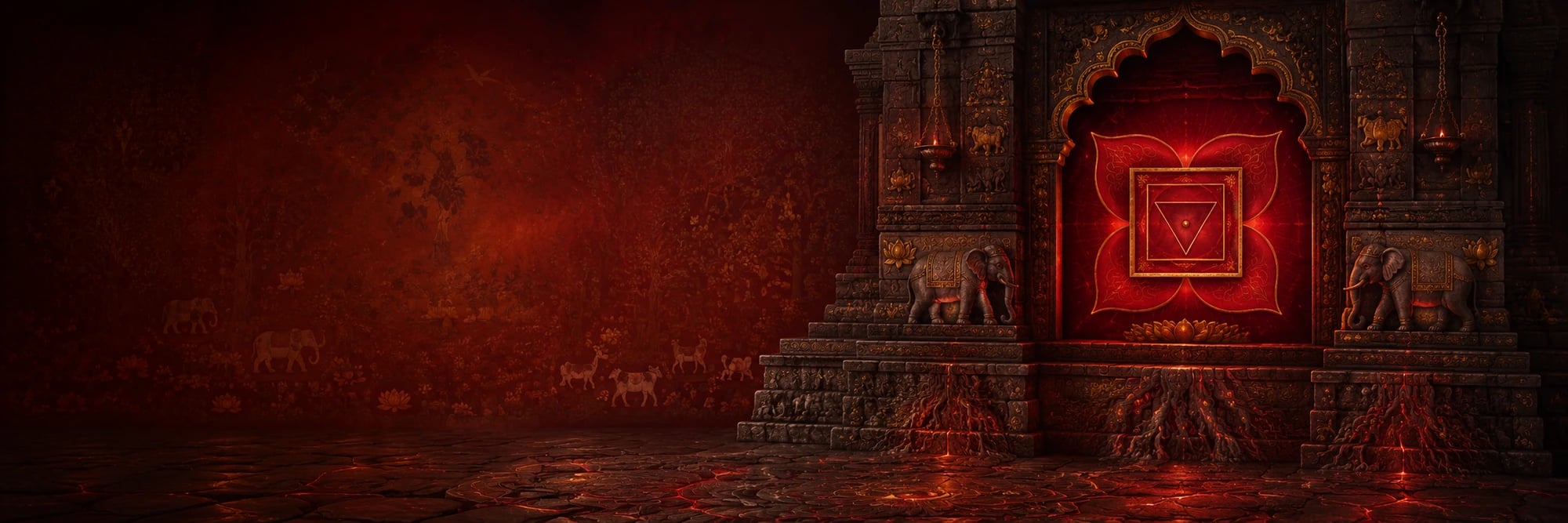
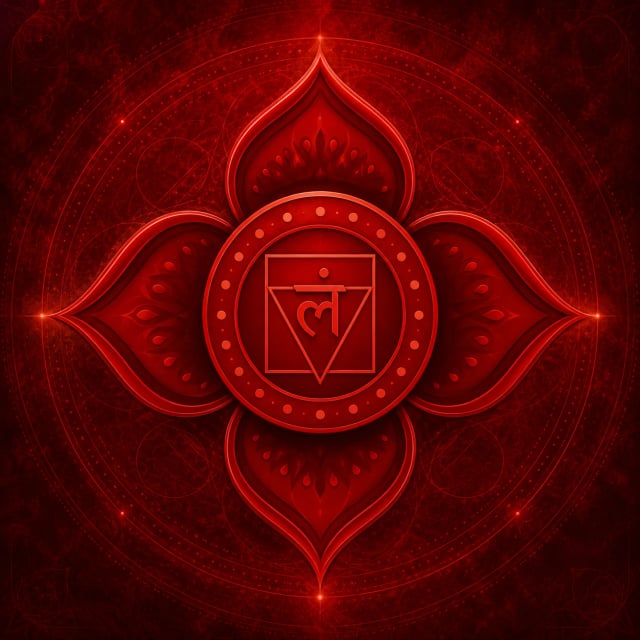
Before a tree can flower, it must root. The Muladhara Chakra is the root of the subtle body — the energetic foundation upon which every other chakra depends. Classical Tantric texts, most notably the Shat-Chakra-Nirupana composed by Purnananda in 1577 CE, describe it as a four-petalled crimson lotus blooming at the base of the spine, with the seed-syllable Laṃ glowing at its centre like steady lightning.
Muladhara governs the most basic questions a human being asks: Am I safe? Do I have what I need? Can I trust the ground beneath me? When this chakra is balanced, the answer to all three is a quiet yes — not because life has stopped throwing difficulty, but because something stable inside has learned to receive difficulty without collapsing. When Muladhara is disturbed, even abundant lives feel precarious. The mind keeps scanning for threat that the outer world is not actually generating.
In the modern Indian context, Muladhara is the chakra that handles the texture of everyday life — the EMI on the first car, the silent calculations during the family meal about who pays for what, the migration from a small town to a tier-1 metro, the hostel adjustment, the first job, the daughter-in-law's adjustment to a new home. These are not glamorous spiritual subjects, but they are exactly what Muladhara was named for. Mūla means root, and root work happens in the soil of daily life, not in cinematic meditation retreats.
The associated element is Earth — Pṛthvī — and the practices that strengthen Muladhara work with earth's qualities: weight, slowness, contact, sensation. Walking barefoot on a clean floor. Sitting cross-legged on the ground rather than on a sofa. Eating root vegetables. Touching soil during garden work. Sleeping on a firm mattress. The chakra responds to literal grounding as much as to mantra.
The bija mantra Laṃ is short by design — a single syllable that ends in a nasal hum which resonates in the lower abdomen and pelvic floor. Daily repetition, even just one hundred and eight times in the morning, gradually retrains the nervous system from threat-mode to ground-mode. This is not poetry; it is what happens when the vagus nerve receives consistent, low-frequency vibratory input from sustained nasal humming. The Tantric tradition described the physiological reality long before science had the vocabulary for it.
The presiding deity is Brahma — the creator — because every act of creation begins at the foundation. The associated devotional deity for Indian householders is Ganesha, the remover of obstacles at the start of every undertaking. The popular Ganesh Vandana chanted before any auspicious work is, in subtle terms, a Muladhara invocation. Whether one thinks of it that way or simply chants 'Om Gan Ganpataye Namaha' before opening a new business, the underlying mechanism is the same: stabilising the root before reaching for the higher.
mūlādhāre sthito brahmā rakṣen māṃ sarvataḥ sadā
May Brahma seated at the root chakra protect me always, from all directions.
Signs of Balance & Imbalance
When Balanced
- ✓A baseline sense of safety in daily life, even when externals are uncertain
बाह्य अनिश्चितता के बावजूद दैनिक जीवन में सुरक्षा का अनुभव
- ✓Healthy relationship with money — neither hoarding from fear nor spending from anxiety
धन से स्वस्थ सम्बन्ध — न भय से जमाना, न चिन्ता से खर्च करना
- ✓Physical vitality, strong immunity, steady energy throughout the day
शारीरिक प्राणशक्ति, सशक्त रोग-प्रतिरोधक क्षमता, स्थिर ऊर्जा
- ✓Ability to make decisions without endless second-guessing
बार-बार पुनर्विचार के बिना निर्णय लेने की क्षमता
- ✓Trust in life's natural unfolding even when it doesn't match the plan
योजना से भिन्न होते हुए भी जीवन की स्वाभाविक गति पर विश्वास
- ✓Restful sleep, especially in the first half of the night
विश्रामपूर्ण निद्रा, विशेषकर रात्रि के पूर्वार्ध में
When Imbalanced
- ✗Persistent financial anxiety even when materially secure
भौतिक सुरक्षा के बावजूद निरन्तर आर्थिक चिन्ता
- ✗Hyper-vigilance — scanning the environment for threats that are not present
अति-सतर्कता — अनुपस्थित खतरों के लिए चारों ओर देखना
- ✗Lower back pain, sciatica, leg heaviness, knee issues
कमर दर्द, साइटिका, पैरों में भारीपन, घुटनों की समस्या
- ✗Decision paralysis driven by fear of getting it wrong
गलत होने के भय से निर्णय में अड़चन
- ✗Disordered eating — either chronic dieting or stress-eating
अनियमित भोजन — कठोर डाइटिंग या तनाव-भोजन
- ✗Difficulty falling asleep, racing thoughts about survival concerns
नींद आने में कठिनाई, जीवन-निर्वाह की चिन्ताएँ
- ✗Feeling 'spaced out' or disconnected from the body
शरीर से कटाव, असंबद्धता
Practices
Japa, visualization, mudra and timing for this chakra
Bija Mantra
Lung — short 'a' as in 'sun', ending with a soft nasal hum that resonates in the base of the spine
Japa Instructions
Sit cross-legged on the floor — Sukhasana or Padmasana — with the spine straight and palms resting on the knees. Close the eyes. Bring attention to the perineum, the space between the sit-bones. Chant Laṃ aloud one hundred and eight times, allowing the nasal ending of each repetition to vibrate in the pelvic floor. Visualize a deep crimson square glowing brighter with each chant.
फर्श पर सुखासन या पद्मासन में बैठें, रीढ़ सीधी, हाथ घुटनों पर। आँखें बन्द करें। मूलाधार पर ध्यान केन्द्रित करें। लं का १०८ बार जप करें — प्रत्येक की नासिक्य गूँज को मूल में अनुभव करें। सिन्दूरी वर्ग की कल्पना करें जो प्रत्येक जप के साथ अधिक चमकीला होता जाए।
Visualization
A four-petalled crimson lotus at the base of the spine, opening with each repetition. Inside the lotus is a glowing yellow square — the symbol of Earth element. Inside the square, a downward red triangle. Inside the triangle, the syllable Laṃ glowing like a small steady flame.
Mudra
Muladhara Mudra (or Bhumi Sparsha Mudra)
Sitting cross-legged, lightly touch the right hand fingertips to the floor in front of you. This is the same gesture the Buddha made when he asked the earth to witness his awakening — a Muladhara gesture across two great Indian traditions.
Timing & Duration
Minimum
Ideal
Extended
Brahma Muhurta (4–6 AM) is most powerful, with the second-best window at sunset (5:30–6:30 PM). Sunrise is especially auspicious for Muladhara because the Earth element wakes with the sun.
In the first 20 repetitions, expect restlessness — the mind protesting at being asked to stay. Stay with it. Around chant 40 to 60, the breath naturally slows and a quiet warmth often rises in the lower body. After completing 108, do not stand up immediately. Sit in silence for at least one minute — this is when the chakra absorbs the vibration. The benefits show up later in the day, not during the practice itself.
Cautions
- !Do not practice on a full stomach — wait two hours after meals
- !Avoid intense Muladhara work in late pregnancy without a teacher's guidance
- !If lower back pain is acute, practice lying down with knees bent rather than seated
- !Stop and ground with a glass of water if dizziness arises

Yoga Pose
Modern India Context
How this chakra shows up in everyday Indian life
If you are away from home for the first time — hostel, PG, the strangeness of a city you don't yet recognise — Muladhara japa before sleep grounds the day. Especially powerful during the run-up to JEE, NEET, CUET, board exams, where the 'kya hoga' anxiety spirals at 2 AM. Eleven minutes of Laṃ japa retrains the nervous system to settle. Add it to the daily routine alongside whatever academic schedule you keep.
पहली बार घर से दूर — हॉस्टल, PG, अनजान शहर। सोने से पहले मूलाधार जप दिन को स्थिर करता है। JEE, NEET, CUET, बोर्ड परीक्षाओं की तैयारी में रात दो बजे की 'क्या होगा' चिन्ता को शान्त करता है।
Recommended Asanas
Tadasana (Mountain Pose)
ताड़ासन
Stand with feet rooted, weight even on both soles, spine long. The simplest and most direct Muladhara posture.
Vrikshasana (Tree Pose)
वृक्षासन
Balance on one foot with the other foot pressed to the inner thigh. Teaches the legs to be a steady root.
Balasana (Child's Pose)
बालासन
Knees wide, forehead to the floor. The hips ground heavily — restorative for an overworked nervous system.
Malasana (Garland / Squat Pose)
मालासन
A deep squat with the heels grounded. Opens the hips and brings strong awareness to the perineum.
Sukhasana (Easy Cross-Legged Pose)
सुखासन
The base posture for seated japa. Simple, sustainable, foundational.
Pranayama
Bhastrika (Bellows Breath)
भस्त्रिका
Vigorous forced inhalation and exhalation that ignites the lower body. Avoid if hypertensive.
Mula Bandha (Root Lock)
मूल बन्ध
Gentle lifting of the pelvic floor during breath retention. The most direct Muladhara technique.
Questions & Answers
What is the Muladhara Chakra in simple terms?▾
Muladhara is the root chakra at the base of the spine. In the classical yogic view of the subtle body, it is the foundation upon which the other six chakras rest. It governs your sense of safety, stability, physical vitality, and basic trust in life. When it is balanced, daily life feels manageable. When disturbed, even good circumstances feel precarious.
How do I know if my Muladhara is blocked or imbalanced?▾
Common signs include persistent financial anxiety even when materially secure, lower back pain or sciatica, difficulty falling asleep due to survival-related worries, decision paralysis driven by fear, and a sense of being 'spaced out' or disconnected from the body. These are not diagnostic in a medical sense — they are pointers from the yogic tradition. If symptoms are physical and persistent, also consult a physician.
What is the LAM mantra and how do I chant it?▾
LAM (लं, pronounced 'lung' with a soft nasal ending) is the bija — seed mantra — of Muladhara. To chant: sit cross-legged with the spine straight, close the eyes, bring attention to the perineum, and chant Laṃ aloud one hundred and eight times. Allow the nasal ending of each repetition to vibrate in the pelvic floor. Visualize a crimson square glowing at the base of the spine.
How long should I do Muladhara meditation each day?▾
A minimum of eight minutes for the practice to actually affect the nervous system. Eleven minutes is ideal for daily householder practice. Twenty-one minutes for an extended session, suitable for weekends or retreat days. Consistency matters more than length — eleven minutes every day will produce more benefit than an hour once a week.
Is Muladhara meditation safe during pregnancy?▾
Gentle LAM chanting and visualization is safe at every stage of pregnancy and can be very supportive. However, intense Mula Bandha (the pelvic-floor lock) and vigorous Bhastrika pranayama should be paused, particularly in the second and third trimesters. When in doubt, consult both a qualified prenatal yoga teacher and your physician.
What is the difference between Muladhara meditation and Kundalini awakening?▾
Kundalini awakening in the classical sense is a profound, life-altering spiritual event requiring a qualified guru and years of preparation. Daily Muladhara meditation as practiced in this app is not Kundalini awakening — it is the cleansing, balancing, and preparation of the root foundation. Think of it as tending the soil, not forcing the seed to sprout.
Can I do this practice if I am not Hindu?▾
The chakra system originated within the Hindu Tantric and Yogic traditions. Practitioners of other faiths who approach it with respect and authenticity are welcome. The bija mantra LAM is not a creedal statement — it is a vibration. Eternal Raga presents the tradition as it is, not in a flattened or sanitised form, and leaves the question of religious framing to the practitioner.
Which Ganesha mantra works best with Muladhara meditation?▾
Om Gan Ganpataye Namaha (ॐ गं गणपतये नमः) is the most accessible and widely chanted. It combines Ganesha's invocation with the bija mantra गं, which itself resonates with the foundational stability that Muladhara represents. Chant 108 times before or after LAM japa for amplified effect.
Daily Affirmation
I am safe. I am grounded. I am rooted in life.
मैं सुरक्षित हूँ। मैं स्थिर हूँ। मैं जीवन में जड़वत् हूँ।
Explore Further
Classical Source
Shat-Chakra-Nirupana (षट्-चक्र-निरूपण) — Purnananda Swami (1577 CE (composed in Bengal)). Sir John Woodroffe (Arthur Avalon), 'The Serpent Power: The Secrets of Tantric and Shaktic Yoga' (1918).
The seven-chakra model presented here is grounded in this classical lineage. Modern interpretations vary widely; some derive from Theosophical and New Age sources that depart significantly from the Tantric originals. Eternal Raga stays close to the classical sources.
Next →
Svadhisthana
Sacral Chakra