Amararama (Amaravati)
अमरारामा
Where Indra installed Shiva's broken linga
Amaravati, Andhra Pradesh, India
AmarārāmaAlso known as: Amararamam, Sri Amareshwara Swamy Temple, Amareshvara, Amaralingeshwara, Amaravati Shiva Temple, Amaralingeshvara Swamy Devasthanam
युग
Kakatiya–Vijayanagara structure (12th–17th c.); site continuously sacred since early centuries CE
वास्तुकला
Dravidian (Andhra regional, with Kakatiya and Vijayanagara additions)
खुला
05:30 – 21:00
आरती
06:00 · 12:00 · 18:30
विशेष
Abhishekam tickets at counter inside complex; Kalyanotsavam performed on Mondays during Karthika masam; major surge during Krishna Pushkaralu (every 12 years)
पवित्र कथा · पवित्र कथा
Amararama is the first of the five Pancharama Kshetra — the five sacred sites in Andhra Pradesh where, according to ancient Saivite tradition, fragments of Tarakasura's atma-linga came to rest after Kumara shattered it to end the asura's terror over the worlds. At Amaravati, on the south bank of the Krishna, the fragment was raised and consecrated by Indra himself, king of the devas — and the town's very name, Amararama, means the Garden of the Immortals. The temple's central linga rises nearly fifteen feet through a two-storey sanctum in white marble, a singular sight in South Indian Saivism, said in living tradition to be still growing. Around it the town carries a double inheritance: ancient capital of the Satavahanas, neighbour to one of the great Buddhist stupa sites of the ancient world, and modern flashpoint of Andhra Pradesh's contested capital project. Through every civilizational turn the devas' garden has remained the devotees' garden.
Sacred Designationपवित्र पदनाम
Sacred Origin Storyपवित्र उत्पत्ति कथा
Source: Skanda Purana (regional Andhra Pancharama narratives) and the Sthala Purana corpus of coastal Andhra Saivism; the broader Tarakasura cycle is drawn from the Skanda Purana, the Shiva Purana (Rudra Samhita, Kumara Khanda), and the Mahabharata's Vana Parva (in which Markandeya narrates the asura's defeat)
The roots of the Pancharama narrative stretch back to a cosmic crisis. Tarakasura, an asura of immense austerity, won from Brahma a boon that he could be killed only by a son of Shiva — and at the time of the boon there was no such son, for Sati had returned to fire at Daksha's yajna and Shiva had withdrawn into his mountain grief. Confident in his own impossibility, Tarakasura conquered the three worlds, displaced Indra from the celestial Amaravati (the city of the devas from which every later Amaravati on earth takes its name), and ruled with such violence that the gods themselves became refugees within their own creation.
The devas devised the means of their rescue. Through penance and stratagem they drew Shiva and Parvati together; from their union the warrior-child Kumara was born, raised by the six Krittikas and named Karttikeya for those celestial mothers. The Skanda Purana describes the boy growing within seven days into a six-faced commander, mounting his peacock, taking up the Shakti weapon Shiva himself had forged for him, and leading the assembled deva army against the asura in the great battle.
But Tarakasura, in his long age of penance, had carried away more than a boon. From Shiva he had also obtained an atma-linga — a personal Shiva-linga, the embodiment of the Lord himself — which he carried into battle as the source of his invulnerability. The Pancharama Sthala Purana corpus tells how Kumara's Shakti struck this linga and shattered it into pieces. The asura, his protection broken, fell. But the linga's fragments, being themselves Shiva, could not simply lie where they had landed. Five of them came to rest across the land that would later become coastal and central Andhra; and at each site, one of the gods who had been most personally restored by Shiva's grace was chosen to lift the fragment and re-sanctify it.
The largest fragment, the tradition holds, fell on the southern bank of the Krishna river, on a plain not far from where the Satavahanas would one day raise their capital and where Buddhists would build their great stupa. To this place came Indra himself. Of all the gods, Indra had the deepest personal debt to Shiva: it was Indra whose throne Tarakasura had taken, Indra whose celestial Amaravati had been usurped, Indra who could not have been restored without Kumara's victory. Now he came to install the very fragment of the linga that had made his enemy invincible. He raised the linga from the soil of the Krishna plain, consecrated it with Vedic mantras and waters from the seven sacred rivers, and named the place Amararama — the Garden of the Immortals — in token that the devas had come home to the world.
A second strand of the local tradition holds that the linga continued to grow after its installation, drawing into itself the cosmic substance of the original from which it had been broken; and that successive generations of devotees, finding the original sanctum roof too low to contain the linga's rising height, added a second storey to the garbhagriha so that the upper portion of the linga could continue to be seen and worshipped. The two-storey sanctum that pilgrims enter today is the architectural memory of this growth-tradition: it preserves both the historical fact that the temple was rebuilt vertically over time, and the devotional claim that what made the rebuilding necessary was the linga's own sacred self-expansion. To stand in the lower hall and lift one's eyes through the opening above is, in the tradition's own framing, to witness Shiva exceeding his own container.
उद्धृत स्रोत:
- Skanda Purana — regional Pancharama narratives within the Andhra-specific khanda tradition
- Sthala Purana corpus of the five Pancharama Kshetra (oral and printed, primarily Telugu, partially Sanskrit)
- Shiva Purana, Rudra Samhita, Kumara Khanda (Tarakasura cycle and Kumara's birth narrative)
- Mahabharata, Vana Parva, Markandeya Samasya (Markandeya's narration of Kumara and Tarakasura to Yudhishthira)
- Linga Purana (linga theology underlying the Pancharama installation narrative)
अन्य परंपराएँ · अन्य परंपराएँ
Andhra regional variant — the 'fragment as head' reading
A second strand within the Pancharama Sthala Purana corpus reads the five fragments not by relative size but by anatomical metaphor: the fragment at Amararama is identified not as the 'largest' but as the 'head' of the original linga, with the remaining four (at Draksharama, Kumararama, Ksheerarama, and Bhimarama) understood as the four directional limbs. In this reading, Indra's selection as installer follows logically from Amararama's status as the cephalic fragment — the installer of the head is the head of the devas. The size-of-fragment reading and the body-of-linga reading are not always carefully distinguished in popular retellings, and many local sources combine them by treating the head as also the largest piece. Both readings co-exist in the living tradition.
Pre-Tarakasura Indra-worship strand (regional Amaravati tradition)
A separate Amaravati-specific tradition holds that Indra had worshipped Shiva at this site long before the Tarakasura episode, in penance for the killing of Vritra (an act for which Indra incurred Brahmahatya, the gravest of ritual sins, and undertook severe atonement). In this telling, the spot was already sacred to Shiva — known to Indra alone — before Kumara ever struck the asura's linga; and the fragment fell here not by chance but because the place had been ordained as Indra's own restorative shrine since the earlier age. The Tarakasura installation then becomes the public manifestation of a sanctity that was already privately established. This strand reconciles two otherwise separate stories about Indra — his guilt for Vritra's killing and his loss of throne to Tarakasura — by giving both their resolution at the same Krishna-bank site.
विद्वत संदर्भ
Modern scholarship on the Pancharama tradition treats it as a regionally focused Andhra Saivite network whose textual formalisation appears most clearly in the medieval Telugu Sthala Purana corpus rather than in the pan-Indian Mahapuranic mainstream — the Tarakasura cycle itself is widely attested in Sanskrit Puranic literature, but the specific identification of five Andhra sites as the resting places of the linga fragments is largely a southern-coastal regional articulation. The Amaravati site itself complicates the picture: it is one of South India's most documented early historic sacred landscapes, with the Mahachaitya (Amaravati Stupa) becoming a principal Buddhist centre under Satavahana patronage from approximately the second century BCE. Continuous Saivite worship at the Amareshwara linga site is not separately attested in the earliest layer, and historians of Andhra religion are divided on whether the Saivite tradition at this spot is a successor to or contemporaneous with the Buddhist phase. By the high medieval period the Saivite layer is documentarily clear: Kakatiya-era inscriptions, Reddy and Vijayanagara patronage, and Sri Krishnadevaraya's Pancharama tour are all attested in the epigraphic and literary record. The modern political context — Amaravati's 2014 designation as the new Andhra Pradesh state capital, the 2020 tri-capital proposal, and the litigation that has followed — has reshaped the temple town's surroundings without changing the temple's administrative status; the shrine remains under the AP Charitable and Hindu Religious Institutions and Endowments Department. Eternal Raga presents the religious history primarily and notes the modern political context only where it bears on present-day pilgrimage logistics.
Historyइतिहास
Amararama's documented history is inseparable from the broader story of Amaravati itself, one of the longest continuously sacred landscapes in South India. The plain on the southern bank of the Krishna river was already a major religious centre under the Satavahana dynasty (approximately the second century BCE through the third century CE), when the neighbouring Mahachaitya — the Amaravati Stupa — became one of the great Buddhist art centres of the ancient world. Whether continuous Saivite worship at the Amareshwara linga site dates to the Satavahana period or emerged as a successor tradition after the Buddhist phase declined is a question historians of Andhra religion still debate; the earliest unambiguous epigraphic record of the Saivite temple as a functioning institution belongs to the high medieval period.
By the time of the Kakatiyas (twelfth through fourteenth centuries), the temple is documentarily clear. A series of Sanskrit and Telugu inscriptions records gifts, endowments, and renovations under Kakatiya political ascendancy in central and southern Andhra. The Reddy dynasty of Kondavidu, who succeeded the Kakatiyas in this region, continued patronage. With the rise of Vijayanagara in the fifteenth century the Pancharama Kshetra acquired imperial-tier recognition: Sri Krishnadevaraya, in his celebrated tour of the coastal Andhra sacred sites, is recorded as having visited the five Pancharama temples and made endowments at Amararama. The temple's Vijayanagara-period additions — mandapa pillars, surrounding compound work, sculptural elaboration — are still visible in the present complex.
The long eighteenth and early nineteenth centuries brought the temple under the patronage of Vasireddy Venkatadri Nayudu (1761–1816), the zamindar of Chintapalli and one of the most influential Andhra patrons of the late-Mughal and early-British transition era. He undertook substantial renovations at the Amareshwara temple, contributed to mandapa construction, and reorganised temple administration during his tenure. He is also remembered for his patronage of the adjacent Buddhist site, then still partially intact above ground, and for his role in the early British-era recording of Amaravati's sacred landscape — the same period in which Colin Mackenzie and later James Burgess and Robert Sewell would survey the Mahachaitya for the East India Company and the Archaeological Survey of India.
Under twentieth-century administration the temple passed to the Andhra Pradesh Charitable and Hindu Religious Institutions and Endowments Department, which has overseen the shrine through the second half of the century. The most consequential modern event for the temple town has not been religious but political: in 2014, following the bifurcation of Andhra Pradesh and the formation of Telangana, the Amaravati region was designated as the new state capital of Andhra Pradesh, and the Andhra Pradesh Capital Region Development Authority (APCRDA) was established to plan a capital city centred on the historic temple town. A 2020 proposal by a successor state government to redistribute the capital functions across three cities — Amaravati, Visakhapatnam, and Kurnool — was struck down by the Andhra Pradesh High Court in March 2022, and the capital question has continued to evolve through subsequent litigation and political turns. The temple itself remains under the Endowments Department and continues its daily ritual life uninterrupted; the change in its surroundings is the change in everything around it, not in the shrine.
Historical Timelineऐतिहासिक कालक्रम
Under Satavahana patronage, the Amaravati plain emerges as one of South India's earliest major sacred landscapes. The Mahachaitya (Amaravati Stupa) on the immediately adjacent site becomes a principal Buddhist art and pilgrimage centre, attracting royal endowments and producing the celebrated Amaravati School of Buddhist sculpture. The precise antiquity of continuous Saivite worship at the Amareshwara linga is not separately attested in this earliest layer, but the surrounding sacred geography of the Krishna river plain is unbroken from this period forward.
Dating the Saivite layer separately from the well-documented Buddhist phase is methodologically complex; standard scholarship treats the broader sacred landscape as continuous while acknowledging that the Amareshwara linga's specific antiquity is unproven by the earliest epigraphy. The Saivite tradition's own Sthala Purana sources project the temple's antiquity into mythic time, which is a religious rather than archaeological claim.
A series of Sanskrit and Telugu inscriptions at the temple record gifts, endowments, and renovations during the Kakatiya political ascendancy in central and southern Andhra. These inscriptions establish the Amareshwara temple as a functioning Saivite institution by at least the high medieval period and document the integration of the Pancharama Kshetra into the political-religious patronage networks of the Kakatiya court and its vassal chieftains. Earlier inscriptions, if any, are not currently identified in the published epigraphic corpus.
Sri Krishnadevaraya of Vijayanagara is recorded as having visited the Pancharama Kshetra during his tours of coastal Andhra, with Amararama among the sites endowed. The visit is consistent with the emperor's documented programme of patronising Saivite and Vaishnava sites across his expanding southern domains, and Vijayanagara-period additions to the temple complex — mandapa pillars, sculptural work in the surrounding compound, and inscriptions — remain visible in the present structure.
The Amuktamalyada attribution to Krishnadevaraya is itself debated by some literary historians, but the broader epigraphic record of Vijayanagara patronage at Amararama is independently attested and does not depend on the Amuktamalyada question.
Vasireddy Venkatadri Nayudu (1761–1816), zamindar of Chintapalli and one of the most influential Andhra patrons of the late-Mughal and early-British transition era, undertakes substantial renovations at the Amareshwara temple, contributes to mandapa construction, and reorganises temple administration during his tenure. He simultaneously patronises the adjacent Buddhist site — then still partially intact above ground — and is connected, through his political networks, to the early British-era documentation of the Amaravati sacred landscape by Colin Mackenzie and later Archaeological Survey personnel.
Following the bifurcation of Andhra Pradesh and the formation of Telangana state, the Amaravati region is designated as the new state capital of Andhra Pradesh and the Andhra Pradesh Capital Region Development Authority (APCRDA) is established to plan a capital city centred on the historic temple town. A subsequent 2020 proposal by a successor state government to distribute capital functions across three cities (Amaravati, Visakhapatnam, Kurnool) is struck down by the Andhra Pradesh High Court in March 2022. The capital question has continued to evolve through litigation and political turns, with substantive impact on land use and infrastructure around the temple precinct; the Sri Amareshwara Swamy temple itself, however, remains administratively under the AP Charitable and Hindu Religious Institutions and Endowments Department, and its ritual life is unaffected by the political question of the surrounding city's status.
This event is included in the historical timeline because of its substantial impact on the modern context of the temple town. The political and legal questions surrounding the capital project are contested and continue to evolve; Eternal Raga presents the documented sequence of events neutrally and directs readers to current Andhra Pradesh government sources and reputable journalism for the most recent status. This entry is flagged for semi-annual re-verification given the live and evolving nature of the surrounding political question.
What You'll Seeदर्शन में
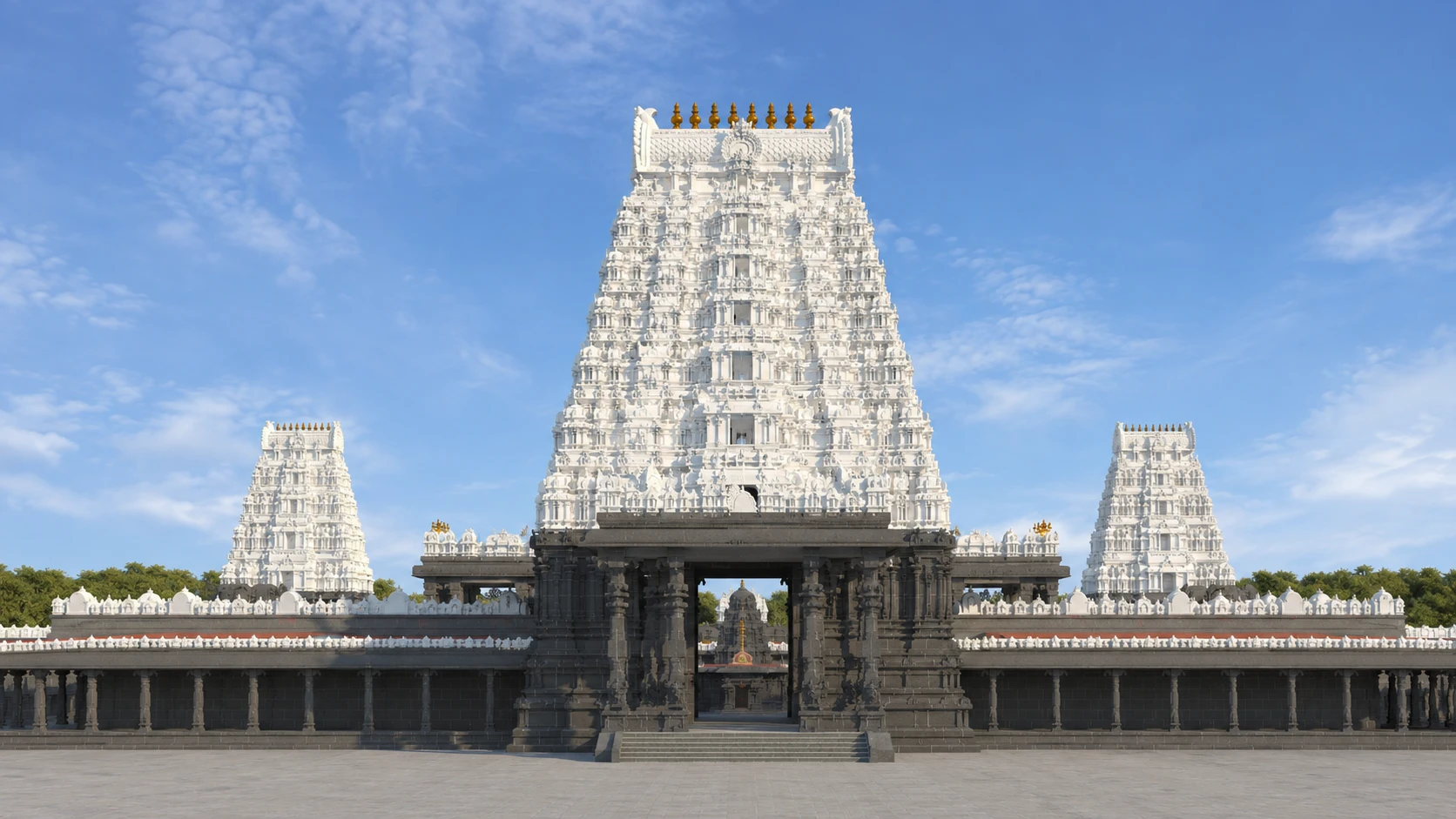
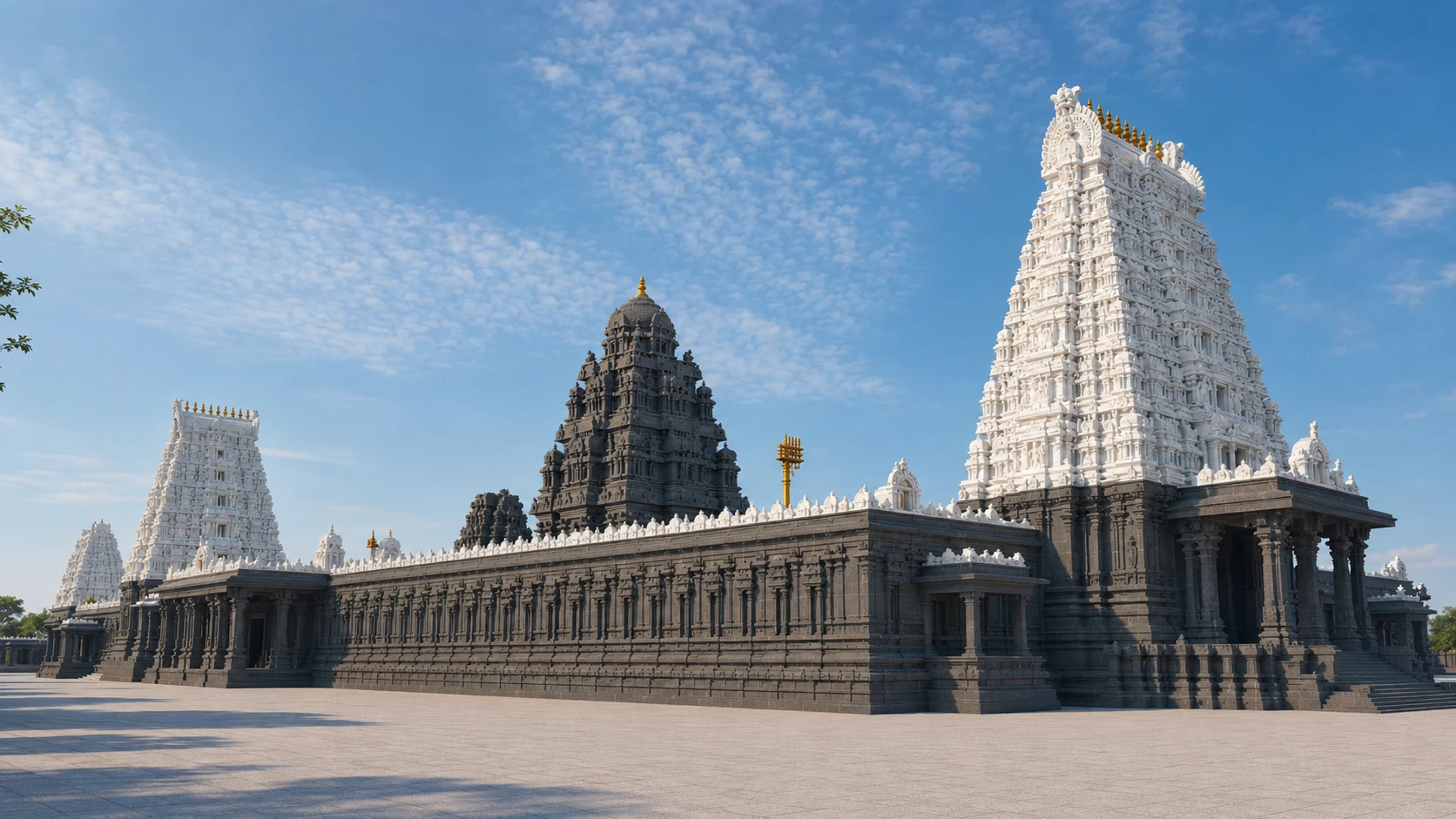
The presiding image at Amararama is a white marble linga of remarkable height, rising approximately fifteen feet through a two-storey garbhagriha. The sanctum's vertical arrangement is the temple's defining iconographic feature: devotees view the linga's base and middle from the ground-floor mandapa, then ascend an internal staircase to a first-floor circumambulatory passage from which the upper portion of the linga can be seen and offered worship. Daily abhishekam is performed in stages, with priests moving between the two levels so that water, milk, and other consecratory substances can flow over the linga along its full height. The linga rests on a panavattam (yoni-pitha) of dark stone, and the contrast between the dark base and the pale marble shaft is striking in early-morning light.
The Bala Chamundika Devi shrine sits within the main temple complex, distinct from the Amareshwara garbhagriha. The Devi is enshrined as a youthful (bala) form of Chamundika — a Durga-Mahakali aspect — and her image is canonically four-armed, holding khadga (sword), trishula (trident), kapala (skull-cup), and abhaya mudra (gesture of protection). Devotees customarily complete darshan of Amareshwara first and then proceed to the Devi shrine, in keeping with the local convention that the consort is approached after the Lord.
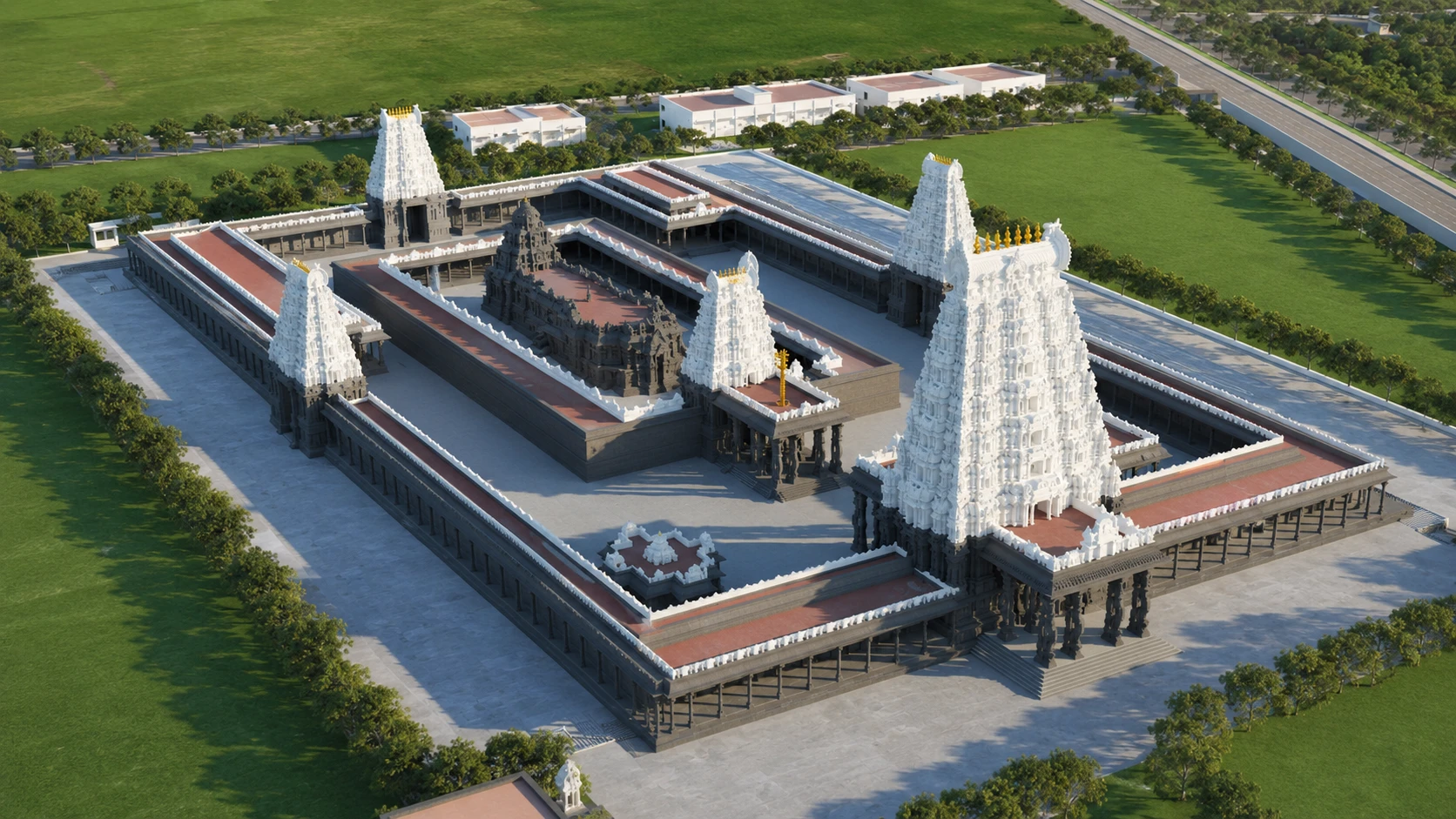
The surrounding precinct includes subsidiary shrines to Subrahmanya (Kartikeya — significant given his role in the Pancharama origin myth as the one whose blow broke the original linga), Vinayaka, the Navagrahas, and a Krishna river kshetrapalaka. A pushkarini (sacred tank) is present in the temple compound, and the temple's western boundary faces the Krishna river itself; pilgrim circuits often include a ritual bath in the river before darshan, particularly during Karthika masam and the twelve-yearly Krishna Pushkaralu. Visitors familiar with the larger Pancharama Kshetra network will note that Amareshwara's iconographic emphasis is on the linga's height rather than on a particular mythological narrative carved into the sanctum surrounds; the temple's storytelling is vertical, not narrative.
Distinctive Practicesविशिष्ट परंपराएँ
Two-storey darshan and abhishekam
द्वि-मंज़िला दर्शन और अभिषेक
Daily during all darshan and aarti hours; full-height abhishekam during Karthika Pournami and Maha Shivaratri
The Amareshwara linga's approximately fifteen-foot height requires a darshan and abhishekam protocol unlike any other major Shiva temple in South India. Pilgrims first take darshan of the linga's base and middle from the ground floor of the garbhagriha, then ascend a narrow internal staircase to a first-floor circumambulatory passage that opens onto the upper portion of the linga. During abhishekam, priests coordinate between the two levels — the lower priest pours over the base while the upper priest bathes the rising shaft — so that the consecratory flow covers the linga along its full height. The two-storey ritual is visible to all devotees, not reserved for any particular service tier.
The two-storey practice embodies the Sthala Purana claim that the linga continued to grow after Indra's installation, drawing into itself the cosmic substance of the original from which it had been broken. To ascend the staircase and circumambulate the linga's upper portion is, in the tradition's framing, to witness Shiva exceeding his own physical container — a meditation on the linga as both bounded form and unbounded principle. The vertical labour of darshan also enacts a small physical homage: the devotee's body must rise to meet the linga, rather than the linga descending to the level of ordinary sight.
Karthika masam observance and Kalyanotsavam
कार्तिक मास साधना और कल्याणोत्सव
Annual, during the lunar month of Karthika (typically November–December); Kalyanotsavam performed on Mondays through the month
The lunar month of Karthika is the temple's principal annual cycle. Through the month devotees observe the broader Karthika vratam — sunrise river-bath in the Krishna, daylight fast, evening lamp-lighting, recitation of the Karthika Mahatmya — and on each Monday of the month the temple performs the Kalyanotsavam, the ritual celestial marriage of Amareshwara and Bala Chamundika. The ceremony enacts the divine union with full mantric protocol: the deity utsava-murtis are bathed, dressed, garlanded, processed, and brought together in the formal Kalyana mandapam, with priests reciting the marriage mantras while devotees witness as wedding guests. Karthika Pournami, the full-moon night of the month, sees the temple lit by thousands of oil lamps and the largest single-day pilgrim flow outside Maha Shivaratri.
Karthika is theologically the most Shaivite of the lunar months — the period in which Shiva is said to have churned the cosmic ocean's poison, granted Tripurasura's defeat, and showered grace upon the devas. At Amararama, the Karthika Kalyanotsavam reads doubly: it celebrates the cosmic marriage of Shiva and Devi as the renewing principle of all creation, and it commemorates locally the restoration of devic order after Tarakasura's defeat — for what Indra installed at Amararama was not just a linga but the proof that the cosmic family could be reunited after the asuric breach. Karthika lamps offered at Amararama re-enact, in human-scale form, the celestial light that returned to the world when the linga was raised here.
Krishna Pushkaralu — the twelve-year river festival
कृष्णा पुष्करलु — द्वादश-वर्षीय नदी महोत्सव
Every twelve years, when Jupiter enters Kanya rashi (Virgo); the most recent observance was 12–23 August 2016, the next is expected in 2028
Once every twelve years the Krishna river is honoured as Pushkara — the embodiment of divine waters — when Jupiter (Brihaspati) transits into Kanya rashi (Virgo). For approximately twelve days devotees from across Telugu-speaking regions and beyond gather at all major ghats along the river to perform tarpana for ancestors, ritual bath, and special darshan at the river's principal temples. Amararama, standing on the southern bank of the Krishna, is one of the most significant Pushkaralu pilgrimage destinations: special pontoon bridges, ghat construction, and crowd-management protocols are deployed for the duration, and the temple's normal abhishekam schedule is supplemented with continuous Pushkara-period rituals. The convergence of the river festival with the Pancharama identity is theologically charged — for it is the very Krishna that received the linga in Indra's installation, and the Pushkaralu year returns the river to its consecratory role.
The Pushkaralu cycle articulates a theological idea older than the Pancharama narrative itself: that sacred rivers are not always equally sacred, but rotate through periods of heightened consecratory potency keyed to celestial cycles. To bathe in the Krishna at Amararama during the Pushkaralu twelve-day window is, in the tradition, to gather merit equivalent to many ordinary bathings — and to do so within reach of the largest fragment of Shiva's atma-linga is to align two consecutive sacred geographies (the river of devic installation and the linga of devic restoration) into a single act. The twelve-year interval also offers, for the devotee, a calendar that exceeds the individual lifetime: most pilgrims will witness Pushkaralu only a handful of times, and the rarity is itself part of the sanctity.
Did You Know?क्या आप जानते हैं?
The Amareshwara linga rises approximately fifteen feet through a two-storey sanctum, making Amararama one of the very few Hindu temples in the world where the architecture had to be built vertically to accommodate the deity rather than horizontally to contain Him. Devotees view the base from the ground floor and ascend an internal staircase to circumambulate the upper portion of the linga from a first-floor passage.
Sri Amareshwara Swamy Devasthanam temple literature (Andhra Pradesh Endowments Department); P. Sitapati, Telugu Sthala Purana surveys
The Sthala Purana of Amararama identifies Indra himself, king of the devas, as the one who installed and consecrated the linga fragment that fell here — and Indra's selection is not random: of all the gods, he had the deepest personal stake in Tarakasura's defeat, because the asura had displaced him from the celestial Amaravati. The town's earthly name remembers what the linga's installation restored.
Pancharama Sthala Purana (Telugu); Skanda Purana regional Pancharama narratives
The temple stands a short walk from the Amaravati Mahachaitya — one of the great Buddhist stupa sites of the ancient world, active from approximately the second century BCE through the fourteenth century CE under Satavahana and later patronage. The two sacred traditions, Saivite and Buddhist, share the same Krishna river plain, and Amaravati is one of very few South Indian sites where a major Hindu pilgrimage temple and an internationally celebrated Buddhist archaeological site occupy effectively the same sacred landscape.
Archaeological Survey of India site reports; James Burgess, 'The Buddhist Stupas of Amaravati and Jaggayyapeta' (1887)
Amararama is the first of a five-temple network — the Pancharama Kshetra — distributed across coastal and central Andhra Pradesh, each enshrining a fragment of Tarakasura's atma-linga. The five temples taken together form one of South India's most thematically tight Saivite pilgrimage circuits, with each fragment installed by a different deity: Amararama by Indra, Draksharama by Surya, Kumararama by Kumara himself, Ksheerarama by Vishnu, and Bhimarama by Chandra.
Pancharama Sthala Purana corpus; Andhra Pradesh Endowments Department temple network documentation
The presiding consort goddess, Sri Bala Chamundika Devi, is enshrined in her own separate shrine within the temple compound. The 'bala' (youthful) form of Chamundika — a Durga-Mahakali aspect — is rare among major South Indian Devi enshrinements, where the consort is more commonly worshipped as Parvati, Lalita Tripurasundari, or a regional Mahalakshmi form. The Bala Chamundika choice at Amararama is theologically connected to the temple's broader narrative of cosmic restoration after Tarakasura: a youthful, fierce, protective Devi to attend the linga of devic re-installation.
Sri Amareshwara Swamy Devasthanam temple literature; regional Devi-mahatmya traditions of coastal Andhra
Sri Krishnadevaraya of Vijayanagara is the most celebrated of the temple's pre-modern patrons. The great sixteenth-century emperor undertook a documented tour of the Pancharama Kshetra and is recorded as having endowed all five sites; the Amuktamalyada, a Telugu literary work attributed to him, refers to the southern coastal sacred geography in terms that align with first-hand acquaintance with the Pancharama network.
Amuktamalyada (Telugu, attributed to Krishnadevaraya); Robert Sewell, 'A Forgotten Empire: Vijayanagar' (1900)
Visitor Accessप्रवेश जानकारी
Sri Amareshwara Swamy Temple at Amararama is open to devotees of all backgrounds, without restriction by gender, caste, or community. Standard South Indian temple decorum applies — devotees are asked to remove footwear before entering the temple complex, maintain silence near the sanctum, and dress in modest, preferably traditional, attire. Photography is permitted in the outer courtyard and around the temple grounds; photography inside the sanctum (garbhagriha) is at the discretion of temple authorities and should be confirmed on the day. Non-Hindus are welcome.
Consult the Sri Amareshwara Swamy Devasthanam information desk on arrival for the day's seva schedule, abhishekam availability, and any temporary access protocols. The Andhra Pradesh Endowments Department's official site lists the temple under its registered devasthanam list. Verify any third-party booking offers against the official devasthanam — no third-party agent is required for ordinary darshan.
Festivalsत्योहार
Maha Shivaratri
महाशिवरात्रि
Feb-Mar (Phalguna Krishna Chaturdashi)
The principal festival of the temple year, observed with night-long jagaran, four praharas of abhishekam, and continuous chanting of the Lingashtakam and Om Namah Shivaya. The two-storey abhishekam protocol — water, milk, honey, sandal paste, and rosewater carried up to the first-floor passage to be poured over the linga's upper portion — is performed in extended form across the four praharas, making Maha Shivaratri at Amararama one of the most visually distinctive observances of the festival in coastal Andhra. The festival draws pilgrims from across Andhra Pradesh, Telangana, and Tamil-Telugu speaking diasporas, and the temple administration coordinates with state authorities for crowd management and additional darshan slots.
Karthika Masam — month-long observance with weekly Kalyanotsavam
कार्तिक मास — साप्ताहिक कल्याणोत्सव के साथ मास-व्यापी साधना
Nov-Dec (Karthika)
The lunar month of Karthika is the temple's principal annual cycle of devotional observance. Through the month devotees keep the broader Karthika vratam — pre-dawn river-bath in the Krishna, daylight fasting, evening lamp-lighting, recitation of the Karthika Mahatmya — and on each Monday of the month the temple performs the Kalyanotsavam, the ritual celestial marriage of Amareshwara and Bala Chamundika. Karthika Pournami, the full-moon night of the month, sees the temple lit by thousands of oil lamps and a single-day pilgrim flow second only to Maha Shivaratri.
Devi Navaratri (for Sri Bala Chamundika Devi)
देवी नवरात्रि (श्री बाला चामुण्डिका देवी के लिए)
Sep-Oct (Ashwin Shukla Pratipada to Navami)
The nine nights of Sharadiya Navaratri are observed at the Bala Chamundika Devi shrine within the temple complex. Each of the nine nights is dedicated to one of the nine Durga forms (Navadurga), with corresponding abhishekam, alankaram (deity dress and adornment), and recitation of the Devi Mahatmya and the Lalita Sahasranama. The Pancharama connection lends Devi Navaratri at Amararama a distinctive theological accent: Bala Chamundika is celebrated here as the youthful protective Devi who attends the linga of devic re-installation — a fierce protection paired with the restored linga, both together as the proof of cosmic order regained.
Krishna Pushkaralu — twelve-year river festival
कृष्णा पुष्करलु — द्वादश-वर्षीय नदी महोत्सव
Once every twelve years; most recent 12–23 August 2016; next expected in 2028
When Jupiter enters Kanya rashi (Virgo), the Krishna river is honoured as Pushkara — divine waters — for approximately twelve days. Amararama, standing on the southern bank, becomes one of the largest single-festival pilgrimage destinations in coastal Andhra during the Pushkaralu window. Special ghats and pontoon arrangements are constructed; the temple's normal seva schedule is supplemented with continuous Pushkara-period rituals; and pilgrims combine river-bath, tarpana for ancestors, and Amareshwara darshan as a single integrated act. The twelve-year cadence means most pilgrims will see this convergence only a handful of times in a lifetime, and the rarity is itself part of the festival's gravitas.
Traditional Offeringsपारंपरिक अर्पण
प्राथमिक अर्पण
Bilva Patra (Bilva leaves)
बिल्व पत्र
बिल्व पत्र
The three leaflets of the bilva are read as the three eyes of Shiva, the trident he wields, and the trinity of creation, preservation, and dissolution. The Shiva Purana holds that even a single bilva leaf offered with devotion outweighs elaborate rituals. At Amararama the leaf is offered onto the linga's base by ground-floor devotees and is also carried upstairs to be offered onto the upper portion of the linga during full-height abhishekam.
Krishna Jal (water from the Krishna river)
कृष्णा जल
कृष्णवेणी जल
Water drawn from the Krishna river immediately west of the temple is used for the day's abhishekam, carrying the consecratory power of the very river that — in the Sthala Purana — received the linga fragment at Indra's installation. The act of drawing the abhishekam water from the same river that Indra honoured links every contemporary worship to the founding installation.
Panchamrit (milk, curd, ghee, honey, sugar)
पञ्चामृत
पञ्चामृत
The five sacred substances of abhishekam — milk for purity, curd for prosperity, ghee for victory, honey for sweet speech, sugar for happiness — are offered at Amararama in the temple's distinctive two-storey protocol, with priests at both levels coordinating the flow so the substances cover the linga along its full vertical reach. Each substance is offered with its own mantric formula.
Vibhuti (sacred ash)
विभूति
विभूति
Sacred ash is applied to the linga and to the devotee's forehead as a constant reminder that all material existence finally returns to ash. The three horizontal lines drawn with vibhuti across the forehead symbolize the three realms Shiva governs and the three guna principles he transcends. Vibhuti is distributed as prasad at the exit of darshan.
Kumkum and turmeric for the Devi shrine
देवी मंदिर के लिए कुङ्कुम और हल्दी
कुङ्कुम, हरिद्रा
At the Sri Bala Chamundika Devi shrine within the temple complex, kumkum and turmeric are offered alongside flowers — particularly red hibiscus and marigold. The two substances together represent Devi's auspiciousness (saubhagya) and her protective, life-affirming aspect; kumkum is also distributed as prasad to female devotees and married pilgrim couples.
इस मंदिर की विशेषता
Two-storey abhishekam sponsorship (full-height linga consecration)
द्वि-मंज़िला अभिषेक प्रायोजन (पूर्ण-ऊँचाई लिंग प्रतिष्ठा)
Distinctive to Amararama: devotees may sponsor a full-height abhishekam in which the consecratory substances are carried up to the first-floor passage and offered onto the upper portion of the linga simultaneously with the ground-floor offering. The seva enacts a specifically Pancharama-Amaravati form of worship — there is no other major South Indian temple where 'sponsoring the full linga' means physically reaching its upper extent. Sponsorship is arranged at the temple counter; the seva is performed in the early-morning or noon abhishekam slot.
Krishna river pre-darshan bath and tarpana
कृष्णा नदी पूर्व-दर्शन स्नान और तर्पण
Many pilgrims observe the older Pancharama discipline of taking a ritual bath in the Krishna immediately west of the temple before approaching Amareshwara — and many also perform tarpana (libation offerings) for departed ancestors at the river ghats before darshan. The pre-darshan river practice is not a fee-based seva; it is a devotional observance undertaken at the river by the pilgrim, often with the help of a riverside purohit. The temple administration provides general guidance but does not charge for the river observance itself.
Pilgrims may bring offerings from outside the temple grounds; the temple counter also offers pre-arranged offering bundles, prasad packets, and seva sponsorship. The Sri Amareshwara Swamy Devasthanam operates under the Andhra Pradesh Charitable and Hindu Religious Institutions and Endowments Department, and seva fees go through the official devasthanam counter — third-party intermediaries are not required for any standard offering or darshan. Devotees with questions about specific seva availability or sponsorship windows are advised to call the temple in advance.
How to Reachकैसे पहुँचें
Amaravati town sits in the lower Krishna river valley, approximately 35 kilometres from Guntur and 50 kilometres from Vijayawada. Guntur Junction is the closest major railhead, with frequent express train services on the Howrah–Chennai main line and good connectivity to Hyderabad, Bengaluru, and most major South Indian cities. Vijayawada Junction is a larger railhead approximately 60 kilometres away, with broader long-distance connectivity for pilgrims travelling from northern and western India. From either Guntur or Vijayawada, regular Andhra Pradesh State Road Transport Corporation (APSRTC) buses run to Amaravati through the day, and private taxis and ride-share options are widely available. By air, Vijayawada International Airport at Gannavaram (approximately 50 km from the temple) is the closest airport, with direct connections to Delhi, Mumbai, Bengaluru, Chennai, Hyderabad, and Visakhapatnam. The drive from Vijayawada Airport to Amaravati is approximately 75–90 minutes depending on traffic; the route runs along the Krishna river and passes through the southern bank pilgrim infrastructure. The temple itself sits in the small core of the historic Amaravati town and is reachable on foot from most points within the town; the surrounding capital-project zone has substantially altered the broader infrastructure landscape and pilgrims arriving from far away are advised to confirm current road access with the temple administration or recent visitors.
Plan Your Visitयात्रा की योजना
🌤 सर्वोत्तम मौसम
October through March, when the Krishna river plain is at its most temperate. Days are warm and dry, evenings comfortably cool, and the Karthika (Nov-Dec) and Maha Shivaratri (Feb-Mar) festival windows fall within this period — the temple is most alive during these months. April through June is uncomfortably hot, with temperatures regularly above 38°C and humidity along the river plain making outdoor pilgrimage activities taxing. July through September brings the southwest monsoon; pilgrim activity continues but heavy rain can disrupt road access and river ghat operations.
👘 पहनावे का नियम
Traditional Indian attire is preferred and is the norm among most devotees: dhoti and angavastram or kurta-pyjama for men, saree or salwar-kameez for women, with the head respectfully uncovered for men and traditionally covered or uncovered as the devotee chooses for women. Shorts, sleeveless tops, and short skirts may attract polite request to cover up, particularly for sanctum-level darshan. Footwear is removed at the entrance to the inner temple complex; covered shoe-rack facilities are available. Cleanliness rather than formality is the underlying standard.
📱 फोन और फोटोग्राफी
Mobile phones are generally permitted in the outer courtyards and around the temple grounds. Inside the inner sanctum (garbhagriha) and during abhishekam, devotees are asked to switch phones to silent and refrain from photography; the temple's specific photography policy for the inner sanctum should be confirmed on the day with the information desk, as policies can change with the season and the specific seva in progress.
🏨 आवास
Amaravati town has limited dedicated dharamshala accommodation; most pilgrims stay in Vijayawada (50 km) or Guntur (35 km), where mid-range hotels, business hotels, and well-rated guesthouses are widely available. The Andhra Pradesh Tourism Development Corporation (APTDC) operates Haritha hotels in both cities and at intermediate locations. Several private boutique hotels have opened in the broader Amaravati capital region since 2014, though availability and operations are affected by the ongoing political fluctuations in the capital project. For Karthika Pournami, Maha Shivaratri, and the twelve-yearly Krishna Pushkaralu, advance booking through APTDC or major hotel chains is strongly recommended.
Sacred Soundsपवित्र ध्वनि
क्या आप जानते हैं? · Did You Know?
वही अनुवाद त्रुटि जिसने हिन्दू धर्म में '33 कोटि' को '33 करोड़' बनाया, बौद्ध धर्म में भी हुई। बौद्ध ग्रन्थों के चीनी अनुवाद ने 'सप्त कोटि बुद्ध' (7 श्रेष्ठ बुद्ध) का अनुवाद '7 करोड़ बुद्ध' कर दिया। तिब्बती अनुवाद ने सही किया: 7 प्रकार, 7 करोड़ नहीं। एक संस्कृत शब्द, दो प्रमुख विश्व धर्मों में गलत पढ़ा गया, ने दो एकसमान भ्रम स्वतन्त्र रूप से उत्पन्न किए।
Related Contentसंबंधित सामग्री
Related Scriptures
Community Reflections
🕉️
Be the first to share your reflection.