Ksheerarama (Palakollu)
क्षीरारामा
Where Vishnu raised the milk-pale fragment in devotion to Shiva
Palakollu, Andhra Pradesh, India
KṣīrārāmaAlso known as: Ksheerarama, Kshirarama, Sri Ksheera Ramalingeshwara Swamy Temple, Palakollu Ksheerarama Temple, Ksheera Ramalingeswara Devalayam
युग
Eastern Chalukya period predominant (9th–11th c.); continuous worship documented from at least the early medieval period; major Kakatiya and Vijayanagara additions
वास्तुकला
Eastern Chalukya / Dravidian Andhra (with Kakatiya, Reddy, and Vijayanagara sculptural and inscriptional layers)
खुला
05:30 – 21:00
आरती
06:00 · 12:00 · 18:30
विशेष
Two-storey abhishekam tickets at counter inside complex; Maha Shivaratri Kalyanotsavam; Devi Navaratri sevas at Parvati shrine; surge during Vaikuntha Ekadashi (Vishnu-installer festival particular to this site) and the twelve-yearly Godavari Pushkaralu
पवित्र कथा · पवित्र कथा
Ksheerarama is the fourth of the Pancharama Kshetra and the only one in the sequence where the installer of the linga fragment is Vishnu — the cosmic preserver, here acting not as a competing deity to Shiva but as Shiva's devotee. Local Sthala Purana tradition holds that Vishnu, before installing the linga, undertook a long tapasya at this site on the Godavari delta plain near Palakollu; that he poured milk from the celestial cow over the fragment as part of his consecration; and that the linga, absorbing both Vishnu's devotion and his milk-offering, took on the pale luminous quality from which the temple takes its name. Ksheerarama means 'milk place' or 'milk grove,' and the town's name Palakollu is the Telugu translation of the same — 'pala' (milk) plus 'kollu' (lake or place). The presiding linga rises through a two-storey sanctum in pale shaft; beside it Sri Parvati Devi is enshrined in her standard form as Shiva's eternal consort. The temple's particular theological character — that Vishnu installed Shiva's linga as an act of devotion rather than as a parallel cosmic act — gives Ksheerarama a unique place within the broader Hindu tradition of inter-deity reverence, and accounts for the temple's strong following among both Shaivite and Vaishnava pilgrims across the centuries.
Sacred Designationपवित्र पदनाम
Sacred Origin Storyपवित्र उत्पत्ति कथा
Source: Skanda Purana (regional Andhra Pancharama narratives) and the Sthala Purana corpus of coastal Andhra; the broader Tarakasura cycle drawn from the Skanda Purana, the Shiva Purana (Rudra Samhita, Kumara Khanda), and the Mahabharata's Vana Parva; the Vishnu-as-installer narrative draws on regional Smarta-Vaishnava synthesis traditions and on the Bhagavata Purana's broader treatment of Vishnu as Shiva's eternal devotee (Harih Shankara-priyaḥ)
When Kumara's Shakti weapon shattered Tarakasura's atma-linga in the great battle, the fragments scattered across what would later become coastal Andhra. The cosmic crisis ended; the asura fell; the worlds were saved. But the fragments could not lie where they had landed, for they were Shiva himself, in pieces. The devas assembled to determine the proper installation of each fragment. At the fourth site, on a Godavari delta plain near a small forest of palmyra and tamarind, the fragment had come to rest in a particular hollow of the earth — not far from the sea, where the river's last branch released its waters into the Bay of Bengal.
Vishnu rose to install this fragment. Of all the devas, Vishnu carried the most complex relationship with the Pancharama narrative: he had not fought in the Tarakasura battle, but he had been the one, generations earlier in the Daksha-yajna cycle, who used his discus to fragment Sati's body and free Shiva from the grief that had paralysed the cosmos. The Pancharama installations were in their own way completing what the Sati-fragmentation had begun — the cosmic restoration that Vishnu had set in motion was now being structurally rebuilt at the five sites in the Godavari delta, and Vishnu's installation at the fourth Pancharama returned him to the work of cosmic preservation.
But the Sthala Purana frames Vishnu's act with a distinctive quality not present in the installations by Indra, Surya, or Kumara. The earlier installers approached the fragments as cosmic functionaries — devic kingship, divine illumination, warrior victory. Vishnu approached the fragment as a devotee. The Sthala Purana describes him undertaking a long tapasya at the site before lifting the linga, sitting in meditation by the small lake that pilgrims still bathe in, and addressing Shiva not as one Trimurti deity to another but as worshipper to Lord. The tapasya is the founding gesture of the temple's identity, and the temple's particular character as a site of inter-deity devotion derives from it.
When Vishnu's tapasya concluded, the Sthala Purana says that the celestial cow Surabhi appeared at the site — for the act of installation required a substance worthy of the Lord, and milk from Surabhi was the offering Vishnu chose. He poured the milk over the fragment, performing the abhishekam himself. As the milk flowed, the fragment absorbed it, taking on a pale luminous quality — and from that moment the linga has carried the milk-pale appearance that gives the temple its name. The pool of milk that gathered around the linga's base seeped into the earth and became, in the local tradition, the small lake beside which Vishnu had earlier sat — its waters from that day held to be sanctified by the dual sanctity of Vishnu's tapasya and Shiva's consecration. After the abhishekam, Vishnu raised the linga in its place and named the site Ksheerarama — the milk place — and the surrounding settlement, in the Telugu language of the region that would later flourish here, became Palakollu, the same name in vernacular form.
A strand of the Sthala Purana extends the account into the daily life of the temple. It says that on auspicious days — particularly Vaikuntha Ekadashi, the principal Vishnu festival of the year — the linga still carries traces of Vishnu's milk-aspersion, and that water poured in abhishekam at this site is touched by milk-quality in a way that does not occur at the other Pancharama temples. The folk tradition holds this in literal as well as devotional reading; the temple priesthood preserves the tradition with appropriate care, and individual experience varies. Whether the milk-quality is read as literal phenomenon, as ritual symbol, or as devotional remembrance, it is the temple's signature theological claim and the basis of its name.
उद्धृत स्रोत:
- Skanda Purana — regional Pancharama narratives within the Andhra-specific khanda tradition
- Pancharama Sthala Purana corpus (Telugu and Sanskrit; printed editions)
- Shiva Purana, Rudra Samhita, Kumara Khanda
- Mahabharata, Vana Parva
- Bhagavata Purana — passages on Vishnu's reverence for Shiva (Harih Shankara-priyaḥ tradition)
- Local Ksheerarama Sthala Mahatmya (Telugu, printed editions through the AP Endowments Department)
अन्य परंपराएँ · अन्य परंपराएँ
Milk-quality variant readings — strong, moderate, and symbolic
Sources differ on how the milk-quality of the linga should be understood. Folk-devotional tradition, particularly preserved in oral Telugu narratives, holds the milk-quality as literal: water poured over the linga during abhishekam turns milky in colour, and the linga is said to exude a milky substance on certain auspicious days. A moderate reading, preserved in temple literature and in some Sthala Purana strands, treats the milk-quality as a description of the stone's pale luminous appearance combined with a remembrance of Vishnu's milk-aspersion at the founding consecration — a real visual property of the linga read through devotional framing. A more symbolic reading, found in some Smarta and Vedantic commentaries, treats the milk-quality as a metaphor for the purifying grace of Vishnu's installation, with no claim of empirical milk-phenomenon. Eternal Raga records all three readings without arbitrating between them: the stone's pale luminosity is genuinely observable; the stronger empirical claims are presented as living devotional tradition.
Vishnu-installer variant — joint Vishnu-Brahma reading
A small minority of regional Pancharama sources, particularly in some folk hagiographies, describe the Ksheerarama installation as a joint act of Vishnu and Brahma, with Brahma present as witness and Vishnu as principal installer. This reading reflects the broader Trimurti theology in which all three great deities are present at major cosmic events. The majority canonical position keeps Vishnu as sole installer at Ksheerarama; Eternal Raga follows the majority position while documenting the variant.
विद्वत संदर्भ
Modern scholarship places Ksheerarama's principal construction phase under the Eastern Chalukyas of Vengi in the ninth through eleventh centuries CE, consistent with the construction histories of Draksharama, Kumararama, and Bhimarama. The temple's inscriptional record begins from this period, with major royal patronage continuing through the Kakatiya, Reddy, and Vijayanagara periods. The integration of the Ksheerarama site into the broader Pancharama Kshetra theological network is documented in Eastern Chalukya inscriptions, confirming that the five-site Pancharama identity was established by this period rather than being a later retrojection. The Vishnu-as-installer attribution is consistent across the Sthala Purana corpus and the canonical Pancharama Stotram tradition. The April 2022 Andhra Pradesh district reorganisation split the former West Godavari district into West Godavari and Eluru districts; Palakollu remained in West Godavari, so unlike the other Pancharama sites in former East Godavari district, the temple's district name did not change — though district boundaries did. The milk-linga tradition is documented in Sthala Purana strands from the medieval period onward; the strongest folk-empirical claims (water turning milky during abhishekam) are best treated as living devotional tradition, with the pale-stone visual appearance being the underlying observable fact. Scholarly discussion has focused on the Eastern Chalukya construction phasing, the integration of the Vishnu-installer narrative with the wider Smarta-Vaishnava synthesis tradition in coastal Andhra, and the relationship of the Ksheerarama Sthala Purana to pan-Hindu Vishnu-Shiva devotional traditions.
Historyइतिहास
Ksheerarama's documented history begins under the Eastern Chalukyas of Vengi in the ninth through eleventh centuries CE, the dynasty whose patronage produced the principal architectural phase of all the major Pancharama temples. The temple's Eastern Chalukya construction phase falls within the same dynastic and chronological window as Draksharama, Kumararama, and Bhimarama, with inscriptions of the period recording royal endowments and the temple's formal integration into the broader Pancharama Kshetra theological network. The eleventh century brings the temple under Vimaladitya and Rajaraja Narendra, the same Eastern Chalukya court at which Nannaya Bhattaraka composed the foundational Telugu Mahabharata — and the temple's Vishnu-installer identity made it a particular touchstone for the Smarta-Vaishnava synthesis tradition that emerged in the Eastern Chalukya intellectual milieu.
The Kakatiyas (twelfth through fourteenth centuries) maintained Ksheerarama's standing as a regional pilgrimage centre, adding substantial sculptural and inscriptional layers to the existing Eastern Chalukya structure. Reddy patronage in the fourteenth century continued the line. Vijayanagara contributions to the temple complex include sculptural work in the prakara and inscriptions associated with Sri Krishnadevaraya's celebrated early-sixteenth-century tour of the Pancharama Kshetra. The temple's Vishnu-installer identity was particularly congenial to Vijayanagara religious policy, which honoured both Shaivite and Vaishnava traditions and supported the Smarta synthesis at major coastal Andhra sites.
The Qutb Shahi and Mughal periods brought the broader Godavari delta under different political arrangements, but the temple itself remained in continuous worship under local administration. The eighteenth and nineteenth centuries saw local zamindari patronage, with the temple's inscriptions beginning to be systematically documented under late-British-era archaeological administration. The twentieth century brought the temple under the Andhra Pradesh Charitable and Hindu Religious Institutions and Endowments Department.
The most recent administrative event of relevance is the April 2022 Andhra Pradesh district reorganisation, which split the former West Godavari district into the present West Godavari district and the new Eluru district. Palakollu remained within West Godavari district, so unlike Draksharama and Kumararama (whose district names changed), Ksheerarama's district name did not change — though the district's overall geography and administrative seat were affected. The Godavari Pushkaralu of 2015 (12 July–23 July) was the most recent major pan-river festival; the next is expected in 2027. Pilgrim flow has remained steady through the post-Independence period under Endowments Department administration, with Ksheerarama functioning as the fourth stop on the standard Pancharama Kshetra pilgrim circuit and as a principal Smarta-tradition site in coastal Andhra.
Historical Timelineऐतिहासिक कालक्रम
Principal Eastern Chalukya construction phase of the present temple complex. Royal patronage is attested under multiple Eastern Chalukya rulers, culminating in significant additions under Vimaladitya (reign c. 1011–1018 CE) and Rajaraja Narendra (reign c. 1018–1061 CE) — the same Eastern Chalukya court that produced Nannaya Bhattaraka's foundational Telugu Mahabharata. Inscriptions of this period record gifts, endowments, and the formal integration of Ksheerarama into the broader Pancharama Kshetra theological network.
Kakatiya patronage maintains the temple's standing as a regional pilgrimage centre. Substantial sculptural and inscriptional additions to the existing Eastern Chalukya structure are documented from this period. Reddy patronage in the fourteenth century continues the line, with the temple's place in the Pancharama Kshetra circuit firmly established.
Sri Krishnadevaraya of Vijayanagara visits Ksheerarama as part of his celebrated tour of the Pancharama Kshetra and makes endowments at the temple. Vijayanagara religious policy was particularly congenial to the temple's Vishnu-installer identity, which embodied the Smarta-Vaishnava synthesis that Vijayanagara patronage supported across major coastal Andhra sites. Vijayanagara-period sculptural and inscriptional additions remain visible in the temple's prakara.
The temple passes through local zamindari patronage during the Qutb Shahi successor period and the British colonial era. Inscriptions are systematically documented under late-British-era archaeological administration. The early Andhra Pradesh state period brought the temple under the Andhra Pradesh Charitable and Hindu Religious Institutions and Endowments Department, the administrative authority under which it currently functions.
The Andhra Pradesh district reorganisation of April 2022 splits the former West Godavari district into the present West Godavari district and the new Eluru district. Palakollu remained within West Godavari district; unlike Draksharama and Kumararama in the former East Godavari division, the district name for Ksheerarama did not change — though the district's overall geography and administrative seat were affected. The temple remains under the AP Charitable and Hindu Religious Institutions and Endowments Department.
What You'll Seeदर्शन में
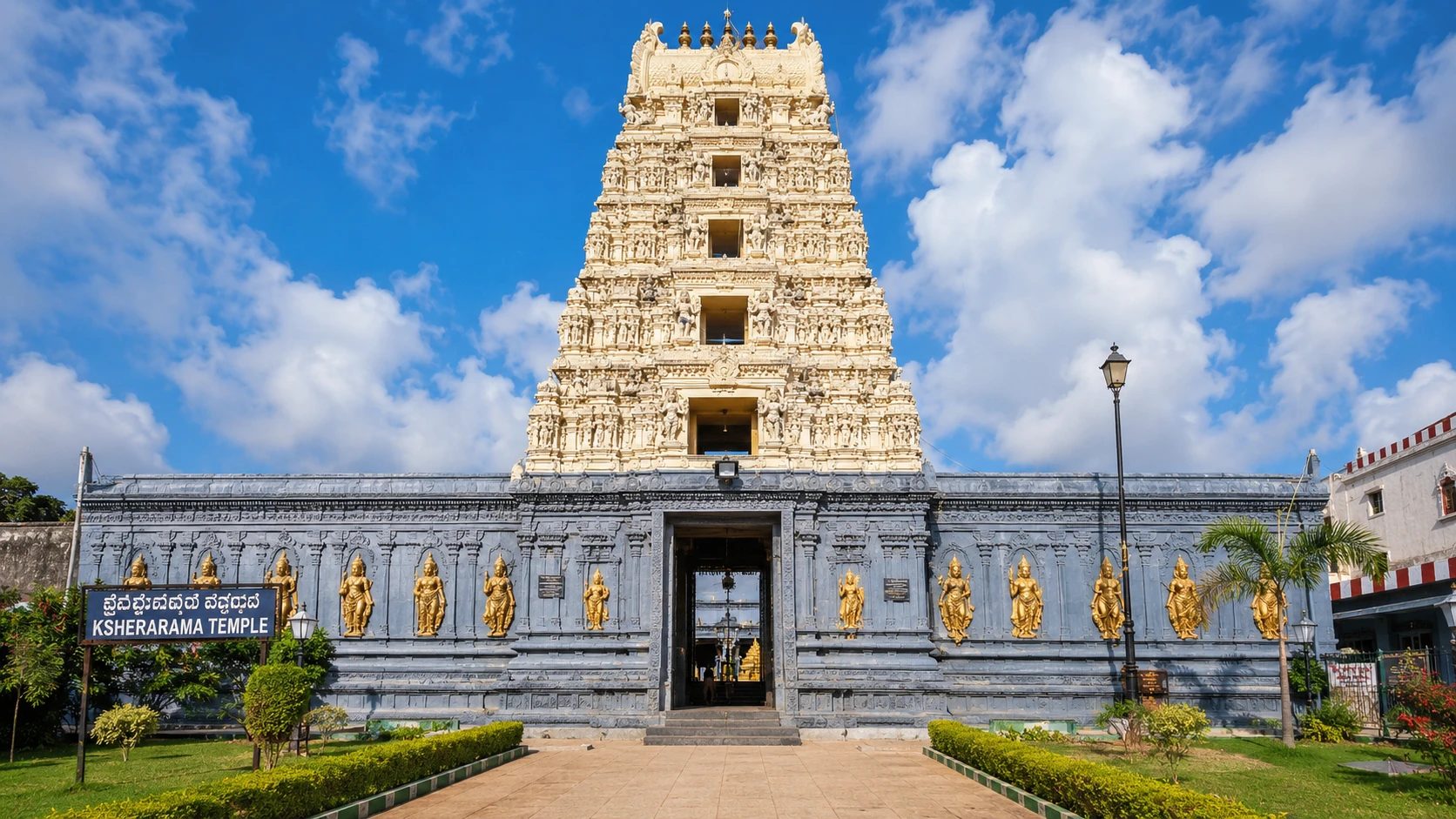
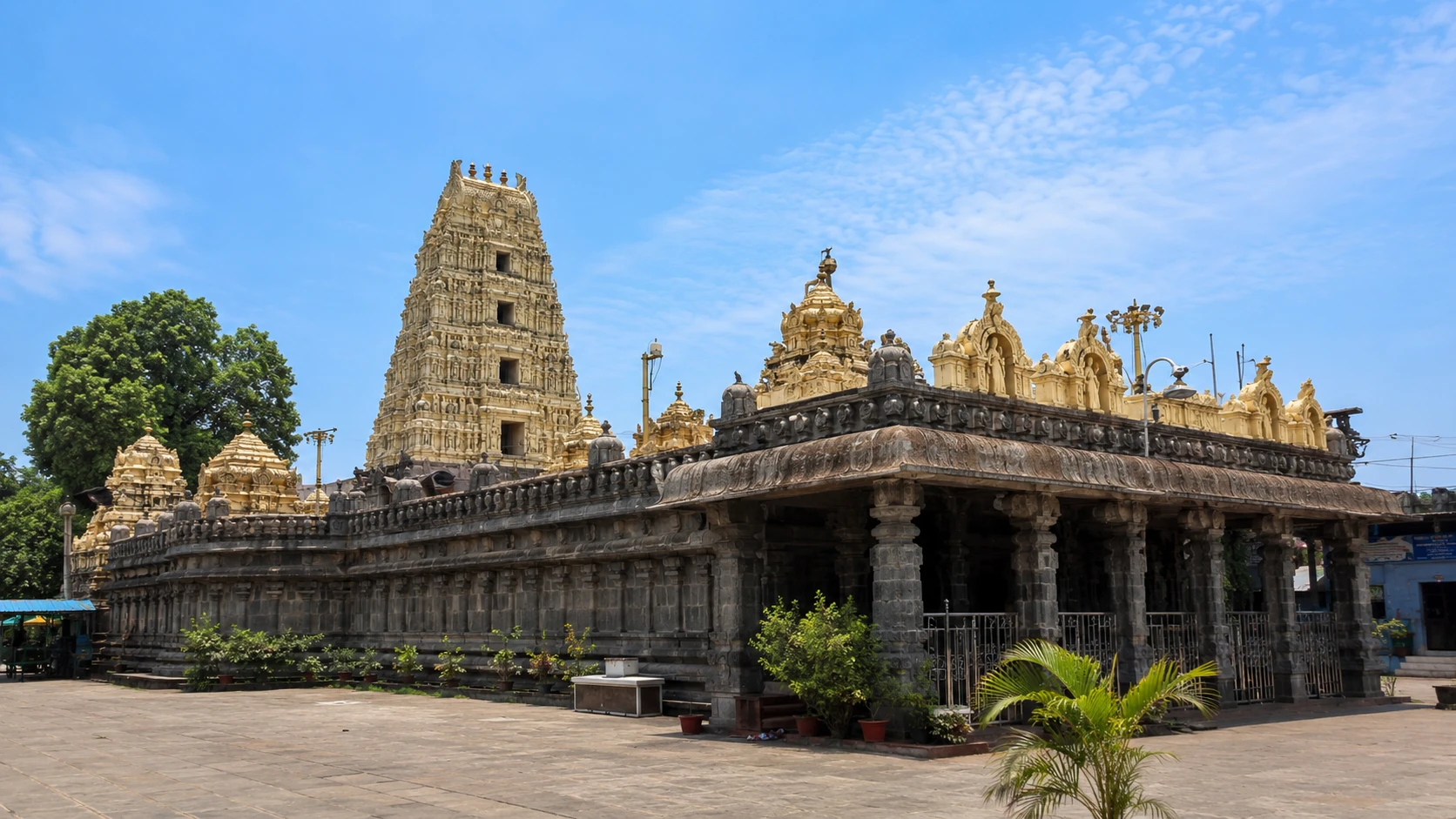
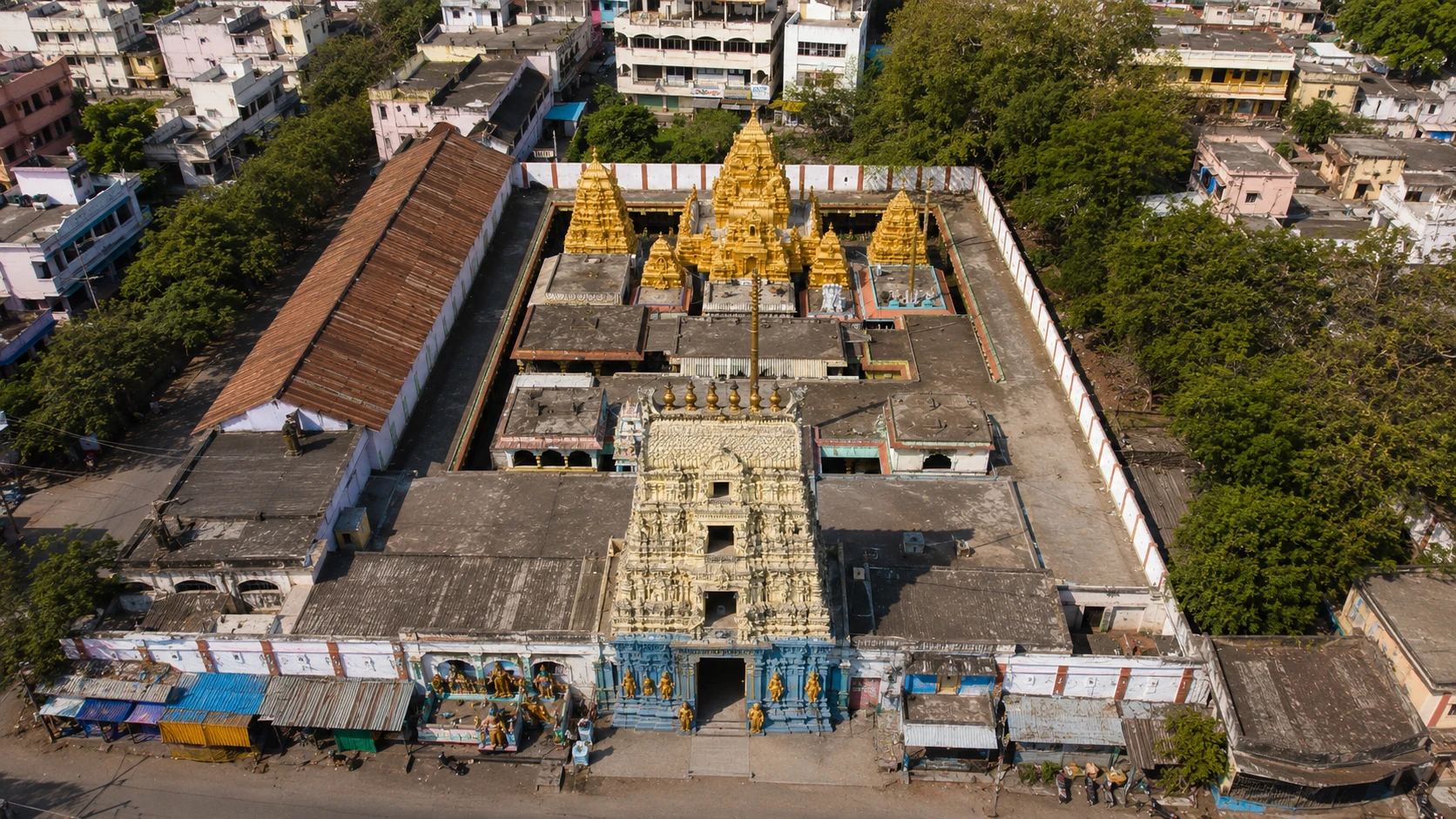
The presiding image at Ksheerarama is Sri Ksheera Ramalingeshwara, manifest as a pale-stone linga rising through a two-storey garbhagriha. The linga's stone is genuinely lighter in tone than the lingas at Amararama, Draksharama, and Kumararama — a visual property that, combined with the Sthala Purana's milk-aspersion tradition, gives the temple its name Ksheerarama (milk place). Temple literature cites the linga's height as approximately nine feet, moderate among the Pancharama lingas though still requiring the two-storey architectural arrangement. Devotees view the linga's base and middle from the ground floor and ascend an internal staircase to a first-floor circumambulatory passage from which the upper portion is offered worship. The linga rests on a panavattam of darker stone, the colour contrast between linga and base accentuating the milk-pale character of the shaft.
The Sri Parvati Devi shrine sits within the same temple complex in its own enclosure. The Devi is enshrined in her standard form as Shiva's eternal consort — four-armed, holding pasha and ankusha, showing varada and abhaya mudras — with daily worship following standard Shaivite-consort protocol rather than any Mahavidya- or Sri-Vidya-specific tradition. The shrine's relative quietness compared with the elaborate Shakti-Peeth and Sri-Vidya alankarams at Draksharama and Kumararama is itself characteristic of Ksheerarama: the temple's emphasis falls on the inter-deity devotion narrative (Vishnu installing Shiva) rather than on the consort goddess tradition.
The surrounding precinct includes a particularly notable Vishnu shrine — the only Pancharama site with a dedicated Vishnu shrine commemorating the installer-deity by the same logic that gives Kumararama its Subrahmanya shrine. The Vishnu shrine is held in local tradition to mark the spot of Vishnu's tapasya before the linga installation, and is the focal point of Vaikuntha Ekadashi observance at the temple. Additional subsidiary shrines include Vinayaka, Subrahmanya, Nataraja, the Navagrahas, Saptamatrika, and Veerabhadra. The temple's pushkarini — known locally as the Ksheera Pushkarini or Pala Cheruvu (milk tank) — is held in tradition to be the lake into which Vishnu's surplus milk from the linga abhishekam seeped during the founding consecration, and is consequently treated as having a milk-quality of its own; a pre-darshan bath in the Ksheera Pushkarini is the customary first act of pilgrimage at Ksheerarama. Eastern Chalukya sculptural panels on the prakara depict the Tarakasura battle, Vishnu's tapasya, the celestial cow Surabhi's appearance, and the milk-abhishekam scene in carved narrative form — making the temple's iconographic surrounds among the most narratively explicit in the Pancharama network for the founding mythology.
Distinctive Practicesविशिष्ट परंपराएँ
Vaikuntha Ekadashi at the installer's temple
स्थापक के मंदिर पर वैकुण्ठ एकादशी
Annual; Margashirsha Shukla Ekadashi (December–January)
Vaikuntha Ekadashi is the principal Vishnu festival of the Hindu calendar, observed in temples across India as the day on which the gates of Vaikuntha — Vishnu's heavenly abode — are said to open and devotees who pass through them receive moksha. At Ksheerarama, the festival carries unique theological density: this is the only Pancharama site whose installer is Vishnu, and the Vaikuntha Ekadashi observance here is the only one in the Pancharama network where the festival's central deity is also the temple's founding installer. Devotees pass through the special Vaikuntha Dwaram (the heavenly gate) constructed in the prakara, receive darshan at the dedicated Vishnu shrine that marks Vishnu's tapasya spot, and then proceed to the main Bhimeshwara linga for the founding-narrative completion. The festival pairing of Vaikuntha Ekadashi at Ksheerarama and Maha Shivaratri at the same temple captures the temple's distinctive Smarta-Vaishnava-Shaivite synthesis in two complementary annual peaks.
Vaikuntha Ekadashi at the installer's temple is read in the local tradition as the moment when Vishnu's founding gesture (the tapasya, the milk-abhishekam, the installation) becomes available to the devotee in ritual present. To pass through the Vaikuntha Dwaram at Ksheerarama is to walk in Vishnu's own footsteps from his tapasya spot to the linga he installed — and the festival's promise of moksha through the gate is, at this site, structurally completed by the devotee's subsequent darshan at the linga Vishnu raised.
Ksheera abhishekam — milk consecration
क्षीर अभिषेक — दूध की प्रतिष्ठा
Daily morning abhishekam; intensified observance on Pradosha vrats, Maha Shivaratri, and Karthika Mondays
Daily abhishekam at Ksheerarama centres on milk in a way distinct from the other Pancharama sites: where Amararama, Draksharama, and Kumararama use milk as one of the panchamrit components alongside curd, ghee, honey, and sugar, Ksheerarama makes pure milk abhishekam the structural centre of the daily seva, in remembrance of Vishnu's founding consecration of the linga with milk from the celestial cow Surabhi. The morning abhishekam typically uses substantial quantities of milk poured continuously over the linga's full height through the two-storey protocol, with priests at both levels coordinating the flow. On Pradosha and Maha Shivaratri the milk abhishekam is extended to its full ceremonial form, with the celestial-cow narrative recited during the offering.
The ksheera abhishekam returns the temple's daily worship to the founding moment of Vishnu's installation. Each morning's milk offering re-enacts, in ritual time, the celestial-cow consecration through which the linga acquired its milk-pale quality and the temple acquired its name. The pure-milk centring (rather than panchamrit centring) is also a theological statement: at Ksheerarama, the singular substance honours the singular act of Vishnu's devotion, as the panchamrit's five-fold symbolism is replaced by the focused remembrance of the one substance Vishnu chose.
Pre-darshan bath in the Ksheera Pushkarini
क्षीर पुष्करिणी में पूर्व-दर्शन स्नान
Daily; particularly observed on festival days and during the Pancharama Kshetra Yatra
The Ksheera Pushkarini — known locally as the Pala Cheruvu, the milk tank — is held in Sthala Purana tradition to be the lake into which Vishnu's surplus milk seeped during the founding abhishekam. Pilgrims at Ksheerarama traditionally take a pre-darshan bath in the Ksheera Pushkarini before proceeding to the main shrine, in keeping with the tradition that the tank's waters carry a milk-quality of their own from the founding event. The practice is functionally similar to the Saptarshi Pushkarini bath at Draksharama but is theologically distinct — at Draksharama the tank waters carry the seven-fold Godavari identification, while at Ksheerarama they carry the milk-quality. No fee is charged for the tank itself; bathing arrangements and ritual assistance are made through the temple priest network.
The pre-darshan bath in the Ksheera Pushkarini is the embodied participation of the pilgrim in the temple's founding moment. Where the milk-abhishekam returns Vishnu's gesture to the linga in ritual time, the pushkarini bath returns the milk-substance to the pilgrim's own body — and the pilgrim then enters the temple having participated in the milk-tradition twice over: through the tank's waters and through the abhishekam's milk.
Did You Know?क्या आप जानते हैं?
Ksheerarama is the only one of the five Pancharama Kshetra installed by Vishnu, and the only Hindu temple in the Pancharama network where Vishnu's act of installation is framed as devotion to Shiva rather than as a parallel cosmic act. The Sthala Purana's portrait of Vishnu as worshipper rather than as competing deity makes Ksheerarama a foundational site for the Smarta-Vaishnava synthesis tradition in coastal Andhra — an inter-deity devotional theology embedded in the temple's central narrative.
Pancharama Sthala Purana corpus (Telugu and Sanskrit); Bhagavata Purana — passages on Vishnu's reverence for Shiva
The temple's name Ksheerarama means 'milk place' or 'milk grove' in Sanskrit, and the town's name Palakollu — pala (milk) plus kollu (lake or place) — is the direct Telugu translation of the same. Both names encode the central milk-linga tradition derived from Vishnu's consecration with milk from the celestial cow Surabhi. Palakollu is one of the few major Telugu town names whose etymology is directly traceable to a Hindu temple's founding mythology.
Sri Ksheera Ramalingeshwara Swamy Devasthanam temple literature; Telugu place-name etymology in P. V. P. Sastry's regional studies
The milk-quality of the Ksheerarama linga is documented in three interpretive registers: as a literal phenomenon (folk-devotional tradition holding that water poured over the linga during abhishekam turns milky), as a real visual property of the pale-stone shaft combined with remembrance of Vishnu's founding milk-aspersion (the temple-literature reading), and as a symbol of the purifying grace of Vishnu's installation (the Smarta-Vedantic reading). The linga's stone is genuinely lighter in tone than at the other Pancharama sites; the stronger empirical claims are presented as living devotional tradition.
Sri Ksheera Ramalingeshwara Swamy Devasthanam temple literature; Telugu Ksheerarama Sthala Mahatmya; Smarta commentaries on Pancharama theology
Ksheerarama is the only Pancharama site with a dedicated Vishnu shrine within the temple complex, marking the spot of Vishnu's tapasya before the linga installation. The presence of the installer-deity in a separate shrine within the temple he founded parallels the Kumararama pattern (Subrahmanya shrine for installer Kumara) and is one of only two such installer-shrine arrangements in the Pancharama network. The Ksheerarama Vishnu shrine is the focal point of the temple's Vaikuntha Ekadashi observance, the most important Vishnu festival of the year.
Sri Ksheera Ramalingeshwara Swamy Devasthanam temple literature; Pancharama Sthala Purana corpus
Daily abhishekam at Ksheerarama centres on pure milk in a way distinct from the other Pancharama sites. Where the sibling temples use milk as one of five panchamrit components alongside curd, ghee, honey, and sugar, Ksheerarama elevates milk to the structural centre of the daily seva, in remembrance of Vishnu's founding consecration of the linga with milk from Surabhi. The Ksheera abhishekam tradition is one of the temple's signature distinguishing practices within the Pancharama network.
Sri Ksheera Ramalingeshwara Swamy Devasthanam temple literature; Pancharama Sthala Purana corpus
Of the five Pancharama sites, Ksheerarama is the only one whose post-April-2022 district name did not change: it remained in West Godavari district while the new Eluru district was carved from western portions of the former West Godavari. By contrast, Amararama (now NTR district, formerly Krishna), Draksharama (now Konaseema district), and Kumararama (now Kakinada district) all received new district designations in the same reorganisation. Ksheerarama's stable district name is a small but useful reference point for pilgrims comparing pre- and post-2022 travel literature.
Andhra Pradesh Districts (Formation) Act 2022; AP Revenue Department notifications (April 2022)
Visitor Accessप्रवेश जानकारी
Sri Ksheera Ramalingeshwara Swamy Temple at Ksheerarama is open to devotees of all backgrounds, without restriction by gender, caste, or community. Standard South Indian temple decorum applies — devotees remove footwear before entering the temple complex, maintain silence near the sanctum, and dress in modest, preferably traditional, attire. The Bhimeshwara, Parvati, and Vishnu shrines all follow the same access norms. Photography is permitted in the outer courtyards and around the temple grounds; photography inside the inner sanctums is at the discretion of temple authorities and should be confirmed on the day. Non-Hindus are welcome.
Consult the Sri Ksheera Ramalingeshwara Swamy Devasthanam information desk on arrival for the day's seva schedule, ksheera abhishekam availability, two-storey full-height abhishekam timing, Vaikuntha Ekadashi seva sponsorship, and Parvati alankaram. The Andhra Pradesh Endowments Department's official site lists the temple under its registered devasthanam list. Verify any third-party booking offers against the official devasthanam — no third-party agent is required for ordinary darshan or routine seva.
Festivalsत्योहार
Vaikuntha Ekadashi — the installer's festival
वैकुण्ठ एकादशी — स्थापक का उत्सव
Dec-Jan (Margashirsha Shukla Ekadashi)
Vaikuntha Ekadashi is the principal Vishnu festival of the Hindu calendar, observed across India as the day on which the gates of Vaikuntha — Vishnu's heavenly abode — are said to open and devotees who pass through them receive moksha. At Ksheerarama the festival carries unique theological density within the Pancharama network: this is the only one of the five sites whose installer is Vishnu, and the Vaikuntha Ekadashi observance here is the only one in the network where the festival's central deity is also the temple's founding installer. A special Vaikuntha Dwaram (the heavenly gate) is constructed in the prakara; pilgrims pass through it, receive darshan at the dedicated Vishnu shrine marking Vishnu's tapasya spot, and then proceed to the main Bhimeshwara linga for the founding-narrative completion. The pairing of Vaikuntha Ekadashi (December–January) and Maha Shivaratri (February–March) at the same temple captures the Smarta-Vaishnava-Shaivite synthesis at the temple's heart in two complementary annual peaks.
Maha Shivaratri with Ksheera abhishekam
क्षीर अभिषेक के साथ महाशिवरात्रि
Feb-Mar (Phalguna Krishna Chaturdashi)
The principal Shaivite festival of the temple year, observed at Ksheerarama with night-long jagaran and four praharas of two-storey ksheera abhishekam — the milk-centred abhishekam that returns the linga to its founding consecration. The four-prahara protocol uses substantial quantities of fresh milk poured continuously over the linga's full height, with the celestial-cow narrative recited during each prahara. Devotees participate in continuous chanting of the Lingashtakam, Bilvashtakam, and Om Namah Shivaya through the night, with the Mahapradosha hour marked by a particularly elaborate ksheera abhishekam sequence.
Devi Navaratri at the Parvati shrine
पार्वती मंदिर पर देवी नवरात्रि
Sep-Oct (Ashwin Shukla Pratipada to Vijayadashami)
The nine nights of Sharadiya Navaratri are observed at the Sri Parvati Devi shrine with the standard nine-form alankaram cycle — daily transformations of the Devi's adornment and seva that mark each of the nine canonical Shakti forms. Unlike the elaborate Sri Vidya alankarams at Draksharama and Kumararama, the Ksheerarama Navaratri follows the more general Shaivite-consort protocol, in keeping with Parvati's standard-form enshrinement at this site. Vijayadashami concludes with the Aayudha Puja and a procession that links the Parvati shrine, the Bhimeshwara linga, and the Vishnu shrine in a three-shrine festival circuit characteristic of Ksheerarama's tri-deity layout.
Karthika Masam and Karthika Pournami
कार्तिक मास और कार्तिक पूर्णिमा
Nov-Dec (Karthika)
The lunar month of Karthika is observed at Ksheerarama with the broader Karthika vratam — pre-dawn river-bath in the Godavari channel near Palakollu, daylight fasting, evening lamp-lighting, recitation of the Karthika Mahatmya — and weekly Kalyanotsavam on each Monday of the month. Karthika Pournami, the full-moon night of the month, sees the temple lit by thousands of oil lamps. The month immediately precedes Vaikuntha Ekadashi in December–January, so the Karthika–Vaikuntha Ekadashi cycle gives Ksheerarama a particularly concentrated devotional season spanning from November through January each year.
Traditional Offeringsपारंपरिक अर्पण
प्राथमिक अर्पण
Pure milk (ksheera) for the central abhishekam
केन्द्रीय अभिषेक के लिए शुद्ध दूध (क्षीर)
क्षीर
Pure milk is the structurally central offering at Ksheerarama, in keeping with Vishnu's founding consecration of the linga with milk from the celestial cow Surabhi. Daily abhishekam centres on milk poured continuously over the linga's full height through the two-storey protocol. Devotees may bring milk from outside the temple or sponsor the temple's institutional ksheera abhishekam through the seva counter; the milk-centring distinguishes Ksheerarama's daily worship from the panchamrit-centring of the other Pancharama temples.
Bilva Patra
बिल्व पत्र
बिल्व पत्र
The three leaflets of the bilva represent the three eyes of Shiva, the trident, and the trinity of creation, preservation, and dissolution. At Ksheerarama the bilva is offered onto the linga's base by ground-floor devotees and carried up to the first-floor passage for upper-portion offering during full-height abhishekam, in the standard Pancharama two-storey protocol.
Tulasi for the Vishnu shrine
विष्णु मंदिर के लिए तुलसी
तुलसी
Tulasi — the sacred basil that is Vishnu's principal floral offering — is offered at the Vishnu shrine that marks the installer-deity's tapasya spot within the temple complex. The offering of tulasi at Ksheerarama is unique among the Pancharama sites because Ksheerarama is the only one with a dedicated Vishnu shrine in the founding-installer position. Tulasi garlands are particularly emphasised during Vaikuntha Ekadashi and on Vishnu's lunar days (Ekadashi).
Ksheera Pushkarini water and panchamrit
क्षीर पुष्करिणी जल और पञ्चामृत
क्षीर पुष्करिणी जल, पञ्चामृत
Water from the temple's Ksheera Pushkarini — held in local tradition to carry a milk-quality of its own from Vishnu's founding consecration — is used in supplementary abhishekam alongside the central pure-milk offering. Panchamrit is also offered, particularly on festival days, with the five sacred substances coordinated through the two-storey protocol.
Vibhuti, Kumkum, and Flowers across the three shrines
तीनों मंदिरों के पार विभूति, कुङ्कुम, और पुष्प
विभूति, कुङ्कुम, पुष्प
Vibhuti is applied to the Bhimeshwara linga and to the devotee's forehead. At the Parvati shrine kumkum is offered alongside flowers. White flowers (jasmine) are preferred at the Shiva linga; red flowers and tulasi at the Vishnu shrine. Devotees on the three-shrine darshan circuit characteristically receive vibhuti from the linga seva, kumkum from the Devi shrine, and tulasi prasadam from the Vishnu shrine before exiting.
इस मंदिर की विशेषता
Institutional ksheera abhishekam sponsorship
संस्थागत क्षीर अभिषेक प्रायोजन
Distinctive to Ksheerarama: devotees may sponsor the institutional ksheera abhishekam in which substantial quantities of pure milk are poured continuously over the linga's full height through the two-storey protocol, in remembrance of Vishnu's founding consecration with milk from Surabhi. The ksheera abhishekam can be sponsored in three tiers — standard (morning seva), extended (full ceremonial form on Pradosha), and Mahanyasam-paired (full ritual on Maha Shivaratri and Vaikuntha Ekadashi). Sponsorship is arranged at the temple counter in advance, with priest coordination across both levels of the garbhagriha.
Vaikuntha Dwaram darshan sponsorship
वैकुण्ठ द्वारम दर्शन प्रायोजन
Distinctive to Ksheerarama: during Vaikuntha Ekadashi, devotees may sponsor a dedicated Vaikuntha Dwaram darshan in which they pass through the heavenly gate constructed in the prakara, receive special darshan at the Vishnu shrine marking the installer's tapasya spot, and then proceed to the main Bhimeshwara linga for the founding-narrative completion. The sponsorship includes priest accompaniment through the full three-shrine circuit and special prasadam from all three deities. This seva is one of the most sought-after at Ksheerarama and typically requires advance booking weeks before the Vaikuntha Ekadashi date.
Pilgrims may bring milk and other offerings from outside the temple grounds; the temple counter also offers pre-arranged offering bundles, prasad packets, and seva sponsorship for all three principal shrines (Bhimeshwara, Parvati, Vishnu). The Sri Ksheera Ramalingeshwara Swamy Devasthanam operates under the Andhra Pradesh Charitable and Hindu Religious Institutions and Endowments Department, and seva fees go through the official devasthanam counter — third-party intermediaries are not required for any standard offering or darshan. Devotees with questions about ksheera abhishekam tiers, Vaikuntha Dwaram sponsorship, or two-storey full-height abhishekam timing should call the temple in advance.
How to Reachकैसे पहुँचें
Palakollu sits in the Godavari delta of coastal Andhra Pradesh, with the temple in the historic core of the town. Palakollu railway station, on the Narsapur branch line of the South Central Railway, is within the town itself, approximately one kilometre from the temple. The branch line connects Palakollu to Bhimavaram (closest junction; approximately 25 km), Narsapur (approximately 18 km), and Vijayawada (approximately 130 km), with onward connectivity to Hyderabad, Bengaluru, Chennai, and most major South Indian and northern cities. From the station, autorickshaws and short taxi rides reach the temple directly. By air, Rajahmundry Airport at Madhurapudi (approximately 75 km) is the closest with daily connections to Hyderabad, Bengaluru, and Chennai; Vijayawada International Airport at Gannavaram (approximately 130 km) provides broader long-distance connectivity for pilgrims travelling from northern India; Visakhapatnam International Airport (approximately 250 km) is the option for international and longer-distance domestic arrivals. The drive from Rajahmundry Airport is approximately 100 minutes; from Vijayawada, approximately 3 hours; from Visakhapatnam, approximately 5 hours. Pilgrims combining Ksheerarama with the wider Pancharama Kshetra circuit typically arrive at Ksheerarama as the fourth stop, after Amararama, Draksharama, and Kumararama, and immediately before Bhimarama (which is only about 25 km away at Bhimavaram).
Plan Your Visitयात्रा की योजना
🌤 सर्वोत्तम मौसम
October through March, when the Godavari delta is at its most temperate. Days are warm and dry, evenings comfortably cool, and the Devi Navaratri (Sep-Oct), Karthika (Nov-Dec), Vaikuntha Ekadashi (Dec-Jan), and Maha Shivaratri (Feb-Mar) festival windows all fall within this period — making the October–March window the most concentrated devotional season at Ksheerarama. April through June is hot and humid, with temperatures regularly above 38°C. July through September brings the southwest monsoon — pilgrim activity continues but heavy rain can disrupt road access and ghat operations.
👘 पहनावे का नियम
Traditional Indian attire is preferred and is the norm among most devotees: dhoti and angavastram or kurta-pyjama for men, saree or salwar-kameez for women. Shorts, sleeveless tops, and short skirts may attract polite request to cover up, particularly for sanctum-level darshan. Footwear is removed at the entrance to the inner temple complex; covered shoe-rack facilities are available. All three principal shrines (Bhimeshwara, Parvati, Vishnu) follow the same dress conventions.
📱 फोन और फोटोग्राफी
Mobile phones are generally permitted in the outer courtyards and around the temple grounds. Inside the inner sanctums and during abhishekam, alankaram, or the Vaikuntha Dwaram procession, devotees are asked to switch phones to silent and refrain from photography. The temple's specific photography policy for the inner sanctums should be confirmed on the day with the information desk. Photography during the Vaikuntha Ekadashi crowd flow and during the Maha Shivaratri ksheera abhishekam is particularly discouraged.
🏨 आवास
Palakollu itself has limited dedicated dharamshala accommodation and a small number of basic hotels. Most pilgrims stay in Bhimavaram (25 km), Rajamahendravaram (90 km), or Vijayawada (130 km), where mid-range hotels, business hotels, and well-rated guesthouses are widely available. The Andhra Pradesh Tourism Development Corporation (APTDC) operates Haritha hotels in these larger cities. Some basic dharamshala accommodation is available within Palakollu through the AP Endowments Department; quality is functional rather than premium. For Vaikuntha Ekadashi, Maha Shivaratri, Navaratri, Karthika Pournami, and the twelve-yearly Godavari Pushkaralu, advance booking through APTDC or major hotel chains is strongly recommended. Pilgrims combining Ksheerarama and Bhimarama in the same trip often base themselves at Bhimavaram (25 km from Palakollu, with Bhimarama in town).
Sacred Soundsपवित्र ध्वनि
Lingashtakam
stotram
Bilvashtakam
stotram
Shiv Tandav Stotram
stotram
Vishnu Sahasranama (Mahabharata, Anushasana Parva)
stotram
Hari Hara Stuti (devotional verses on the unity of Vishnu and Shiva)
stotram
Sri Ksheera Ramalingeshwara Ashtottara Shatanamavali (108 names of Ksheera Ramalingeshwara)
ashtottara
क्या आप जानते हैं? · Did You Know?
वही अनुवाद त्रुटि जिसने हिन्दू धर्म में '33 कोटि' को '33 करोड़' बनाया, बौद्ध धर्म में भी हुई। बौद्ध ग्रन्थों के चीनी अनुवाद ने 'सप्त कोटि बुद्ध' (7 श्रेष्ठ बुद्ध) का अनुवाद '7 करोड़ बुद्ध' कर दिया। तिब्बती अनुवाद ने सही किया: 7 प्रकार, 7 करोड़ नहीं। एक संस्कृत शब्द, दो प्रमुख विश्व धर्मों में गलत पढ़ा गया, ने दो एकसमान भ्रम स्वतन्त्र रूप से उत्पन्न किए।
Related Contentसंबंधित सामग्री
Related Scriptures
Community Reflections
🕉️
Be the first to share your reflection.