Bhimarama (Gunupudi)
भीमारामा
Where Chandra installed the linga that pales at the full moon and darkens at the new
Bhimavaram, Andhra Pradesh, India
BhīmārāmaAlso known as: Bhimaramam, Sri Someshwara Janardana Swamy Temple, Gunupudi Someshwara Temple, Bhimavaram Someshwara Temple, Someshwara Devasthanam
युग
Eastern Chalukya period predominant (9th–11th c.); continuous worship documented from at least the early medieval period; major Chola, Kakatiya, and Vijayanagara additions
वास्तुकला
Eastern Chalukya / Dravidian Andhra (with Chola, Kakatiya, and Vijayanagara sculptural and inscriptional layers)
खुला
05:30 – 21:00
आरती
06:00 · 12:00 · 18:30
विशेष
Two-storey abhishekam tickets at counter inside complex; Maha Shivaratri Kalyanotsavam; Karthika Pournami (the lunar-installer festival particular to this site); Annapurna alankaram; surge during the twelve-yearly Godavari Pushkaralu
पवित्र कथा · पवित्र कथा
Bhimarama is the fifth and final of the Pancharama Kshetra and the only one in the sequence installed by Chandra — Soma, the Moon-god, the divine who sits in Shiva's own crown. Local Sthala Purana tradition holds that Chandra raised the fifth fragment of Tarakasura's atma-linga at this site as part of his long penance to Shiva after the Daksha curse; that the linga, absorbing Chandra's lunar character, took on a sympathetic resonance with the moon's monthly cycle; and that to this day the linga's pale stone visibly responds to the lunar phases — appearing brightest and palest at the full moon (Pournami), darkening progressively through the krishna paksha, and reaching its darkest cast at the new moon (Amavasya). The temple's name 'Someshwara' encodes the installer-deity identification: 'Soma' (the moon, Chandra) plus 'Ishwara' (the Lord), the Lord installed by Soma. The town of Bhimavaram itself takes its name from the temple — 'Bhima' (the fierce Lord, the same Bhimeshwara name borne by the lingas at the other Pancharama sites) plus 'avaram' (the place around) — and grew up around the temple complex over many centuries. The temple's Hari-Hara character (the Someshwara linga paired with a prominent Janardana-Vishnu shrine within the same complex) and the colour-changing linga tradition together give Bhimarama its distinctive place at the close of the Pancharama network.
Sacred Designationपवित्र पदनाम
Sacred Origin Storyपवित्र उत्पत्ति कथा
Source: Skanda Purana (regional Andhra Pancharama narratives) and the Sthala Purana corpus of coastal Andhra; the broader Tarakasura cycle drawn from the Skanda Purana, the Shiva Purana (Rudra Samhita, Kumara Khanda), and the Mahabharata's Vana Parva; the Chandra-as-installer narrative draws on the Daksha-curse cycle preserved in the Shiva Purana and the Vayu Purana, and on the broader Soma-Shiva devotional tradition that gives rise to the Somnath foundational narrative at the Saurashtra site
When Kumara's Shakti weapon shattered Tarakasura's atma-linga in the great battle, the fragments scattered across what would later become coastal Andhra. The cosmic crisis ended; four fragments were raised by Indra, Surya, Kumara, and Vishnu at Amararama, Draksharama, Kumararama, and Ksheerarama. The fifth and final fragment had come to rest on a delta plain south of the great Godavari channels, at a place where, in time, a town would grow that took its name from the fragment itself.
Chandra rose to install this final fragment. His selection at the closing position of the Pancharama sequence followed from his particular relationship with Shiva. Long before the Tarakasura battle, Chandra had wedded the twenty-seven daughters of Daksha — the Nakshatra-wives, the lunar mansions — and had favoured Rohini above the others. The slighted twenty-six wives appealed to their father Daksha, and Daksha cursed Chandra to wane and die. The moon-god, his light progressively diminishing, sought refuge at various sites where Shiva could be approached, performing tapasya in each. The most famous of these tapasyas took place at Prabhas on the Saurashtra coast, where the linga of Somnath ('Soma's Lord,' the Lord whom Soma approaches) was installed and consecrated; Chandra's penance there is the founding narrative of the first Jyotirlinga and is the senior layer of the Soma-Shiva devotional tradition. But Chandra's tapasya was not confined to Prabhas, and the fifth Pancharama installation belongs to the broader trajectory of his Daksha-curse penance.
The Sthala Purana describes Chandra's arrival at the fifth Pancharama site as both an act of cosmic completion and an act of personal restoration. Cosmic completion, because the fifth and final fragment had to be installed — the Pancharama sequence could not be left at four — and Chandra was the deva of the closing position, the installer of the final fragment that would complete the network. Personal restoration, because Chandra's installation here was part of the long arc of his penance to Shiva, and the act of raising and consecrating Shiva's own linga was, for the moon-god, the deepest possible gesture of devotion to the Lord he had wronged in his earlier favouritism.
Chandra approached the fragment in the small hours of the night, when the moon-god's own power is at its fullest. The Sthala Purana describes a particular tenderness in the act: Chandra, of all the devas, was the one most intimately bound to Shiva's own person, sitting as the Chandrashekhara crescent in Shiva's matted hair, and the lifting of Shiva's fragment by Chandra was not the installation of a deity by another but the gesture of the moon returning a piece of its own Lord to the Lord. As Chandra consecrated the fragment, the linga absorbed something of Chandra's lunar character — a quality the Sthala Purana describes as 'soma-anugraha,' the moon's grace — and from that moment the linga has carried a sympathetic resonance with the lunar cycle. On the full moon, when Chandra's light is at its brightest, the linga appears at its palest and brightest. On the new moon, when Chandra is invisible, the linga's stone takes on its darkest cast. Through the krishna paksha and shukla paksha the linga's apparent colour shifts in step with the moon's waxing and waning.
After the linga was raised, Chandra installed beside it the form of the goddess he understood would best serve the closing of the Pancharama narrative: Sri Annapurna Devi, the goddess of nourishment. The Tarakasura crisis had been, at its deepest level, a threat to the world's ability to feed itself — the asura had taken Indra's heaven (Amaravati, the site of the first Pancharama), and the cosmic order that allowed food to come from the gods to humans had broken down. With the fifth installation completing the Pancharama network, the goddess of nourishment beside the fifth linga marked the restoration of cosmic feeding — the worlds, which the asura had threatened, could now again receive their proper food from the gods, the gods receive their proper offerings from the worlds, and the circuit of nourishment that holds the cosmos together could resume. The naming of the place followed: Bhimarama, Bhima's place — Bhimeshwara, the fierce form of Shiva, the name borne by the lingas of multiple Pancharama installations — and around the temple, over many centuries, the town grew that takes its name from the temple itself.
उद्धृत स्रोत:
- Skanda Purana — regional Pancharama narratives within the Andhra-specific khanda tradition
- Pancharama Sthala Purana corpus (Telugu and Sanskrit; printed editions)
- Shiva Purana, Rudra Samhita (Daksha-curse cycle; Soma-Shiva tradition)
- Vayu Purana (Daksha-curse and Chandra's penance)
- Mahabharata, Vana Parva
- Local Bhimarama Sthala Mahatmya (Telugu, printed editions through the AP Endowments Department)
अन्य परंपराएँ · अन्य परंपराएँ
Colour-changing linga — interpretive registers
Sources differ on how the colour-changing tradition of the Bhimarama linga should be understood. Folk-devotional tradition holds the colour-change as a literal physical phenomenon — the linga's stone actually shifts visible colour through the lunar cycle. A moderate reading, prominent in temple literature and in some Sthala Purana strands, treats the colour-change as a sympathetic resonance ('soma-anugraha') — the linga absorbing Chandra's lunar character at the founding consecration and continuing to respond to the lunar cycle, with the visible colour-shift being a real perceptual phenomenon arising from a complex interaction of the pale-stone composition, the two-storey sanctum lighting conditions, the seasonal moisture cycle, and the devotee's ritual attention to the lunar phase. A more symbolic reading treats the colour-change as a metaphor for Chandra's own waxing and waning, with the linga's apparent shift being a vehicle for contemplating impermanence and the cyclical nature of cosmic time. Eternal Raga records all three readings without arbitrating between them: pilgrim experience of the colour-shift is widely attested across generations and is a defining feature of the temple's appeal; the underlying perceptual mechanism is not independently verified.
Consort variant — Annapurna versus Mahalakshmi reading
A minority of regional Pancharama sources, particularly some popular devotional writings, identify the Bhimarama consort as Mahalakshmi rather than Annapurna. This variant may reflect the temple's Hari-Hara character — Mahalakshmi being Vishnu's consort and theologically connected to the Janardana shrine present at the same complex — read back into the principal consort identification. The temple-literature majority position holds the consort as Sri Annapurna Devi, the goddess of nourishment, in keeping with the cosmic-feeding theology that completes the Pancharama narrative. Eternal Raga follows the majority position while documenting the variant for completeness.
विद्वत संदर्भ
Modern scholarship places Bhimarama's principal construction phase under the Eastern Chalukyas of Vengi in the ninth through eleventh centuries CE, consistent with the construction histories of Draksharama, Kumararama, and Ksheerarama. The temple's inscriptional record begins from this period, with major royal patronage continuing through the Kakatiya, Reddy, and Vijayanagara periods. Royal patronage by Chalukya Bhima I (reign c. 892–921 CE) is attested in inscriptions, and the town's name Bhimavaram is most plausibly derived from this Chalukya royal connection alongside the Bhimeshwara temple identity. The integration of Bhimarama into the broader Pancharama Kshetra theological network is documented in Eastern Chalukya inscriptions, confirming the five-site identity as a medieval framework rather than a later retrojection. The Chandra-as-installer attribution is consistent across the Sthala Purana corpus and the canonical Pancharama Stotram tradition. The April 2022 Andhra Pradesh district reorganisation split the former West Godavari district into West Godavari and Eluru districts; Bhimavaram remained in West Godavari, and the new district administration was headquartered at Bhimavaram itself. The colour-changing linga tradition is documented in Sthala Purana strands from the medieval period onward; the precise empirical mechanism (whether the colour-shift represents an actual physical change in the linga's stone, a perceptual phenomenon arising from architectural lighting and ritual attention, or a symbolic-ritual claim accepted in devotional tradition) is not independently verified. Scholarly discussion has focused on the Eastern Chalukya construction phasing, the Hari-Hara character of the temple's twin Shiva-Vishnu enshrinement, and the integration of the Chandra-installer narrative with the broader Soma-Shiva tradition that also gives rise to the Somnath Jyotirlinga foundational story.
Historyइतिहास
Bhimarama's documented history begins under the Eastern Chalukyas of Vengi in the ninth through eleventh centuries CE, the dynasty whose patronage produced the principal architectural phase of all four of the major Pancharama temples documented in the inscriptional record (Draksharama, Kumararama, Ksheerarama, and Bhimarama). Royal patronage by Chalukya Bhima I (reign c. 892–921 CE) is firmly attested in inscriptions, and the town's name Bhimavaram is most plausibly derived from a combination of the Bhimeshwara temple identity and this Chalukya royal connection — the king who built around the linga, and the linga around which the town in turn was built. Subsequent Eastern Chalukya rulers including Vimaladitya (reign c. 1011–1018 CE) and Rajaraja Narendra (reign c. 1018–1061 CE) — the same court at which Nannaya Bhattaraka composed the foundational Telugu Mahabharata — continued patronage, and the temple's place within the Pancharama Kshetra theological network was formally established by this period.
The Kakatiyas (twelfth through fourteenth centuries) maintained Bhimarama's standing as a regional pilgrimage centre. Substantial Kakatiya and Reddy sculptural and inscriptional additions to the Eastern Chalukya structure are documented, with the temple's Hari-Hara character (the twin Someshwara-Janardana enshrinement) particularly congenial to the Kakatiya religious framework that supported both Shaivite and Vaishnavite traditions in coastal Andhra. Vijayanagara contributions include sculptural work in the prakara and inscriptions associated with Sri Krishnadevaraya's celebrated early-sixteenth-century tour of the Pancharama Kshetra, with Bhimarama as the closing station of his five-temple pilgrimage.
The Qutb Shahi and Mughal periods brought the broader Godavari delta under different political arrangements, but the temple itself remained in continuous worship under local administration. The eighteenth and nineteenth centuries saw local zamindari patronage and systematic British-era documentation of inscriptions. The twentieth century brought the temple under the Andhra Pradesh Charitable and Hindu Religious Institutions and Endowments Department, the administrative authority under which it currently functions.
The most recent administrative event of relevance is the April 2022 Andhra Pradesh district reorganisation, which split the former West Godavari district into the present West Godavari district and the new Eluru district. Bhimavaram remained within West Godavari district, and notably the new West Godavari district administration was headquartered at Bhimavaram itself — making the temple-town the district seat in the post-reorganisation configuration. The Godavari Pushkaralu of 2015 (12 July–23 July) was the most recent major pan-river festival; the next is expected in 2027. Pilgrim flow has remained steady through the post-Independence period under Endowments Department administration, with Bhimarama functioning as the fifth and closing stop on the standard Pancharama Kshetra pilgrim circuit and as a principal Hari-Hara site in coastal Andhra.
Historical Timelineऐतिहासिक कालक्रम
Principal Eastern Chalukya construction phase of the present temple complex under Chalukya Bhima I (reign c. 892–921 CE). The town's name Bhimavaram is most plausibly derived from a combination of the Bhimeshwara temple identity and this Chalukya royal connection. Royal endowments and the temple's place in the Pancharama network are attested in inscriptions of the reign.
Continued Eastern Chalukya patronage under Vimaladitya (reign c. 1011–1018 CE) and Rajaraja Narendra (reign c. 1018–1061 CE) — the same court at which Nannaya Bhattaraka composed the foundational Telugu Mahabharata. Additional inscriptions of this period record renovations, endowments, and the formal integration of Bhimarama into the broader Pancharama Kshetra theological network as the closing station of the five-site circuit.
Kakatiya patronage maintains the temple's standing as a regional pilgrimage centre. Substantial sculptural and inscriptional additions to the existing Eastern Chalukya structure are documented from this period, with the temple's Hari-Hara character particularly congenial to the Kakatiya religious framework. Reddy patronage in the fourteenth century continues the line.
Sri Krishnadevaraya of Vijayanagara visits Bhimarama as the closing station of his celebrated tour of the Pancharama Kshetra and makes endowments at the temple. Vijayanagara-period sculptural and inscriptional additions to the prakara are visible. The temple's Hari-Hara character was particularly suited to Vijayanagara religious policy, which supported both Shaivite and Vaishnavite traditions across major coastal Andhra sites.
The Andhra Pradesh district reorganisation of April 2022 splits the former West Godavari district into the present West Godavari district and the new Eluru district. Bhimavaram remained within West Godavari district; the new district administration was headquartered at Bhimavaram itself, making the temple-town the district seat in the post-reorganisation configuration. No change in temple administration, ritual life, access, or status accompanies the reorganisation. The temple remains under the AP Charitable and Hindu Religious Institutions and Endowments Department.
What You'll Seeदर्शन में
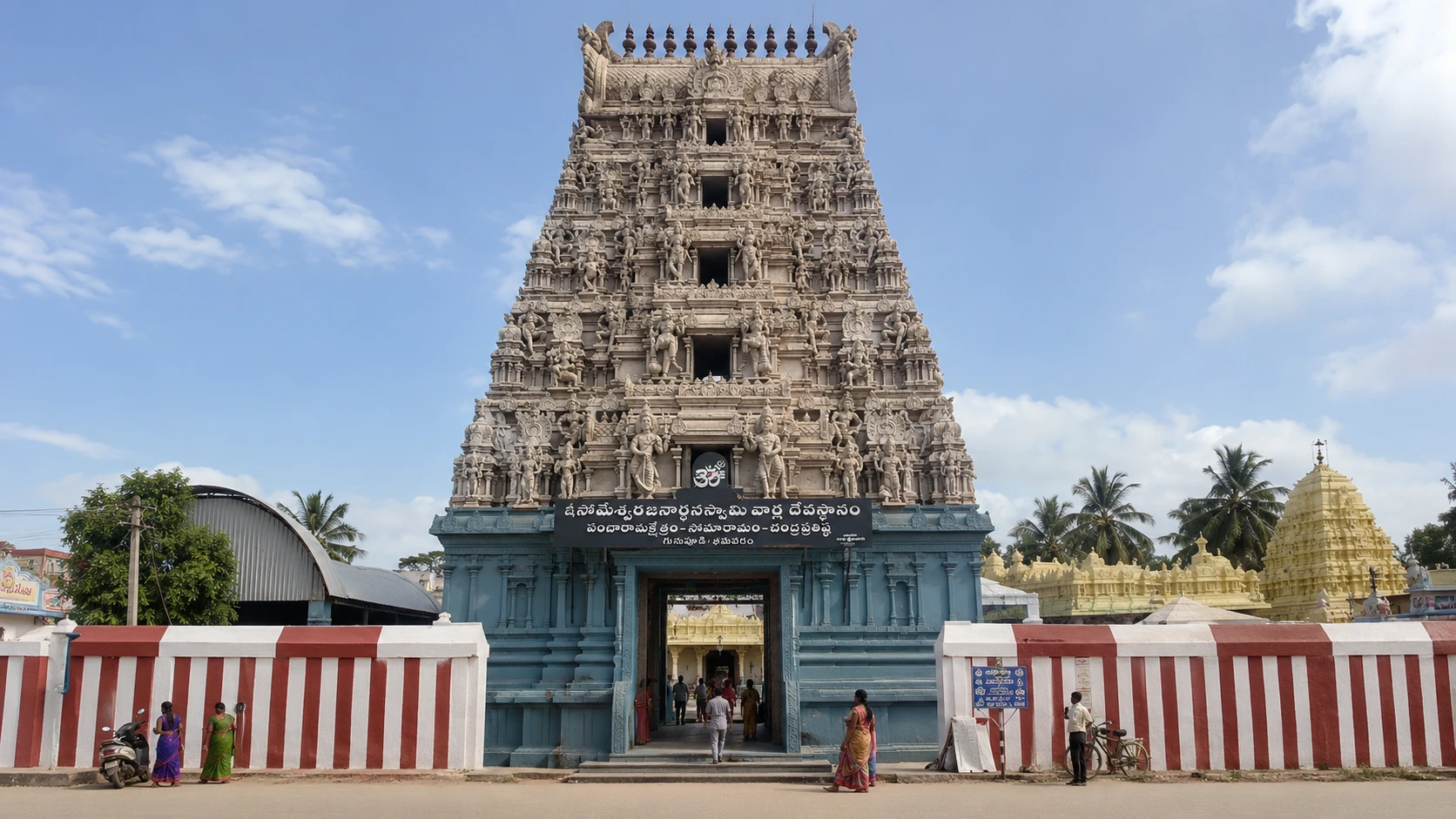
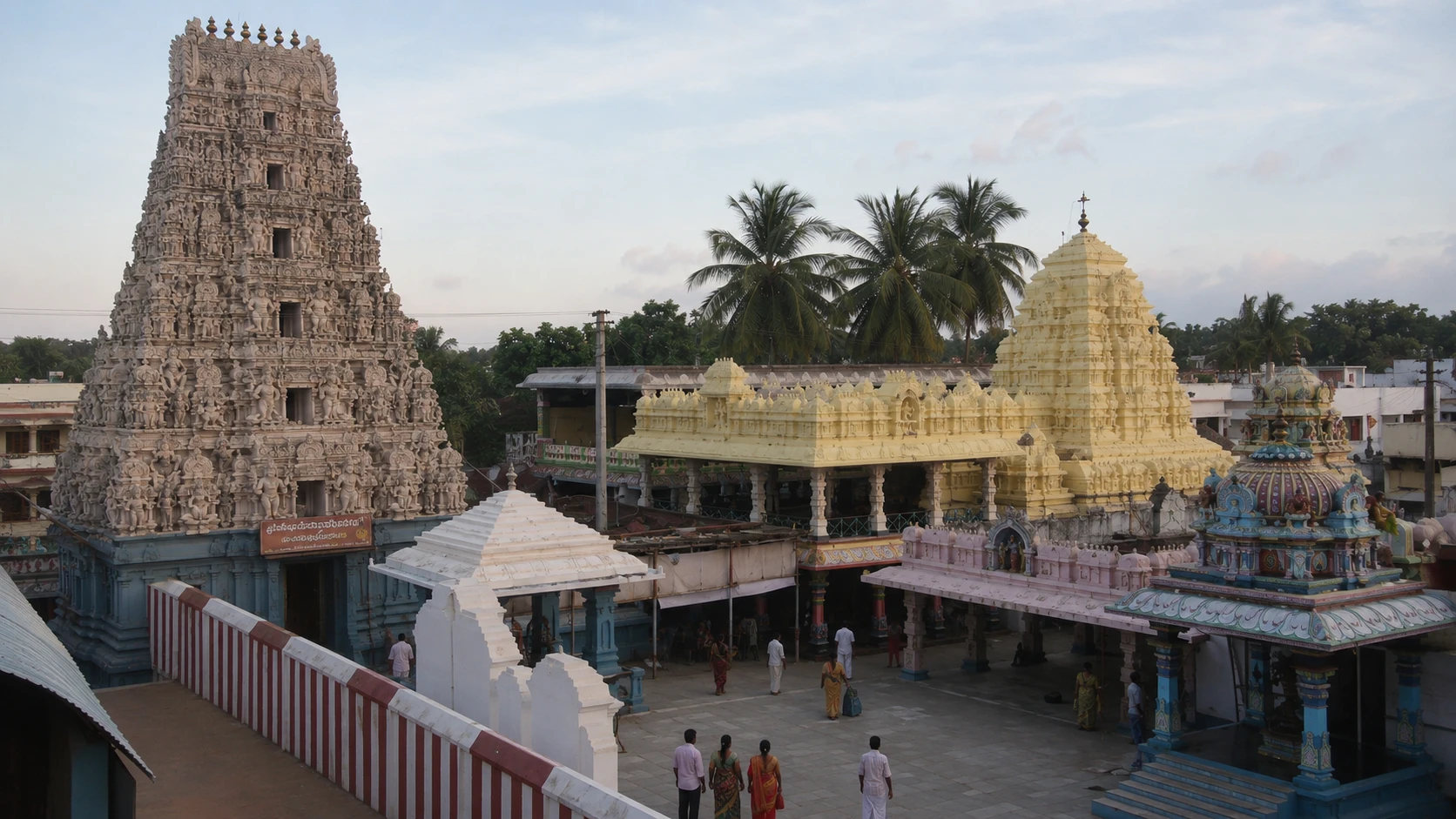
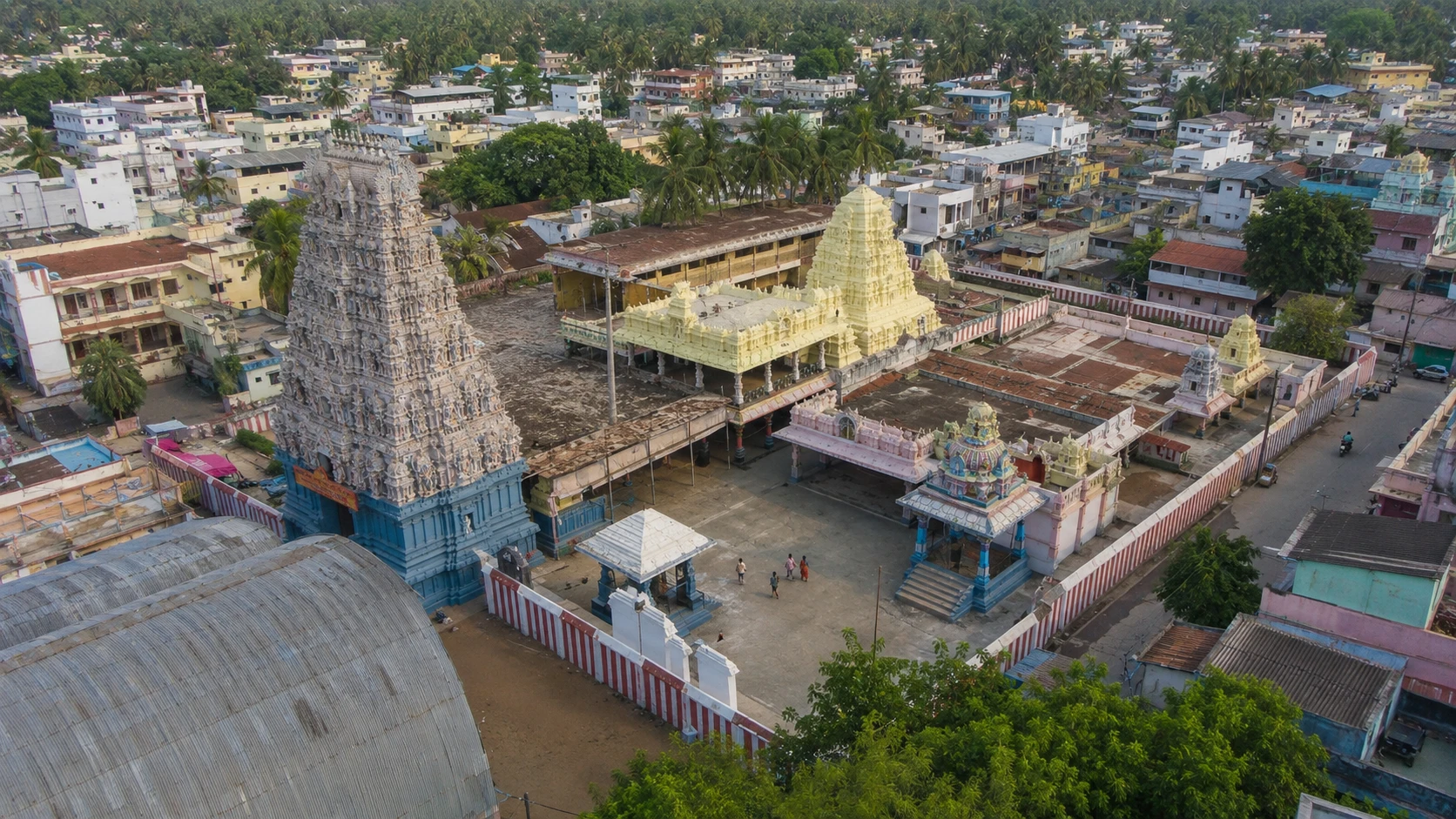
The presiding image at Bhimarama is Sri Someshwara Swamy, manifest as a pale-stone linga rising approximately seven feet through a two-storey garbhagriha. The linga's stone takes on visibly different tonal cast through the lunar cycle — appearing palest and brightest at the full moon (Pournami), darkening progressively through krishna paksha, and reaching its darkest cast at the new moon (Amavasya). Whether the apparent colour-change is read as a literal physical phenomenon, as a perceptual phenomenon arising from the two-storey sanctum's lighting conditions, or as a symbolic resonance with Chandra's lunar character, it is consistently observed by pilgrims across generations and is a defining feature of darshan at this site. Devotees view the linga's base and middle from the ground floor and ascend an internal staircase to a first-floor circumambulatory passage for upper-portion darshan. The linga rests on a panavattam of darker stone.
Within the same temple complex, the Sri Janardana Swamy shrine enshrines Vishnu in a prominent and equally accessible setting — making Bhimarama formally a Hari-Hara temple, with the Shaivite Someshwara linga and the Vaishnavite Janardana image both serving as principal objects of pilgrim devotion. The Janardana image is held in standard Vaishnava form, with shankha, chakra, gada, and padma in the four hands. The temple's Hari-Hara character is distinctive even among the Pancharama network — Ksheerarama has a Vishnu shrine commemorating its installer-deity, but Bhimarama's Janardana enshrinement has equal liturgical weight with the Someshwara linga rather than supplementary status. Pilgrims typically visit both shrines as part of a single integrated darshan circuit.
The Sri Annapurna Devi shrine sits in its own enclosure within the same complex. The Devi is enshrined in her standard four-armed form, holding the sruva (ladle) and anna-patra (rice-vessel) that signify her function as the universal feeder of the worlds. The Annapurna shrine is the focal point of the temple's Devi Navaratri observance and of the regular Anna Daanam (food-distribution) seva that Annapurna temples worldwide are known for. Additional subsidiary shrines include Vinayaka, Subrahmanya, the Navagrahas, Saptamatrika, Nataraja, and Veerabhadra. The temple's pushkarini is the Chandra Pushkarini (also called the Mavullamma Tank), held in tradition to derive from Chandra's own arrival at the site during the founding installation. Eastern Chalukya sculptural panels on the prakara depict the Tarakasura battle, Chandra's Daksha-curse penance, the Soma-Shiva devotional cycle, and the Annapurna feeding-tradition in carved narrative form.
Distinctive Practicesविशिष्ट परंपराएँ
Karthika Pournami — the lunar-installer's festival
कार्तिक पूर्णिमा — लूनर-स्थापक का उत्सव
Annual; full-moon night of the Karthika lunar month (November–December)
Karthika Pournami is the annual full-moon night of the Karthika month, observed as a particularly auspicious lunar day across Shaivite India. At Bhimarama the festival carries unique theological density because the temple's installer is Chandra — the moon-god — and the full moon of Karthika is the calendrical moment when Chandra's light is at its most powerful and the Pancharama linga is at its palest and brightest cast. Pilgrims travel to Bhimarama specifically for the Karthika Pournami darshan to witness the linga in its full-lunar-cycle peak appearance. The temple is lit by thousands of oil lamps throughout the night; the abhishekam protocols are extended to full ceremonial form; and the Annapurna shrine offers special anna-daanam to the assembled pilgrims. The festival pairing of Karthika Pournami (peak lunar) and Maha Shivaratri (peak Shaivite) gives Bhimarama two complementary annual high points, both rooted in the temple's particular installer-and-linga relationship.
Chandra-cycle darshan timing
चन्द्र-चक्र दर्शन समय
Year-round; particular emphasis on full-moon (Pournami) and new-moon (Amavasya) days
Pilgrims at Bhimarama who wish to experience the colour-changing tradition of the linga are advised by the temple to plan darshan around the lunar cycle. The clearest perception of the linga's apparent colour-shift is reported by devotees who visit on or near the full moon (when the linga is at its palest) and again on or near the new moon (when the linga is at its darkest); the contrast between the two darshans is what makes the lunar-resonance tradition vivid. Some pilgrims undertake a deliberate two-visit pilgrimage, returning to Bhimarama at opposite ends of the lunar cycle to complete the colour-cycle experience. Whether the perceived shift represents a literal physical change in the stone, a perceptual phenomenon arising from sanctum lighting and devotional attention, or a symbolic-ritual claim accepted in devotional tradition, the practice of cycle-timed darshan is one of Bhimarama's distinctive pilgrimage modes.
Pancharama Yatra closing-station darshan and anna-daanam
पंचाराम यात्रा समापन-स्टेशन दर्शन और अन्न दानम
Year-round; particular emphasis from pilgrims completing the formal five-temple yatra
Bhimarama occupies the closing position of the Pancharama Kshetra Yatra circuit — the fifth and final of five — and pilgrims completing the formal yatra culminate their journey here. The temple's traditional practice for closing-station pilgrims includes a final formal darshan at the Someshwara linga (the completion of the five-installer sequence), darshan at the Janardana shrine (acknowledging the Hari-Hara character of the closing site), and anna-daanam at the Annapurna shrine (the cosmic-feeding completion that the Annapurna installation framed at the temple's founding). The anna-daanam — receiving prasadam as cooked food from the goddess of nourishment — is the symbolic seal on the completed Pancharama yatra: the worlds that were once threatened by Tarakasura have, through the five installations, received their proper food again, and the pilgrim's own meal at the closing temple participates in that restoration. The temple counter arranges yatra-completion certification and sponsored anna-daanam for closing-station pilgrims.
Did You Know?क्या आप जानते हैं?
Bhimarama is the only one of the five Pancharama Kshetra installed by Chandra — the Moon-god, Soma — and the only one where the linga is traditionally held to change visible colour through the lunar cycle, appearing palest at the full moon (Pournami) and darkest at the new moon (Amavasya). The colour-change tradition is one of the most-cited 'living wonders' of the Pancharama network and a defining feature of Bhimarama's pilgrim appeal; whether read as a literal physical phenomenon, as a perceptual phenomenon arising from sanctum lighting, or as a symbolic-ritual claim, the experience is consistently reported by pilgrims across generations.
Pancharama Sthala Purana corpus (Telugu and Sanskrit); Sri Someshwara Janardana Swamy Devasthanam temple literature
The town of Bhimavaram takes its name from this temple, not the other way around: the temple was the founding institution and the town grew up around it over many centuries. The town name 'Bhimavaram' is most plausibly derived from a combination of the Bhimeshwara temple identity ('Bhima,' the fierce form of Shiva) and the Eastern Chalukya royal patronage of Chalukya Bhima I (reign c. 892–921 CE), with 'avaram' (the place around) completing the formation. Few major Indian town names trace this directly to a Hindu temple's founding.
Sri Someshwara Janardana Swamy Devasthanam temple literature; Eastern Chalukya inscriptions at Bhimarama; P. V. P. Sastry's regional studies
Bhimarama is the only Pancharama site whose principal deity-pair structure formally includes both a Shaivite and a Vaishnavite presiding form. The Someshwara linga (Shiva) and the Janardana image (Vishnu) are enshrined in their own respective sanctums within the same complex, with equal liturgical weight rather than supplementary status — making Bhimarama a Hari-Hara temple in the formal sense. Ksheerarama has a Vishnu shrine commemorating its installer-deity, but Bhimarama's Janardana enshrinement is theologically and ritually co-equal with the Someshwara linga.
Sri Someshwara Janardana Swamy Devasthanam temple literature; Pancharama Sthala Purana corpus
The consort goddess at Bhimarama is Sri Annapurna Devi — the goddess of nourishment, the form of Parvati who feeds the worlds. Of all the Pancharama consort goddesses, Annapurna is the most clearly associated with the cosmic-feeding function, and her enshrinement at the closing Pancharama site frames the temple as the place where the worlds threatened by Tarakasura receive the restoration of their proper food. The Annapurna shrine is the focal point of regular anna-daanam (food-distribution) seva, distinctive among the Pancharama temples.
Sri Someshwara Janardana Swamy Devasthanam temple literature; Pancharama Sthala Purana corpus
Bhimarama occupies the closing position of the Pancharama Kshetra Yatra circuit — the fifth and final of five — and pilgrims completing the formal yatra culminate their journey here, often receiving anna-daanam from the Annapurna shrine as the symbolic seal on the completed pilgrimage. The combination of Someshwara darshan (the closing Pancharama linga), Janardana darshan (the Hari-Hara dimension), and Annapurna anna-daanam (the cosmic-feeding completion) gives the closing-station pilgrimage at Bhimarama a particular ritual completeness not available at the other four sites.
Pancharama Kshetra Yatra pilgrim tradition; AP Endowments Department temple network documentation
Following the April 2022 Andhra Pradesh district reorganisation, the new West Godavari district administration was headquartered at Bhimavaram itself — making the temple-town the district seat in the post-reorganisation configuration. Bhimarama is consequently the only Pancharama site located in a town that is itself the headquarters of its district, with the temple at the historic-civic core of the district seat.
Andhra Pradesh Districts (Formation) Act 2022; AP Revenue Department notifications (April 2022)
Visitor Accessप्रवेश जानकारी
Sri Someshwara Janardana Swamy Temple at Bhimarama is open to devotees of all backgrounds, without restriction by gender, caste, or community. Standard South Indian temple decorum applies — devotees remove footwear before entering the temple complex, maintain silence near the sanctum, and dress in modest, preferably traditional, attire. The Someshwara, Janardana, and Annapurna shrines all follow the same access norms. Photography is permitted in the outer courtyards and around the temple grounds; photography inside the inner sanctums is at the discretion of temple authorities and should be confirmed on the day. Non-Hindus are welcome.
Consult the Sri Someshwara Janardana Swamy Devasthanam information desk on arrival for the day's seva schedule, two-storey abhishekam availability, Karthika Pournami sevas, Annapurna anna-daanam sponsorship, and yatra-completion certification for closing-station pilgrims. The Andhra Pradesh Endowments Department's official site lists the temple under its registered devasthanam list. Verify any third-party booking offers against the official devasthanam.
Festivalsत्योहार
Karthika Pournami — the lunar-installer's peak festival
कार्तिक पूर्णिमा — लूनर-स्थापक का शिखर उत्सव
Nov-Dec (Karthika Shukla Pournami, the full-moon night)
The principal annual festival celebrating the temple's installer-deity Chandra at his peak lunar moment. Karthika Pournami is observed across India as an auspicious full-moon day, but at Bhimarama it carries unique theological density because the installer is the Moon-god himself, and Karthika is the lunar month most associated with Shiva-Soma devotion. On this night the linga reaches its palest and brightest visual cast in the full-moon's reflected light, and pilgrims who time their darshan for Karthika Pournami witness the temple at its full-lunar-cycle peak. The temple is lit by thousands of oil lamps; the abhishekam protocols are extended to full ceremonial form; the Annapurna shrine offers special anna-daanam. The festival is the second-largest annual pilgrim flow after Maha Shivaratri.
Maha Shivaratri with two-storey abhishekam
द्वि-मंज़िला अभिषेक के साथ महाशिवरात्रि
Feb-Mar (Phalguna Krishna Chaturdashi)
The principal Shaivite festival of the temple year, observed at Bhimarama with night-long jagaran and four praharas of two-storey abhishekam at the Someshwara linga. The Maha Shivaratri night falls on the new moon (Amavasya), making the festival theologically distinctive at Bhimarama: it is the moment when the lunar-installer's linga reaches its darkest visual cast in the absence of lunar light, even as the Shaivite festival reaches its peak. The contrast between Karthika Pournami (peak full moon, peak linga brightness) and Maha Shivaratri (new moon, peak linga darkness) gives the temple two annual high points that frame the colour-cycle tradition at its visual extremes.
Devi Navaratri at the Annapurna shrine
अन्नपूर्णा मंदिर पर देवी नवरात्रि
Sep-Oct (Ashwin Shukla Pratipada to Vijayadashami)
The nine nights of Sharadiya Navaratri are observed at the Sri Annapurna Devi shrine with the standard nine-form alankaram cycle. The Annapurna form's centrality to Bhimarama's daily worship — particularly the regular anna-daanam seva — gives Navaratri here a particular emphasis on the cosmic-feeding theology, with daily anna-daanam extending to all assembled pilgrims through the nine nights. The festival concludes with the Aayudha Puja on Vijayadashami and a procession that links the Annapurna shrine, the Someshwara linga, and the Janardana shrine in a three-shrine festival circuit characteristic of Bhimarama's Hari-Hara-plus-Annapurna layout.
Karthika Masam — month-long observance leading to Pournami
कार्तिक मास — पूर्णिमा तक की मास-व्यापी साधना
Nov-Dec (Karthika)
The lunar month of Karthika is observed at Bhimarama with the broader Karthika vratam — pre-dawn river-bath, daylight fasting, evening lamp-lighting, recitation of the Karthika Mahatmya — and weekly Kalyanotsavam on each Monday of the month. The month's progression toward Karthika Pournami gives Bhimarama a uniquely structured devotional season: each progressive day of the month brings the linga closer to its annual peak brightness on the full-moon night, with pilgrims who undertake the full month's vratam at the temple participating in the lunar-cycle theology over its complete arc. Karthika at Bhimarama is the temple's signature month-long pilgrimage observance.
Traditional Offeringsपारंपरिक अर्पण
प्राथमिक अर्पण
Bilva Patra for the Someshwara linga
सोमेश्वर लिंग के लिए बिल्व पत्र
बिल्व पत्र
The three leaflets of the bilva represent the three eyes of Shiva, the trident, and the trinity of creation, preservation, and dissolution. At Bhimarama the bilva is offered onto the Someshwara linga's base by ground-floor devotees and carried up to the first-floor passage for upper-portion offering during full-height abhishekam, in the standard Pancharama two-storey protocol. Bilva offerings reach their peak in scale on Karthika Pournami and Maha Shivaratri.
Panchamrit and Chandra Pushkarini water
पञ्चामृत और चन्द्र पुष्करिणी जल
पञ्चामृत, चन्द्र पुष्करिणी जल
The five sacred substances of abhishekam (milk, curd, ghee, honey, sugar) are offered at the Someshwara linga in the two-storey protocol. Water from the temple's Chandra Pushkarini — held in local tradition to derive from Chandra's own arrival at the founding installation — is also used in daily abhishekam, particularly on full-moon days when the pushkarini's lunar association is at its peak.
Tulsi for the Janardana shrine
जनार्दन मंदिर के लिए तुलसी
तुलसी
Tulsi — the sacred basil that is Vishnu's principal floral offering — is offered at the Janardana shrine within the temple complex. The presence of Tulsi offerings at Bhimarama gives the temple's daily worship a balanced Hari-Hara character: bilva for the Someshwara linga (Shiva) and tulsi for the Janardana shrine (Vishnu), offered in parallel by devotees on the integrated three-shrine circuit.
Anna (cooked rice) and seasonal grains for the Annapurna shrine
अन्नपूर्णा मंदिर के लिए अन्न (पका हुआ चावल) और मौसमी अनाज
अन्न, धान्य
Cooked rice and seasonal grains are offered at the Sri Annapurna Devi shrine — and crucially, are returned to the assembled devotees as anna-daanam (food-distribution prasadam) in the same ritual cycle that other Pancharama temples use only for ritual offering. The Annapurna shrine at Bhimarama is the focal point of the temple's regular anna-daanam seva, which is distinctive among the Pancharama network and is the principal way devotees participate in the cosmic-feeding theology embedded in the temple's founding narrative.
Vibhuti, Kumkum, and Flowers across the three shrines
तीनों मंदिरों के पार विभूति, कुङ्कुम, और पुष्प
विभूति, कुङ्कुम, पुष्प
Vibhuti is applied to the Someshwara linga and to the devotee's forehead. At the Annapurna shrine kumkum is offered alongside flowers and food-substances. White flowers (jasmine) are preferred at the Someshwara linga; red flowers, tulsi, and yellow flowers at the Janardana shrine; saffron and turmeric paste with red flowers at the Annapurna shrine. The three-shrine darshan circuit characteristically delivers a tripartite prasadam set: vibhuti from the linga, tulsi-prasadam from Janardana, and kumkum-and-anna-daanam from Annapurna.
इस मंदिर की विशेषता
Karthika Pournami sponsorship — full-moon peak darshan
कार्तिक पूर्णिमा प्रायोजन — पूर्ण-चन्द्र शिखर दर्शन
Distinctive to Bhimarama: devotees may sponsor a dedicated Karthika Pournami seva that includes special darshan at the Someshwara linga during the full-moon peak hour (when the linga is at its palest visual cast), extended abhishekam ceremony, lamp-offering at the temple's exterior, and anna-daanam participation. The seva is the temple's most sought-after annual sponsorship and typically requires advance booking several weeks before the Karthika Pournami date. Devotees who undertake the Karthika Pournami sponsorship often pair it with a return visit at Maha Shivaratri (new-moon peak, opposite end of the colour cycle) to complete the full lunar-cycle darshan experience.
Pancharama yatra-completion anna-daanam
पंचाराम यात्रा-समापन अन्न दानम
Distinctive to Bhimarama as the closing Pancharama station: devotees who have completed the full five-temple yatra may sponsor a yatra-completion anna-daanam at the Annapurna shrine, in which the cooked-rice and grain offerings to the goddess are returned as prasadam to the sponsoring devotee, the sponsoring family, and a circle of fellow pilgrims at the temple. The seva carries the symbolic seal on the completed Pancharama pilgrimage: the cosmic-feeding crisis that the Tarakasura cycle threatened is, through the five installations, completed by the worlds receiving their proper food again — and the devotee participates in that restoration through the meal taken at the closing temple. Yatra-completion certification is issued by the temple counter alongside the anna-daanam sponsorship.
Pilgrims may bring offerings from outside the temple grounds; the temple counter also offers pre-arranged offering bundles, prasad packets, and seva sponsorship for all three principal shrines (Someshwara, Janardana, Annapurna). The Sri Someshwara Janardana Swamy Devasthanam operates under the Andhra Pradesh Charitable and Hindu Religious Institutions and Endowments Department, and seva fees go through the official devasthanam counter — third-party intermediaries are not required for any standard offering or darshan. Devotees with questions about Karthika Pournami sponsorship, yatra-completion anna-daanam, or colour-cycle darshan timing should call the temple in advance.
How to Reachकैसे पहुँचें
Bhimavaram sits in the Godavari delta of coastal Andhra Pradesh, with the temple in the Gunupudi locality at the historic core of the town. Bhimavaram is the most accessible of the Pancharama sites by rail: Bhimavaram Junction is on the Howrah–Chennai main line with frequent express train services and is also the terminus of the Narsapur branch line; Bhimavaram Town station (within walking distance of the temple, approximately 2 km) offers convenient local access. Connectivity to Hyderabad, Bengaluru, Chennai, Visakhapatnam, and most major South Indian and northern cities is excellent. From either station, autorickshaws and short taxi rides reach the temple directly. By air, Rajahmundry Airport at Madhurapudi (approximately 90 km) is the closest with daily connections to Hyderabad, Bengaluru, and Chennai; Vijayawada International Airport at Gannavaram (approximately 110 km) provides broader long-distance connectivity for pilgrims travelling from northern India; Visakhapatnam International Airport (approximately 270 km) is the option for international and longer-distance domestic arrivals. The drive from Rajahmundry Airport is approximately 100 minutes; from Vijayawada, approximately 2.5 hours; from Visakhapatnam, approximately 5.5 hours. Bhimavaram now serves as the headquarters of West Godavari district (post-April-2022 reorganisation) and has correspondingly good road and rail connectivity. Pilgrims completing the Pancharama Kshetra yatra typically arrive at Bhimarama as the closing fifth stop, often by short road journey from Palakollu (25 km) after completing Ksheerarama earlier the same day.
Plan Your Visitयात्रा की योजना
🌤 सर्वोत्तम मौसम
October through March, when the Godavari delta is at its most temperate. Days are warm and dry, evenings comfortably cool, and the Devi Navaratri (Sep-Oct), Karthika Masam and Karthika Pournami (Nov-Dec), and Maha Shivaratri (Feb-Mar) festival windows all fall within this period. For pilgrims drawn by the colour-changing linga tradition, the October–March window also offers the clearest sanctum lighting and the most stable lunar visibility, making the cycle-timed darshan (full-moon and new-moon pairs) most rewarding in this season. April through June is hot and humid; July through September brings the southwest monsoon and the Godavari's flood season.
👘 पहनावे का नियम
Traditional Indian attire is preferred and is the norm among most devotees: dhoti and angavastram or kurta-pyjama for men, saree or salwar-kameez for women. Shorts, sleeveless tops, and short skirts may attract polite request to cover up, particularly for sanctum-level darshan. Footwear is removed at the entrance to the inner temple complex; covered shoe-rack facilities are available. All three principal shrines (Someshwara, Janardana, Annapurna) follow the same dress conventions.
📱 फोन और फोटोग्राफी
Mobile phones are generally permitted in the outer courtyards and around the temple grounds. Inside the inner sanctums and during abhishekam, alankaram, or Karthika Pournami / Maha Shivaratri night-worship cycles, devotees are asked to switch phones to silent and refrain from photography. The temple's specific photography policy for the inner sanctums should be confirmed on the day with the information desk. Photography during the colour-cycle peak darshans (Karthika Pournami and Maha Shivaratri) is particularly discouraged.
🏨 आवास
Bhimavaram, as the headquarters of West Godavari district post-2022, has substantially better accommodation options than Palakollu or Samarlakota — including mid-range hotels, business hotels, and well-rated guesthouses suitable for pilgrim families. The Andhra Pradesh Tourism Development Corporation (APTDC) operates Haritha hotels in the broader region. Some basic dharamshala accommodation is available within Bhimavaram through the AP Endowments Department; quality is functional rather than premium. For Karthika Pournami, Maha Shivaratri, Navaratri, and the twelve-yearly Godavari Pushkaralu, advance booking through APTDC or major hotel chains is strongly recommended. Pilgrims combining Ksheerarama and Bhimarama in the same trip often base themselves at Bhimavaram (25 km from Palakollu, with Bhimarama within the town).
Sacred Soundsपवित्र ध्वनि
क्या आप जानते हैं? · Did You Know?
वही अनुवाद त्रुटि जिसने हिन्दू धर्म में '33 कोटि' को '33 करोड़' बनाया, बौद्ध धर्म में भी हुई। बौद्ध ग्रन्थों के चीनी अनुवाद ने 'सप्त कोटि बुद्ध' (7 श्रेष्ठ बुद्ध) का अनुवाद '7 करोड़ बुद्ध' कर दिया। तिब्बती अनुवाद ने सही किया: 7 प्रकार, 7 करोड़ नहीं। एक संस्कृत शब्द, दो प्रमुख विश्व धर्मों में गलत पढ़ा गया, ने दो एकसमान भ्रम स्वतन्त्र रूप से उत्पन्न किए।
Related Contentसंबंधित सामग्री
Related Scriptures
Community Reflections
🕉️
Be the first to share your reflection.