Kutralam Kuttralanathar (Chitra Sabha)
कुत्रालम
The Picture Hall at the foot of the Western Ghats — Kutralanathar Temple of Kutralam, where Shiva's Tripura Tandava is preserved in painted murals and the monsoon waterfalls thunder a few kilometres from the sanctum
Kutralam, Tamil Nadu, India
Kuṟṟālanāthar (Kuṟṟālam / Courtallam)Also known as: Kutralanathar Temple, Thirukutralanathar Temple, Courtallam Temple (colonial-era and tourism-era English form), Chitra Sabhai — the Picture Hall of the Pancha Sabhai, Kuttalam Kutralanathar Kovil, குற்றாலம் குற்றாலநாதர் கோயில்
युग
Site origin attested in Tevaram literature (Nayanar period 7th–9th c. CE); Pandya-era structural foundation (medieval Pandya patronage 8th–13th c.); Vijayanagara and Madurai Nayak-era expansion (14th–17th c.); the Chitra Sabhai's celebrated painted murals are principally a Nayak-era achievement of the seventeenth century with stages of later restoration
वास्तुकला
Tamil Dravidian — Pandya structural foundation with Vijayanagara and Madurai Nayak expansion; the Chitra Sabhai's defining feature is its painted mural cycle, structurally smaller than the other Pancha Sabhai sub-shrines but artistically the most distinctive
खुला
06:00 – 21:00
आरती
06:30 · 11:30 · 17:30 · 20:30
विशेष
The Chitra Sabhai sub-shrine, housing the painted murals depicting the Tripura Tandava and associated mythological narratives, is opened to devotees during the principal daily darshan windows. The painted murals are protected by glass and lighting protocols intended to balance pilgrim access with conservation; flash photography and direct touching of the painted walls are restricted under standing temple convention and ASI conservation policy. The Kutralam waterfalls, approximately 2 km from the temple, function as a tirtha (sacred bathing site) in the regional pilgrim tradition; many devotees combine temple darshan with ritual bathing at the falls when seasonal water flow permits.
पवित्र कथा · पवित्र कथा
Kutralanathar Temple of Kutralam — the fifth and final of the Pancha Sabhai — sits in the foothills of the Western Ghats in Tenkasi district, far down in the southwestern reaches of Tamil Nadu, where the Courtallam waterfalls thunder during the monsoon season just a few kilometres from the temple sanctum. The temple's location at the foot of the Trikuda Hills — the 'three-peaked' hills that give the site its name (Tri-Kutalam → Kutralam) — places it at the threshold of a different geography from the other four Pancha Sabhai: not the agrarian plains of central or northern Tamil Nadu, but the cool foothill country where monsoon rains, waterfall pools, and forest air shape both pilgrimage and devotional life. The deity Kutralanathar (Shiva) and his consort Kuzhalvai Mozhi Amman (Parvati) are housed here in a temple complex of relatively modest scale by Tamil Saivite standards, but one that holds the most artistically distinctive of the five sabhas: the Chitra Sabhai, the Picture Hall, whose walls bear painted murals depicting Hindu mythological narratives — the Tandava, the marriage of Shiva and Parvati, the dance of Patanjali and Vyaghrapada, and other episodes from the Saivite imaginary. The Chitra Sabhai's dance form is the Tripura Tandava, the cosmic dance Shiva performed after the destruction of the three demonic cities (Tripurasura) — a dance of victorious resolution rather than ongoing performance, distinct from the contemplative Muni Tandava at Tirunelveli or the upward Urdhva Tandava at Tiruvalankadu. The temple is canonically among the 276 Tevaram Padal Petra Sthalams, sung by the Saiva poet-saints, and tradition associates the sage Agastya with its founding, the great southern rishi whose presence anchors much of the Tamil Saivite geography of the deep south. The temple's painted murals have been the focus of art-historical scholarship and conservation work; the layers of painting on the Chitra Sabhai walls represent stages of original seventeenth-century work and later restoration, with the precise dating and authorship of different segments a subject of ongoing research. The proximity of the Courtallam waterfalls — a major regional monsoon tourism destination from June through September — gives the temple an unusual rhythm of pilgrimage compared with the other four Pancha Sabhai sites, with seasonal flows of mixed devotional and recreational visitors. The temple is administered by the Tamil Nadu Hindu Religious and Charitable Endowments Department and continues to hold its place as the southwestern terminus of the Pancha Sabhai pilgrimage circuit.
Sacred Designationपवित्र पदनाम
Sacred Origin Storyपवित्र उत्पत्ति कथा
Source: Saiva Tripura-dahana tradition (the cosmic burning of the three cities), with regional Kutralam Sthala Purana, Tevaram literature, and Pancha Sabhai theological framework
Long before the present age, when the asuras Vidyunmali, Tarakaksha, and Kamalaksha — three sons of the demon-king Tarakasura — had performed terrible austerities and won from Brahma a boon of near-invincibility, the divine architect Mayasura built for them three flying cities: one of gold in heaven, one of silver in mid-space, and one of iron upon the earth. The cities were impregnable, the asuras within them invincible — but the boon carried a single condition: the cities could only be destroyed when all three aligned in a single moment, pierced by a single arrow loosed by a single god. For ages, the cities terrorised the three worlds; the gods, unable to act, appealed in desperation to Shiva. Shiva consented to act and prepared for cosmic warfare. He took up his great bow, the Pinaka, mounting Mount Meru as the bowstaff and the cosmic serpent Vasuki as the bowstring; Vishnu became his arrow; Brahma served as charioteer; the earth itself became his chariot; the sun and the moon became its wheels. When at last the three cities aligned in their predestined moment, Shiva loosed the arrow — and with a single shot all three cities burned and fell, the Tripurasura destroyed in a single cosmic instant. The gods gathered in celebration, but Shiva, in the moment of victory, danced his Tripura Tandava: the cosmic dance of resolution after the great destruction, the dance in which terrible power finds its closure in beauty. The dance was witnessed by all the gods and by the assembly of sages who had gathered for the moment. In Tamil Saivite tradition, the Chitra Sabhai at Kutralam is the site where this dance is eternally enshrined in painted memory: the murals on its walls depict the Tripura-dahana sequence — the building of the cities, the assembly of the devas, the cosmic chariot, the loosing of the arrow, the burning cities, and the culminating dance — preserved as visual narrative rather than as a single bronze icon. The temple's founding is associated in regional tradition with the sage Agastya, the great southern rishi who is held to have established many of the Saivite sites of the deep south during his legendary journey from the Himalayas to the southern peninsula. Agastya is said to have meditated at the Trikuda Hills — the three-peaked hills behind the temple — and to have consecrated the principal Kutralanathar linga at the conclusion of his austerities here, the linga continuing as a swayambhu (self-manifested) presence at the site since.
उद्धृत स्रोत:
- Tripura-dahana narrative — preserved across the Mahabharata (Karna Parva), Linga Purana, and Shiva Purana
- Kutralam Sthala Purana (Tamil regional tradition)
- Tevaram corpus — Saiva poet-saint pasurams on Kutralam
- Agastya tradition — regional Tamil Saivite literature on the southern journey of the sage
अन्य परंपराएँ · अन्य परंपराएँ
A second strand of Kutralam's mythological identity, distinct from but not displacing the Tripura-Tandava narrative, holds that the temple's significance derives principally from its founding by the sage Agastya during his legendary journey from the Himalayas to the southern peninsula. In this tradition, Agastya — sent south by Shiva to balance the cosmic weight of the Himalayan north — undertook a long pilgrimage establishing Saivite shrines across the deep south of the Tamil country, with the Trikuda Hills at Kutralam being one of his principal meditation sites. The Kutralanathar linga is held to be the linga Agastya consecrated at the conclusion of his austerities at this site, and the temple's continued sanctity derives from this founding meditation. In this reading, the Pancha Sabhai integration of Kutralam as the Chitra Sabhai is a later theological elaboration that builds on the older Agastya-founding tradition: the temple was a major southern Saivite site for centuries before its identification within the Pancha Sabhai theological framework. This account complements rather than displaces the Tripura-Tandava primary narrative; both traditions are integral to the temple's full mythological identity and are visible in the painted mural cycle of the Chitra Sabhai itself, which includes Agastya scenes alongside the Tripura sequence.
A devotional reading of the Chitra Sabhai found in commentaries on the Pancha Sabhai network holds that the painted murals are not primarily commemorative — preserving a single historical dance — but pedagogical, instructing the devotee in the full Saivite imaginary. Where the other Pancha Sabhai sites enshrine a single bronze icon as the focal point of darshan, the Chitra Sabhai presents an extensive narrative cycle that allows the worshipper to traverse the Saivite mythological tradition systematically: Tripura-dahana, the marriage of Shiva and Parvati, the cosmic dance witnessed by Patanjali and Vyaghrapada, the lila of Murugan, and the Agastya pilgrimage are all woven into the painted walls. The Chitra Sabhai is in this reading less a single sabha than a school: a place where the structure of the devotional imagination is taught through extended visual narrative. The dance is in the walls but also in the seeing — the devotee's act of attending to the full mural cycle is itself the participation in the Tandava that the sabha enshrines.
विद्वत संदर्भ
Kutralanathar Temple combines several distinct historical and mythological layers that are visible in different aspects of the temple's present form. The Agastya-founding tradition is the older mythological stratum, connecting Kutralam to the wider Tamil Saivite geography of the deep south through the southern-pilgrimage narrative of the great sage. The Pancha Sabhai integration — Kutralam's identification as the Chitra Sabhai with the Tripura Tandava as its presiding dance form — is a relatively later theological development, consolidated across the medieval Pandya, Vijayanagara, and Madurai Nayak periods. The Chitra Sabhai's defining feature, the painted mural cycle, is principally a Madurai Nayak-era achievement of the seventeenth century, though the present murals bear stages of later restoration. Conservation work in the twentieth century, including overpainting and consolidation, has altered the visible surface in places; modern art-historical scholarship (the work of Anna Dallapiccola on South Indian mural painting, and the Tamil Nadu Department of Archaeology mural conservation reports) attempts to disentangle the layers but the precise dating and authorship of different mural segments remains an area of ongoing research. A regional folk tradition holds that the principal Kutralanathar linga has an unusual pliable or herbal composition — that it can be marked or worked by hand in a way ordinary stone cannot. Eternal Raga treats this as a tradition of regional devotional belief rather than an established scientific fact: no peer-reviewed analysis of the linga's material composition has been published, and the temple administration does not generally permit physical testing of the principal sanctum icon. The tradition is honoured as devotional belief while the scientific status of the claim remains open. The Kutralam waterfalls — approximately 2 km from the temple — function as a tirtha (sacred bathing site) in the regional pilgrim tradition, with their monsoon-season water flow (June–September) drawing both devotional pilgrims and recreational visitors; this mixed-visitor pattern is one of Kutralam's distinctive operational features and is addressed in the temple's operational guidance.
Historyइतिहास
Kutralanathar Temple's documented history follows the broad arc characteristic of Tamil Saivite shrines in the deep south: Tevaram-period devotional attestation, Pandya-era stone construction, Vijayanagara-period expansion, a Madurai Nayak-era flourishing that produced the temple's most artistically distinctive features, and modern institutional administration. The site's earliest devotional documentation comes from the Tevaram pasurams of the Nayanar saints — principally Tirugnana Sambandar — composed during the Tamil Saivite efflorescence of the seventh through ninth centuries; Kutralanathar is canonically among the 276 Padal Petra Sthalams, the Shiva shrines glorified in the Tevaram corpus. The temple's structural foundation dates principally to the medieval Pandya period (eighth through thirteenth centuries), under successive Pandyan kings whose territory included this southwestern reach of Tamil Nadu and whose inscriptions remain at the site. Following the collapse of Pandyan power and the brief Madurai Sultanate interlude in the early fourteenth century, Vijayanagara reassertion of Hindu polity brought renewed patronage from the fourteenth century onward. The most consequential single development in the temple's history, however, was the Madurai Nayak-era patronage of the seventeenth century, when the present Chitra Sabhai painted mural cycle was created — making Kutralam one of the principal documents of seventeenth-century Tamil mural painting. The Nayak-period work used natural pigments on prepared lime plaster, the painted cycle covering the Chitra Sabhai walls with narrative depictions of the Tripura-dahana, the marriage of Shiva and Parvati, the Patanjali-Vyaghrapada darshan of the cosmic dance, the Agastya legend, and other Saivite scenes. The murals have undergone subsequent restoration in stages during the colonial period and after independence; some segments bear nineteenth-century overpainting, and twentieth-century conservation work (including consolidation and protective glass installation) has further altered the visible surface. The temple came under Tamil Nadu HR&CE administration following independence, and the Chitra Sabhai murals are concurrently protected as a heritage asset under Archaeological Survey of India and Tamil Nadu Department of Archaeology conservation protocols. The temple today remains active for daily worship and stands at the southwestern terminus of the Pancha Sabhai pilgrimage circuit, with the rhythm of pilgrim flow shaped substantially by the monsoon-season tourism cycle of the nearby Kutralam waterfalls.
Historical Timelineऐतिहासिक कालक्रम
Tevaram pasurams in praise of Kutralanathar are composed by the Tamil Saiva poet-saints, principally Tirugnana Sambandar. The temple is canonised among the 276 Padal Petra Sthalams of the Tevaram corpus, anchoring its devotional standing in the formative Tamil Saivite literary tradition.
Scholarly catalogues attribute the Kutralam Tevaram pasurams principally to Sambandar; attribution of pasurams by Appar or Sundarar to this specific shrine is less clearly attested in standard concordances.
Pandya-era structural construction and expansion of the Kutralanathar temple. Successive Pandyan kings — whose territory included the deep southwestern reach of Tamil Nadu — patronise the temple with stone construction, inscriptions, and ritual endowments. The earliest stone elements of the present structure, including foundational sanctum walls and early mandapams, date to this period.
Vijayanagara-period expansion of the Kutralanathar temple following the collapse of Pandyan power. Under Vijayanagara provincial governance and subsequently under the Madurai Nayak viceroys (who later became independent sovereigns of the southern Tamil country), the temple receives substantial structural additions including expanded mandapams, gopurams, and the consolidation of the Chitra Sabhai sub-shrine as part of the formal Pancha Sabhai network with the Tripura Tandava as its presiding dance.
Creation of the Chitra Sabhai painted mural cycle under Madurai Nayak patronage. The cycle, executed in natural pigments on prepared lime plaster, covers the Chitra Sabhai walls with narrative depictions of the Tripura-dahana, the marriage of Shiva and Parvati, the Patanjali-Vyaghrapada darshan of the cosmic dance, the Agastya legend, and other Saivite mythological narratives. The work makes Kutralam one of the principal surviving documents of seventeenth-century Tamil mural painting, comparable in art-historical importance to the contemporary mural traditions at Nayak-era Madurai and Sittannavasal.
The precise dating of individual mural segments and the identification of original Nayak-era work versus later restoration is a continuing subject of art-historical research. The Nayak-era origin of the cycle is well-established; the precise extent of later overpainting and conservation alteration is an area where modern scholarship continues to refine understanding.
Successive restoration and conservation work on the Chitra Sabhai murals across the colonial and post-independence periods. Some mural segments bear nineteenth-century overpainting attributable to local devotional restoration efforts; twentieth-century conservation work by the Tamil Nadu Department of Archaeology and the Archaeological Survey of India has included consolidation of the plaster surface, protective glass installation in select areas, and lighting protocols designed to balance pilgrim access with conservation requirements. Post-independence, the temple comes under Tamil Nadu HR&CE administration and the murals are concurrently protected as a heritage asset under conservation protocols.
Photography and direct touching of the mural surfaces are restricted under current conservation protocols to prevent further damage to the painted plaster. Devotees and visitors may observe the murals under the prevailing lighting and access conditions but flash photography is not permitted.
What You'll Seeदर्शन में
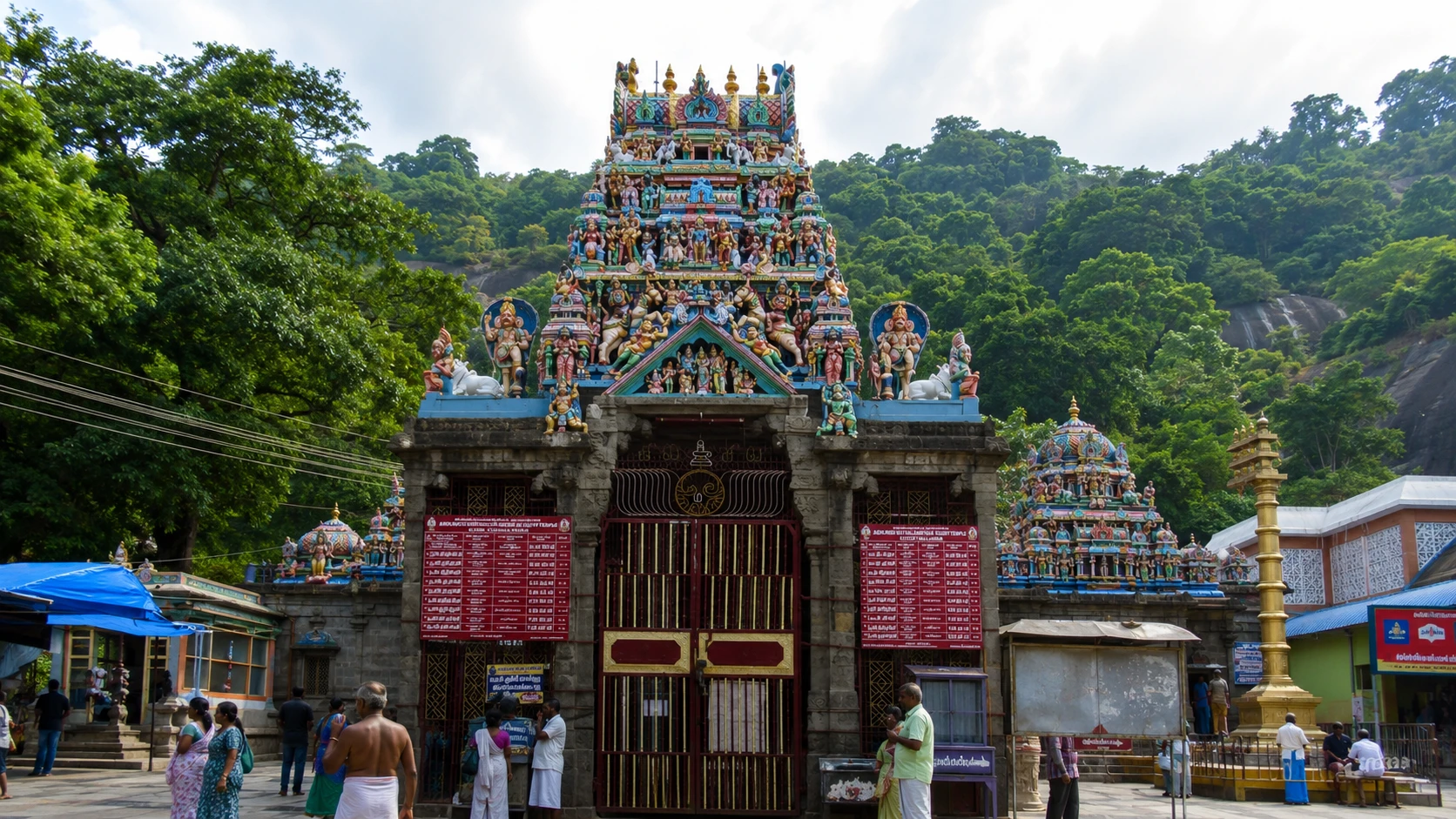
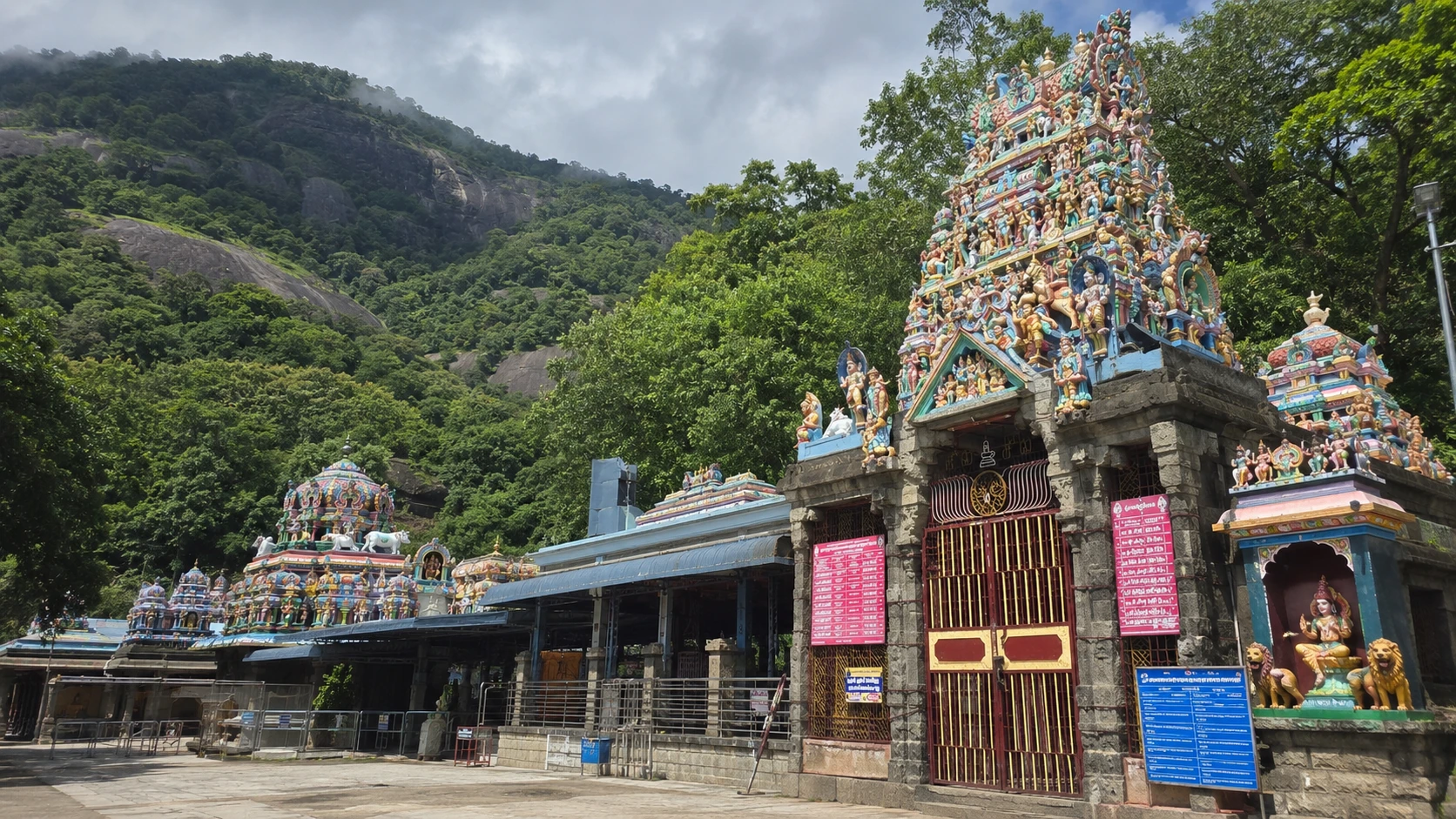
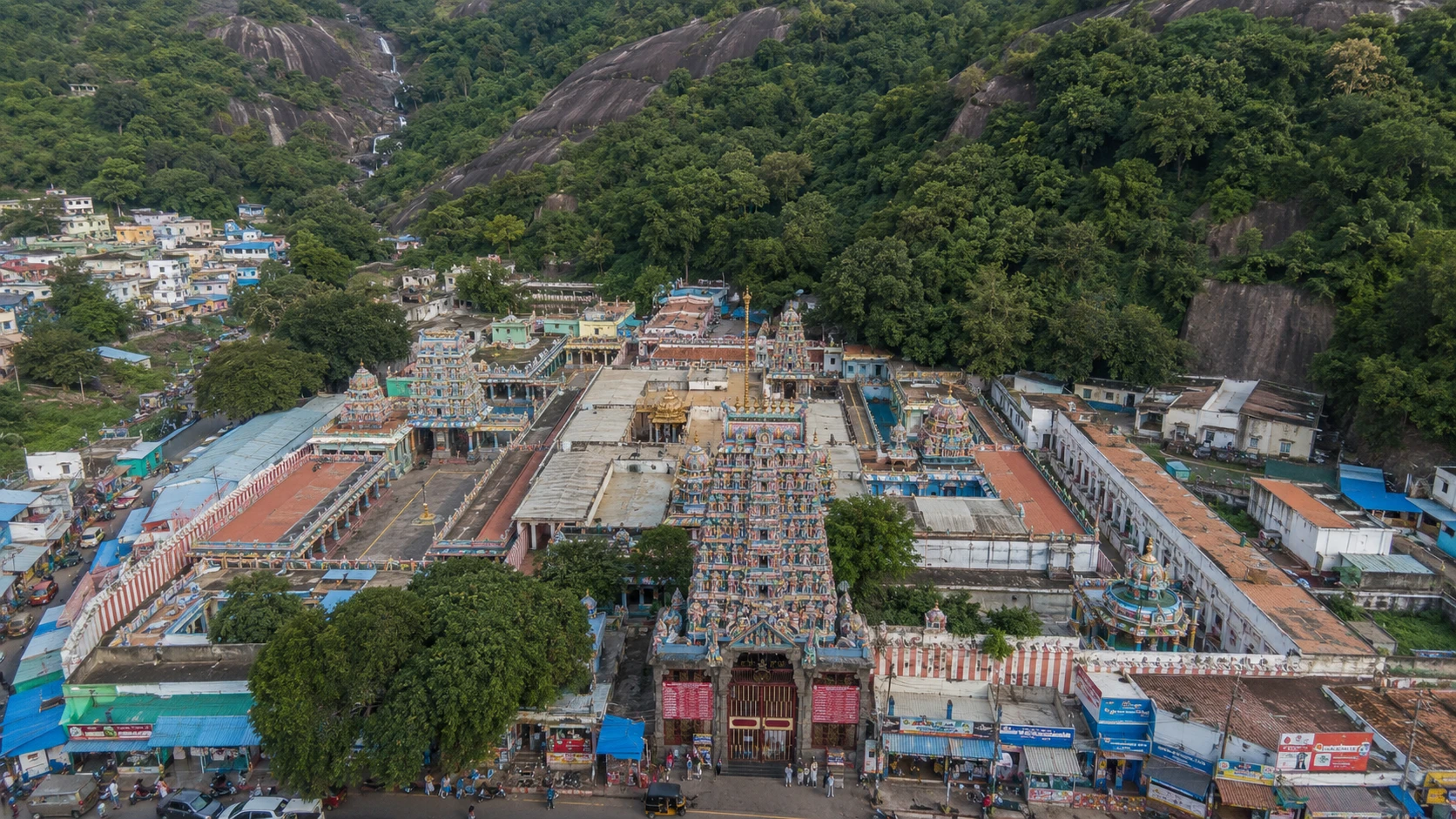
The Kutralanathar Temple compound is organised on a relatively modest architectural scale compared with the other Pancha Sabhai sites, but with high artistic concentration in the Chitra Sabhai sub-shrine. The principal Kutralanathar sanctum, oriented to the east, houses a swayambhu (self-manifested) Shiva linga of considerable antiquity. The linga is dark in colour and stands within a Pandya-era foundational sanctum shell, with Vijayanagara and Nayak-era enhancement to the surrounding mandapams and gopuram structures. A regional folk tradition holds that the principal linga has an unusual pliable or herbal composition — that it can be marked by hand in a way ordinary stone cannot; this is treated as a tradition of regional devotional belief rather than a verified material claim, as no peer-reviewed scientific analysis of the linga's composition has been published and the temple administration does not generally permit physical testing of the principal sanctum icon. The consort shrine of Kuzhalvai Mozhi Amman (Parvati) lies to the south of the main sanctum, with its own ritual establishment. The Chitra Sabhai sub-shrine, within the larger compound but spatially distinct from the principal sanctum, is the temple's most artistically distinguished space: a smaller pillared hall whose walls bear the cycle of painted murals depicting the Tripura-dahana, the marriage of Shiva and Parvati, the Patanjali-Vyaghrapada darshan of the cosmic dance, the Agastya legend, and other Saivite mythological narratives. The murals are executed in natural pigments on prepared lime plaster, the cycle principally a Madurai Nayak-era achievement of the seventeenth century with stages of subsequent restoration in the nineteenth and twentieth centuries. Under current conservation protocols, the painted walls are protected by lighting and viewing arrangements that balance pilgrim access with preservation; flash photography is not permitted, and direct touching of the mural surfaces is restricted. The Chitra Sabhai's vimana (sanctum tower) is structurally smaller than those of the other four Pancha Sabhai sub-shrines but distinctive for the integration of painted ornament with sculpted architectural ornament. The temple's gopurams — the principal east gopuram and the smaller gateway towers — bear Madurai Nayak-era stucco work, and the surrounding mandapams (including the Vasantha Mandapam and the various pillared halls connecting the principal sanctum to the Chitra Sabhai) feature characteristic Nayak-period carved pillar work. The temple's tirtha (sacred water source) is unusually situated for a Tamil Saivite temple: rather than a constructed temple tank within the compound, the temple's principal tirtha is the Kutralam waterfalls themselves, approximately 2 km from the temple, whose monsoon-season cascade is treated as a sacred bathing site by the regional pilgrim tradition.
Distinctive Practicesविशिष्ट परंपराएँ
Chitra Sabhai mural darshan and narrative contemplation
चित्र सभा म्यूरल दर्शन और कथा चिंतन
Throughout the principal daily darshan windows; particularly observed during the Arudra Darshan festival (Margazhi month, December–January) and during the temple's annual Brahmotsavam
Devotees who approach Kutralam as a Pancha Sabhai pilgrimage destination observe a specific darshan practice at the Chitra Sabhai that is qualitatively different from the bronze-Nataraja darshan at the other four sabhas: rather than concentrating their devotion on a single iconic image, they walk slowly through the painted hall, attending in turn to each segment of the mural cycle — the building of Tripura, the assembly of the gods, the cosmic chariot, the burning cities, the Tandava, the marriage of Shiva and Parvati, the Patanjali-Vyaghrapada darshan, the Agastya legend. The practice is contemplative and pedagogical rather than concentrated and iconic: the darshan extends in time as the devotee reads the cycle. Temple priests sometimes accompany serious pilgrims through the cycle, providing brief narrative explanation of each segment.
The Chitra Sabhai's pedagogical approach to darshan articulates a Saivite proposition that the cosmic dance is not a single static reality but an unfolding narrative — the destruction of Tripura, the resolution of cosmic conflict, the integration of Shiva and Shakti, the transmission of vision to the sages, all aspects of a single divine activity that unfolds across time. Walking the mural cycle is held in tradition to integrate the worshipper's perception of these aspects, training the devotional imagination to see the cosmic dance as a sustained narrative rather than a momentary spectacle.
Kutralam waterfalls tirtha-bathing (monsoon-season)
कुत्रालम झरने तीर्थ-स्नान (मानसून-मौसम)
Principally during the monsoon season (June through September) when seasonal water flow at the falls is at its peak; the Saral Vizha (Kutralam season festival) is celebrated during this period
Pilgrims to Kutralanathar customarily combine temple darshan with ritual bathing at the Kutralam waterfalls, approximately 2 km from the temple. The practice is most observed during the monsoon season (June–September) when the falls are in full flow, though some pilgrims visit year-round and observe a symbolic ritual washing even when seasonal flow is reduced. The principal Main Falls, the Five Falls, and the smaller cascades each serve different ritual purposes in the regional tradition; the Main Falls is the most generally observed tirtha. Devotees who follow the traditional practice perform the bathing first, then proceed to the temple for darshan in a purified state. The waterfalls are also a major regional monsoon tourism destination, drawing recreational as well as devotional visitors; the mixed-visitor pattern is one of Kutralam's distinctive features.
The integration of waterfall tirtha-bathing with temple darshan reflects a regional understanding in which natural sacred geography and built temple sanctity are continuous rather than separate. The Kutralam falls are theologically integrated with the Kutralanathar temple as an extension of its tirtha — the sacred water — rather than a separate destination; bathing at the falls and worshipping in the temple are aspects of a single pilgrimage. The monsoon-season concentration of the practice connects it to the agricultural and ecological rhythm of the deep south, where the southwest monsoon's water carries both physical sustenance and ritual purification.
Pradosham abhishekam at the Kutralanathar sanctum
कुत्रालनाथर गर्भगृह पर प्रदोषम अभिषेकम
Every Pradosham — the 13th lunar day (Trayodashi) of both fortnights, in the evening twilight (4:30 PM – 6:00 PM); twice monthly
As at all major Saivite shrines, Pradosham at Kutralanathar is observed with full abhishekam of the swayambhu linga at the principal sanctum. The abhishekam substances are offered in the standard sequence — water, milk, curd, ghee, honey, panchamrita, sandalwood paste, turmeric — accompanied by recitation of the Shri Rudram, the Chamakam, and the Panchakshari. Given the regional folk tradition concerning the linga's pliable/herbal character, the temple priests perform the abhishekam with particular care, the offering observed by devotees from the outer mandapam. After the principal sanctum abhishekam, many Pradosham pilgrims also visit the Chitra Sabhai for an evening darshan of the mural cycle, the murals taking on a particular luminous quality in the twilight lighting.
Pradosham at any Saivite shrine is held to be the time of Shiva's cosmic dance, performed at Mount Kailash with all the devas in attendance. At the Chitra Sabhai — where the cosmic dance is enshrined in painted memory — the Pradosham observance carries the additional resonance of witnessing the painted dance at the very hour the original dance proceeds in cosmological reality. The twilight darshan of the murals is held to be a particularly luminous form of seeing, the painted figures coming alive under the evening light in a way that they are not in midday.
Did You Know?क्या आप जानते हैं?
Kutralanathar Temple is the only one of the five Pancha Sabhai whose central iconographic feature is painted rather than sculpted: the Chitra Sabhai's cycle of seventeenth-century murals, depicting the Tripura-dahana, the marriage of Shiva and Parvati, the Patanjali-Vyaghrapada darshan, and the Agastya legend, makes it one of the principal surviving documents of Tamil mural painting from the Madurai Nayak period.
Tamil Nadu Department of Archaeology mural conservation reports; Anna L. Dallapiccola's scholarship on South Indian mural painting traditions
Kutralam takes its name from the Trikuda Hills — the 'three-peaked' hills (tri + kuda = 'three peaks') that rise behind the temple. The Sanskrit form Trikutalam (or Trikutam) was contracted in Tamil to Kutralam. The hills are themselves part of the broader Western Ghats and form a visible backdrop to the temple compound.
Tamil-Sanskrit etymological tradition; Madras Tamil Lexicon; Place-name studies in southern Tamil Nadu
A regional folk tradition holds that the principal Kutralanathar linga has an unusual pliable or herbal composition — different from ordinary stone. Eternal Raga treats this as a tradition of devotional belief rather than verified scientific fact: no peer-reviewed analysis of the linga's material composition has been published, and the temple administration does not generally permit physical testing of the principal sanctum icon. The tradition is part of Kutralam's regional devotional identity but its scientific status remains open.
Regional Tamil devotional literature; Eternal Raga editorial note on verification status
The Kutralam waterfalls, approximately 2 km from the temple, function as the temple's principal tirtha (sacred water source) in the regional pilgrim tradition — an unusual arrangement compared with the standard Tamil Saivite temple practice of a constructed temple tank within the compound. The falls draw both devotional pilgrims and recreational visitors during the monsoon season (June through September), creating a mixed-visitor pattern that distinguishes Kutralam from the other Pancha Sabhai sites.
Regional Tamil pilgrimage tradition; Tamil Nadu Tourism documentation
Tenkasi district itself, in which Kutralam sits, is one of Tamil Nadu's most recently formed administrative districts — carved out of Tirunelveli district in November 2019 to provide closer governance to the southwestern Tamil region. The district's existence as a separate administrative unit is younger than many of the temple's modern conservation reports, reflecting an ongoing realignment of regional administration in Tamil Nadu.
Government of Tamil Nadu administrative notifications, November 2019
Visitor Accessप्रवेश जानकारी
Kutralanathar Temple welcomes devotees of all backgrounds for darshan without entry restrictions based on gender, age, or origin. Photography is permitted in the outer courtyards, mandapams, and the temple compound's external areas, but is prohibited inside the principal Kutralanathar sanctum, the Kuzhalvai Mozhi Amman sanctum, and the Chitra Sabhai sub-shrine during darshan hours and especially during abhishekam and aarti. Flash photography in the Chitra Sabhai is strictly prohibited under conservation protocols to protect the painted murals from light damage; direct touching of the mural surfaces is also restricted. Mobile phones must be silenced inside the temple compound. Footwear must be removed before entering the temple — footwear stalls operate at the main entrance, typically free or with a nominal charge. Modest dress is expected: shoulders and knees should be covered for both men and women. As is traditional in Tamil Saivite temples, men may be requested to remove their upper garment (shirt or vest) before entering the principal sanctum.
Allow 90 minutes to 2 hours for a thoughtful visit covering the principal Kutralanathar sanctum, the Kuzhalvai Mozhi Amman sanctum, the Chitra Sabhai mural cycle (which rewards extended attention), and the surrounding mandapams. The temple's modest scale compared with the other Pancha Sabhai sites means the visit is generally less crowded except during the monsoon season (June–September) when the Saral Vizha festival and the Kutralam waterfalls tourism cycle bring substantial visitor numbers. During this period, expect mixed visitor flows of devotional pilgrims and recreational tourists; the temple itself remains a place of worship throughout but the surrounding area takes on a festival-tourism character. For devotees focused exclusively on the spiritual experience, the off-monsoon months (October through May) offer a quieter visit. The temple is well-connected by road from Tenkasi (~6 km east) and from Tirunelveli (~60 km east). Auto-rickshaws and local buses serve the route.
Festivalsत्योहार
Arudra Darshan
आरुद्र दर्शन
Margazhi (December–January) — observed on the Tiruvadirai (Ardra) nakshatra, the full-moon day
Arudra Darshan is the principal Pancha Sabhai festival, celebrated simultaneously at all five Pancha Sabhai shrines across Tamil Nadu on the day of the Tiruvadirai nakshatra in the Tamil month of Margazhi. At Kutralanathar, the Chitra Sabhai is the centre of the festival observance: special evening lighting allows the painted mural cycle to be viewed in its full devotional resonance, with the Tripura Tandava segment of the cycle taking particular significance as the festival commemorates Shiva's cosmic dance. The temple priests recite the relevant Tevaram pasurams and the regional Kutralam Sthala Purana narrative, and devotees walk the full mural cycle as part of the festival darshan. The festival is observed alongside the parallel Arudra Darshan celebrations at the other four Pancha Sabhai sites, the simultaneous observance connecting the five sabhas across Tamil Nadu's sacred geography in a single day of cosmological remembrance.
Saral Vizha (Kutralam Monsoon Season Festival)
सरल विझा (कुत्रालम मानसून मौसम त्योहार)
Aadi (July–August) through Avani (August–September) — the principal monsoon season at Kutralam
The Saral Vizha is the regional festival of the Kutralam season, observed during the southwestern monsoon when the Kutralam waterfalls are in full flow. The festival's name — Saral being a Tamil term associated with mist or fine spray — references the cool monsoon atmosphere and the spray of the waterfalls. It is a hybrid devotional-recreational observance: pilgrims undertake the traditional Kutralanathar darshan combined with ritual bathing at the falls, while the broader regional community celebrates the monsoon season with extended visits, family gatherings, and the seasonal water-themed festivities that have grown up around the waterfalls. The temple takes particular care during this period to maintain its devotional character while accommodating the larger seasonal visitor flows. The Saral Vizha is one of Tamil Nadu's distinctive regional festivals, less widely known outside the deep south than the major pan-Tamil festivals but central to Kutralam's annual rhythm.
Maha Shivaratri
महाशिवरात्रि
Phalguna (February–March) — the 14th lunar night of the dark fortnight
Maha Shivaratri at Kutralanathar is observed with the standard pan-Saivite practices of all-night vigil, four-prahara abhishekam, and continuous recitation of the Shri Rudram. The four pujas through the night each address Shiva in a different aspect, with the fourth prahara — the dancing lord — receiving particular emphasis at this Pancha Sabhai site. A distinctive Kutralam practice during Maha Shivaratri is extended attention to the Chitra Sabhai murals during the night-long observance, with devotees making multiple visits to the painted hall through the four pujas, reading the mural cycle as visual accompaniment to the night-long invocation. Devotees observe a complete fast through the day and remain awake through the night within or near the temple compound.
Brahmotsavam (Annual Temple Festival)
ब्रह्मोत्सवम (वार्षिक मंदिर त्योहार)
Chittirai or Vaikasi (April–June) — the annual ten-day temple festival, dates vary year to year per the Tamil panchangam
The annual Brahmotsavam is the principal temple-festival of Kutralanathar, a ten-day observance featuring daily processions of the utsava (procession) deities through the streets surrounding the temple compound, with the deities mounted on different vahanas (mounts) each day — the rishabha (bull), the simha (lion), the gaja (elephant), and the silver chariot among them. The festival is timed to fall in the pre-monsoon months when access from across Tamil Nadu is straightforward and the temple's local community can devote full attention to the celebrations before the monsoon-season mixed-visitor flows begin. The Brahmotsavam culminates in the temple-tank or waterfalls Theerthavari, in which the utsava deities are ritually immersed, and the Garuda Sevai. The Brahmotsavam is the principal annual occasion when the temple's devotional community gathers without the dilution of monsoon tourism, and is regarded by long-term devotees as the most concentrated devotional period of the year.
Traditional Offeringsपारंपरिक अर्पण
प्राथमिक अर्पण
Bilva (bel) leaves
बिल्व पत्र
The trifoliate bilva leaf is the most sacred botanical offering to Shiva, the three leaflets corresponding to the three eyes of the deity, the three gunas, and the three principal aspects of cosmic activity.
Vibhuti (sacred ash)
विभूति
The sacred ash applied to the forehead symbolises both Shiva's ascetic identity and the impermanence of all material form.
Milk for abhishekam
अभिषेकम के लिए दूध
Milk is the principal abhishekam substance for the Shiva linga, symbolising purity, nourishment, and the lunar-cooling quality (Soma) that pacifies Shiva's cosmic fire.
Pure water (theertha)
शुद्ध जल (तीर्थ)
Water for abhishekam at Kutralanathar is drawn principally from the Kutralam waterfalls — the temple's unusual non-tank tirtha — connecting the offering directly to the temple's distinctive sacred geography.
Kungumam (vermilion)
कुमकुम
Vermilion is offered principally to Kuzhalvai Mozhi Amman at her shrine, the Shakta-Saiva integration of the temple expressed through coordinated offerings to the lord and the consort.
इस मंदिर की विशेषता
Waterfall-drawn theertha
झरना-तीर्थ
In keeping with the temple's distinctive tirtha — the Kutralam waterfalls themselves rather than a constructed temple tank — devotees customarily either bathe in the falls before darshan or carry small vessels of waterfall water to offer at the principal sanctum. The practice integrates the temple ritual with the natural sacred geography of the Western Ghats foothills in a way distinctive among Tamil Saivite shrines.
Mural cycle contemplation as offering
भेंट के रूप में म्यूरल चक्र चिंतन
A distinctive Kutralam practice treats sustained, attentive viewing of the Chitra Sabhai mural cycle as itself a devotional offering — the worshipper's attention as the gift, the reading of the painted narrative as the practice. This is not a substitute for material offerings (bilva, milk, vibhuti) but a parallel offering that the Chitra Sabhai's painted-rather-than-sculpted form distinctively makes possible.
Kutralanathar is administered by the Tamil Nadu Hindu Religious and Charitable Endowments Department (HR&CE); standard temple-shop offerings (bilva leaves, kungumam, vibhuti packets, ghee for lamps, flowers, coconuts) are available at modest cost from vendors immediately outside the compound and from official temple counters within. The temple's small size compared with the other Pancha Sabhai sites means the offerings infrastructure is more modest but sufficient for the visitor flow.
How to Reachकैसे पहुँचें
Kutralanathar Temple sits in the small town of Kutralam (Courtallam) in Tenkasi district, approximately 6 km west of Tenkasi town and 60 km west of Tirunelveli. By rail, Tenkasi Junction (station code TSI) is the nearest major railway hub, with daily express train connections to Chennai (Pearl City Express, ~13-14 hour overnight journey), Madurai (multiple daily trains, ~4 hour journey), and Tirunelveli (multiple daily local and express trains, ~45 minute journey). For limited direct rail access to Kutralam itself, Kutralam railway station receives some services but the more frequent practice is to alight at Tenkasi and take onward road transport. By road, Kutralam is on the Tenkasi–Kollam (Kerala) road, accessible via NH-744 from Tirunelveli; Tamil Nadu State Transport Corporation buses operate regularly from Tirunelveli, Madurai, and Tenkasi. From Tenkasi town, frequent local buses and shared auto-rickshaws cover the 6 km to Kutralam in 15–20 minutes. By air, Thiruvananthapuram International Airport (TRV) in Kerala is approximately 100 km southwest and is often the most practical international option; Madurai Airport (IXM) is approximately 160 km northeast; Tuticorin Airport (TCR) is approximately 110 km east. Given Kutralam's proximity to the Kerala border, devotees travelling from the Kerala side (Kollam, Thiruvananthapuram) often find the Kerala-route access more convenient than the Tamil Nadu interior route from Chennai or Madurai.
Plan Your Visitयात्रा की योजना
🌤 सर्वोत्तम मौसम
Kutralam has a distinctive seasonal rhythm not shared by the other Pancha Sabhai sites. For devotees primarily focused on the Kutralanathar darshan and Chitra Sabhai mural experience, October through May offers a quieter visit with lower visitor volumes and stable weather (daytime temperatures 24°C–32°C). For devotees who wish to combine the temple darshan with the traditional Kutralam waterfalls tirtha-bathing — and who are comfortable with the larger seasonal visitor flows — the monsoon season (June through September) when the falls are in full flow is the traditional pilgrimage period, culminating in the Saral Vizha festival. The Brahmotsavam in April–June is the major devotional festival; Arudra Darshan in December–January is the major Pancha Sabhai festival. Maha Shivaratri in February–March is observed with the standard all-night vigil. Temperatures rise into the high 30s°C from April through June, but the Trikuda Hills moderate the climate somewhat compared with the Tamil plains.
👘 पहनावे का नियम
Traditional or modest dress is expected. For women, sarees, salwar-kameez, or long skirts with full-sleeved or three-quarter-sleeved tops are appropriate; shorts, sleeveless tops, and short dresses should be avoided. For men, dhoti or trousers with shirts are appropriate; shorts are not permitted within the principal sanctum. As is traditional in Tamil Saivite temples, men may be requested to remove their upper garment (shirt or vest) before entering the principal Kutralanathar sanctum. Footwear must be removed before entering the temple compound. Visitors who combine the temple visit with waterfall bathing should bring appropriate change of clothing — wet clothing should not be worn into the temple compound, and waterfall-bathing attire is not appropriate for darshan.
📱 फोन और फोटोग्राफी
Mobile phones must be silenced inside the temple compound. Photography is permitted in the outer courtyards, mandapams, and the temple compound's external areas, but is prohibited inside the principal sanctums. Flash photography is strictly prohibited inside the Chitra Sabhai under conservation protocols protecting the painted murals from light damage; non-flash photography in the Chitra Sabhai may be permitted at the discretion of temple staff but devotees are encouraged to prioritise quiet darshan over photography. No formal mobile-phone deposit counter operates at the temple — devotees retain their phones but observe the photography restrictions by self-discipline.
🏨 आवास
Kutralam town has substantial accommodation infrastructure given its dual role as a pilgrimage site and a monsoon tourism destination — budget lodges, mid-range hotels, and a few higher-end resorts cater to the seasonal flow. The largest concentration of accommodation is in the immediate Kutralam falls area, with options ranging from pilgrim lodges (yatri nivas) to family-run hotels. For higher-end accommodation, Tenkasi town (6 km east) and Tirunelveli (60 km east) offer fuller hotel infrastructure. Booking well in advance is essential during the monsoon season (June–September) when the Saral Vizha festival and waterfalls tourism bring substantially higher visitor volumes. For devotees seeking a quieter visit focused on the temple darshan, the off-monsoon months (October through May) offer easier accommodation availability and lower rates.
Sacred Soundsपवित्र ध्वनि
108 Japa Practice
Om Namah Shivaya — the Panchakshari mantra, the five-syllable invocation of Shiva
Chant 108 times in the spirit of this temple
क्या आप जानते हैं? · Did You Know?
वही अनुवाद त्रुटि जिसने हिन्दू धर्म में '33 कोटि' को '33 करोड़' बनाया, बौद्ध धर्म में भी हुई। बौद्ध ग्रन्थों के चीनी अनुवाद ने 'सप्त कोटि बुद्ध' (7 श्रेष्ठ बुद्ध) का अनुवाद '7 करोड़ बुद्ध' कर दिया। तिब्बती अनुवाद ने सही किया: 7 प्रकार, 7 करोड़ नहीं। एक संस्कृत शब्द, दो प्रमुख विश्व धर्मों में गलत पढ़ा गया, ने दो एकसमान भ्रम स्वतन्त्र रूप से उत्पन्न किए।
Related Contentसंबंधित सामग्री
Related Scriptures
Community Reflections
🕉️
Be the first to share your reflection.