Tiruvalankadu (Ratna Sabha)
तिरुवालंगाडु
The Ruby Hall where Shiva performed the Urdhva Tandava — Tiruvalankadu, the banyan-grove cremation ground where Karaikkal Ammaiyar sang her hymns to the Lord of the dance
Tiruvalankadu, Tamil Nadu, India
Vaṭāraṇyeśvarar (Tiruvāḷaṅkāṭu)Also known as: Vadaranyeswarar Temple, Tiruvalankadu Nataraja Temple, Ratna Sabha — Thillai's gem-hall counterpart, Aalan Kadu Temple (Tamil — the Banyan Forest Temple), Vaṭāraṇyeśvarar Kōvil, Thiruvalangadu Temple (alternate transliteration)
युग
Site origin attested in Tevaram literature of the Nayanar period (6th–9th c. CE); current temple structure principally Chola-era (10th–12th c.) with subsequent Vijayanagara (14th–17th c.) and Nayak-era additions; consecrated sub-shrine of the Ratna Sabhai retains its smaller-shrine character within the larger compound
वास्तुकला
Tamil Dravidian — Chola structural foundation with Vijayanagara-era mandapam additions and Nayak-period embellishment
खुला
06:00 – 21:00
आरती
06:30 · 11:00 · 17:30 · 20:30
विशेष
Karaikkal Ammaiyar shrine darshan within the temple compound — distinct from the main Vadaranyeswarar sanctum; the Pey-form iconography of Karaikkal Ammaiyar is a singular devotional sight in Tamil Saivism. The Ratna Sabhai sub-shrine houses the bronze Nataraja in Urdhva Tandava posture and is opened to devotees during the principal daily darshan windows.
पवित्र कथा · पवित्र कथा
Tiruvalankadu — literally 'the sacred banyan forest' in Tamil — is the third of the five Pancha Sabhai, the cosmic dance halls of Shiva. Here, in a small jewel-adorned shrine within the Vadaranyeswarar Temple compound, tradition holds that Shiva performed the Urdhva Tandava, the most physically singular of all his dance forms: one leg lifted vertically toward the sky while the other supported the body. The Saivite legend frames the dance as the resolution of a contest between Shiva and the goddess Kali, who in this site's mythology presided over the cremation-ground forest as a fierce form before yielding to Shiva's authority. The shrine that holds this story is called the Ratna Sabhai, the Ruby Hall — its name drawn from the gemstone-adorned Nataraja icon that anchors the smaller dance-shrine within the larger temple complex. Tiruvalankadu is also the site of one of the most theologically significant female narratives in Tamil Saivism: Karaikkal Ammaiyar, the woman saint of Karaikal who through extreme penance transformed herself into a Pey (a fierce attendant-spirit form) and came here to the banyan-forest cremation grounds to sing her hymns to the dancing Shiva. Her two principal works — the Atbhuta Tiruvanthadhi and the Tiruvirattai Manimalai — are foundational texts of the Tamil Saivite canon, and she is counted among the 63 Nayanars whose lives Sekkizhar narrated in the 12th-century Periya Puranam. The temple is canonically among the 276 Tevaram Padal Petra Sthalams, sung by the Saiva poet-saints, and combines Pallava-era stone foundations with extensive Chola, Vijayanagara, and later Nayak structural expansion. Today the shrine is administered by the Tamil Nadu Hindu Religious and Charitable Endowments Department (HR&CE) and receives a steady but modest devotional flow — its smaller scale relative to Chidambaram or Madurai keeps it among the more contemplative of the five sabhas, a place where the silence of the banyan trees and the iconography of Urdhva Tandava are felt more keenly than the crowds of larger Tamil temple towns.
Sacred Designationपवित्र पदनाम
Sacred Origin Storyपवित्र उत्पत्ति कथा
Source: Tiruvalankadu Sthala Purana, Tamil Saivite Tevaram tradition, and Sekkizhar's Periya Puranam — Tamil Saivite canonical sources
Long before recorded history, the banyan forest at Aalan Kadu was a cremation ground ruled by the fierce goddess Kali, surrounded by her Pey-ganas — the wild attendant spirits of the wilderness. Kali, in her form here, was the unyielding presiding power of the forest, accepting the offerings of the dead and dancing her own fierce dance among the ash and bone. Shiva, drawn to the cremation-forest as his own preferred dwelling-ground, descended to Aalan Kadu and sought to establish it as the site of his cosmic dance. The two divine powers — Shiva the dancing lord and Kali the fierce goddess — entered a dance contest to determine which would preside over the sacred forest. They danced through the cycles of cosmic motion, each matching the other's intricate steps, neither yielding. At the climactic moment, Shiva lifted one leg vertically toward the sky — the Urdhva Tandava, the upward dance — and held the impossible pose with cosmic stillness. The traditional account holds that Kali could not replicate this pose, and yielded the dance-ground to Shiva. The sabha that holds this story is the Ratna Sabhai, named for the jewelled adornment of the Nataraja icon installed there, and the Urdhva Tandava became the dance-form forever associated with Tiruvalankadu. Kali was not banished — she was installed as a co-presiding power within the temple complex, her shrine retained alongside Shiva's, the older wilderness-goddess accommodated within the consolidating Saivite cosmography. Centuries later, the woman saint Karaikkal Ammaiyar — born Punitavati in the coastal town of Karaikkal, abandoned by her husband after he witnessed her divine miracles, and granted by Shiva the gaunt skeletal form of a Pey-attendant — walked on her hands to Tiruvalankadu so her feet would not defile the holy cremation-ground. There she composed her hymns to the dancing Shiva, was granted vision of the cosmic Tandava, and became the first woman counted among the 63 Nayanars. Her presence at Tiruvalankadu, alongside the older Kali-tradition and the Urdhva Tandava narrative, makes the temple a site where feminine devotional and divine power are deeply interwoven with the iconography of Shiva's dance.
उद्धृत स्रोत:
- Tiruvalankadu Sthala Purana (Tamil) — temple's foundational legend text
- Sekkizhar, Periya Puranam (12th c. CE Tamil) — hagiography of the 63 Nayanars including Karaikkal Ammaiyar
- Karaikkal Ammaiyar, Atbhuta Tiruvanthadhi and Tiruvirattai Manimalai (c. 6th–7th c. CE) — the saint's own canonical hymns
- Tevaram corpus — Sundarar's pasurams glorifying Tiruvalankadu among the 276 Padal Petra Sthalams
- Sekkizhar's section on Karaikkal Ammaiyar in Periya Puranam covering her transformation and arrival at Tiruvalankadu
अन्य परंपराएँ · अन्य परंपराएँ
An older and more philosophically-oriented reading, found in later Saiva Siddhanta commentaries and the doctrinal exposition of the Tamil acharyas, frames the Urdhva Tandava not principally as the resolution of a contest with Kali, but as Shiva's enactment of the cosmological doctrine of pati-pashu-pasha (Lord–soul–bondage). In this reading, the lifted leg points to moksha — the upward trajectory of the soul released from bondage — while the supporting leg, planted firmly on the earth, holds the dharma of the embodied life. The dance is the union: the renunciate's transcendence and the householder's grounded existence held in a single divine posture. The Kali narrative, in this reading, is a mythopoetic frame for a metaphysical truth, not its sole content. This interpretation is articulated in Saiva Siddhanta literature and is cited as the doctrinal complement to the narrative tradition.
An independent strand of the Tiruvalankadu tradition centres not on the contest narrative but on Karaikkal Ammaiyar as the primary spiritual exemplar of the site. In this reading, the temple's deepest meaning lies in the saint's transformation, her hymns, and her granted vision of the cosmic dance — and the Urdhva Tandava is significant principally because it is the dance she beheld and sang. Karaikkal Ammaiyar's renunciation of conventional feminine beauty and her embrace of the Pey form represent a radical reordering of devotional possibility: the saint who chose terrifying spiritual form over socially-sanctioned attractiveness, who walked on her hands rather than defile sacred ground, who composed hymns of unflinching theological depth. This reading, prominent in scholarship by Karen Pechilis and Vidya Dehejia, foregrounds the site as a locus of feminine devotional agency that operates parallel to — and is theologically prior to — the masculine-victory framing of the Shiva-Kali contest.
विद्वत संदर्भ
The Tiruvalankadu mythological complex is a useful case study in how multiple narrative traditions accumulate at a single Saivite site. The primary Shiva-Kali dance-contest narrative is the canonical Sthala Purana account and is widely retold in Tamil Saivite devotional literature; it serves the theological purpose of articulating the historical-mythopoetic process by which an older wilderness-Kali tradition was accommodated within the consolidating Tamil Saivite cosmography of the Pallava-Chola period. Modern scholarly readings, particularly in feminist Hindu studies and Tamil Saivite literary criticism, have noted the gender-normative dimension of the contest narrative: the framing that Kali concedes 'due to feminine modesty' (she would not lift her leg vertically as Shiva did) reflects, on these readings, the patriarchal cultural sensibilities through which the inherited narrative was articulated rather than a theological necessity intrinsic to either deity. Scholars such as David Shulman, Vidya Dehejia, and Karen Pechilis have argued for multivalent readings that hold the canonical narrative alongside theological-allegorical interpretations (the lifted leg as moksha-trajectory) and feminine-devotional interpretations (the Karaikkal Ammaiyar tradition's parallel claim on the site's meaning). Eternal Raga presents the canonical narrative faithfully as the tradition holds it, includes the theological-allegorical and feminine-devotional readings as alternateAccounts, and acknowledges modern critical scholarship in scholarlyNote where relevant — without endorsing or rejecting any single framing, and without effacing the Tamil Saivite tradition's own self-understanding.
Historyइतिहास
Tiruvalankadu's documented history runs deep into the foundational period of Tamil Saivism. The site was already recognised as a major dance-ground of Shiva by the time Karaikkal Ammaiyar — conventionally dated to the 6th or early 7th century CE — composed her hymns to the dancing Lord at this very forest, making it one of the earliest temples whose sanctity is independently attested in surviving Tamil devotional literature. The Tevaram corpus of the seventh-to-ninth-century Nayanar saints further established Tiruvalankadu's stature: Sundarar in particular sang pasurams in praise of the temple, and the site is canonically numbered among the 276 Padal Petra Sthalams — the Shiva shrines glorified in the Tevaram hymns. The temple's structural history, however, took its decisive turn under Chola patronage. Stone construction at the site dates to the early Chola period, with the major architectural campaign attributed to the early-to-middle Chola kings of the 10th and 11th centuries. The single most consequential historical event associated with the temple is the issuing of the Tiruvalankadu Copper Plates by Rajendra Chola I in 1018 CE — one of the most important epigraphic documents of medieval South India, containing an extensive genealogy of the Chola dynasty and serving today as a foundational source for Chola historical reconstruction. Sekkizhar's Periya Puranam (c. 1135 CE), the comprehensive hagiography of the 63 Nayanars, devotes detailed narrative to Karaikkal Ammaiyar's transformation and her arrival at Tiruvalankadu, cementing the site's place in the Tamil Saivite literary imagination. Vijayanagara-era patronage (14th–16th centuries) saw further structural additions, particularly the expansion of mandapams and the consolidation of the Ratna Sabhai sub-shrine with its bronze Nataraja in Urdhva Tandava posture. Nayak-era patronage in the 17th century added ornamental work and ritual infrastructure. Under colonial-era reforms and post-independence administrative reorganisation, the temple came under the management of the Tamil Nadu Hindu Religious and Charitable Endowments Department, where it remains today as a Tevaram Padal Petra Sthalam of distinct theological importance but moderate pilgrim flow — a smaller-scale shrine where the depth of the Saivite tradition is felt with particular contemplative force.
Historical Timelineऐतिहासिक कालक्रम
Karaikkal Ammaiyar — born Punitavati in the coastal town of Karaikkal — composes her foundational hymns at the Tiruvalankadu cremation grounds: the Atbhuta Tiruvanthadhi, the Tiruvirattai Manimalai, and two patikams known as the Tiruvalankattu Mootha Tirupatigam. She is among the earliest of the 63 Nayanars and the first woman counted in their canon. Her hymns establish Tiruvalankadu as a site of dance-vision in Tamil Saivite literary tradition.
Karaikkal Ammaiyar's exact dates are debated among Tamil scholars. The conventional dating places her in the 6th to early 7th c. CE, prior to or roughly contemporaneous with the major Tevaram saints (Sambandar, Appar, Sundarar) who came in the following two centuries. Some scholars (Kamil Zvelebil) place her slightly later, but the broad scholarly consensus is the early Pallava period.
Tevaram pasurams glorifying Tiruvalankadu are composed by the Tamil Saiva poet-saints, principally Sundarar (Sundaramurthi Nayanar). The temple is canonised among the 276 Padal Petra Sthalams — the Shiva shrines glorified in the Tevaram hymns and forming the architectural and theological backbone of the Tamil Saivite pilgrimage tradition. The Tevaram corpus is later codified in the seven volumes of the first three Tirumurais of the twelve-volume Saiva canon.
Of the three principal Tevaram saints (Sambandar, Appar, Sundarar), Sundarar's pasurams on Tiruvalankadu are the most clearly attested. Scholarly catalogues vary slightly on whether Sambandar and Appar also sang of this temple specifically; Eternal Raga reports Sundarar's authorship as the conservative attestation.
The Tiruvalankadu Copper Plates are issued by Rajendra Chola I, recording a royal land-grant to the Tiruvalankadu temple. The thirty-one inscribed copper plates contain an extensive genealogy of the Chola dynasty in Sanskrit and Tamil, tracing the line from mythic ancestors through to Rajendra himself. They are today one of the single most important documentary sources for medieval South Indian dynastic history. The plates are preserved in the Government Museum, Chennai, having been recovered from the temple in the early 20th century.
Sekkizhar composes the Periya Puranam, the comprehensive Tamil hagiography of the 63 Nayanars, devoting an extensive narrative section to Karaikkal Ammaiyar — her childhood in Karaikkal, her marriage and abandonment, her transformation into the Pey form, her journey to Tiruvalankadu walking on her hands, and her vision of Shiva's dance at this site. The Periya Puranam is itself the 12th Tirumurai of the Saiva canon and remains the foundational text for the Nayanar tradition. Its detailed treatment of Tiruvalankadu cements the temple's standing in Tamil Saivite literary memory.
Vijayanagara-era patronage (14th–16th c.) sees structural expansion of the temple compound, particularly the addition of pillared mandapams and the consolidation of the Ratna Sabhai sub-shrine. The bronze Nataraja icon in Urdhva Tandava posture, central to the Ratna Sabhai's devotional identity, is enshrined in its current form during this period. Subsequent Nayak-era patronage in the 17th century adds ornamental work and ritual infrastructure. The temple's iconographic and ritual identity as a Pancha Sabhai shrine takes its mature form across these centuries.
The precise sequencing of Vijayanagara versus Chola structural elements within the temple compound remains a matter of ongoing architectural and epigraphic scholarship. Different ASI surveys and academic studies attribute specific mandapams and structural features differently. Eternal Raga reports the broad consensus that significant Vijayanagara-era addition occurred, while acknowledging that fine-grained attribution requires continuing scholarly work.
What You'll Seeदर्शन में
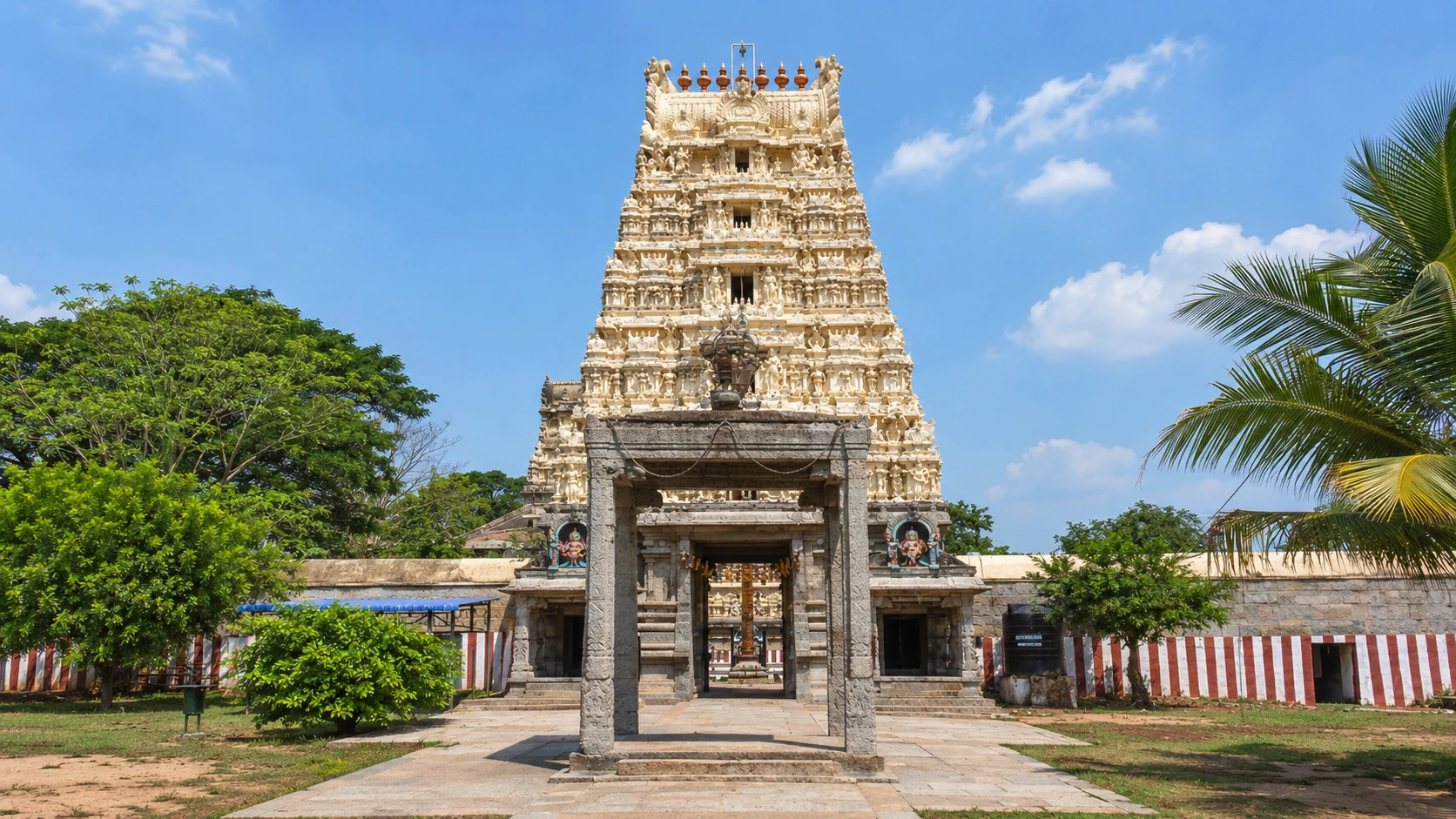
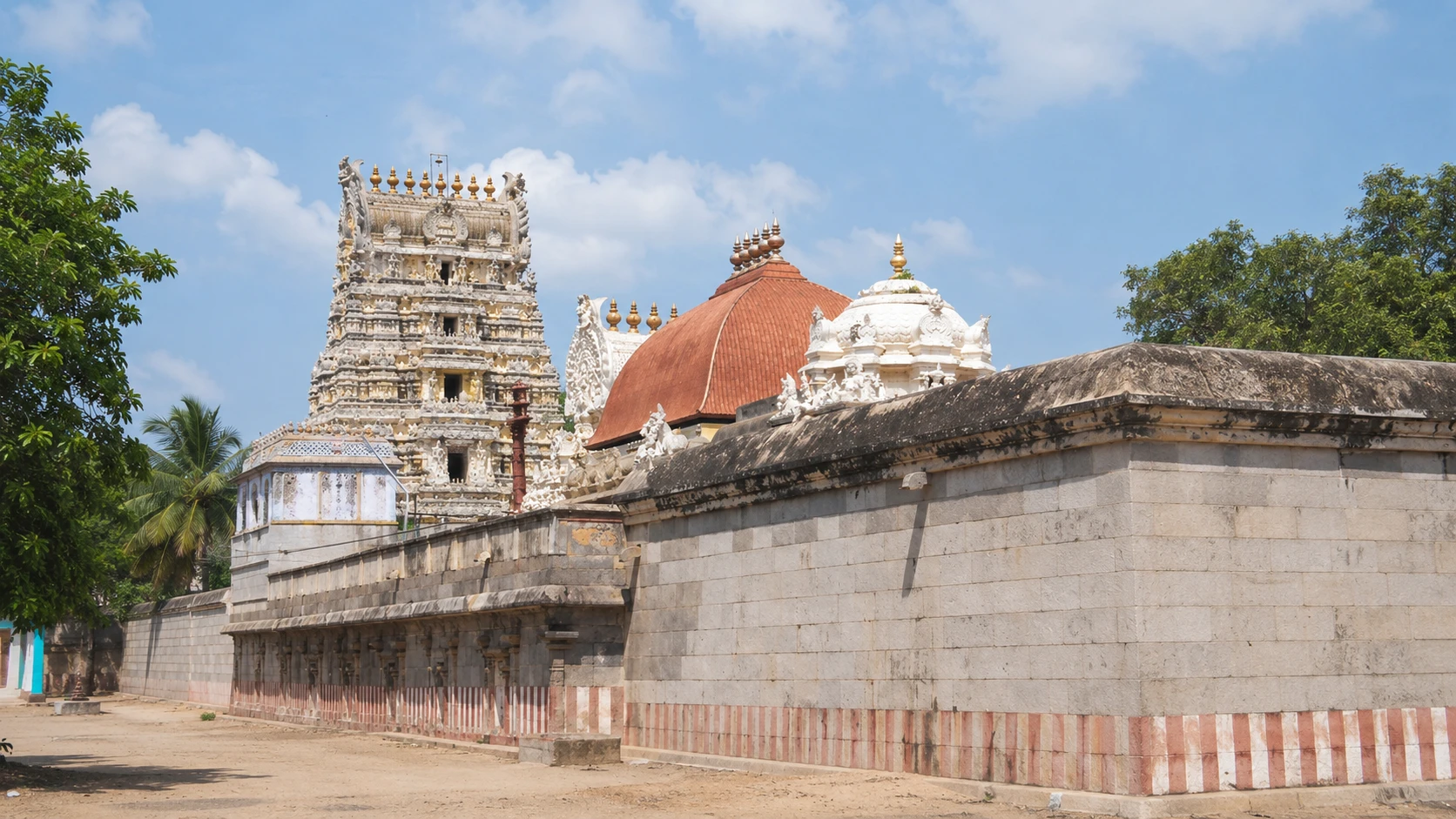
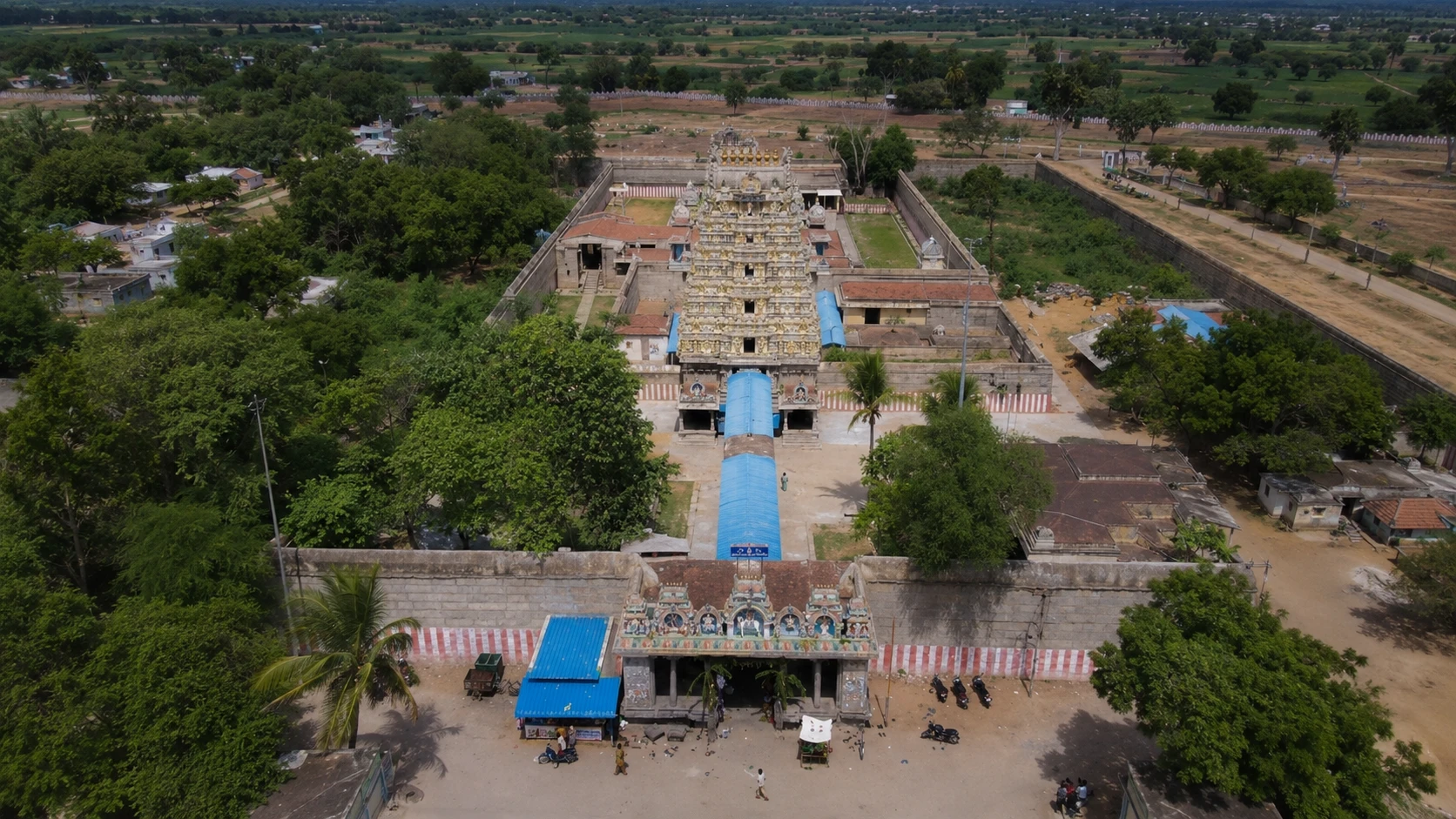
The Tiruvalankadu temple complex centres on two iconographic foci: the principal Vadaranyeswarar sanctum, housing a swayambhu (self-manifested) Shiva linga of considerable antiquity, and the smaller Ratna Sabhai sub-shrine, housing the bronze Nataraja in the distinctive Urdhva Tandava posture. The Vadaranyeswarar linga is dark stone, unadorned at base and surmounted by a brass kavacha (protective cover) during principal pujas; it is consecrated within a Chola-period stone sanctum oriented to the east, with the standard ambulatory passage permitting the parikrama (circumambulation) ritual. The consort shrine of Vandar Kuzhali Amman lies to the south of the main sanctum, with its own dvajastambha (flag-pole), navagraha (nine-planet) shrine, and balipeetha (offering altar) — the standard architectural complement of a major Tamil Saivite temple. The Ratna Sabhai sub-shrine, situated within the larger compound but spatially distinct from the main sanctum, is structurally a smaller pillared hall housing a bronze Nataraja icon in the Urdhva Tandava posture: the left leg raised vertically toward the sky, the right leg planted on the dwarf-figure of Apasmara (the demon of forgetfulness), the four arms holding the damaru (drum of cosmic time), the agni (fire of dissolution), and the gestures of abhaya (fearlessness) and gajahasta (the elephant-trunk pose pointing to the lifted foot). The icon is finely cast in the South Indian bronze tradition and is among the more iconographically distinctive Nataraja images in Tamil Nadu — most Nataraja icons across the Pancha Sabhai depict the Ananda Tandava (blissful dance), whereas the Tiruvalankadu icon is the canonical reference for the Urdhva Tandava form. The Karaikkal Ammaiyar shrine within the compound holds an emaciated, skeletal Pey-form bronze icon depicting the saint as Sekkizhar described her: gaunt, with hollowed cheeks, her thin frame seated cross-legged, often shown with cymbals in her hands. This Pey-form image of Karaikkal Ammaiyar is itself rare in Tamil temple iconography and is one of the most theologically powerful representations of feminine devotional renunciation in the South Indian tradition. The temple gopuram (gateway tower) on the east side is of modest scale relative to major Tamil temple-towns but bears Vijayanagara and Nayak-era ornamental stucco work. The kalyana mandapam (marriage pavilion) and the music-mandapam (sangeetha mandapam) within the compound bear typical South Indian pillared structure with carved deities and dancers. The temple tank (theertham) on the east side serves the ritual purpose of pre-darshan ablution.
Distinctive Practicesविशिष्ट परंपराएँ
Karaikkal Ammaiyar darshan and pasuram recitation
कारैक्काल अम्मैयार दर्शन और पासुरम पठन
Throughout the day during principal darshan windows; particularly observed during the Karaikkal Ammaiyar festival (Aippasi month, October–November) and on Ammaiyar's individual remembrance days in the Tamil ritual calendar
Devotees visiting Tiruvalankadu observe a near-universal practice of including a separate darshan at the Karaikkal Ammaiyar shrine within the compound — distinct from the main Vadaranyeswarar sanctum darshan. The shrine houses the rare Pey-form bronze icon of the saint, and devotees offer flowers (typically white or red), light ghee lamps, and frequently recite verses from her hymns (the Atbhuta Tiruvanthadhi or the Tiruvalankattu Mootha Tirupatigam). The practice acknowledges Karaikkal Ammaiyar's foundational role in the temple's literary identity and is uncommon as a major devotional focus in most other Tamil Saivite temples, where the Nayanar saints are honoured collectively rather than individually.
Karaikkal Ammaiyar's life — her renunciation of conventional beauty, her acceptance of the terrifying Pey form, her hand-walked pilgrimage to Tiruvalankadu, and her composition of unflinching hymns to the dancing Shiva — represents in Tamil Saivite spiritual tradition a complete model of bhakti-vairagya: devotion-as-renunciation. Honouring her shrine alongside the main sanctum is a ritual recognition that devotion to Shiva at Tiruvalankadu is theologically inseparable from the saint who first sang his dance here.
Ratna Sabhai Nataraja darshan and Urdhva Tandava contemplation
रत्न सभा नटराज दर्शन और ऊर्ध्व ताण्डव चिंतन
During the principal evening darshan windows when the Ratna Sabhai is opened to devotees; particularly during the Arudra Darshan festival (Margazhi month, December–January) which celebrates Shiva's cosmic dance across all five Pancha Sabhais
Devotees who approach Tiruvalankadu as a Pancha Sabhai pilgrimage destination observe a specific darshan ritual at the Ratna Sabhai sub-shrine: standing before the bronze Urdhva Tandava Nataraja, they perform a brief contemplation of the dance-form, often reciting the Shiva Nataraja Ashtakam or the Patanjali-Vyaghrapada hymns associated with Saivite dance-theology. The contemplation typically focuses on the symbolism of the lifted leg as moksha-trajectory, the supporting leg as dharmic stability, and the destruction of Apasmara underfoot as the cessation of forgetfulness and ignorance.
The Urdhva Tandava is not merely a posture but a doctrinal statement: in Saiva Siddhanta the dance is the cosmological engine, and each gesture and pose articulates a metaphysical proposition. Contemplating the Tiruvalankadu Nataraja in particular — being the canonical Urdhva Tandava image — is held in tradition to confer insight into the soul's upward path (moksha-marga) and the integration of renunciation with dharmic life. The contemplation is brief by design: the dance is not to be reduced to discursive analysis but received as visual-spiritual instruction.
Pradosham abhishekam at the Vadaranyeswarar sanctum
वडारण्येश्वर गर्भगृह पर प्रदोषम अभिषेकम
Every Pradosham — the 13th lunar day (Trayodashi) of both the waxing and waning fortnights, specifically the evening twilight (4:30 PM – 6:00 PM); twice monthly
Pradosham — the evening twilight of Trayodashi — is considered the most auspicious time to perform abhishekam to Shiva at any Saivite shrine, and is a long-established practice at Tiruvalankadu. The Vadaranyeswarar linga is bathed in succession with water from the temple theertham, milk, curd, ghee, honey, panchamrita, sandalwood paste, and turmeric, with vibhuti (sacred ash) applied between layers. The ritual is accompanied by the recitation of the Shri Rudram, the Chamakam, and the Panchakshari (Om Namah Shivaya). Devotees attending Pradosham at Tiruvalankadu observe the practice from the outer mandapam, with the principal abhishekam performed by the temple priests.
The Pradosham window is held in Saivite tradition to be the time when Shiva himself performs his cosmic dance at Mount Kailash, with all the devas in attendance. Performing or witnessing abhishekam during this window is therefore held to multiply the spiritual merit of the offering exponentially. At Tiruvalankadu, where the temple's own theological identity centres on the dance, Pradosham observance is felt to carry particular weight: the devotee witnesses earthly abhishekam at the very site of one of the canonical sabhas while, in the cosmological understanding, the dance proceeds in its archetypal form simultaneously.
Did You Know?क्या आप जानते हैं?
Karaikkal Ammaiyar is the first woman counted among the 63 Nayanars, and one of only three women in that canonical list (alongside Mangaiyarkkarasiyar and Isaignaniyar). Her presence at Tiruvalankadu predates the consolidation of the temple's canonical Pancha Sabhai identity by several centuries — meaning the site was a place of Tamil Saivite devotion long before it was named as one of the five cosmic dance halls.
Sekkizhar, Periya Puranam; Karen Pechilis (2012), 'Interpreting Devotion'
The Tiruvalankadu Copper Plates of Rajendra Chola I (1018 CE), comprising thirty-one inscribed copper plates with detailed Chola genealogy in Sanskrit and Tamil, are today preserved at the Government Museum, Chennai. They were recovered from the temple in the early 20th century and remain one of the single most important documentary sources for medieval South Indian dynastic history.
Hultzsch, 'South Indian Inscriptions'; K. A. Nilakanta Sastri, 'The Cholas'
Of the five Pancha Sabhais, the Tiruvalankadu Ratna Sabhai is the only one anchored to the Urdhva Tandava form. The other four sabhas — Chidambaram (Ananda Tandava), Madurai (Sandhya Tandava), Tirunelveli (Muni Tandava), and Kutralam (Tripura Tandava) — each present different Tandava forms. The Tiruvalankadu icon is therefore the canonical reference for the lifted-leg dance in Tamil temple iconography.
Standard concordances of Pancha Sabhai Tandava attributions in Tamil Saivite literature
The temple's name 'Tiruvalankadu' is a contraction of 'Tiru' (sacred) and 'Aalan Kadu' (banyan forest), reflecting its identity as a cremation-ground forest at the foot of an ancient banyan grove. The Sanskrit form 'Vadaranyeswarar' similarly combines 'vata' (banyan) with 'aranya' (forest) and 'iswara' (lord) — both names preserving the memory of a forest landscape no longer visible at the site, where urban settlement has long since replaced the wilderness.
Tamil-Sanskrit etymological tradition; Madras Tamil Lexicon
Karaikkal Ammaiyar's hymns are uncommon in the Tamil Saiva canon for their unflinching theological content: she addresses Shiva not as a remote deity but as the dancing lord of the cremation-ground whom she has personally beheld in vision. Her self-description as walking on her hands toward Tiruvalankadu — refusing to defile the holy ground with her feet — is among the most physically vivid pilgrimage images in Indian devotional literature.
Karaikkal Ammaiyar's own hymns; Indira Viswanathan Peterson, 'Poems to Siva' (1989)
Visitor Accessप्रवेश जानकारी
Tiruvalankadu welcomes devotees of all backgrounds for darshan without entry restrictions based on gender, age, or origin. Photography is permitted in the outer courtyards, mandapams, and the temple compound's external areas, but is prohibited inside the main Vadaranyeswarar sanctum, the Karaikkal Ammaiyar shrine, and the Ratna Sabhai sub-shrine during darshan hours and especially during abhishekam and aarti. Mobile phones must be silenced inside the temple compound. Footwear must be removed before entering the temple — there are footwear stalls at the main entrance, typically free or with a nominal charge. Modest dress is expected: shoulders and knees should be covered for both men and women. Men are sometimes asked to remove their upper garment (shirt) before entering the principal sanctum, in keeping with traditional Tamil Saivite practice; this convention varies and is not universally enforced.
There is no formal VIP darshan system at Tiruvalankadu — the temple's modest pilgrim flow generally allows direct darshan without queues on most days. On Pradosham evenings and during major festivals (particularly Arudra Darshan in Margazhi and the annual Brahmotsavam), expect significantly higher footfall and longer wait times. Allow 60–90 minutes for a full circuit covering the main Vadaranyeswarar sanctum, the Karaikkal Ammaiyar shrine, the Ratna Sabhai sub-shrine, and the consort shrine of Vandar Kuzhali Amman. Carry a photo ID as occasional security checks may apply during festival periods.
Festivalsत्योहार
Arudra Darshan
आरुद्र दर्शन
Margazhi (December–January) — observed on the Tiruvadirai (Ardra) nakshatra, the full-moon day
Arudra Darshan is the most significant Pancha Sabhai festival, celebrated on the day of the Tiruvadirai nakshatra in the Tamil month of Margazhi. Tradition holds this is the day Shiva first revealed his cosmic dance form to the seers Patanjali and Vyaghrapada. At Tiruvalankadu, the bronze Nataraja in the Ratna Sabhai is taken in special procession through the temple compound, with abhishekam performed in elaborate ritual sequence. The festival forms the spiritual high point of the temple's calendar year and is observed simultaneously at all five Pancha Sabhai shrines across Tamil Nadu.
Maha Shivaratri
महाशिवरात्रि
Phalguna (February–March) — the 14th lunar night of the dark fortnight
Maha Shivaratri — the great night of Shiva — is observed at Tiruvalankadu with the standard pan-Saivite practices of all-night vigil, four-prahara abhishekam, and continuous recitation of the Shri Rudram. The four pujas through the night each address Shiva in a different aspect: the first prahara honours him as the dispeller of ignorance, the second as the destroyer of cosmic illusion, the third as the lord of yoga, and the fourth as the dancing lord — the latter taking particular significance at this Pancha Sabhai site. Devotees observe a complete fast throughout the day and remain awake through the night within or near the temple compound.
Karaikkal Ammaiyar Festival (Aippasi Karthigai)
कारैक्काल अम्मैयार त्योहार
Aippasi (October–November) — the festival is observed across multiple days surrounding the Karthigai nakshatra in this Tamil month
An unusually prominent saint-festival in Tamil Saivite practice — at most major temples the Nayanars are honoured collectively rather than in individual annual festivals. Tiruvalankadu observes a multi-day festival centred on Karaikkal Ammaiyar, with special darshan at her shrine, recitations of her hymns (the Atbhuta Tiruvanthadhi and the Tiruvalankattu Mootha Tirupatigam), processions of her Pey-form bronze image through the temple compound, and discourses by visiting scholars and acharyas on her spiritual significance. The festival draws devotees from across Tamil Nadu and from the diaspora communities of the Tamil-speaking world.
Brahmotsavam (Annual Temple Festival)
ब्रह्मोत्सवम (वार्षिक मंदिर त्योहार)
Chittirai or Vaikasi (April–June) — the annual ten-day temple festival, dates vary year to year per the Tamil panchangam
The annual Brahmotsavam is the principal temple-festival of Tiruvalankadu, a ten-day observance featuring daily processions of the utsava (procession) deities through the streets surrounding the temple, with the deities mounted on different vahanas (mounts) each day — including the rishabha (bull), the simha (lion), the gaja (elephant), and the silver chariot. The festival culminates in the Theerthavari — the ritual immersion of the utsava deities in the temple tank — and the Garuda Sevai. Local communities surrounding the temple participate substantially, and the festival is the principal annual occasion when the temple's pilgrim flow temporarily rivals that of the larger Tamil temple-towns.
Traditional Offeringsपारंपरिक अर्पण
प्राथमिक अर्पण
Bilva (bel) leaves
बिल्व पत्र
The trifoliate bilva leaf is the most sacred botanical offering to Shiva, the three leaflets corresponding to the three eyes of the deity, the three gunas (sattva, rajas, tamas), and the three principal aspects of cosmic activity (creation, preservation, dissolution).
Vibhuti (sacred ash)
विभूति
The sacred ash applied to the forehead symbolises both Shiva's ascetic identity and the impermanence of all material form — the ash being the final state to which all bodies return, and which Shiva himself wears as ornament.
Milk for abhishekam
अभिषेकम के लिए दूध
Milk is the principal abhishekam substance for the Shiva linga, symbolising purity, nourishment, and the lunar-cooling quality (Soma) that pacifies Shiva's cosmic fire.
Pure water (theertha)
शुद्ध जल (तीर्थ)
Water from the temple's own theertham (tank) is the most basic and continuous abhishekam offering — symbolically connecting every offering at every Saivite shrine to the cosmic waters from which the linga rose at the beginning of time.
Kungumam (vermilion)
कुमकुम
Vermilion is offered principally to the consort Vandar Kuzhali Amman, marking the Shakta-Saiva integration of the temple's devotional architecture: Shiva receives ash and bilva, Devi receives kungumam and turmeric, both honoured in a single ritual visit.
इस मंदिर की विशेषता
White flowers at the Karaikkal Ammaiyar shrine
कारैक्काल अम्मैयार मंदिर पर सफ़ेद पुष्प
Devotees customarily offer white flowers — most often white lotus, jasmine, or white nerium — at the Karaikkal Ammaiyar shrine, the colour symbolising her renunciate purity and her embrace of the Pey form. The offering is accompanied by recitation of verses from her own hymns rather than the standard Shiva mantras.
Dance-offering during Arudra Darshan
आरुद्र दर्शन पर नृत्य-भेंट
During the Arudra Darshan festival, dance offerings — particularly Bharatanatyam performances in front of the Ratna Sabhai — are made by devotee-performers. The dance-offering is theologically significant at this Pancha Sabhai site as both honour to Shiva-Nataraja and as a continuation of the temple's role as a place where the cosmic dance has been understood for over a millennium as the central devotional reality.
Tiruvalankadu is administered by the Tamil Nadu Hindu Religious and Charitable Endowments Department (HR&CE); standard temple-shop offerings (bilva leaves, kungumam, vibhuti packets, ghee for lamps, flowers) are available at modest cost within the compound or from vendors at the temple entrance. Devotees are encouraged to purchase offerings on-site rather than carry pre-prepared offering kits.
How to Reachकैसे पहुँचें
Tiruvalankadu sits on the Chennai Suburban Railway corridor, making it the most rail-accessible of the three remaining Pancha Sabhai shrines. By rail, Tiruvalangadu station lies on the Chennai Beach–Arakkonam line of the Chennai Suburban Railway, with frequent EMU local trains from Chennai Beach, Chennai Central (via Arakkonam connection), and intermediate stations including Avadi and Tiruninravur. Journey time from Chennai Central is approximately 90 minutes by direct local; the station is within walking distance (under 1 km) of the temple. By road, the temple is approximately 60 km from Chennai via the Chennai–Bengaluru National Highway (NH-48 / formerly NH-4), exiting toward Tiruvallur and proceeding via the Tiruvallur–Tiruvalankadu state road; the drive takes 90 minutes to 2 hours depending on Chennai traffic. Tamil Nadu State Transport Corporation buses operate from Chennai (Koyambedu Mofussil Bus Terminus) to Tiruvallur, with onward connections to Tiruvalankadu. By air, Chennai International Airport (MAA) is approximately 75 km southeast of the temple, with road transfer the standard onward option. The temple's location on the suburban rail line makes day-trips from Chennai entirely practical — many devotees combine Tiruvalankadu with the other Tiruvallur-district temples (including the Veeraraghava Perumal Temple at Tiruvallur town) in a single day.
Plan Your Visitयात्रा की योजना
🌤 सर्वोत्तम मौसम
October to March is the most comfortable season for visiting Tiruvalankadu, with daytime temperatures typically between 22°C and 32°C and lower humidity than the summer months. The festival calendar concentrates several major observances in this window — the Karaikkal Ammaiyar Festival in October–November, Arudra Darshan in December–January, and Maha Shivaratri in February–March — making the cooler months both meteorologically and devotionally favourable. April through July sees temperatures rising into the high 30s°C and at times above 40°C, with high humidity; pilgrim flow drops correspondingly. The northeast monsoon (October–December) brings significant rainfall to coastal Tamil Nadu but does not typically disrupt access to the temple.
👘 पहनावे का नियम
Traditional or modest dress is expected. For women, sarees, salwar-kameez, or long skirts with full-sleeved or three-quarter-sleeved tops are appropriate; shorts, sleeveless tops, and short dresses should be avoided. For men, dhoti or trousers with shirts are appropriate; shorts are not permitted within the principal sanctum. As is traditional in Tamil Saivite temples, men may be requested to remove their upper garment (shirt or vest) before entering the main Vadaranyeswarar sanctum; this is a long-standing convention rather than a rigidly enforced rule. Footwear must be removed before entering the temple compound.
📱 फोन और फोटोग्राफी
Mobile phones must be silenced inside the temple compound. Photography is permitted in the outer courtyards and mandapams but is prohibited inside the main Vadaranyeswarar sanctum, the Karaikkal Ammaiyar shrine, and the Ratna Sabhai sub-shrine during darshan hours and especially during abhishekam and aarti. No formal mobile-phone deposit counter operates at this temple — devotees retain their phones but observe the photography restriction by self-discipline.
🏨 आवास
Tiruvalankadu itself is a small town with limited dedicated pilgrim accommodation; most devotees visit as a day-trip from Chennai or stay at Tiruvallur (the district headquarters, approximately 10 km away) which offers a wider range of budget and mid-range hotels and lodges. Chennai (60 km southeast) offers the full spectrum of accommodation from budget to luxury. For devotees seeking traditional temple-town stay, some smaller pilgrim lodges (yatri nivas) operate near Tiruvallur and Tiruninravur stations. Booking in advance is recommended during the major festival periods (Arudra Darshan in Margazhi, Karaikkal Ammaiyar Festival in Aippasi, and the annual Brahmotsavam).
Sacred Soundsपवित्र ध्वनि
108 Japa Practice
Om Namah Shivaya — the Panchakshari mantra, the five-syllable invocation of Shiva
Chant 108 times in the spirit of this temple
क्या आप जानते हैं? · Did You Know?
वही अनुवाद त्रुटि जिसने हिन्दू धर्म में '33 कोटि' को '33 करोड़' बनाया, बौद्ध धर्म में भी हुई। बौद्ध ग्रन्थों के चीनी अनुवाद ने 'सप्त कोटि बुद्ध' (7 श्रेष्ठ बुद्ध) का अनुवाद '7 करोड़ बुद्ध' कर दिया। तिब्बती अनुवाद ने सही किया: 7 प्रकार, 7 करोड़ नहीं। एक संस्कृत शब्द, दो प्रमुख विश्व धर्मों में गलत पढ़ा गया, ने दो एकसमान भ्रम स्वतन्त्र रूप से उत्पन्न किए।
Related Contentसंबंधित सामग्री
Related Scriptures
Community Reflections
🕉️
Be the first to share your reflection.