Nageshwar
नागेश्वर
The tenth Jyotirlinga, Lord of the Serpents on the Saurashtra coast
Dwarka, Gujarat, India
NāgeśvaraAlso known as: Nageshwara, Nagesha Jyotirlinga, Nagnath, Darukavaneshwar, Lord of Serpents
युग
Pilgrimage tradition referenced from at least the early medieval period; current temple complex substantially reconstructed in the 1990s under the patronage of Gulshan Kumar of T-Series; 25-metre (82-foot) Shiva statue added during the same reconstruction phase
वास्तुकला
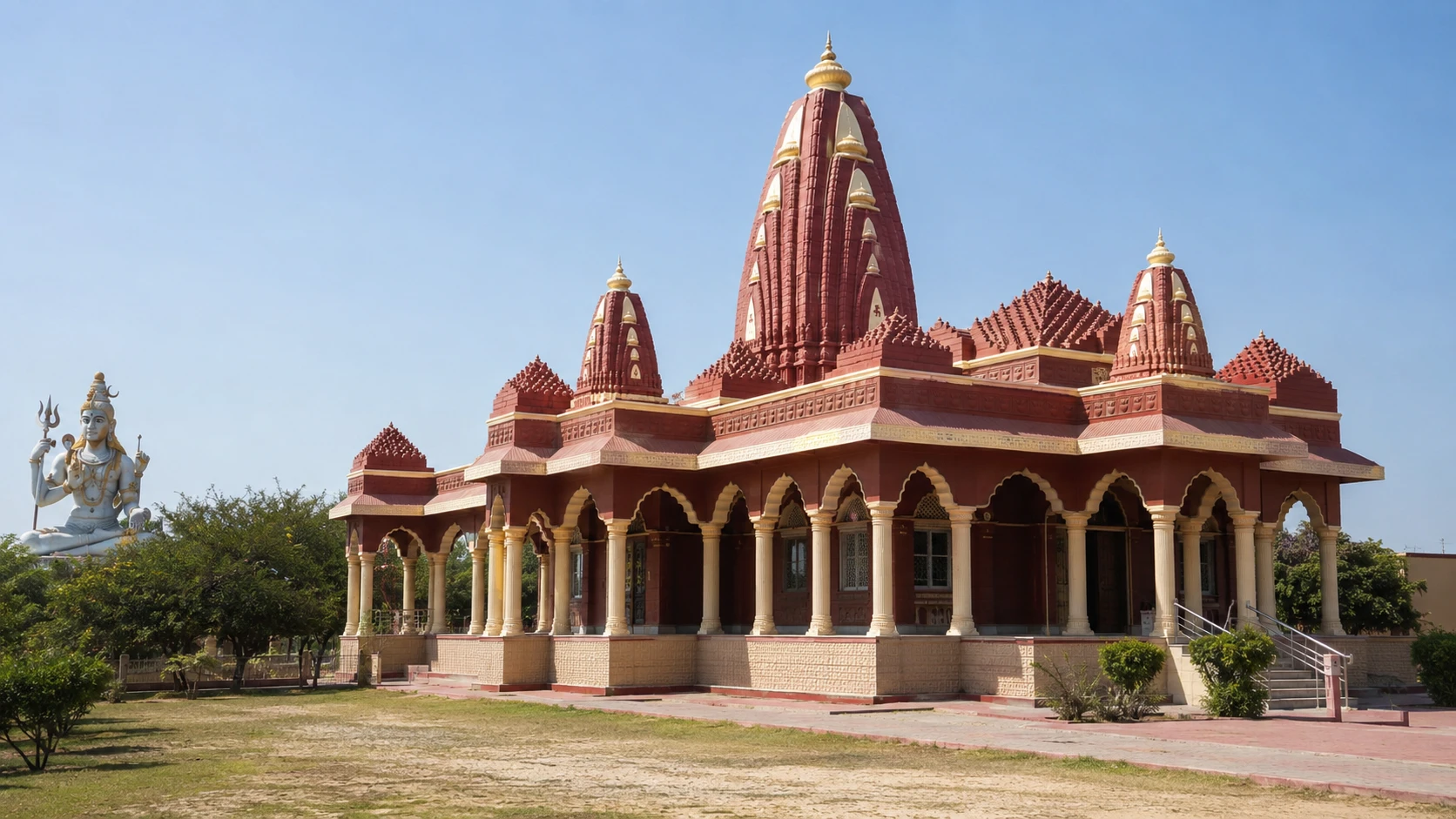
Modern Nagara reconstruction (1990s) on the site of an earlier, simpler shrine; the present complex retains traditional Nagara forms but reflects late-20th-century construction methods and proportions
खुला
06:00 – 21:00
आरती
05:30 · 12:00 · 16:00 · 19:00 · 21:00
विशेष
Maha Shivaratri all-night darshan; Shravan Mondays; the lingam-with-coiled-Naga iconography is a Nageshwar-specific darshan focus, distinct from any other Jyotirlinga
पवित्र कथा · पवित्र कथा
Nageshwar is the tenth Jyotirlinga, set on the Saurashtra coast some seventeen kilometres from the city of Dwarka, Krishna's mythic capital, and bound to the Puranic geography of the Darukavana, the forest where the demon Daruka once held a community of Shiva-devotees in captivity. The Shiva Purana places this Jyotirlinga's origin in the rescue of one such devotee, the Vaishya merchant Supriya: when the asuras attacked the prison where he led group worship of Shiva, the Lord himself manifested wielding the Pashupata weapon, slew the demons, and remained at the spot as Nageshwar, the Lord of Nagas, of serpents, of the protective and the chthonic. Of the twelve Jyotirlingas, Nageshwar carries the most explicitly serpent-coded iconography: the lingam at the sanctum is depicted with the cosmic naga coiled around it, mirroring the serpent-garland that Shiva wears on his throat. The temple stands on the same coastal pilgrim circuit as Dwarkadhish, Bet Dwarka, and Rukmini Devi, and a Char Dham Dwarka pilgrimage is rarely completed without darshan here. Three sites across India contest the canonical Nageshwar attribution; this is the Saurashtra anchor that the Stotram tradition and the Char Dham circuit converge on.
Sacred Designationपवित्र पदनाम
बारह ज्योतिर्लिंगों में 10वें
बारह ज्योतिर्लिंगों में 10th
Sacred Origin Storyपवित्र उत्पत्ति कथा
Source: Shiva Purana (Koti Rudra Samhita), widely-attested
In an age when the asuras held tracts of the earth in fear, there was a forest on the western coast called Darukavana, the wood of the daru tree, dense with shade and unmarked by human path. The asura Daruka and his demoness wife Daruki ruled this forest and the sea-coast adjoining it.
Daruki had once received a boon from Parvati: that wherever she set foot, that ground would belong to her, and the forest itself would move with her. Armed with this boon, the asura couple were impossible to corner, wherever the gods or sages tried to fight them, the trees and undergrowth shifted to keep them safe.
The asuras preyed on travellers, on sages, and especially on devotees of Shiva. Among those they targeted were merchants on the western sea-route, for in those times the coast that now belongs to Gujarat was a great trading shore, with ships bound for Persia and Arabia putting out from its harbours.
One such merchant was a Vaishya named Supriya, born into a trading family but devoted from childhood to Shiva. He carried with him a small clay Shivling on every voyage, and at every dawn and dusk he led whatever crew or fellow-travellers he had in the worship of the Lord.
During one voyage, the asuras intercepted Supriya's ship. They seized the merchant and a number of his fellow-passengers, brought them ashore at Darukavana, and cast them into a great prison-pit dug deep into the coastal earth. The asuras intended that the captives die slowly of hunger and despair.
But Supriya did not despair. He gathered the prisoners around him, drew the small clay lingam from his pouch, and led the worship as he had every day at sea. The other captives joined him, and the prison-pit echoed each evening with the chanting of Shiva's names. The sound of the chant carried up through the earth and reached the asuras at their fortress.
Daruka was enraged. He stormed to the pit with his army, drew his sword, and prepared to slaughter every prisoner. As the asura raised his weapon over Supriya's head, the merchant did not flinch. He closed his eyes, called upon Shiva by every name he knew, and offered his life as the final pranam.
The earth around the pit cracked open. Light burst from the broken ground. Shiva himself rose into the asuras' midst, not in his peaceful form but in his most terrible aspect, with the Pashupata astra in his hand: the cosmic weapon that no creature can withstand. He hurled the astra, and Daruka's army fell. He turned upon Daruka himself; the asura-king was reduced to ash.
Daruki, however, Shiva spared. She had been granted her boon by his own consort Parvati, and the Lord would not undo what the Devi had given. Daruki retreated into the forest, diminished but not destroyed.
Supriya and the freed devotees fell at Shiva's feet. They begged him not to leave the place where he had answered them, to remain at this spot, in this forest where his presence had broken open the earth itself. Shiva agreed.
He took form as a Jyotirlinga at the very ground where the prison-pit had been, with the cosmic Naga, Vasuki, the king of serpents, coiled around the lingam in protection. From this day, he said, he would be Nageshwar, the Lord of Serpents, guarding all devotees who called upon him in extremity.
The Shiva Purana places this Jyotirlinga as the tenth among the twelve and identifies it with the Saurashtra coast, in the Darukavana that lies near the city of Krishna, Dwarka. The lingam coiled by the serpent is the iconographic signature of this site alone among the Jyotirlingas, and to this day the merchant's clay Shivling and the cosmic Naga are remembered together in the temple's central darshan.
उद्धृत स्रोत:
- Shiva Purana, Koti Rudra Samhita, Chapter 22 (Nageshwar Jyotirlinga origin)
- Linga Purana, Jyotirlinga origin sections
- Skanda Purana, regional Saurashtra Khanda references
अन्य परंपराएँ · अन्य परंपराएँ
Aundha Nagnath (Maharashtra), alternate Jyotirlinga claim
A separate temple at Aundha (Audhgram) in Hingoli district, Maharashtra, called Aundha Nagnath, asserts that it, and not Dwarka, is the canonical tenth Jyotirlinga. The textual hinge is the canonical Stotram phrase 'nagesham darukavane' (नागेशं दारुकावने), 'Nagesha in the Darukavana.' Maharashtra-tradition commentators read 'Darukavana' not as the coastal forest near Dwarka but as a forest in central India where this Aundha shrine stands.
The Aundha Nagnath temple is a documented Hemadpanthi-era structure (c. 13th century) with substantial stone-inscription and architectural evidence of its antiquity, and is venerated by the Marathi Bhakti tradition, saints including Tukaram, Namdev, and Eknath are said to have visited.
Among Marathi-speaking pilgrim communities, Aundha Nagnath is widely held as the canonical Nageshwar Jyotirlinga.
Jageshwar Dham (Uttarakhand), etymological alternate claim
A third claim originates at Jageshwar Dham in the Almora district of Uttarakhand, where a complex of more than 100 stone temples dating from the 7th to 12th centuries CE, built under the Katyuri dynasty in distinctive Pala-influenced North-Indian Nagara style, stands in a valley of ancient deodar (Sanskrit: daru) cedars.
The Jageshwar claim hinges on a Sanskrit-etymological reading of 'Darukavana': the word 'daru' means deodar/cedar, and the Jageshwar valley's ancient deodar forest is, in this reading, the original Darukavana of the Stotram.
The Jageshwar complex is the oldest of the three contesting sites by physical evidence, with documented Katyuri-era construction predating both the present Dwarka Nageshwar reconstruction and the Aundha Nagnath Hemadpanthi shrine.
The Jageshwar tradition is supported by the depth of the etymological reading and the temple's archaeological antiquity, but is the least prominent of the three in the dominant Stotram-correspondence canon.
विद्वत संदर्भ
Nageshwar is one of the two most genuinely contested Jyotirlinga attributions in the entire canonical correspondence, alongside Vaidyanath, where Parli (Maharashtra) contests Deoghar (Jharkhand). Where Vaidyanath has two contesting sites, Nageshwar has three: Dwarka (Gujarat), Aundha Nagnath (Maharashtra), and Jageshwar (Uttarakhand). The textual hinge is the Stotram phrase 'nagesham darukavane' (नागेशं दारुकावने), 'Nagesha in the Darukavana', and each site reads 'Darukavana' through its own regional geography: Dwarka as the coastal forest near the asura Daruka's stronghold; Aundha as a central-Indian forest tract; Jageshwar through the Sanskrit etymology in which 'daru' means deodar/cedar. Modern scholarship (Diana Eck, 'India: A Sacred Geography', 2012) presents all three as genuine contesting traditions rather than as a single canonical site with two pretenders, and notes that Stotram correspondences of this antiquity often resist single-site resolution. The Eternal Raga corpus follows the manifest's anchor at Dwarka, supported by the dominant Char Dham circuit tradition and the Saurashtra Stotram reading, while presenting the Aundha and Jageshwar claims with their own scholarly and devotional weight.
Historyइतिहास
The documented pre-modern history of the Nageshwar shrine at Dwarka is unusually thin. The Saurashtra coast was a major medieval pilgrimage and trading region, the Somnath complex stands less than 200 km away, but the regional records that survive the Bahmani-Sultanate-Mughal-Maratha-British-era transitions are concentrated on the Somnath and Dwarkadhish sites, with Nageshwar receiving only intermittent mention.
The pilgrimage tradition is referenced from at least the early medieval period, with the temple appearing in regional Saurashtra Khanda devotional literature and in itinerary accounts of pilgrims to Dwarka, but specific structural attributions and dated patronages are largely absent before the modern era.
What can be said with confidence is that the temple existed as a small ancient shrine through the medieval and early-modern periods, with successive minor renovations whose specific dating is conjectural. The Saurashtra coast's history of repeated invasions affecting Somnath would have shaped the broader regional Shaiva landscape; whether Nageshwar was directly attacked or simply diminished by the disruption to pilgrim flows is not separately documented.
The defining transformation in the temple's modern form came in the early 1990s, when Gulshan Kumar Dua (1956, 1997), founder of the music label T-Series and a major Shaiva devotee, undertook substantial reconstruction of the temple complex.
The pre-reconstruction shrine was a small structure largely indistinguishable from many other regional Shaiva temples in the area; the Gulshan Kumar reconstruction transformed it into a major Char Dham circuit destination.
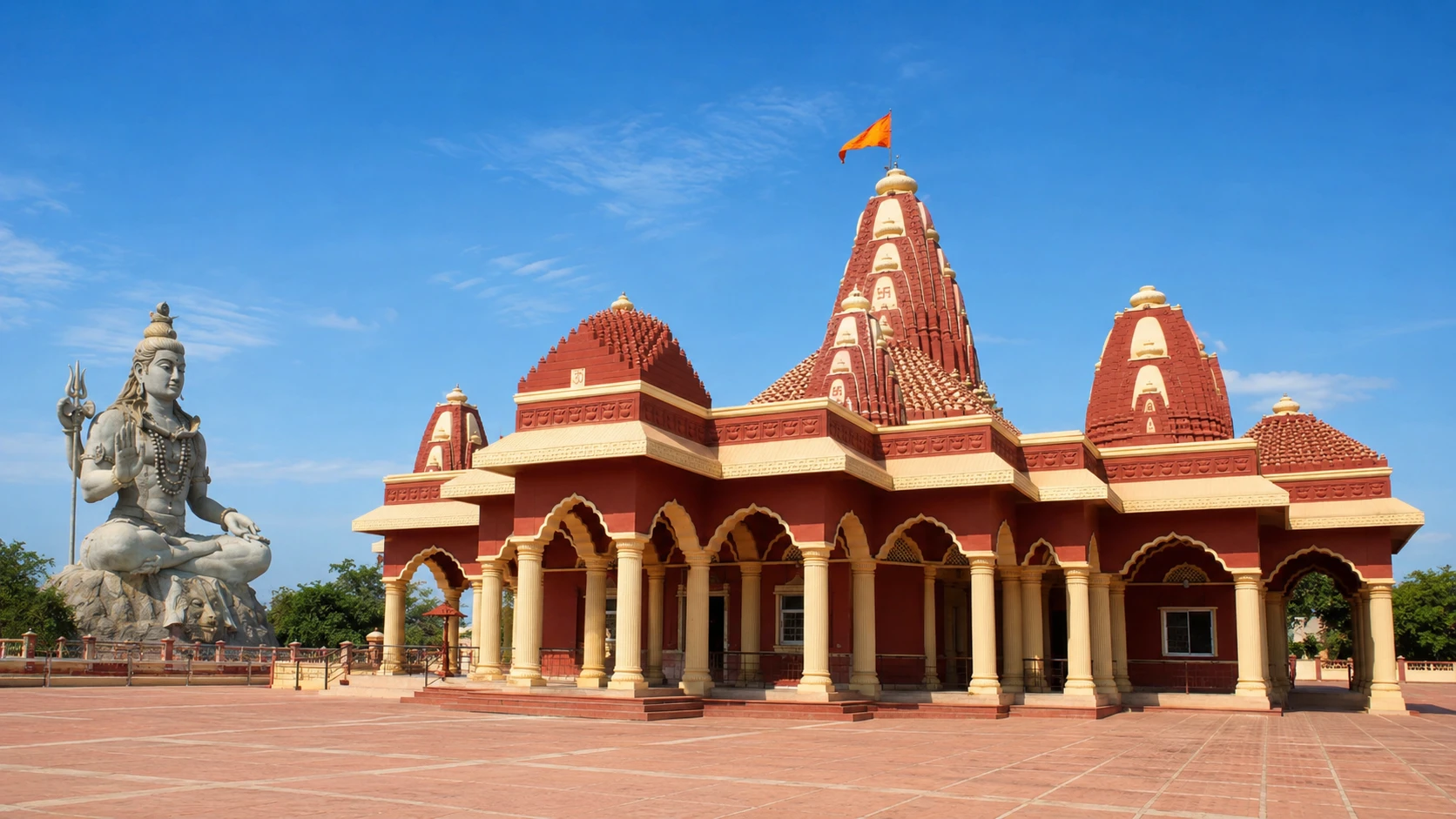
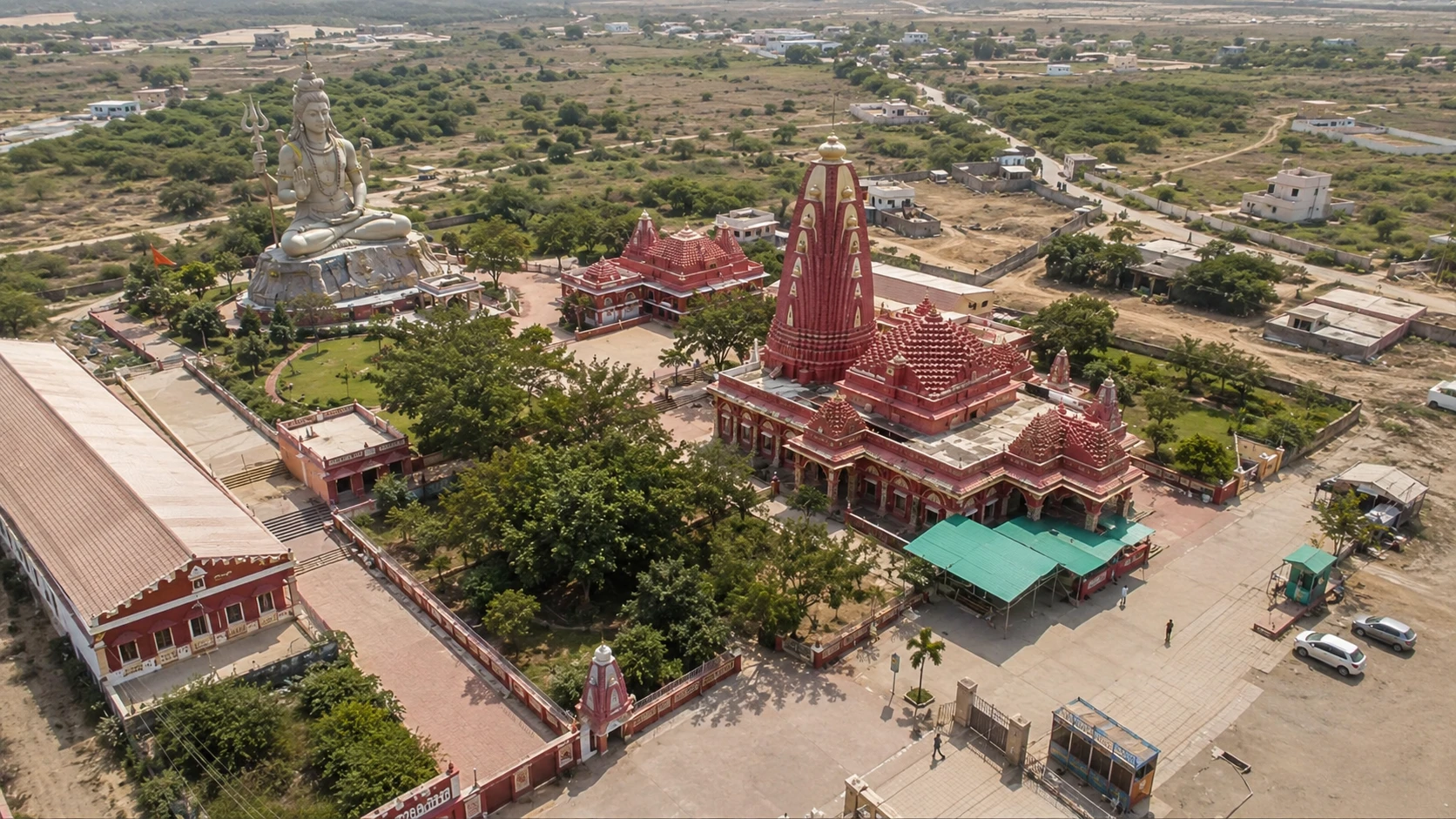
The signature element of the new complex, a 25-metre (82-foot) statue of Shiva in seated meditation posture, visible from the approach road, was added during the same construction phase. The statue is one of the largest Shiva representations on the Indian peninsula and has become the temple's most-photographed external feature.
Gulshan Kumar was assassinated in Mumbai on 12 August 1997, and his role in the temple's modern form is part of the temple's contemporary memory. The reconstruction work was completed by the Trust after his death. Today the temple is administered under the Government of Gujarat's Devasthan framework with Trust oversight, and is one of the four canonical destinations on the Dwarka Char Dham pilgrim circuit alongside Dwarkadhish, Bet Dwarka, and Rukmini Devi Mandir.
In 2013 the Devbhumi Dwarka district was carved out of Jamnagar district, and Nageshwar now falls within this new district's administrative jurisdiction. Pilgrim infrastructure, road connectivity, and the broader Saurashtra circuit have seen continuous improvement since the 1990s reconstruction; the shrine's annual pilgrim volume now runs into the millions, with peaks during Shravan, Maha Shivaratri, and the school-holiday Char Dham circuit months.
Historical Timelineऐतिहासिक कालक्रम
References to the Nageshwar shrine appear in regional Saurashtra Khanda devotional literature and in pilgrim itinerary accounts of the Dwarka coast. The shrine is treated as ancient even in these references, but specific structural descriptions and dated patronages are absent, the temple is mentioned as a destination on the Dwarka pilgrim circuit rather than as a site with its own architectural history.
Pre-modern documentation of the Dwarka Nageshwar is genuinely sparse. Unlike Somnath (which has detailed Mahmud-era and Mughal-era records) or Kashi Vishwanath (which has Aurangzeb-era documentation), the Nageshwar shrine receives only itinerary-list mentions in pre-modern sources. The architectural history of the temple before the 1990s reconstruction is largely reconstructed from the Trust's tradition rather than from datable evidence.
The temple existed as a small ancient shrine through successive medieval and early-modern periods, with minor renovations whose specific dating is conjectural. The Saurashtra coast's history of repeated invasions affecting Somnath would have shaped the broader regional Shaiva landscape; whether Nageshwar was directly attacked, indirectly affected by pilgrim-flow disruption, or quietly preserved through the disturbance is not separately documented in the surviving record.
This entry is included for completeness rather than as a securely dated event. The pre-modern history of Nageshwar should be read as a continuity of small-shrine survival rather than as a sequence of dated patronages.
Gulshan Kumar Dua (1956, 1997), founder of the music label T-Series and a major Shaiva devotee, undertakes substantial reconstruction of the Nageshwar temple complex. The pre-reconstruction shrine was a small ancient structure largely indistinguishable from many other regional Shaiva temples in the Saurashtra coastal belt; the Gulshan Kumar reconstruction expands and rebuilds the complex, transforming it into a major Char Dham circuit destination with modern Nagara reconstruction architecture. The reconstruction is one of the most well-documented modern temple-rebuilding patronages in independent India and is closely associated with Gulshan Kumar's personal devotion.
A 25-metre (82-foot) statue of Shiva in seated meditation posture is added to the Nageshwar complex during the same Gulshan Kumar reconstruction phase. The statue, one of the largest Shiva representations on the Indian peninsula and visible from the approach road, becomes the temple's most-photographed external feature and a defining element of the modern Char Dham Dwarka pilgrim experience. The statue's specific completion date varies across sources between 1995 and the early 2000s; the Trust completed the works after Gulshan Kumar's assassination in August 1997.
The 25-metre Shiva statue's completion date is not consistently reported across sources; some accounts give 1995, others date completion to the early 2000s. The safer formulation is 'late-1990s reconstruction phase' rather than a specific year.
The Devbhumi Dwarka district is created by the Government of Gujarat through bifurcation of the existing Jamnagar district, taking effect on 15 August 2013. The Nageshwar temple now falls within this new district's administrative jurisdiction, alongside Dwarka city, Bet Dwarka, Khambhalia, and Okha. The district reorganization has shaped the modern administrative framework of the temple's pilgrim infrastructure, traffic management, and Char Dham circuit connectivity.
What You'll Seeदर्शन में
The Nageshwar Jyotirlinga is a swayambhu (self-manifested) lingam of dark stone, set in the central garbhagriha of the modern temple complex on a low yoni-pitha. The lingam's defining iconographic feature, and the feature that distinguishes Nageshwar from every other Jyotirlinga in the canonical correspondence, is the cosmic Naga, the king-serpent Vasuki, depicted coiled around the lingam in protective wrap.
The Naga is rendered in copper or silver casing during ceremonial darshan, with the serpent's hood spread above the lingam's crown like an umbrella, and its body wrapping the shaft in two or three coils. This is the iconographic signature that gives the Lord his name, Nageshwar, the Lord of Serpents, and the lingam-with-coiled-Naga form is the single most-photographed darshan element of the temple (where photography is permitted; the inner sanctum is restricted).
The garbhagriha itself is small, set within a modern Nagara-reconstruction shikhara that rises in the standard stepped pyramidal form to a kalasha. The temple's architectural register is consistent late-20th-century Nagara, clean stone surfaces, structurally simpler than the layered Hemadpanthi or Pala-era temples elsewhere in the corpus, and reflecting the 1990s reconstruction's choice of a traditional but modernized idiom.
The walls of the garbhagriha and the surrounding pradakshina path carry sculpted niches with Shiva, Parvati, Ganesha, Kartikeya, and Nandi figures; the Devi consort Nageshwari is represented in an adjacent shrine within the same complex.
The most visible iconographic feature of the modern Nageshwar complex is not within the temple but immediately outside it: a 25-metre (82-foot) statue of Shiva in seated padmasana meditation posture, hand raised in abhaya mudra, painted white and visible from the approach road for several kilometres.
The statue, added during the 1990s Gulshan Kumar reconstruction phase, is one of the largest open-air Shiva representations on the Indian peninsula. It serves as the unofficial gateway icon of the Char Dham Dwarka pilgrim circuit and is for many pilgrims the first sight that signals their arrival at Nageshwar.
The Saurashtra coast itself is part of the temple's iconographic context: the salt-laden sea wind, the low scrubland of the Devbhumi Dwarka district, and the proximity of the Arabian Sea less than a kilometre to the west all anchor the Puranic Darukavana, the coastal forest of the Daruka asura, to a specific living geography rather than to abstract sacred space.
Distinctive Practicesविशिष्ट परंपराएँ
Naga Abhishekam, Water Offering with Vasuki Invocation
नाग अभिषेकम, वासुकि आह्वान के साथ जल अर्पण
Daily; with extended ritual on Naga Panchami (Jul, Aug) and Maha Shivaratri
The abhishekam at Nageshwar is conducted with explicit invocation of Vasuki, the king of serpents, whose form is wrapped around the lingam in the temple's iconographic signature. The water (or milk, or panchamrit) is poured by the priest in a measured spiral that traces the path of the coiled Naga around the lingam, moving once around the shaft for each turn of the cosmic serpent. The ritual is accompanied by recitation of Naga-specific mantras alongside the standard Mahamrityunjaya, treating the abhishekam as an offering simultaneously to Shiva and to the serpent who guards him. No other Jyotirlinga abhishekam carries this dual-recipient ritual structure.
In Shaiva theology Vasuki is not separate from Shiva, the king of serpents is part of Shiva's iconography (the serpent at his neck, the Naga garland, the Naga that supports the cosmic axis). At Nageshwar the integration is taken to its furthest extent: the abhishekam is offered to the Lord-and-the-Serpent as a single object of worship. The Naga is the protective form of consciousness that wraps around the still center; the abhishekam ritually re-enacts that wrapping each morning.
Char Dham Dwarka Circuit Sequence
चार धाम द्वारका परिपथ अनुक्रम
Year-round; peaks during school-holiday months (May, June, Oct, Nov) and on Janmashtami
Nageshwar is one of four canonical destinations on the Dwarka pilgrim circuit, alongside the Dwarkadhish temple (the Char Dham Krishna temple at Dwarka city), Bet Dwarka (the island shrine reached by ferry), and Rukmini Devi Mandir (Krishna's principal consort). Pilgrims arriving for the Char Dham Dwarka rarely take darshan at any one of these four without taking darshan at the others; the circuit is treated as a unified pilgrimage rather than four separate temple visits. The conventional sequence varies, some itineraries place Nageshwar first as the Shaiva anchor before the three Vaishnava-Krishna sites, others end the circuit at Nageshwar, but the four-temple completion is the norm. This is the only Jyotirlinga in the canon that is structurally embedded in another temple-circuit in this way.
The Char Dham Dwarka integration reflects a long-standing Saurashtra-region tradition in which the Jyotirlinga is not a destination unto itself but the Shaiva counterweight to the Vaishnava centre at Dwarkadhish. Krishna's city contains both the Lord of Dwarka and the Lord of Serpents within a few kilometres of each other; the pilgrim who completes the circuit has paid darshan to both faces of the divine in their adjacent earthly geographies.
Naga Panchami Special Darshan
नाग पंचमी विशेष दर्शन
Naga Panchami (Shravan Shukla Panchami, July, August)
Naga Panchami, the lunar fifth day of the bright fortnight in Shravan, dedicated across Hindu traditions to the worship of serpents, has special significance at Nageshwar above all other Shiva temples in India. On this day the temple's silver and copper Naga casings around the lingam are cleaned and re-polished in an elaborate morning ritual, milk is poured in unusual quantity for the abhishekam (milk being the canonical Naga Panchami offering), and live serpent-charmer traditions historically practiced in the Saurashtra region are observed in the temple precincts under priestly oversight. Naga Panchami is also when the Devi consort Nageshwari receives her own elaborated abhishekam in the adjacent shrine, treating Shiva-as-Nagesha and Nageshwari as a paired Naga-divinity for the day.
Naga Panchami is the festival of serpents across Hindu tradition; at the Lord-of-Serpents temple, it is structurally the temple's foundational day. The Lord's protective Naga is honoured directly rather than only through the Lord; Nageshwar's iconography makes possible a darshan in which the serpent receives its own respect as part of the Lord's retinue.
Did You Know?क्या आप जानते हैं?
Nageshwar is the only Jyotirlinga in the canonical correspondence whose lingam is iconographically depicted with the cosmic serpent (Vasuki) coiled around it. The Naga is rendered in copper or silver casing during ceremonial darshan, the serpent's hood spread above the lingam's crown like an umbrella, its body wrapping the shaft in two or three coils. This is the iconographic signature that gives the Lord his name (Nagesha = Lord of Serpents) and is the single feature by which Nageshwar can be recognized in any image even before any text identifies the temple.
Shiva Purana, Koti Rudra Samhita, Chapter 22; Trust documentation of the Nageshwar iconography
Nageshwar is the most contested attribution in the twelve-Jyotirlinga canon by site count. Three separate temples claim to be the canonical tenth Jyotirlinga: Dwarka (Gujarat, Eternal Raga's manifest anchor), Aundha Nagnath (Maharashtra, with documented 13th-century Hemadpanthi architecture and Marathi Bhakti tradition support), and Jageshwar Dham (Uttarakhand, with the strongest archaeological-antiquity case via the 7th, 12th-century Katyuri-period temple complex set in deodar forest). The dispute hinges on competing readings of the Stotram phrase 'nagesham darukavane', Dwarka reads Darukavana as the coastal forest, Aundha as a central-Indian forest, Jageshwar as the deodar-cedar forest by Sanskrit etymology.
Diana Eck, 'India: A Sacred Geography' (2012); D.C. Sircar's Stotram-correspondence studies
The 25-metre (82-foot) seated Shiva statue immediately outside the Nageshwar complex is one of the largest open-air Shiva representations on the Indian peninsula. Added during the 1990s reconstruction of the temple under Gulshan Kumar Dua's patronage, the statue depicts Shiva in padmasana with hand raised in abhaya mudra, painted white, and is visible from the approach road for several kilometres. It is the unofficial gateway icon of the Char Dham Dwarka pilgrim circuit and for many pilgrims is the first signal of their arrival at Nageshwar.
Trust construction records of the 1990s reconstruction; contemporary Indian newspaper coverage
Nageshwar is the only Jyotirlinga that is structurally embedded in a separate canonical pilgrim circuit, the Char Dham Dwarka, alongside three Vaishnava-Krishna temples (Dwarkadhish, Bet Dwarka, Rukmini Devi). Pilgrims arriving for the Dwarka Char Dham almost universally include Nageshwar darshan as part of the same trip; in the local pilgrimage grammar, the four temples are taken together as a unified Saurashtra-coast pilgrimage rather than as four separate temple visits. No other Jyotirlinga in the canon has this kind of structural integration with a non-Shaiva temple circuit.
Char Dham Dwarka pilgrim circuit tradition; Government of Gujarat tourism documentation
The temple's modern form is the work of Gulshan Kumar Dua (1956, 1997), founder of the music label T-Series, whose patronage in the 1990s transformed Nageshwar from a small ancient shrine into a major Char Dham circuit destination. Gulshan Kumar was assassinated in Mumbai in August 1997, and the reconstruction was completed by the Trust after his death. The Nageshwar reconstruction is one of the most well-documented modern temple-rebuilding patronages in independent India and is closely associated with his personal devotion to Shiva.
T-Series corporate records; Indian newspaper coverage of the reconstruction and of Gulshan Kumar's assassination, 1997
Visitor Accessप्रवेश जानकारी
Nageshwar welcomes devotees of all backgrounds for darshan, there are no entry restrictions based on caste, gender, age, or origin. Footwear must be removed at the temple entrance; mobile phones must be silenced. Photography is prohibited in the inner sanctum (garbhagriha) and during abhishekam, but is permitted in the outer courtyards and at the 25-metre Shiva statue (which is in fact one of the most-photographed sites on the Char Dham Dwarka circuit). Direct touching of the lingam is restricted; abhishekam offerings are passed to the priests. Pilgrims should expect modest queue waits during the Char Dham Dwarka peak months (May, June, October, November, school holidays), longer waits during Shravan Mondays and Maha Shivaratri, and short waits during the rest of the year.
Plan Nageshwar darshan as part of a half-day Char Dham Dwarka segment rather than as an isolated visit, the conventional sequence is Dwarkadhish in the morning, then onward to Bet Dwarka by ferry, Rukmini Devi en route, and Nageshwar before sunset. The road from Dwarka to Nageshwar (~17 km) is well-maintained NH-51; auto-rickshaws and shared taxis are readily available. The 25-metre Shiva statue is the photo stop most pilgrims plan for; its best light is morning (eastern face lit) and golden hour. Carry sun protection, the Saurashtra coast is exposed and the temple courtyard offers limited shade. Drinking water is available at Trust-managed counters but pilgrims may want to carry their own bottles given coastal heat from March to June.
Festivalsत्योहार
Maha Shivaratri
महाशिवरात्रि
Feb-Mar (Phalgun Krishna Chaturdashi)
The most important Shaiva festival of the year, observed at Nageshwar with all-night darshan and continuous abhishekam through the four watches (pahar) of the night. Devotees fast through the day and offer water, bilva, and ghee diyas; the midnight nishitha-kala darshan window is considered the most spiritually charged hour, and at Nageshwar the Naga abhishekam takes its most elaborate form on this night, with extended Vasuki invocations and silver-Naga casing displays. The 25-metre Shiva statue is illuminated through the night, drawing pilgrims from across the Saurashtra coast.
Naga Panchami
नाग पंचमी
Jul-Aug (Shravan Shukla Panchami)
Naga Panchami, the festival of serpents, has unique significance at Nageshwar above all other Shiva temples in India, given the Lord's role here as Nagesha, the Lord of Serpents. The temple's silver and copper Naga casings around the lingam are cleaned and re-polished in an elaborate morning ritual; milk is poured in unusual quantity for the abhishekam (milk being the canonical Naga Panchami offering). The Devi consort Nageshwari receives her own elaborated abhishekam in the adjacent shrine. The festival is structurally the temple's foundational day in the annual ritual calendar and is observed with greater ceremony than at any of the other Jyotirlingas.
Shravan Somvar (Sawan Mondays)
श्रावण सोमवार
Jul-Aug (Shravan)
Each of the four (sometimes five) Mondays of Shravan draws large crowds at Nageshwar, with continuous abhishekam through the day and extended sanctum darshan windows. The Shravan crowd profile is regional, pilgrims from across Gujarat, Maharashtra, and Rajasthan combine their Char Dham Dwarka with Shravan Shaiva observance, and the temple operates additional queue lanes during these days. The combination with Naga Panchami (which falls within Shravan) makes the lunar month the busiest non-Mela period in the temple's annual calendar.
Janmashtami (Krishna Janmashtami at Dwarka)
जन्माष्टमी (द्वारका में कृष्ण जन्माष्टमी)
Aug-Sep (Bhadrapada Krishna Ashtami)
Janmashtami is observed at Dwarka, Krishna's mythic capital, on a scale that draws pilgrims from across India, and the Char Dham Dwarka circuit (Dwarkadhish, Bet Dwarka, Rukmini Devi, and Nageshwar) operates at peak capacity for the surrounding week. Although Janmashtami is principally a Krishna festival rather than a Shaiva one, Nageshwar is included in the circuit and receives the same elevated pilgrim flow as the three Vaishnava temples. Local Saurashtra tradition treats this as one of the year's two highest-volume periods at Nageshwar (alongside Shravan), reflecting the temple's structural integration with the Krishna-anchored Char Dham circuit.
Traditional Offeringsपारंपरिक अर्पण
प्राथमिक अर्पण
Bel Patra (Bilva leaves)
बेल पत्र
बिल्व पत्र
The three leaflets of the bilva tree represent the three eyes of Shiva, the trident he wields, and the cosmic functions of creation, preservation, and dissolution. The Shiva Purana states that even a single bilva leaf, offered with devotion, surpasses elaborate rituals. At Nageshwar, bilva is offered alongside the standard arpan bundle and is placed by the priest on the lingam between the silver-Naga coils, threading the leaf into the iconographic structure of the temple's signature image.
Milk (Dugdha), with Vasuki invocation
दूध, वासुकि आह्वान के साथ
दुग्ध
Milk is the canonical Naga-offering across Hindu tradition (Naga Panchami's central abhishekam fluid is milk), and at Nageshwar, the Lord-of-Serpents Jyotirlinga, milk takes on a uniquely doubled significance. The morning abhishekam typically begins with a milk pour traced in a spiral that follows the path of the coiled Vasuki around the lingam, with explicit Naga-mantra recitation alongside the standard Mahamrityunjaya. On Naga Panchami the milk-offering volume increases dramatically, with the temple reserving substantial supply for the festival's elaborate abhishekam sequence.
Panchamrit (Five sacred substances)
पंचामृत
पञ्चामृत
The ritual bathing of the lingam with five sacred substances, milk, curd, honey, ghee, and sugar, is performed at Nageshwar through the resident priesthood. Each substance has symbolic meaning: milk for purity, curd for prosperity, honey for sweet speech, ghee for victory, and sugar for happiness. The five together represent the five elements (panchabhuta) returning to their cosmic source. At Nageshwar the panchamrit pour follows the Naga-spiral pattern of the milk abhishekam, with the priest tracing the path of Vasuki's coils as each substance is offered.
Vibhuti (Sacred ash)
विभूति
विभूति
Sacred ash applied to the lingam and to the devotee's forehead. Vibhuti represents the ultimate truth that all material existence eventually returns to ash, a constant reminder of impermanence. Three horizontal lines (tripundra) drawn across the forehead with vibhuti symbolize the three realms Shiva governs and the three gunas of nature. At Nageshwar, vibhuti is offered to devotees as prasad after darshan; many carry small portions home for daily worship.
Dhatura flowers and fruit
धतूरा के फूल और फल
धत्तूर
The trumpet-shaped dhatura flower and its spiked fruit, despite the plant's toxicity, are sacred to Shiva. The plant is said to have emerged when Shiva consumed the halahala poison during the churning of the cosmic ocean, the flower represents Shiva's capacity to transform poison into something offered back to him in worship. At Nageshwar, dhatura carries an additional resonance: the Lord who wears serpents is the Lord who transmutes their venom, and the offering of poison-bearing plants to the Lord-of-Serpents extends the same theological logic into floral form.
Coconut
नारियल
नारिकेल
The coconut symbolizes the human ego, which must be broken before Shiva for spiritual progress. At Nageshwar, the coconut is part of the standard arpan bundle alongside bilva, flowers, and dhatura, and is broken in the temple courtyard before darshan. Pilgrims completing the Char Dham Dwarka circuit often offer coconuts at all four temples; the Nageshwar offering is treated as the Shaiva component of the unified circuit pranam.
इस मंदिर की विशेषता
Naga-Spiral Abhishekam (Vasuki-Path Pour)
नाग-सर्पिल अभिषेकम (वासुकि-पथ धारा)
The Nageshwar-specific abhishekam practice in which the priest pours the offering fluid (water, milk, panchamrit) in a measured spiral that traces the path of the cosmic Naga Vasuki coiled around the lingam, moving once around the shaft for each turn of the serpent's body. The pour is accompanied by recitation of Naga-specific mantras (including invocation of Vasuki by name) alongside the standard Mahamrityunjaya. No other Jyotirlinga abhishekam is structured around tracing the path of the deity's serpent retinue; this is unique to Nageshwar's iconographic theology.
Char Dham Combined Pranam
चार धाम संयुक्त प्रणाम
A pilgrim-tradition offering specific to the Char Dham Dwarka circuit context: pilgrims carry forward small quantities of prasad and tirtha-jal from each of the preceding three Char Dham sites (Dwarkadhish, Bet Dwarka, Rukmini Devi) and offer them along with their own Nageshwar arpan as a four-temple unified pranam. The practice acknowledges the Char Dham Dwarka as a single pilgrimage rather than four separate visits and treats Nageshwar, the circuit's Shaiva anchor, as the place where the integration is ritually completed. The Trust accepts these combined offerings during ordinary darshan windows; on peak Char Dham days, pilgrims may need to arrange the combined offering at the on-site Trust counter rather than directly at the lingam.
Devotees may bring offerings from outside; vendor stalls along the approach road and at Nageshwar village sell pre-assembled bundles of bilva, flowers, dhatura, and a small coconut. Milk is widely available at the temple-perimeter stalls for those wanting to bring an additional Naga-offering pour. The Trust permits walk-in abhishekam offerings during designated darshan windows, conducted by the resident priesthood. Photography during abhishekam is not permitted. Pilgrims arriving as part of a Char Dham Dwarka circuit are encouraged to plan the Nageshwar abhishekam as the day's primary ritual stop rather than as a quick darshan, given the temple's distinctive Naga-spiral abhishekam practice.
How to Reachकैसे पहुँचें
Nageshwar lies on the Saurashtra coast in Gujarat, ~17 km northeast of Dwarka city on the Dwarka, Bet Dwarka, Okha road (NH-51), in the Devbhumi Dwarka district. The temple is approached almost exclusively as part of the Char Dham Dwarka pilgrim circuit; few pilgrims travel to Nageshwar without also taking darshan at Dwarkadhish, Bet Dwarka, and Rukmini Devi.
By rail, Dwarka Railway Station (~17 km from the temple) is the practical nearest station, with direct Western Railway connections from Mumbai (~12 hours via the Saurashtra Mail and Saurashtra Janata Express), Ahmedabad (~7 hours), Jamnagar (~2 hours), and Rajkot (~4 hours).
The Okha terminus (~30 km), the end of the Saurashtra branch, also receives several daily long-distance services. Pre-paid taxis, shared autos, and tour-bus tie-ins from Dwarka station to Nageshwar are readily available.
By air, Jamnagar Airport (~140 km, ~3 hour drive) is the primary domestic connection with daily flights from Mumbai. Porbandar Airport (~115 km) offers limited connections. For a wider flight network, including all international entries, Ahmedabad's Sardar Vallabhbhai Patel International Airport (~440 km, ~8 hour drive or overnight train) is the standard choice.
Many Char Dham Dwarka pilgrims fly into Ahmedabad, take a guided multi-day road or rail tour through Junagadh, Somnath, and Porbandar, and arrive at Dwarka on the third or fourth day.
By road, Dwarka is connected by NH-51 to Jamnagar, Junagadh, Porbandar, and the broader Saurashtra circuit. Government-run GSRTC buses and private operators run regularly from Ahmedabad (~440 km, ~8 hours), Rajkot (~225 km, ~4 hours), Jamnagar (~140 km, ~3 hours), and Mumbai (~870 km, ~16 hours).
The road from Dwarka city to Nageshwar (~17 km) takes ~30 minutes outside peak hours, longer during the Char Dham Dwarka school-holiday months.
A Char Dham Dwarka day-trip itinerary typically combines Dwarkadhish (early morning), Nageshwar (mid-morning), Bet Dwarka (boat from Okha, mid-day), Rukmini Devi (afternoon en route), and ends back at Dwarka by sunset. Pilgrims with more time often add Somnath (~230 km south, ~4, 5 hours by road) for a Saurashtra-coast Jyotirlinga combination, taking darshan at the first and tenth Jyotirlingas in the canonical sequence within the same pilgrim trip.
Plan Your Visitयात्रा की योजना
🌤 सर्वोत्तम मौसम
October to March is the most comfortable period for Nageshwar darshan. Saurashtra coastal weather in this window is dry, sunny, with temperatures ranging from 16, 28°C and low humidity, pleasant walking conditions and clear visibility for the 25-metre Shiva statue and the coastal approach. November to February is particularly pleasant. Avoid April to June if heat is a concern: the Saurashtra coast in pre-monsoon months reaches 38, 42°C with significant humidity, making the temple courtyard and the open approach roads physically demanding for elderly pilgrims and small children. The monsoon (July to September) brings the Shravan Mondays and Naga Panchami crowds, spiritually charged but logistically demanding given monsoon road conditions and the coastal weather. October post-monsoon is when the Char Dham Dwarka circuit fully reopens to peak operating capacity.
👘 पहनावे का नियम
Modest, traditional dress is preferred, sarees, salwar suits, dhotis, or full-length trousers with covered shoulders. Western dress is broadly tolerated within the Char Dham Dwarka circuit context but full-coverage attire is requested for sanctum entry. Avoid leather items inside the temple complex. Light cotton clothing is recommended given the coastal humidity, especially March to October; carry a light shawl for early-morning aartis when the Saurashtra coast is cool even in summer.
📱 फोन और फोटोग्राफी
Mobile phones must be on silent within the temple complex. Photography with phones is permitted in the outer courtyards and at the 25-metre Shiva statue (which is in fact one of the most-photographed sites on the entire Char Dham Dwarka circuit), but is strictly prohibited inside the inner sanctum (garbhagriha) and during abhishekam. Mobile network coverage at Nageshwar is generally good, all major Indian carriers have signal at the temple, though pilgrims should expect intermittent coverage on the Bet Dwarka ferry crossing if continuing the circuit by sea.
🏨 आवास
Most pilgrims base themselves in Dwarka city (~17 km from Nageshwar), where the full range of accommodation is available, Trust dharamshalas, MTDC-equivalent Gujarat Tourism guesthouses, mid-range hotels, and a small selection of business-class properties. The Iskcon Dwarka guesthouse, the Jaipuria Bhavan, and several private hotels along the temple-approach road in Dwarka serve the bulk of the Char Dham circuit traffic. Accommodation directly at Nageshwar village is limited to a few small guesthouses and Trust-managed pilgrim rooms, primarily for those wanting an early-morning sanctum darshan. Bet Dwarka and Okha also have basic accommodation. During the Char Dham Dwarka peak months (school holidays May, June and October, November) and Janmashtami week, advance booking in Dwarka is strongly recommended.
Sacred Soundsपवित्र ध्वनि
क्या आप जानते हैं? · Did You Know?
वही अनुवाद त्रुटि जिसने हिन्दू धर्म में '33 कोटि' को '33 करोड़' बनाया, बौद्ध धर्म में भी हुई। बौद्ध ग्रन्थों के चीनी अनुवाद ने 'सप्त कोटि बुद्ध' (7 श्रेष्ठ बुद्ध) का अनुवाद '7 करोड़ बुद्ध' कर दिया। तिब्बती अनुवाद ने सही किया: 7 प्रकार, 7 करोड़ नहीं। एक संस्कृत शब्द, दो प्रमुख विश्व धर्मों में गलत पढ़ा गया, ने दो एकसमान भ्रम स्वतन्त्र रूप से उत्पन्न किए।
Related Contentसंबंधित सामग्री
Related Scriptures
Community Reflections
🕉️
Be the first to share your reflection.