Yamunotri Temple
यमुनोत्री मंदिर
Goddess Yamuna at her source, sister of Yama, daughter of Surya, river of Krishna's play
Yamunotri, Uttarakhand, India
YamunotrīAlso known as: Yamunotri Dham, Yamuna Mata Mandir, Janma-bhumi of Yamuna, Kalindi Mata Mandir
युग
Pilgrimage site referenced in the Vedic Yama-Yami dialogue (Rig Veda 10.10), the Mahabharata, and the major Puranas; current temple structure substantively from the early 19th century, with multiple later reconstructions due to glacial avalanche and seismic damage
वास्तुकला
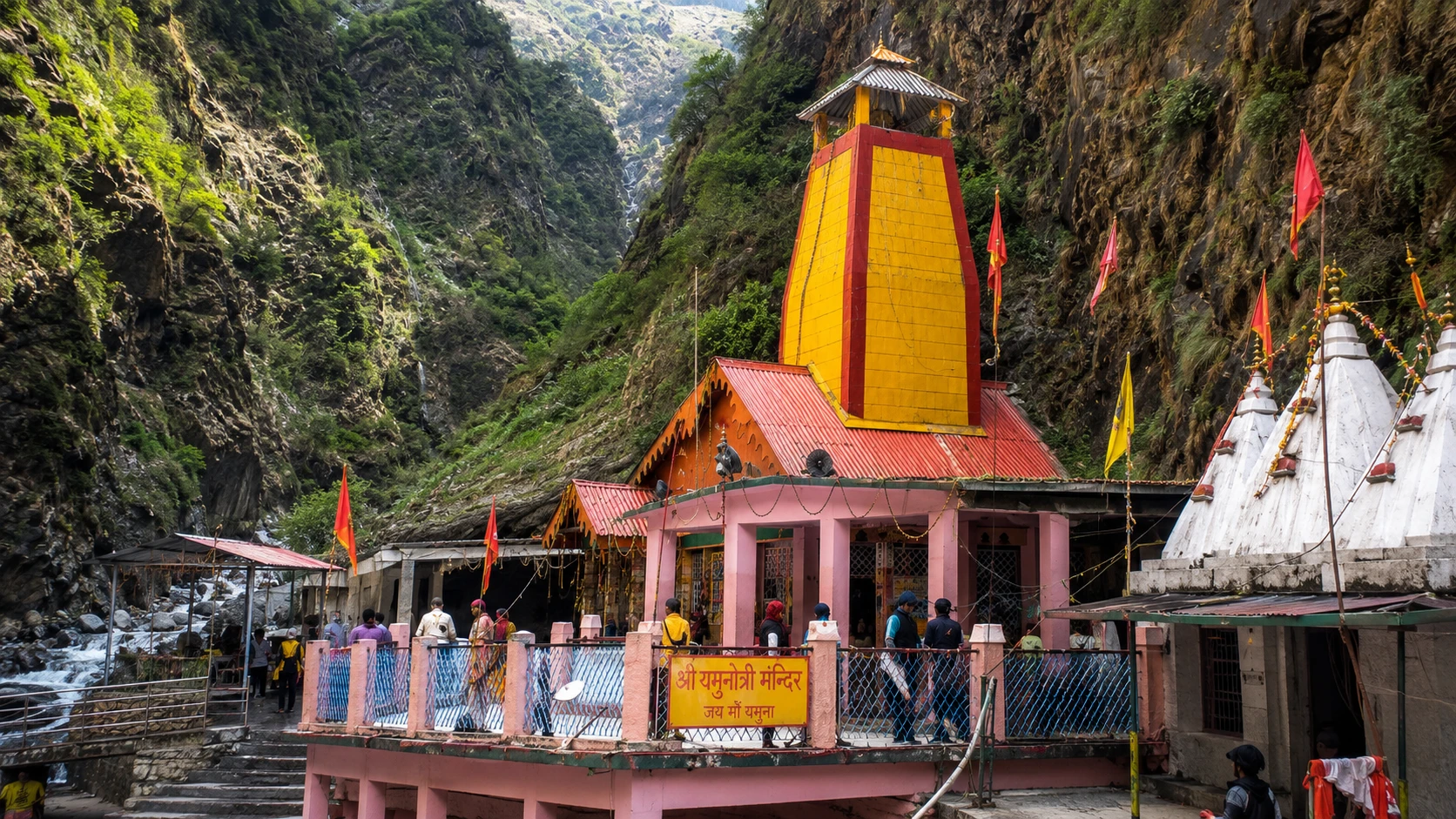
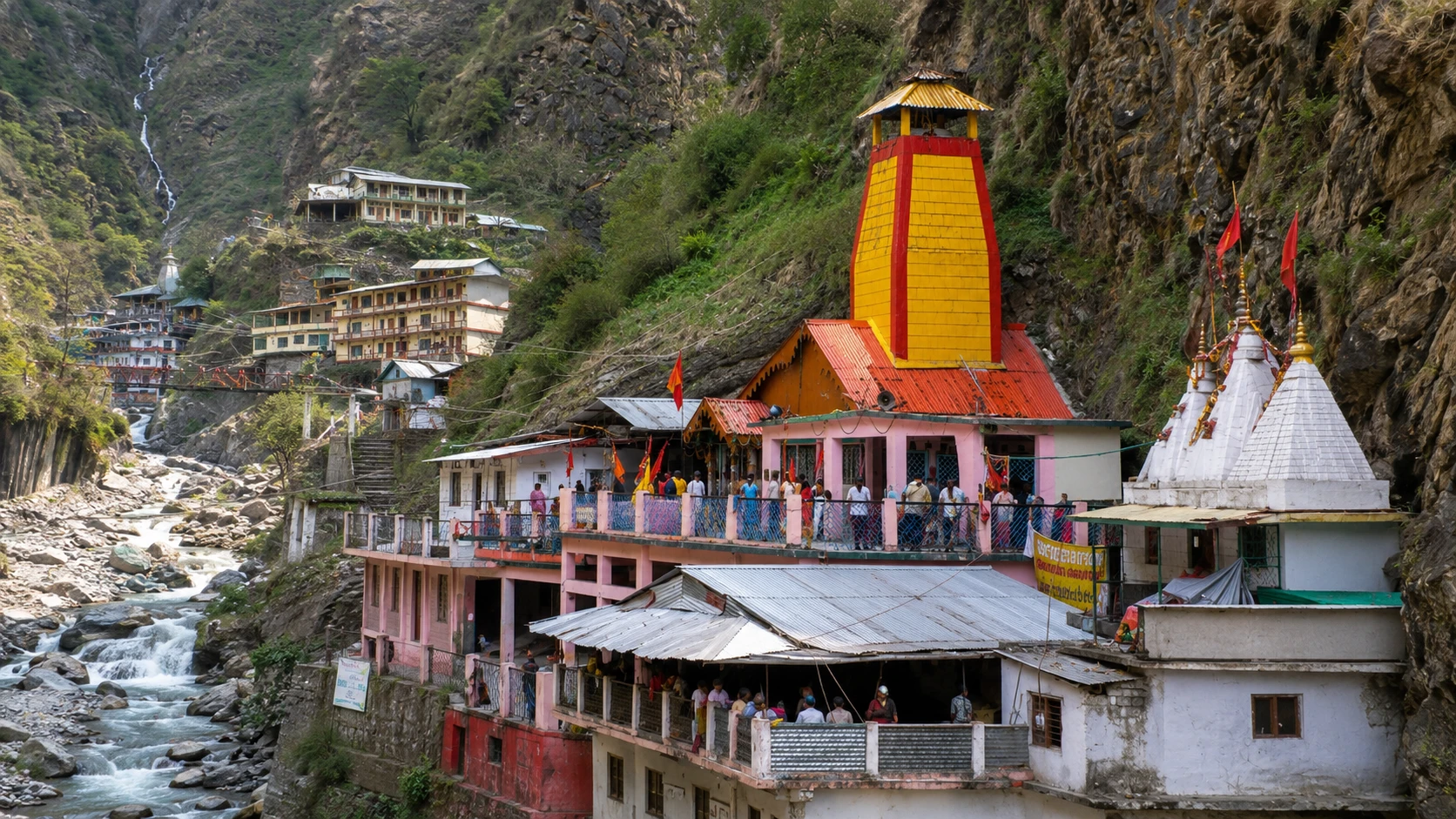
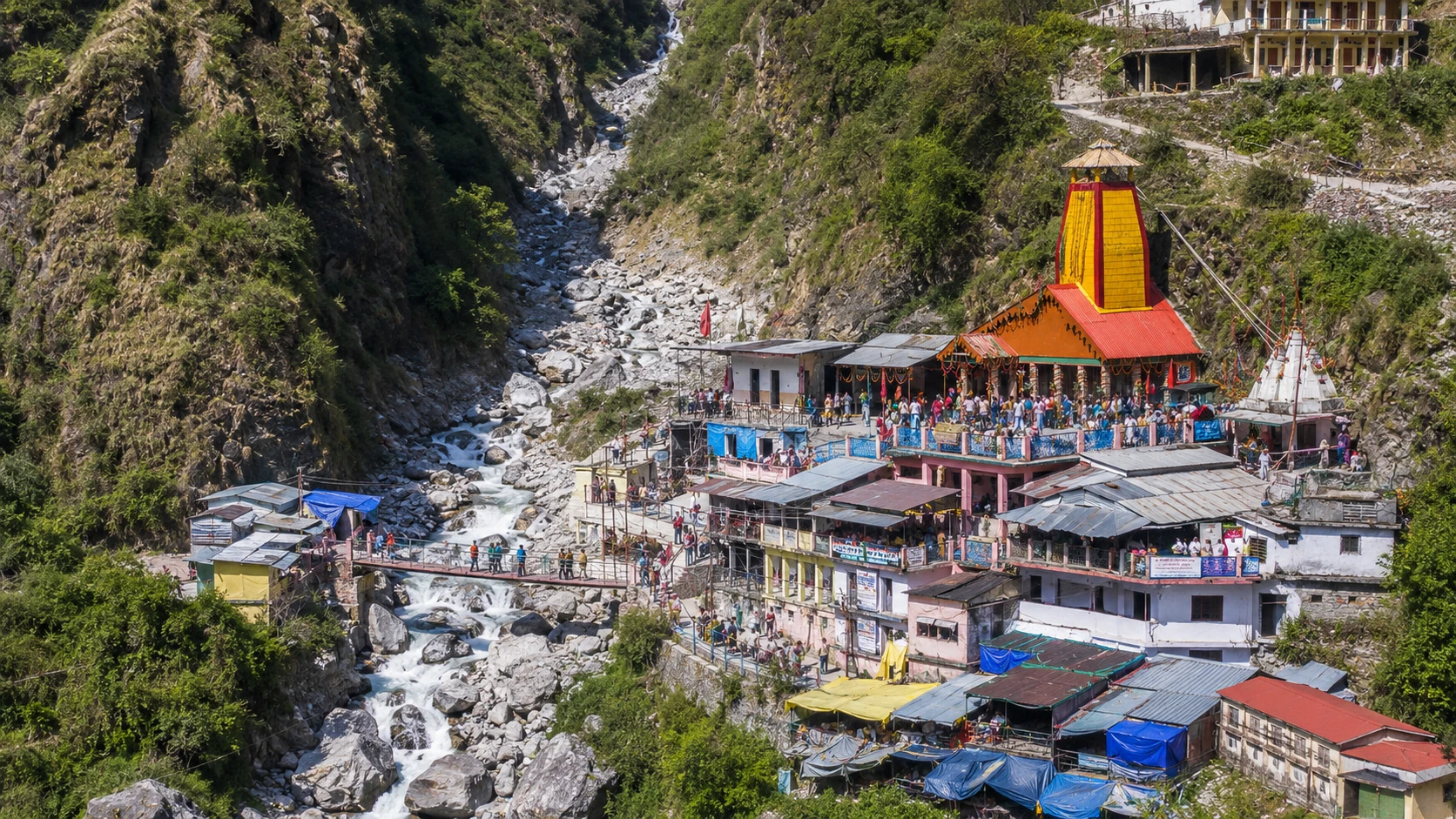
Garhwali Pahari with local stone construction; small, modestly ornamented, scaled to high-altitude conditions and trek-only access, the temple's footprint is among the smallest of any Char Dham shrine, reflecting the geographical and climatic constraints of its site
खुला
Approx. 06:30 (Mangala Aarti onwards) during the open yatra season – Approx. 21:00 (Shayan Aarti); the temple is closed for kapaat-band for six months in winter, opening on Akshay Tritiya (late April / early May) and closing on Yama Dwitiya / Bhai Dooj (the second day after Diwali, October, November); winter worship continues at Kharsali village (a few kilometres below the temple) where the utsava-murti of Yamuna is taken in formal procession
आरती
06:30 Mangala Aarti · 08:00 Snan Aarti at Surya Kund · 12:00 Madhyahna Bhog · 18:30 Sandhya Aarti · 21:00 Shayan Aarti
विशेष
Kapaat opening on Akshay Tritiya (procession from Kharsali bringing the utsava-murti of Yamuna up to Yamunotri, accompanied by traditional Garhwali musicians); Yama Dwitiya / Bhai Dooj, the festival's geographical origin point; Yamuna Jayanti; the kapaat closing ceremony, which uniquely takes place on Yama Dwitiya itself (the same festival that originates here)
पवित्र कथा · पवित्र कथा
Yamunotri is where the Yamuna is worshipped at her source, the daughter of Surya, the twin sister of Yama, the river that will flow the length of north India through Mathura and Vrindavan and Delhi to meet the Ganga at Prayag, here in her newest form, emerging from glacial waters in the Bandarpunch range. The temple at 3,293 metres in the Uttarkashi district of Uttarakhand sits at the western end of the Chota Char Dham of Uttarakhand and is, by canonical pilgrim order, the first stop in the four-temple yatra that closes at Badrinath. Beside the temple, two natural hot springs, Surya Kund, named for the goddess's father, and Gauri Kund, bubble up at temperatures near boiling even at this elevation; pilgrims tie rice in cloth and dip it into Surya Kund, where it cooks within minutes, making Yamunotri the only Char Dham temple where the prasad is prepared by the goddess's own geothermal heat. The shrine itself is small, with a long history of being damaged and rebuilt by the Himalayan elements; the present white-granite structure substantively dates to the early 19th century, attributed in tradition to Maharani Gularia of Jaipur with Tehri Garhwal kingdom patronage. The actual physical source of the Yamuna lies at Saptarishi Kund near Kalindi Parvat, six kilometres upstream and four hundred metres higher than the temple, a difficult trek rarely attempted by pilgrims; the temple at Yamunotri is the goddess's place of public reception, where she is met when she has just begun her flow toward the plains.
Sacred Designationपवित्र पदनाम
Sacred Origin Storyपवित्र उत्पत्ति कथा
Source: Rig Veda (10.10, the Yama-Yami dialogue, the most ancient textual layer); Mahabharata (Vana Parva, Yamuna as sacred river); Vamana Purana; Padma Purana; Skanda Purana (Kedara Khanda); Garuda Purana (Yama tradition); Bhagavata Purana and Brahmavaivarta Purana (Krishna-Yamuna devotional layer), widely-attested across the Vedic corpus, the epics, and the Puranas
In an age before this age, Surya the sun god married Sanjna, daughter of Vishvakarma the celestial architect. Their union produced three children: the firstborn Manu, who would become the progenitor of the present human race, and the twins Yama and Yamuna, the god of dharma who would become lord of death, and the river that would carry his sister-name across the subcontinent.
Yamuna was, from her childhood in Surya's house, the joyful counterweight to her solemn brother. Where Yama grew into the unbending judge of the dead, Yamuna became a goddess whose entire mythology turns on play, on the affection of siblings, on the flow of cool water through summer plains, on the long playful biography she would later witness at Vrindavan when Krishna chose to enact his childhood and youth on her banks.
But the river in Yamuna comes from elsewhere. Some texts hold that she descended like Ganga, by tapasya, by the petitioning of an ancient royal line, and was caught in the Himalayas to be released gently to the plains. Others place her terrestrial origin at Kalindi Parvat, the dark mountain in the Bandarpunch range above what is now Yamunotri, where the Saptarishi, the seven sages of the cosmic tradition, performed a long austerity at a kund that took her name: Saptarishi Kund.
From there she flows down: through the village now called Yamunotri, past Hanuman Chatti and Janki Chatti, down through the foothills, then through Vikasnagar and Yamunanagar and Delhi and Mathura and Vrindavan, where Krishna would meet her, where his leelas would be performed in her sight, where she would become in Vaishnava tradition the river whose every drop holds his presence, and finally to Prayag, where she joins the Ganga in the Triveni Sangam.
The most enduring story told at Yamunotri is the one that gives the temple's autumn closing day its name. After Yamuna had taken her place as a goddess on earth, her twin brother Yama, having become the lord of the dead, was so consumed by his solemn duties that he stopped visiting his family. Years passed.
Yamuna, who lived now as the river herself, sent invitation after invitation: come and visit your sister.
When at last Yama came, on a bright day in the autumn, Yamuna received him with all the ritual joy of a long-awaited brother. She bathed him, dressed him in fresh clothes, applied vermilion tilak on his forehead, fed him a meal prepared with her own hands, and gave him gifts.
Yama was so moved by her hospitality, by the tenderness of a sister who had not forgotten her brother despite his dread occupation, that he offered her a boon.
Yamuna asked: 'Grant that any sister who receives her brother on this day with this same care, and any brother who comes to her and accepts her tilak and her offering, that brother and sister shall be protected. The brother shall not face premature death; the bond of affection between them shall remain undiminished by distance or duty.' Yama agreed.
That day became Yama Dwitiya, the second day of the bright half of Kartika, two days after Diwali. Across the Hindu world it is called Bhai Dooj or Bhau-Beej; sisters perform the rituals Yamuna performed for Yama. But the original meeting, the day Yama came to his sister and she received him, happened, in the geographical imagination of the tradition, here at Yamunotri.
The temple closes for the winter on this day: the goddess receives her brother, fulfils the boon, and then descends to her village seat at Kharsali. Pilgrims who time their visit to Bhai Dooj receive darshan at the source of the festival itself.
उद्धृत स्रोत:
- Rig Veda 10.10, the Yama-Yami dialogue, the most ancient textual layer of the sibling tradition
- Mahabharata, Vana Parva (Yamuna as sacred river)
- Vamana Purana (Yamuna's birth and lineage)
- Padma Purana (Yama-Yamuna sibling stories)
- Skanda Purana, Kedara Khanda (Himalayan pilgrimage geography)
- Garuda Purana (Yama tradition)
- Bhagavata Purana, Skandhas 10, 11 (Krishna's leelas at the Yamuna)
- Brahmavaivarta Purana (Krishna-Yamuna devotional tradition)
विद्वत संदर्भ
Modern scholarship treats Yamunotri as a convergence of three distinct devotional and historical threads. The first is the Vedic-Puranic Yamuna-Yama sibling narrative, traceable to Rig Veda 10.10 and stable across the major Sanskrit textual layers, among the most consistent narratives in the Hindu canon, with the Yama Dwitiya / Bhai Dooj festival origin as its central celebratory expression. The second is the Krishna-Vaishnava devotional layer, particularly developed in the Pushtimarg tradition founded by Vallabhacharya in the 15th, 16th century and in the Gaudiya Vaishnava lineages from Bengal, where Yamuna is held in even higher sanctity than Ganga because of her witness to Krishna's leelas at Mathura and Vrindavan. In this devotional reading, every drop of Yamuna water, including at her glacial source, is held to carry the resonance of Krishna's presence; David Haberman's 'River of Love in an Age of Pollution' (2006) is the principal academic study of this tradition and its contemporary expression. The third thread is the temple's documented architectural history: the present white-granite shrine substantively dates to the early 19th century and is most commonly attributed to Maharani Gularia of Jaipur with Tehri Garhwal kingdom patronage, though some sources credit Tehri Garhwal Maharaja Pratap Shah, and the construction may have been a multi-stage process across patrons. Pre-19th-century shrines at this site are recorded in pilgrim accounts but were repeatedly destroyed by glacial avalanches and seismic events characteristic of the high Bandarpunch range; no pre-19th-century fabric survives. The 1991 Uttarkashi earthquake and the 2013 Uttarakhand floods both caused damage to the Yamunotri yatra route, the access trek from Janki Chatti and the temple precinct itself, though the temple structure was not destroyed. The Yamuna at this point is glacially fed and in volume far smaller than the river that reaches the plains, but the source character is what makes the place sacred: the goddess at her newest, before any of the journey downstream.
Historyइतिहास
Yamunotri's documented history begins with its place in early Sanskrit literature, Rig Veda 10.10's Yama-Yami dialogue establishes the sibling tradition that gives the temple its narrative core, and the Mahabharata, Vamana Purana, and Padma Purana extend the story.
The first phase of institutional consolidation belongs to Adi Shankaracharya's late-8th- or early-9th-century reorganisation of pan-Indian Hindu monastic geography; tradition associates Shankara with restoring formal worship at all four sites that would later constitute the Chota Char Dham of Uttarakhand, and with the establishment of Jyotirmath (Joshimath) as the northern matha that administers the wider Garhwal pilgrimage.
The hereditary Uniyal Brahmin priesthood at Yamunotri is recorded from at least the medieval Garhwali kingdom period.
Through the medieval period, Yamunotri was a high-altitude seasonal pilgrimage site approached on foot from Janki Chatti, where the Tehri Garhwal kingdom held nominal patronage from the 14th century onwards. Permanent stone temple architecture at this elevation was unfeasible given the half-year snowpack and the recurring glacial avalanches that affect the upper Bandarpunch range; the worship took place at small wooden shrines that were repeatedly destroyed and rebuilt.
The present white-granite temple is most commonly attributed to Maharani Gularia of Jaipur in the early 19th century, with Tehri Garhwal kingdom patronage. Some sources credit Tehri Garhwal Maharaja Pratap Shah; both attributions appear in regional historical records, and the construction may have been a multi-patron process.
Subsequent damage from glacial avalanches and the harsh winter has required repeated reconstructions through the 19th and 20th centuries; the present temple's visible fabric is largely a 20th-century reconstruction overlaid on the early-19th-century footprint.
The 20th century brought the gradual development of pilgrim infrastructure on the Dehradun, Uttarkashi, Janki Chatti road, the establishment of the 6 km trek from Janki Chatti to Yamunotri as the standard final-leg pilgrimage, and the introduction of pony, palanquin, and porter services for the climb.
The 1991 Uttarkashi earthquake (M6.8) damaged structures along the entire upper Yamuna and Bhagirathi valleys, including elements of the Yamunotri precinct; reconstruction followed.
Modern administration is vested in the Yamunotri Mandir Samiti under the Government of Uttarakhand's Devasthan framework, with the hereditary Uniyal Brahmin priesthood retaining the daily seva. The 2013 Uttarakhand floods caused significant damage to the Yamunotri yatra route, the road to Janki Chatti, the bridges, and parts of the trek path, leading to several years of reconstruction; the impact was less severe than at Kedarnath but more affecting than at Badrinath or Gangotri.
The Char Dham Pariyojana highway expansion, initiated 2016, continues on the Dehradun, Janki Chatti leg and remains in stages of completion. The Uttarakhand Char Dham Shrine Management Act of 2019 placed Yamunotri (with the other three Chota Char Dham temples) under a centralised Devasthanam Management Board; the Act was repealed in November 2021 after sustained priest-collective protests, restoring traditional administration.
The seasonal closure on Yama Dwitiya / Bhai Dooj, the festival's origin point, is one of the few Hindu temple closing ceremonies that coincides with the festival the temple itself originates.
Historical Timelineऐतिहासिक कालक्रम
References to Yamuna's lineage and the Yamuna-Yama sibling tradition span the Rig Veda (10.10, the Yama-Yami dialogue), the Mahabharata, the Vamana Purana, the Padma Purana, and the Skanda Purana's Kedara Khanda. The pre-medieval form of worship at this Himalayan source is understood by historians as seasonal high-altitude pilgrimage to a sacred geography rather than as continuous shrine activity at this elevation.
The Rig Vedic Yama-Yami dialogue is among the oldest textual layers of the Hindu canon and is widely treated as the foundational reference for the sibling tradition. The Yama Dwitiya / Bhai Dooj festival's geographical attribution to Yamunotri is canonical-traditional and has been continuous in pilgrim practice.
Adi Shankaracharya's reorganisation of pan-Indian Hindu monastic geography brings Yamunotri institutionally within the Vedantic framework. Tradition associates Shankara with restoring formal worship at all four Chota Char Dham sites of Uttarakhand and with the establishment of Jyotirmath (Joshimath) as the northern of his four cardinal mathas. The administrative connection between Yamunotri and the Joshimath matha continues through subsequent centuries.
The dating of Adi Shankara's life remains debated (traditional 788, 820 CE; some modern scholars argue earlier dates). The Chota Char Dham institutional consolidation under Shankara is consistent across hagiographic sources; pre-Shankara worship at this site is well-attested in the Sanskrit literature, but Shankara's specific architectural or institutional intervention at Yamunotri is hagiographic tradition rather than independently documented.
Construction of the present white-granite temple at Yamunotri, most commonly attributed in tradition to Maharani Gularia of Jaipur, with Tehri Garhwal kingdom patronage. Some regional historical sources credit Tehri Garhwal Maharaja Pratap Shah; the construction may have been a multi-stage process across patrons. The small wooden shrine that preceded it on the site, repeatedly destroyed and rebuilt across centuries due to glacial avalanches characteristic of the upper Bandarpunch range, is replaced by a stone structure scaled to the high-altitude environment.
The attribution of the temple's construction is variously recorded in regional Garhwali, Tehri, and Jaipur sources. Maharani Gularia of Jaipur is the most commonly cited patron, but the absence of an inscription on the surviving structure means the construction date and patron(s) are reconstructed from later regional records rather than primary epigraphy. The temple's visible fabric has been substantially replaced by 20th-century reconstructions.
Repeated reconstructions of the Yamunotri temple following damage from glacial avalanches, snow loads, and seismic events characteristic of the upper Bandarpunch range. Pilgrim infrastructure on the Dehradun, Uttarkashi, Janki Chatti road develops gradually; the 6 km trek from Janki Chatti is established as the standard final-leg pilgrimage approach. Pony, palanquin, and porter (pithoo) services for the climb take their present form in the late 19th and early 20th century. The 1991 Uttarkashi earthquake (M6.8, October 1991) damages structures along the entire upper Yamuna valley, including elements of the Yamunotri precinct; reconstruction follows.
The June 2013 Uttarakhand floods cause significant damage to the Yamunotri yatra route, the road to Janki Chatti, the bridges crossing the Yamuna and its tributaries, and parts of the trek path; reconstruction continues through 2014, 2018. The temple itself is not destroyed but the access infrastructure requires multi-year rebuilding. The Char Dham Pariyojana highway expansion (initiated 2016) continues on the Dehradun, Janki Chatti leg. The Uttarakhand Char Dham Shrine Management Act of 2019 places Yamunotri under a centralised Devasthanam Management Board; the Act is repealed in November 2021 after sustained priest-collective protests, restoring traditional administration. The Yamunotri Mandir Samiti, with the hereditary Uniyal Brahmin priesthood, continues the daily seva.
Casualty figures and the specific extent of damage to the Yamunotri yatra route in the 2013 floods derive from Government of India and Government of Uttarakhand reports; independent assessments largely concur. The Devasthanam Board chronology is current to 2021, 2022; subsequent administrative arrangements have continued to evolve and warrant verification at the time of pilgrimage.
What You'll Seeदर्शन में
Inside the small white-granite temple at Yamunotri, the principal murti is a black stone image of Goddess Yamuna seated on her vahana, the kurma, the tortoise, the steady patient creature whose form distinguishes Yamuna iconographically from her sister-river Ganga (whose vahana is the makara).
The murti is roughly half a metre in height, with Yamuna shown in classical Devi iconography: holding a kalasha (water pot) of life-giving water, the other hands in blessing and lotus mudras, with the kurma emerging beneath her seat.
The iconographic choice of the kurma reflects the Vedic-Puranic theological reading of Yamuna as the slower, deeper, more patient sister of the swifter Ganga; where Ganga descends in cataracts and torrents, Yamuna flows in dark, still pools through the plains.
Beside her in the small sanctum stand subsidiary murtis: Yama, her twin brother, in solemn pose; sometimes Surya, her father, and Sanjna, her mother; and a smaller image of the Saptarishi associated with the Saptarishi Kund source upstream.
The deity is dressed in red and gold silks daily, with chunaris offered by pilgrims layered over her body; in winter, the entire image is taken in palanquin to Kharsali village a few kilometres below, where winter worship continues.
But as at Gangotri, the deity at Yamunotri is also present in two other forms beyond the metal murti: in the Yamuna river itself, flowing past the temple; and in Surya Kund, the boiling hot spring at the temple's foot, named for Yamuna's father, a geothermal manifestation that pilgrims use to prepare prasad rice before darshan.
Photography is generally permitted in the temple courtyard and at the kunds; inside the small inner sanctum during aarti and bhog, photography is discouraged, and pilgrims are asked to keep phones pocketed.
Distinctive Practicesविशिष्ट परंपराएँ
Surya Kund rice prasad, cooking by the goddess's geothermal heat
सूर्य कुंड चावल प्रसाद, देवी की भू-तापीय ऊष्मा से पाक
Year-round during the open yatra season; pilgrims typically prepare the rice prasad before their first darshan
The defining practice at Yamunotri is found at the temple's eastern foot, at a hot spring called Surya Kund, named for Yamuna's father, the sun god. The kund's water bubbles up at temperatures near boiling (commonly measured between 88°C and 95°C in the open pool, with the source vent considerably hotter), even at this 3,293-metre elevation. Pilgrims tie raw rice grains in a small cloth bag, typically a length of ordinary cotton mulmul, and lower the bag into the kund on a string. Within five to ten minutes the rice is fully cooked. Some pilgrims add potatoes, lentils, or other simple ingredients in additional cloth bags. The cooked rice is then carried up to the temple, offered to the goddess, and shared as the family's personal prasad, the only major Hindu temple where the prasad is prepared not by trust-employed cooks but by the worshipper themselves, using nothing but the goddess's own thermal water.
The Surya Kund cooking is the most theologically literal of any Char Dham practice. Yamuna is the daughter of Surya; the hot spring at her feet is the warmth of her father reaching her even at this glacial altitude, even into the depths of winter when nothing else here is warm. The pilgrim who cooks rice in this water is not preparing food in the goddess's vicinity, they are receiving food prepared by the goddess herself, through the agency of her father. The do-it-yourself character of the prasad is read as a form of intimate familial reception: Yamuna is treated not as a remote sovereign whose kitchens prepare your meal but as a sister who has shown you the kund and asked you to cook with her.
Six-month seasonal kapaat, opening on Akshay Tritiya, closing on Bhai Dooj
छह माह ऋतुजन्य कपाट, अक्षय तृतीया पर उद्घाटन, भाई दूज पर समापन
Annual: opening on Akshay Tritiya (April, May), closing on Yama Dwitiya / Bhai Dooj (the second day after Diwali, October, November)
The Yamunotri kapaat cycle is structurally similar to its three Chota Char Dham siblings, opens with Akshay Tritiya, closes in the Diwali shoulder. But the closing day is unique: Yamunotri closes precisely on Yama Dwitiya / Bhai Dooj, the second day of the bright half of Kartika, which is the festival the temple itself originates. The procession from Kharsali, the village a few kilometres below where the goddess winters, brings the utsava-murti up to Yamunotri on Akshay Tritiya morning, accompanied by traditional Garhwali musicians; on Bhai Dooj, the procession reverses, and the goddess is escorted back down to Kharsali for the six-month winter residence. The Uniyal Brahmin priests perform the kapaat opening and closing ceremonies; the akhand jyoti is preserved through the closed months at Kharsali.
Yamunotri is the only major Hindu temple whose closing ceremony coincides with the festival the temple's myth originates. On Bhai Dooj, the day Yamuna received her brother Yama in the original story, the goddess fulfils her boon to all sisters across the Hindu world, then descends to her village seat. The closing is a return, to her family, to Kharsali, to the winter intimacy of the smaller community where the Yamunotri season's drama of pilgrim crowds gives way to the quieter daily seva of a village shrine. Pilgrims who time their visit to Bhai Dooj witness both the festival's geographical origin point and the moment the goddess steps off the public stage for the year.
Bhai Dooj at the festival's geographical origin
उत्सव के भौगोलिक उद्गम पर भाई दूज
Yama Dwitiya / Bhai Dooj, the second day of the bright half of Kartika (October, November); the same day as the kapaat closing
Pilgrims who time their visit to Bhai Dooj come to Yamunotri specifically to perform the brother-sister tilak ritual at the place the festival originates. Sisters and brothers travel together in family groups; the sister applies tilak on the brother's forehead at the temple itself or at the edge of Surya Kund, accompanied by the recitation of the goddess's boon. The temple's hereditary Uniyal priests guide the rite for those who request it. The boon Yamuna asked of her brother, protection from premature death, enduring affection across distance, is read as being most directly available at this geographical point, where the original boon was given. The rite is brief but heavily attended on Bhai Dooj day; many sisters travel to Yamunotri for this single observance and return to the plains the same week.
The Bhai Dooj festival is celebrated by hundreds of millions of Hindus across the subcontinent every year, but the geographical origin of the rite is here, at Yamunotri, where Yama came to his sister and accepted her hospitality. Pilgrims who perform the rite at the source treat it as the canonical version of what they have done in their own homes for years: the gesture is the same, but the location adds the resonance of the original event. For sisters whose brothers have died young, or whose brothers live far away, the rite at Yamunotri carries particular weight, the boon was for the long-distance bond and the protection from early death, and pilgrims come to the place where the boon was offered.
Did You Know?क्या आप जानते हैं?
Beside the Yamunotri temple bubbles Surya Kund, a natural hot spring named for Yamuna's father, the sun god, at temperatures near boiling even at 3,293 metres elevation. Pilgrims tie raw rice in a small cloth bag, lower it into the kund on a string, and within five to ten minutes pull it out fully cooked. The rice is then offered to the goddess and shared as the family's personal prasad. Yamunotri is the only major Hindu temple where pilgrims prepare their own prasad in the temple's own thermal water, by the goddess's own geothermal heat.
Yamunotri Mandir Samiti pilgrim guides; Geological Survey of India publications on Garhwal hot springs; pilgrim tradition recorded in Atkinson's 'The Himalayan Gazetteer' (1882)
Yamunotri is the geographical origin point of Bhai Dooj, also called Yama Dwitiya, Bhau-Beej, or Bhratri Dwitiya, the festival celebrated across the Hindu world in which sisters apply tilak on their brothers' foreheads on the second day after Diwali. The ritual originates in the Puranic story of Yamuna receiving her twin brother Yama at this site after long absence, and Yama granting her the boon that any brother accepting his sister's tilak on this day shall be protected from premature death. Pilgrims who time their visit to Bhai Dooj come to Yamunotri specifically to perform the rite at its source, and the temple closes for the winter on this same day, the festival of its own myth.
Padma Purana; Garuda Purana; Vamana Purana; Rig Veda 10.10 (Yama-Yami dialogue, the most ancient layer); Diana L. Eck, 'India: A Sacred Geography' (2012)
Yamunotri is the only Char Dham temple that cannot be reached by motor vehicle; the road ends at Janki Chatti, six kilometres below the temple, and the final climb must be completed on foot. Pilgrims who cannot walk the trek may hire a pony, a kandi (a four-person palanquin carried by porters), or a pithoo (a porter who carries children or small adults in a back-mounted seat). The trek climbs about 200 metres in elevation along a paved path beside the Yamuna's upper reaches and is among the most physically demanding final approaches in the Char Dham circuit. Pilgrim flow is heavy through the open season; pony and palanquin queues at Janki Chatti commonly extend to several hours during peak weeks.
Yamunotri Mandir Samiti pilgrim communications; Government of Uttarakhand Tourism Department publications; pilgrim accounts across the modern era
The actual physical source of the Yamuna lies six kilometres above the Yamunotri temple at Saptarishi Kund, near Kalindi Parvat in the Bandarpunch range, at over 4,400 metres elevation. The trek to Saptarishi Kund is technically demanding, a steep climb above the temple, often through residual snow even in summer, and is rarely attempted by general pilgrims; it is undertaken mostly by serious trekkers and ascetics. The kund itself is held in tradition as the spot where the Saptarishis (the seven cosmic sages) performed an extended tapasya, and where the river takes her name from their austerity. The temple at Yamunotri is the goddess's place of public reception; the source above remains, by the difficulty of access, a site of continuing privacy.
Survey of India topographic sheets; Garhwal pilgrimage gazetteers; Geological Survey of India high-altitude survey reports
The mountain range above Yamunotri, Bandarpunch, takes its name (literally 'monkey's tail') from a folk tradition that Hanuman, after burning Lanka with his fire-tipped tail, came here to extinguish it in the snow. The range is the second-highest in the western Garhwal Himalayas, with Bandarpunch I (6,316 m) and Bandarpunch II (6,102 m) as its principal peaks. The Yamunotri temple sits on the southern flank of the range; the Yamuna emerges from glaciers fed by the Bandarpunch system. The folk story situates Hanuman's tail-fire extinction in the same icy geography that produces the goddess Yamuna, a small piece of Ramayana mythology overlaid on a Yamuna site, characteristic of the way Garhwal pilgrim geography weaves multiple narrative traditions into single landscapes.
Garhwal folk tradition recorded in regional sthala-puranas; Survey of India Bandarpunch range topography; Atkinson, 'The Himalayan Gazetteer' (1882)
Visitor Accessप्रवेश जानकारी
Yamunotri's principal access constraint is the 6 km trek from Janki Chatti, the road terminus, to the temple. The climb gains about 200 metres in elevation along a paved path beside the upper Yamuna and takes most pilgrims 2, 4 hours one way; pony, kandi (palanquin), and pithoo (porter-back seat) services are available at Janki Chatti for those unable to walk. At 3,293 metres, altitude sickness (acute mountain sickness, AMS) is a real risk for elderly pilgrims, those with cardiovascular conditions, pregnant women, and anyone arriving rapidly from the plains; pilgrims are advised to break the journey at Barkot (~1,300 m) or Hanuman Chatti (~2,400 m) before the final push. The state government mandates yatra registration through the official Tourist Care Uttarakhand portal before pilgrims may begin the road climb; daily caps may apply at peak season. The temple is closed for six months each winter (kapaat-band, opening Akshay Tritiya and closing Bhai Dooj), outside the open season the road above Hanuman Chatti is largely closed and the temple precinct is buried in snow. Photography is generally permitted in the temple courtyard and at the kunds; the small inner sanctum is more conservative during aartis. Mobile signal at Yamunotri is limited; ATMs are scarce and pilgrims should carry sufficient cash. Surya Kund's water is near boiling, pilgrims should approach with caution, particularly with children, and use the designated rice-cooking points with attendant supervision.
आध्यात्मिक आधार
The seasonal closure on Bhai Dooj is the only Char Dham closing that coincides with the festival the temple originates, the goddess fulfils her boon to all sisters and brothers of the world, then descends to her family at Kharsali. The 6 km trek is by tradition part of the pilgrim's offering: Yamunotri is the easternmost-westernmost outlier of the Chota Char Dham, the climb is the only one of the four that cannot be skipped by helicopter alone, and the physical effort is read in pilgrim tradition as the worshipper's own gesture toward the goddess. Pilgrims who arrive at Yamunotri having walked the climb are held to have approached more directly than those who arrive at the other dhams by motor vehicle.
Festivalsत्योहार
Akshay Tritiya / Kapaat Opening
अक्षय तृतीया / कपाट उद्घाटन
April, May (Vaishakha Shukla Tritiya; exact date announced annually by the Yamunotri Mandir Samiti)
The day the doors of Yamunotri open after six months of winter closure. The procession from Kharsali village carrying the utsava-murti of Yamuna, accompanied by traditional Garhwali musicians and the local community, climbs to the temple on the morning of opening; the Uniyal priests perform the first puja, the akhand jyoti is rekindled, and the yatra season begins. The same day marks the kapaat opening at Gangotri (the other Chota Char Dham western pair), making Akshay Tritiya the institutional start of the Uttarakhand Char Dham yatra season. Pilgrims who time their visit to opening day are typically the first of the year to perform the rice-cooking prasad at Surya Kund.
Yamuna Jayanti / Yamuna Chhath
यमुना जयंती / यमुना छठ
March, April (Chaitra Shukla Shashthi)
The goddess's own birthday, observed across the Vaishnava devotional world but with particular intensity at Yamunotri. The festival commemorates Yamuna's birth from Surya and Sanjna and is celebrated with abhishek of the murti, special floral offerings of yellow and red, recitation of the Yamuna Stotra, and the offering of bhog including milk-based sweets. At Yamunotri the festival typically falls before the kapaat opening (since the temple is still closed in March, April), so the principal celebration is at Kharsali, where the goddess winters, and at downstream Yamuna sites. Vaishnava pilgrims, particularly Pushtimarg followers, time visits to Mathura and Vrindavan to coincide with this date.
Yamuna Saptami
यमुना सप्तमी
April, May (Vaishakha Shukla Saptami)
The day Yamuna is held in tradition to have first appeared on earth, paired in observation with Ganga Saptami. The festival typically falls just after the kapaat opening, making it one of the early-season highlights at Yamunotri. Special abhishek of the murti, riverside aarti at the Yamuna's edge below the temple, and a community feast for pilgrims and the local Kharsali community. The recitation of the Yamuna Sahasranama on this day is among the most spiritually weighted observances of the season.
Yama Dwitiya / Bhai Dooj, Kapaat Closing
यम द्वितीया / भाई दूज, कपाट समापन
October, November (Kartika Shukla Dwitiya, the second day after Diwali)
The closing ceremony, the inverse of the Akshay Tritiya opening, and the festival the temple itself originates. Yama, in the Puranic story, came to his sister Yamuna at this site on this day; the festival of Bhai Dooj observed across the Hindu world begins here. Pilgrims who time their visit witness the festival at its geographical source: sisters apply tilak on their brothers' foreheads at the temple itself or at the edge of Surya Kund. The Uniyal priests perform the final pujas; the utsava-murti of Yamuna is placed in the palanquin and carried in procession down to Kharsali, where she will reside through the winter. The akhand jyoti is preserved through the closed months at the Kharsali shrine. Yamunotri is the only Char Dham temple whose closing ceremony coincides with the festival of its own myth, a structural elegance that has become the temple's most-noted poetic detail.
Traditional Offeringsपारंपरिक अर्पण
प्राथमिक अर्पण
Surya Kund Rice Prasad, cooked by the goddess's geothermal heat
सूर्य कुंड चावल प्रसाद, देवी की भू-तापीय ऊष्मा से पका
तप्तकुण्डान्न-प्रसाद
Pilgrims tie raw rice in cotton bags and lower them into the boiling Surya Kund, where the rice cooks in five to ten minutes by the spring's geothermal heat. The cooked rice is offered to the goddess and shared as the family's personal prasad. This is the most distinctive offering at Yamunotri and the only Char Dham temple where pilgrims prepare prasad in the temple's own thermal water by the goddess's own heat. Many pilgrims carry portions of the cooked rice home for distribution to family who could not make the pilgrimage.
Yamuna-jal, taking the river herself home
यमुना-जल, स्वयं नदी को घर ले जाना
यमुनाजल
Like its sister-tradition at Gangotri, the act of taking is a central offering. Pilgrims fill copper or brass containers with Yamuna-jal directly from the river at the temple's foot, the goddess's newest, glacier-fed water before any of the journey downstream. The water is taken home for use in domestic puja, in religious rites, and in some Vaishnava households for daily Krishna worship (where Yamuna-jal is held to carry Krishna's leela-resonance). Sealed bottles are also available at the trust counter.
Chunari and Vastra (red-and-yellow Devi-iconographic offerings)
चुनरी और वस्त्र (लाल-और-पीले देवी-प्रतिमा-विज्ञानिक अर्पण)
Red and yellow are Yamuna's iconographic colours, yellow for her father Surya, red for the standard Devi palette. Chunaris (long stoles) and sari-lengths in this combination are offered to the goddess by pilgrims and used by the priests to dress the murti. Sponsoring a chunari for a specific aarti is a common seva.
Sindur, Haldi, and Tilak items
सिंदूर, हल्दी, और तिलक सामग्री
The standard Devi offerings of sindur (vermilion) and haldi (turmeric) are applied to the goddess's forehead and feet during the daily seva. At Yamunotri, the sindur and tilak items take additional weight on Bhai Dooj day, when sisters use the same materials to apply tilak on their brothers' foreheads at the temple, replicating, at the festival's source, the gesture Yamuna performed for Yama. Pilgrims may take home consecrated tilak materials from the trust counter.
Coconut, fruit, and milk-based sweets
नारियल, फल, और दूध-आधारित मिठाइयाँ
Standard Hindu puja items, whole coconuts, seasonal fruits, and traditional milk-based sweets including pedhas, peda, and barfi, are offered at the temple counter and incorporated into the daily bhog. Yamuna's Krishna-tradition associations make milk-based sweets particularly suitable; the sweet bhog distributed afterward is among the most-sought take-homes.
इस मंदिर की विशेषता
Yamuna Puja Sponsorship at Surya Kund
सूर्य कुंड पर यमुना पूजा प्रायोजन
Pilgrims may sponsor a special Yamuna puja performed by the Uniyal priests at the Surya Kund, the riverside aarti combined with abhishek of the goddess and individual rice-prasad preparation in the kund for the sponsoring family. Arrangements are made through the temple office; the rite is brief but carries the temple's distinctive Surya-Kund-and-Yamuna combination.
Bhai Dooj Sponsorship, sister-and-brother rite at the festival's source
भाई दूज प्रायोजन, उत्सव के उद्गम पर बहिन-और-भ्राता अनुष्ठान
On Yama Dwitiya / Bhai Dooj, sisters and brothers may sponsor a formal performance of the tilak rite at the temple itself or at the edge of Surya Kund, with the Uniyal priests reciting the goddess's boon and providing the consecrated tilak materials. The sponsoring siblings receive certificates and a portion of the day's bhog. Slots are limited on Bhai Dooj day given the closing-day pilgrim density and should be booked well in advance.
Akhand Jyoti Sponsorship
अखंड ज्योति प्रायोजन
Sponsorship of a portion of the akhand jyoti, the continuous flame inside the sanctum during the open season, traditionally said to be preserved through the closed months at the Kharsali shrine. Sponsorship covers the ghee for one day, one week, or one full open season; certificates are issued.
Pilgrims may bring chunaris, fruit, mishri, sindur, ghee, and rice for the Surya Kund cooking from outside; in practice most purchase trust-vetted offering packets at the BKTC-style counter near the temple entrance, including pre-measured rice in cotton bags ready for the kund. Bhai Dooj sponsorships should be booked through the Yamunotri Mandir Samiti office at Janki Chatti (in person during the open season); on-the-day availability for Bhai Dooj specifically is rare given the closing-day pilgrim density. The principal take-home from Yamunotri is the Surya Kund rice-prasad and Yamuna-jal, the rice should be eaten or distributed within a few days of cooking; the jal keeps for years.
How to Reachकैसे पहुँचें
Yamunotri sits in Uttarkashi district, Uttarakhand, in the Garhwal Himalayas. The temple is reachable only on foot from Janki Chatti (the road terminus, 6 km below); there is no road, rail line, or airport at the temple itself. Most pilgrims approach via Dehradun as the staging hub.
By rail: The nearest railway stations are Dehradun (~175 km, ~6, 7 hours by mountain road), Rishikesh (~220 km, ~7, 8 hours), and Haridwar Junction (~245 km, ~8, 9 hours). Dehradun is the most efficient railhead for Yamunotri; it has direct connections from Delhi, Mumbai, Lucknow, and other major North Indian cities.
Onward travel from Dehradun is by shared taxi, private taxi, or Uttarakhand Transport Corporation buses; the road climbs through Mussoorie (about 35 km from Dehradun), Barkot (about 90 km, the standard halt before the climb), Hanuman Chatti, and on to Janki Chatti, the road's end.
By road: NH-507 from Dehradun to Janki Chatti is the main road artery. The road is fully tarmac in dry conditions but is subject to landslides during and after the monsoon (July, September). Most pilgrims break the journey at Barkot for one night before the final climb. The state government regulates traffic flow on the upper road during the yatra season.
Final approach (Janki Chatti to Yamunotri, 6 km, on foot or by pony/palanquin): The trek climbs about 200 metres in elevation along a paved path beside the Yamuna's upper reaches. Pony hire, kandi (4-person palanquin), and pithoo (porter-back seat for children or small adults) services are available at Janki Chatti, regulated by local cooperatives; rates and queues vary with season and pilgrim flow.
The trek takes 2, 4 hours one way for most pilgrims; pony rides cover the same path more quickly.
By air: The nearest airport is Jolly Grant near Dehradun (~165 km, ~6 hours by road), Yamunotri is the closest of the four Chota Char Dham to Dehradun. Seasonal helicopter services operating under DGCA permission run from Sahastradhara Helipad in Dehradun to Kharsali (a few kilometres below the temple), with onward road connection to Janki Chatti and the trek thereafter.
Operators rotate annually; booking is through the official Uttarakhand state portal.
Yatra registration: All pilgrims to any Uttarakhand Char Dham must register through the state's official Tourist Care Uttarakhand portal (registrationandtouristcare.uk.gov.in) before travel; identity verification takes place at registration counters in Haridwar, Rishikesh, and Dehradun before pilgrims are permitted onto the upper road.
Daily pilgrim caps may apply during peak season.
From Delhi: The total Delhi-to-Yamunotri drive (~410 km via NH-334 / NH-7 / NH-507) is typically broken across two days, with overnight halts at Dehradun and Barkot.
Plan Your Visitयात्रा की योजना
🌤 सर्वोत्तम मौसम
The kapaat-open window, Akshay Tritiya through Yama Dwitiya / Bhai Dooj (late April / early May to October, November), defines the entire visiting season; outside this window the temple is closed and the road above Hanuman Chatti is largely shut. Within the open season, May to early June and mid-September to mid-October are the most settled periods. July and August see the south-west monsoon, landslides and road closures are common, the trek path can become treacherous, and pilgrim numbers thin out. Mid-June is one of the busiest weeks (school holidays, Char Dham peak season). November onward is too cold for general pilgrimage; pilgrims who time their visit to Bhai Dooj for the kapaat closing should plan for icy conditions on the trek and night temperatures below zero. Pilgrims with health concerns should avoid the highest-altitude, lowest-temperature shoulders of the season.
👘 पहनावे का नियम
Modest dress is expected, but the binding constraints are the cold and the trek. Even during summer, daytime temperatures at Yamunotri rarely exceed 18°C and night temperatures fall to 4, 10°C; the trek path is colder still, particularly in the morning and evening. Layered woollens and a windproof outer shell are essential year-round; rainwear during monsoon. For the trek, sturdy walking shoes with good grip are critical, leather hiking boots or well-fitted sports shoes; flip-flops, slippers, and dressy shoes are unsafe on the gravel-and-stone path. Inside the sanctum the standard temple modesty applies, full-length trousers or salwar/saree, covered shoulders. For pilgrims using Surya Kund for the rice-cooking practice, additional clothing for changes is useful (clothes can get spattered with hot water). Footwear is removed at the outer step.
📱 फोन और फोटोग्राफी
Mobile photography is permitted in the temple's outer courtyard, on the trek path, and at Surya Kund and Gauri Kund. Inside the small inner sanctum during aarti and bhog, photography is discouraged; the priests will ask pilgrims to keep phones pocketed during darshan. The trust asks for silenced phones during all aartis. Mobile signal at Yamunotri is limited; BSNL has the strongest coverage at altitude, and even on supported networks data is intermittent, pilgrims should not rely on real-time connectivity for navigation, payments, or emergency contact. The yatra registration card and the Janki Chatti pony/palanquin booking voucher should be carried as physical printouts.
🏨 आवास
Garhwal Mandal Vikas Nigam (GMVN), the state tourism corporation, runs Tourist Rest Houses (TRHs) at Janki Chatti, Hanuman Chatti, and Barkot, the standard halts on the Yamunotri yatra route; GMVN bookings are made through their official portal. A range of private hotels, ashrams, and dharamshalas operate during the open season at all three halts; capacity at Janki Chatti is more limited than at Barkot. There is essentially no commercial accommodation at Yamunotri itself (only a handful of small dharamshalas serving pilgrims who choose to stay overnight at the temple precinct, with very basic amenities); most pilgrims base at Janki Chatti or Barkot and visit Yamunotri as a day trip from the closer base. During festival peaks (Akshay Tritiya, Bhai Dooj), advance booking by several weeks is essential. Pilgrims combining Yamunotri with Gangotri typically allow at least one extra day for the cross-route drive (Janki Chatti to Gangotri is approximately 220 km via Uttarkashi and takes 8, 9 hours).
Book a Pujaपूजा बुक करें
The Yamunotri Mandir Samiti does not currently operate a single canonical online portal for seva booking; pilgrims should be cautious of websites and intermediaries claiming to offer Yamunotri-specific bookings online. Multiple fraudulent websites mimic Char Dham branding and accept payments for sevas they cannot deliver, the Government of Uttarakhand has issued repeated public advisories warning against these. The only verified online process for any Uttarakhand Char Dham pilgrimage is yatra registration on the official state portal at registrationandtouristcare.uk.gov.in. Do not pay any fee for a Char Dham yatra registration that claims to be 'expedited' or 'guaranteed' through a third party. Helicopter ticketing for the Sahastradhara, Kharsali sector is operated through the state portal only; rotating private operators publish availability there each season. Pony, kandi, and pithoo services at Janki Chatti are operated through local cooperatives at administration-regulated rates, pilgrims should pay only at the official counter and never to unaccredited touts on the path. Bhai Dooj sponsorships are heavily oversubscribed on the closing day given the festival-origin significance; only temple-recognised purohits should be engaged for the rite at the temple. Phone numbers and email contacts for the Yamunotri Mandir Samiti are not currently published in a single canonical place; pilgrims should plan to arrive at Janki Chatti a day in advance to arrange specific sevas in person.
Managed by: Yamunotri Mandir Samiti (Yamunotri Temple Committee), under the Government of Uttarakhand Devasthan framework; the hereditary Uniyal Brahmin priesthood retains the daily seva
Yamuna Aarti participation (riverside Snan Aarti)
यमुना आरती सहभागिता (नदी-तट स्नान आरती)
Mahabhishek Puja
महा अभिषेक पूजा
Surya Kund rice prasad puja (with Uniyal priest guidance)
सूर्य कुंड चावल प्रसाद पूजा (उनियाल पुजारी मार्गदर्शन के साथ)
Bhai Dooj Sponsorship, sister-and-brother rite at the festival's source
भाई दूज प्रायोजन, उत्सव के उद्गम पर बहिन-और-भ्राता अनुष्ठान
Akhand Jyoti Sponsorship (one-day, weekly, or full season)
अखंड ज्योति प्रायोजन (एक-दिवसीय, साप्ताहिक, या पूर्ण सीज़न)
Kapaat Opening / Closing Procession participation (Akshay Tritiya / Bhai Dooj)
कपाट उद्घाटन / समापन यात्रा सहभागिता (अक्षय तृतीया / भाई दूज)
Booking information verified: 2026-05-07
Sacred Soundsपवित्र ध्वनि
क्या आप जानते हैं? · Did You Know?
वही अनुवाद त्रुटि जिसने हिन्दू धर्म में '33 कोटि' को '33 करोड़' बनाया, बौद्ध धर्म में भी हुई। बौद्ध ग्रन्थों के चीनी अनुवाद ने 'सप्त कोटि बुद्ध' (7 श्रेष्ठ बुद्ध) का अनुवाद '7 करोड़ बुद्ध' कर दिया। तिब्बती अनुवाद ने सही किया: 7 प्रकार, 7 करोड़ नहीं। एक संस्कृत शब्द, दो प्रमुख विश्व धर्मों में गलत पढ़ा गया, ने दो एकसमान भ्रम स्वतन्त्र रूप से उत्पन्न किए।
Related Contentसंबंधित सामग्री
Related Scriptures
Community Reflections
🕉️
Be the first to share your reflection.