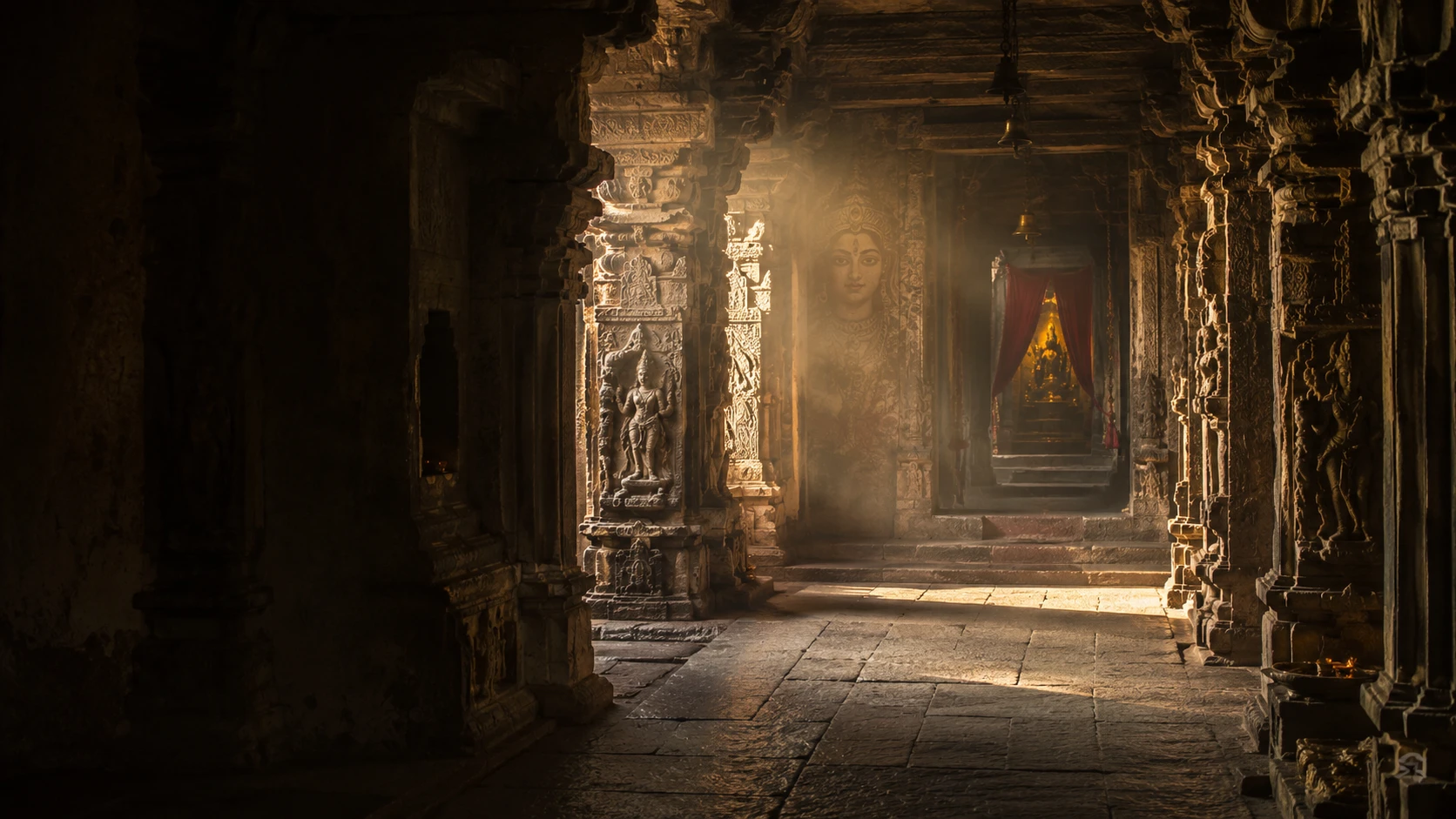
Every temple guidebook will tell you the year of construction, the dynasty that built it, and the deity inside. Very few will tell you why the sanctum at Chidambaram is empty, why the goddess at Kamakhya bleeds, or what sits behind the sealed vault at Padmanabhaswamy. The stories that matter most in Indian temples are the ones the plaques leave out.
At Chidambaram, in Tamil Nadu, the Nataraja temple draws visitors for its bronze of Shiva dancing the cosmic dance. The bronze is famous. Postcards carry it. Coffee-table books reproduce it. But the real secret of Chidambaram is not the bronze. It is what sits behind it. The innermost sanctum of the temple contains the *Chidambara Rahasyam*, the "secret of Chidambaram." During the daily abhishekam, when the priests pull back the curtain behind the Nataraja, there is nothing there. No idol. No linga. A few dried bilva leaves hang from gold chains against an empty wall. The space itself is the deity. The tradition calls this the *Akasha Linga*, the linga of space, and it represents the fifth element: ether, the formless substratum of all form. The temple's theology is built on this absence. Shiva is worshipped here not as a shape but as the space that makes all shapes possible. Most visitors see the bronze, photograph it, and leave without ever learning what the curtain conceals.
In Guwahati, Assam, the Kamakhya temple sits on Nilachal Hill overlooking the Brahmaputra. Guidebooks describe it as one of the fifty-one Shakti Peethas, the sites where parts of Sati's body fell after Vishnu's Sudarshana Chakra dismembered her corpse. Kamakhya marks the spot where her yoni, the creative organ, fell. There is no idol inside the temple. The sanctum contains a natural rock fissure in the shape of a yoni, kept moist by an underground spring. Every June, during the Ambubachi Mela, the spring water turns red. The temple closes for three days. When it reopens, devotees receive pieces of red cloth as prasad. The tradition holds that the Goddess menstruates during this period. The festival draws hundreds of thousands of visitors and is one of the few religious observances anywhere in the world that centres a menstrual cycle as sacred rather than polluting. Most guidebooks mention Ambubachi in a single line. They do not explain what it means for a tradition often accused of treating menstruation as impure to have a major temple that does the opposite.
Thiruvananthapuram's Padmanabhaswamy temple became international news in 2011 when a Supreme Court-appointed panel opened six vaults beneath the temple and found a treasure valued at over one lakh crore rupees: gold coins from the Roman trade era, Napoleonic-era diamonds, gold chains eighteen feet long, and ceremonial objects studded with rubies and emeralds. Five vaults were opened. The sixth, labelled Vault B, was not. The heavy iron door bears the image of a serpent, and local tradition holds that opening it would bring catastrophe. The Supreme Court ordered it left sealed. The treasure is not the story. The story is how it got there. For centuries, the Travancore royal family, the temple's custodians, donated a portion of state revenues to the deity. The deity, Padmanabha (Vishnu reclining on the serpent Ananta), was the legal sovereign of Travancore. The king ruled as the deity's servant, signing documents as "Padmanabha Dasa." The treasure is not a hoard. It is the accumulated offering of a kingdom that considered its god the actual king.
At Lepakshi, in Andhra Pradesh, a sixteenth-century Virabhadra temple holds a pillar that does not touch the ground. The temple has seventy pillars. Sixty-nine rest on the floor. One hangs from the ceiling, with a visible gap between its base and the stone below. Visitors pass thin sheets of paper or cloth under the pillar to confirm the gap is real. British engineers in the colonial period tried to dislodge the pillar to study its mechanism and reportedly shifted it slightly off-centre, where it remains today. The local explanation is that the temple's architect, Virupanna, built it as a demonstration of skill. The engineering explanation is that the pillar is a cantilever, held in tension by the ceiling structure above it. Both explanations coexist. Neither fully satisfies. The pillar has become a test case for how people relate to architectural anomalies in sacred spaces: do you see a miracle, or do you see a solution to a structural problem that we have lost the documentation for? The temple does not ask you to choose. It lets the pillar hang.
Thanjavur's Brihadeshwara temple, built by Rajaraja Chola I in 1010 CE, is an engineering statement disguised as a prayer. The vimana (temple tower) rises sixty-six metres, making it one of the tallest temple structures built in India before the modern era. At the summit sits a single granite capstone weighing an estimated eighty tonnes. How it got there is a question that has occupied engineers for a century. The prevailing theory is that builders constructed a ramp of earth four miles long, with a gentle enough gradient to drag the stone to the top. After placing the capstone, they removed the ramp. No crane, no pulley system, no technology beyond inclined planes and human labour. The temple carries another detail that guides often skip. At noon on equinox days, the vimana casts no shadow on the ground. The tower's proportions are calculated so that at the equinox solar angle, the shadow falls entirely on the tower's own base. Whether this was intentional or a consequence of the proportional ratios used in Chola temple architecture is debated. The effect is observable.
What these stories share is a quality that guidebooks cannot contain: they ask a question and refuse to close it. Chidambaram asks what it means to worship emptiness. Kamakhya asks what it means to call a bodily function sacred. Padmanabhaswamy asks what it means for a deity to own property. Lepakshi asks what it means when the explanation and the experience do not match. Brihadeshwara asks what it means to solve an engineering problem so well that the solution looks like something other than engineering. None of these questions have clean answers. That is why the temples still draw people. A building with all its questions answered is a museum. A building with questions still open is a temple.
The next time you visit a temple, walk past the main sanctum. Find the oldest priest or the temple's sthapati (architect-priest, if the temple still has one). Ask a question the plaque does not answer: why is this pillar different from the others? Why does this ritual happen at this hour and not another? Why is this deity facing west when most face east? The answers live in oral tradition, in the memories of families who have served a temple for eight or twelve generations. These stories are not written in any book. They are passed from priest to priest, father to son, and they are disappearing faster than the temples themselves. Every temple visit is a chance to catch one before it goes.
Explore Temple Stories on Eternal Raga
Detailed profiles of temples across India with the stories, architecture, and traditions that guidebooks miss. Start with the five temples from this post.
Explore on Eternal RagaTags
Community Reflections
🕉️
Be the first to share your reflection.