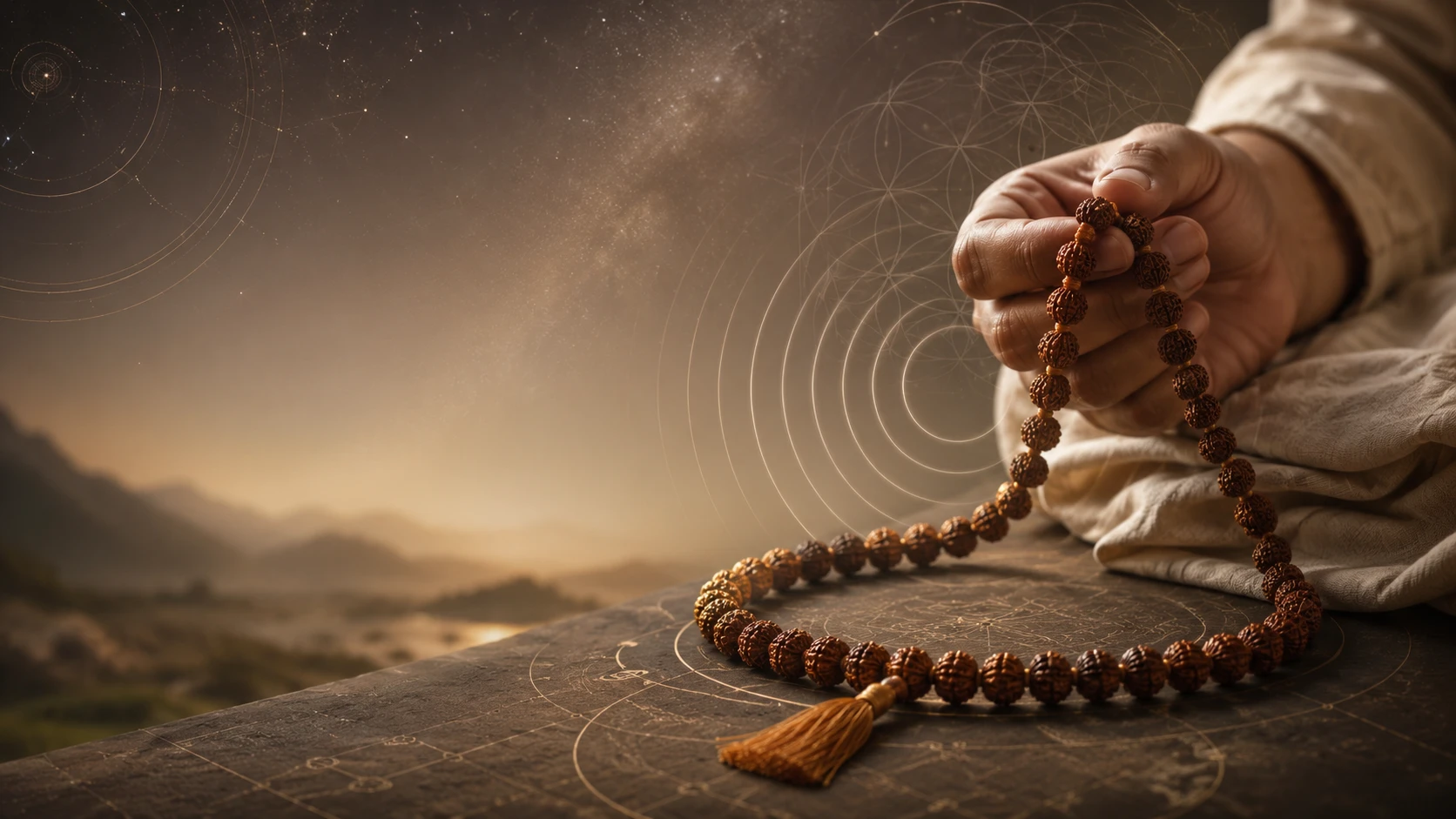
Ask anyone who chants why they repeat a mantra 108 times and you will get one of two answers: because that is what my grandmother did, or because 108 is a sacred number. Both are true. Neither is complete. The number 108 sits at the intersection of mathematics, astronomy, physiology, and a very old tradition of counting what the mind does when it repeats the same sound over and over.
Sit with a mala and count. One bead, one repetition. By the twentieth bead, you are still thinking about the words. By the fiftieth, the words start saying themselves. Somewhere around the seventieth or eightieth, the gap between one repetition and the next disappears. The mantra stops being something you are doing and becomes something that is happening. By the time you reach the sumeru, the 109th bead where you stop and do not cross, your breathing has changed. Your voice has dropped. The speed has settled into a rhythm your body picked, not your mind. This is not mysticism. It is what happens when any human being repeats a short phrase for twelve to fifteen minutes without interruption. The tradition observed this and built a practice around it. The number it chose was 108.
The mathematics of 108 attracted Indian thinkers long before anyone attached it to a mala. The number is the product of 1 raised to the first power, 2 raised to the second power, and 3 raised to the third power: 1 × 4 × 27 = 108. It divides evenly by 2, 3, 4, 6, 9, 12, 18, 27, 36, and 54, making it one of the most divisible numbers under 120. In Vedic astronomy, the distance between the earth and the sun is roughly 108 times the sun's diameter. The distance between the earth and the moon is roughly 108 times the moon's diameter. These ratios are approximate, not exact, but they were known to Indian astronomers and recorded in texts like the *Surya Siddhanta*. Whether the japa tradition drew on these ratios or arrived at 108 through a separate path is a question no one can answer with certainty. What is clear is that the number carried weight across multiple Indian knowledge systems before it became a bead count.
The Sanskrit alphabet offers another layer. Different counting traditions enumerate between 51 and 54 letters in Sanskrit, depending on whether they count compound sounds separately. The *Meru Tantra* and several related texts describe 54 letters, each with a masculine and feminine aspect (Shiva and Shakti). 54 multiplied by 2 gives 108. This is not a modern back-calculation. These texts present 108 as a number that contains the full range of spoken sound. A complete cycle of 108 mantra repetitions, by this logic, moves the practitioner through every possible articulation of the human voice. Whether you accept this as metaphysics or as a counting convention, the structure is there in the texts.
Set the numerology aside. What does repetition do to the body? Researchers at the University of Pavia studied the effect of repetitive prayer and mantra chanting on cardiovascular rhythms. They found that recitation at a pace of roughly six cycles per minute (close to the natural pace of a slow japa) synchronized participants' heart rate, blood pressure, and breathing into a coherent pattern. A 2018 study published in the International Journal of Yoga measured cortisol levels in participants before and after twenty minutes of Om chanting. Cortisol dropped. Heart rate variability, a marker of parasympathetic nervous system activation, increased. These are not extraordinary claims. They are the predictable physiological consequences of slow, rhythmic breathing paired with vocal vibration. Singing does something similar. So does humming. What mantra adds is a fixed syllabic structure that locks the breath into a repeating pattern the body can follow without conscious effort.
The mala itself is a piece of technology. A standard japa mala has 108 beads plus one sumeru bead. The practitioner holds the mala in the right hand, draped over the middle finger, and advances one bead per repetition using the thumb. The index finger does not touch the mala (the tradition associates the index finger with the ego, the ahamkara). When the practitioner reaches the sumeru, the round is complete. If a second round is desired, the mala is flipped and counted in the opposite direction. You do not cross the sumeru. This rule turns the mala into a closed loop with a boundary marker: you always know where you are in the count without needing to track the number consciously. Your fingers count. Your mind chants. The division of labor is the whole point.
Different traditions prescribe different materials for the mala, and the choice is not arbitrary. Rudraksha beads, the dried seeds of the Elaeocarpus ganitrus tree, are standard for Shaiva practice and general-purpose japa. Tulsi (holy basil) wood beads are standard for Vaishnava practice and mantras addressed to Vishnu, Krishna, or Rama. Crystal (sphatika) malas are used for Devi mantras and for practitioners who want a material that does not absorb oils from the skin. Sandalwood malas carry a light fragrance that some practitioners find grounding. Each material has a textural quality that the fingers learn over hundreds of hours. A rudraksha bead has a rough, ridged surface. A tulsi bead is smooth and light. The fingertip learns to recognize the transition between beads without looking, the way a pianist's hand learns the gap between keys.
The tradition also recognizes that 108 is a target, not a prison. The *Vishnu Smriti* and other dharmashastra texts describe graduated levels of japa. A full mala of 108 is called uttama (best). Half a mala, 54 repetitions, is madhyama (middle). A quarter mala, 27 repetitions, is kanishtha (minimum). For practitioners with limited time, 27 repetitions of a mantra with full attention carry more weight than 108 repetitions done while checking a phone. The tradition is practical about this. The point of the count is not the count. The point is to give the mind a track long enough that it forgets it is running.
जपतो नास्ति पातकं
For the one who chants, there is no falling.
If you have never done a full mala, start with a mantra you already know. Om Namah Shivaya works for Shaiva practice. Om Namo Narayanaya works for Vaishnava practice. The Gayatri works for anyone. Set a timer for fifteen minutes the first time, not because the timer matters but because it removes the anxiety of wondering how long you have been sitting. Hold the mala in your right hand. Close your eyes or fix them on a point. Begin. Do not worry about speed. The first few rounds will feel mechanical. That is fine. The mala is doing its job: giving your fingers something to track so your voice can settle into its own pace. By the time you have done this for a week, the fifteen minutes will feel like five. That compression of time is not a metaphor. It is the clearest signal that the practice is working.
Start Your Japa Practice with Guided Audio
Choose a mantra, set your pace, and follow along with audio that matches the traditional japa rhythm. Tracks available for Om Namah Shivaya, Gayatri, and Om Namo Narayanaya.
Explore on Eternal RagaTags
Community Reflections
🕉️
Be the first to share your reflection.