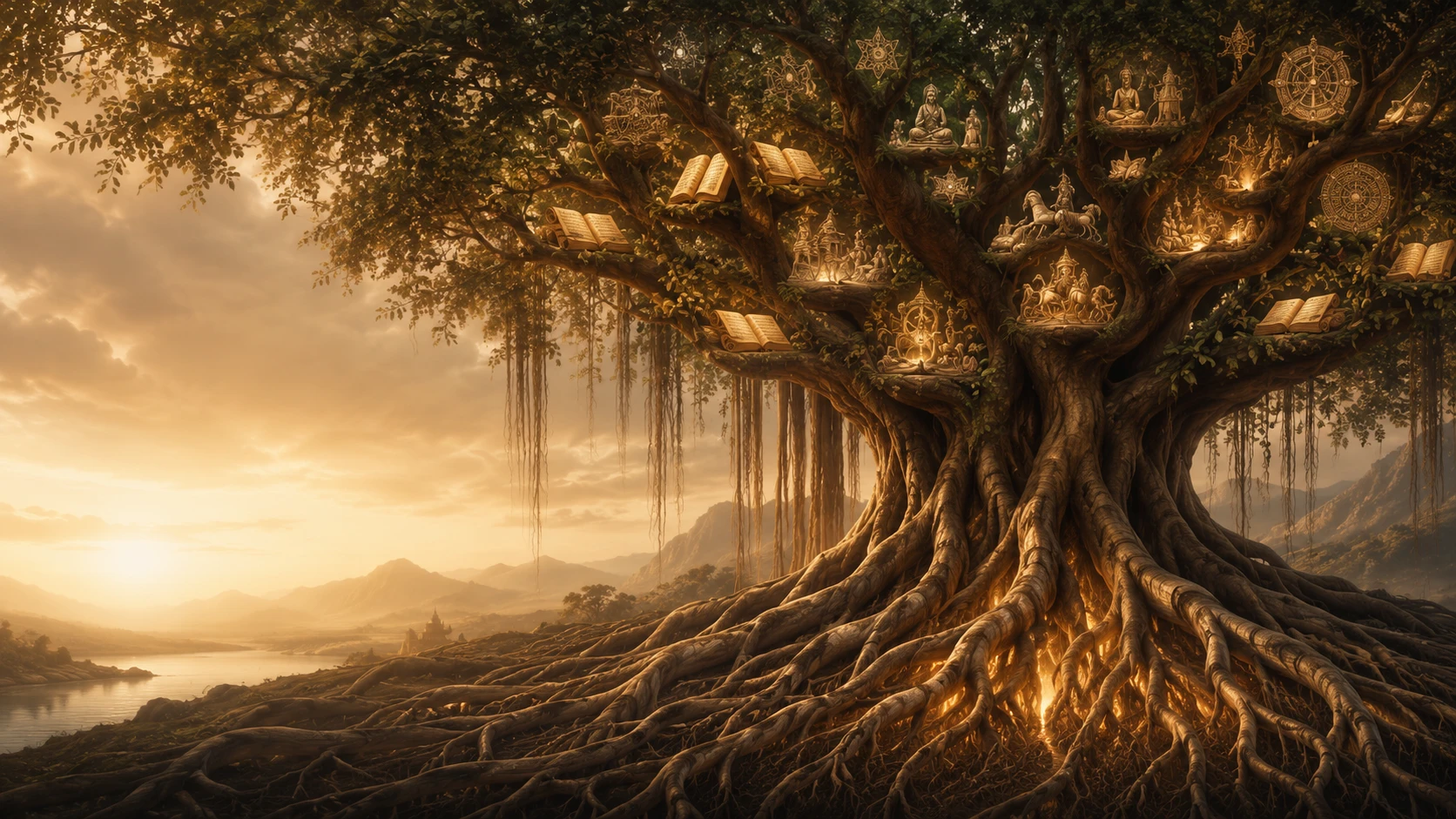
Hindu scripture is not a single book. It is a library that grew over three thousand years, and no one alive has read all of it. Most educated Hindus can name the Vedas, the Gita, and a few Puranas. Fewer can explain how these texts relate to each other, which ones carry more authority, or where a given teaching originates. The Shastra Vriksha, the "tree of scriptures," is a way to see the whole structure at once.
Think of a banyan tree. The roots go deep and wide. The trunk is thick. The branches spread in every direction, and some of them send down aerial roots that become new trunks. You cannot tell, from any single branch, what the whole tree looks like. Hindu scripture works the same way. There is a root system (the Vedas), a trunk (the core Vedic canon), primary branches (the epics, the Puranas, the philosophical schools), and secondary growth that keeps producing new shoots in every century. The Shastra Vriksha is not a metaphor someone invented for a textbook. It is how the tradition describes itself. The *Skanda Purana* compares the body of sacred literature to a tree whose root is the Veda and whose fruit is liberation. The image works because it captures something a list cannot: the texts are alive, connected, and still growing.
The first division is the most important one: *Shruti* and *Smriti*. Shruti means "that which is heard." It refers to the Vedas and everything contained within them. The tradition holds that the Vedas were not composed by any human author. They were perceived by the rishis in states of deep meditation and transmitted orally for centuries before they were written down. Shruti carries the highest authority in any doctrinal argument. If a Puranic story contradicts a Vedic statement, the Vedic statement prevails. Smriti means "that which is remembered." It covers everything else: the epics, the Puranas, the Dharma Shastras, the Agamas, and the vast body of commentary literature. Smriti texts have named authors (or attributed ones). They interpret, extend, and apply the principles found in Shruti. They carry authority, but it is derivative authority. When Tulsidas wrote the *Ramcharitmanas* in Awadhi Hindi in the sixteenth century, he was producing Smriti, a remembered retelling of a story whose roots reach back to Valmiki's Sanskrit *Ramayana*, itself a Smriti text.
The roots of the tree are the four Vedas: Rig, Sama, Yajur, and Atharva. Each Veda has four layers, and this is where most people lose the map. The first layer is the *Samhita*, the collection of hymns and mantras. When someone says "the Rig Veda," they usually mean the Rig Veda Samhita, the 1,028 hymns addressed to deities like Agni, Indra, Varuna, and Surya. The second layer is the *Brahmana*, prose texts that explain the rituals in which the Samhita hymns are used. The third layer is the *Aranyaka*, or "forest text," transitional works that shift from external ritual to internal contemplation. The fourth layer is the *Upanishad*, the philosophical conclusions that sit at the end of each Veda. The word "Vedanta" means "end of the Veda," and it refers to the Upanishads. So when you hear someone say "Vedantic philosophy," they mean the philosophical tradition rooted in the Upanishads, not in the hymns or the rituals.
The trunk of the tree, rising from these roots, is the Vedic canon as a whole: Samhitas, Brahmanas, Aranyakas, and Upanishads across all four Vedas. Branching from this trunk are six auxiliary disciplines called the *Vedangas*, the "limbs of the Veda." These are not philosophy. They are technical tools required to read, recite, and perform the Vedic corpus correctly. *Shiksha* teaches phonetics and pronunciation. *Chandas* teaches metre. *Vyakarana* teaches grammar (Panini's *Ashtadhyayi* belongs here). *Nirukta* teaches etymology and word meaning. *Jyotisha* teaches the astronomical calculations needed to fix the timing of rituals. *Kalpa* teaches the procedural rules for performing rituals. Without the Vedangas, the Vedas are text without operating instructions.
The first major branch is the *Itihasas*, the two great epics. The *Ramayana*, attributed to Valmiki, tells the story of Rama's exile, Sita's abduction, and the war to recover her. It runs to about 24,000 verses in the critical edition. The *Mahabharata*, attributed to Vyasa, tells the story of the Kuru dynasty's civil war and contains roughly 100,000 verses, making it the longest poem in any language. The *Bhagavad Gita* sits within the Mahabharata (in the Bhishma Parva, chapters 25 through 42 of the critical edition). People sometimes treat the Gita as a standalone scripture. It is, in practice, a conversation inside a war inside an epic. Both Itihasas carry Smriti status. They do not override the Vedas, but their stories, characters, and ethical frameworks shape how most Hindus actually encounter their tradition. More people know the story of Rama than can recite a single Vedic hymn. This is not a failing. It is how Smriti works: it makes the abstract principles of Shruti into stories people can live inside.
The second major branch is the eighteen Mahapuranas. These are long, encyclopedic texts that cover cosmology, genealogy, geography, temple legends, and sectarian theology. The *Bhagavata Purana* (the primary text of Krishna devotion), the *Shiva Purana*, the *Vishnu Purana*, the *Devi Bhagavata Purana*, and the *Markandeya Purana* (which contains the Devi Mahatmya) are the five most widely read. Each Purana is traditionally classified by which deity it elevates: Vishnu, Shiva, or Brahma. In practice, most Puranas blend material freely. The Puranas served a social function that the Vedas could not: they brought scriptural teaching to communities who had no access to Vedic recitation. Women, Shudras, and people outside the formal varna system could hear the Puranas recited in temples and public gatherings. The Puranas are where most of popular Hinduism lives.
The third major branch is the six *Darshanas*, the classical schools of Hindu philosophy. These come in pairs: Nyaya (logic) and Vaisheshika (atomic theory of matter), Sankhya (enumeration of cosmic principles) and Yoga (practice of mental discipline), and Mimamsa (Vedic ritual interpretation) and Vedanta (Upanishadic philosophy). Each darshana has a foundational sutra text, a primary commentary, and centuries of sub-commentaries. Vedanta alone has three major sub-schools: Advaita (non-dualism, Shankara), Vishishtadvaita (qualified non-dualism, Ramanuja), and Dvaita (dualism, Madhva). When people say "Hindu philosophy," they usually mean Vedanta. But Sankhya's framework of purusha (consciousness) and prakriti (matter) runs through the Gita, and Yoga's eight limbs (from Patanjali's *Yoga Sutras*) shape how millions practice today. The darshanas do not agree with each other. They argue. That internal argument is the tradition.
Beyond these three branches, the tree keeps growing. The *Agamas* and *Tantras* form a parallel scriptural tradition focused on temple worship, mantra practice, and ritual procedure. Shaiva Agamas govern Shiva temples. Vaishnava Agamas (also called Pancharatra or Vaikhanasa texts) govern Vishnu temples. Shakta Tantras govern Devi worship. Every temple you visit in South India follows an Agamic protocol that determines where each deity is placed, how the sanctum is oriented, what rituals happen at which hour, and what materials the priest uses. The Agamas do not replace the Vedas. They run alongside them, governing the practical side of worship that the Vedic Samhitas do not cover in detail.
The point of the Shastra Vriksha is not to memorize every branch. It is to know where you are standing when you read any Hindu text. If someone quotes the Gita, you know it sits inside the Mahabharata, which is an Itihasa, which is Smriti. If someone references "Vedic tradition," you can ask: do they mean the Samhita hymns, the Brahmana rituals, or the Upanishadic philosophy? These are different things. If a yoga teacher cites Patanjali, you know they are drawing from the Darshana branch, not from the Vedas directly. The map does not make you a scholar. It makes you a reader who cannot be misled about where a teaching comes from. In a tradition this large, that is worth knowing.
Explore the Shastra Vriksha on Eternal Raga
An interactive visual map of Hindu scripture. Tap any branch to see the texts it contains, with summaries and reading guides for each.
Explore on Eternal RagaTags
Community Reflections
🕉️
Be the first to share your reflection.