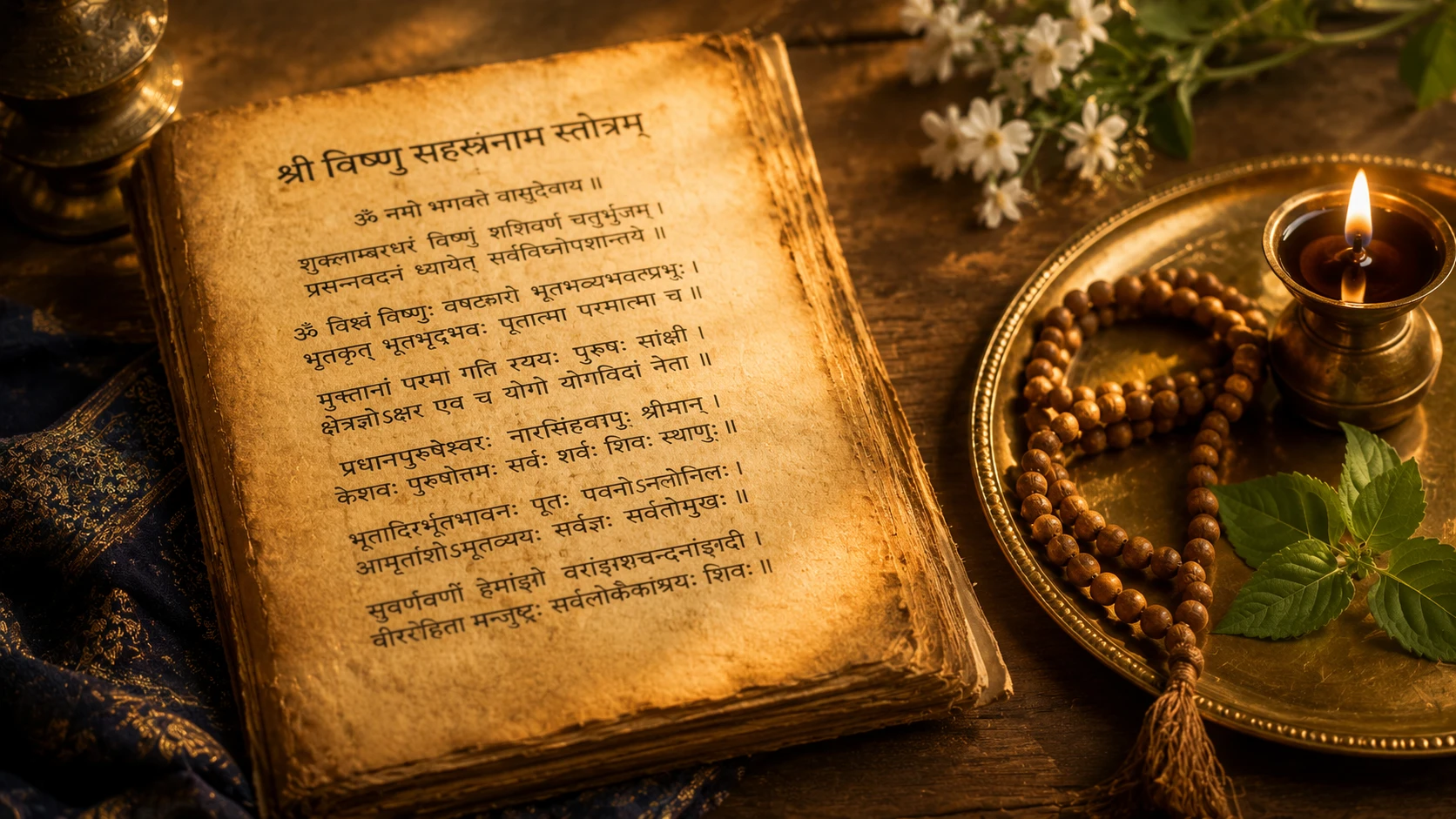
Sahasra means thousand. Nama means name. A Sahasranama is a hymn that holds a thousand names of a single deity, each name a facet, each facet a meditation. This article explains where the tradition comes from, which Sahasranamas exist, and how to begin reciting one.
A Thousand Names for One God
The word breaks into two halves. Sahasra means thousand. Nama means name. A Sahasranama is a hymn that strings together a thousand names of a single deity, one after another, in metrical Sanskrit verse. The actual count in most Sahasranamas is 1,008, not a round thousand. The extra eight are not padding. In Hindu numerology, 1,008 recurs as a number of completeness: 108 multiplied by the nine planets, or by the nine forms of devotion, depending on which tradition you ask.
But the number is less interesting than the idea behind it. A name, in Hindu worship, is not a label. It is a description. Each of the thousand names captures one quality, one act, one relationship, one aspect of the deity that the other 999 do not. To recite a Sahasranama is to rotate the deity slowly in your mind the way you might turn a cut diamond, watching light catch a different facet with each turn.
Why Names Matter
Hindu theology holds that a deity's name carries the deity's presence. This is not metaphor. The tradition treats nama (name) and nami (the named one) as inseparable. When you say Govinda, you are not referring to Krishna at a distance. You are, within the logic of bhakti, making Krishna present in the sound itself. This is why nama japa (repetition of a divine name) is considered a complete spiritual practice on its own, not a preparation for something else.
A Sahasranama takes this principle and extends it a thousandfold. Each name opens a different door into the same deity. Vishnu as Narayana (the one who dwells in all beings) is not the same Vishnu as Hrishikesha (the lord of the senses), though both names belong to the same god. The thousand names are not synonyms. They are a thousand distinct meditations arranged in a single recitation.
Vishnu Sahasranama
The Vishnu Sahasranama is the one you are most likely to have heard. It appears in the Anushasana Parva of the Mahabharata, where Bhishma recites it to Yudhishthira from his bed of arrows. The recitation takes about twenty minutes at a steady pace.
In households across India, this is the Sahasranama of the early morning. A grandmother in a Chennai flat sits cross-legged before the puja shelf at 5:30 AM, a well-thumbed booklet open on her lap, and begins. The house is still dark. The recitation fills the room before the first cup of filter coffee is brewed. By the time the rest of the family wakes, the thousand names have already been spoken. In many South Indian Brahmin families, this has been the first sound of the day for generations.
Lalita Sahasranama
The Lalita Sahasranama belongs to the Brahmanda Purana and addresses the goddess as Lalita Tripura Sundari, the divine feminine in her sovereign form. Where the Vishnu Sahasranama is recited daily in many households, the Lalita Sahasranama follows a weekly rhythm, recited on Fridays, the day associated with the goddess.
In South Indian homes, the Friday recitation of the Lalita Sahasranama has its own texture. The puja shelf is decorated with red flowers. Kumkum is fresh. The recitation is often done by the women of the house together, sometimes three generations sitting in a row. The names move through the goddess's attributes systematically: her form, her weapons, her moods, her relationships with the other deities, her role as the substrate of creation itself. The recitation takes about thirty minutes and carries a rhythmic density that rewards familiarity.
Shiva Sahasranama and Others
The Shiva Sahasranama appears in multiple texts, including the Linga Purana and the Mahabharata. It addresses Shiva through names that cover his dual nature: the ascetic who sits in cremation grounds and the householder who lives on Kailash with Parvati and his sons. Devotees recite it on Mondays and during Mahashivratri.
Beyond these three, the tradition carries Sahasranamas for several other deities. The Hanuman Sahasranama is recited on Tuesdays and Saturdays by devotees who have already memorised the Hanuman Chalisa and want a longer, more meditative practice. The Venkateswara Sahasranama is recited at Tirumala and in Vaishnava households across Andhra Pradesh and Tamil Nadu. Sahasranamas also exist for Ganesha, Surya, Rama, and Lakshmi, each with its own textual source and its own community of daily reciters.
How to Begin
A full Sahasranama recitation takes between twenty and forty minutes depending on the text and your pace. If that feels like too much to start with, the tradition itself offers a shorter entry point. Many Sahasranamas have an associated Ashtottara Shatanamavali, a list of 108 names drawn from the larger thousand. The 108-name version takes about five minutes and works as a daily practice when time is short.
The practical advice is simple. Pick the Sahasranama that matches the deity you feel closest to. Read it with a transliteration guide the first few times so the Sanskrit settles into your mouth. Do not try to understand every name on the first pass. Let the sound carry you. Meaning builds over weeks and months as names you once found opaque begin to open up through repetition.
Some families assign days: Vishnu Sahasranama daily, Lalita Sahasranama on Fridays, Shiva Sahasranama on Mondays. Others recite one Sahasranama for a forty-day period and then rotate. There is no single correct method. The tradition holds that the act of reciting the names is itself the practice. Pronunciation does not need to be perfect. Intention does.
The Names Are Waiting
You do not need to be a Sanskrit scholar to recite a Sahasranama. You do not need to sit in a temple. You need a text, a quiet corner, and twenty minutes. The grandmother in Chennai who has recited the Vishnu Sahasranama every morning for forty years started the same way you will: with a booklet, a stumbling first attempt, and the decision to try again tomorrow.
Eternal Raga carries the complete Sahasranama for eight deities, with Sanskrit text, transliteration, and name-by-name meaning. Browse them in the Mantras section and begin with the one that draws you in.
Browse All Sahasranamas
Sahasranamas on Eternal Raga
Complete Sahasranama for eight deities: Vishnu, Lalita, Shiva, Hanuman, Venkateswara, Ganesha, Rama, and Lakshmi. Sanskrit text, transliteration, and name-by-name meaning.
Explore on Eternal RagaTags
Community Reflections
🕉️
Be the first to share your reflection.