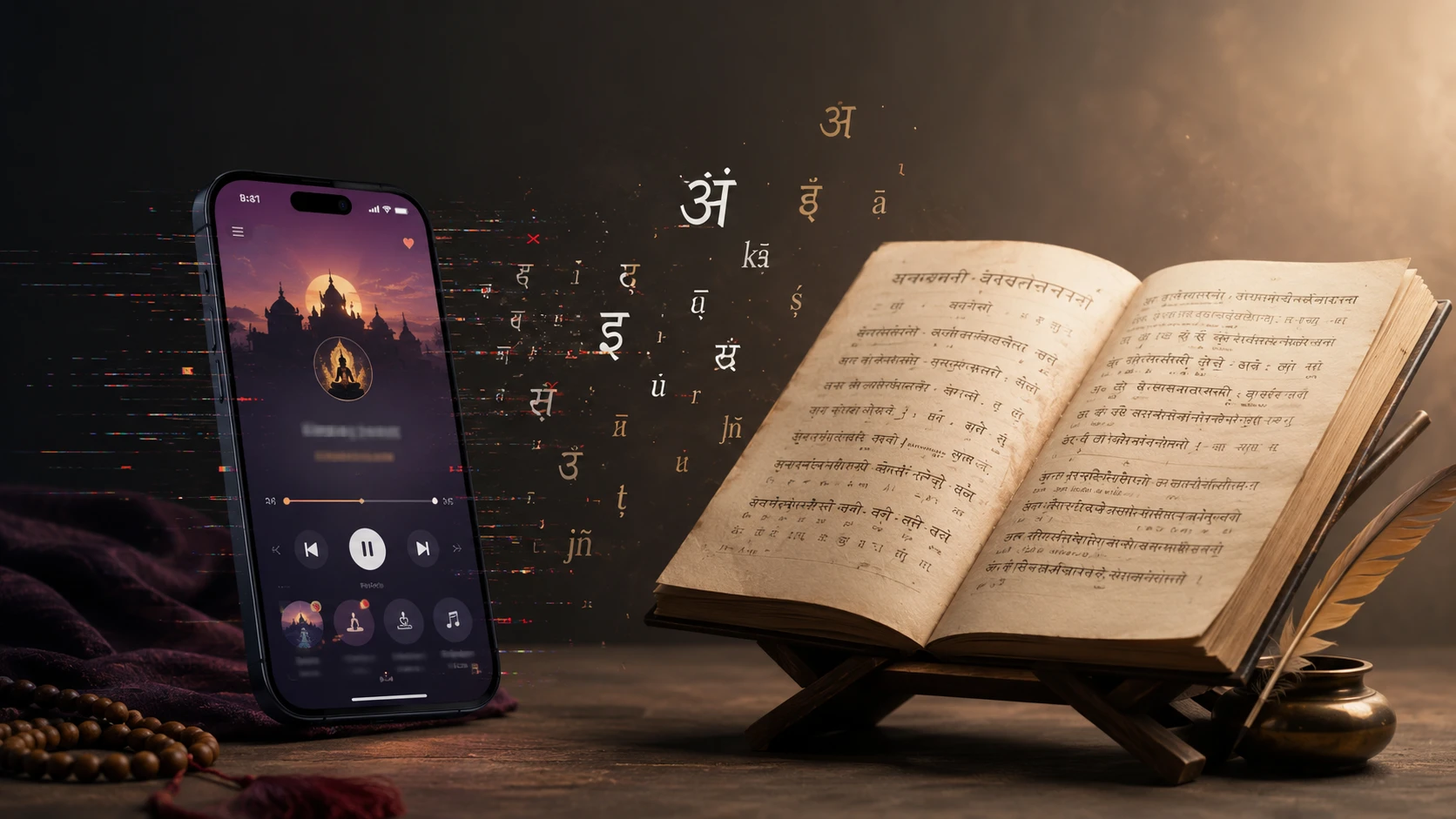
Open any devotional app on your phone. Search for the Gayatri Mantra. You will find three different spellings on three different apps, none of them consistent, and at least one that would make a Sanskrit teacher wince. The problem is not carelessness. The problem is that most app developers treat Sanskrit as decoration, not as a language with rules.
Try a small experiment. Open three devotional apps on your phone and search for the same mantra. The Gayatri will do. On the first app, you will see "Om Bhur Bhuva Swaha." On the second, "Aum Bhoor Bhuvah Svah." On the third, something in between, with random capital letters and no consistent logic. All three claim to offer the authentic text. At least two of them are wrong in ways that change the sound, and in Sanskrit, the sound is the meaning.
Sanskrit has forty-six sounds, each assigned a precise position in the mouth. The difference between "ta" and "ta" (one dental, one retroflex) is the difference between the tip of your tongue touching your teeth and curling back to touch the roof of your mouth. Both exist as separate letters in Devanagari. English has one "t." When a developer romanizes Sanskrit without a system, those two sounds collapse into the same letter, and the user has no way to recover the original pronunciation. This is not a minor inconvenience. For a chanting practice, it is the equivalent of printing sheet music with half the notes missing.
The problem begins with a missing decision. Before writing a single mantra in Roman script, an app needs to pick a transliteration standard. Two exist in wide use. IAST (International Alphabet of Sanskrit Transliteration) uses diacritical marks: a dot below a letter signals a retroflex consonant, a line above a vowel signals length. It is precise, reversible, and used by every Sanskrit department in every university in the world. The second option is simplified romanization: "Shiva" instead of "Śiva," "Rama" instead of "Rāma." It sacrifices precision for readability, and works well when the audience already knows the sounds from spoken Hindi, Tamil, or another Indian language. Both are valid choices. The problem is that most apps choose neither. They use a patchwork: IAST diacritics in one mantra, simplified spelling in the next, phonetic Hindi guesswork in the third.
The second common failure is Devanagari itself. You would expect the original script to be immune from error. It is not. Many apps generate Devanagari text by running romanized input through an automated converter, and these converters make predictable mistakes. They confuse the anusvara (the dot above a letter, representing a nasal sound) with the chandrabindu (the crescent-and-dot, representing nasalization of a vowel). They drop the visarga (the two dots that create an aspirated "h" sound at the end of syllables like "namah" or "duhkha"). They split conjunct consonants into separate syllables, turning a single blended sound into two distinct beats. A trained eye catches these errors in seconds. An untrained user trusts the screen.
A third layer of error sits in the sequencing. Sanskrit verses follow a strict metrical structure called chhandas. Each verse has a fixed number of syllables per line, and those syllables alternate between laghu (light, short) and guru (heavy, long) in defined patterns. When an app breaks a verse at the wrong point, or runs two lines together, or inserts a line break in the middle of a word, the metre disappears. The reader sees a block of text. The chanter loses the rhythm that carries the sound forward. This matters because metre in Sanskrit is not ornamental. It is structural. The *Gayatri* metre has twenty-four syllables arranged in three lines of eight. If your app displays it as two lines of twelve, it has changed the mantra's architecture.
Why does this keep happening? The short answer is economics. Building a Sanskrit text engine that handles Devanagari rendering, IAST transliteration, verse-line preservation, and audio synchronization is months of specialized work. Most devotional apps are built by small teams with limited budgets, and Sanskrit accuracy is the line item that gets cut first. The text comes from whatever source the developer could find online, often copied from another app or website that copied it from somewhere else. Nobody in the chain verified the original against a printed critical edition or consulted a Sanskrit scholar. The errors compound with each copy.
The deeper answer is cultural. In the Indian technology ecosystem, Sanskrit occupies an awkward position. Everyone respects it. Few people on a development team read it. The language sits in a prestige category that discourages questions: nobody wants to admit they cannot tell whether a particular Devanagari rendering is correct. So the text ships unverified, and the user assumes the app knows better than they do. This cycle of mutual deference, where the developer trusts the source and the user trusts the developer, keeps bad Sanskrit circulating across millions of phones.
What does correct handling look like? It starts with three commitments. First, pick one transliteration standard and apply it across every single text in the app. If the audience is general Indian users comfortable with Hindi, simplified romanization works: Shiva, Rama, Om, namah. If the audience includes learners who want to reconstruct pronunciation, IAST is the right choice. Do not mix them. Second, source every Devanagari text from a printed critical edition, not from the internet. The Gita Press editions, the BORI critical edition of the Mahabharata, and the Vaidika Samshodhana Mandala editions of the Vedas are standard references that any Sanskrit scholar can verify. Third, preserve the verse structure. Display each verse with its original line breaks, and if the screen is too narrow for a full line, break at a word boundary, never in the middle of a syllable.
This is the standard Eternal Raga follows. Every mantra on this platform carries its Devanagari text verified against a critical edition, a consistent simplified romanization for readability, and preserved verse structure down to the syllable. We made a choice about transliteration and applied it everywhere. That choice cost time. It cost money. It cost arguments with developers who wanted to ship faster. But a mantra is not a paragraph of marketing copy. It is a sound-structure that someone will chant a thousand times. Getting it right is the minimum the tradition asks of anyone who claims to represent it.
Browse Verified Mantras on Eternal Raga
Every mantra with Devanagari original, consistent transliteration, and verse-accurate line breaks. Start with the Gayatri Mantra and hear the difference.
Explore on Eternal RagaTags
Community Reflections
🕉️
Be the first to share your reflection.