Bhastrikā
भस्त्रिका
Practitioners report intense warming, heightened alertness, and a particular kind of energetic charge that no other pranayama produces in the same way. The body feels alive and intensely awake. Done correctly under guidance, Bhastrika can produce profound shifts in energy. Done incorrectly or by practitioners for whom it is inappropriate, it can produce dizziness, headache, anxiety spikes, and cardiovascular stress.
What It Does
In the body
Bhastrika consists of rapid, forceful inhalations AND exhalations of equal vigor (distinct from Kapalbhati, which has only forceful exhalations with passive inhalations). The diaphragm pumps both directions rapidly. After a round of 20 to 30 such breaths, the practice culminates in a deep inhale followed by kumbhaka (breath retention), often with bandhas applied. The combination produces strong sympathetic activation, significantly raises body temperature, increases blood oxygenation, and engages the entire core musculature.
Energetically
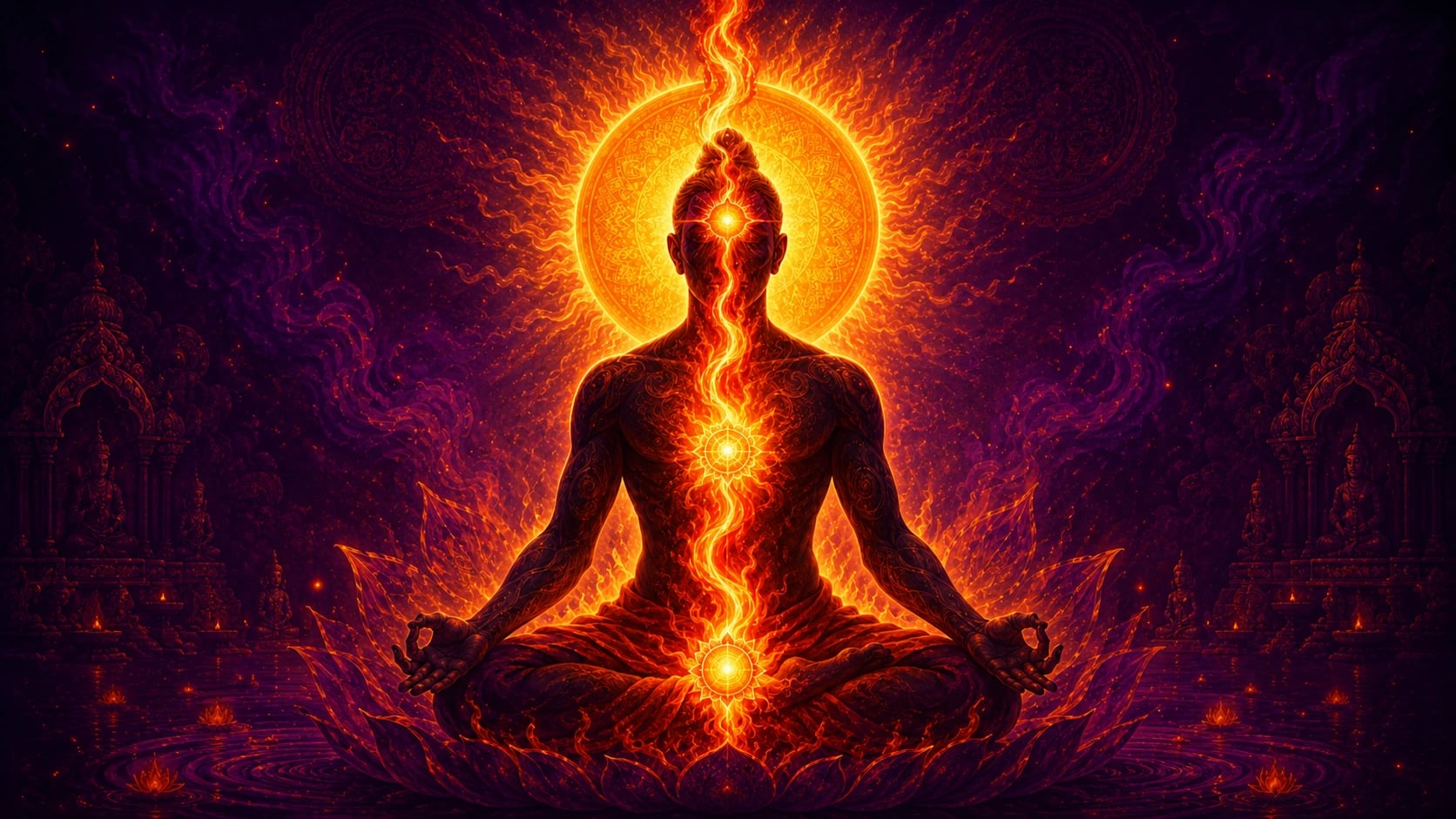
The Hatha tradition makes the strong claim that Bhastrika is the most direct kundalini-awakening pranayama. HYP 2.66 describes it as piercing the three granthis (subtle knots that obstruct the flow of prana through sushumna). The practice generates intense internal heat (tapas) which the tradition holds is necessary for the deeper energetic work. It is the practice most directly connected to kundalini sadhana in classical Hatha — and for this reason it is also one of the most carefully gated practices in traditional teaching.
In practice
Practitioners report intense warming, heightened alertness, and a particular kind of energetic charge that no other pranayama produces in the same way. The body feels alive and intensely awake. Done correctly under guidance, Bhastrika can produce profound shifts in energy. Done incorrectly or by practitioners for whom it is inappropriate, it can produce dizziness, headache, anxiety spikes, and cardiovascular stress.
Accessible Alternatives
Preparation
Best times
- Brahma Muhurta (4 AM to 6 AM) — the classical recommendation
- Morning only — never in evening (the energising effect interferes with sleep significantly)
- After warm-up but before any other intense practice
- On strictly empty stomach
Posture options
- · Padmasana (lotus pose) — classically prescribed and most stable
- · Siddhasana (perfect pose)
- · Sukhasana (cross-legged) — acceptable
- · Vajrasana
Stomach
STRICTLY empty stomach. At least 4 hours after a meal. The forceful abdominal pumping with food in the system can cause nausea, reflux, and abdominal cramping.
Step-by-Step Technique
Settle into stable posture
Sit in a stable cross-legged or lotus posture with spine erect. The posture must be solid — Bhastrika's force will disturb an unstable seat. Hands rest on the knees. Close the eyes.
Take three preparatory deep breaths
Slow, full, deep inhales and exhales through the nose. This settles the system and confirms the breath is clear.
Begin the bellows rounds
Inhale forcefully through the nose (the chest expands and the diaphragm drops sharply). Exhale forcefully through the nose (the abdomen contracts and the diaphragm rises sharply). Both directions are equally vigorous. The rhythm is roughly 1 breath per second initially — one full inhale-exhale cycle per second. Begin with 20 breaths per round.
Conclude the round with a deep inhale and kumbhaka
After 20 forceful breaths, take a deep slow full inhale to the maximum capacity. Hold the breath (kumbhaka) for 10 to 20 seconds (longer with experience). Apply jalandhara bandha (chin lock) and mula bandha (root lock) during the retention if you have learned them; beginners can skip the bandhas.
Release the retention and exhale slowly
Release the bandhas. Exhale slowly and completely through the nose. Sit for 30 seconds to 1 minute of natural breathing before beginning the next round.
Rest is essential between rounds
The full minute of natural breathing between rounds is not optional. The body needs to integrate the energetic effects of each round. Skipping this rest produces dizziness and reduces the practice's effectiveness.
Repeat for 3 to 5 rounds
Beginners: 3 rounds of 20 breaths each, with full rest between rounds. Intermediate: 3 to 5 rounds of 30 to 60 breaths each. Advanced (with teacher guidance): up to 5 rounds of 60 to 120 breaths. Total session typically 10 to 20 minutes including rest.
Close with stillness
After the final round, sit quietly for several minutes with natural breathing. Notice the heat, the alertness, the heightened energy. Bhastrika is often followed immediately by seated meditation, since the cleared and charged system supports deep concentration.
Breath Pattern
Stroke Rate
Approximately 1 breath per second initially (60 strokes per minute). Both inhale AND exhale are forceful, unlike Kapalbhati where only the exhale is forceful.
Rounds Beginner
3 rounds of 20 breaths each, with 1 minute rest between rounds
Rounds Intermediate
3 to 5 rounds of 30 to 60 breaths each, with kumbhaka
Rounds Advanced
5 rounds of 60 to 120 breaths each, with full kumbhaka and bandhas
Kumbhaka Duration
10 to 30 seconds at the end of each round (longer with teacher guidance)
Approximate Total Duration
10 to 20 minutes including rest between rounds
Benefits
Traditional claims
- Generates internal heat (tapas)
- Awakens kundalini and pierces the three granthis (HYP 2.66 — the strongest soteriological claim made for any single pranayama)
- Cleanses the nadis
- Strengthens the digestive fire (agni)
- Removes obstacles to deeper meditation
- Cures disorders of kapha, pitta, and vata (HYP 2.65)
- Prepares the body for advanced Hatha practices
Research-supported
- Strengthens diaphragmatic and abdominal musculature
- Improves lung function and oxygen exchange
- Brief sympathetic activation followed by parasympathetic rebound
- Increased alertness immediately after practice
Common Mistakes
Mistake
Confusing Bhastrika with Kapalbhati
Correction
The defining difference: Kapalbhati has forceful exhale ONLY (passive inhale); Bhastrika has forceful inhale AND forceful exhale (both active). Doing Bhastrika without forceful inhale is just Kapalbhati.
Mistake
Skipping the kumbhaka
Correction
The retention at the end of each round is essential to Bhastrika. Without it, the practice is just rapid breathing without the energetic transformation. The kumbhaka with bandhas is where the depth lies.
Mistake
Going too fast initially
Correction
Beginners should start at 1 breath per second. Faster is not better if sharpness is lost or if the forceful inhale-exhale becomes ragged.
Mistake
Skipping rest between rounds
Correction
The minute of natural breathing between rounds is not optional. The body needs to integrate. Skipping rest produces dizziness, headache, and reduces effectiveness.
Mistake
Attempting Bhastrika without Kapalbhati foundation
Correction
Kapalbhati teaches the forceful exhale and abdominal pumping. Bhastrika adds the forceful inhale on top. Without 3 months of established Kapalbhati practice, the technique is unlikely to be correct.
Mistake
Practising with cardiovascular or other contraindications
Correction
See the safety section. Bhastrika has significant contraindications and is not appropriate for everyone.
Modifications
For beginners
- ·Start with 3 rounds of 20 breaths only
- ·Pace at 1 breath per second; do not speed up early
- ·Take full minute of rest between rounds
- ·Kumbhaka of just 5 to 10 seconds initially; build over weeks
- ·Skip bandhas until you can learn them properly
For advanced
- ·Build rounds to 60 to 120 breaths over months
- ·Extend kumbhaka to 20 to 30 seconds with full bandhas
- ·Add up to 5 rounds total
- ·Pair with seated meditation immediately after
For pregnancy
- ·DO NOT PRACTICE BHASTRIKA AT ANY STAGE OF PREGNANCY. The forceful abdominal pumping, intense sympathetic activation, and kumbhaka are all contraindicated.
For seniors
- ·Generally not recommended above age 60 without individual teacher assessment
- ·Many seniors have one or more contraindications that rule out Bhastrika
- ·Anulom Vilom and Bhramari are the safer foundational pranayamas for seniors
For children
- ·Children under 16 should not practice Bhastrika at full intensity
- ·Forcing children through this practice is counterproductive and potentially harmful
Safety & Contraindications
Safety level: HIGH
Bhastrika has contraindications equivalent to or greater than Kapalbhati. The forceful bidirectional breath, sympathetic activation, intense temperature rise, and kumbhaka with bandhas all contribute. The contraindications below are based on classical Hatha texts and modern medical assessment.
Do not practice if
- Pregnant (any trimester)
- Uncontrolled hypertension (high blood pressure)
- Heart disease — any history of heart attack, angina, arrhythmia, or cardiac surgery
- Hernia (umbilical, hiatal, inguinal)
- Recent abdominal surgery (within 6 months minimum)
- Active gastric or duodenal ulcer
- Epilepsy or seizure disorder
- Vertigo or chronic balance disorder
- Detached retina or recent eye surgery
- Glaucoma (the intraocular pressure changes during kumbhaka are risky)
- Severe asthma in active flare-up
- Menstruation (traditional view; most modern teachers recommend pausing during the first three days)
- Recent stroke or brain aneurysm history
- Severe anxiety or panic disorder
- Hyperthyroidism
Consult doctor first
- You have controlled hypertension (doctor's clearance important)
- You have any cardiac history even if currently well
- You have any chronic respiratory condition
- You have any abdominal condition
- You are over 60
- You take medications affecting heart rate, blood pressure, or thyroid function
Stop if experiencing
- Dizziness, lightheadedness, or vertigo
- Chest pain, tightness, or palpitations
- Sharp headache
- Nausea or vomiting
- Tingling or numbness anywhere
- Visual disturbance
- Abdominal pain
- Excessive sweating or feeling overheated beyond reasonable
- Anxiety spike or panic feeling
- Inability to catch breath after practice
Scriptural Source
Hatha Yoga Pradipika by Svatmarama (15th century CE) — Chapter 2, verses 59 to 67 describe Bhastrika at length (more verses than any other single pranayama in HYP). It is the FIFTH of the 8 named kumbhakas in HYP 2.44.
- · Gheranda Samhita (17th century CE) — Chapter 5
- · Shiva Samhita — references to bhastrika as kundalini-awakening practice
- · Various Hatha and Tantric teaching traditions
ऊर्ध्वाधो गतिरुष्णां च मुक्त्वा कुम्भकमाचरेत्। स प्राप्नोति न संदेहो भस्त्रावल्लोहकारयोः॥
ūrdhvādho-gatir uṣṇāṃ ca muktvā kumbhakam ācaret | sa prāpnoti na sandeho bhastrāval lohakārayoḥ ||
Performing the upward and downward (in-and-out) breath movements forcefully and producing heat, the yogi should then perform kumbhaka. Without doubt, he attains the qualities of the blacksmith's bellows. — Hatha Yoga Pradipika 2.59 (paraphrase)
Deep Dive
Bhastrika is the practice that classical Hatha Yoga reserves for serious sadhana. The Hatha Yoga Pradipika devotes nine verses to it (2.59 through 2.67): more than any other single pranayama in the text, and the soteriological claim at 2.66 is the strongest made for any practice in the chapter. Bhastrika awakens kundalini and pierces the three granthis (the subtle knots of Brahma, Vishnu, and Rudra). This places Bhastrika at the energetic centre of Hatha Yoga's transformative aspirations.
The technique itself is described directly. Forceful inhalations and forceful exhalations through the nose, performed in rapid succession at roughly one breath per second, for a round of 20 to 60 (eventually up to 120) breaths. The round concludes with a deep inhale and breath retention (kumbhaka), classically with mula bandha (root lock) and jalandhara bandha (chin lock) applied. The retention releases through a slow exhale. A minute of natural breathing follows, integrating the round's effects. Three to five such rounds complete the session.
The distinguishing feature of Bhastrika is its bidirectional force. Kapalbhati uses forceful exhalation only, with passive automatic inhalation between. Bhastrika makes the inhalation equally active and forceful. Both directions actively pump the diaphragm; both produce the rapid-fire bellows rhythm that gives the practice its name. The Hatha Yoga Pradipika compares the rhythm directly to a blacksmith's bellows (bhastrāval lohakārayoḥ: 'like the bellows of the blacksmith'), and the metaphor is precise: a leather bellows compresses to push air out and expands to draw air in, both directions equally driven by the bellows-operator's force.
The mechanism the tradition describes (the generation of intense internal heat, the cleansing of the nadis, the eventual awakening of kundalini at the base of the spine) is among the most ambitious in all of Hatha Yoga. The granthi-piercing claim at HYP 2.66 is particularly significant. The three granthis are subtle knots theorized to obstruct the upward flow of prana through sushumna: Brahma granthi at the perineum (associated with attachment to the material), Vishnu granthi at the heart (associated with emotional attachment), and Rudra granthi between the eyebrows (associated with attachment to subtle phenomena and visions). Bhastrika is held to be one of the few practices powerful enough to pierce these knots, allowing the kundalini energy to rise through the central channel.
Modern physiological research on Bhastrika is more limited than for the gentler practices, but available studies show what one would expect: significant sympathetic activation during practice, measurable temperature rise, increased oxygen saturation, strengthening of diaphragmatic and abdominal musculature with regular practice. Cardiovascular load during the forceful breathing is significant, which is why the cardiovascular contraindications are correspondingly significant. The deeper energetic claims (kundalini awakening, granthi piercing) are inherently difficult to evaluate in modern terms and depend on the entire framework of preparation, bandhas, posture, ethical conduct, and ideally guru-transmission that classical Hatha holds to be necessary for such transformations.
The contraindications are extensive and serious. Pregnancy rules out Bhastrika entirely. Uncontrolled hypertension, heart disease, hernia, recent abdominal surgery, glaucoma, detached retina, epilepsy, severe asthma, recent stroke, severe anxiety: all of these contraindicate Bhastrika. Even compared to Kapalbhati (which has many of the same contraindications), Bhastrika's bidirectional force and longer kumbhaka with bandhas amplify the cardiovascular and intracranial pressure changes. The tradition's emphasis on teacher transmission for Bhastrika reflects this: the practice is not suited to self-discovery from a text or app.
The practical recommendation for someone considering Bhastrika is honest assessment. Have you established Kapalbhati practice for at least three months? Are you comfortable with Nadi Shodhana including retention? Is your cardiovascular system healthy and verified so? Do you have access to a qualified Hatha teacher who can observe your practice? Do you have any of the contraindications? Bhastrika is appropriate when all of these alignments are present. It is inappropriate when even one is missing.
The Eternal Raga app presents Bhastrika as part of the classical eight kumbhakas in honesty to the tradition's framework, but the page itself is framed for understanding and serious preparation rather than as a casual how-to. Where Kapalbhati, Anulom Vilom, Bhramari, and Ujjayi can be safely learnt by most healthy practitioners from clear written instruction, Bhastrika benefits substantially from teacher transmission and should be approached within that framework. The classical tradition itself is patient and explicit about this: deeper practices come when the practitioner is ready, and not before. There is no urgency to attempt Bhastrika; the foundational practices carry one a long way before this practice becomes the natural next step.
Frequently Asked
In Modern India
Bhastrika travels through Indian yoga life in two distinct streams. The popular stream, through Baba Ramdev's televised yoga camps and similar mass-media yoga, taught Bhastrika to millions of Indians as part of the daily morning routine, often without sufficient emphasis on the contraindications and the prerequisite of established Kapalbhati practice. The result has been mixed: many practitioners benefit; some have experienced adverse effects (raised blood pressure, cardiac stress, anxiety spikes) that proper screening would have prevented.
The serious-practitioner stream, through the Bihar School of Yoga, Kaivalyadhama, the Krishnamacharya tradition, and various Hatha and Tantric lineages, teaches Bhastrika as an advanced practice requiring established foundation, qualified teacher transmission, and careful screening. In this stream Bhastrika is approached with the depth of preparation its classical status warrants.
In Ayurvedic-yogic integrative practice in India, Bhastrika is prescribed selectively for kapha-pitta balanced constitutions in cold months, with explicit warnings to avoid it in pitta-aggravation, hypertension, or any cardiovascular condition.
For the Indian diaspora the practice travels in both streams: popular yoga teachers introducing it freely, classical Hatha teachers gating it carefully. The Eternal Raga app's presentation aligns with the serious-practitioner stream: Bhastrika as part of the classical eight, with extensive safety framing, prerequisite emphasis, and the recommendation that practitioners not approach it casually.