Haridwar — Har Ki Pauri
हरिद्वार — हर की पौड़ी
Where the Ganga descends to the plains and Vishnu left his footprint, third of the seven Mokshapuri cities
Haridwar, Uttarakhand, India
Hara Kī Paiḍī (Brahmakuṇḍa, Māyāpurī)Also known as: Har Ki Pauri, Hari Ki Pauri, Brahma Kund, Mayapuri Ghat, Haridwar Ghats, Vishnu Padam Ghat
Era
Hindu sacred geography pre-historic per Vedic, Mahabharata, and Puranic traditions; the city's Mayapuri identity confirmed in 7th-century CE Buddhist accounts (Hsuan Tsang); modern Har Ki Pauri ghat structures rebuilt and extended in stages from the 18th century through the 20th, with the British Upper Ganga Canal works (1855) shaping the present hydrology
Architecture
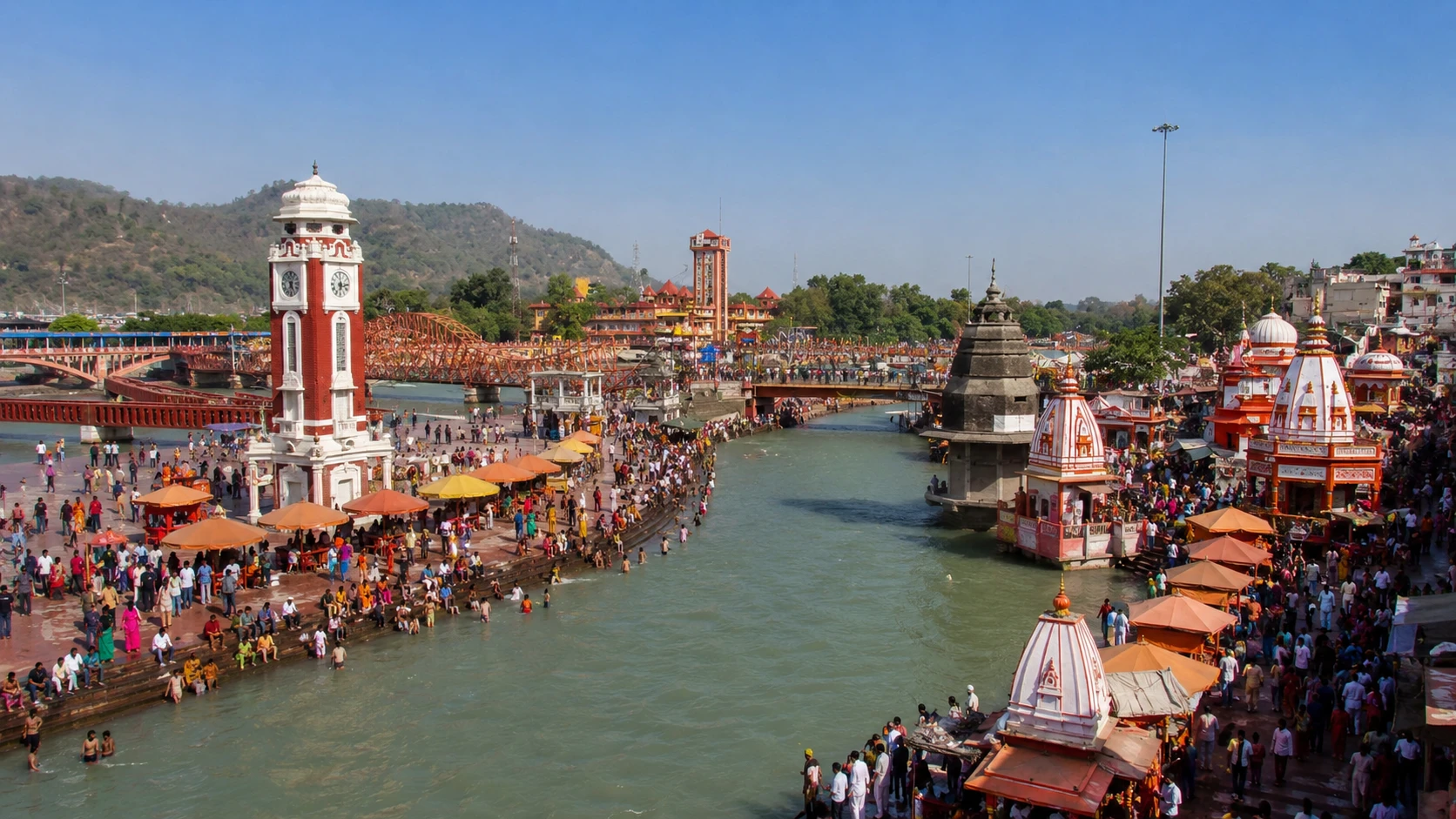
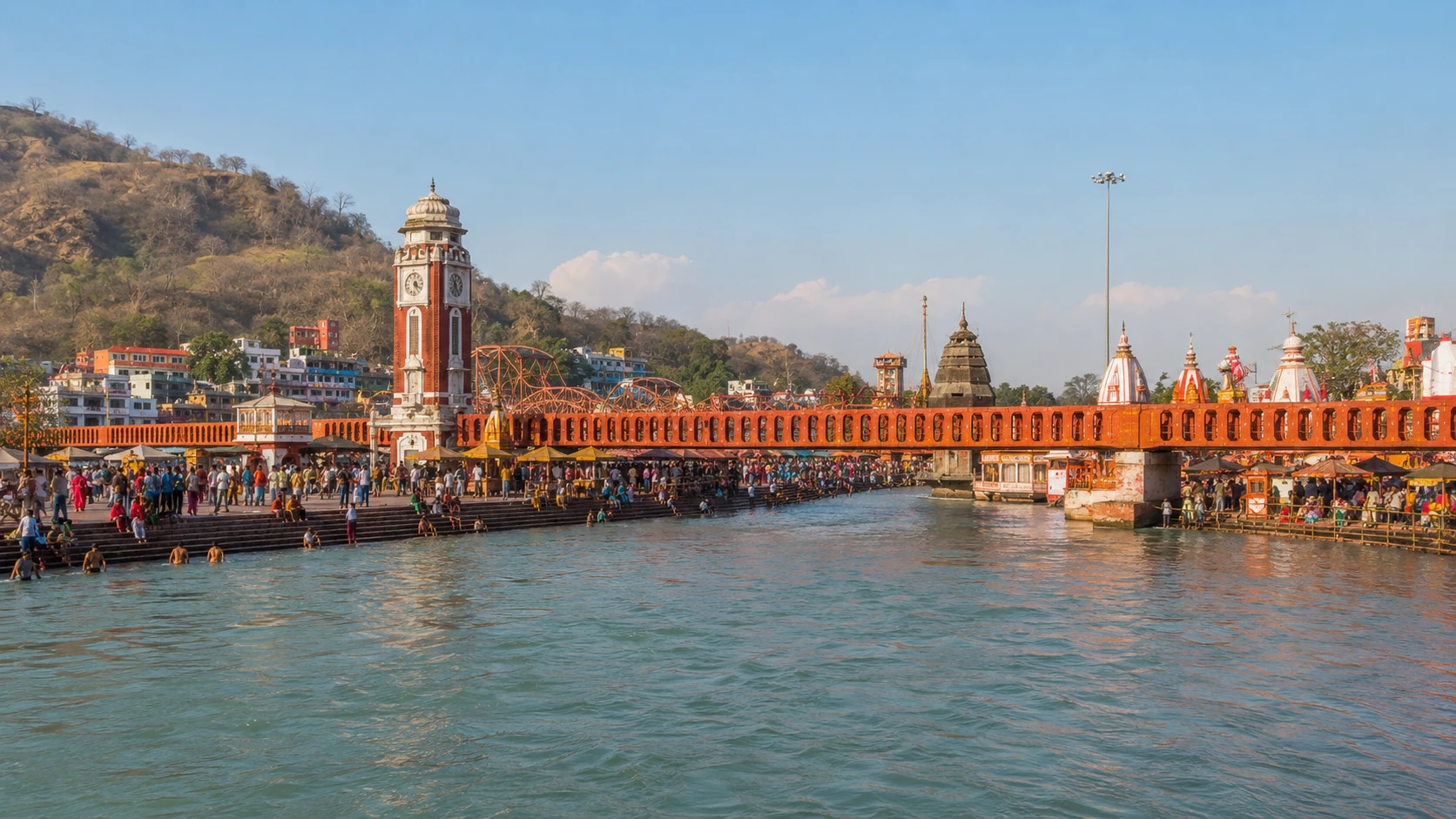
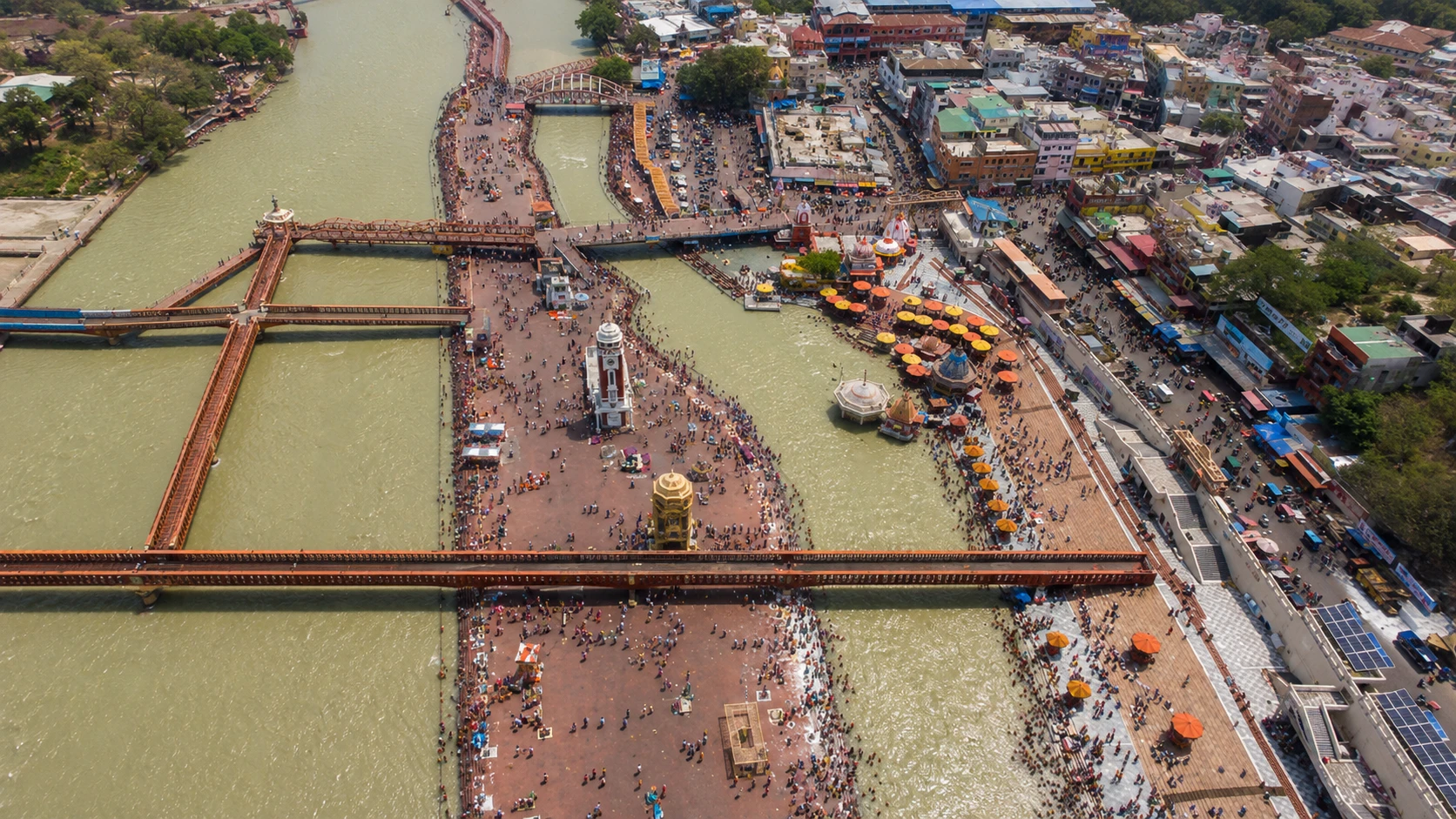
Open-air ghat complex on the banks of the Ganga; the principal feature is the Brahma Kund central platform housing the Vishnu Padam shrine; surrounding ghats (Subhash Ghat, Gau Ghat, Naya Ghat, Tara Ghat) extend 1.5 km along the river. Hilltop Mansa Devi temple is reached by a 1.5-km steep climb or by Mansa Devi Ropeway (Udan Khatola); cross-river Chandi Devi temple is reached by Chandi Devi Ropeway. The Daksha Mahadev temple at Kankhal (5 km south) is a separate temple structure
Open
00:00 – 23:59
Aarti
05:30 · 18:30
Special
Ganga Sandhya Aarti at Brahma Kund is the iconic ritual, performed at sunset (timing shifts seasonally between 17:30 in winter and 19:00 in summer). VIP aarti seating is available via Shri Ganga Sabha (the Trust managing Brahma Kund and the principal ghat). During Kumbh Mela (every 12 years; last Maha Kumbh 2021), Ardh Kumbh (every 6 years; next 2027), and Kanwar Yatra (annual, July, August), security and crowd-management protocols change substantially; pilgrims should plan around the major shahi snan (royal bath) muhurtas on Mahakumbh days. The ghats are open 24 hours but specific shrines (Maya Devi, Mansa Devi, Chandi Devi) maintain shorter hours; Mansa Devi and Chandi Devi ropeways operate approximately 07:00, 19:00.
The Sacred Legend · पवित्र कथा
Har Ki Pauri is the great pilgrim ghat where the Ganga, after a 250-kilometre descent from the icy mouth of the glacier at Gomukh, finally enters the Indian plains, and it is, by tradition, the spot where Lord Vishnu himself placed his foot to bless the city of Mayapuri (modern Haridwar), leaving his footprint embedded in the stone of Brahma Kund. Haridwar is the third of the seven Mokshapuri cities listed in the canonical Mokshapuri Stotram, named 'Maya' in the Stotram for the namesake Devi whose shrine still stands one kilometre from the ghat. Twice each day, at the predawn Mangla Aarti and at the great Ganga Sandhya Aarti at sunset, the ghats fill with hundreds of thousands of pilgrims who set diyas afloat on the river while priests sing the Ganga aarti from the central platform at Brahma Kund. Every twelve years the city hosts the Kumbh Mela, the largest religious gathering on earth, drawing tens of millions who come to bathe in the Ganga at the precise muhurta when, by the Samudra Manthan tradition, drops of amrit (the nectar of immortality) fell into the river at this exact spot. Haridwar is not a single temple but a sacred geography, Brahma Kund and the Vishnu Padam at its center, the Maya Devi Shakti Peeth to the west, the hilltop Mansa Devi to the north, the cross-river Chandi Devi to the east, the Daksha Mahadev at Kankhal to the south, and Har Ki Pauri is the structural anchor at which the whole geography turns.
Sacred Designationपवित्र पदनाम
One of the Seven Moksha Citiesसप्त पुरी
Sacred Origin Storyपवित्र उत्पत्ति कथा
Source: Vishnu Purana, Skanda Purana (Kedara Khanda, Mayapur Mahatmya), Padma Purana, Mahabharata (Vana Parva, the Ganga's descent and Bhagiratha narrative), Devi Bhagavata Purana (for the Maya Devi Shakti Peeth account), widely-attested across multiple Puranic sources
Three sacred narratives meet at Har Ki Pauri.
The first is the descent of the Ganga. King Bhagiratha of the Suryavamsha had an inheritance of grief: his ancestor Sagara's sixty thousand sons had been burned to ash by the curse of Sage Kapila, and their ashes lay un-cremated by holy water, their souls unable to attain the next life.
Bhagiratha undertook tapas of unimaginable severity to bring the heavenly Ganga down to earth to liberate them. Brahma, moved, granted the boon, but warned that the Ganga's fall would shatter the earth itself if not broken. So Lord Shiva caught the descending river in his matted locks (jata), holding her there for ages until he released her gently.
The Ganga emerged from his hair at Gangotri in the Himalayas, flowed down through Devprayag (where she met the Alaknanda from the western Himalayas), and finally reached the plains at the spot now called Har Ki Pauri, 'the steps of Hari.' Bhagiratha led her further, all the way to the ocean at Sagar Island, where she touched his ancestors' ashes and liberated them.
But the precise spot of her arrival in the plains, the gate at which the heavenly river entered ordinary geography, is Brahma Kund. By tradition, the river still carries, at this spot, the original purity of her Himalayan-Shiva passage.
The second is the footprint of Vishnu. Lord Vishnu himself, by the Vishnu Purana's account, placed his foot at the same spot to bless the city of Mayapuri and to authenticate the Ganga's descent. The Vishnu Padam, the imprint of Vishnu's right foot, remains visible in the stone of Brahma Kund and is the central object of pilgrim darshan at Har Ki Pauri.
Pilgrims touch the stone, offer Tulsi and flowers in the depression of the footprint, and bathe in the kund where the Ganga's water continually washes the imprint.
The third is the falling drops of amrit. When the Devas and Asuras churned the cosmic ocean (Samudra Manthan) and produced the amrit kalasha, the pot of immortal nectar, Garuda (in some accounts, Jayanta, son of Indra) carried the kalasha through the heavens for twelve days while the Asuras pursued him.
Drops of amrit fell at four earthly spots: Haridwar, Prayagraj, Nasik-Trimbakeshwar, and Ujjain. These four became the four Kumbh Mela sites, each spot held to retain a perpetual residue of the amrit that fell. Every twelve years, when the planetary configuration matches the original moment of Garuda's flight, Jupiter in Aquarius and the Sun in Aries for Haridwar, the spot becomes maximally auspicious, and the Kumbh Mela is observed; bathing in the Ganga at Brahma Kund during the shahi snan muhurta is held to grant the same liberation that the original drop of amrit would have granted.
Three narratives, Ganga, Vishnu, amrit, converge at one ghat, one stone, one bathing pool. Pilgrims bathe at Brahma Kund knowing they are bathing in the river of Bhagiratha's tapas, on the stone of Vishnu's footprint, in the water that still holds the Samudra Manthan's amrit.
The defining quality of Har Ki Pauri is precisely this layered convergence, multiple sacred narratives folding into a single physical place where the divine touches ordinary geography.
The sub-shrines around the city extend the geography: Maya Devi at the city's western edge marks where, by the Devi Bhagavata, the navel of Sati fell during Vishnu's chakra-cutting of her body after Daksha's yajna and Sati's self-immolation; this same Daksha yajna is commemorated at the Daksha Mahadev temple at Kankhal, five kilometres to the south.
Mansa Devi on the Bilwa Parvat hilltop is the wish-granting goddess. Chandi Devi across the Ganga is one of the principal Devi shrines of the Garhwal hills. Each is a separate pilgrimage in its own right, but the city's center, and the Sapt Puri designation, belong to Har Ki Pauri.
Sources cited:
- Vishnu Purana, Amsha 4, the Bhagiratha narrative
- Skanda Purana, Kedara Khanda, Mayapur Mahatmya, extended treatment of Haridwar's sacred status and the Vishnu Padam
- Padma Purana, Patala Khanda, the Samudra Manthan and the four amrit-drop sites
- Mahabharata, Vana Parva, Adhyayas 108, 109, the Bhagiratha and Ganga descent narrative
- Devi Bhagavata Purana, Skanda 7, the Maya Devi Shakti Peeth account and Daksha yajna context
- Bhagavata Purana, Skanda 9, Adhyayas 8, 9, Bhagiratha and the descent of Ganga
Other Traditions · अन्य परंपराएँ
Buddhist tradition, Hsuan Tsang's 7th-century identification of the city as 'Mo-yu-lo' (Mayapur)
Hsuan Tsang (Xuanzang), the Chinese Buddhist pilgrim who travelled through India between 629 and 645 CE, recorded a visit to a city he transliterated as 'Mo-yu-lo', the Chinese rendering of Mayapur (the Sanskrit antecedent of the modern name Haridwar).
His Si-yu-ki (Records of the Western Regions) describes Mayapur as a city of approximately twenty-li circumference, with a population that was 'mostly Hindu' but included Buddhist communities maintaining several monasteries (sangharamas).
He noted the city's pilgrim character, pilgrims came from distant regions to bathe in the Ganga at the city's principal ghat, and identified the bathing site by its association with Vishnu (whom Buddhists of the era often interpreted as a regional manifestation of dharma rather than as a separate-tradition deity).
Hsuan Tsang's account is the earliest non-Hindu textual confirmation of Haridwar's pilgrim-city identity and of the Mayapuri-Haridwar identification that the Mokshapuri Stotram preserves. His record places the city's pilgrim status well over a thousand years before its present-day form was consolidated.
Sikh tradition, Guru Nanak's visit and the Janamsakhi episode at Haridwar
Sikh tradition records that Guru Nanak Dev, the founder of Sikhism, visited Haridwar around 1504 CE during one of his udasis (long teaching journeys). The most famous Janamsakhi (life-narrative) episode from his Haridwar visit describes his encounter with Hindu pilgrims at Brahma Kund: as Nanak watched them throwing water westward toward the rising sun as tarpan offerings to their ancestors who, by tradition, dwelt in the realm of the dead in the west, he turned and began throwing water eastward.
When asked what he was doing, Nanak replied that he was watering his fields in Punjab, far to the east. The pilgrims protested that water thrown from Haridwar could not possibly reach Punjab. Nanak answered: if your water can reach the realm of the dead beyond the western horizon, why can mine not reach my fields, which are merely a few hundred miles east?
The episode, recorded in the principal Janamsakhi traditions including the Puratan Janamsakhi and the Bala Janamsakhi, became a foundational Sikh teaching on the questioning of ritual without inner conviction. The Gurudwara Gyan Godri at Haridwar marks the site of Nanak's visit.
Sikh pilgrims continue to visit Haridwar today, with the Gurudwara as the principal Sikh-tradition site within the broader pilgrim geography of the city.
Historyइतिहास
Haridwar's sacred status in Hindu tradition is foundational, with continuous textual presence across the Vedas, the Mahabharata, and the major Puranas. The city's Mayapur identity is confirmed in 7th-century Buddhist accounts (Hsuan Tsang's Si-yu-ki) and in the canonical Mokshapuri Stotram.
Pilgrim infrastructure at Brahma Kund and the surrounding ghats has been continuously maintained for at least the past millennium, with successive ruling powers, the Pratiharas, the Tomaras, the Chauhans, the Tughluqs, the Mughals, the Marathas, the Sikhs, the British Raj, accommodating the pilgrim flow without significantly disrupting the ritual geography.
Timur raided Haridwar in 1399 during his Indian campaign, attacking pilgrims and gosains at the ghats; he records the raid in his Tuzuk-i-Timuri. The Kumbh Mela tradition at Haridwar is documented continuously in Mughal-era European travelers' accounts (notably Thomas Coryat in 1615), and disputes over Kumbh-bath precedence between the Naga akharas and Sikh-affiliated pilgrim groups in 1796 shaped subsequent akhara administration of the festival.
The British Upper Ganga Canal, designed by Sir Proby Cautley and inaugurated in 1855, diverted a substantial volume of the Ganga from above Haridwar for irrigation purposes, but the engineering deliberately preserved Brahma Kund and Har Ki Pauri ghat in their pilgrim function, with the canal head works structured to ensure that the sacred kund continued to receive river water.
The Shri Ganga Sabha, the principal trust managing Brahma Kund and the Har Ki Pauri ghat complex, was constituted in 1916 and remains the operational authority. The city has hosted Kumbh Mela approximately every twelve years through the modern period; the 2021 Maha Kumbh, held during the second wave of the COVID-19 pandemic, was the subject of major public-health controversy and was truncated by the Uttarakhand state government.
The next Ardh Kumbh is scheduled for 2027, and the next Maha Kumbh for 2033.
Historical Timelineऐतिहासिक कालक्रम
Hsuan Tsang (Xuanzang), the Chinese Buddhist pilgrim travelling through northern India between 629 and 645 CE, visited the city he transliterated as 'Mo-yu-lo', the earliest non-Hindu textual confirmation of the Mayapur, Haridwar identity. His Si-yu-ki (Records of the Western Regions) describes the city as a pilgrim center of approximately twenty-li circumference, with a population mostly Hindu but including Buddhist monasteries, and identifies the principal ghat as a bathing site associated with Vishnu. Hsuan Tsang's account is the earliest external textual witness to the city's pilgrim status and confirms that the city's central religious geography in the 7th century was substantially the same as it remained into the modern period.
The 'Mo-yu-lo' identification with Mayapur (and thus modern Haridwar) is the standard reading among scholars of Chinese Buddhist pilgrim literature, supported by Beal, Watters, and the modern Wriggins. The dating of the visit specifically to 634 CE is approximate; Hsuan Tsang's full Indian journey extended from 630 to 643/644, and his Mayapur visit occurred during the broader north Indian itinerary that reconstructions place in the early-to-mid 630s.
Timur (Tamerlane) raided Haridwar in early 1399 during his Indian campaign, attacking pilgrims and gosains gathered at the ghats. Timur's own memoir, the Tuzuk-i-Timuri (or Malfuzat-i-Timuri), records the raid: Timur's forces attacked the city after his return from sacking Delhi, plundering temples and killing pilgrims. The gosain communities at Haridwar, armed renunciate-warriors who acted as pilgrim guards at the Kumbh and other major occasions, offered limited resistance. The raid did not destroy the ghat infrastructure permanently and pilgrim activity resumed within a generation, but the event marks Haridwar's position in the pre-Mughal medieval geography of repeated invasions through the Gangetic-plains corridor.
The Haridwar Kumbh Mela of 1796 was marred by a violent conflict at Brahma Kund between Naga sannyasis (renunciate-warrior orders affiliated with the Shaiva akharas) and Sikh-affiliated pilgrim groups, primarily Khalsa Sikhs participating in the broader Hindu Kumbh observance. The conflict, recorded in colonial-era East India Company despatches and in Sikh chronicles, arose over precedence in the shahi snan (royal bath) sequence on the principal Kumbh muhurta. Hundreds of pilgrims and akhara members were killed. The 1796 conflict prompted the formal codification of shahi snan precedence among the akharas, a system that the Akhil Bharatiya Akhara Parishad continues to administer today, and contributed to the British East India Company's later assertion of administrative oversight of Kumbh festivals to prevent further communal violence.
The British Upper Ganga Canal, designed by Sir Proby Cautley and constructed between 1842 and 1854, was inaugurated by Lord Dalhousie on 8 April 1855 at Haridwar. The canal head works diverted a substantial portion of the Ganga's flow above Haridwar into the canal system for irrigation across the Doab region, but the engineering was deliberately structured to preserve Brahma Kund and Har Ki Pauri ghat in their full pilgrim function, with the canal off-take placed to ensure that the sacred kund continued to receive river water and that the principal aarti and bathing geography remained undisturbed. This was an early and significant accommodation of Hindu sacred geography in colonial-period engineering, Cautley and his team consulted with the gosain and pandit communities of Haridwar before finalizing the head-works design. The canal itself transformed the agricultural economy of north-western India, but its impact on Haridwar's pilgrim function was, by intent, minimal.
The 2021 Haridwar Maha Kumbh Mela, originally planned to run from 27 February to 30 April 2021, was held during the second wave of the COVID-19 pandemic in India. The Uttarakhand state government truncated the festival's duration to 1 to 30 April after central government and public-health concerns intensified. Despite reduced duration, the festival drew an estimated 9.1 million pilgrims to Haridwar across April 2021, with the Shahi Snan days on 12 April (Somvati Amavasya) and 14 April (Mesha Sankranti / Baisakhi) drawing the largest crowds. The festival became the subject of major national and international public-health controversy: thousands of positive COVID-19 cases were recorded among pilgrims and akhara members during and after the event, with senior swamis from multiple akharas contracting the virus. Prime Minister Narendra Modi appealed for the remainder of the Kumbh to be observed 'symbolically' on 17 April. The Niranjani Akhara and several other akharas withdrew from active festival participation. The 2021 Maha Kumbh remains the most legally and ethically debated Kumbh in modern Indian history, with multiple PILs filed before the Supreme Court of India and the Uttarakhand High Court.
The 2021 Maha Kumbh remains a politically and medically contested event whose full epidemiological and policy assessment is ongoing. Pilgrim attendance figures range across sources from approximately 7 million to over 9 million depending on counting methodology; COVID-19 case attribution to the festival is similarly contested between models that count cases identified during the festival period and models that attempt downstream contact-tracing. Eternal Raga's editorial position is to document the festival's occurrence factually with primary government and press citations, noting the controversy without taking a position on policy responsibility. Future editions of this entry should reflect any subsequent academic or government assessments published after the editorial verification date.
What You'll Seeदर्शन में
Har Ki Pauri's iconography is unlike that of any sanctum-style Hindu temple, it is a sacred riverine landscape rather than a single enclosed shrine, and the structural elements that organize the pilgrim's experience are open-air features along the western bank of the Ganga rather than a murti in a garbhagriha.
The center of the geography is Brahma Kund, a stone-walled bathing pool roughly twelve metres across, set into the ghat directly at the river's edge. Within Brahma Kund, embedded into the central stone platform, is the Vishnu Padam (also called Hari Ki Charan-Chinha), the imprint, by tradition, of Lord Vishnu's right foot, where the deity placed his step to bless the city of Mayapuri.
The footprint stone is the central object of darshan at Har Ki Pauri; pilgrims approach it after bathing, touch the imprint with their right hand, place fresh Tulsi leaves and marigold petals in the depression of the foot, and offer a small ladle of Ganga water poured directly over the stone.
The kund's walls carry small bell-fittings and lamp-niches; the surrounding paving is worn smooth by centuries of bare feet.
Extending in both directions along the riverbank from Brahma Kund are the named ghats, Naya Ghat, Subhash Ghat, Gau Ghat, Tara Ghat, Kushwarnath Ghat, Asthi Pravah Ghat, together covering approximately 1.5 kilometres of pilgrim-accessible river frontage.
Each ghat has its specific ritual identity: Asthi Pravah Ghat is reserved for the immersion of cremation ashes; Gau Ghat is associated with offerings on behalf of cattle; Subhash Ghat is named for Subhas Chandra Bose, who visited in 1939.
Above Brahma Kund stands the iconic Har Ki Pauri Clock Tower (Ghantaghar), an Italianate tower donated by industrialist GD Birla in 1938, a structure that has become the visual signature of the entire complex and one of the most photographed temple-area landmarks in India.
Directly adjacent to Brahma Kund is the central Aarti Platform, a small, lamp-lit stone platform from which the priests of the Shri Ganga Sabha conduct the Mangla Aarti (predawn) and the Sandhya Aarti (sunset) twice each day.
During the Sandhya Aarti, the platform is illuminated with multi-tier brass lamps; the priests, dressed in saffron, move the lamps in slow circular sweeps over the river while the assembled pilgrim crowd, sometimes a hundred thousand strong, chants 'Jai Ganga Mata' and floats small leaf-boat diyas (purvai) downstream.
The Ganga is, in this configuration, the deity-equivalent, the river itself receiving the lamp-offering rather than a sculpted murti.
The peripheral sacred geography expands outward from this center. The Maya Devi Temple, one kilometre west of Brahma Kund, is the Shakti Peeth where, by Devi Bhagavata tradition, the navel of Sati fell during Vishnu's chakra-cutting of her body after the Daksha yajna; the temple gives the city its Mokshapuri-Stotram name 'Maya' (Mayapuri).
The Daksha Mahadev temple at Kankhal, five kilometres south of Har Ki Pauri, marks the actual site of the Daksha yajna where Sati immolated herself, closing the geographical narrative loop that Maya Devi's nabhi-fall opens.
The Mansa Devi temple, on the Bilwa Parvat hilltop one kilometre north and accessible by ropeway (Udan Khatola) or a steep climb, is the wish-granting goddess in north Indian Devi tradition; pilgrims tie sacred threads on the temple's wishing tree and untie them on a return visit when their wish is fulfilled.
The Chandi Devi temple, on the Neel Parvat hill across the Ganga and accessible by Chandi Devi Ropeway, is a major Devi shrine of the Garhwal hills attributed to Adi Shankaracharya. Each is a separate pilgrimage in its own right; together with Har Ki Pauri at the geographic center, they constitute the Mokshapuri sacred precinct that the Mokshapuri Stotram identifies as 'Maya.'
Distinctive Practicesविशिष्ट परंपराएँ
Ganga Sandhya Aarti at Brahma Kund
ब्रह्मकुंड पर गंगा संध्या आरती
Daily, at sunset (timing shifts seasonally between approximately 17:30 in winter and 19:00 in summer); duration approximately 35, 45 minutes
The daily Ganga Sandhya Aarti at Brahma Kund is among the most-witnessed religious rituals in modern India and is the iconic ceremony of Haridwar. The aarti is conducted by the priests of the Shri Ganga Sabha, a panel of approximately 250 hereditary pandits whose ancestors have served the ghat for generations, from the central Aarti Platform adjacent to Brahma Kund. The ceremony begins with the lighting of brass deepa-lamps of multiple tiers (some carrying 21, 51, or 108 wicks); the priests then conduct an extended sequence of arati-circuits in which the lamps are moved in slow clockwise sweeps over the river while traditional Ganga stutis are sung, accompanied by conch shells, brass bells, and the Sanskrit chanting of the Ganga Sahasranama. The assembled pilgrim crowd, ranging from several thousand on a normal weekday to over a hundred thousand on Saturdays, festival days, and during Kanwar Yatra, chants 'Jai Ganga Mata' in response and floats small leaf-boat diyas (purvai) downstream. The aarti culminates with the offering of camphor-flame to the Ganga, the simultaneous distribution of Ganga prasad to assembled pilgrims, and the dispersal of the crowd in the soft after-light of the riverside lamps. The aarti is broadcast live on multiple devotional television channels and YouTube streams.
The Sandhya Aarti enacts a theological proposition that distinguishes Haridwar from temple-sanctum-centered Hinduism: the deity to whom the offering is made is not enclosed in a structure but is herself the river, the openly flowing geographic feature that the pilgrims have come to bathe in. The aarti is an act of receiving rather than commanding, the priests do not control the deity through ritual; they offer their lamps to a goddess who continues moving past them at all hours, indifferent to whether they are lit. This iconographic openness, the divine as flowing water rather than as enclosed sculpture, gives the Sandhya Aarti a physiological intensity unlike most temple aartis: pilgrims describe a felt sense of the deity's continuous presence rather than a ritual-bounded encounter, with the river's literal flow providing a metaphysical metaphor for the impermanence and continuity that the entire Ganga theology rests upon.
Brahma Kund Sankalp Snan and the Carrying of Ganga Jal
ब्रह्मकुंड संकल्प स्नान और गंगा जल का धारण
Year-round, during all open hours; particularly intensified during Mauni Amavasya, Somvati Amavasya, Ganga Dussehra, Kartik Purnima, and the Kumbh shahi snan muhurtas
The principal pilgrim ritual at Har Ki Pauri is a sequenced bath-and-water-carrying observance combining four elements: the formal sankalp (ritual statement of intent), the actual immersion in Brahma Kund, the offering of pinda or tarpan to ancestors at the appropriate moment, and the filling of a kalasha (typically copper or brass, sometimes plastic for transport) with Ganga jal to be carried home for household abhishekam, marriage rituals, antim-sanskar (last rites), and other family ceremonies. The pilgrim arrives at the appropriate riverside changing area, takes the sankalp from a Shri Ganga Sabha pandit (or independently), descends to the kund, immerses three times facing the rising sun (or, for Maha Kumbh, at the prescribed muhurta), then climbs back to the central platform to touch the Vishnu Padam. Tarpan offerings to deceased family members, water poured westward, the gesture Guru Nanak observed in 1504 and questioned, are made from the riverbank, with til (sesame) and kusha grass added to the water by tradition. The kalasha-filling is the final act; the sealed kalasha of Ganga jal is the principal pilgrimage souvenir of Haridwar and is treated as a household sanctifying agent for years after the visit.
The carrying of Ganga jal home is the structural innovation that distinguishes Haridwar from purely darshan-based pilgrim sites: the pilgrim does not merely receive blessing at the spot but transports a portion of the sanctified physical material (the river water) home for ongoing household use. The Skanda Purana's Mayapur Mahatmya makes this transport-sanctity explicit: water taken from Brahma Kund retains its sanctifying power across distance and time, and a household that maintains a kalasha of Haridwar Ganga jal is held to remain auspicious for the period the water is preserved. This logic, that the divine can be physically extended through carried matter rather than only through symbolic memory, underwrites the Kanwar Yatra (the saffron-clad pilgrim brigade) as well as numerous family rituals across north India that depend on access to genuine Haridwar Ganga jal. The pilgrim is not only a darshan-recipient but also a courier of the sacred between geographies.
Kanwar Yatra
कांवड़ यात्रा
Annual, during the Hindu lunar month of Shravana (Sawan), typically late July through mid-August, with the principal Shivaratri occurring on the Ashadha Krishna Trayodashi/Chaturdashi (the 'Kanwariya Shivaratri' in late July or early August)
The Kanwar Yatra is among the largest annual mass pilgrimages on earth: an estimated 30 to 50 million saffron-clad devotees (kanwariyas), drawn primarily from Uttar Pradesh, Bihar, Haryana, Delhi, Rajasthan, Madhya Pradesh, and Uttarakhand, walk to Haridwar (and to a lesser extent to Gaumukh, Gangotri, and Sultanganj) during the Shravana month to fill their kanwars, bamboo-pole carriers with two hanging vessels (typically copper or stainless steel), with Ganga jal at Har Ki Pauri or the upstream ghats. The kanwariyas then walk back to their home villages and towns, carrying the Ganga jal continuously without setting the kanwar on the ground (a strict observance, the kanwar must rest on a platform or be held throughout the journey), and on the Shravana Shivaratri day pour the Ganga jal as abhishekam over the Shiva-lingam in their home temples. The Yatra has grown dramatically since the 1990s: 1980s estimates were under 1 million participants; recent years see 30, 50 million. The Yatra peaks during the second and third weeks of Sawan; Haridwar's pilgrim infrastructure, transportation, and hotel capacity all reorganize for the duration. The Uttarakhand state government, the Uttar Pradesh state government, and the railway authorities run special arrangements during the Yatra. Kanwariyas typically wear orange-saffron clothing, march in chanting groups to 'Bol Bam' calls, and observe vegetarian food and ritual abstinence for the journey duration.
The Kanwar Yatra is a continuous-motion enactment of the sankalp-snan-jal-carrying logic at the scale of mass devotion. Each kanwariya is a courier of Ganga jal from Haridwar to a personal Shiva-lingam, the geographic reach of Haridwar's sanctity is, through the Yatra, extended each year to tens of thousands of village and town Shiva temples across north India. The duration of the journey (often 10, 15 days walking each way for participants from distant districts), the strict observances (kanwar never touches the ground, no shoes, vegetarian food, abstinence), and the chanting of 'Bol Bam' together create a temporary monastic discipline among householders who would not otherwise enter ascetic practice. The theological logic is the Shiva tradition's accommodation within the Vaishnava-anchored Mokshapuri geography, the Ganga (whom Shiva caught in his locks at Har Ki Pauri's mythological origin moment) returns to Shiva at the end of the yatra, with the kanwariya as the willing intermediary.
Did You Know?क्या आप जानते हैं?
The Vishnu Padam stone embedded in the central platform of Brahma Kund is the structural focal point of Har Ki Pauri's identity. The footprint is approximately 25 centimetres in length, recessed into the stone in the depth-form of a right foot with the toe-impressions distinct from the heel. The Vishnu Purana and the Skanda Purana's Mayapur Mahatmya both record the imprint as having been made by Vishnu's right foot during a moment of cosmic blessing of the city; the practice of pouring Ganga water directly over the imprint, embedded in continuous tradition for at least the past millennium, is the central pilgrim act at the ghat. The footprint also gives the city the alternate name 'Hari-dwar', literally 'gate of Hari [Vishnu]', distinguishing it from the etymologically parallel 'Hara-dwar' (gate of Hara/Shiva) sometimes used in the same texts; the name's Vishnu-Shiva ambivalence reflects the city's actual liminality between the two great traditions.
Vishnu Purana, Amsha 4; Skanda Purana, Kedara Khanda, Mayapur Mahatmya; James G Lochtefeld, God's Gateway: Identity and Meaning in a Hindu Pilgrimage Place (Oxford University Press, 2010), chapter on the Vishnu Padam and the Hari/Hara name etymology
The Maya Devi Temple, one kilometre west of Brahma Kund, is one of the 51 Shakti Peethas of the Devi tradition, held to be the spot where Sati's nabhi (navel) fell when Vishnu used his Sudarshan Chakra to dismember her body after Daksha's yajna and her self-immolation. The city's canonical Mokshapuri Stotram name 'Maya' derives directly from this Shakti Peeth, the Stotram does not name the modern term 'Haridwar' but preserves the older Shakti-Peeth-anchored identity. The Daksha Mahadev temple at Kankhal, five kilometres south of Har Ki Pauri, marks the actual site of Daksha's yajna where Sati immolated herself. Together Maya Devi and Daksha Mahadev form the geographic narrative loop: Sati's death-place at Kankhal, her nabhi-fall at Maya Devi, the Vishnu-Shiva intervention at Har Ki Pauri itself.
Devi Bhagavata Purana, Skanda 7; Kalika Purana, for the Shakti Peetha enumeration; D C Sircar, The Sakta Pithas (Motilal Banarsidass, second edition 1973), foundational scholarly study of the 51 Shakti Peetha tradition; James G Lochtefeld, God's Gateway (2010)
The Har Ki Pauri Clock Tower (Ghantaghar), the iconic Italianate landmark above Brahma Kund, was donated to the Shri Ganga Sabha in 1938 by industrialist GD Birla in memory of his deceased wife. The tower's structure draws Italian Renaissance clocktower elements, multi-tier brick-and-stone composition, ogive arches at the upper levels, a colonnaded clock-housing chamber, and a copper finial, but is positioned within the riverside ghat geography that is otherwise stylistically Indian. The tower's inscription identifies it as a 'gift to the Hindu nation in memory of Mahadevi.' The clock itself is an British-manufactured period piece, still operational and synchronised manually by Sabha staff. The Ghantaghar has become the most-photographed individual structure in Haridwar; for many pilgrims, the silhouette of the tower against the Ganga at sunset is the visual signature of the entire pilgrimage.
Shri Ganga Sabha institutional records and the tower's own inscription; GD Birla biographical materials; Lochtefeld, God's Gateway (2010), section on the Ghantaghar; visible inscription dated 1938
The Kanwar Yatra has grown from approximately 1 million annual participants in the 1980s to a 2024 estimated peak of approximately 45 million across the Sawan month, making it among the largest annual mass-pilgrimages on earth, comparable in scale only to the Hajj (approximately 2.5 million annually in a single observance) and exceeding annual pilgrimages to Lourdes (5 million), Fatima (5 million), or Tirupati (24 million). The Yatra's growth is attributed to expanding rural-urban transport infrastructure, the codification of the kanwar-walk discipline through chanting groups (jathas) led by experienced kanwariyas, the emergence of social-media-coordinated kanwariya groups in the 2010s, and broader north Indian Hindu religious revival. The economic activity of the Yatra is estimated at approximately ₹50,000 crore (₹500 billion) annually across the region during Sawan. Logistic planning for the Yatra in Haridwar involves the Uttarakhand state government, the Uttar Pradesh state government, the Indian Railways, and the National Highways Authority of India.
Uttarakhand and Uttar Pradesh state government Kanwar Yatra coordination notifications and post-Yatra reports; Indian Railways special-train operations data; Press coverage in The Hindu, Indian Express, Times of India, BBC News; Lochtefeld, God's Gateway (2010); Diana L Eck, India: A Sacred Geography (Harmony, 2012), comparative scale data
Guru Nanak Dev's c. 1504 visit to Haridwar, recorded in the Janamsakhi traditions and commemorated at the Gurudwara Gyan Godri at the city, produced one of Sikhism's most well-known foundational episodes. Watching pilgrims throw water westward at Brahma Kund as tarpan to ancestors who, by tradition, dwelt in the western realm of the dead, Nanak began throwing water eastward; when challenged, he answered that he was watering his fields in Punjab, and asked: if your water can reach the realm of the dead, why can mine not reach my fields, which are merely a few hundred miles east? The episode became foundational to Sikh teaching on the questioning of ritual without inner conviction, a teaching that did not reject Hindu pilgrimage but interrogated its mechanical-ritualistic forms while honoring its devotional intent. Sikh pilgrims continue to visit Haridwar at significant numbers; Sikhs and Hindus today pray and bathe side-by-side at the same Brahma Kund.
Puratan Janamsakhi (Bhai Vir Singh edition, 1926); Bala Janamsakhi; W H McLeod, Guru Nanak and the Sikh Religion (Oxford University Press, 1968); Gurudwara Gyan Godri institutional history
Visitor Accessप्रवेश जानकारी
Har Ki Pauri's principal area, Brahma Kund and the surrounding ghats, is open 24 hours and accessible to all visitors regardless of caste, gender, denomination, or faith; Sikh pilgrims, Jain visitors, foreign tourists, and devotees of all Hindu sampradayas pray and bathe alongside one another. The bathing area at Brahma Kund has separate changing facilities for men and women; modest swimwear or traditional bathing attire (men: dhoti or shorts; women: salwar-kameez or sari with appropriate underclothing) is expected. Mobile phones and cameras are permitted at the ghats and during Sandhya Aarti; specific peripheral shrines (Maya Devi, Mansa Devi, Chandi Devi) maintain their own photography rules. The Mansa Devi and Chandi Devi temples on the hilltops require footwear removal at their gates; leather goods are prohibited inside these shrines. During Kanwar Yatra (July, August), Kumbh Mela (every 12 years), and Ardh Kumbh (every 6 years), substantial security and crowd-management protocols are in effect; the Uttarakhand state government redirects traffic and limits vehicular access to the ghat area. Visitors with mobility limitations can request wheelchair assistance at the Shri Ganga Sabha office; the Mansa Devi and Chandi Devi ropeways provide accessible alternatives to the temple climbs. Pilgrims wishing to perform asthi-pravah (cremation-ash immersion) should approach the Asthi Pravah Ghat specifically with the appropriate documentation and pandit accompaniment.
Spiritual Basis
Har Ki Pauri's structural openness, its character as a public ghat rather than a sanctum-style temple, gives it an inclusivity unusual even by the Hindu tradition's broader standards. The Ganga, as the principal deity-equivalent at Har Ki Pauri, accepts the bath and the offering of any pilgrim who approaches her; the river makes no caste, gender, or sectarian distinction in her flow. This is not a modern accommodation but a foundational theological position: the Mahabharata's Ganga-stuti and the Skanda Purana's Mayapur Mahatmya both describe the river as universally welcoming. The peripheral shrines (Maya Devi, Mansa Devi, Chandi Devi, Daksha Mahadev) maintain their own ritual specifics, particularly footwear and leather restrictions appropriate to their sanctum-spaces, but the central ghat geography preserves the open-river ethos. The presence of the Sikh Gurudwara Gyan Godri within the same precinct and the historical record of Sikh-Hindu joint observance at the same Brahma Kund underscores the practical reality of this inclusivity.
Festivalsत्योहार
Kumbh Mela and Ardh Kumbh
कुंभ मेला और अर्ध कुंभ
Kanwar Yatra
कांवड़ यात्रा
Ganga Dussehra
गंगा दशहरा
Kartik Purnima Snan
कार्तिक पूर्णिमा स्नान
Traditional Offeringsपारंपरिक अर्पण
Primary Offerings
Tulsi (Holy Basil leaves)
तुलसी
तुलसी
Tulsi is the foundational offering for any Vishnu deity, and at Har Ki Pauri it is offered specifically to the Vishnu Padam, fresh Tulsi leaves are placed in the depression of the footprint stone at Brahma Kund, alongside marigold petals and a small ladle of Ganga water poured directly over the imprint. The Padma Purana describes Tulsi as the most-loved offering of Vishnu, and the Skanda Purana's Mayapur Mahatmya specifically names Tulsi as the appropriate offering for the Vishnu Padam. Devotees often bring Tulsi from their home gardens for the offering, the act of carrying the household plant to the tirtha being held to multiply its devotional weight.
Ganga Jal (offered as abhishekam to the Vishnu Padam)
गंगा जल (विष्णु पादम् को अभिषेकम् के रूप में अर्पित)
गङ्गा-जलम्
Ganga jal is itself the central offering at Har Ki Pauri, drawn from Brahma Kund itself by the pilgrim, poured directly over the Vishnu Padam stone as continuous abhishekam. Unlike at most temples where the abhishekam liquid is brought from outside, at Brahma Kund the deity is bathed in her own water, the river offering itself to the deity who blessed her descent. This circular offering, water of the Ganga returning to the Vishnu who placed his foot in her path, is the structural ritual gesture at Brahma Kund, repeated by every pilgrim who completes the snan-and-darshan sequence.
Yellow flowers (Marigold, Genda) and red Hibiscus
पीले पुष्प (गेंदा) और लाल अड़हुल
पीतपुष्प, जपा-पुष्प
Yellow flowers are the canonical Vishnu offering, placed in the footprint depression at Brahma Kund alongside Tulsi, and floated in small leaf-boats on the Ganga during the Sandhya Aarti. Red Hibiscus (jaba) is offered specifically for the peripheral Devi shrines (Maya Devi, Mansa Devi, Chandi Devi), with each shrine maintaining its own preferred floral mix. Pilgrims undertaking the full Mokshapuri pradakshina around the city carry both yellow and red flowers in their offering bundles to honor Vishnu at the center and Devi at the periphery.
Diya and Camphor (for the floating leaf-boat offerings during Sandhya Aarti)
दीया और कर्पूर (संध्या आरती के दौरान प्रवाहित पत्र-नौका अर्पणों हेतु)
दीप, कर्पूर
The floating diya, a small earthen lamp placed in a leaf-boat (purvai), typically a bowl-shape made from a Sal or banana leaf with marigold petals around the rim, is among the most spiritually charged offerings at Har Ki Pauri. Pilgrims light the lamp at the riverbank and float the boat downstream during the Sandhya Aarti, watching the lights drift toward the south while the priests' aarti-lamps illuminate Brahma Kund. Many pilgrims attach a written prayer or wish to the leaf-boat. The visual spectacle, thousands of small lights floating downstream against the dark river, is among the most photographed devotional images in modern India. Camphor is also burned in small offerings on the ghat itself; the complete combustion of camphor symbolizes the dissolution of the ego in the deity's presence.
Coconut and Phal (Banana, seasonal fruits)
नारियल और फल (केला, ऋतु अनुसार फल)
नारिकेल, फल
Coconut is the universal Hindu offering, regarded as the purest fruit because it is sealed in its own husk and cannot be defiled, at Har Ki Pauri it is offered specifically at the Vishnu Padam, broken at the platform and the kernel placed before the footprint as naivedya. Bananas are offered for prosperity. Seasonal fruits (sugarcane during winter, mango in summer, sweet lime in spring) are added to the daily offering rotation. After the offering, fruits are typically distributed as prasad to fellow pilgrims at the same ghat, a structural element of the Haridwar offering economy where the pilgrim's offering becomes the next pilgrim's prasad.
Til, Kusha grass, and Pinda (for tarpan offerings)
तिल, कुश, और पिंड (तर्पण अर्पणों हेतु)
तिल, कुश, पिण्ड
For pilgrims undertaking the tarpan ritual (water offerings to deceased ancestors at the riverbank), the canonical accompaniments are til (sesame seeds, black for shraddha, white for general tarpan), kusha grass (long, tough grass held in the right hand during the offering, then placed on the river surface to float), and pinda (small balls of cooked rice and barley flour mixed with milk and ghee, offered to the named ancestors and then floated on the Ganga). The ghat-pandits supply these materials at small stalls along the riverbank and assist pilgrims with the appropriate Sanskrit invocations for parents, grandparents, and more distant ancestors. The tarpan is the same ritual Guru Nanak observed and questioned in 1504, but it remains structurally central to the Haridwar pilgrim experience for many devotees, particularly during Pitru Paksha (the autumn fortnight dedicated to ancestors).
Unique to This Temple
Floating Purvai Diya (Leaf-boat lamp set adrift on the Ganga)
प्रवाहित पुरवाई दीया (गंगा पर छोड़ा गया पत्र-नौका दीप)
The signature pilgrim offering of Har Ki Pauri, the floating purvai is found at all major Ganga ghats but is structurally most associated with the Sandhya Aarti at Brahma Kund. The act combines several theological elements: the deepa (lamp) as ritual light-offering, the leaf as natural-material vessel that will biodegrade, the river as the deity who carries the offering, and the deliberate releasing-without-recovery of the lamp as a physical enactment of letting-go (vairagya). The visual scale during peak Sandhya Aarti, tens of thousands of lights drifting south, is itself an offering-as-spectacle that the pilgrim contributes to. Most pilgrims write a wish or a prayer on a small piece of paper inserted into the leaf-boat. The boats are constructed by riverside vendors using freshly-cut Sal or banana leaves, marigold petals, and small camphor pieces alongside the cotton wick.
Asthi Pravah (Cremation Ash Immersion)
अस्थि प्रवाह (दाह-संस्कार राख विसर्जन)
The Asthi Pravah Ghat, separate from the bathing ghats and dedicated specifically to the immersion of cremation ashes, performs a distinct and serious ritual function within Haridwar's pilgrim economy. Hindu families across north India bring the ashes (asthi) of their deceased to Haridwar, typically within ten days of cremation but sometimes much later, for immersion in the Ganga; the river is held to carry the ashes through Bhagiratha's geographic route to ultimate liberation, completing the journey of the soul through the same waters that liberated Sagara's sixty thousand sons. The asthi-pravah is conducted by the family with the assistance of a designated Asthi Pravah Ghat pandit, who recites the appropriate Sanskrit antim-sanskar mantras as the ashes are released into the river. The ritual is solemn and brief; specific timings are observed for inauspicious tithis to be avoided. Asthi-pravah is among the most-performed serious rituals at Haridwar, a continuous flow of bereaved families arrives each day from across north India.
Haridwar's offering economy is structured around the open-river logic of the ghat: many offerings (Tulsi, flowers, fruits, leaf-boat diyas) are purchased from riverside vendors immediately before use rather than brought from home, with the freshly-purchased material acquiring its full sanctity through the immediate offering. Devotees may bring offerings from outside or purchase them from the vendor stalls; outside offerings are accepted without restriction at the open ghats. The peripheral shrines (Maya Devi, Mansa Devi, Chandi Devi, Daksha Mahadev) maintain their own offering norms, Mansa Devi specifically welcomes the tying of sacred threads on its wishing tree, and Chandi Devi accepts traditional Garhwal-region offerings. No alcohol, tobacco, leather goods, or non-vegetarian items may be brought into the principal shrine sanctums (the open ghats themselves are less restricted, but the same general ethic applies). Beware of pandits who solicit pilgrims at the gates and quote inflated prices for offering bundles or sankalp packages, the Shri Ganga Sabha maintains a registered pandit panel with standardized service rates, available through the Sabha's main office near Brahma Kund.
How to Reachकैसे पहुँचें
✈️By Air
Jolly Grant Airport, Dehradun (DED) is the nearest airport, 35 km from Haridwar (approximately 1 hour by road). It receives daily flights from Delhi, Mumbai, Bengaluru, Kolkata, Lucknow, and Hyderabad, operated by Indigo, Air India Express, SpiceJet, and Akasa Air; international connectivity is limited to occasional regional flights.
Indira Gandhi International Airport Delhi (DEL), 220 km away, is the principal alternative for international travelers and pilgrims requiring wider domestic connectivity; from Delhi, road or train transfer to Haridwar takes 4, 5 hours.
🚆By Train
Haridwar Junction (HW), 1.5 km from Har Ki Pauri, is the principal station and is served by extensive train connectivity. Daily Vande Bharat Express service from Delhi Anand Vihar reaches Haridwar in approximately 4.5 hours; the Mussoorie Express, Doon Express, AC Special, and numerous mail and express trains operate the Delhi, Haridwar, Dehradun corridor.
Direct trains operate from Mumbai, Howrah, Chennai, Bengaluru, Pune, Lucknow, Ahmedabad, and other major cities. During Kanwar Yatra (July, August) and Kumbh Mela periods, Indian Railways operates substantial special-train services; advance booking 4, 6 weeks ahead is essential during these windows.
Pre-paid auto-rickshaws and e-rickshaws operate from Haridwar Junction's eastern exit; Har Ki Pauri's pedestrian-only zone is reached approximately 1 km from the station.
🚌By Road
Haridwar is well-connected by road. NH-58 (the Delhi, Mana national highway, the principal Char Dham access route) passes through Haridwar and continues to Rishikesh, Devprayag, Rudraprayag, Joshimath, and Badrinath. NH-334 connects Haridwar to Roorkee and onward to the Punjab.
From Delhi, the standard route is via Meerut and Muzaffarnagar on NH-58, totaling approximately 220 km / 5 hours; the alternative via Yamuna Expressway and the Eastern Peripheral takes a similar time but with better road quality. UPSRTC and UTC operate regular Volvo and AC bus services from Delhi, Dehradun, Rishikesh, Haldwani, and major UP and Uttarakhand cities.
Self-drive routes from Delhi are well-mapped and popular for weekend pilgrim trips. Parking near Har Ki Pauri is restricted to designated lots, particularly during festival periods.
🛺Local Transport
E-rickshaws and shared autos are the dominant local transport in Haridwar, with fares in the ₹30, 100 range for most pilgrim-area destinations. Cycle-rickshaws are widely available and remain a popular choice for the slower-paced pilgrim economy of the inner-ghat area.
The Har Ki Pauri precinct itself is largely pedestrian-only, vehicles are not permitted within approximately 500 metres of Brahma Kund; the walk from designated parking and rickshaw drop-off zones to the central ghats is straightforward and well-signposted.
The Mansa Devi Ropeway (Udan Khatola) and Chandi Devi Ropeway operate from approximately 07:00 to 19:00 (varying seasonally) with combined ticket options. UTC city buses run fixed routes between Haridwar Junction, Har Ki Pauri, Bharat Mata Mandir, and the surrounding ashram zones. Uber and Ola operate in Haridwar with adequate coverage.
Book a Pujaपूजा बुक करें
FRAUD WARNING, VERIFY OFFICIAL CHANNELS AND PRICING BEFORE PAYING ANYTHING. Haridwar's open-ghat economy makes it a particular target for pricing fraud and impersonator-pandit scams. Several specific concerns: (1) Pandit pricing fraud, independent pandits at the gates and along the ghats frequently quote inflated prices for sankalp, snan, tarpan, or asthi-pravah services. The Shri Ganga Sabha maintains a registered pandit panel with standardized rates at the Sabha office near Brahma Kund; verify rates at the Sabha office before engaging any pandit and be prepared to walk away from inflated quotes. Asthi-pravah pricing fraud is particularly common, bereaved families are an obvious target, and 'special' rates of ₹5,000, 25,000 are often quoted against actual Sabha rates a fraction of that. (2) Aarti pass scams, the standard Sandhya Aarti is free; only the small reserved VIP platform is paid through the Sabha. Anyone outside the Sabha selling 'priority' or 'guaranteed' aarti seating for high fees is fraudulent. (3) Hotel and dharamshala fraud, Haridwar sees significant accommodation fraud during Kanwar Yatra (July, August), Kumbh Mela, and major bathing days. Book through established platforms (MakeMyTrip, Booking.com, Goibibo) or directly with verified properties; avoid hotel touts at the railway station. (4) Taxi and auto overcharging from Haridwar Junction, use pre-paid services from designated stands or app-based Uber/Ola. (5) Monkey theft warning, the Mansa Devi and Chandi Devi temple climbs and the surrounding hilltop areas have aggressive monkey populations that snatch bags, mobile phones, prasad, and offerings; secure all valuables and avoid carrying food in the open. (6) Ganga water-quality concerns are real and ongoing, limit ritual ablution to the Brahma Kund and standardized ghats, and avoid swallowing water during snan. The Brahma Kund is structurally protected from upstream contamination by the canal-works geometry but is not chemically pristine.
Managed by: Shri Ganga Sabha
VIP Aarti Seating (reserved platform near Brahma Kund for Sandhya Aarti)
वीआईपी आरती बैठक (संध्या आरती हेतु ब्रह्मकुंड के निकट आरक्षित मंच)
Sankalp and Snan Pandit Service (priest-assisted ritual at Brahma Kund)
संकल्प एवं स्नान पंडित सेवा (ब्रह्मकुंड पर पुजारी-सहायित अनुष्ठान)
Asthi Pravah Seva (cremation-ash immersion ceremony at Asthi Pravah Ghat)
अस्थि प्रवाह सेवा (अस्थि प्रवाह घाट पर दाह-संस्कार राख विसर्जन समारोह)
Booking information verified: 2026-05-08
Sacred Soundsपवित्र ध्वनि
108 Japa Practice
Om Namo Narayanaya (Ashtakshara, Eight-syllable Vishnu Mantra, in honor of the Vishnu Padam at Brahma Kund)
Chant 108 times in the spirit of this temple
Did You Know? · क्या आप जानते हैं?
The same translation error that turned '33 Koti' into '33 crore' in Hinduism also happened in Buddhism. The Chinese translation of Buddhist texts rendered 'Sapta Koti Buddha' (7 Supreme Buddhas) as '7 Crore Buddhas.' The Tibetan translation got it right: 7 types, not 7 crore. One Sanskrit word, misread across two major world religions, generated two identical misconceptions independently.
Community Reflections
🕉️
Be the first to share your reflection.