Kedarnath
केदारनाथ
The fifth Jyotirlinga, where Shiva fled the Pandavas as a bull and remains as the hump of the earth at 3,583 m in the Garhwal Himalayas, abode of Kedareshwar, sealed in ice for half the year, opened for half.
Kedarnath, Uttarakhand, India
Kedāranātha (Kedāreśvara)Also known as: Kedareshwar, Kedaranath, Kedara, Kedarkhand, Mahesh / Krodhi
The Sacred Legend · पवित्र कथा
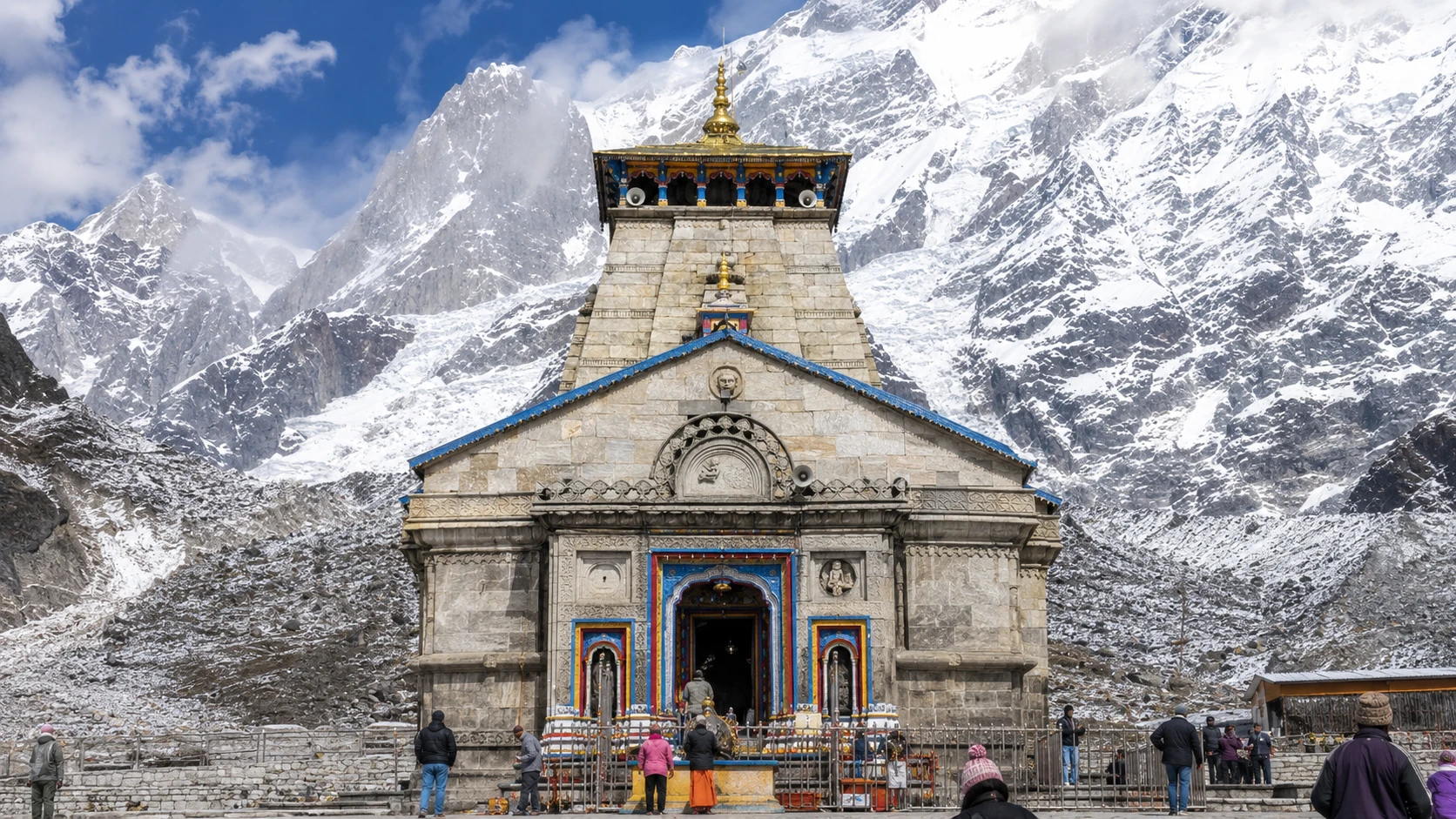
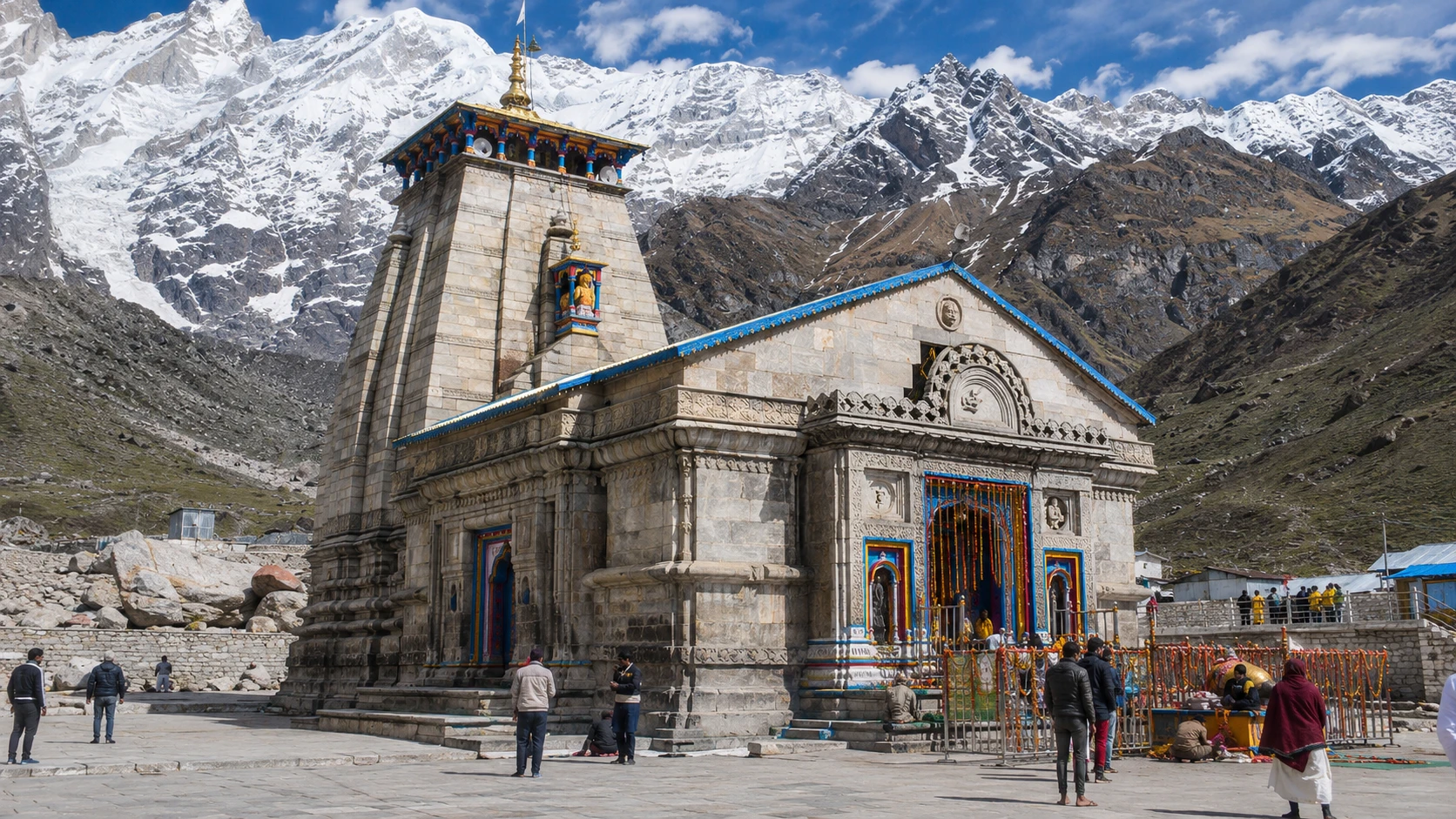
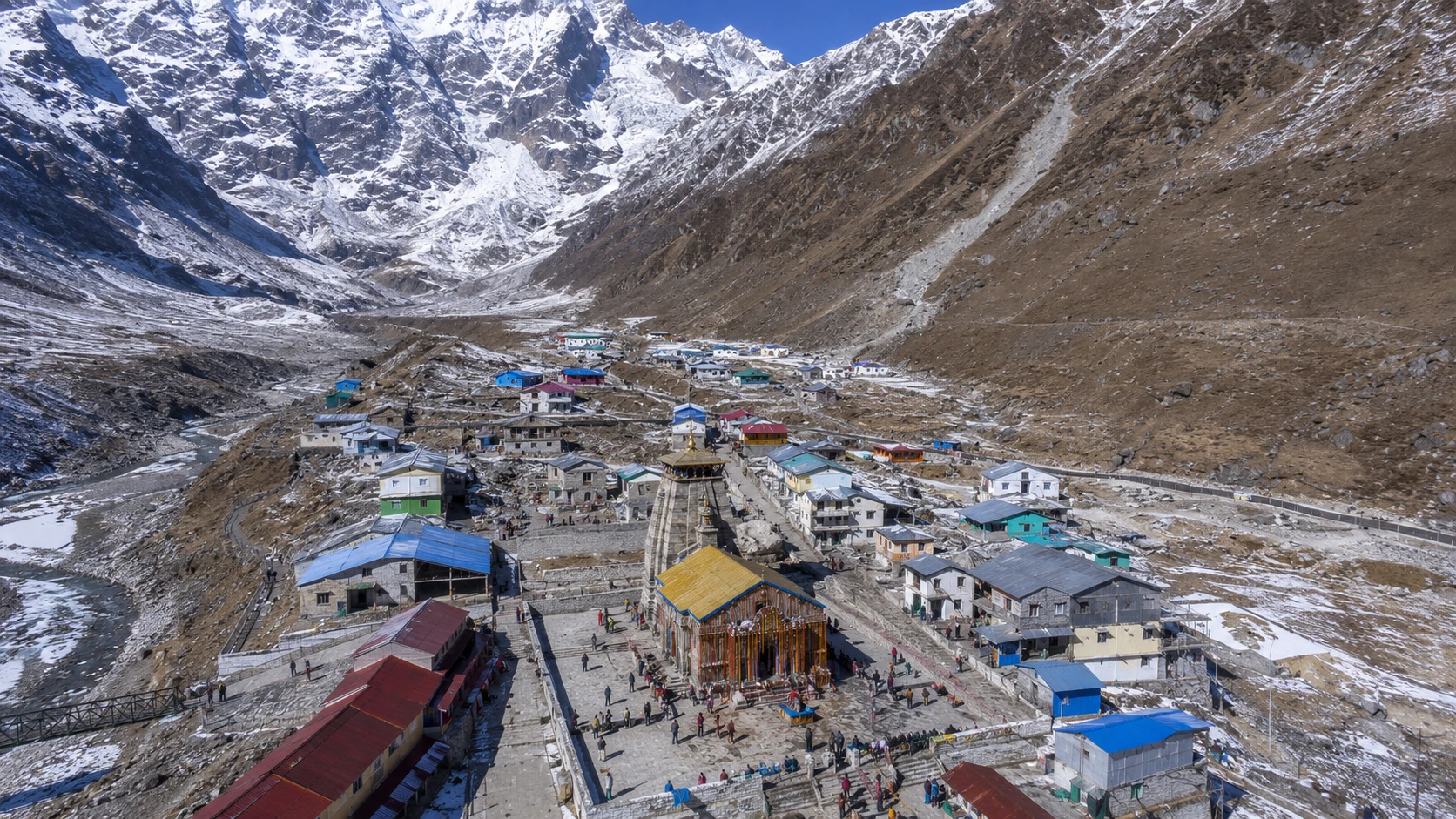
After the eighteen-day slaughter of Kurukshetra, the Pandavas were victorious but stained with the blood of kinsmen, gurus, and brahmins, sins for which only Shiva himself could grant absolution. They climbed northward into the Himalayas in search of him, but Shiva, displeased, would not grant darshan to those whose hands were so heavy with death. He took the form of a bull and hid among a herd grazing in Garhwal. Bhima, the strongest of the brothers, recognised the disguised lord by his unusual gait and seized him by the hump as he sought to dive into the earth. The body of the bull broke apart and dispersed: the hump remained at Kedarnath; the arms emerged at Tungnath; the face at Rudranath; the navel at Madhyamaheshwar; the matted hair at Kalpeshwar, together forming the Panch Kedar circuit. Pleased by the brothers' devotion, Shiva at last manifested in svayambhu form as the Kedareshwar Jyotirlinga, the conical hump-shaped lingam that pilgrims see today, and granted them moksha. This Pandava-foundation account is the central narrative of Kedarnath; the temple stands at 3,583 metres on the bank of the Mandakini at the foot of the Kedarnath peak, and is the only Jyotirlinga in the high Himalayas, accessible only for the six summer months of each year before the snows seal it again from autumn to spring.
Sacred Designationपवित्र पदनाम
5th of 12 Jyotirlingas
बारह ज्योतिर्लिंगों में 5th
Historyइतिहास
The history of Kedarnath as a pilgrimage site reaches into the prehistoric: the kshetra is named in the Skanda Purana's Kedar Khanda, a composite text of Puranic-period material whose latest layers date to the early second millennium CE but whose Garhwal-pilgrimage core is much older.
The site sits at 3,583 metres on the Mandakini, in a glacial valley scoured by the retreating ice of the late Pleistocene; geological surveys after the 2013 disaster confirmed striations on the temple's exterior stones consistent with prolonged glacial cover, suggesting the temple was buried under ice during much of the Little Ice Age (roughly 13th to 17th centuries CE) and uncovered as the glaciers withdrew.
The Pandava-foundation account of the Skanda Purana places the original temple's construction at the close of the Mahabharata war; tradition unanimously credits the Pandavas with the building, but the present cyclopean stone structure cannot be dated to that period and represents a much later reconstruction in the same form.
The most influential historical event in Kedarnath's medieval life is the visit of Adi Shankaracharya in the 8th, 9th century, who is held by tradition to have restored the dilapidated shrine, established the lineage of Veera Shaiva Rawal priests from Karnataka who continue to officiate to this day, and to have attained samadhi at Kedarnath itself, a tradition contested by alternative accounts placing his samadhi at Kanchipuram, but maintained by the Jyotirmath (Joshimath) lineage which is the northern of his four mathas and which administered Kedarnath through the medieval centuries.
The Garhwal kingdom under successive Katyuri and Pawar dynasties patronised Kedarnath through the medieval period; copper-plate inscriptions of the Garhwal Pawars reference grants to the temple from the 14th century onward.
Mughal-era records make almost no reference to Kedarnath, in part because the route was effectively impassable for non-pilgrim military expeditions; the temple appears to have been left undisturbed by the political churn of the plains.
The Tehri Garhwal kingdom under the Pawar Rajputs (1803, 1949) administered the temple through the modern period until the merger of Tehri Garhwal with India in 1949 and subsequent transfer of administration to the Government of Uttar Pradesh, then in 2000 to Uttarakhand. Edwin T.
Atkinson's monumental Himalayan Districts gazetteer of 1882 contains the first detailed European-period documentation, including a description of the temple's Katyuri masonry that remains a primary reference. The most catastrophic event in modern memory is the Kedarnath disaster of 16, 17 June 2013, when a glacial-lake outburst from Chorabari Tal upstream of the temple, combined with extreme monsoonal rainfall, generated a flash flood that destroyed the lower town, killed and disappeared several thousand pilgrims and residents, and would have erased the temple itself but for an enormous boulder, Bheemshila, that lodged behind the structure and split the floodwaters around it.
The temple emerged structurally intact from the disaster; the surrounding town did not. Reconstruction of the kshetra has been ongoing since 2014 under combined Uttarakhand state and central government initiatives, and on 5 November 2021 a 12-foot, 35-tonne statue of Adi Shankaracharya was unveiled at the samadhi site behind the temple, replacing the original which had been swept away in 2013.
Pilgrim numbers have recovered and exceeded pre-disaster levels: the 2023 yatra registered approximately 1.96 million pilgrims, the highest in the temple's recorded history.
Historical Timelineऐतिहासिक कालक्रम
The historicity of the Pandava-era foundation cannot be archaeologically established and rests entirely on Puranic and oral traditional authority. Modern historians treat the present cyclopean stone temple as a much later reconstruction (likely Katyuri-period) preserving an older traditional form rather than as the literal Pandava-period structure.
The dating of Adi Shankaracharya's life is disputed in the same range as elsewhere in his hagiography (traditional 788, 820 CE; alternative scholarly proposals 6th, 9th century). The samadhi location is genuinely contested between northern and southern matha traditions; the Eternal Raga editorial position is to record the Kedarnath samadhi tradition as held by Jyotirmath while flagging the Kanchipuram counter-tradition. The Karnataka Veera Shaiva Rawal lineage at Kedarnath is well-attested in modern times and remains the active priestly community, regardless of the Shankara samadhi question.
Casualty figures for the disaster vary substantially across sources: the Government of Uttarakhand initially confirmed several hundred deaths, with thousands listed as missing; the Comptroller and Auditor General's audit and subsequent state assessments have placed the death-and-missing total at over five thousand. Independent estimates by NGOs and journalistic investigations have proposed higher figures. The wide range reflects the difficulty of confirming missing-presumed-dead in the high-altitude debris field and the absence of verified pilgrim-registration records at the time of the disaster. Eternal Raga records the figure as 'several thousand' to reflect this range without committing to a contested specific number.
What You'll Seeदर्शन में
The deity at Kedarnath is a self-manifested (svayambhu) lingam of unusual irregular form: a conical, broadly pyramidal block of dark stone rising approximately three to four feet from the floor of the garbhagriha, somewhat broader at the base and tapering toward a rounded apex, with the entire surface softened by millennia of abhishekam.
Tradition identifies this form as the hump (prishtha) of the bull-shape Shiva took when fleeing the Pandavas, and reads the irregularity as the natural break-line where the bull's body parted as it dove into the earth. The lingam is unlike most Jyotirlingas in being not a smooth cylindrical shaft but an asymmetric outcrop, and is treated in liturgy as svayambhu (self-emerged) rather than installed.
The garbhagriha around it is unornamented stone, dim, and very old; the temple is built of large grey ashlar stone slabs joined without mortar in a cyclopean technique that is itself part of the iconography in the broader sense, the stones are described in tradition as having been arranged by the Pandavas (later restorers having only re-arranged stones broken by frost, never quarrying afresh).
The mandapa contains images of the Pandavas, of Krishna, of Nandi (the bull), and of the kshetrapal Bhairavnath, whose separate shrine sits a short walk above the main temple. The exterior of the temple, when visible above the snowline in summer, presents a stark, austere silhouette of stone against the white-and-grey backdrop of the Kedarnath peak (6,940 m) and the Kedar Dome (6,831 m).
A statue of Nandi, the bull whose hump is the very deity inside, stands in the open courtyard facing the temple's southern entrance. Photography of the lingam itself is prohibited at all times by order of the Sri Badrinath-Kedarnath Temple Committee and the temple Rawal; the deity is kept unphotographed, and pilgrims experience darshan only in person.
Distinctive Practicesविशिष्ट परंपराएँ
Doli Yatra (Palanquin Procession of the Utsav Murti)
डोली यात्रा (उत्सव मूर्ति की पालकी यात्रा)
The most distinctive Kedarnath practice is the Doli Yatra: the seasonal palanquin procession of the temple's utsav murti (festival image of Kedareshwar) between Kedarnath and the winter abode at Omkareshwar Temple, Ukhimath. On the auspicious day of Bhai Dooj (Yama Dwitiya, the day after Diwali), as winter approaches and Kedarnath is to be sealed, the utsav murti is placed in a silver-and-wood palanquin and carried down from the temple by hereditary doli-bearers, accompanied by the Rawal, the priests, and a procession of devotees. The journey takes several days, descending through Gaurikund, Sonprayag, Guptkashi, and finally to Ukhimath, where the murti is enthroned at the Omkareshwar Temple for the entire winter. There the daily worship continues unbroken, the deity is in residence at the lower-altitude winter seat. On Akshaya Tritiya in spring (April, May), the procession reverses: the murti is carried back up to Kedarnath, the doors of the high temple are opened with elaborate ceremony, and the summer yatra season formally begins. The Doli Yatra is one of the oldest continuously-observed pilgrimage practices in the Indian Himalayas; the precise calendrical timings are determined by the Rawal in consultation with the Tehri Garhwal kingdom's rajguru tradition.
The Doli Yatra preserves a continuous lineage of worship: the deity does not 'rest' for the winter, the deity moves. The seasonal descent and ascent recapitulate the foundational mythology in which Shiva moved through the Garhwal landscape, and the daily worship at Ukhimath in winter ensures that no day in the year passes without Kedareshwar receiving abhishekam. Pilgrims who cannot reach Kedarnath in summer can still receive the deity's darshan at Ukhimath in winter; the practice thus democratises access to one of the most physically demanding pilgrimages in Sanatana Dharma.
Bhairavnath Darshan as Mandatory Companion-Pilgrimage
अनिवार्य सह-तीर्थ के रूप में भैरवनाथ दर्शन
Tradition holds that a Kedarnath pilgrimage is incomplete without darshan of Bhairavnath, the kshetrapal (territorial guardian) of Kedarnath, at his shrine a short uphill walk above the main temple. Bhairavnath is regarded as the protector who watches over Kedarnath through the long months when the main shrine is sealed in winter, his shrine remains open and his presence active even when Kedareshwar himself is at Ukhimath. Pilgrims complete their Kedarnath darshan, then climb the path to Bhairavnath, perform pradakshina, offer red cloth and lamps, and only then descend to Gaurikund. The omission of Bhairavnath darshan is regarded as gravely incomplete: tradition holds that the kshetrapal must be acknowledged, lest the pilgrim's blessings not 'settle'. The shrine itself is small and exposed, with stark images of Bhairav and his sankha-chakra weapons.
The Bhairav-Shiva pairing at sacred kshetras is a pan-Indian Shaiva pattern: the central deity (Shiva) embodies grace, while the kshetrapal (Bhairav) embodies the protective fierceness needed to guard sacred space and to enforce the boundaries between the everyday world and the consecrated. At Kedarnath, where the temple is closed for half the year and the kshetra is exposed to extreme weather, avalanches, and wildlife, the protective role is felt with particular intensity.
Adi Shankaracharya Samadhi Darshan
आदि शंकराचार्य समाधि दर्शन
Following the main darshan and Bhairavnath visit, pilgrims in the post-2021 era stop at the Adi Shankaracharya Samadhi shrine immediately behind the main temple, where the 12-foot statue of the seated Acharya stands within an enclosed mandapa on the reconstructed samadhi platform. Pilgrims circumambulate the samadhi, offer flowers and lamps, and pay homage to the lineage that, by tradition, kept the temple alive through the medieval centuries. The samadhi darshan has rapidly become a fixture of the Kedarnath pilgrimage; for the Veera Shaiva and Smarta sub-traditions, this is among the most spiritually charged moments of the entire visit, ranking equal to the lingam darshan itself.
Trek from Gaurikund and the Helicopter Alternative
गौरीकुंड से पदयात्रा और हेलीकॉप्टर विकल्प
The traditional approach to Kedarnath is on foot, by trek from Gaurikund, a journey of approximately 16 kilometres on the standard route (extended after 2013 to a partly-rerouted path crossing several rebuilt bridges over the Mandakini). The trek climbs from approximately 1,980 m at Gaurikund to 3,583 m at the temple, a vertical gain of about 1,600 m, completed by most pilgrims in 6, 10 hours of walking with stops. Pony, doli (manual palanquin), and porter services are available along the route; the doli option remains popular among older pilgrims and those for whom the trek is medically inadvisable. From 2002 onwards, helicopter services from Phata, Sersi, and Guptkashi have provided an alternate aerial darshan for those unable to undertake the trek; helicopter slots are limited and competitive, requiring advance booking through the IRCTC heli-services portal under UCADA (Uttarakhand Civil Aviation Development Authority) regulation. The choice between trek and helicopter is itself a contemporary practice: traditionally the trek was the only option, and many practitioners regard the trek as part of the tapas (austerity) of the pilgrimage.
Did You Know?क्या आप जानते हैं?
Kedarnath is the only one of the twelve Jyotirlingas located in the high Himalayas, at 3,583 metres (11,755 feet) above sea level, more than three times the altitude of any other Jyotirlinga. The temple is fully closed for approximately six winter months of every year.
The lingam at Kedarnath is not a smooth cylindrical shaft but an irregular conical-pyramidal stone outcrop, identified in tradition as the natural hump of the bull-form Shiva took when fleeing the Pandavas, making it the only Jyotirlinga with this specific iconographic form.
The Kedarnath temple survived the catastrophic flash flood of 16, 17 June 2013 because of a single enormous boulder, Bheemshila, that lodged behind the structure at the height of the flood and split the torrent into two streams that passed around the temple rather than over it. The boulder remains in place today and is a darshan-stop for pilgrims.
Geological surveys conducted after the 2013 disaster identified glacial striations on the temple's exterior stones, suggesting the structure was buried under ice for a substantial portion of the Little Ice Age (approximately 13th to 17th centuries CE), making the local tradition of Shiva 'sealing' the shrine in winter a memory of a far longer historical sealing.
Kedarnath is the head of the Panch Kedar pilgrimage circuit, five Garhwal Shiva shrines that mark the five sites where parts of the bull-form Shiva are said to have emerged: Kedarnath (hump), Tungnath (arms, the world's highest Shiva temple at 3,680 m), Rudranath (face), Madhyamaheshwar (navel), and Kalpeshwar (matted hair). The full circuit takes pilgrims roughly 14, 18 days on foot.
The deity does not stay in Kedarnath through the winter, on Bhai Dooj (the day after Diwali), the utsav murti is carried in palanquin procession down to Ukhimath at the Omkareshwar Temple, the deity's winter abode. Daily worship continues there unbroken until Akshaya Tritiya in spring, when the murti is carried back up. Kedarnath is thus the only Jyotirlinga whose deity formally relocates between two temples each year.
The hereditary chief priest of Kedarnath, the Rawal, belongs to a Veera Shaiva (Lingayat) lineage from Karnataka, said in tradition to have been brought to Garhwal by Adi Shankaracharya himself in the 8th, 9th century. Despite a thousand kilometres of mountain between Kedarnath and Karnataka, the same lineage has officiated continuously through the medieval and modern periods.
Tradition pairs Kedarnath with Pashupatinath in Kathmandu as two halves of one Lord, Kedarnath is the body (specifically the back/hump), Pashupatinath is the face. A pilgrim's journey is traditionally regarded as complete only when both have been seen.
Festivalsत्योहार
Kapat Opening, Akshaya Tritiya
कपाट उद्घाटन, अक्षय तृतीया
Maha Shivratri (observed at Ukhimath in winter)
महाशिवरात्रि (शीत में उखीमठ पर मनाई जाती है)
Shravan Maas (Sawan)
श्रावण मास (सावन)
Badri-Kedar Festival
बद्री-केदार उत्सव
Kapat Closing, Bhai Dooj (Yama Dwitiya)
कपाट समापन, भाई दूज (यम द्वितीया)
Traditional Offeringsपारंपरिक अर्पण
Primary Offerings
Bilva (bel) leaves
बिल्व पत्र (बेल पत्र)
Mandakini water
मंदाकिनी जल
Milk (dugdha)
दूध (दुग्ध)
Honey (madhu) and Curd (dadhi)
मधु और दधि
White flowers
श्वेत पुष्प
Bhasma (sacred ash)
भस्म (पवित्र भस्म)
Unique to This Temple
Brahma Kamal
ब्रह्म कमल
Ghee (ghrita) abhishekam
घृत (घी) अभिषेक
Offerings should be sourced from BKTC-authorised vendors at Gaurikund, Phata, or the temple entrance. Bringing offerings from outside the kshetra is permitted but subject to environmental rules (no plastic packaging). The trust counter inside the temple complex provides standardised offering kits at fixed prices. During peak Shravan and yatra-opening periods, the abhishekam process is time-restricted; pilgrims booking maha-abhishekam services receive priority access. Outside the kshetra, devotees can perform offerings on behalf of Kedareshwar at the Omkareshwar Temple, Ukhimath, throughout the year.
How to Reachकैसे पहुँचें
Kedarnath is a three-stage approach: long-distance travel to the Garhwal region, road travel to the trailhead at Sonprayag/Gaurikund, and final ascent on foot or by helicopter. By air, the nearest airport is Jolly Grant (Dehradun), approximately 250 km from Sonprayag, with daily commercial flights from Delhi, Mumbai, Bengaluru, and other major cities.
Heli-services to Kedarnath operate from Phata, Sersi, and Guptkashi (separate from Jolly Grant), these are short-hop helicopters dedicated to the yatra and not standard commercial flights. By rail, the nearest major railheads are Rishikesh (approximately 220 km from Sonprayag, all-day road travel) and Haridwar (240 km, similar timing); both are well-connected to the rest of India.
By road, Sonprayag is the road-head: state-run buses, shared taxis, and private cabs operate from Rishikesh and Haridwar, ascending through Devprayag, Srinagar (Garhwal), Rudraprayag, Tilwara, Agastyamuni, Kund, Guptkashi, and Phata to reach Sonprayag.
The road journey is approximately 8, 10 hours from Rishikesh to Sonprayag and is sensitive to landslides during monsoon; multiple-day buffers are advised in July and August. From Sonprayag, the final 5 km to Gaurikund is by jeep or shared vehicle; private vehicles are not permitted beyond Sonprayag.
From Gaurikund, the 16 km trek to Kedarnath proceeds along a partly-rerouted post-2013 path, with rest stops at Jungle Chatti, Bhimbali, Linchauli, Bada Linchauli, and the helipad area at Kedarnath. Pony, doli, and porter services are available on the trek route.
The alternative is helicopter from Phata, Sersi, or Guptkashi (15, 25 minutes each way), booked in advance through the IRCTC heli-services portal. All pilgrims must complete Char Dham yatra registration on the Uttarakhand Tourism portal before approach; QR code is checked at Sonprayag.
Plan Your Visitयात्रा की योजना
Sacred Soundsपवित्र ध्वनि
Did You Know? · क्या आप जानते हैं?
The same translation error that turned '33 Koti' into '33 crore' in Hinduism also happened in Buddhism. The Chinese translation of Buddhist texts rendered 'Sapta Koti Buddha' (7 Supreme Buddhas) as '7 Crore Buddhas.' The Tibetan translation got it right: 7 types, not 7 crore. One Sanskrit word, misread across two major world religions, generated two identical misconceptions independently.
Related Contentसंबंधित सामग्री
Related Scriptures
Community Reflections
🕉️
Be the first to share your reflection.