Krishna Janmabhoomi
कृष्ण जन्मभूमि
Janmasthan of Lord Krishna, second of the seven Mokshapuri cities
Mathura, Uttar Pradesh, India
Śrī Kṛṣṇa JanmasthānaAlso known as: Shri Krishna Janmasthan, Krishna Janmabhoomi, Keshava Deva Temple (historic, 1618, 1669), Katra Keshav Dev (precinct name), Janmasthan Mandir
Era
Hindu sacred geography pre-historic per Bhagavata Purana tradition (Dvapara Yuga, traditionally c. 3228 BCE in Vaishnava chronology); first archaeologically attested Vaishnava temple at the site dates to c. 1st century CE per A W Entwistle; the Katra Keshadev temple built c. 1150 CE was destroyed by Sikandar Lodhi (early 16th century); rebuilt by Bir Singh Deo Bundela in 1618 as the Keshava Deva temple; destroyed by Aurangzeb in 1669; current Shri Krishna Janmasthan complex completed in stages 1965, 1982
Architecture
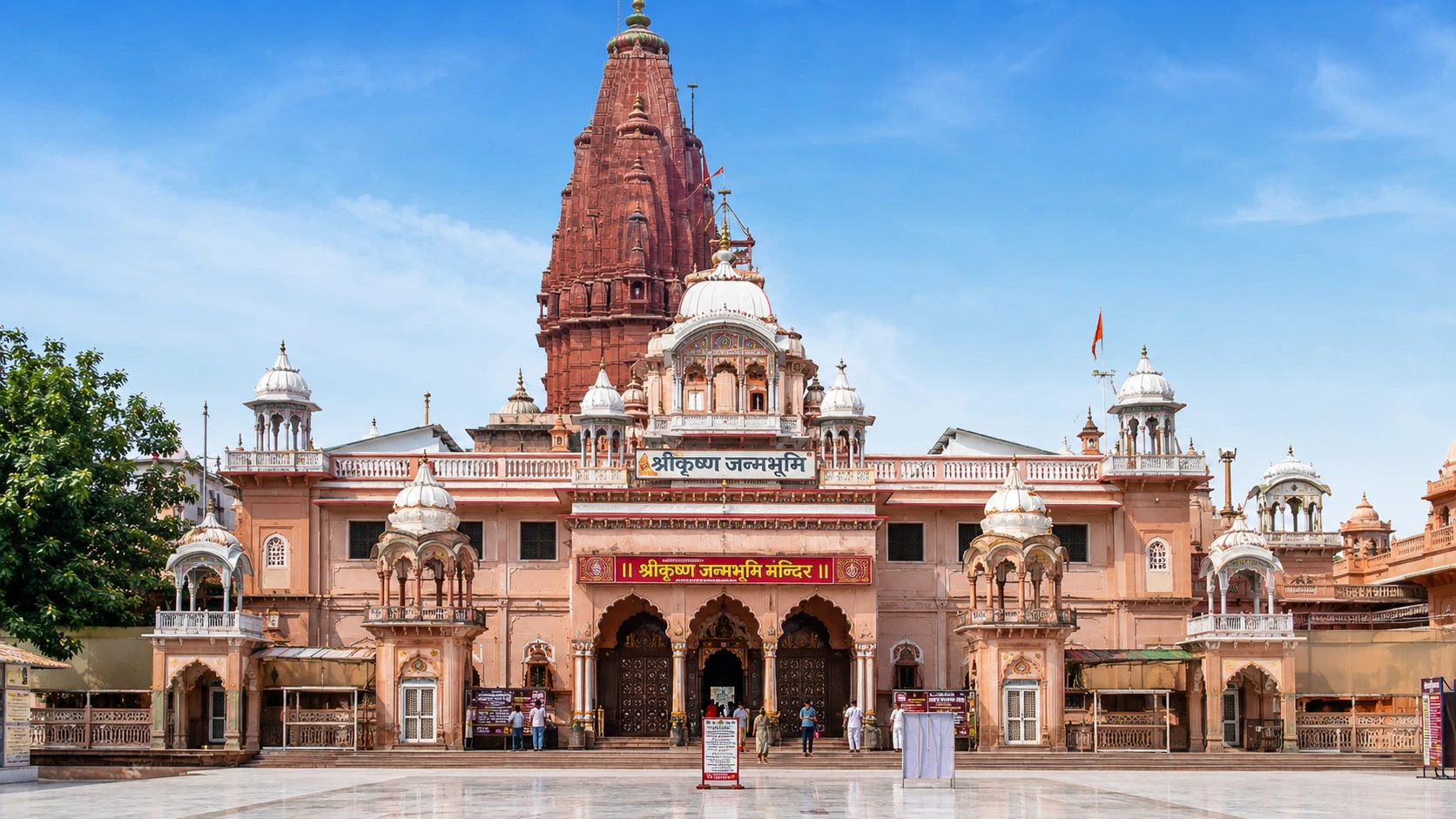
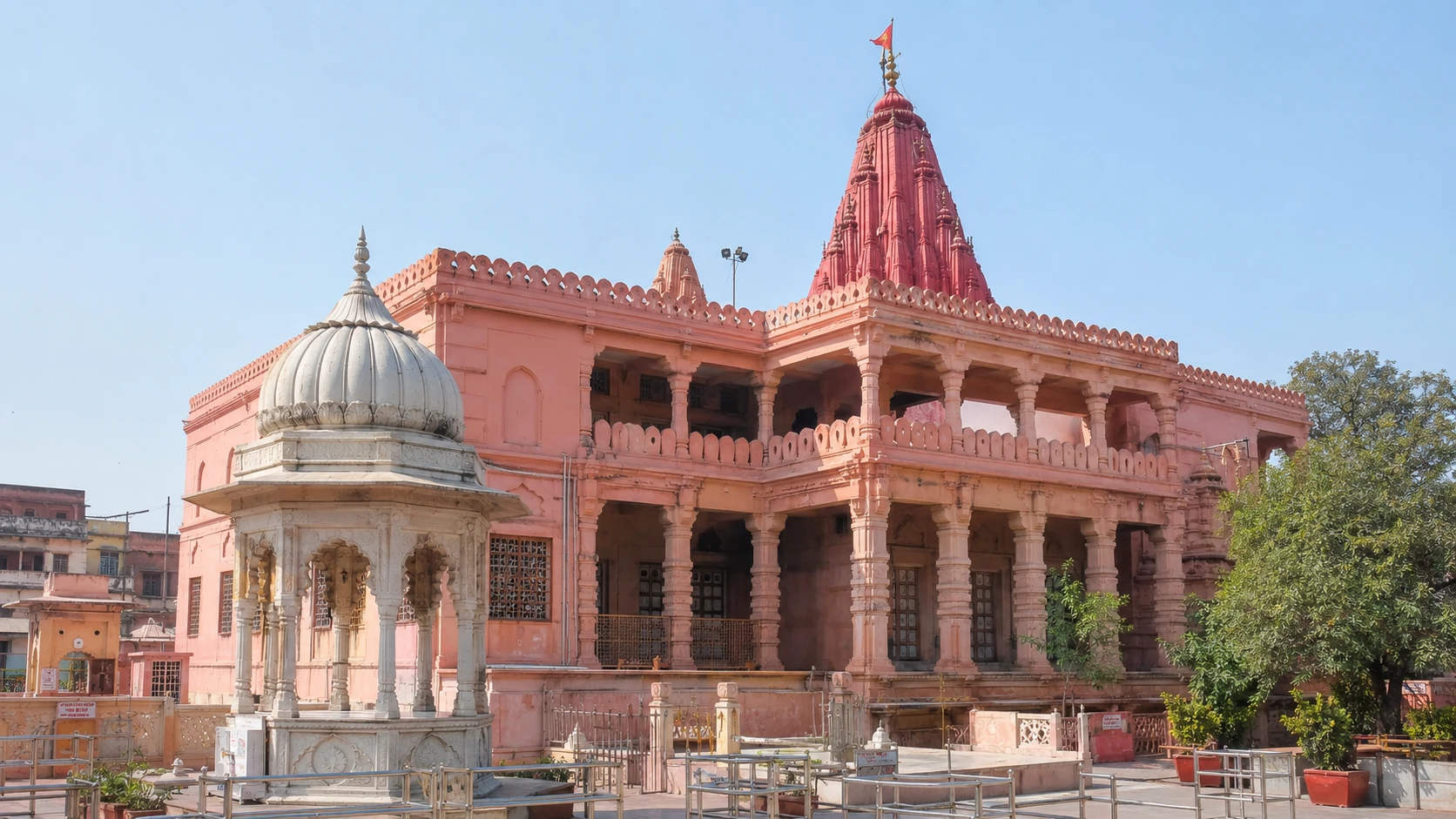
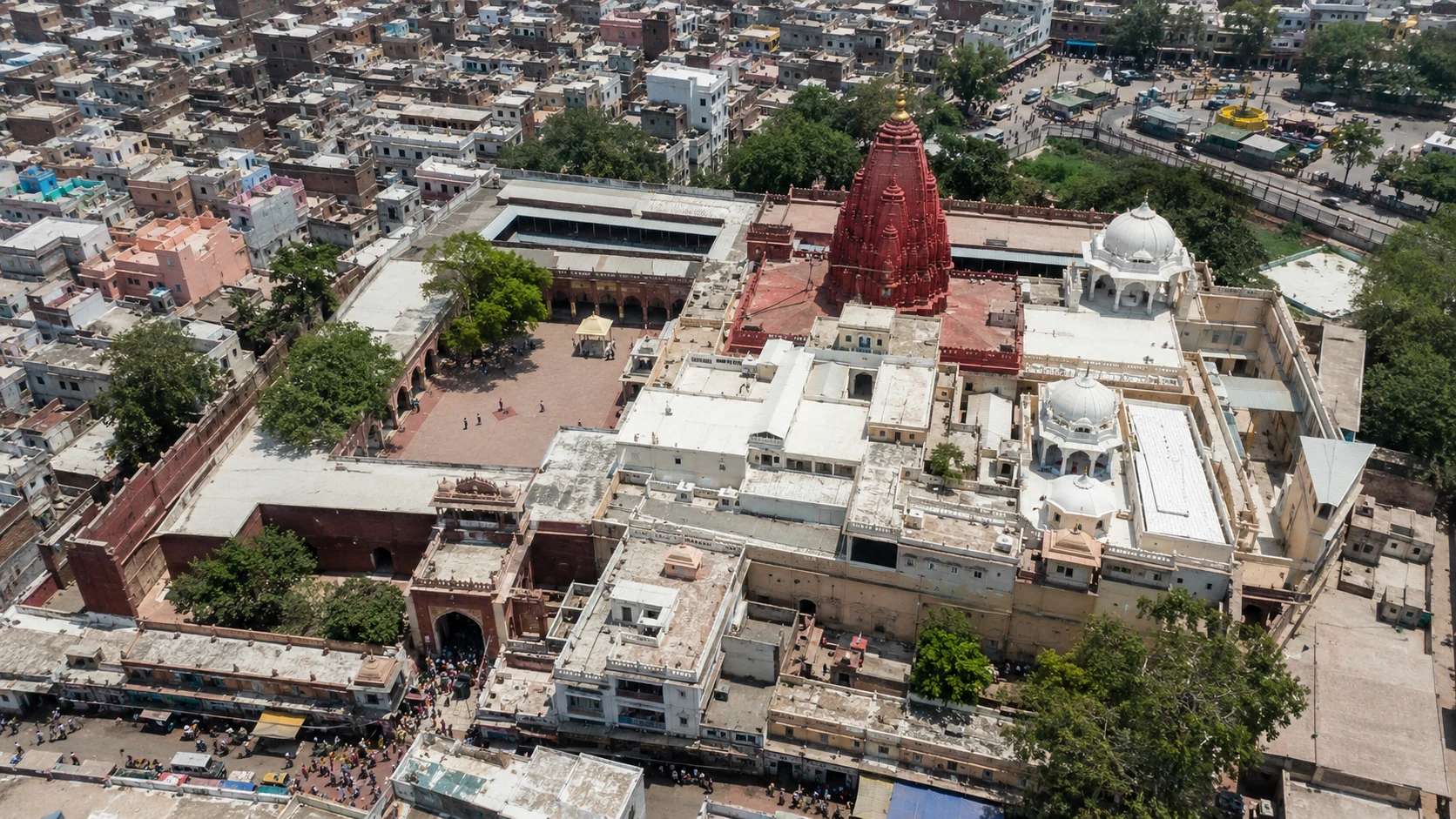
North Indian Nagara temple complex with mid-20th-century reconstruction sensibility; the principal sanctum is structured as the 'Garbha Griha' representing the original prison cell, a small dark enclosure unlike standard Hindu temple sanctums; surrounding shrines include Bhagavata Bhavan, Yogamaya temple, and Keshava Deva temple; the complex shares a wall with the adjacent Shahi Idgah Masjid
Open
05:00 – 21:00
Aarti
05:30 · 08:00 · 12:00 · 16:00 · 20:00
Special
Janmastami Mahotsav darshan beginning at midnight on Bhadrapada Krishna Ashtami is the most-attended event of the year; Trust issues special passes via the Shri Krishna Janmasthan Seva Sansthan administration. Substantial security and queue arrangements during Janmastami; multi-hour wait times common. Mobile phones, cameras, large bags, leather goods, and electronic items prohibited inside the temple complex; cloakrooms (saamaan-ghar) at the entry. The complex requires deeper-than-usual security screening due to the adjacent Shahi Idgah and the litigation environment.
The Sacred Legend · पवित्र कथा
Krishna Janmabhoomi marks the spot where, according to the Bhagavata Purana's tenth canto, Lord Krishna, the eighth avatara of Vishnu, was born at midnight on the Ashtami of the dark fortnight of Bhadrapada, in a prison cell in the city of Mathura where his parents Vasudeva and Devaki had been imprisoned by Devaki's tyrant brother Kamsa. Mathura is the second of the seven Mokshapuri cities listed in the canonical Mokshapuri Stotram, and is the foundational tirtha of the entire Krishna devotional tradition that radiates outward through Vrindavan, Govardhan, Dwarka, and across the global Vaishnava world. The current Shri Krishna Janmasthan temple complex, completed in stages between 1965 and the early 1980s under the Shri Krishna Janmasthan Seva Sansthan, stands at the site where the Janmabhoomi shrine, known historically as the Keshava Deva temple, was built, destroyed, and rebuilt across two thousand years. The garbhagriha at the temple is held to be the original prison cell where Krishna's birth occurred, an intimate, enclosed darkness that pilgrims approach not as a place of spectacle but as the tirtha where divinity once squeezed itself into a single midnight birth, three thousand years ago and still.
Sacred Designationपवित्र पदनाम
One of the Seven Moksha Citiesसप्त पुरी
Sacred Origin Storyपवित्र उत्पत्ति कथा
Source: Bhagavata Purana (Skanda 10), Vishnu Purana (Amsha 5), Harivamsha (sections 1, 4), Brahma Vaivarta Purana, Garga Samhita, widely-attested across the Krishna tradition
In the city of Mathura, on the banks of the Yamuna river, ruled a tyrant. His name was Kamsa, son of Ugrasena, ruler of the Yadavas, and he had imprisoned his own father to seize the throne. On the day of his sister Devaki's wedding to the noble Vasudeva, as Kamsa drove the bridal chariot himself in a gesture of brotherly affection, an akashvani, a voice from the sky, spoke through the air to all who could hear: 'Kamsa, the eighth child of this Devaki shall be your death.'
Kamsa drew his sword to kill his sister on the spot. Vasudeva intervened with a vow: every child Devaki bore, he would deliver into Kamsa's hands. Mollified but not appeased, Kamsa imprisoned Vasudeva and Devaki in a stone cell at the heart of his palace, iron-bound doors, posted guards, a single small window onto the night.
There, over the years, Devaki bore six sons, and Kamsa killed each one in infancy, six small bodies dashed against the prison stones.
When the seventh child was conceived, the goddess Yogamaya, on Vishnu's instruction, transferred the embryo from Devaki's womb to that of Rohini, Vasudeva's other wife, who lived in safety across the Yamuna in the cowherd village of Gokul. Devaki was reported to have miscarried.
The seventh child was Balarama, born in Gokul to Rohini, the elder white-skinned brother who would shadow Krishna through every step of the Bhagavata.
Then the eighth conception. Devaki's body began to glow with an inner light that no walls could contain. Kamsa, terrified, doubled the guards. Eight months passed. Vasudeva and Devaki, in their cell, prayed.
In the deepest dark of the eighth lunar night of the Bhadrapada Krishna Paksha, at the precise midnight hour, under the constellation Rohini, when the Sun was in Leo and the moon was rising, a child was born to Devaki within the prison cell. He was deep blue in complexion, like a stormcloud holding rain. His face was perfect.
His four hands held the Vishnu emblems, conch, discus, mace, and lotus. The cell filled with light.
Vasudeva and Devaki bowed before the child, recognizing Vishnu himself. The child smiled, contracted to the form of an ordinary newborn, and instructed Vasudeva to carry him across the Yamuna to Gokul. Then the most extraordinary night in the Bhagavata began.
The locks of the prison cell opened by themselves. The guards fell into a deep sleep. The chains slipped from Vasudeva's wrists. He took the infant Krishna in a basket, set it on his head, and walked from the prison into the night. The Yamuna river, swollen with rain, parted to let him cross to Gokul.
Sheshanaga, the cosmic serpent, raised a thousand-hooded canopy over the infant to shelter him from the falling rain. In Gokul, in the cowherd household of Nanda and Yashoda, a daughter, Yogamaya in human form, had just been born. Vasudeva exchanged the children. He carried the daughter back to Mathura, restored her to the prison cell, fastened the chains, and waited.
When dawn came and Kamsa, alerted by the guards, hurried to the cell to kill the eighth child, he found a daughter. He seized her by the foot and dashed her against a stone, but she rose into the air as the goddess Yogamaya, the eight-armed form of Devi, and spoke: 'Kamsa, the one who will kill you is already born and growing in safety. Your time has come.'
Krishna grew in Gokul among cowherds, his divinity hidden in the form of an ordinary blue-skinned child. The Bhagavata's tenth canto, the longest and most beloved book of all Hindu scripture, narrates the boyhood that followed: the slaying of demons sent by Kamsa, the lifting of Govardhan hill against Indra's storm, the rasa lila with the gopis, the playful ascent through the leelas of pre-adolescent and adolescent divinity that Vaishnava devotion would build itself around for the next three thousand years.
But the Janmabhoomi, the place of birth, is the prison cell in Mathura, the closed dark room where the avatara entered the world. Pilgrims approach the garbhagriha at the Janmasthan with the awareness that this is not a place of spectacle but of profound interiority: the tirtha where divinity once squeezed itself into a single human birth, in a single cell, in a single midnight, three thousand years ago and still.
Sources cited:
- Bhagavata Purana, Skanda 10, Adhyayas 1, 4 (the Krishnavatara narrative, Devaki's wedding, the akashvani, the imprisonment, and the night of the birth)
- Vishnu Purana, Amsha 5, Adhyayas 1, 4
- Harivamsha, Vishnu Parva, Adhyayas 1, 6
- Garga Samhita, Goloka Khanda, devotional retelling with theological elaboration
- Brahma Vaivarta Purana, Krishna Janma Khanda
Other Traditions · अन्य परंपराएँ
Buddhist canonical and historical tradition, Mathura as a major Buddhist center
Mathura was, for nearly a thousand years from the Mauryan period through the Gupta period (c. 300 BCE, 500 CE), among the foremost Buddhist centers in the Indian subcontinent. The Mathura School of art, flourishing especially in the Kushan period (1st, 3rd centuries CE), produced some of the earliest standing Buddha images known to art history, the figure of the Buddha as standing teacher rather than as the symbolic empty seat of pre-image Buddhist iconography.
The Pali Canon refers to Mathura repeatedly; the Buddha's chief disciple Sariputra is recorded as having visited. Hiuen Tsang, the Chinese Buddhist pilgrim who traveled India in the 7th century, recorded twenty active Buddhist monasteries with two thousand monks at Mathura, alongside numerous stupas attributed to the Mauryan emperor Ashoka.
The Mahasanghika and Sarvastivada Buddhist schools both maintained major institutional presence at Mathura. The Buddhist tradition at Mathura declined gradually through the post-Gupta period and disappeared as a living monastic presence by approximately the 12th century, though the archaeological record, including the extensive sculpture finds at Kankali Tila and elsewhere in the Mathura region, remains foundational to Buddhist art history.
Jain tradition, Mathura and the Yadava connection to Tirthankara Neminatha
Mathura is one of the most foundational Jain sites in the subcontinent, with the Kankali Tila excavations (Vincent A Smith, 1888, 1891) revealing extensive Jain stupas, sculpture, and inscriptions primarily of the Mathura School in the Kushan and Gupta periods.
The 22nd Tirthankara of this avasarpini, Neminatha (also called Aristanemi), is woven into the Yadava genealogy that the Hindu tradition associates with Krishna: in the Jain Antagada-Dasao and the Trishashti-shalaka-purusha-charitra of Hemachandra, Neminatha is described as the cousin of Krishna, Neminatha's father Samudravijaya was the elder brother of Vasudeva.
The Jain tradition holds that Neminatha attained kevala-jnana (omniscience) and that Krishna himself paid him devotion. The Jain Mathura tradition therefore does not displace the Krishna tradition but locates a parallel sacred genealogy through the same Yadava lineage.
Jain religious presence at Mathura, like the Buddhist, declined after the post-Gupta period but the Digambara and Shvetambara Jain traditions continue to maintain ritual interest in the site.
Historyइतिहास
Mathura's sacred status in the Krishna tradition is foundational, the Bhagavata Purana's tenth canto opens at this city. The historian A W Entwistle records that the first Vaishnava temple at the Krishna Janmasthan site was probably built in the 1st century CE, in the Kushan period when Mathura was simultaneously a major Vaishnava, Buddhist, and Jain center; the Heliodorus Pillar at Vidisha (c. 113 BCE) attests that even Greek diplomats had begun adopting Vasudeva-Krishna devotion, evidence of the tradition's pre-Christian-era reach.
A major Katra Keshadev temple was built around 1150 CE under Maharaja Vijaya Pala Deva, described in a Sanskrit inscription as 'brilliantly white and touching the clouds.' This temple was destroyed during Mahmud Ghaznavi's raid on Mathura in 1017 CE and again by the Delhi Sultanate ruler Sikandar Lodhi in the early 16th century.
Bir Singh Deo Bundela, the Orchha ruler, rebuilt the temple in 1618 as the Keshava Deva temple, an act recorded in his court chronicles. In 1669, the Mughal emperor Aurangzeb ordered the demolition of the Keshava Deva temple as part of his broader campaign against major Hindu temples; the Shahi Idgah Masjid was constructed at the site immediately afterward, its construction documented in the Maasir-i-Alamgiri.
Small shrines were maintained around the site through the subsequent two centuries. In 1815 the British East India Company auctioned the Katra Keshav Dev land, which was acquired by Raja Patnimal of Banaras, who attempted but could not complete a temple reconstruction.
In 1944 Jugal Kishore Birla acquired the land, and in 1951 the Shri Krishna Janmabhoomi Trust was constituted with Madan Mohan Malaviya, Hanuman Prasad Poddar, and Birla as principals; the Shri Krishna Janmasthan Seva Sansthan, formed in 1958, undertook the modern temple complex construction in stages between 1965 and 1982.
The Shahi Idgah Masjid stands adjacent to the temple complex, sharing a wall, and is the subject of active and ongoing litigation in the Allahabad High Court and the Supreme Court of India through 2025.
Historical Timelineऐतिहासिक कालक्रम
Mahmud of Ghazni's seventh raid on India targeted Mathura. The Persian court chronicle Tarikh-i-Yamini by Abu Nasr Muhammad Utbi describes the city as containing 'a thousand temples,' which Mahmud's forces plundered systematically over twenty days, melting down recovered idols for their gold and carrying the bullion to Ghazni. Utbi attributes admiration to Mahmud for the Mathura temples even as he ordered their destruction, a notable rhetorical detail in the source. The Krishna Janmasthan precinct, including any temple structure standing at the time, was destroyed during this raid. Mathura's Vaishnava devotional life recovered slowly across the next century, with the c. 1150 CE Katra Keshadev temple representing the most significant subsequent reconstruction prior to the early-modern period.
Bir Singh Deo Bundela, the Orchha ruler, completed the construction of the Keshava Deva temple at the Krishna Janmasthan site. The temple was reportedly funded at a cost of approximately 33 lakh rupees of the period, a sum of major scale by early 17th-century reckoning, and was constructed in the Bundela architectural style with substantial sandstone and marble work. The Keshava Deva temple stood as one of the foremost Vaishnava temples of the Mughal period for fifty-one years, drawing pilgrim attention from across north India. European travelers including Jean-Baptiste Tavernier (visiting 1640s, 1660s) and François Bernier (1659) recorded the temple's prominence. Bir Singh Deo's patronage was made possible by his close relationship with the Mughal emperor Jahangir, who granted him substantial autonomy as the Bundela ruler.
On the orders of the Mughal emperor Aurangzeb, the Keshava Deva temple at the Krishna Janmasthan was demolished as part of his broader campaign against major Hindu temples (the same campaign included the destruction of the Vishwanath temple at Varanasi the same year and the Somnath temple at Veraval shortly afterward). The Maasir-i-Alamgiri, the official court chronicle of Aurangzeb's reign compiled by Saqi Mustaid Khan, records the order in formal language: 'It was ordered that the temple of Keshav Rai at Mathura should be demolished.' The Shahi Idgah Masjid was constructed at the site immediately afterward, with materials from the demolished temple reportedly incorporated into its foundations. The Krishna deity-images that survived the demolition are recorded as having been transferred to safer locations in Rajputana, including to Govind Devji at Jaipur and to Nathdwara, where they remain.
The demolition is documented in primary Mughal court records and is not contested as an event. Scholarly debate concerns interpretation: whether Aurangzeb's temple-destruction campaigns were religiously motivated (the traditional view, supported by Jadunath Sarkar and contemporary court rhetoric), politically motivated against zamindars who had revolted (the revisionist view associated with Audrey Truschke and others), or some combination thereof. The Maasir-i-Alamgiri's own framing presents the demolitions as part of an Islamic-orthodox religious campaign, but modern historians draw on a wider archive of farmans and revenue records to argue for additional political dimensions. The demolition's factuality is settled; its motivations remain a live scholarly question.
Industrialist Jugal Kishore Birla acquired the Katra Keshav Dev land in 1944 from the descendants of Raja Patnimal of Banaras (who had purchased it at the 1815 British East India Company auction). On 21 February 1951, the Shri Krishna Janmabhoomi Trust was constituted with Madan Mohan Malaviya, Hanuman Prasad Poddar, and Jugal Kishore Birla as principal trustees, formed specifically to oversee the reconstruction of the Janmabhoomi temple. The Shri Krishna Janmasthan Seva Sansthan was registered in 1958 as the operational body for the temple complex. Construction of the modern temple complex proceeded in stages from 1965 through 1982, beginning with the Bhagavata Bhavan (the principal temple structure with the central garbhagriha shrine) and the surrounding subsidiary shrines for Yogamaya, Balarama, and Keshava Deva. The complex was deliberately built on the precinct adjacent to the Shahi Idgah Masjid rather than at the exact prison-cell location (now within the Idgah's footprint), preserving the legal status quo while reactivating worship at the broader Janmabhoomi site.
From 2020 onwards, multiple civil suits have been filed in the Mathura district court by Hindu petitioners, initially in October 2020 by advocate Vishnu Jain on behalf of 'Bhagwan Shri Krishna Virajman' and other plaintiffs, seeking removal of the Shahi Idgah Masjid from the 13.37-acre Katra Keshav Dev land claimed as the full Krishna Janmabhoomi precinct, and restoration of the temple. The earlier 1968 compromise between the Shri Krishna Janmasthan Seva Sansthan and the Shahi Idgah Trust, which had partitioned the land between the temple and mosque, was challenged on grounds including that the deity (a juristic person) was not a party to the original compromise. On 14 December 2023, the Allahabad High Court allowed an application for the appointment of a court commissioner to inspect the mosque. Eighteen connected suits were subsequently transferred from the Mathura civil court to the Allahabad High Court itself. In December 2024, the Supreme Court (CJI Sanjiv Khanna, Justice P V Sanjay Kumar) raised concerns about the Allahabad HC's transfer-of-jurisdiction order. On 4 July 2025, a single bench of the Allahabad High Court (Justice Ram Manohar Narayan Mishra) declined to declare the Shahi Idgah Masjid a 'disputed structure' as petitioners had requested. The litigation is active and pending across multiple matters and forums as of editorial verification.
The Mathura litigation is structurally analogous to but distinct from the Ayodhya proceedings. The Ayodhya 2019 verdict explicitly stated that it should not be treated as precedent for similar disputes elsewhere. The Mathura case turns on the validity of the 1968 land-partition compromise, the application of the Places of Worship (Special Provisions) Act 1991, and the question of whether archaeological survey can or should occur. As of the editorial verification date, the litigation is alive across multiple forums and no final determination has been reached. Eternal Raga's editorial position is to document the proceedings factually with primary citations and not to predict or advocate for any specific resolution. Updates to this entry should be expected as proceedings progress.
What You'll Seeदर्शन में
The Shri Krishna Janmasthan complex is structurally unlike most major Hindu temples, its principal sanctum is not a grand sculpted sanctum but a small, dark, enclosed cell intentionally preserved as the Garbha Griha, the prison room where, by tradition, Devaki gave birth to Krishna at midnight three thousand years ago.
Pilgrims enter the Garbha Griha through a low doorway and find inside an idol of Devaki cradling the newborn Krishna, Vasudeva alongside in chains, and architectural elements that evoke the carceral setting, iron-bound bars, a single small window, walls deliberately closed in.
The atmosphere is intentionally cave-like, with low light and close stone, in contrast to the openness and scale of the larger Bhagavata Bhavan that surrounds it. The contrast is the whole iconographic point: divinity entered the world not in a palace or a sanctified hall but in the most cramped and unjust space the antagonist could devise, and the Janmasthan preserves that closeness as the central pilgrim experience.
The Bhagavata Bhavan, the principal multi-storey temple structure of the complex, was completed in stages from the late 1960s onward and houses the principal worship deities. The garbhagriha of Bhagavata Bhavan enshrines Yugal Sarkar, Krishna in the form of the divine flute-player (murali-dhara) with Radharani at his side as the divine couple, the dyad at the heart of medieval Vaishnava bhakti.
Subsidiary shrines around the precinct are dedicated to Keshava Deva (the historic deity-name of the temple, depicting Krishna in his royal Mathura avatara), Yogamaya Devi (the goddess who took the form of Yashoda's daughter and announced Kamsa's doom, depicted in eight-armed warrior form), Balarama (Krishna's elder brother, white-skinned, bearing plough and pestle), and tableaux depicting the Krishna Lila scenes of Vrindavan, Govardhan-uddharana, and the rasa lila with the gopis.
The modern temple architecture is North Indian Nagara, designed by mid-20th-century Indian temple architects working in close consultation with the Birla and Janmasthan Sansthan trustees, blending the fortress-and-precinct architectural language appropriate to a reconstructed Janmabhoomi (heightened wall, multiple security gates, deliberate sight-line management away from the adjacent Shahi Idgah) with the devotional intimacy expected of a Krishna shrine.
The complex's eastern wall is the shared boundary with the Shahi Idgah Masjid; the architectural awareness of this adjacency shapes both the visitor's physical experience of the precinct and the security-screening intensity at every entry gate.
Distinctive Practicesविशिष्ट परंपराएँ
Janmastami Midnight Birth Ceremony
जन्माष्टमी अर्धरात्रि जन्म समारोह
Annual, Bhadrapada Krishna Ashtami midnight (August, September); the principal liturgy occurs precisely at 12:00 AM
At the precise midnight hour of Bhadrapada Krishna Ashtami, the tithi and time of Krishna's birth per the Bhagavata Purana, the Garbha Griha at the Janmasthan becomes the site of the most exact spatial and temporal commemoration possible in the Krishna tradition. Conch shells (shankhanaad) blow continuously from 11:55 PM. At midnight precisely, the abhishekam of the infant Krishna idol begins, milk, yogurt, ghee, honey, sugar, and water in succession (the Panchamrit), with chanting of the Krishna birth slokas from Bhagavata 10.3. The temple complex, packed to capacity through the day with hundreds of thousands of pilgrims, erupts in the singing of 'Nand Ke Anand Bhayo, Jai Kanhaiya Lal Ki', the traditional birth-announcement song attributed to Surdas. Special bal-bhog (child-friendly sweet offerings) is presented to the newborn, kheer, panjiri, makhana, butter, and milk, and distributed to pilgrims as prasad. The midnight ceremony continues until approximately 1:30 AM, after which the temple stays open through the night for darshan.
The Janmastami midnight ceremony at the Janmabhoomi is the most precise convergence of time, place, and being available in the Krishna tradition: the exact tithi (Bhadrapada Krishna Ashtami), the exact hour (midnight), and the exact location (the prison cell garbhagriha) of Krishna's birth, repeated annually as a living re-enactment. The Bhagavata Purana (10.3) describes the moment of birth as the convergence of all auspicious astronomical and ritual signs; the Janmasthan's annual ceremony aspires to match that convergence as exactly as the calendar permits, drawing the devotee's awareness to the precise instant in which the impossible, the supreme being entering as a human infant, actually occurred.
Garbha Griha (Prison Cell) Darshan
गर्भगृह (कारागार-कक्ष) दर्शन
Year-round, during regular temple darshan hours
The Garbha Griha darshan is the principal pilgrim ritual at the Janmasthan and is structurally unlike darshan at any other major Krishna temple. Pilgrims approach the cell through a low passageway, removing footwear and bowing under the deliberately reduced height of the entry. Inside, the cell is small enough that only a few devotees can stand at once, dimly lit, with the idol of Devaki holding the newborn Krishna at eye level rather than elevated on a high pitha. There is no abhishekam witnessed, no aarti spectacle, the darshan is silent, close, and brief. Most pilgrims take less than thirty seconds inside the cell. The brevity is intentional: the practice is designed to inscribe a single moment of intimate proximity to the birth-deity rather than a sustained darshan event. Many pilgrims report the Garbha Griha experience as the most viscerally affecting of any temple visit they have made, precisely because it inverts the typical Hindu temple's grand-sanctum logic.
The traditional Hindu temple architecture orients the devotee toward the elevated, ornamented sanctum that proclaims the deity's transcendent majesty. The Garbha Griha at Janmasthan does the opposite, it locates the deity not in transcendence but in vulnerability: a newborn in his mother's arms, in a prison, surrounded by chains. The architectural humility of the cell teaches a theological humility: that the avatara comes not from above but from within, not in glory but in confinement, not separated from the human condition but at its most constrained. Pilgrims who have completed the Char Dham, the Jyotirlingas, the Shakti Peethas, and the Divya Desams often describe the Janmasthan Garbha Griha as the temple that humbled them most, because it asks the devotee not to admire the deity but to recognize him in the smallest, most fragile possible form.
Braj-bhumi Parikrama (Chaurasi Kos Parikrama)
ब्रज-भूमि परिक्रमा (चौरासी कोस परिक्रमा)
Year-round; particularly during Phalgun (February, March) and Bhadrapada (August, September); the principal Chaurasi Kos pilgrimage runs annually and takes 30, 45 days for full completion
Krishna Janmabhoomi at Mathura serves as the structural anchor of the Braj Parikrama, an extended circumambulation of the Braj-bhumi sacred geography covering 84 kos (approximately 252 km) and visiting the principal sites of Krishna's life and lila: Mathura (birthplace), Vrindavan (childhood and rasa lila), Govardhan (the lifted hill), Barsana (Radha's home), Nandgaon (Krishna's foster home), Gokul (where the swap of children occurred), Madhuvan, Talvan, Kumudvan, and the twelve forests (dvadasha vana) of Braj. The full Chaurasi Kos parikrama takes 30 to 45 days on foot and is traditionally undertaken during Phalgun and Bhadrapada months when weather and pilgrim infrastructure are most favorable. Shorter parikrama circuits, the Govardhan Parikrama (21 km), the Vrindavan Parikrama (10 km), and the Mathura inner-city parikrama, are completable in a day each. The Braj parikrama enacts in walking what the Bhagavata's tenth canto enacts in narrative: the devotee retraces Krishna's biography geographically, the body becoming the medium of devotional memory.
The Braj Parikrama is one of the most structured biographical pilgrimages in the Hindu tradition, every kos of the route corresponds to a documented event from Krishna's life as recorded in the Bhagavata, the Harivamsha, or the medieval Vaishnava devotional literature. The act of walking the entire 84 kos is an act of devotional memory at the scale of geography: the Yamuna where Vasudeva crossed with the infant, the path to Gokul where Yashoda woke to a son not her own, the riverbank at Vrindavan where the rasa lila occurred, the Govardhan hill that Krishna lifted on a single finger. The pilgrim does not visit Krishna's life, the pilgrim walks it. The Janmasthan at Mathura is the structural anchor where this geographic biography begins and, by tradition, ends.
Did You Know?क्या आप जानते हैं?
When Aurangzeb's forces destroyed the Keshava Deva temple in 1669, the principal Krishna deity-images that had been worshipped at the Mathura Janmasthan were transferred to Rajputana for safekeeping. The principal image, Govind Devji, is today the central deity of the Govind Devji temple in Jaipur, where it is worshipped as the original Mathura Janmasthan Krishna and remains one of north India's most prominent Vaishnava shrines. Other deity-images from the Braj region, including Shrinathji, who became the central deity of Nathdwara in Rajasthan, were transferred during the same period through coordinated rescue networks of Brij priestly families. In a meaningful sense, the original Janmasthan deity tradition continues today not only at the Mathura site but also at Jaipur and Nathdwara, with the three locations forming a single pre-modern devotional memory distributed across the religious geography that the 1669 disruption forced into being.
Govind Devji Temple Trust (Jaipur) institutional history; Nathdwara Pushtimarg records of Shrinathji's transfer; Robert Stoler Miller, Songs for the Bride: Wedding Rites of Rural India (Columbia University Press, 1985); A W Entwistle, Braj: Centre of Krishna Pilgrimage (Egbert Forsten, 1987), for the seventeenth-century Vaishnava deity-rescue networks
The Mathura School of art, flourishing from the 1st century BCE through the 5th century CE, is one of the two great schools of early Indian sculpture (the other being Gandhara). The Mathura School produced the foundational Krishna iconography, the murali-dhara flute-playing form, the Govardhan-uddharana hill-lifting form, the Yashoda-with-child Bal-Krishna form, that would dominate Krishna devotional art across the Indian subcontinent for the next two thousand years. The Mathura sculpture is recognizable by its red sandstone (sourced from Sikri quarries near Mathura), its full-bodied volumetric figures, and its early integration of yakshi (female nature-spirit) iconography into mainstream Hindu, Buddhist, and Jain image-making. Major holdings of Mathura School sculpture are preserved at the Government Museum Mathura, the Indian Museum Kolkata, the National Museum Delhi, and the British Museum.
Vincent A Smith, The Jain Stupa and Other Antiquities of Mathura (Allahabad, 1901); Joanna Williams, The Art of Gupta India (Princeton University Press, 1982); Pratapaditya Pal, Indian Sculpture: A Catalogue of the Los Angeles County Museum of Art Collection (1986); Government Museum Mathura collection catalog
Around 113 BCE, well before the Common Era, Heliodorus, a Greek ambassador from the Indo-Greek king Antialcidas of Taxila to the court of King Bhagabhadra at Vidisha, erected a stone pillar dedicated to Vasudeva-Krishna. The Heliodorus Pillar at Besnagar (modern Vidisha, Madhya Pradesh) bears a Brahmi inscription explicitly identifying Heliodorus as a Bhagavata (devotee of Vasudeva), making it the earliest known Indian inscription documenting a foreigner's conversion to Vaishnava devotion. The pillar establishes that Krishna devotion was already a sufficiently formal religious tradition by the 2nd century BCE that diplomatic representatives of Hellenistic kingdoms were adopting it. The Mathura Janmabhoomi tradition is therefore older, in epigraphically attested terms, than any of the surviving competing religious-historical claims for the site.
Heliodorus Pillar Brahmi inscription, Besnagar (Vidisha); Archaeological Survey of India inventory; D C Sircar, Select Inscriptions Bearing on Indian History and Civilization, Volume I (University of Calcutta, 1942), inscription number 2
The Yamuna river figures twice in the Krishna birth narrative as a participant in divine action. First, on the night of birth, Vasudeva's crossing with the infant Krishna in a basket on his head, the Yamuna, swollen with monsoon rain, parted to let him cross to Gokul; this scene is the most painted single image in the entire history of Indian devotional art. Second, during Krishna's boyhood, when the venom of the serpent Kaliya had poisoned the Yamuna at Vrindavan and was killing the cattle and gopas, Krishna jumped into the river, subdued Kaliya by dancing on his hoods, and restored the Yamuna's waters. The river's complicity with the divine, its parting, its pollution, its restoration, is foundational to the Bhagavata's understanding of the Yamuna as a goddess (Yamuna Devi, sister of Yama) actively serving Krishna throughout his lila.
Bhagavata Purana, Skanda 10, Adhyaya 3 (Yamuna parting at Krishna's birth) and Adhyaya 16 (Kaliya-mardana); Vishnu Purana, Amsha 5; Diana L Eck, India: A Sacred Geography (Harmony Books, 2012), for the Yamuna's place in the riverine sacred geography of Hinduism
Brij Bhasha, the Hindi dialect of the Mathura-Vrindavan-Agra region, became the principal devotional language of medieval Krishna bhakti, displacing Sanskrit for popular religious composition across north India between the 14th and 17th centuries. The 'Ashtachhap' (the eight seal-poets of the Pushtimarg), including Surdas (1478, 1583), Krishnadas, Govindswami, and others, composed thousands of pads (devotional songs) in Brij Bhasha that remain the core liturgy of Krishna worship from Pushtikarg ashrams to ISKCON kirtan halls. Surdas's Sursagar alone contains over 5,000 pads, mostly on Krishna's Braj-lila. The Mathura region's linguistic legacy is therefore not just a regional dialect but the lingua franca through which most Hindus across north India encounter Krishna devotion in song; the Janmabhoomi sits at the geographic heart of this linguistic-devotional ecosystem.
John Stratton Hawley, Three Bhakti Voices: Mirabai, Surdas, and Kabir in Their Time and Ours (Oxford University Press, 2005); Kenneth E Bryant, Poems to the Child-God: Structures and Strategies in the Poetry of Surdas (University of California Press, 1978); Pushtimarg ashram liturgical traditions
Visitor Accessप्रवेश जानकारी
The Shri Krishna Janmasthan complex maintains intensive security screening at all entry gates, substantially heavier than typical Hindu temple security, due to the adjacent Shahi Idgah Masjid and the litigation environment around the precinct. Mobile phones, cameras, large bags, leather goods, and electronic items are strictly prohibited inside the temple complex; cloakrooms (saamaan-ghar / jootha-ghar) are available at the main entry. Government-issued photo identification (Aadhaar, passport, voter ID, driving licence) is required for entry and may be checked multiple times. The Garbha Griha sanctum and the Bhagavata Bhavan principal sanctum prohibit all photography. The temple is open to all Hindus and visitors of all denominations and there is no caste-based, gender-based, or religious-affiliation-based restriction; the standard Hindu temple expectation of modest, covering attire applies. During Janmastami (August, September), Holi (February, March), Radhastami, and Govardhan Puja, entry windows are reorganized for crowd flow and visitors should plan an extra-day buffer. Visitors with disabilities can request wheelchair assistance and accessible queues at the Sansthan's help desks.
Spiritual Basis
Restrictions at the Janmasthan are practical and security-oriented, not theological. The complex's heightened security reflects the precinct's specific situation, adjacency to the Shahi Idgah Masjid, active litigation across multiple forums, and the symbolic weight the site carries in contemporary Hindu-Muslim discourse. The Sansthan's stated policy is universal welcome to all visitors regardless of caste, gender, denomination, or faith, consistent with the Krishna tradition's broader inclusive ethic, which the Bhagavata Purana itself dramatizes through Krishna's friendships with cowherds, his acceptance of Sudama's poor offering, and his public dialogue with foreign rulers. Photography prohibitions in the Garbha Griha specifically reflect the iconographic theology of the cell-as-sanctum: the cell's intimate interiority is held to be diluted, not enhanced, by recorded representation, and the Sansthan asks pilgrims to receive the darshan through direct presence rather than camera-mediation.
Festivalsत्योहार
Krishna Janmastami (Sri Krishna Jayanti)
कृष्ण जन्माष्टमी (श्री कृष्ण जयंती)
Holi (Braj Holi, Lathmar at Barsana, Phoolon ki Holi at Vrindavan)
होली (ब्रज होली, बरसाना में लट्ठमार, वृंदावन में फूलों की होली)
Radhastami
राधाष्टमी
Govardhan Puja and Annakut
गोवर्धन पूजा और अन्नकूट
Traditional Offeringsपारंपरिक अर्पण
Primary Offerings
Tulsi (Holy Basil leaves)
तुलसी
तुलसी
Tulsi is the most foundational offering for Krishna and is held in even higher reverence in the Krishna tradition than in the broader Vishnu worship, the Skanda Purana describes Tulsi as Krishna's eternal devotee in plant form, and the Padma Purana states that an offering of even a single Tulsi leaf to Krishna surpasses elaborate yajnas. Tulsi mala (necklaces of Tulsi-wood beads) are worn by Vaishnava devotees as a perpetual offering. At the Janmasthan, fresh Tulsi is offered daily as part of the abhishekam-alankaram of Yugal Sarkar in the Bhagavata Bhavan and forms the core of Krishna's daily mala.
Makhan-Mishri (Butter and Crystallized Sugar)
माखन-मिश्री
नवनीत-शर्करा
Makhan-mishri, fresh butter mixed with crystallized rock sugar, is Krishna's iconographically defining offering. The Bhagavata's tenth canto narrates the Bal-Krishna lila in which the cowherd child stole butter from the gopis' homes; the offering is therefore an enactment of that childhood, the devotee giving willingly what Krishna once took playfully. At the Janmasthan, makhan-mishri is the principal daily naivedya, small portions of fresh butter (homemade churned, not commercial) studded with mishri are presented to the deity through the day, and a small portion is distributed as prasad. Devotees often bring their own makhan-mishri to offer alongside the Sansthan's preparation.
Yellow flowers (Marigold, Champa, Genda)
पीले पुष्प (गेंदा, चंपा)
पीतपुष्प
Yellow is the canonical color of Vishnu and his avataras, Krishna's peetambara (yellow garment), the saffron-yellow that the Bhagavata associates with his divine radiance. Marigold, champa, and genda flowers form the bulk of the daily floral offering at the Janmasthan and at all Krishna temples in the Braj region. The Pushtimarg liturgy specifies seasonally varying floral arrangements (sringar) for the deity, with yellow as the default ground.
Peacock Feather (Mor Pankh)
मोर पंख
मयूर-पिच्छ
The peacock feather is Krishna's most distinctive iconographic identifier, worn in his crown, depicted in every painting and sculpture, referenced across the Bhagavata as the marker of his cowherd-divinity. The Bhagavata explains that Krishna wore the feather as a remembrance of his bond with the natural world of Braj. At the Janmasthan, peacock feathers are offered symbolically, placed at the deity's feet, or used as fans during seva, or distributed to devotees as auspicious reminders. Many pilgrims acquire a Janmasthan-blessed peacock feather and place it at their household shrine as a continuing token of the visit.
Bal-Bhog (Kheer, Khichdi, Panjiri)
बाल-भोग (खीर, खिचड़ी, पंजीरी)
बाल-भोग
Because the principal Janmasthan deity is the newborn Krishna in Devaki's arms, and because the broader Krishna iconography is dominated by the bal-roopa (child form), the bhog cycle is structured around offerings appropriate to a beloved child. Kheer (milk-rice pudding), khichdi (rice and lentil porridge softened for the child), panjiri (sweet flour preparation), and dudh (sweetened milk) are offered through the day in rotation. The Pushtimarg's chappan-bhog tradition, the elaborate 56-dish offering presented on major occasions, is performed at the Janmasthan during Annakut and Janmastami, with the Sansthan preparing dishes representing the regional cuisines of the broader Braj-bhumi diaspora.
Chandan (Sandalwood paste)
चंदन
चन्दन
Sandalwood paste is applied to the Krishna deity as the daily tilak and as part of the alankaram. The Skanda Purana states that chandan offered to Krishna cools the heat of the offerer's accumulated karma and brings them toward the rasa-sweetness that is Krishna's defining theological quality. At the Janmasthan, chandan is also offered as a small tilak to pilgrims after darshan, transferring a fragment of the deity's anointing to the devotee.
Unique to This Temple
Chappan-Bhog (56-Dish Offering)
छप्पन-भोग
The Chappan-Bhog tradition, the offering of 56 distinct dishes to Krishna, derives from the Pushtimarg theological elaboration of Krishna's seven-year-old self at Govardhan. Vallabhacharya's Pushtimarg held that Krishna, who at age seven was nourished only by his mother Yashoda's daily portions, deserved an offering equal to that abundance multiplied across all the cooking traditions of his community: 8 daily meals across 7 days equal 56 offerings, the Chappan-Bhog. At the Janmasthan, Chappan-Bhog is performed on Annakut (the day after Diwali), Janmastami, and major Vaishnava festivals, with the Sansthan kitchens preparing dishes representing the regional cuisines of Mathura, Vrindavan, Gokul, Govardhan, Barsana, and the wider Braj-bhumi diaspora. Pilgrims who arrive on Chappan-Bhog days receive substantial quantities of prasad, often enough that the visit functions also as a meal of religious significance for the family.
Yamuna Theerth (Charanamrit from the Yamuna)
यमुना तीर्थ (यमुना से चरणामृत)
Devotees often bring water from the Yamuna river, drawn at Vishram Ghat in old Mathura, where by tradition Krishna rested after killing Kamsa, or at one of the Vrindavan ghats, as their personal abhishekam offering for the Janmasthan deity. After the abhishekam, the same water (sanctified by contact with the deity) is returned to the devotee as Yamuna Theerth charanamrit, to be carried home or shared with family unable to make the pilgrimage. The Bhagavata's narrative of the Yamuna's parting at Krishna's birth and her later contact with Krishna throughout his Braj lila theologically grounds this practice, the water carried from the Yamuna to the Janmasthan and back is, in the tradition's reading, the goddess Yamuna's perpetual seva to Krishna, in which the pilgrim participates by becoming her courier.
Devotees may bring offerings from outside (Tulsi, flowers, makhan-mishri, peacock feathers, sweets) or purchase them from the Sansthan-authorized counters within the temple complex. The Sansthan does not charge for darshan or for receiving offerings, but maintains paid stalls for those wishing to purchase prepared offering bundles. Outside offerings are accepted within reasonable limits per the security protocol. No leather goods, alcohol, tobacco, or non-vegetarian items may be brought into the temple complex under any circumstances; this restriction is strictly enforced given the security profile of the precinct.
How to Reachकैसे पहुँचें
✈️By Air
Indira Gandhi International Airport Delhi (DEL), 165 km from Mathura, is the principal connecting airport with comprehensive domestic and international flights. From Delhi, the Yamuna Expressway (six-lane access-controlled highway) connects to Mathura in approximately 3 hours by road.
Noida International Airport at Jewar (DXN), approximately 100 km from Mathura, is the alternative when Phase 1 commercial operations stabilize. Agra Airport (AGR), 60 km, has limited domestic flights including Indigo connections to major Indian cities; suitable for travelers combining Mathura with Taj Mahal in a single trip.
Lucknow Airport (LKO), 310 km, is a third option but generally less convenient than Delhi.
🚆By Train
Mathura Junction (4 km from the temple) is a major station on the Delhi, Mumbai mainline (Western Railway zone) and the Agra Cantt route, with extensive train connectivity. The Vande Bharat Express from Delhi (Hazrat Nizamuddin to Khajuraho) reaches Mathura in approximately 2.5 hours; numerous Rajdhani, Shatabdi, and superfast trains stop at Mathura Junction including the Bhopal Shatabdi (Delhi, Bhopal) and Punjab Mail.
Mathura Cantt Station (3.5 km) handles additional trains. Vrindavan station (12 km, narrow gauge heritage line connected to Mathura Junction) is operational primarily for the Mathura, Vrindavan religious circuit. Pre-paid auto-rickshaw and e-rickshaw stands operate outside Mathura Junction.
The Sansthan does not operate dedicated shuttle service from the station; pilgrims arrange local transport on arrival.
🚌By Road
Mathura is exceptionally well-connected by road. The Yamuna Expressway from Delhi (Greater Noida) is the primary access route, a six-lane access-controlled highway covering approximately 165 km in 2.5, 3 hours. NH-19 (the Delhi, Kolkata Grand Trunk Road) passes near Mathura, providing connectivity to Agra (60 km, 1.5 hours) and onward to Lucknow, Kanpur, and the eastern UP cities.
The Agra, Lucknow Expressway and the Yamuna Expressway form the principal highway grid for north Indian access. UPSRTC operates regular Volvo and AC bus services from Delhi, Lucknow, Agra, Jaipur, and major UP cities. From Vrindavan (10 km), shared autos, taxis, and the Mathura, Vrindavan local bus run continuously through the day.
Self-drive routes from Delhi via the Yamuna Expressway are popular and well-mapped on Google Maps and OLA Maps.
🛺Local Transport
E-rickshaws and auto-rickshaws are the dominant local transport in Mathura, with fares in the ₹40, 150 range for most temple-area destinations. Pre-paid services operate from Mathura Junction and Mathura Cantt. Shared tempo (large auto-rickshaw) services run fixed routes between Mathura Junction, the Janmasthan complex, and Vrindavan.
The Janmasthan complex requires walking once parking is reached; from the parking area to the Garbha Griha is approximately 500 metres of walkway through multiple security checkpoints. Cycle-rickshaws are available for those seeking a slower-paced traditional Mathura visit, particularly through the older bazaar areas around Vishram Ghat and the Yamuna riverfront.
Uber and Ola operate in Mathura with limited but functional coverage.
Book a Pujaपूजा बुक करें
FRAUD WARNING, VERIFY OFFICIAL CHANNELS BEFORE PAYING ANYTHING. The Shri Krishna Janmasthan Seva Sansthan does not charge commercial fees for ordinary darshan or temple entry. Janmastami Mahotsav passes and similar special-event entries are issued by the Sansthan directly; any website, individual, or third-party agent charging high fees for Janmasthan darshan booking, VIP passes, photography permits, or 'priority access' should be treated as fraudulent until verified through the Sansthan's published channels. Ayodhya-style fraudulent darshan-booking sites have proliferated for Mathura since the 2024 Ayodhya consecration, including some that closely mimic legitimate temple-trust domain names. Hotel and homestay bookings should be done only through established platforms (MakeMyTrip, Booking.com, Goibibo, Yatra) or directly with verified properties, Mathura sees significant accommodation fraud during Janmastami (August, September), Holi (February, March), and the Janmastami-to-Radhastami fortnight. Avoid unsolicited 'priest' or 'pandit' offers near temple entrances; the Sansthan appoints its own pandits and licensed Mathura purohits, who do not solicit pilgrims at the gates. Photography and videography of the Garbha Griha and the Bhagavata Bhavan principal sanctum are strictly prohibited; anyone offering 'special photography access' for a fee is fraudulent. Photography toward the adjacent Shahi Idgah Masjid is prohibited for security reasons regardless of intent; do not test these rules.
Managed by: Shri Krishna Janmasthan Seva Sansthan
Janmastami Mahotsav Special Pass
जन्माष्टमी महोत्सव विशेष पास
Daily Aarti and Special Darshan
दैनिक आरती एवं विशेष दर्शन
Booking information verified: 2026-05-08
Sacred Soundsपवित्र ध्वनि
108 Japa Practice
Hare Krishna Hare Krishna Krishna Krishna Hare Hare / Hare Rama Hare Rama Rama Rama Hare Hare (Mahamantra)
Chant 108 times in the spirit of this temple
Did You Know? · क्या आप जानते हैं?
The same translation error that turned '33 Koti' into '33 crore' in Hinduism also happened in Buddhism. The Chinese translation of Buddhist texts rendered 'Sapta Koti Buddha' (7 Supreme Buddhas) as '7 Crore Buddhas.' The Tibetan translation got it right: 7 types, not 7 crore. One Sanskrit word, misread across two major world religions, generated two identical misconceptions independently.
Community Reflections
🕉️
Be the first to share your reflection.