Nellaiappar (Tamira Sabha)
नेल्लैअप्पर
The Copper Hall of the deep south — Nellaiappar Temple of Tirunelveli, where the Lord of the paddy fields holds his Muni Tandava and stone pillars sing the seven musical notes
Tirunelveli, Tamil Nadu, India
Nellaiyappar (Tirunelvēli)Also known as: Nellaiappar Temple, Tirunelveli Nellaiappar Kovil, Nellaiyappar–Kanthimathi Twin Temple Complex, Tamira Sabhai — the Copper Hall of the Pancha Sabhai, Tinnevelly Nellaiappar Temple (colonial-era English transliteration), திருநெல்வேலி நெல்லையப்பர் கோயில்
Era
Site origin attested in Tevaram literature of the Nayanar period (7th c. CE under Sambandar's pasurams); Pandya-era structural foundation (medieval Pandya patronage from the 8th–13th c.); major Vijayanagara-period expansion (14th–16th c.); a particularly elaborate Madurai Nayak-era flourishing (16th–17th c.) under the Nayak rulers of Madurai gave the compound its mature architectural form, including the Sangili Mandapam and the Sangeetha Mandapam (musical pillars)
Architecture
Tamil Dravidian — Pandya structural foundation with extensive Vijayanagara-period expansion and elaborate Madurai Nayak-era flourishing; among the largest temple complexes in Tamil Nadu by compound area (approximately fourteen acres) and architecturally distinctive for the Sangili Mandapam (chain hall) and the Sangeetha Mandapam (musical pillars)
Open
06:00 – 21:00
Aarti
06:30 · 11:30 · 17:30 · 20:30
Special
The Sangeetha Mandapam (musical pillars hall) and the Sangili Mandapam (chain mandapam with stone-carved chains) are open to devotees during regular visiting hours and represent architectural-darshan rather than principal-sanctum darshan; the Tamira Sabhai sub-shrine housing the bronze Nataraja in Muni Tandava posture is opened to devotees during principal daily darshan windows. The Kanthimathi Amman shrine on the west of the compound holds its own daily ritual cycle distinct from but synchronized with the Nellaiappar sanctum on the east.
The Sacred Legend · पवित्र कथा
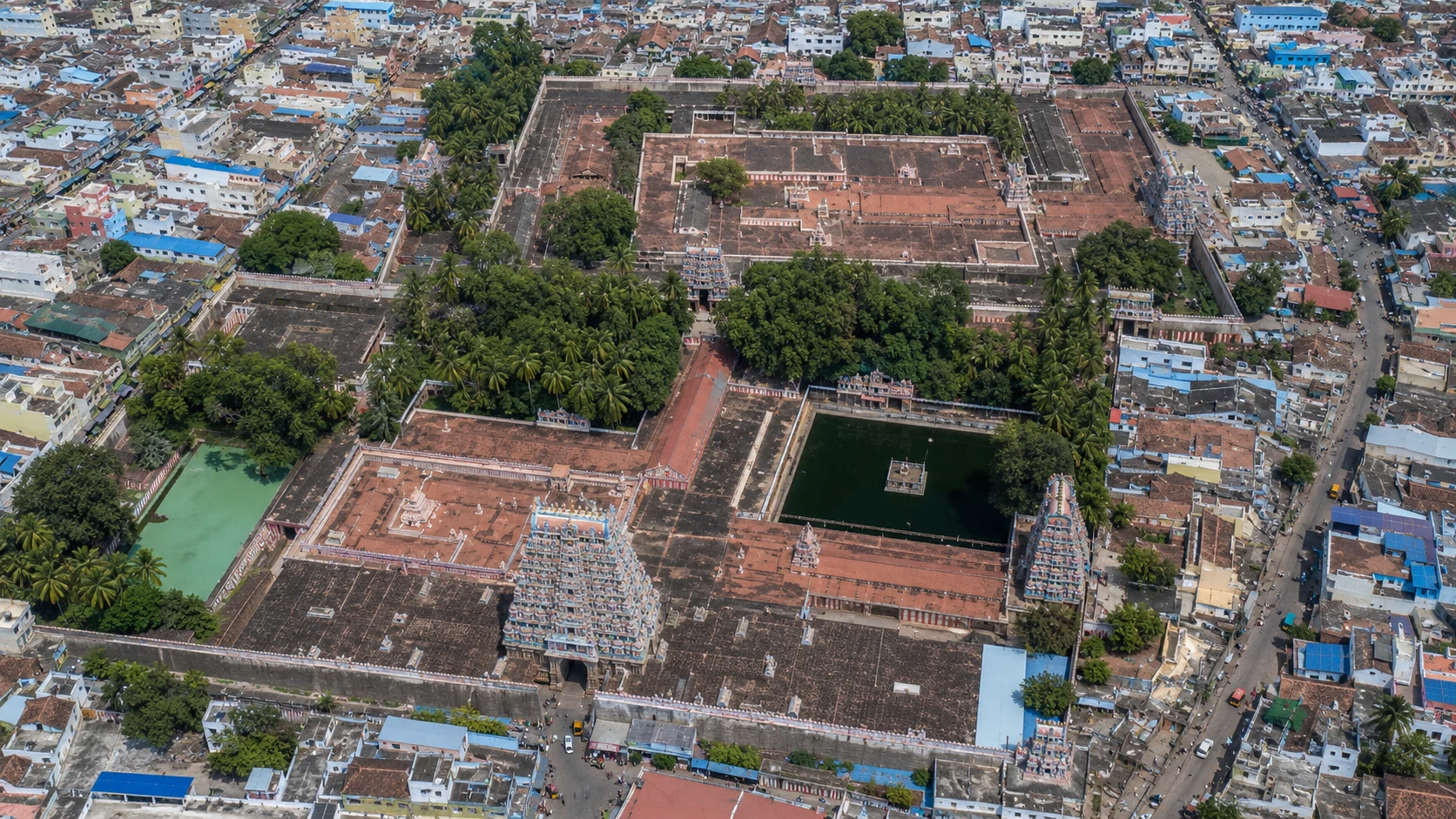
Nellaiappar Temple of Tirunelveli — the fourth of the five Pancha Sabhai — anchors the Tamil Saivite tradition in the deep south of the peninsula, on the banks of the Tamiraparani River roughly 700 km from Chennai. Its name carries its founding legend: Tirunelveli derives from 'Nel-veli,' the 'paddy boundary,' and the deity Nellaiappar is the 'Lord of the Paddy.' Tradition holds that when an ancient devotee was unable to harvest his rice crop before a sudden flood threatened it, he prayed to Shiva, who erected a miraculous fence around the paddy field — a divine boundary that held the floodwaters at bay until the harvest was complete. The temple grew at the site of this miracle, and the deity took his name from the protected paddy. The temple complex is among the largest in Tamil Nadu by compound area, spanning approximately fourteen acres and embracing two architecturally separate but ritually integrated shrines: the Nellaiappar (Shiva) shrine on the east and the Kanthimathi Amman (Parvati) shrine on the west, the two linked by the Sangili Mandapam — the 'Chain Hall' — whose stone columns bear intricately carved long stone chains cut from single monolithic blocks, an architectural conceit unmatched in Tamil temple practice. The Tamira Sabhai itself — the Copper Hall that gives this temple its place in the Pancha Sabhai canon — is a sub-shrine within the larger complex, distinguished by its copper-sheathed vimana (sanctum tower) and housing the bronze Nataraja in the Muni Tandava posture, the 'dance of the sage,' in which Shiva is shown dancing for the sage-seers who attained his vision. The temple is celebrated above all for its Sangeetha Mandapam — the Music Hall — whose monolithic stone pillars are carved to produce different musical notes of the saptaswara when struck, an architectural-acoustic feature of the Madurai Nayak era that has earned the temple international recognition; current ASI conservation protocols restrict the striking of these pillars to protect them from continued damage. Nellaiappar is canonically among the 276 Tevaram Padal Petra Sthalams, sung principally by Tirugnana Sambandar in the seventh century, and the temple's structural history runs from its Pandya-era foundation through extensive Vijayanagara-period expansion and a particularly elaborate Madurai Nayak-era flourishing in the sixteenth and seventeenth centuries that gave the compound its mature form. Administered today by the Tamil Nadu Hindu Religious and Charitable Endowments Department, the temple remains the principal Saivite landmark of southern Tamil Nadu and one of the most architecturally rewarding pilgrimage destinations in the state.
Sacred Designationपवित्र पदनाम
Sacred Origin Storyपवित्र उत्पत्ति कथा
Source: Tirunelveli Sthala Purana, Tevaram tradition (principally Tirugnana Sambandar's pasurams), and the Halasya Mahatmya regional tradition of southern Tamil Nadu
In the age before the present, when the paddy fields stretched along the banks of the Tamiraparani River, a devoted Saivite named Vedasarma — a Brahmin of the region — cultivated his small plot of rice with the offerings of his daily prayer. One year, as the harvest neared and the heavy crop stood ready in the fields, a sudden and devastating flood descended on the river plain, threatening to wash away the grain before it could be cut. Vedasarma had no time to call labourers or build embankments; he stood at the edge of his field and prayed to Shiva with the entire force of his devotion. Shiva, hearing the prayer, descended in invisible form and erected around the paddy field a divine fence — a 'veli' — that held the floodwaters at bay, the rising waters parting around the boundary and leaving the harvest untouched until Vedasarma had cut every stalk. The miracle revealed Shiva's presence at the site, and when Vedasarma marked the place with a linga to commemorate the divine intervention, the linga was found to have been self-manifested in stone, an ancient swayambhu that had been at the site since the beginning of time, waiting for the devotion that would reveal it. The deity took his name from the protected paddy — Nellaiappar, 'the Lord of the Paddy' — and the site was named Tirunelveli, the 'sacred paddy boundary,' commemorating the divine fence. Across the centuries that followed, the temple grew at this site, its mature form taking shape through Pandya, Vijayanagara, and Madurai Nayak patronage. The Tamira Sabhai sub-shrine within the larger complex came to house the bronze Nataraja in the Muni Tandava posture: Shiva dancing for the sage-witnesses Patanjali and Vyaghrapada, who in the wider Saivite tradition had attained the vision of his cosmic dance through meditation and now received its repeated revelation at this southern station of the Pancha Sabhai. The Sangeetha Mandapam — the music hall whose pillars sing the seven notes — and the Sangili Mandapam — the chain hall whose pillars hold stone-carved chains as if defying the laws of stone — emerged as the temple's most architecturally singular features under Madurai Nayak patronage in the sixteenth and seventeenth centuries, the artistic flourishing of a sub-Pandya kingdom that made Nellaiappar one of the most aesthetically refined of all South Indian temples.
Sources cited:
- Tirunelveli Sthala Purana (Tamil) — temple's foundational legend text
- Tevaram corpus — Tirugnana Sambandar's pasurams on Tirunelveli (Tirumurai 1 and 2)
- Halasya Mahatmya — regional southern Tamil Saivite literature contextualising the Pancha Sabhai network
- Madurai Nayak-era temple chronicles and inscriptions documenting the major architectural expansion
Other Traditions · अन्य परंपराएँ
An older theological tradition, found in Saiva Siddhanta commentaries and the broader pan-Saivite literature of the Pancha Sabhai, holds that the Muni Tandava of the Tamira Sabhai is not a distinct or one-time dance but the continuous and visible reality of the cosmic dance as the sage-witnesses Patanjali and Vyaghrapada perceive it. In this reading, the dance is not performed for the sages but is the dance — the sages have attained the perceptual capacity to see what is always occurring. The Tamira Sabhai is thus the site of the continuous Tandava as eternally visible; the Nataraja icon there does not depict a moment but a perpetuity. This account complements rather than displaces the Sthala Purana narrative of Vedasarma and the paddy harvest, situating the temple within the broader Pancha Sabhai theological architecture of five simultaneous and complementary cosmic dances.
Among Tamil Saivite scholarly sources and pilgrim traditions, the dance form associated with the Tamira Sabhai shows minor variation. The most widely-attested attribution — followed in this entry — is the Muni Tandava (the dance of the sage / for the seers). Some traditional sources and pilgrim guides attribute the Tamira Sabhai dance instead to the Sandhya Tandava (twilight dance), or describe a syncretic form combining muni-witness and sandhya-twilight elements. The variation reflects the relatively less codified state of Tandava-attribution at the Tamira and Chitra Sabhais compared with the more firmly fixed Ananda Tandava of Chidambaram and the Urdhva Tandava of Tiruvalankadu. Eternal Raga reports the most widely-attested attribution while acknowledging the variation in scholarlyContext.
Scholarly Context
The mythological framing of Nellaiappar at Tirunelveli reflects a layered accretion typical of major Tamil Saivite sites with long structural histories. The Vedasarma–paddy–protection legend appears to be the temple's oldest Sthala Purana narrative and provides the etymology that anchors the site in regional consciousness ('Nel-veli' as 'paddy boundary'); this layer is pre-medieval and connects the temple to the agrarian devotional life of the Tamiraparani river valley. The Pancha Sabhai integration — Tirunelveli's identification as the Tamira Sabhai, with the Muni Tandava as its presiding dance form — is a relatively later theological development, consolidating across the medieval Pandya, Vijayanagara, and Madurai Nayak periods. The Muni Tandava attribution is the most widely-attested in standard Tamil Saivite literature, though as noted in alternateAccounts there is some variation. The Sangeetha Mandapam (musical pillars) is a Madurai Nayak-era architectural achievement of the sixteenth–seventeenth centuries; its current accessibility for demonstration is restricted under ASI conservation protocols to prevent continued vibrational damage to the carved monoliths. Pilgrims are not generally permitted to strike the pillars, though the hall itself remains open for darshan and observation; Eternal Raga's operational notice flags this verification-status accurately. Modern scholarly work on Nellaiappar architecture (Crispin Branfoot, George Michell, and the work of T. S. Sridhar on the Madurai Nayak temples) provides the principal contemporary documentation; pre-modern sources include the Tevaram pasurams themselves, Sekkizhar's Periya Puranam, and the Pandya-Nayak inscriptional record preserved in ASI epigraphical publications.
Historyइतिहास
Nellaiappar Temple's documented history reaches back into the formative period of Tamil Saivism. The site was already recognised as a major Saivite shrine by the seventh century, when Tirugnana Sambandar — the youngest and most prolific of the three principal Tevaram saints — composed pasurams in its praise during his recorded southern pilgrimage circuit. Sambandar's verses anchor the temple among the 276 Padal Petra Sthalams and establish its devotional standing in the Tamil canon roughly twelve centuries before the present. The temple's structural history is principally a record of three dynastic patronage layers. The earliest stone construction is attributed to medieval Pandya patronage from the ninth through thirteenth centuries; the Pandyas of Madurai, whose territory included Tirunelveli, expanded the temple under several monarchs whose inscriptions remain at the site. The Pandyan polity's collapse following the Madurai Sultanate's invasion (early fourteenth century) interrupted temple-building briefly, but the Vijayanagara reassertion of Hindu polity in the south brought renewed patronage from the fourteenth century onward. The Madurai Nayaks — the Telugu-origin chieftains who governed the southern Tamil country as Vijayanagara provincial rulers and then as independent sovereigns from the sixteenth century — undertook the major architectural campaigns that gave Nellaiappar its mature form. Under Nayak patronage, particularly during the seventeenth century, the Sangili Mandapam was constructed with its stone-carved chains, and the Sangeetha Mandapam with its musical pillars was completed. The Vasantha Mandapam (Spring Hall) with its hundred carved pillars and the elaborate gopuram-towers also date principally to this period. The temple thus represents one of the most concentrated documents of Madurai Nayak architectural and artistic achievement in Tamil Nadu. Following the decline of the Nayak dynasty in the eighteenth century, the temple came under successive administrations — the Nawabs of Arcot, the British East India Company, and the colonial Madras Presidency — with significant institutional preservation through the Hindu Religious Endowments Act after independence. Today the temple is administered by the Tamil Nadu HR&CE Department and remains both an active pilgrimage destination and a protected monument under Archaeological Survey of India supervision for its architectural heritage.
Historical Timelineऐतिहासिक कालक्रम
Tirugnana Sambandar — the youngest and most prolific of the three principal Tevaram poet-saints — composes pasurams in praise of Nellaiappar at Tirunelveli during his southern pilgrimage circuit. The temple is thereby canonised among the 276 Padal Petra Sthalams of the Tamil Saivite tradition.
Scholarly catalogues vary on whether Appar and Sundarar also composed pasurams specifically on Tirunelveli Nellaiappar; Sambandar's authorship is the most clearly attested. Eternal Raga reports Sambandar as the principal Tevaram poet for this shrine.
Pandya-era structural construction and expansion of the Nellaiappar temple. Multiple Pandyan kings — whose territory centred on Madurai and extended south through Tirunelveli — patronise the temple with stone construction, inscriptions, and ritual endowments. The earliest stone elements of the present structure date to this period, including foundational sanctum walls and early mandapams.
Specific Pandyan ruler attributions to phases of construction remain subjects of ongoing epigraphical research; major Pandyan patronage is established but fine-grained chronology continues to be refined.
Vijayanagara-period expansion of the Nellaiappar temple complex following the collapse of Pandyan power and the brief Madurai Sultanate interlude. Under Vijayanagara provincial governance, the temple receives substantial structural additions including expanded mandapams, gopurams, and the consolidation of the Tamira Sabhai sub-shrine with its bronze Nataraja in Muni Tandava posture as part of the formal Pancha Sabhai network.
Madurai Nayak-era flourishing of the Nellaiappar temple — the period of its most concentrated architectural and artistic development. The Madurai Nayaks, ruling first as Vijayanagara viceroys and then as independent sovereigns of the southern Tamil country, undertake the construction of the Sangili Mandapam (chain mandapam, whose pillars hold stone-carved long chains cut from single monolithic blocks), the Sangeetha Mandapam (music hall whose monolithic pillars are carved to produce the seven notes of the saptaswara when struck), the Vasantha Mandapam (Spring Hall with hundred carved pillars), and substantial gopuram and mandapam additions across the fourteen-acre compound. The temple's mature architectural form is essentially the achievement of this period.
Following the consolidation of British colonial administration in the south, the Nellaiappar temple is documented in detail by colonial-era surveyors and remains the principal Hindu monument of the Tinnevelly (colonial-era English form of Tirunelveli) district. The Sangeetha Mandapam musical pillars become internationally known through colonial-era publications. Post-independence, the temple is brought under Tamil Nadu HR&CE administration and is concurrently designated for Archaeological Survey of India conservation protection for its architectural heritage. ASI conservation protocols now restrict striking of the musical pillars to prevent continued vibrational damage to the carved monoliths.
Current accessibility of the musical pillars for striking by pilgrims is restricted; the hall remains open for darshan and observation but the pillars themselves are not generally permitted to be struck. Verification status: confirmed through ASI conservation policy and temple administration.
What You'll Seeदर्शन में
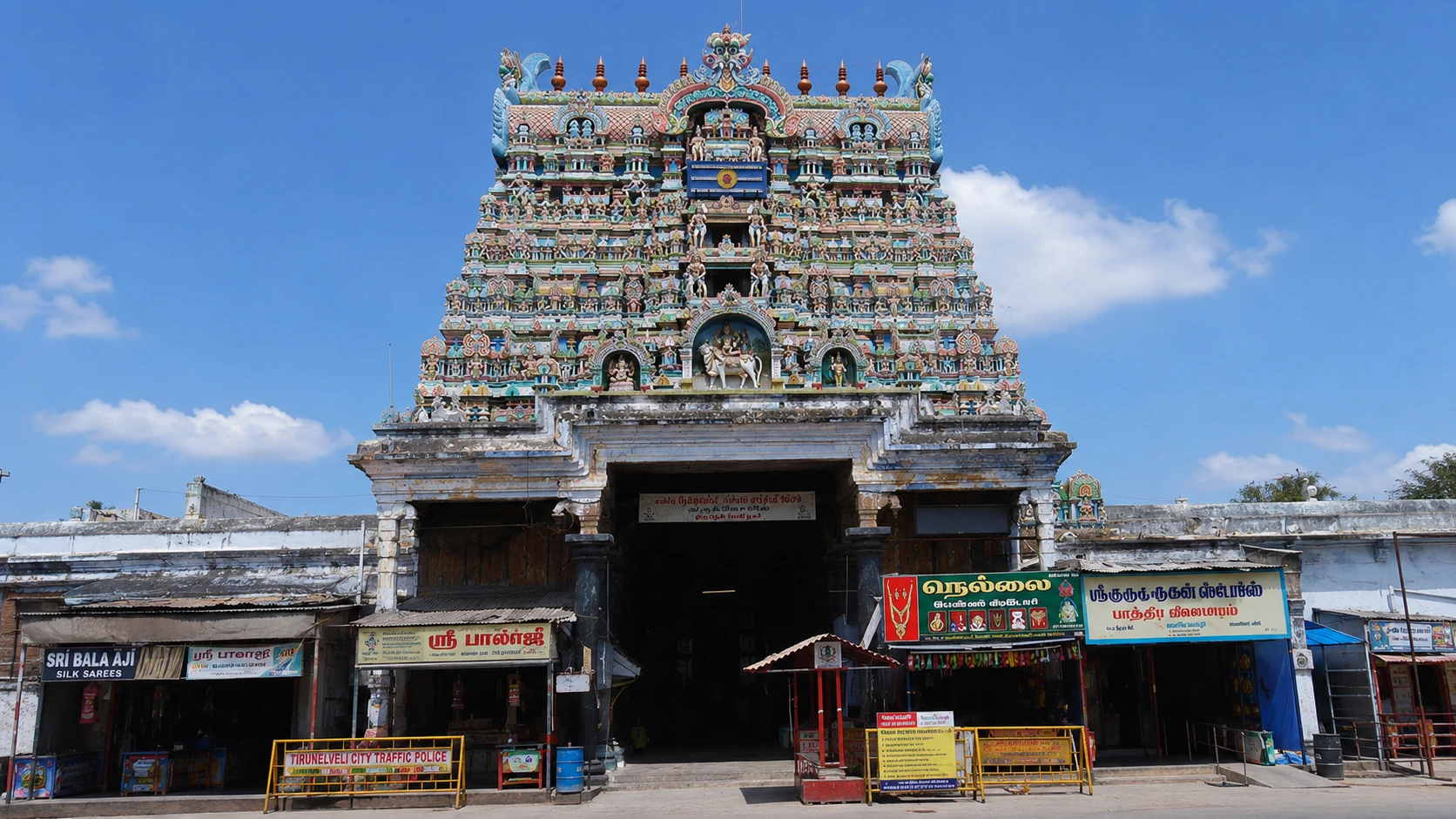
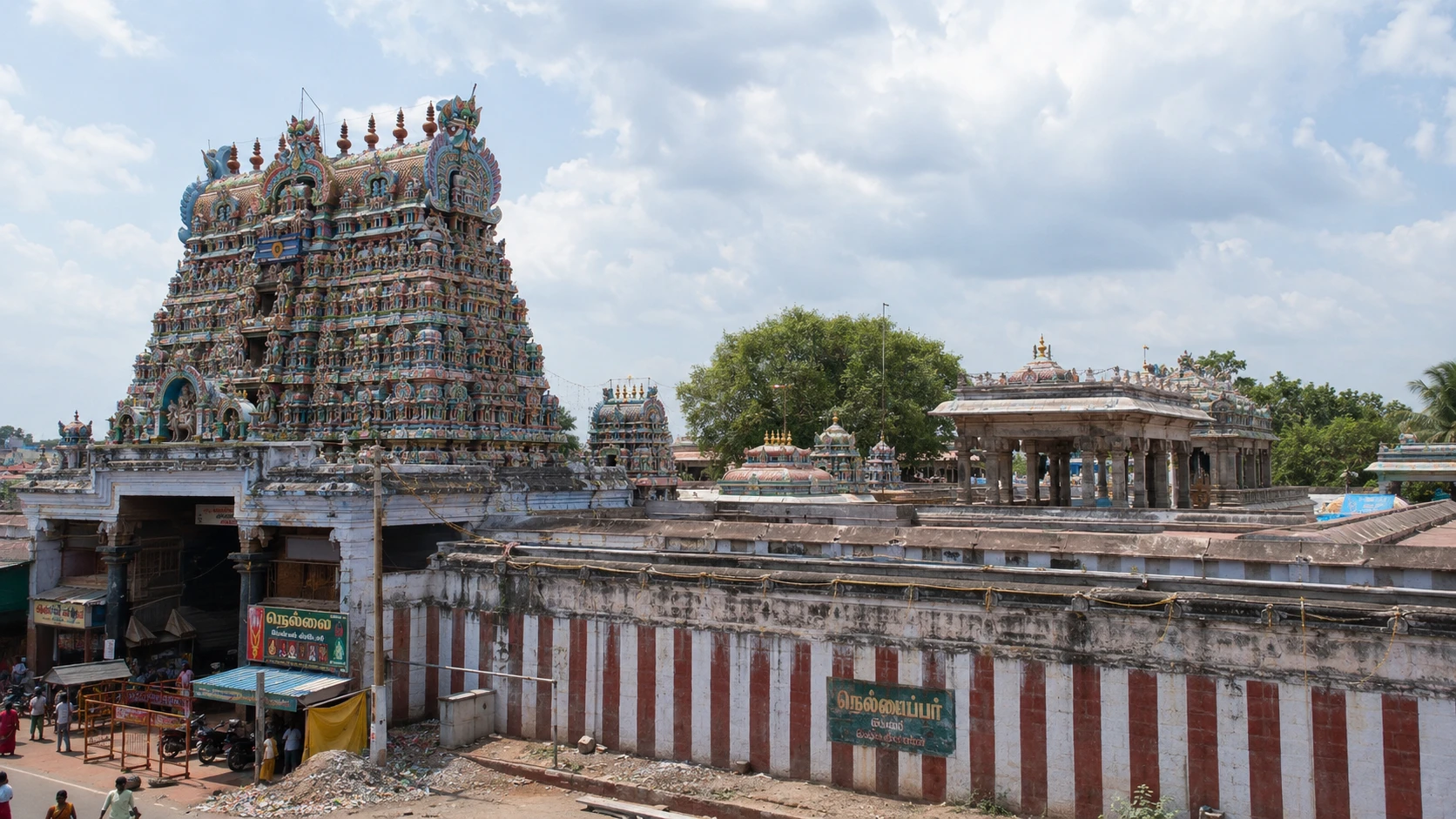
The Nellaiappar temple compound is organised as a twin-temple architectural complex on an east-west axis, with the Nellaiappar (Shiva) shrine on the east and the Kanthimathi Amman (Parvati) shrine on the west, the two structurally separate but ritually linked across approximately fourteen acres of compound area. The principal Nellaiappar sanctum, oriented to the east, houses a swayambhu (self-manifested) Shiva linga of considerable antiquity, dark stone in form and surmounted by a brass kavacha during major pujas. The sanctum stands within a Pandya-era foundational shell with Vijayanagara and Nayak-era enhancement; the parikrama (circumambulatory passage) follows the standard Tamil Saivite pattern. The Kanthimathi Amman shrine to the west is itself a substantial temple, with its own sanctum, mandapams, gopuram, and full ritual establishment — large enough that some pilgrims treat it as a co-equal temple to the Nellaiappar shrine rather than a subsidiary. The two shrines are linked by the Sangili Mandapam, the 'Chain Mandapam,' whose stone pillars bear intricately carved long stone chains cut from single monolithic blocks — an architectural achievement that defies the ordinary expectation of stone as a rigid material, the chains hanging from the pillar capitals as if cast in metal yet carved from single rock-blocks. The Tamira Sabhai sub-shrine within the larger complex is a smaller pillared hall, distinguished externally by its copper-sheathed vimana (sanctum tower) and housing the bronze Nataraja in the Muni Tandava posture: Shiva in a contained dance-pose with the sage-witnesses Patanjali (in serpent-form, the lower body coiled in serpent-attendance) and Vyaghrapada (with tiger-clawed feet, holding the standard rishi-attendant posture). The bronze is cast in the South Indian sthapati tradition, finely worked. The Sangeetha Mandapam — the Music Hall — is the temple's most internationally recognised architectural feature: a Madurai Nayak-era hall whose monolithic stone pillars are carved to produce different musical notes of the saptaswara (the seven swaras of Indian classical music) when struck. The pillars are arranged in clusters, with the carved patterns and internal structure of each pillar tuned to a different note. Under current ASI conservation protocols, striking of the pillars is restricted to prevent further vibrational damage to the carved monoliths; the hall remains open for darshan and visual observation, but the auditory demonstration is not generally accessible. The Vasantha Mandapam (Spring Hall) houses one hundred carved monolithic pillars decorated with deities, dancers, and mythological scenes — a sustained sculptural achievement of the Nayak period. The temple's four gopurams (gateway towers) bear extensive stucco work narrating Saivite mythology, with the principal eastern gopuram being the largest. The temple tank, called the Potramarai Kulam, lies to the east of the compound.
Distinctive Practicesविशिष्ट परंपराएँ
Twin-temple darshan (Nellaiappar and Kanthimathi Amman)
जुड़वाँ-मंदिर दर्शन (नेल्लैयप्पर और कांतिमती अम्मन)
Throughout the day during principal darshan windows; particularly observed on Fridays (the day sacred to the Devi) and during the Aadi Pooram festival (July–August), the principal Kanthimathi Amman festival
Pilgrims visiting Nellaiappar observe the practice of completing darshan at both the Nellaiappar (Shiva) sanctum on the east and the Kanthimathi Amman (Parvati) sanctum on the west, treating them as a single integrated devotional visit rather than primary-and-subsidiary. Devotees typically begin with the Nellaiappar shrine, traverse the Sangili Mandapam linking the two, and complete with the Kanthimathi Amman shrine — though the order may be reversed on Fridays when the Devi shrine is the principal focus. The practice acknowledges the temple's architectural design as a twin-temple complex rather than a Shiva temple with a consort shrine, distinguishing Nellaiappar from many other Tamil Saivite temples.
The architectural choice of structurally co-equal shrines for Shiva and Shakti embodies the Saiva-Shakta integration that is theologically central to Tamil Saivite practice: Shiva and Shakti are not lord and consort but two aspects of a single ultimate reality, ardhanareshwara at the cosmic level even when shrined separately at the architectural level. The twin-temple practice at Nellaiappar honours this integration in lived ritual.
Sangeetha Mandapam observation and saptaswara contemplation
संगीत मंडपम अवलोकन और सप्तस्वर चिंतन
Throughout regular temple-visiting hours; particularly observed during the annual Brahmotsavam (April–June) and the Aani Thirumanjanam festival (June–July)
Devotees and visitors observe the Sangeetha Mandapam — the music hall of carved monolithic pillars — as a darshan-object in its own right, separate from but devotionally continuous with the principal sanctum darshan. The standing practice is contemplative observation rather than auditory demonstration: visitors walk through the pillared hall, observe the carved patterns of each pillar (each tuned in tradition to a different note of the saptaswara), and reflect on the integration of music and stone-craft in Saivite devotional architecture. Under ASI conservation protocols the pillars are not generally struck; this restriction is understood as preservation rather than restriction of devotional access. The hall continues to function as a meditation space where the relationship between sound, stone, and divine presence is contemplated.
The Sangeetha Mandapam embodies the Saivite theological proposition that all sound is ultimately nada — the divine vibration from which the universe arises and into which it dissolves. That stone itself can be carved to produce music is held in tradition to be a visible demonstration of this principle: matter and sound are not separate, music is not an addition to stone but latent within it, awaiting craftsmanship to make it audible. Contemplating the hall is contemplating the unity of matter and vibration that the Saivite cosmology asserts.
Pradosham abhishekam at the Nellaiappar sanctum
नेल्लैयप्पर गर्भगृह पर प्रदोषम अभिषेकम
Every Pradosham — the 13th lunar day (Trayodashi) of both fortnights, in the evening twilight (4:30 PM – 6:00 PM); twice monthly
As at all major Saivite shrines, Pradosham at Nellaiappar is observed with full abhishekam of the swayambhu linga: water from the Potramarai temple tank, milk, curd, ghee, honey, panchamrita, sandalwood paste, and turmeric in succession, with vibhuti applied between layers and the Shri Rudram, Chamakam, and Panchakshari recited throughout. Devotees attending Pradosham at Nellaiappar customarily complete a circumambulation of the entire temple compound after the abhishekam — a longer pradakshina than at most Tamil temples given the fourteen-acre compound area — which is held to multiply the merit of the offering.
Pradosham observance at Nellaiappar is held to carry the same theological significance as at any Saivite shrine — the evening twilight of Trayodashi being the time of Shiva's cosmic dance — and at this Pancha Sabhai site the observance is felt to be doubly significant: the worshipper participates in the cosmological reality that Tirunelveli's Tamira Sabhai locally enshrines. The extended circumambulation reflects the temple's exceptional compound size and the devotional practice of treating the entire fourteen-acre area as a single sacred geography rather than a sanctum with attached structures.
Did You Know?क्या आप जानते हैं?
The Sangeetha Mandapam at Nellaiappar Temple is one of only a handful of musical-pillar halls in Indian temple architecture (the others include Vittala Temple at Hampi, Madurai Meenakshi, and a few smaller examples). The Nellaiappar pillars are carved from single monolithic blocks and are tuned to produce different notes of the saptaswara. Under current ASI conservation protocols striking the pillars is restricted to prevent further vibrational damage — devotees observe the hall but do not generally hear the demonstration.
ASI documentation; Crispin Branfoot, 'Gods on the Move' (2007)
The Sangili Mandapam's stone chains — long ornamental chains carved from single monolithic stone blocks and hanging from pillar capitals — represent one of the most virtuosic feats of carving in any South Indian temple. Each chain link is structurally independent yet carved as part of the single block from which the chain emerges, a technique that requires the sculptor to carve away surrounding material while preserving the chain's articulated form.
ASI architectural documentation; T. S. Sridhar's work on Madurai Nayak architecture
The temple's compound area of approximately fourteen acres makes it one of the largest temple compounds in Tamil Nadu — larger than most of the major Tamil Saivite sites except a few exceptional cases (Srirangam at over 150 acres being the outlier, and Madurai Meenakshi at fifteen acres being a comparable case). The scale reflects both Madurai Nayak architectural ambition and Nellaiappar's status as the principal Saivite landmark of southern Tamil Nadu.
ASI compound-area documentation; Tamil Nadu Department of Archaeology surveys
The deity Nellaiappar's name literally means 'Lord of the Paddy' in Tamil — 'Nellai' deriving from 'nel' (paddy/rice) and 'appar' being a respectful Tamil term for 'lord' or 'father.' The temple's etymology preserves the agrarian origin-legend of the divine fence Shiva erected to protect Vedasarma's rice harvest from flood, and through this name Nellaiappar remains theologically connected to the agricultural devotional life of the Tamiraparani river valley over which his protection was first manifested.
Tamil-Sanskrit etymological tradition; Madras Tamil Lexicon
The twin-temple architecture of Nellaiappar — with Shiva and Parvati housed in structurally co-equal but separate shrines linked by the Sangili Mandapam — is unusual in Tamil Saivite practice, where most temples house the Devi as a subsidiary shrine within the larger Shiva temple. The architectural choice at Nellaiappar embodies the Saiva-Shakta theological integration of the Madurai Nayak period and is itself a significant document of how Tamil Saivism's understanding of the divine feminine evolved during the early modern period.
Crispin Branfoot, 'Gods on the Move' (2007); Velcheru Narayana Rao, David Shulman, Sanjay Subrahmanyam, 'Symbols of Substance: Court and State in Nayaka Period Tamilnadu' (1992)
Visitor Accessप्रवेश जानकारी
Nellaiappar Temple welcomes devotees of all backgrounds for darshan without entry restrictions based on gender, age, or origin. Photography is permitted in the outer courtyards, mandapams, and the temple compound's external areas, but is prohibited inside the principal Nellaiappar sanctum, the Kanthimathi Amman sanctum, and the Tamira Sabhai sub-shrine during darshan hours and especially during abhishekam and aarti. The Sangeetha Mandapam (musical pillars hall) is open for darshan and observation but striking the pillars is restricted under ASI conservation protocols. Mobile phones must be silenced inside the temple compound. Footwear must be removed before entering the temple — footwear stalls operate at the main entrance, typically free or with a nominal charge. Modest dress is expected: shoulders and knees should be covered for both men and women. As is traditional in Tamil Saivite temples, men may be requested to remove their upper garment (shirt or vest) before entering the principal Nellaiappar sanctum.
Allow at minimum 2 hours for a thoughtful visit covering the principal Nellaiappar sanctum, the Kanthimathi Amman sanctum, the Sangili Mandapam linking the two, the Tamira Sabhai sub-shrine, the Sangeetha Mandapam, and the Vasantha Mandapam. The fourteen-acre compound rewards unhurried exploration. There is no formal VIP darshan ticket system; the temple's pilgrim flow is moderate on most days and longer wait times apply principally during major festivals (Brahmotsavam in April–June, Aani Thirumanjanam in June–July, Aadi Pooram in July–August, Karthigai Deepam in November–December, and Arudra Darshan in December–January). Carry a photo ID as occasional security checks may apply during festival periods. The temple is well-marked from Tirunelveli Junction railway station (approximately 2 km away) and from the city centre; auto-rickshaws are readily available.
Festivalsत्योहार
Arudra Darshan
आरुद्र दर्शन
Margazhi (December–January) — observed on the Tiruvadirai (Ardra) nakshatra, the full-moon day
Arudra Darshan is the principal Pancha Sabhai festival, celebrated simultaneously at all five Pancha Sabhai shrines across Tamil Nadu on the day of the Tiruvadirai nakshatra in the Tamil month of Margazhi. At Nellaiappar, the bronze Muni Tandava Nataraja in the Tamira Sabhai is taken in special procession through the temple compound, with elaborate abhishekam and the recitation of the Tevaram pasurams associated with the temple. The festival is regarded as the day on which Shiva first revealed his cosmic dance to the sages Patanjali and Vyaghrapada, and at the Tamira Sabhai whose dance form is the Muni Tandava — the dance for the sages — the festival carries particular thematic weight.
Brahmotsavam (Annual Temple Festival)
ब्रह्मोत्सवम (वार्षिक मंदिर त्योहार)
Chittirai or Vaikasi (April–June) — the annual twelve-day temple festival, dates vary year to year per the Tamil panchangam
The annual Brahmotsavam is the principal temple-festival of Nellaiappar, a twelve-day observance featuring daily processions of the utsava (procession) deities through the streets surrounding the fourteen-acre compound. The deities are mounted on different vahanas (mounts) each day — including the rishabha (bull), the simha (lion), the gaja (elephant), the kamadhenu (divine cow), and the silver chariot. The festival culminates in the Theerthavari — the ritual immersion of the utsava deities in the Potramarai temple tank — and the Garuda Sevai. The Nellaiappar Brahmotsavam draws devotees from across southern Tamil Nadu and from the diaspora communities of the deep south, and is the principal annual occasion when the entire temple-town of Tirunelveli is given over to the festival celebration.
Aani Thirumanjanam
आणि तिरुमंजनम
Aani (June–July)
Aani Thirumanjanam — the abhishekam festival of the month of Aani — is observed across Tamil Nadu Saivite temples but takes particular form at Nellaiappar. The principal day features an elaborate abhishekam of the swayambhu linga at the Nellaiappar sanctum, the Kanthimathi Amman murti at the consort sanctum, and the bronze Nataraja at the Tamira Sabhai. Devotees observe a partial fast and gather in large numbers for the principal evening abhishekam, the temple tank being filled to capacity with the substances of the offering. The festival is closely associated with the temple's twin-shrine architecture, the parallel abhishekams at the Shiva and Devi sanctums being performed in coordinated ritual sequence.
Aadi Pooram
आडी पूरम
Aadi (July–August) — observed on the Pooram nakshatra in this Tamil month
Aadi Pooram is the principal Kanthimathi Amman festival at the Nellaiappar temple — the major annual observance honouring the Devi. The festival features special abhishekam of the Kanthimathi Amman murti, processional movements of the Devi's utsava image through the temple compound, recitations of Devi-stotras and the Lalita Sahasranama, and devotional offerings particularly characteristic of feminine devotional practice (kungumam, turmeric, sarees, bangles). The festival is observed especially by women devotees and draws substantial attendance from across the region; the practice of married women circumambulating the Kanthimathi Amman shrine on Aadi Pooram is held to bring particular blessings for marital harmony and family prosperity.
Traditional Offeringsपारंपरिक अर्पण
Primary Offerings
Bilva (bel) leaves
बिल्व पत्र
The trifoliate bilva leaf is the most sacred botanical offering to Shiva, the three leaflets corresponding to the three eyes of the deity, the three gunas, and the three principal aspects of cosmic activity.
Vibhuti (sacred ash)
विभूति
The sacred ash applied to the forehead symbolises both Shiva's ascetic identity and the impermanence of all material form.
Milk for abhishekam
अभिषेकम के लिए दूध
Milk is the principal abhishekam substance for the Shiva linga, symbolising purity, nourishment, and the lunar-cooling quality (Soma) that pacifies Shiva's cosmic fire.
Pure water (theertha)
शुद्ध जल (तीर्थ)
Water from the Potramarai temple tank is the most basic and continuous abhishekam offering, connecting every Saivite offering to the cosmic waters from which the linga first rose.
Kungumam (vermilion)
कुमकुम
Vermilion is offered principally to Kanthimathi Amman at her separate sanctum, marking the strong Shakta-Saiva integration of this twin-temple complex.
Unique to This Temple
Paddy (nel) and rice offerings
धान्य (नेल) और चावल भेंट
In keeping with the temple's founding etymology — Nellaiappar as the 'Lord of the Paddy' — devotees customarily offer raw paddy stalks, husked rice, or rice-based naivedyam (cooked rice offerings) at the principal sanctum. The practice connects every contemporary visit to the founding miracle of the divine paddy-boundary, situating the worshipper within a millennia-long agrarian devotional history.
Coordinated twin-shrine offerings
समन्वित जुड़वाँ-मंदिर भेंट
Devotees customarily make coordinated offerings at both the Nellaiappar and Kanthimathi Amman sanctums — bilva and milk at the Shiva shrine, kungumam and turmeric at the Devi shrine, with the coordination expressing the Saiva-Shakta theological integration embodied in the temple's twin-shrine architecture.
Nellaiappar is administered by the Tamil Nadu Hindu Religious and Charitable Endowments Department (HR&CE); standard temple-shop offerings (bilva leaves, kungumam, vibhuti packets, ghee for lamps, flowers, coconuts) are available at modest cost from vendors immediately outside the compound and from official temple counters within the compound.
How to Reachकैसे पहुँचें
Nellaiappar Temple sits in the heart of Tirunelveli city, approximately 2 km from Tirunelveli Junction railway station and well-served by all modes of intra-city transport. By rail, Tirunelveli Junction (station code TEN) is a major hub on the Chennai Egmore–Kanyakumari main line, with direct daily express trains from Chennai (Pearl City Express, Anantapuri Express, Kanyakumari Express, ~12-13 hour journey), Madurai (multiple daily trains, ~3 hour journey), Coimbatore, Tiruchirappalli, and via connecting routes from across India. From the station, auto-rickshaws and city buses connect directly to the temple in 10–15 minutes. By road, Tirunelveli sits at the intersection of NH-44 (the major north-south corridor from Chennai through Bengaluru to Kanyakumari) and NH-138; the city is well-connected by Tamil Nadu State Transport Corporation buses from Chennai, Madurai, Coimbatore, Tiruchirappalli, Thiruvananthapuram, and Kanyakumari. By air, Tuticorin Airport (TCR) is approximately 50 km east with limited domestic connections (principally Chennai and Bengaluru); Madurai International Airport (IXM) is approximately 160 km north with broader domestic connections; Thiruvananthapuram International Airport (TRV) is approximately 130 km southwest and is the most internationally connected option for devotees travelling from outside India. The temple is centrally located in Tirunelveli city, with full accommodation, dining, and transport infrastructure within walking or short auto-rickshaw distance.
Plan Your Visitयात्रा की योजना
🌤 Best Season
October through March is the most comfortable season for visiting Tirunelveli, with daytime temperatures typically between 24°C and 32°C and the northeast monsoon (October–December) bringing intermittent but generally short-duration rainfall. The festival calendar concentrates several major observances in this window — Karthigai Deepam in November–December, Arudra Darshan in December–January, and Maha Shivaratri in February–March. April through July sees temperatures rising substantially, often above 38°C and occasionally above 40°C; pilgrim flow drops correspondingly except during the Brahmotsavam (April–June) which draws devotees regardless of heat. The southwest monsoon (June–September) brings less rainfall to Tirunelveli than to coastal Kerala or western Tamil Nadu, making the period less wet but still hot.
👘 Dress Code
Traditional or modest dress is expected. For women, sarees, salwar-kameez, or long skirts with full-sleeved or three-quarter-sleeved tops are appropriate; shorts, sleeveless tops, and short dresses should be avoided. For men, dhoti or trousers with shirts are appropriate; shorts are not permitted within the principal sanctum. As is traditional in Tamil Saivite temples, men may be requested to remove their upper garment (shirt or vest) before entering the principal Nellaiappar sanctum. Footwear must be removed before entering the temple compound.
📱 Phones & Photography
Mobile phones must be silenced inside the temple compound. Photography is permitted in the outer courtyards, mandapams, and the temple compound's external areas. Photography is prohibited inside the principal Nellaiappar sanctum, the Kanthimathi Amman sanctum, and the Tamira Sabhai sub-shrine during darshan hours and especially during abhishekam and aarti. No formal mobile-phone deposit counter operates at the temple — devotees retain their phones but observe the photography restriction by self-discipline. Striking of the Sangeetha Mandapam musical pillars is restricted under ASI conservation protocol.
🏨 Accommodation
Tirunelveli city offers a full range of accommodation from budget lodges to mid-range hotels. The area immediately surrounding the temple has numerous pilgrim-oriented lodges (yatri nivas) at modest prices; the central city area (along Trivandrum Road and Madurai Road) has mid-range hotels with full amenities. For higher-end accommodation, devotees may need to look at hotels in the city centre or the Palayamkottai area (Tirunelveli's twin city). Booking in advance is strongly recommended during the major festival periods (Brahmotsavam in April–June, Aani Thirumanjanam in June–July, Aadi Pooram in July–August, Arudra Darshan in December–January). For devotees combining Nellaiappar with Tiruchendur (the Subrahmanya temple ~60 km east) and Kanyakumari (the southern tip ~85 km south), Tirunelveli serves as the natural overnight base.
Sacred Soundsपवित्र ध्वनि
108 Japa Practice
Om Namah Shivaya — the Panchakshari mantra, the five-syllable invocation of Shiva
Chant 108 times in the spirit of this temple
Did You Know? · क्या आप जानते हैं?
The same translation error that turned '33 Koti' into '33 crore' in Hinduism also happened in Buddhism. The Chinese translation of Buddhist texts rendered 'Sapta Koti Buddha' (7 Supreme Buddhas) as '7 Crore Buddhas.' The Tibetan translation got it right: 7 types, not 7 crore. One Sanskrit word, misread across two major world religions, generated two identical misconceptions independently.
Related Contentसंबंधित सामग्री
Related Scriptures
Community Reflections
🕉️
Be the first to share your reflection.